Tag Archives: Model 57

Smith and Wesson Revolver Week: Magnum Wednesday — S&W Model 57 “No-Dash”


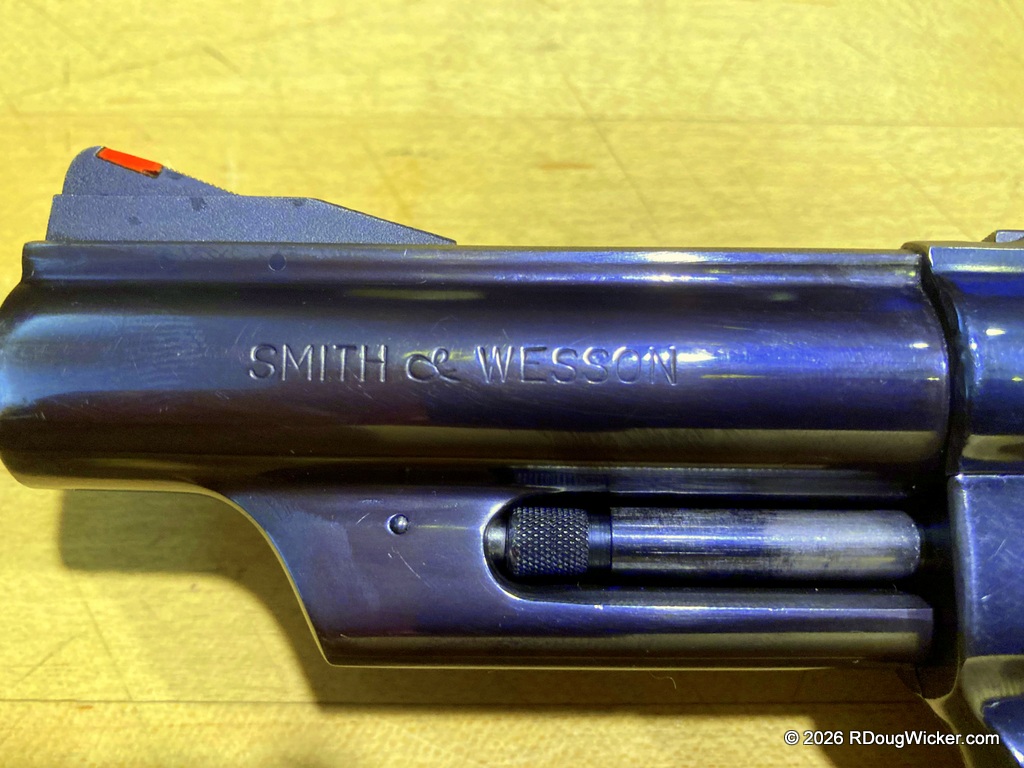
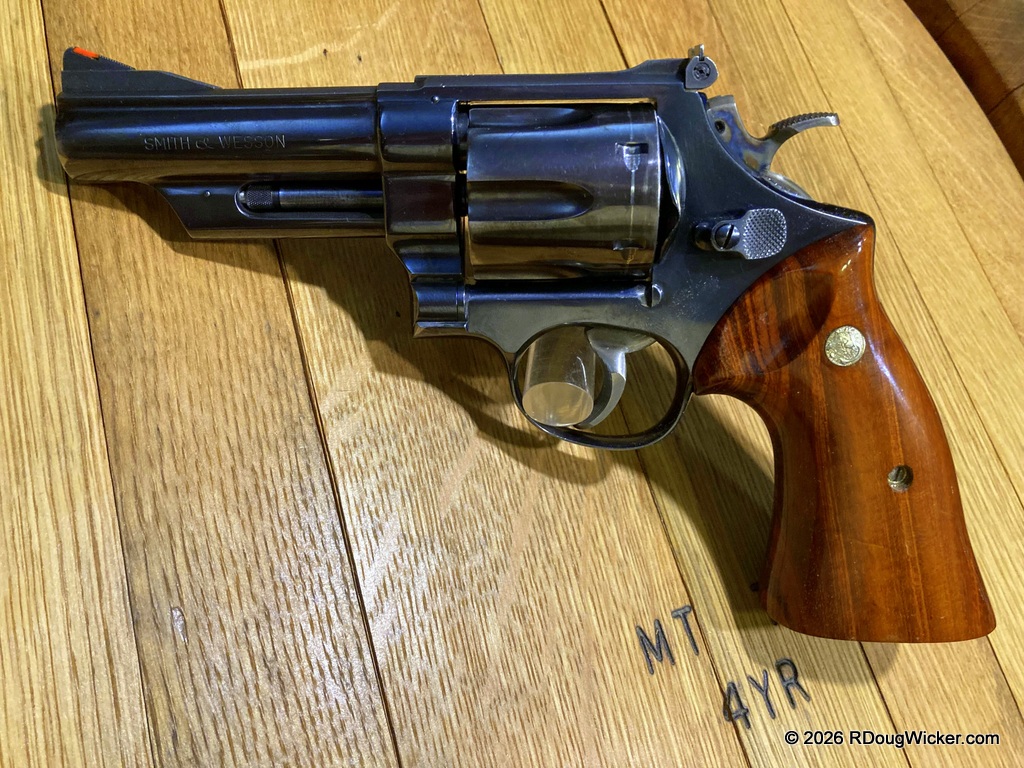
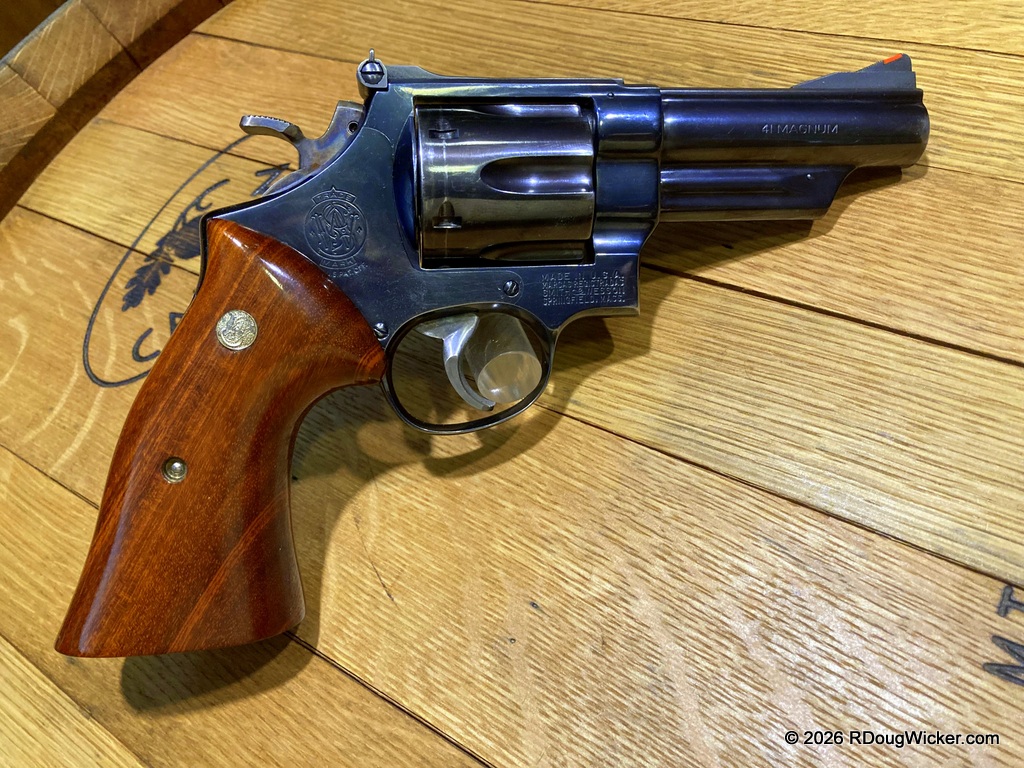
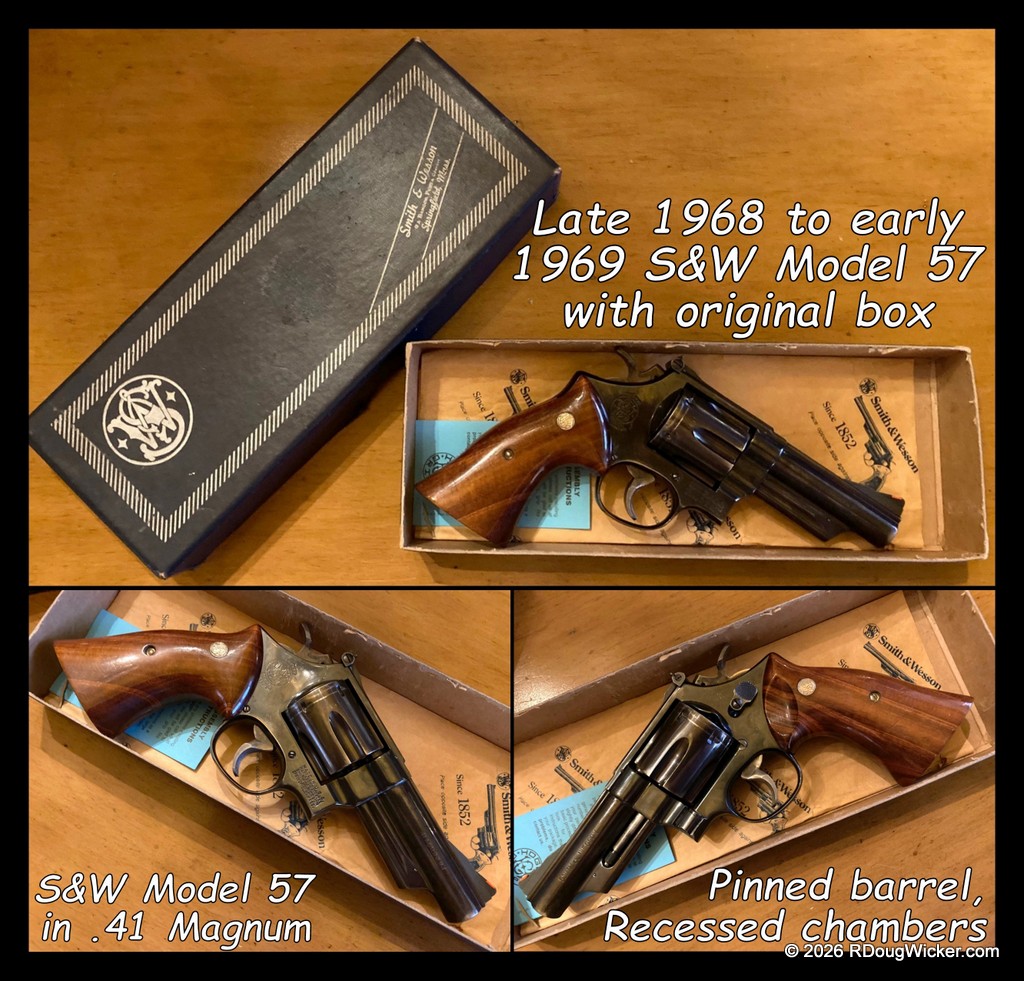
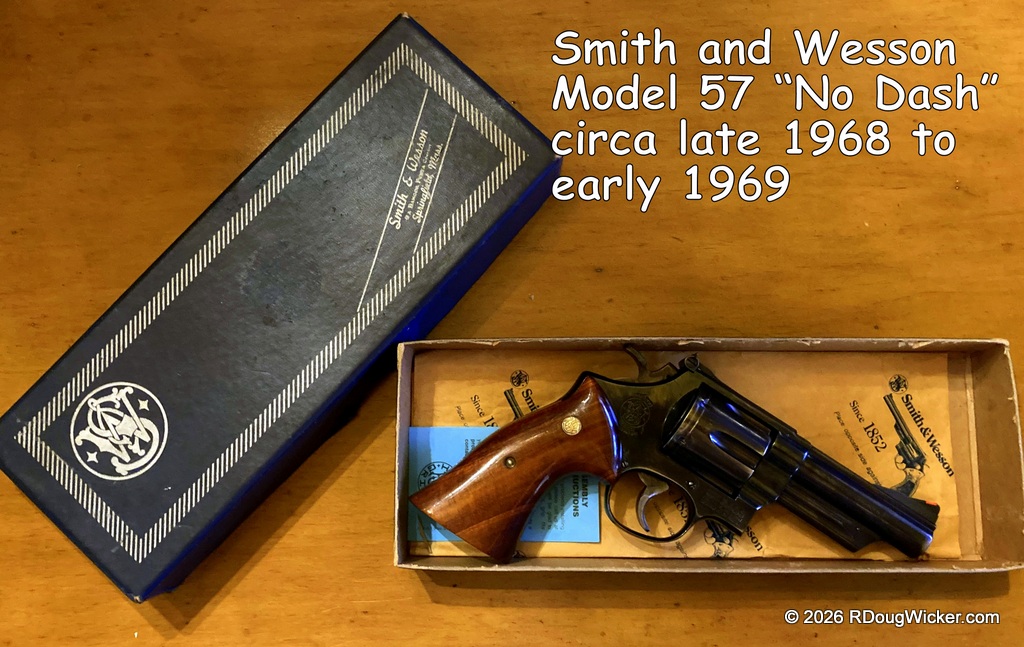
An early S&W Model 57 S-series “No Dash” cambered in .41 Magnum

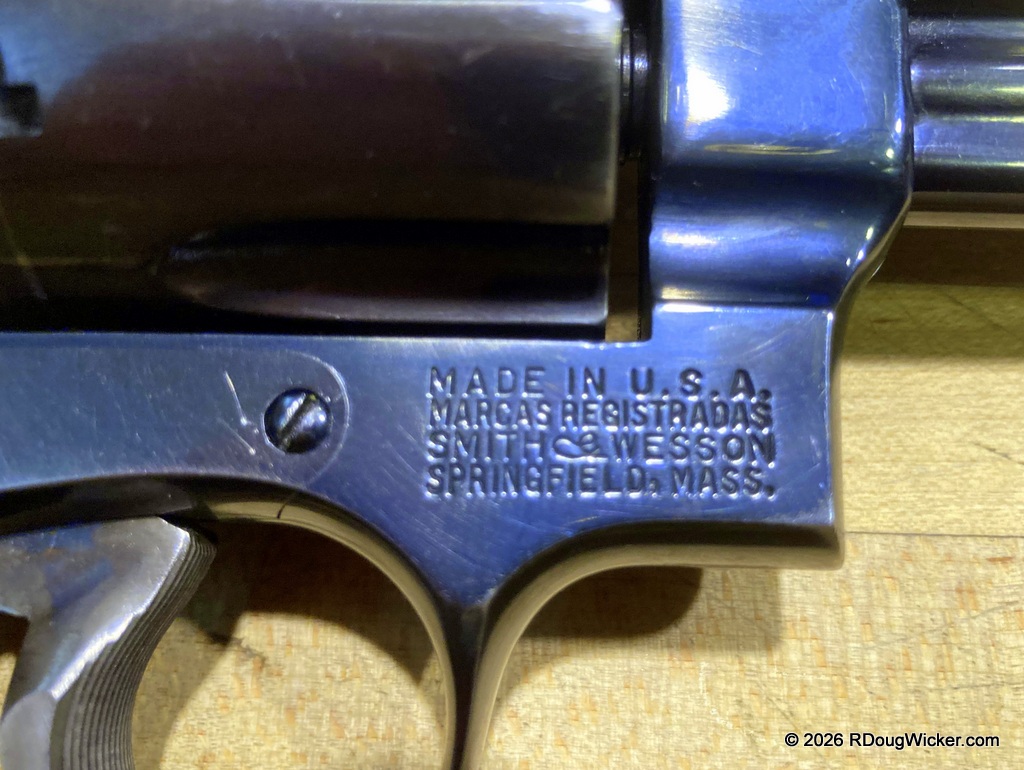
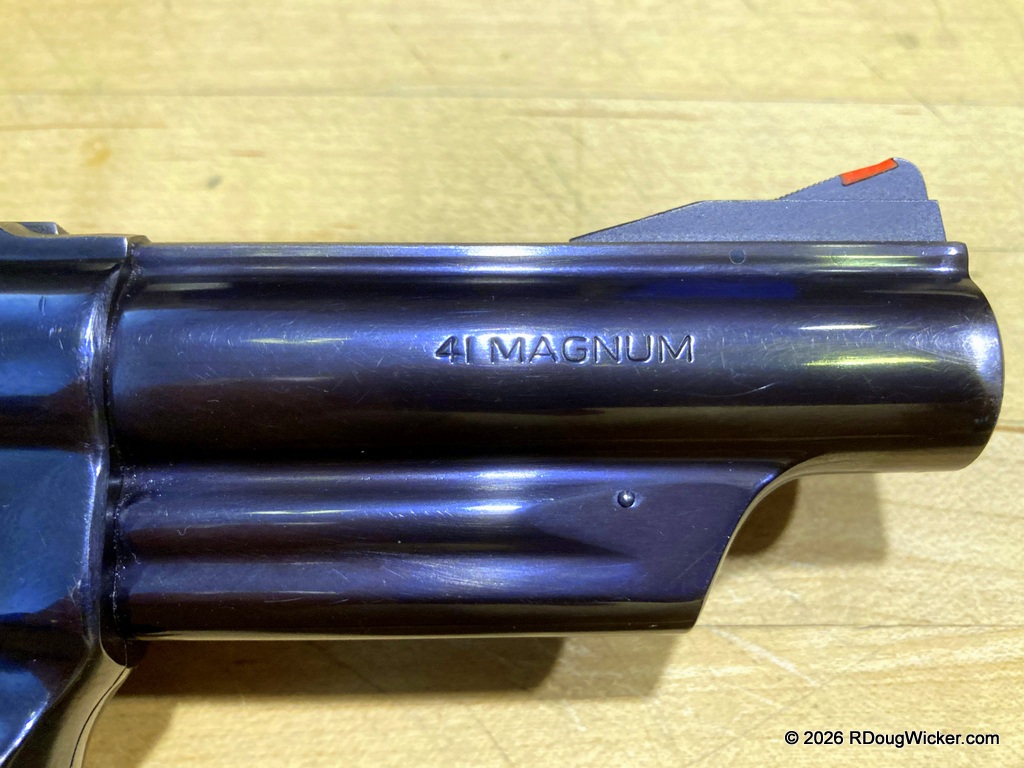
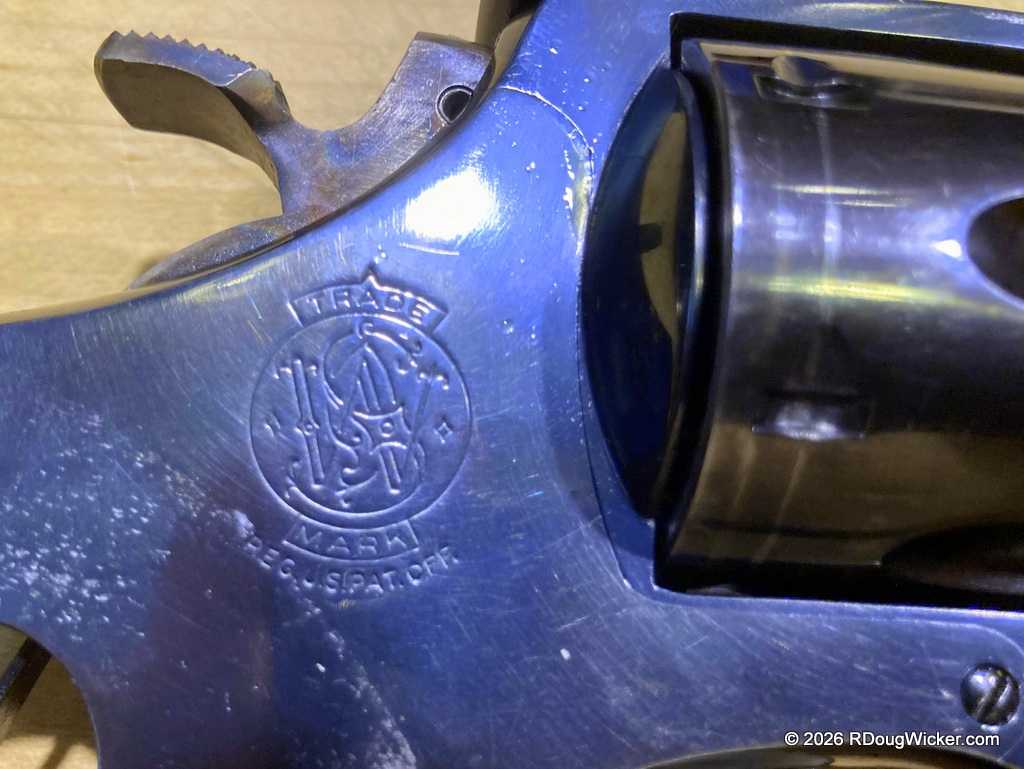
Today I present to you a bit of a civilian handgun history, as opposed to Monday’s military handguns history on the Smith and Wesson “Victory” Model used during World War II. What makes this gun historical is that the Smith and Wesson Model 57 was the first handgun chambered for the powerful, versatile, and, in my view, vastly underrated .41 Remington Magnum. The S&W Model 57 you see pictured today is an early “No Dash” sporting an S-series serial number, pinned barrel, and recessed chambers. (For a lesson on what all that means, see my article: Smith & Wesson Revolver Lesson/Quiz — What do “Pinned,” “Recessed,” and “No-Dash” mean?) Later no-dash Model 57s transitioned to an N-series serial number in early 1970. That means this one is earlier. Specifically, based upon the serial number range, this gun was born in late 1968 to early 1969. My guess, based upon that range, is very early in 1969.
Whereas Monday featured a mid-size S&W L-frame, and this week’s Fun Firearm Friday will present S&W’s smaller J-frame, today’s Model 57 is a large N-frame. N-frame revolvers originated with the Smith & Wesson .44 Hand Ejector 1st Model ‘New Century,’ a.k.a., the ‘Triple Lock.’ Now for a comparison featuring a misleading large S&W Model 36 J-frame with a longer than normal barrel and larger grip:
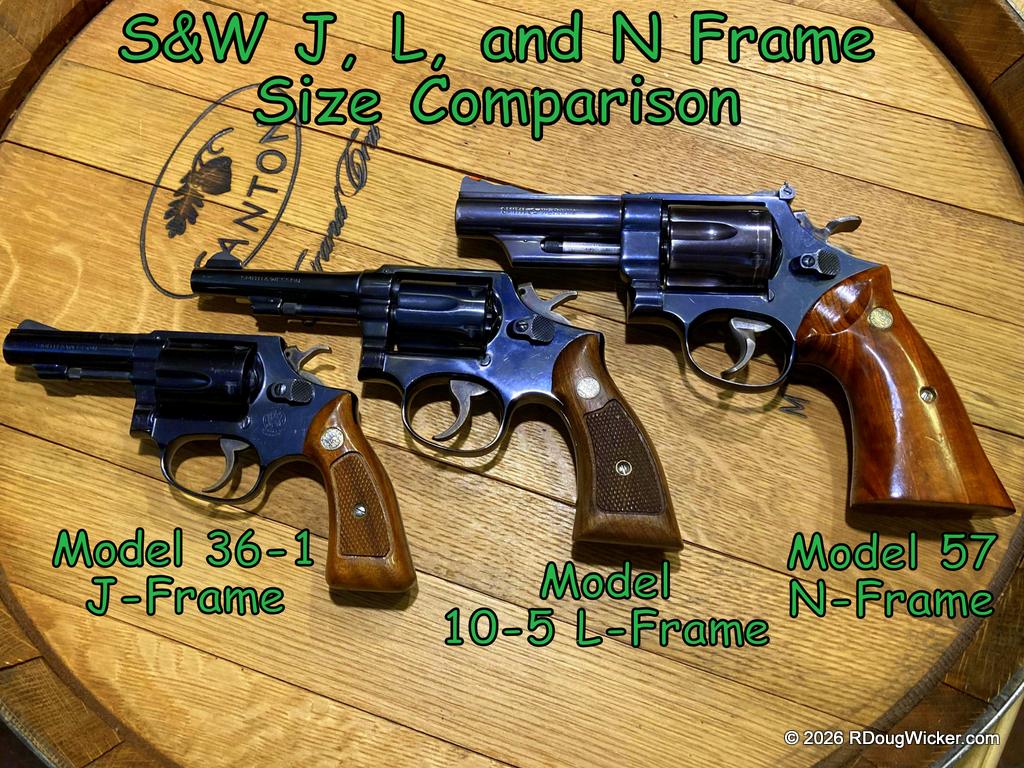
Smith and Wesson J-frame vs L-frame vs N-frame

Some of you read that title and said to yourselves, “That’s a typo. Surely he means .44 Magnum.” Well, that’s not a typo, and don’t call me Shirley. So, what’s all this .41 Magnum stuff all about: It all began with a handgun ballistics genius named Elmer Keith. Elmer Keith developed the first Magnum cartridge way back in 1935, and it quickly became a legendary law enforcement round — the .357 Magnum. In the 1950s Keith developed the .44 Magnum, a round he designed for large game, but which also soon gained a much-deserved reputation for protection from grizzly bears and other large predators.
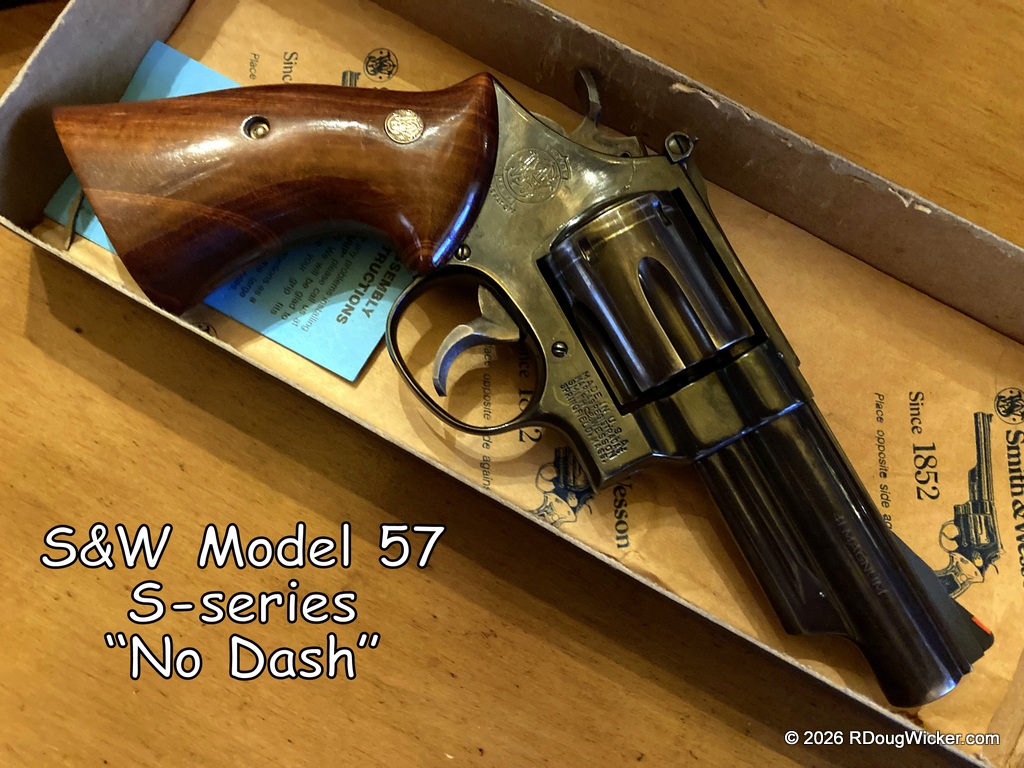
S&W Model 57

So, if .357 Magnum is a great law enforcement round, and .44 Magnum (which San Francisco PD Inspector Harry Callahan famously dubbed “… the most powerful handgun in the world, and would blow your head clean off….”) is superb for hunting and outdoor protection from predators, what’s the raison d’être for the .41 Magnum? Keith reasoned that the .44 Magnum was just too powerful. He perceived a gap between the .357 and .44 Magnum, and he wanted to give law enforcement an upgrade to the .357 that would also serve both hunters and target shooters. A true multi-purpose handgun round.
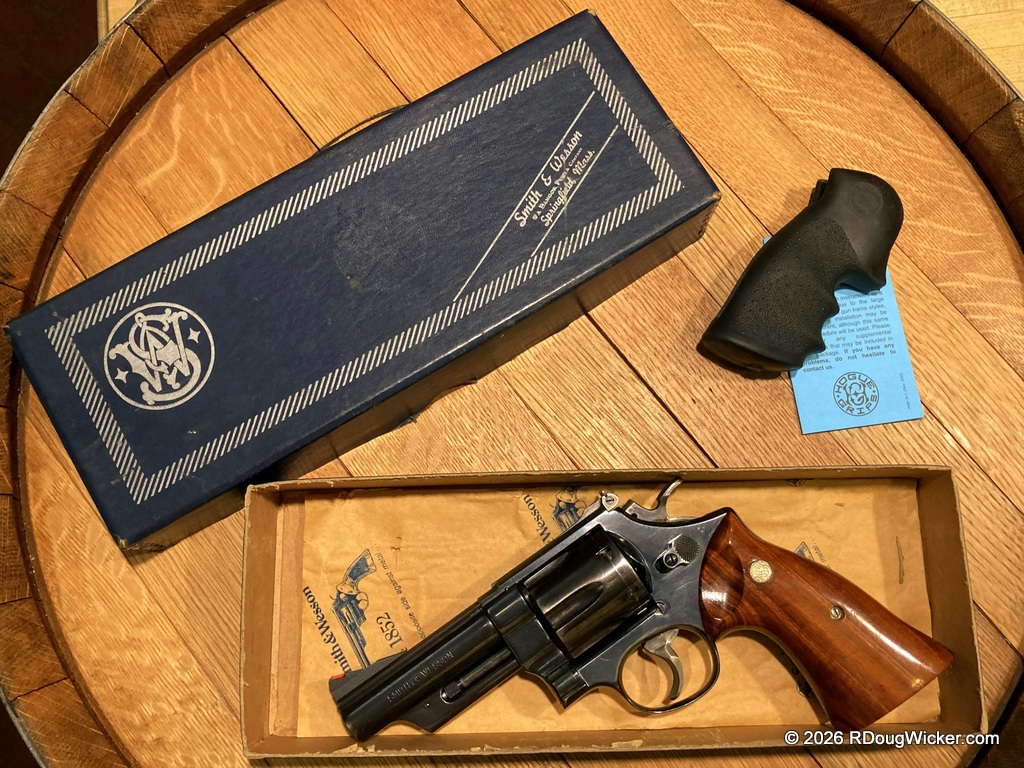
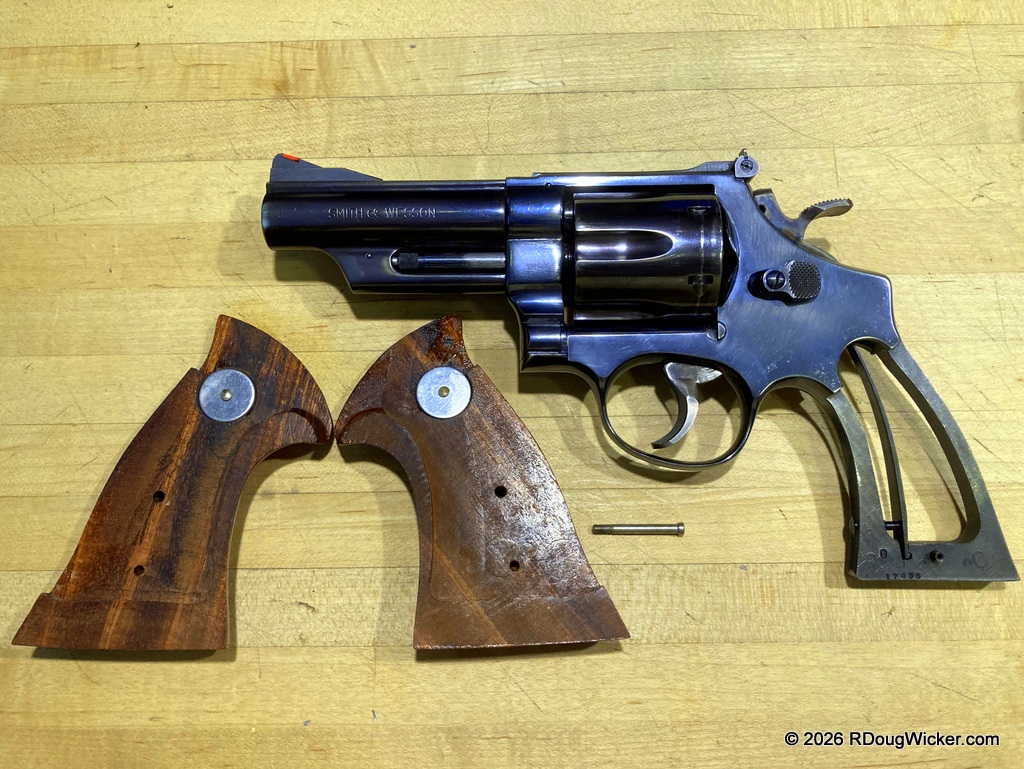
A pair of Hogue grips included courtesy of the previous owner

Keith’s intent was to fashion two loadings for the .41 Magnum — a milder “.41 Police” load pushing a 200 grain/13g semiwadcutter bullet at 900 to 1,050 feet/274-320 meters per second, and a more powerful load for hunters and target shooters propelling a 210 grain/14g projectile at a phenomenal 1,400–1,500 fps/427-457ms. For a target shooter, that second load translates to a very flat-shooting bullet. Sounds great. What really makes sense about this concept is that the .357 Magnum can shoot the cheaper, easier to handle, .38 S&W Special; and the .44 Magnum also chambers the cheaper, much more pleasant to shoot .44 S&W Special. As the .41 Magnum had no weaker sibling, Keith wanted to just adjust the load to fit a broad spectrum of uses.
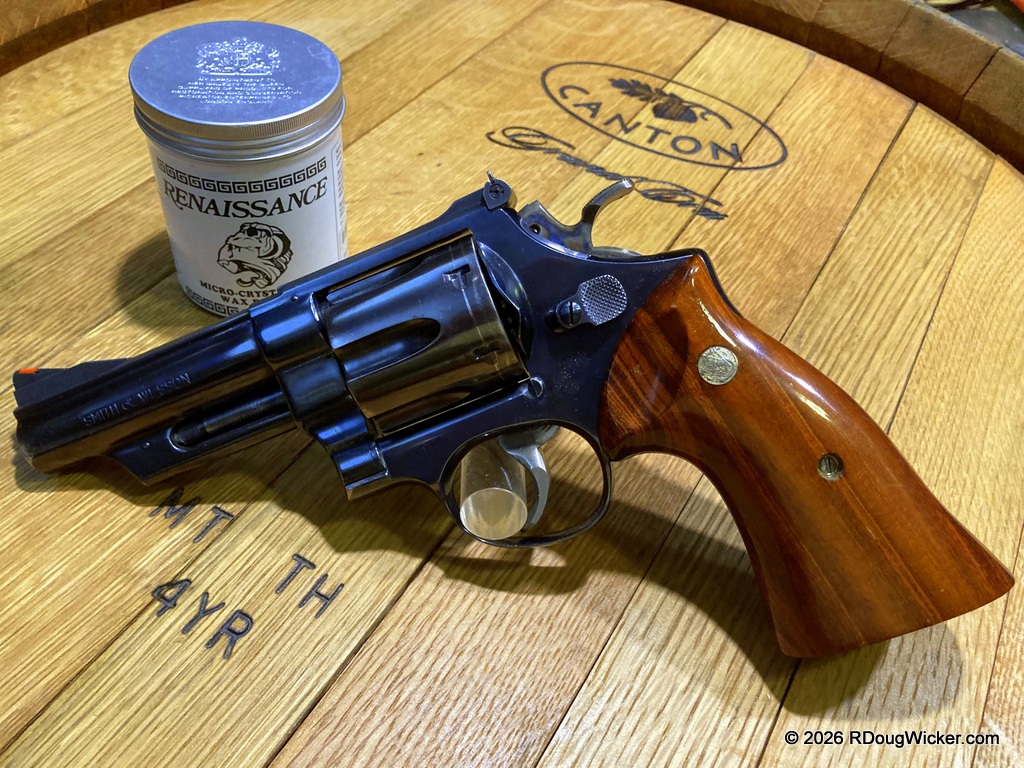
Prepping for long-term storage with my favorite museum grade preservation wax

Unfortunately, law enforcement never bit on the concept. While a lot of highway patrols used the .357 Magnum, many police departments were wedded to the .38 Special. Even though reduced in power, the “.41 Police” was deemed too powerful, epecially for urban environments where overpenetration is always a concern. Another factor weighing against the round is that the N-frame is not a light gun, and the .41 Magnum has considerably more recoil than the .38 Special. Police departments stayed away in droves.
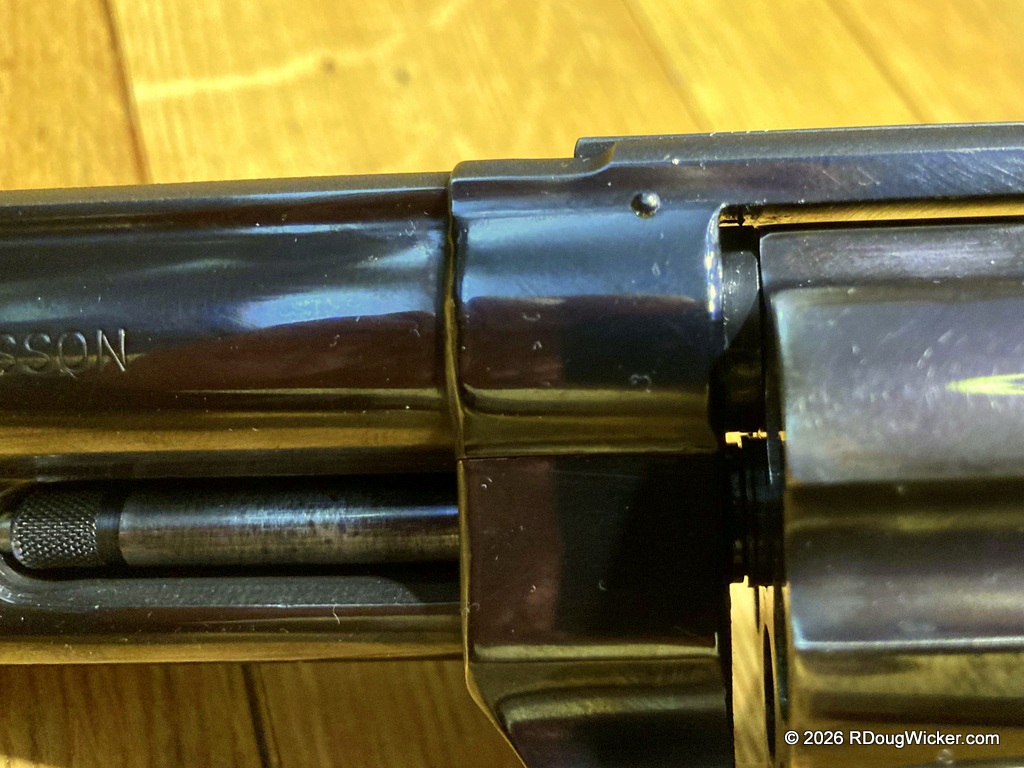
Pinned barrel (pin located on top strap in this image)

But hunters appreciated the 20% reduction in recoil over the .44 Magnum, and target shooters enjoyed the .41 Magnum’s flatter trajectory (although that’s overhyped; at 150 yards the difference is barely noticeable). With this crowd the round became a mild success and developed an almost cult status. But beyond that, the .41 Magnum never really took off.
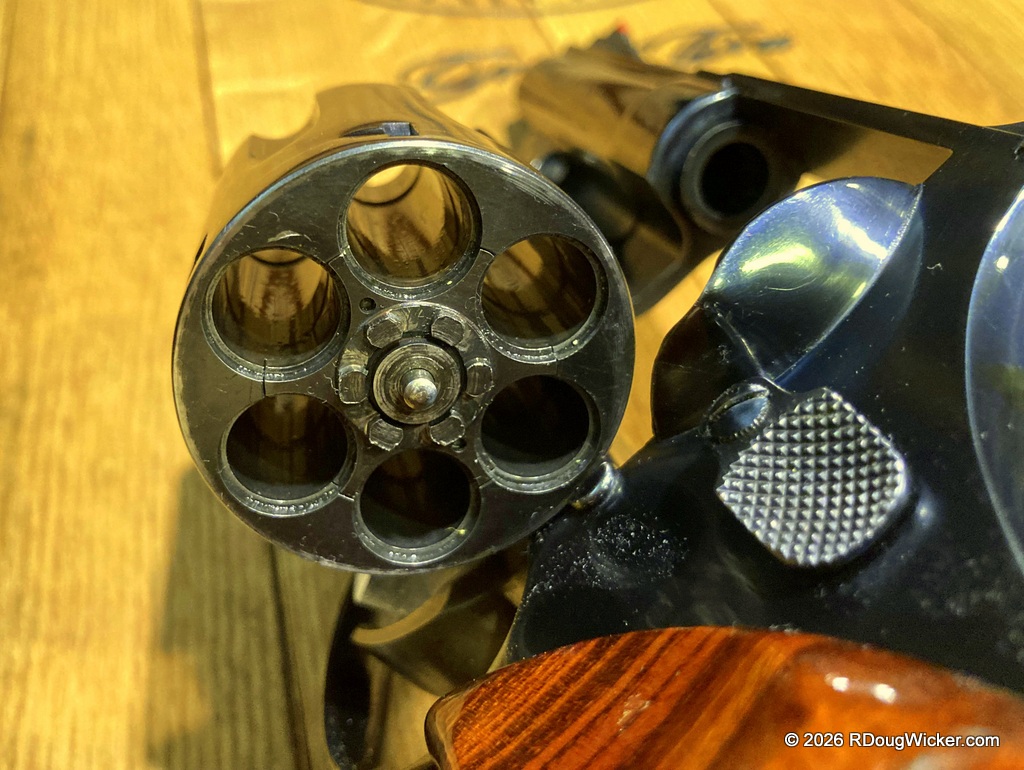
Recessed chambers

Now it’s time to discuss the S&W Model 57 and its law enforcement cousin, the Model 58. The Models 57 and 58 came out in 1964 in conjuction with the introduction with the .41 Remington Magnum. The Model 57 featured adjustable sight and a ramped front sight with a red insert. The Model 58, geared toward the law enforcement market, had a fixed notch, channel-set rear sight, no insert on the front sight, cheaper “magna service” grips, and lacked a shroud for the ejector rod.
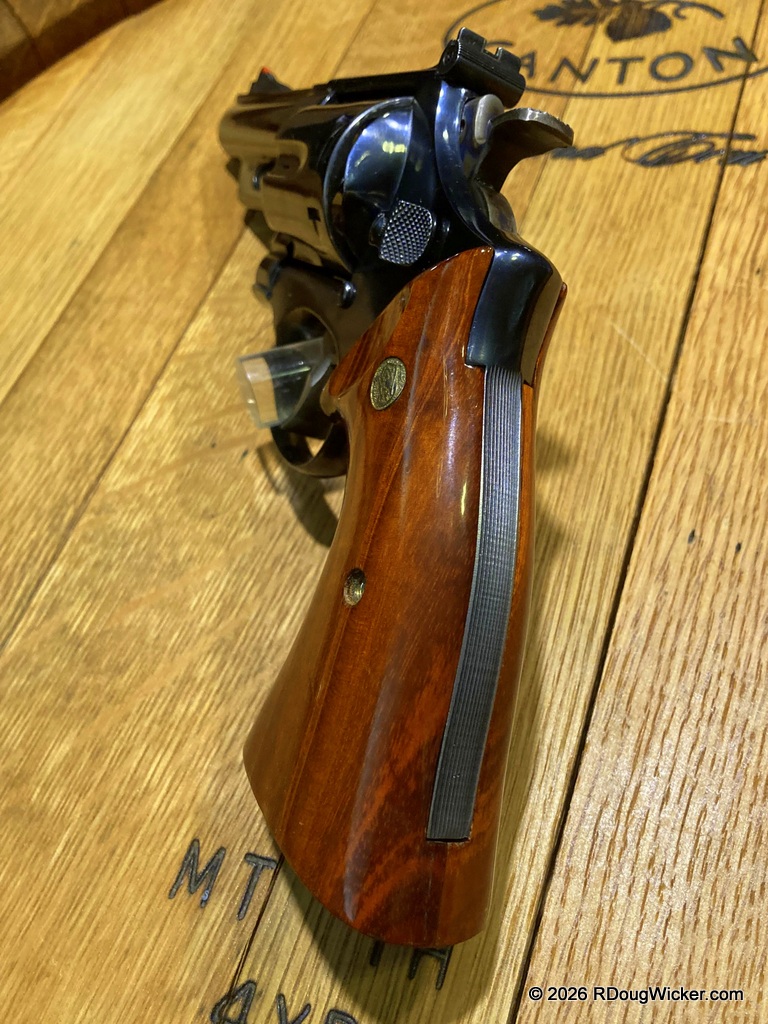
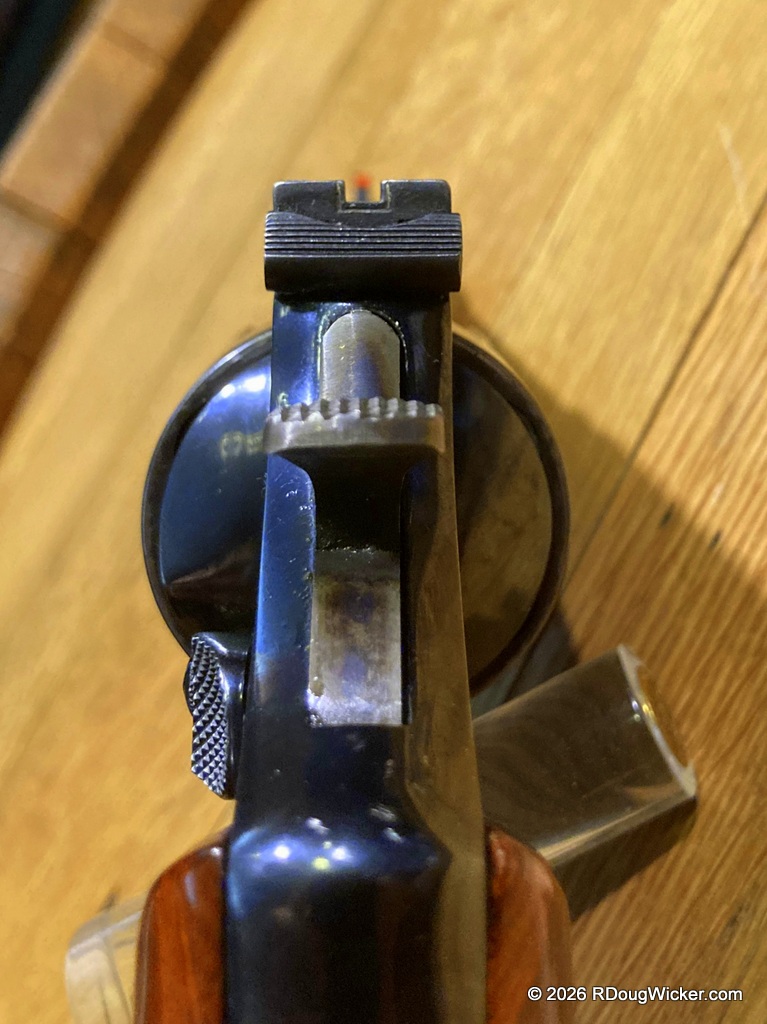
Adjustable rear target sight
S&W Model 57 sight picture, focused on the rear
Ramped front sight with red insert

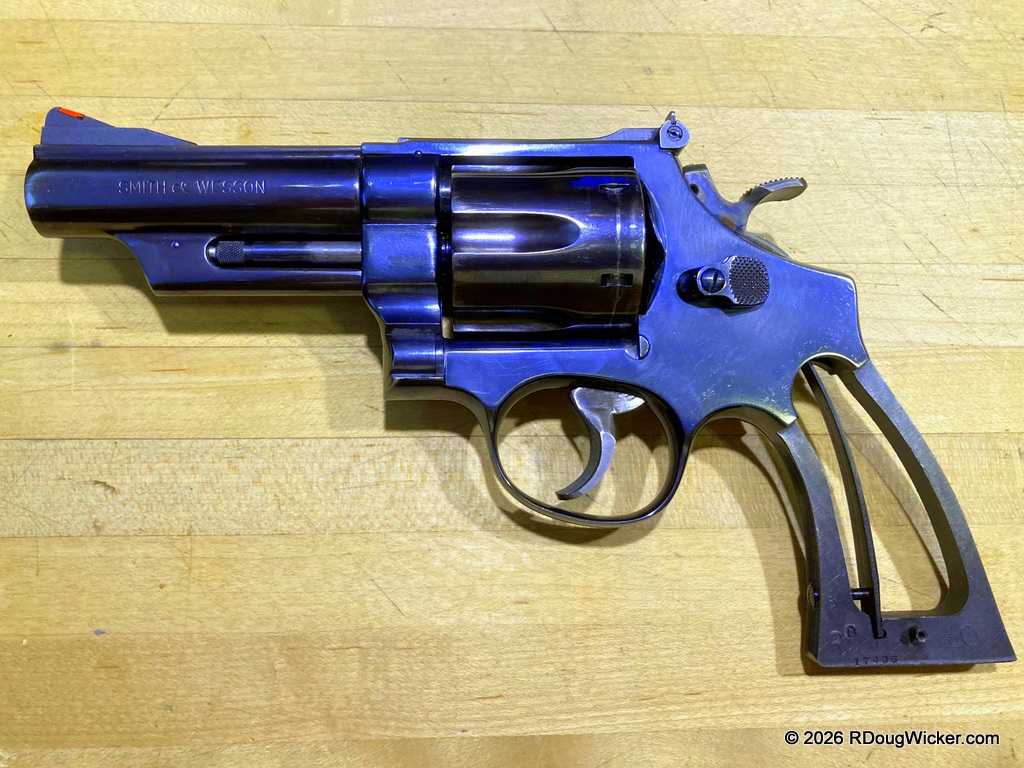
If you recall me previous articles on Smith and Wesson revolvers, you may remember that the serial number is always located on the butt, and almost never anywhere else. Monday’s Victory was an exception, as it had the serial number in three locations. Today’s Model 57 is also an exception. You have to remove the grips to find the serial number in the normal location:
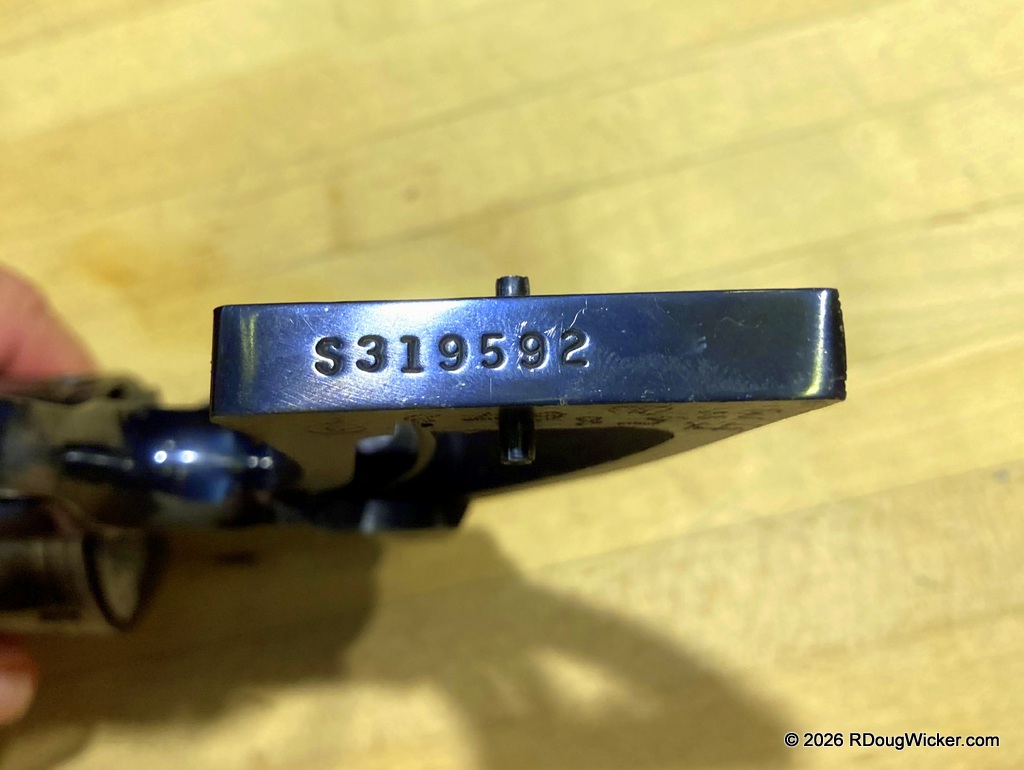
S&W Model 57 serial number stamped on the butt of the frame

But I also found the serial number stamped on the crane, along with the usual location for the model and change numbers. As this is a no-dash, there is no change number following the model number:
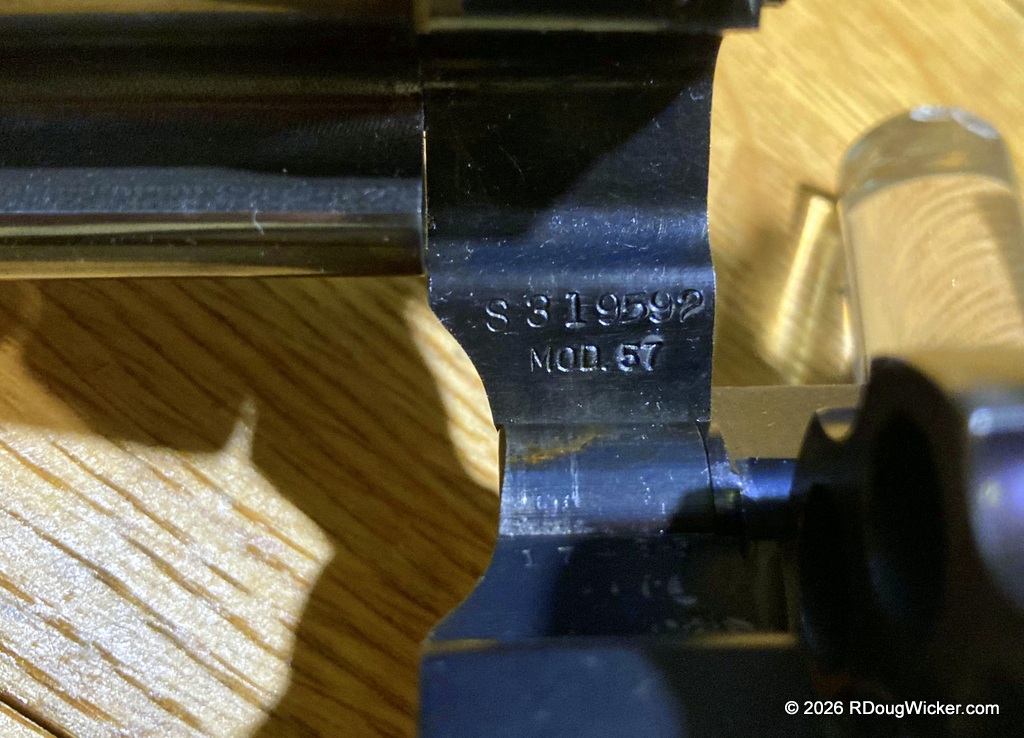
Serial and model numbers; if this were a 57-1, you would see that here affixed to the model number

That number opposite the numbers above, on the yoke, is an internal assembly number used to track the hand fitted parts:
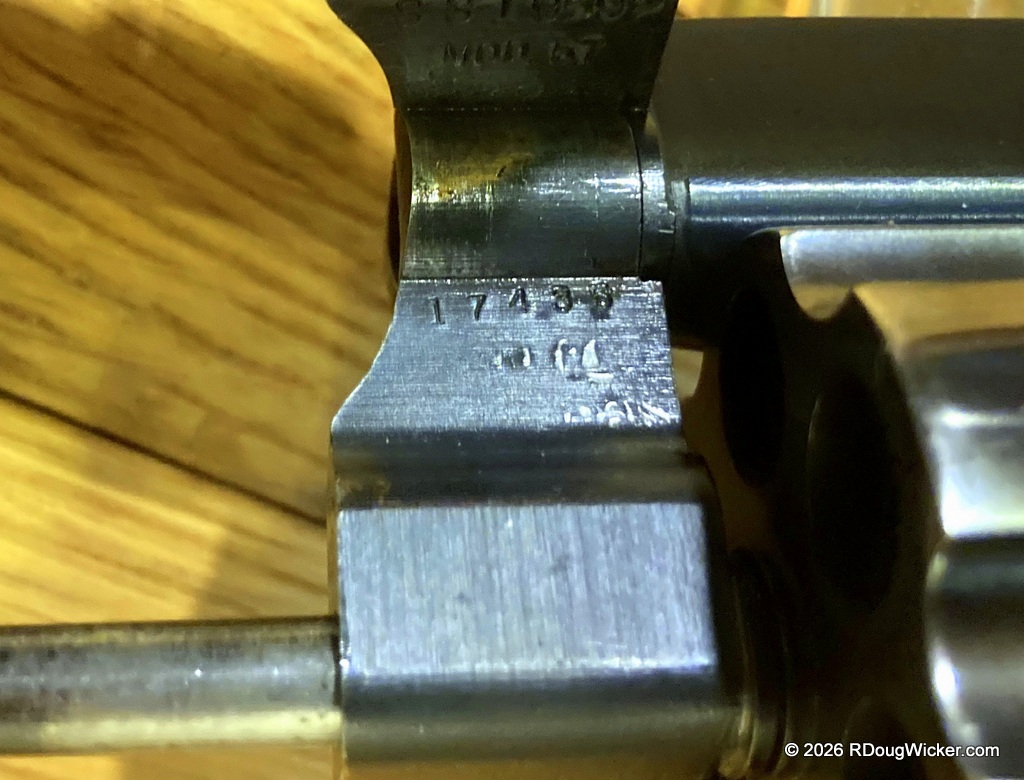
S&W assembly number for tracking parts

This Model 57 also sported an assembly identical assembly number on the left side of the frame butt:
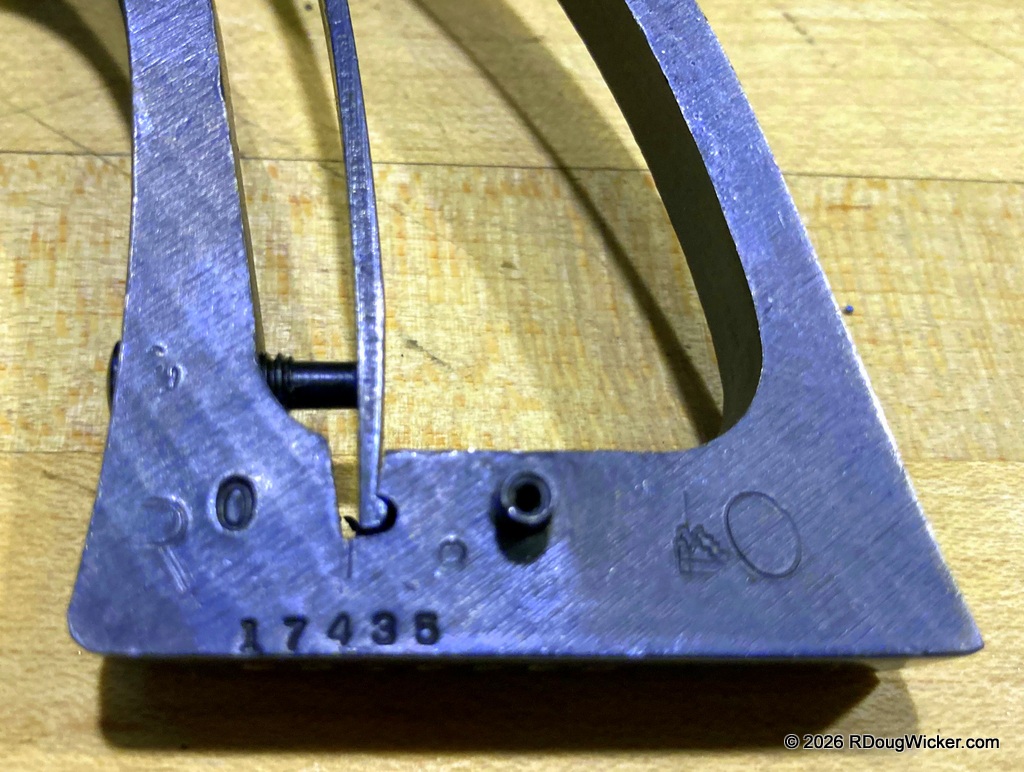
Assembly number; no relation to the serial number

If your early Model 57 has all matching serial and assembly numbers, you might want to ensure that the grips are original. Remove them and on the inside of the grip panels you should see matching inventory numbers preceded by N-LH on one, and N-RH on the other. That stands for N-frame Left Hand and N-frame Right Hand respectively. These were included to ensure the hand-fitted grip panels matched up:
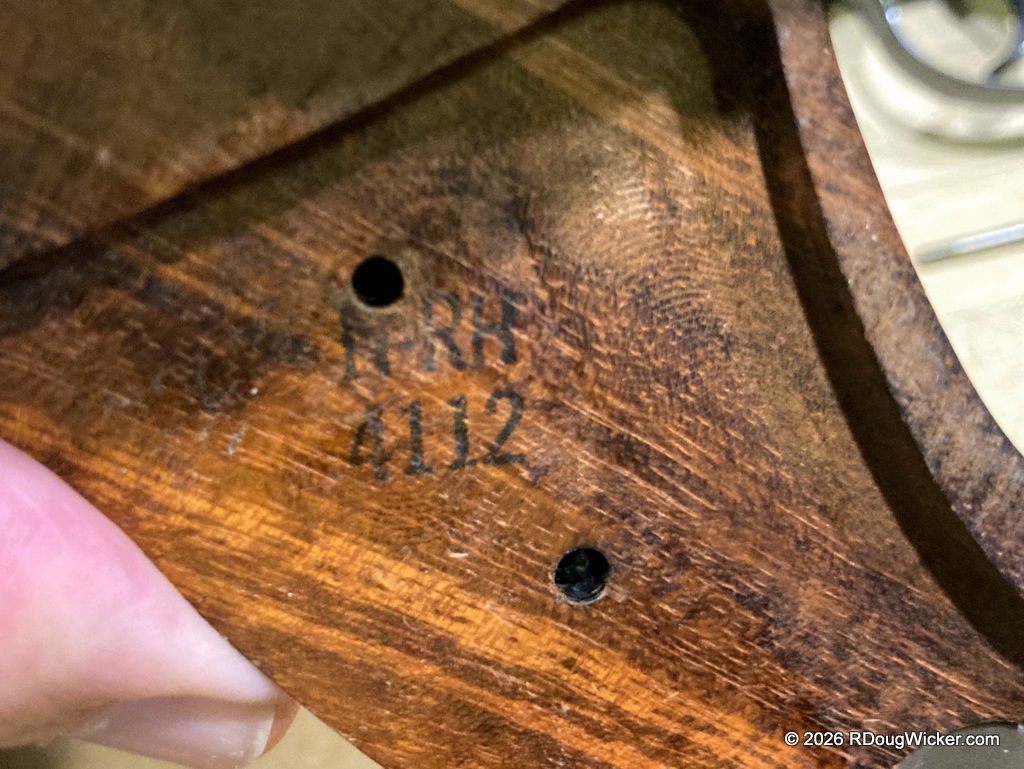
N-RH 4112 (N-frame, Right Hand, inventory fitting number 4112)

Check out the right side of the frame butt for inspection marks. This one has two — a circle containing a “G” and a triangle surrounding an “N”. As for the 58698 engraved in the same location, I have no idea. If you know, please leave me a comment.
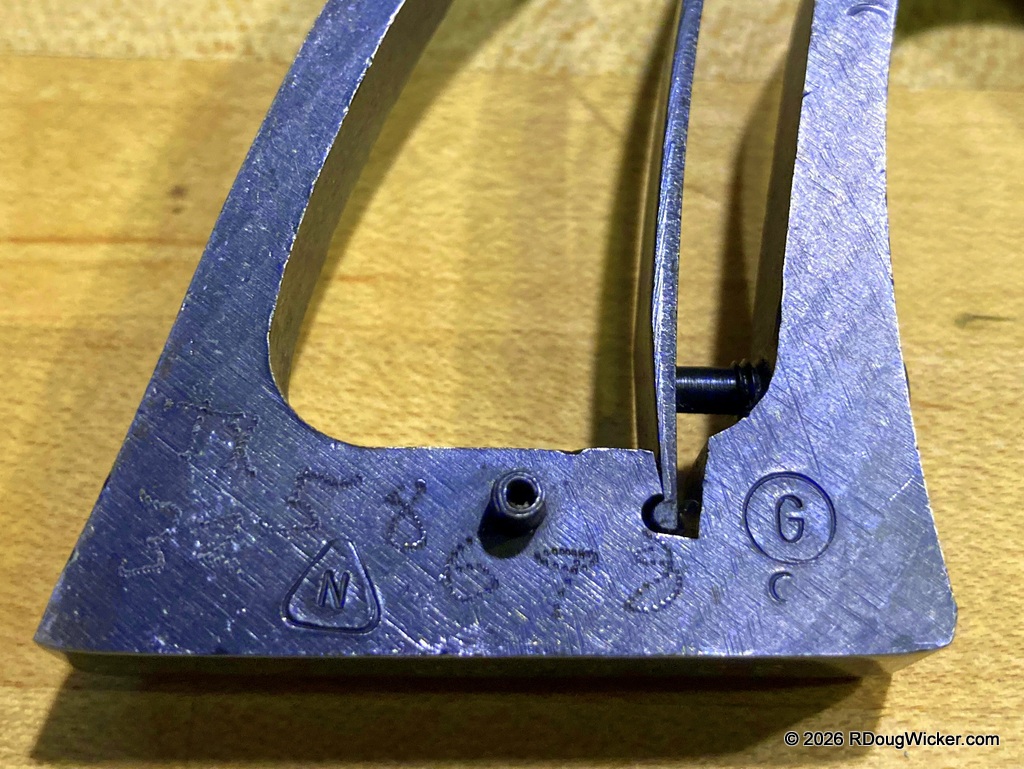
Circled G and Triangled N inspection marks

If you’re serious about gun collecting, make sure you carry around something to inspect the inside of the barrel. Look for clean rifling and no pitting or corrosion:
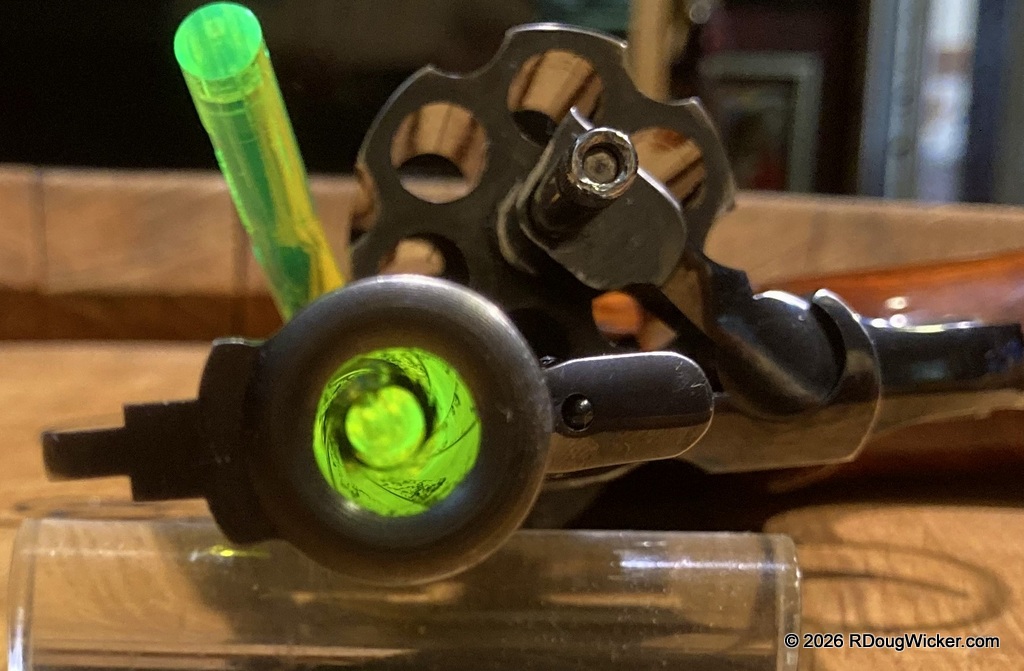
Barrel passed inspection, but there was some residue; it cleaned up nicely

Check the trigger and hammer. They should show typical Smith and Wesson case hardening rather than being blued.
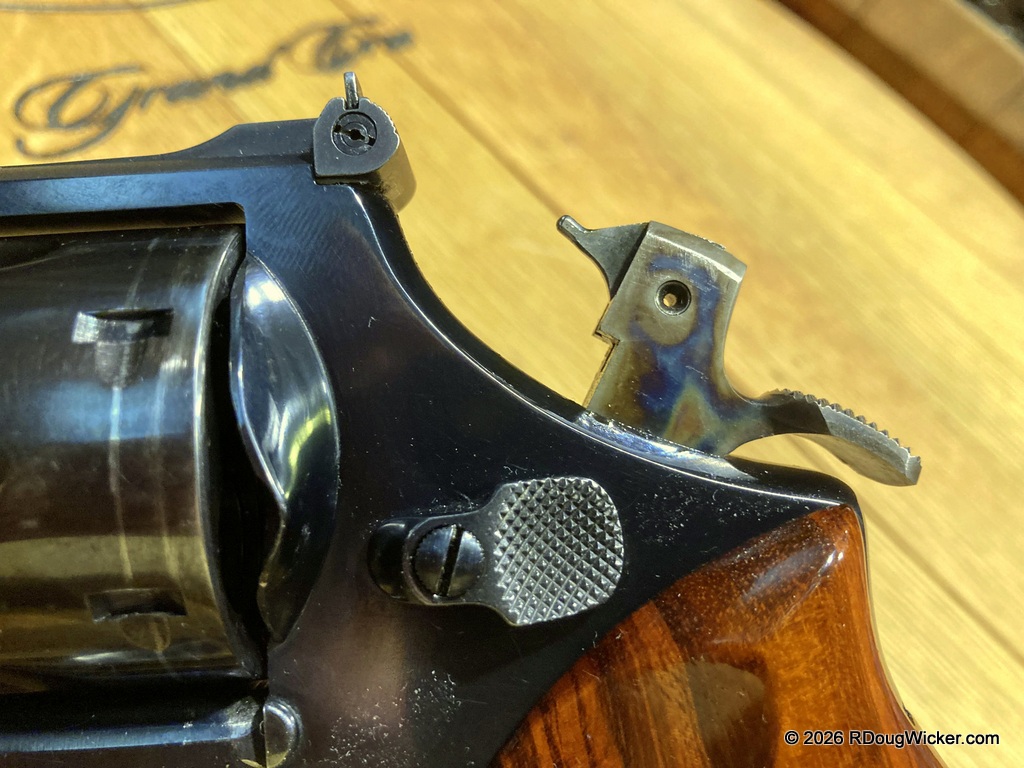
Case hardened hammer

Now for a photo gallery/slide show of Model 57 images, including how the frame appears beneath the grips:
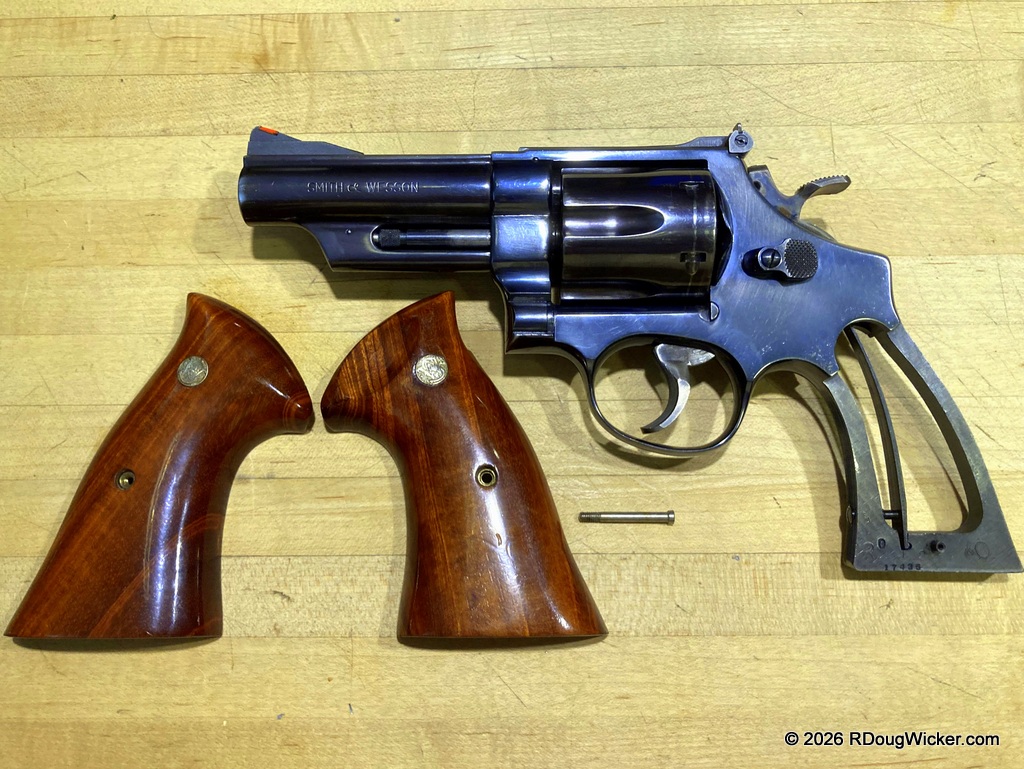
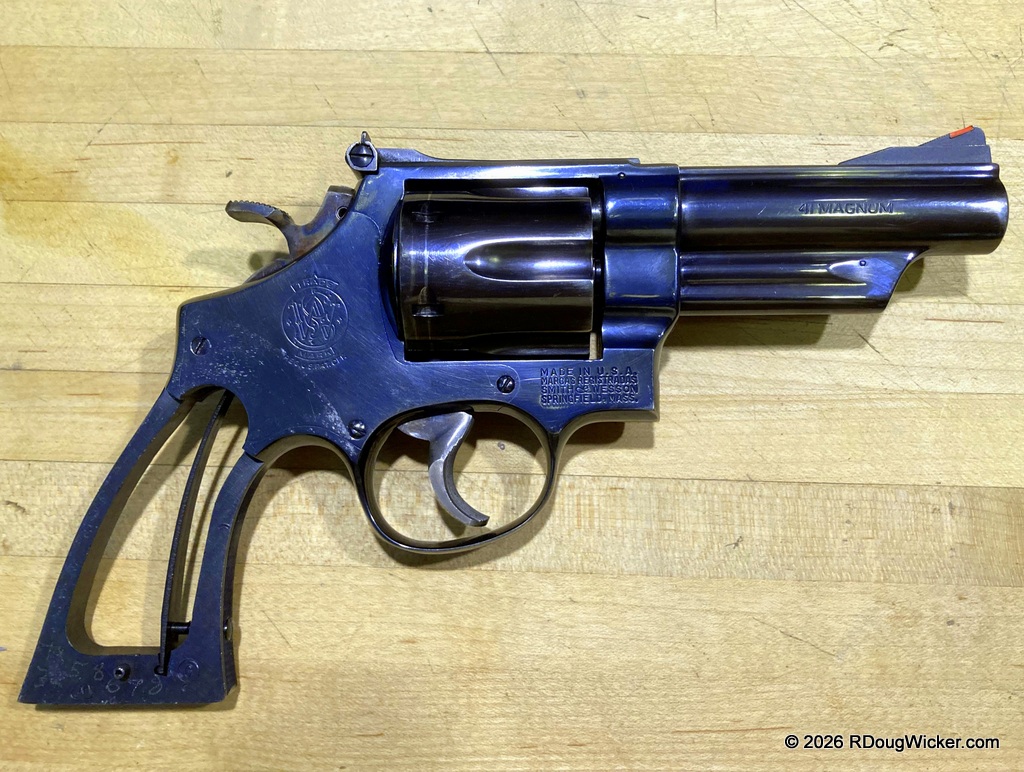
Слава Україні! (Slava Ukraini!)

Leave a comment

Filed under Firearms, R. Doug Wicker

Fun Firearm Friday — Answers to Wednesday’s Collectible S&W Revolver Quiz


S&W Revolvers — Which are Pinned, Recessed, Both, or Neither?

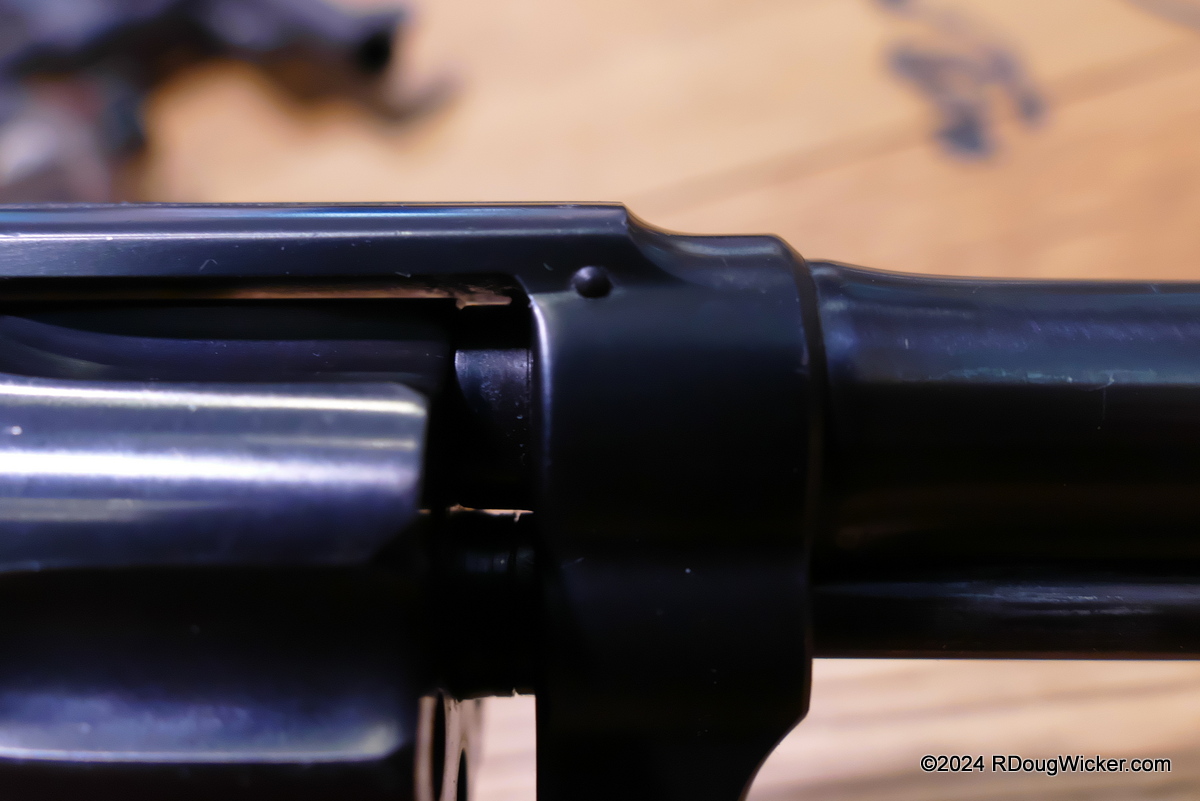
Did you take Wednesday’s quiz? If so, how do you think you did after that little lesson on classic collectible Smith and Wesson revolvers? Hopefully, if I did my job, you learned what is meant by S&W “pinned” barrels, “recessed” cylinders, and “dash” and “no-dash” models. As you may recall, a pinned barrel has this:

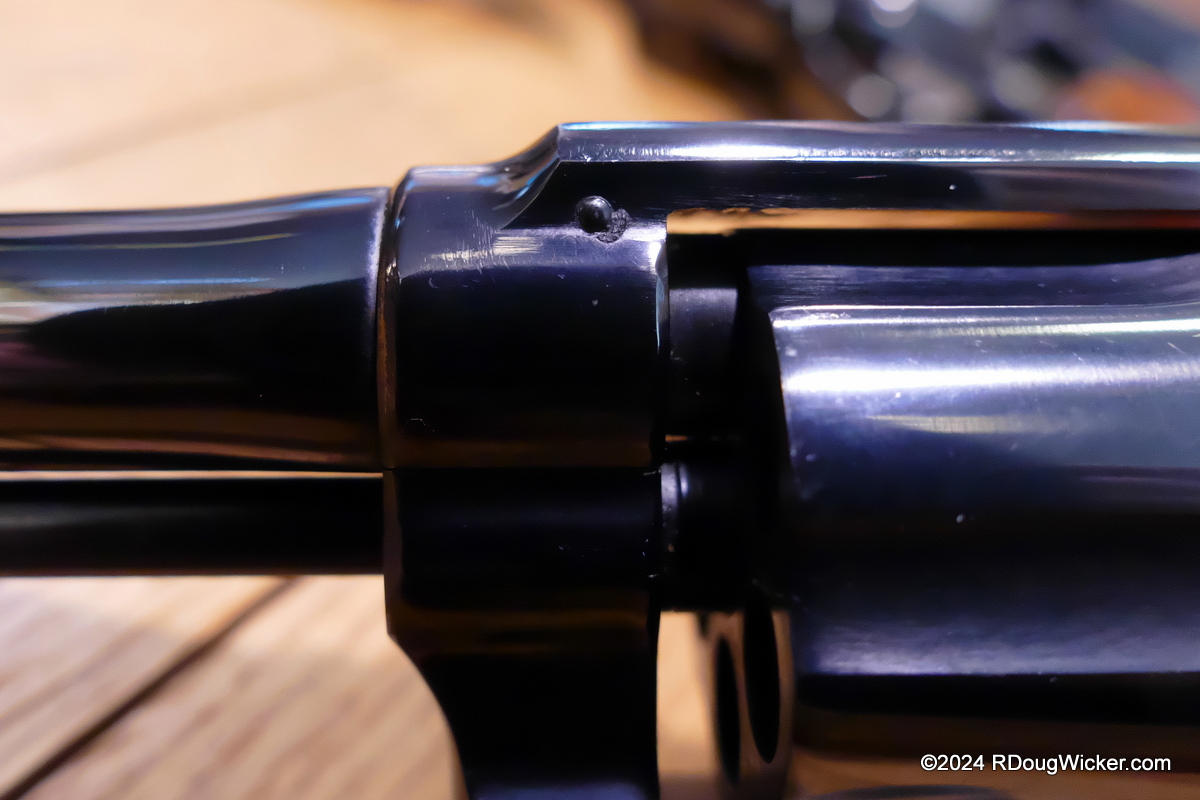
S&W Pinned Barrel

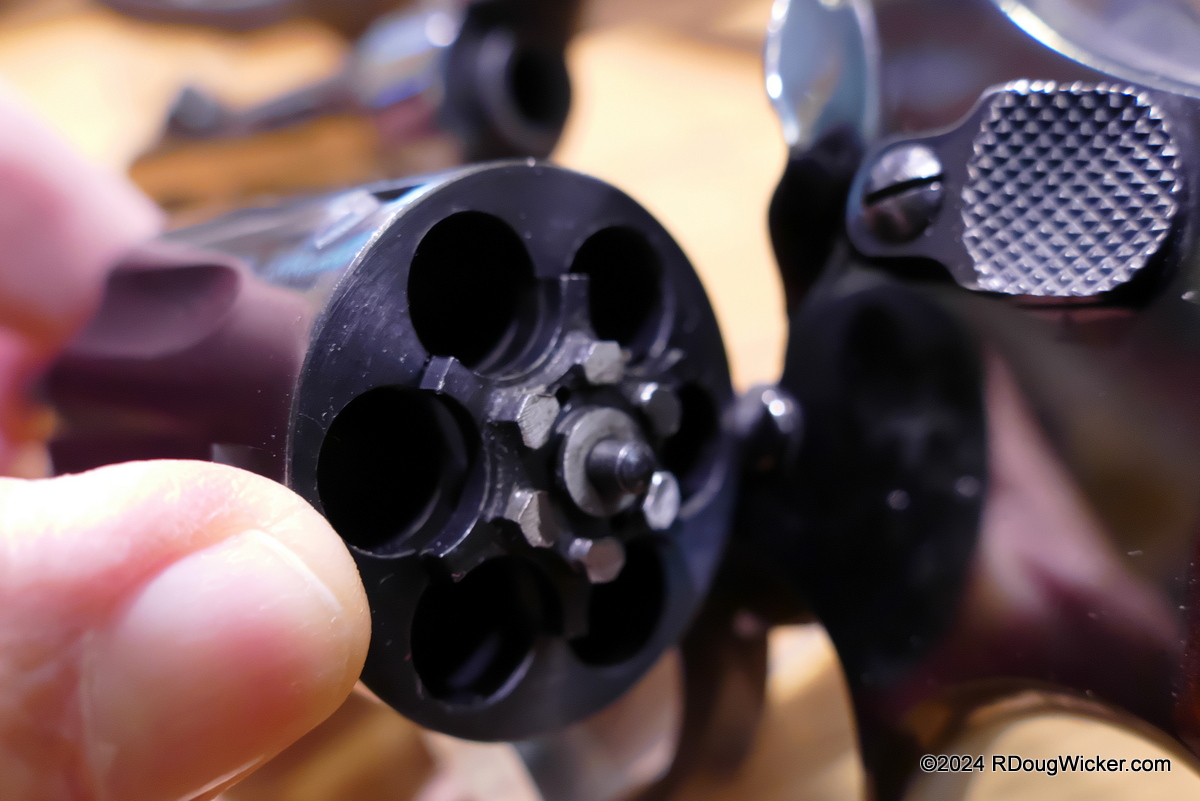
While this is an example of a nonrecessed cylinder:

S&W Nonrecessed Cylinder

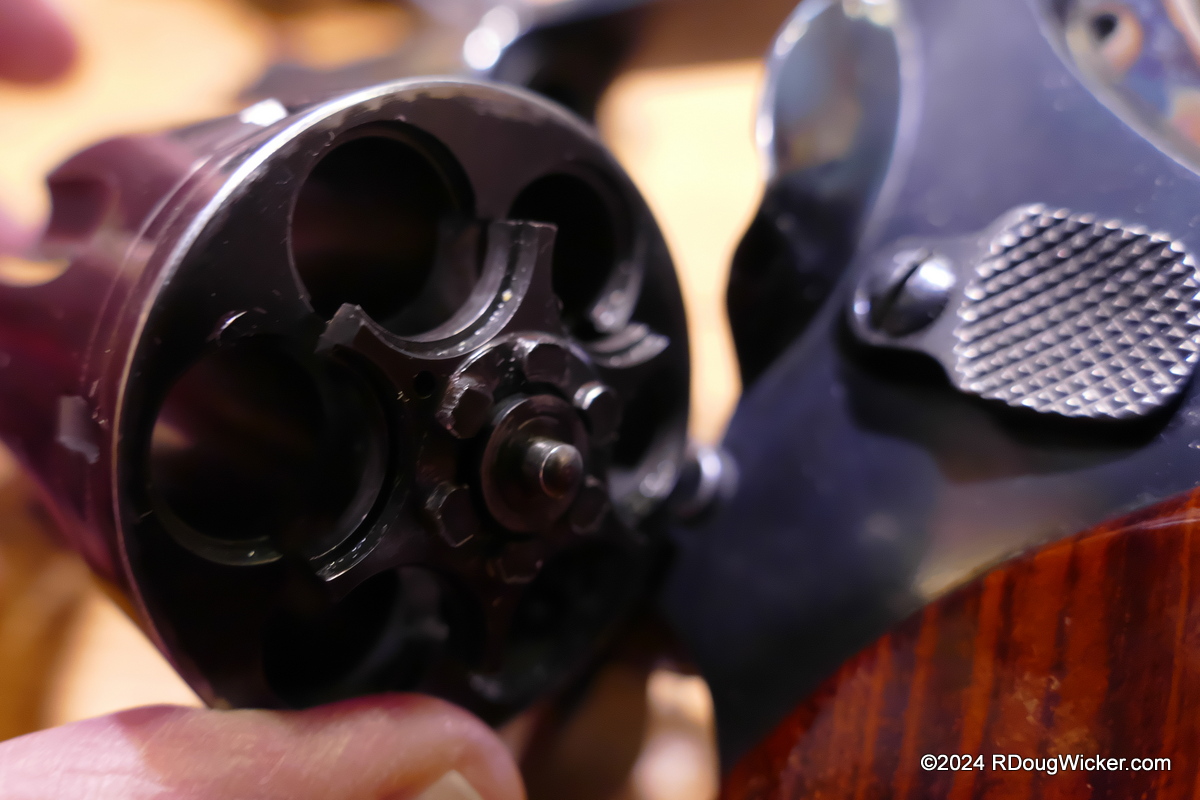
And this is an example of a recessed one:

S&W Recessed Cylinder

You may recall that recessed cylinders are almost flush to the recoil plate:

Recessed Cylinder flush with Recoil Plate

While nonrecessed cylinders require a gap to accommodate the protruding cartridge rim:

Gap between Nonrecessed Cylinder and Recoil Plate

I then gave you a quiz with which you could test yourself. Just by identifying the year and caliber of any S&W revolver made from 1905 on, you should be able to use that information alone to tell if the revolver has a pinned barrel, a recessed chamber, both, or neither. Below is the answer sheet, with correct answers highlighted in red and underlined. Also included with each question is a note as to what makes that answer correct. Here you go:

  1. Model 10-5 with uncommon 6-inch barrel; .38 S&W Special; 1969 or ’70
    a. Pinned Barrel (NOTE: correct period for pinned and recessed Smith and Wessons, but wrong caliber for a recessed cylinder — no .38 S&W Special revolvers sported recessed cylinders)
    b. Recessed Cylinder
    c. Both
    d. Neither
  2. Model K-22 “Outdoorsman”; .22 LR; 1938
    a. Pinned Barrel
    b. Recessed Cylinder
    c. Both (NOTE: correct period for pinned barrels, and S&W recessed .22 LR cylinders starting in 1931 with the K-22 Ourdoorsman)
    d. Neither
  3. A no-dash Model 57; .41 Magnum; 1968 or ’69
    a. Pinned Barrel
    b. Recessed Cylinder
    c. Both (NOTE: correct period, and S&W recessed cylinders on all Magnum revolvers — .357 S&W Magnum, .41 Remington Magnum, and .44 Remington Magnum)
    d. Neither
  4. WWII “Victory” Model M&P; .38 Special; 1944
    a. Pinned Barrel (NOTE: correct period for pinned and recessed S&W, but wrong caliber for a recessed cylinder — no .38 S&W Special revolvers sported recessed cylinders)
    b. Recessed Cylinder
    c. Both
    d. Neither
  5. Model 10-5 with common 4-inch barrel; .38 S&W Special; 1966 or ’67
    a. Pinned Barrel (NOTE: correct period for pinned and recessed S&W, but wrong caliber for a recessed cylinder — no .38 S&W Special revolvers sported recessed cylinders)
    b. Recessed Cylinder
    c. Both
    d. Neither
  6. Model 60-7 “Ladysmith”; .38 S&W Special; 1994
    a. Pinned Barrel
    b. Recessed Cylinder
    c. Both
    d. Neither (NOTE: starting in 1982, and finishing the following year, S&W transitioned all their revolver lines away from pinned barrels and recessed cylinders)

Now that you’re knowledgeable on classic collectible Smith and Wesson revolvers, have fun hunting for one to add to your own collection.

Слава Україні! (Slava Ukraini!)
Comments Off on Fun Firearm Friday — Answers to Wednesday’s Collectible S&W Revolver Quiz

Filed under Fun Firearm Friday, R. Doug Wicker

Smith & Wesson Revolver Lesson/Quiz — What do “Pinned,” “Recessed,” and “No-Dash” mean?


Collectible Smith and Wesson revolvers

Collectors of firearms tend to specialize in a only a few firearms of interest. Ofttimes only one. My interests are a bit more eclectic than most, however. For instance, I have an interest in tip-barrel Berettas, Beretta Cheetahs, PP-series and P99 AS-type Walthers, Sig Sauer P22(x) variants, “Old” 1st Issue Ruger Bearcats and Super Bearcats, Model 1911 Colts, and a few other odds-and-ends — a trio of Russian Mosins, a couple of Swiss K-31 straight-pull bolt-action rifles, and some Old West-style shootin’ irons. But in 2019 I got bit by the classic Smith and Wesson revolver bug, starting with a very rare prewar K-22 “Outdoorsman” I found at the local Cabelas listed for a small fraction of its actual value. I suspected immediately it was a prewar variant because it sported a tapered “pencil” barrel. I did some quick research, identified it as an “Outdoorsman” rather than a postwar “Masterpiece,” and immediately headed back to Cabelas to snatch it up.

Since that first acquisition I’ve added five, as you can see above, and I have an eye toward acquiring a few more if the opportunities arise and the prices are right. As an example of what would entice me, I have S&W Model 10-5 revolvers in both the common 4-inch/102mm and uncommon 6-inch/152mm barrel lengths. It would be nice to acquire three more Model 10 “dash fives” with 2-inch, 3-inch, and 5-inch barrels for a complete set. At any rate, the Smith and Wessons that most interest me are “pinned” and, in some cases “recessed” versions. That means I’m pretty much limited to S&W revolvers built before 1982 (or 1983 a few models).

So… what do I mean by “pinned” and “recessed?” And while we’re at it, let’s throw in a couple other S&W collector terms — “dash” and “no-dash.” But first let’s look at the firearms featured in today’s article. You might want to pay attention if you wish to participate in the quiz at the end. Answers to that quiz will be featured on this week’s Fun Firearm Friday. For now, let’s take another look at that above photo, but this time with the revolvers identified:

Today’s Roster of Smith & Wesson Revolvers

Today’s Roster of Smith & Wesson Revolvers (hyperlinks below go to articles I wrote on the specific firearm pictured above):

  1. Model 10-5 with uncommon 6-inch barrel from 1969 or ’70; . .38 S&W Special
  2. Model K-22 “Outdoorsman” shipped from the factory on 1 September 1938; .22 LR
  3. A no-dash Model 57 from 1968 or ’69; .41 Magnum (yep, you read that correctly; .41 Magnum)
  4. WWII “Victory” Model M&P (Military and Police) circa mid-1944; .38 S&W Special
  5. Model 10-5 with common 4-inch barrel from 1966 or ’67; . .38 S&W Special
  6. Model 60-7 “Ladysmith” made in late 1994(?); .38 S&W Special

First, let’s start with “Dash” versus “No-Dash” Smith and Wessons:

  • You’ll notice that the Model 57 above is a “No-Dash,” which means it is the first variant of that particular model. In the case of the Model 57, that would include all examples made from its introduction in 1962 until 1982 (remember that last date; it’ll come in handy in a moment).
  • The two Model 10 revolvers listed above are 10-5 variants, meaning they represent the fifth engineering change of the Model 10. That would encompass standard “pencil” barrel Model 10s made from 1962 until it was superseded by the Model 10-7. The Model 10-6 and subsequent 10-8 would be for the concurrently produced heavy barrel variant.
  • The Model 60-7 would be the seventh engineering change of the Model 60, which would date this variant between 1990 and 1996. This, and the concurrently manufacture Model 60-8 (made for the NYPD) were the last Model 60s chambered solely for .38 S&W Special. Subsequent variants were designed to handle .357 Magnum (which means they would also accept .38 S&W Special).

So, now that you know Dash from No-Dash, let’s move on to “pinned.” But first a brief primer on how Colt, Smith and Wesson, and many other manufacturers attach a barrel to a revolver frame. Believe it or not, the male-threaded barrel is mated into the female-threaded frame by simply screwing it in. But if the front sight is an integral non-removable part of the barrel that can pose a problem. If the barrel stops too soon, the front blade will be canted to the right. Too late and it gets canted left. Both situations will throw off the aim — left of target in the former case, and right of target in the latter. There’s also a remote possibility of a barrel coming loose, although that’s an exceedingly rare occurrence. But there is a solution, one which only Smith and Wesson ever used beginning in 1905 and stretching until 1982 (told you that date would come in handy later). S&W revolvers made during that span had a notch cut across the barrel screw threads. The barrel would then get screwed into the frame until that notch aligned with two holes drilled into the frame. At that point, a pin was inserted through the holes and across the barrel notch, giving your this:

A S&W “Pinned” Barrel

Pinning a barrel to a revolver frame is not cheap, which is probably why only Smith & Wesson, as far as I know, did this. By 1982 S&W began phasing this out, completing the transition to a strictly torqued barrel by sometime in 1983 for all models.

S&W Pin viewed from the right side

“Recessed” refers to something else entirely. It defines how Smith and Wesson made some of their revolver cylinders beginning in 1931, with the .22 LR K-22, and 1935 for their “Registered Magnum,” which was chambered for the then new .357 Magnum cartridge. And here’s where that gets confusing because while all recessed Smith and Wessons will sport a pinned barrel, but not all pinned S&W revolvers have a recessed cylinder.

Just to illistrate how confusing this situation can be, I once had a gun store owner say to me, “This Smith has a pinned barrel, but the cylinder is not recessed.” I then told him why, and now I’m going to tell you: It was because the gun was chambered for .38 S&W Special. I’ll explain that in a moment.

A S&W revolver with a recessed cylinder

In a recessed cylinder, the chambers are counterbored so that the rim of the cartridge lies flush with the rear of the cylinder (see above). A cartridge rim on a nonrecessed cylinder will protrude from the chamber.

Nonrecessed S&W cylinder

There’s a lot that goes into recessing a cylinder, for much must be changed to accommodate this feature. For instance, the ejector for a recess cylinder must also be recessed:

Recessed ejector

Which is more expensive to manufacture than a simple nonrecessed ejector:

Nonrecessed ejector

Even the cylinder-to-frame fit must be modified. On a recessed cylinder, the rear lies almost flush with the recoil plate:

Recessed cylinder flush mounted to frame

Whereas a nonrecessed cylinder must have a space between the rear of the cylinder and the recoil plate to accommodate the protruding rim of the cartridge:

Spacing for cartridge rim on a nonrecessed cylinder

So, why did Smith and Wesson recess the cylinders on some of their pinned revolvers, but not others? It has to do with caliber, and here I’m going to do some educated speculating on the reasoning. The only cylinders S&W recessed were for weapons chambered in .22 LR or for certain high-pressure rounds — .357 Magnum (Maximum SAAMI pressure 35,000 psi/240 MPa), .41 Magnum (Maximum SAAMI pressure 36,000 psi/250 MPa), and .44 Magnum (Maximum SAAMI pressure 36,000 psi/250 MPa).

For .22 LR it kind of makes sense. Recessing a rimfire cartridge mitigates the possibility that the rim will snag on something, which could potentially ignite the primer imbedded inside the rim and set off the cartridge. But if the frame behind the cylinder is properly made, there should be nothing there to snag that rim.

On Magnum revolvers I’m assuming it had to do with concern over power never before seen in a pistol. Elmer Keith developed the .357 Magnum in 1935, overtaking Colt’s .38 Super +P in sheer power (539 ft. lbs. for a 158gr Magnum bullet vs 426 ft. lbs. for a 130gr .38 Super bullet), but not quite in pure pressure (Maximum .38 Super SAAMI pressure 36,500 psi/251.66 MPa). If a cartridge case ruptures, especially at these pressures, the resulting explosion would be devastating to the weapon and potentially catastrophic for the shooter’s health and well-being. Fully enclosing the cartride all the way to the rim was probably a means of easing reluctance on the part of those transitioning from weaker cartridges, such as the .38 S&W Special, to the .357 Magnum. This “danger” was overblown, however. As long as a Magnum cartridge isn’t overloaded with powder, and the casing is enclosed to the rim, there is almost zero chance of such a rupture occurring. And in 1982 S&W made the decision to decrease manufacturing costs to eliminate this feature along with the pinned barrel.

So, are pre-1982 Smith and Wesson revolvers better that post-1983 revolvers? Probably not much, if any. Nevertheless, pinned-barrel Smiths are sought after by collectors because they represent craftsmanship and an attention to detail that is no longer a priority with many of today’s revolver manufacturers. I know that I have a special place in my heart for such revolvers.

Now for that promised quiz, the answers to which will appear on this week’s Fun Firearm Friday.

Below is a list of the revolvers featured in today’s article. Below each revolver listing choose whether that particular Smith and Wesson feature a pinned barrel, a recessed cylinder, both, or neither. No fair clicking on the images above to blow up the photo, either; you should have enough information from the descriptions in the quiz to figure it out. Please leave a comment to let me know how you did. Good luck!

  1. Model 10-5 with uncommon 6-inch barrel; .38 S&W Special; 1969 or ’70
    a. Pinned Barrel
    b. Recessed Cylinder
    c. Both
    d. Neither
  2. Model K-22 “Outdoorsman”; .22 LR; 1938
    a. Pinned Barrel
    b. Recessed Cylinder
    c. Both
    d. Neither
  3. A no-dash Model 57; .41 Magnum; 1968 or ’69
    a. Pinned Barrel
    b. Recessed Cylinder
    c. Both
    d. Neither
  4. WWII “Victory” Model M&P; .38 Special; 1944
    a. Pinned Barrel
    b. Recessed Cylinder
    c. Both
    d. Neither
  5. Model 10-5 with common 4-inch barrel; .38 S&W Special; 1966 or ’67
    a. Pinned Barrel
    b. Recessed Cylinder
    c. Both
    d. Neither
  6. Model 60-7 “Ladysmith”; .38 S&W Special; 1994
    a. Pinned Barrel
    b. Recessed Cylinder
    c. Both
    d. Neither

Слава Україні! (Slava Ukraini!)

Comments Off on Smith & Wesson Revolver Lesson/Quiz — What do “Pinned,” “Recessed,” and “No-Dash” mean?

Filed under Firearms, R. Doug Wicker