
El Paso Military Aviation and Biggs Army Airfield:
In 1919 the first permanent aviation presence arrived at Fort Bliss Aviation Field. The U.S. Army deployed to Fort Bliss the 104th Aero Squadron, which operated the Geoffrey de Havilland-designed Dayton-Wright DH-4. These aircraft patrolled the border between the United States and Mexico, becoming the first aerial Border Patrol operation.

Dayton-Wright DH-4, based on the Airco D.H.4
Meanwhile, in December of that same year, the Army relocated airship operations from Brooks Field, San Antonio, to a location two miles northeast of Bliss Aviation Field, on National Guard Camp Owen Bierne. On January 5, 1925, Bliss Aviation Field was renamed Biggs Field in honor of El Paso native Lt. James B. Biggs, who lost his life flying a pursuit aircraft in France during World War I, and on July 1, 1926, Biggs Field relocated to Camp Owen Beirne, which to this day is the present location of Biggs Army Airfield.
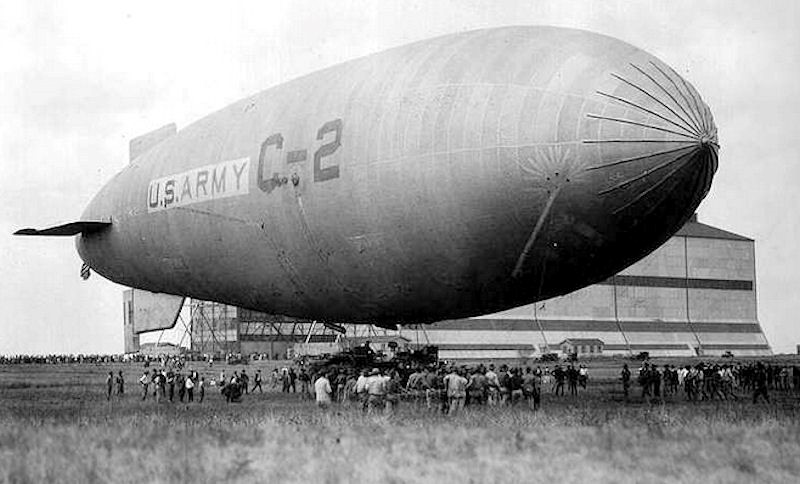
U.S. Army C-2 blimp at Brooks Field, San Antonio, 1922
During World War II Biggs Field would take on a new, expanded role. Bombers arrived, and aircrews began training for the conflict by learning to operate the Boeing B-17 Flying Fortress, Consolidated B-24 Liberator, and later in the war the Boeing B-29 Superfortress.

Consolidated B-24 Liberator
In 1947, command of Biggs Field transferred to the newly formed United States Air Force, which operated Biggs Air Force Base as a heavy bomber base under control of the Strategic Air Command (SAC). During its days as a SAC base, Biggs Air Force Base hosted the Boeing B-50 Superfortress (post-war advancement of the WWII era B-29 Superfortress), the massive 10-engine (six propellers, four jet engines) Convair B-36 Peacemaker, Boeing B-47 Stratojet, Boeing KC-97 Stratofreighter, Boeing B-52 Stratofortress, and the Boeing KC-135 Stratotanker. Biggs Air Force Base closed in 1966, at which time control of the field reverted to the U.S. Army. However, Biggs Field would remain closed for seven years, resuming operations as Biggs Army Airfield in 1973.

Convair B-36 Peacemaker
Today Biggs Army Airfield has one runway. Runway 21/03 is one of the longest in the Western United States, measuring 13,554 x 150 feet (4, 131 x 46 meters).
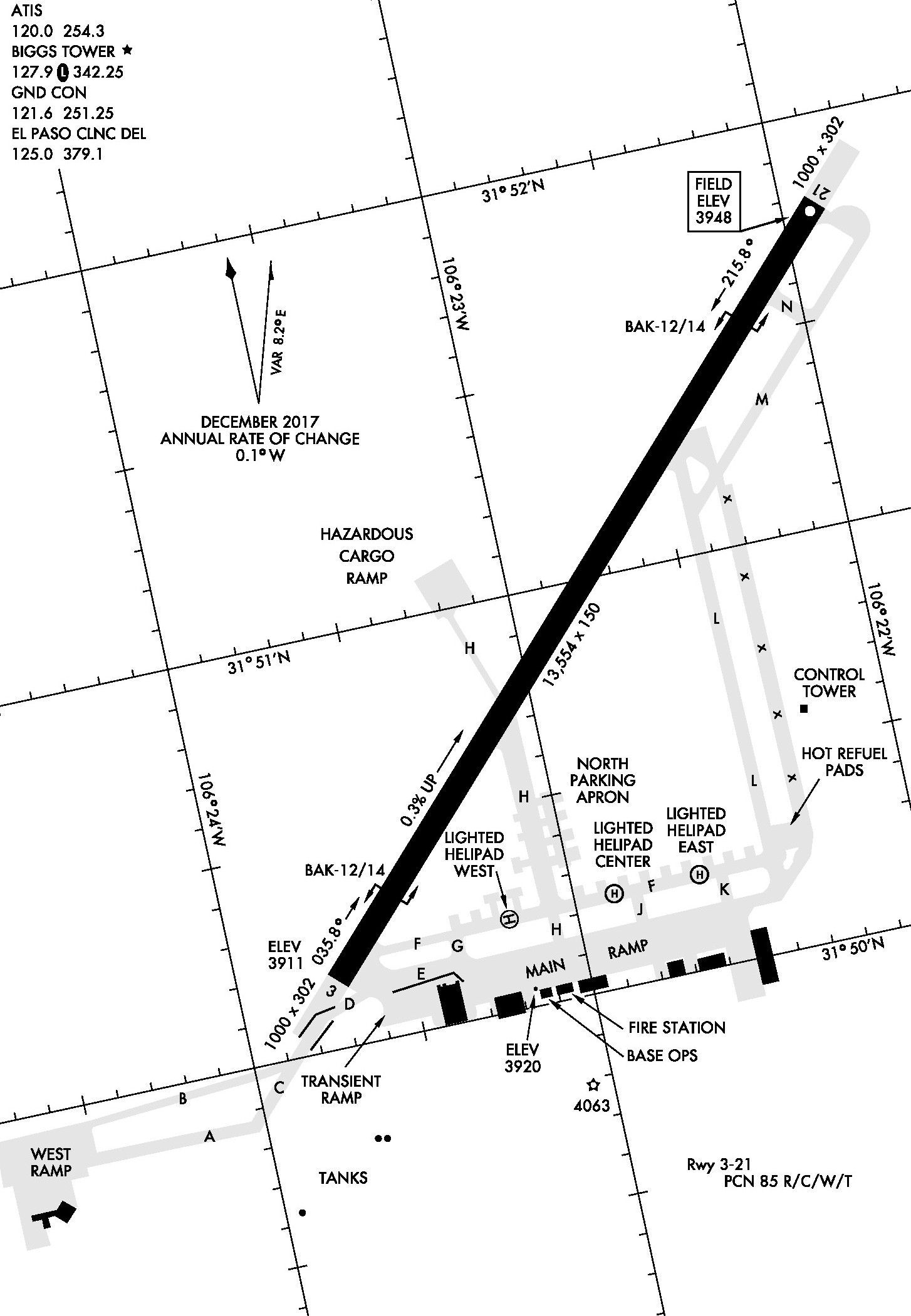
Biggs Army Airfield diagram
Wednesday — El Paso Civil Aviation
© 2018 R. Doug Wicker







 Decisions — Murder in Paradise
 The Globe — Murder in Luxury
