


Next week we return to travel and travel photograph, but this is Revolver Week. And today we begin Revolver Week with a Smith & Wesson Model 10, change 5. Or, more simply, a Model 10-5. This particular example dates back to 1966-1967. I can say that because of the serial number (see below). The “C” range of serial numbers stretched from 1948 until they ran out in 1967. The range for 1966-1967 are serial numbers C810,533 through C999,999. As such, I guesstimate this one at probably around the late-first to mid-second quarter of 1967. But that’s a pure shot in the dark.

So, why am I calling this “Military Monday?” Because before Smith & Wesson changed the name to Model 10 in 1957, this line of revolvers was called Military and Police model, or M&P for short. And, yes, both the military and numerous police departments in both the U.S. and around the world used the M&P revolver back in its heyday.

This line of revolvers has a long, long history, beginning way back with its introduction as the Smith & Wesson .38 Hand Ejector Model of 1899. Since that time it has gone under several names, including the S&W Victory Model used during World War II and exported to various allied powers such as Australia, Canada, New Zealand, and the United Kingdom. But I digress. Today’s topic is specifically on the Model 10, and this example is the fifth change of that model.

If the profile of this gun appears vaguely familiar to my readers, it’s because the Model 10 is a K-Frame (medium frame) revolver. And, yes, I’ve done a previous article on a rare pre-war K-Framed S&W K-22 Outdoorsman. Both have the classic tapered “pencil” barrel, but the K-22 is chambered in .22 LR, while the Model 10 and its predecessor the Hand Ejector Model of 1899 were made to handle the .38 S&W Special cartridge (hereafter referred to as “.38 Spl”).
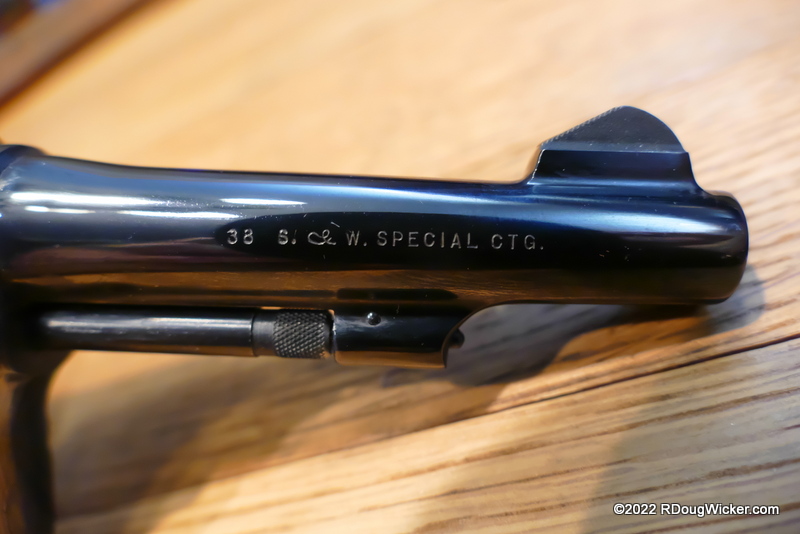
The bluing on this particular example is exquisite. Perhaps too exquisite. While the stamps and roll marks are incredibly sharp, my go-to guy Paul Lee, owner of my favorite local gun store El Paso Gun Exchange, looked over the weapon and thought he detected minute evidence of blued-over pitting on the frame backstrap. As I trust Paul, I’ll just go ahead and declare this one a probably reblued weapon. But you sure could fool me when you see this kind of clarity:


That crispness extends even to the assembly numbers hidden beneath the left grip and inside the crane:


While we’re looking at the stamps inside the crane, here is how to tell both the model and change number on a Smith & Wesson revolver:

The image below shows the frame backstrap, which Paul thought might indicate that the finish was not original:

So, how do you tell if a Smith & Wesson is a Smith & Wesson? Silly question:
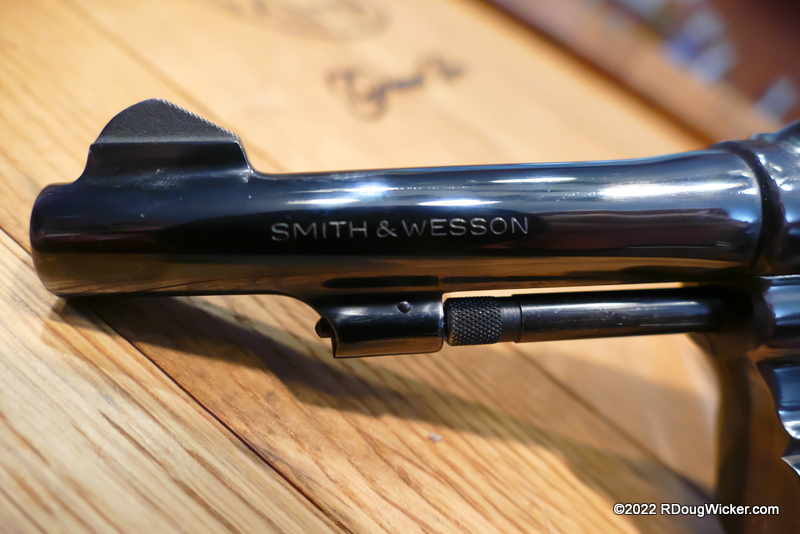
The M&P and Model 10 were basic, dependable, well-built revolvers. As they were designed for military and police budgets, there aren’t a lot of frills here. That extends to the very basic sights — a fixed blade ramped front sight paired with a rear “sight” that is nothing more than the groove running alone the top strap. Not that there’s anything wrong with this, as this type sighting system has been a fixture of revolvers dating well back into the 19th century.


Now let’s discuss the particulars of the Smith & Wesson Model 10 with a four-inch tapered “pencil” barrel. The trigger pull in double-action is estimated, as it exceeded the limitations on my digital guage. Single-action measurement is an average of five pulls.
- Length: 9.13 inches/232 mm
- Barrel length (actual): 3.94 inches/100 mm
- Height: 5.12 inches/130 mm
- Width (cylinder): 1.46 inches/37 mm
- Weight: 30.64 ounces/869 grams
- Capacity: 6 rounds
- Caliber: .38 S&W Special
- Trigger pull (single-action): 2 lbs. 12.1 oz./1.25 kg
- Trigger pull (double-action): approximately 11 to 12 lbs./5 to 5.4 kg

The firing pin on the Model 10 is fixed directly onto the hammer. But you needn’t worry. Although this model lacks a transfer bar, there is an internal hammer block that keeps the firing pin safely away from the cartridge primer unless the trigger is pulled. Unlike the old West-style single-actions, it is safe to carry this gun with all six chambers loaded. When I released the trigger, the top of the hammer receded a full ⅜ of an inch/9.5 mm.
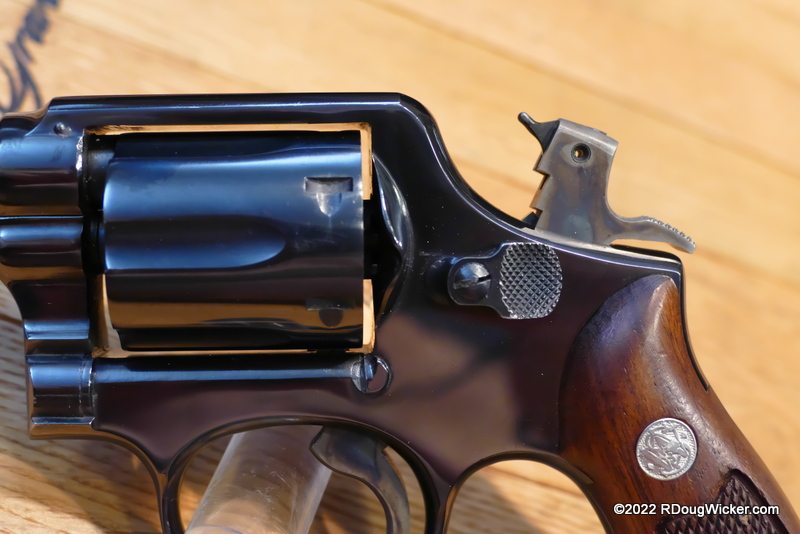
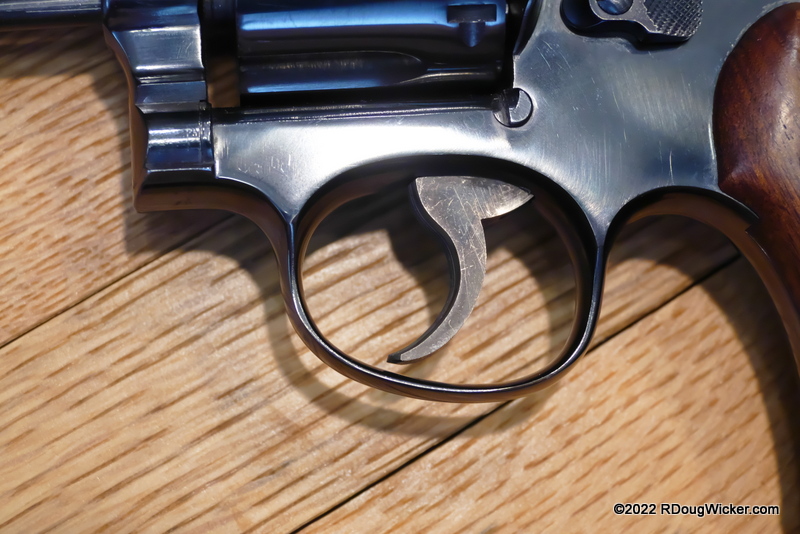
Let’s discuss Smith & Wesson’s marvelous trigger, a feature I love with every older S&W revolver I’ve ever handled. It is, quite simply, superb in both double-action and single-action. Double-action is as you would expect — long and a bit weighty, but easily controllable through the pull. There is a slightly audible click just prior to halfway through the pull, but there is zero grittiness or hesitancy all the way to the trip of the hammer.

But single-action is where these old Smiths really shine. There is absolutely no take-up on the single-action pull, and the trigger weight is an almost uncomfortably light 2 pounds, 12.1 ounces/1.25 kilograms. I say “almost” because I’ve trained for years with DA/SA weapons, mostly older hammer-equipped semiautomatics, so I’m comfortable firing pretty much any weapon is either double-action or single-action. Those who grew up firing Glock-style, striker-fired weapons will probably be taken aback by the lightness of this trigger when the hammer is cocked back. On Wednesday I’ll be taking a look at a S&W Model 60-7, but I’ll tell you right now that trigger is even a couple of ounces lighter in single-action, so this superb trigger is not an anomaly with Smith & Wesson.

Wednesday’s revolver is one for the ladies, another Smith & Wesson. On that article I will present to you a S&W Model 60-7 “Lady Smith” also chambered in .38 Spl, but in a more compact J-Frame. Until then, I’ll leave you with this remaining gallery of Model 10 photos:













 Decisions — Murder in Paradise
 The Globe — Murder in Luxury
 R. Doug Wicker — Author