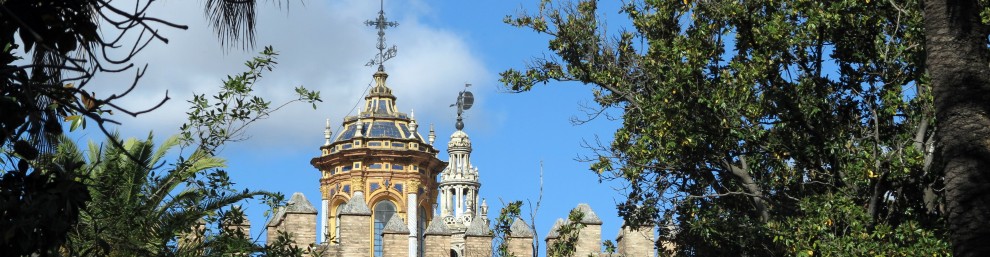

Last week I finished up my series on our most recent transatlantic cruise with a look at Spain’s Valencia region. Our ship continued on to Civitavecchia, the port city for Rome. Here we disembarked, on April 19, and shared a ride to Rome’s Leonardo da Vinci–Rome Fiumicino Airport. After that it was a flight to one of our favorite cities, and one we had not revisted in many years. Welcome to Istanbul in the country of Republic of Türkiye. At the Sabiha Gökçen International Airport we hired transportation with an absolutely wonderful company — Ülger Araç Kiralama – Shuttle Transfer (Phone: +90 216 588 08 04) — for an affordable ride to our boutique hotel in a very spacious and comfortable limousine. For one price paid upfront, they even guaranteed our pickup and transportation four days later for Istanbul Airport on the opposite side of town. The driver was friendly, informative, and took us the long way to our hotel for a little sightseeing along the way. He even took us on the ferry to avoid heavy rush hour traffic.
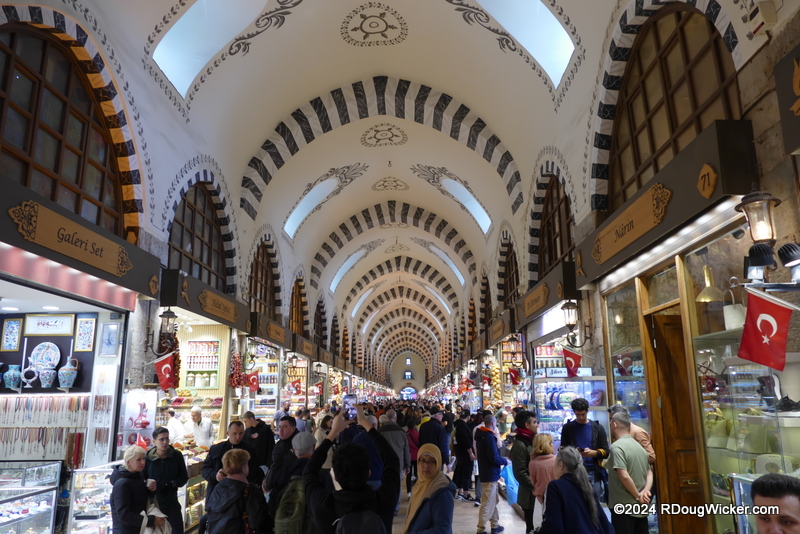
After settling into our wonderful hotel room and taking it easy for the rest of the day, Ursula had a desire to visit Istanbul’s two most famous shopping venues — the Spice Bazaar (also called the Egyptian Bazaar, or Mısır Çarşısı in Turkish) and the massive Grand Bazaar. We had visited the latter on one of our previous trips, but we’d never before hit the Spice Bazaar. So we made the Spice Bazaar our first destination.

The Spice Bazaar dates back to 1660, but the beautiful interior belies its 360+ years of existence. The building is part of the New Mosque complex near the Galata Bridge, and proceeds from vendor rentals go toward maintaing the mosque. Being named the Spice Bazaar one would think there are spices involved. And so there are:
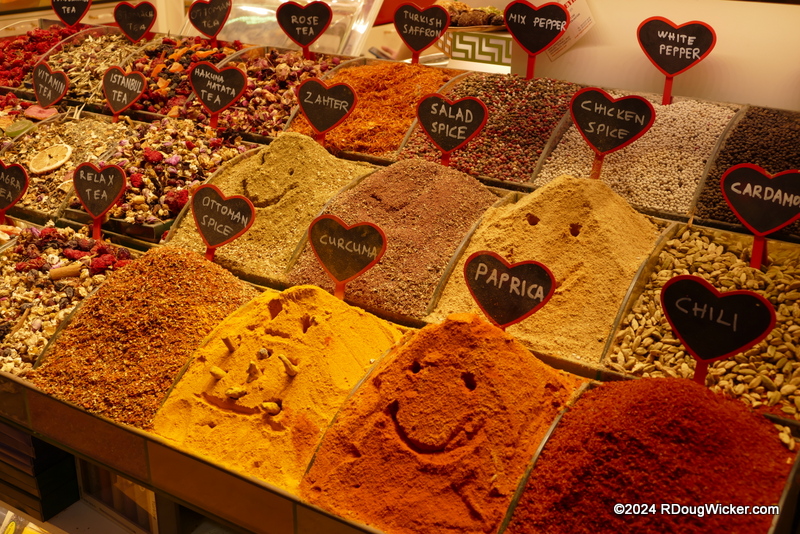
But spices are not the sole commodity among the bazaar’s eighty-five vendors. Here you will also find sweet treats, souvenirs, Turkish lamps, intricate chess sets, and carved wood. And then there’s gold. Lots of gold:
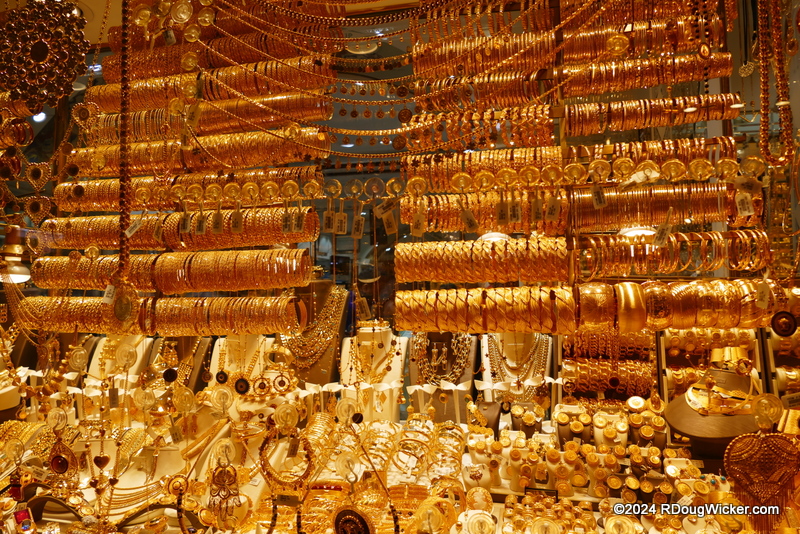
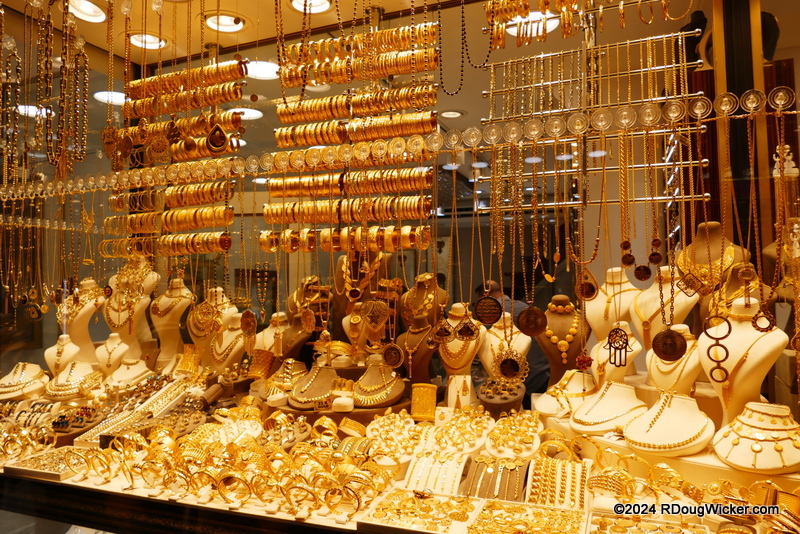
Gold content seems to be a region-specific thing. For instance, in the U.K. it’s not uncommon to find 10k pieces. Here, in the U.S., 14k and 18k are in vogue. Most of Europe seems to enjoy 18K. India goes all out with 24k. But in Türkiye the preferred choice seems to be 22k, which displays the intense yellow of 24k but without the subsequent softness. At any rate, if you decide on a piece you’re expected to haggle. When I found Ursula a gold-and-enamel evil eye pendant, I asked the karat and weight of the piece and whipped out my phone to check the going rate for the actual gold content of the alloy. To that I tacked on a fair amount for the craftsmanship/work involved, minus a bit for haggling purposes, and gave an initial offer. Be prepared to walk, as heading toward the exit often elicits a lower counter.
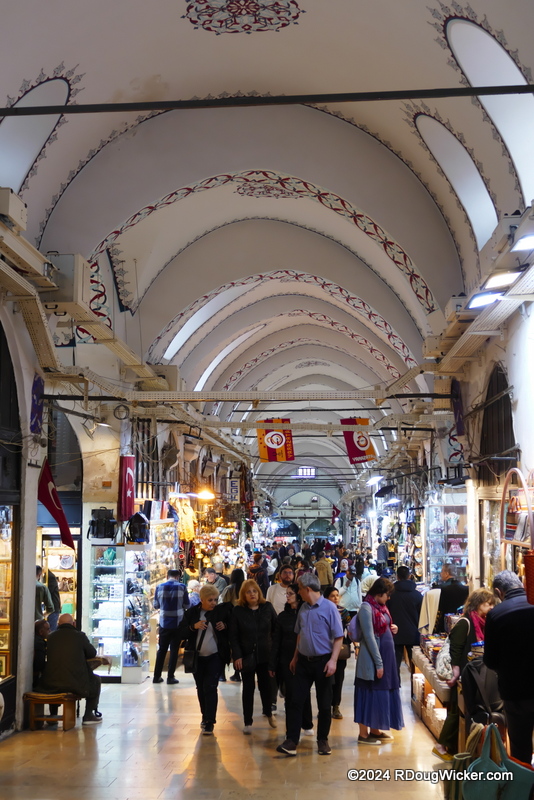
After leaving the Spice Bazaar we hoofed it to the even older (by 200 years) and larger (4,000 shops) Grand Bazaar. This place is simply massive. One could easily spend several days here and not take in all it has to offer. The Grand Bazaar, by the way, goes by two other names — Covered Market (Kapalıçarşı) and Grand Market (Büyük Çarşı).

Here you will find merchandise similar to that available in the Spice Bazaar — gold, spices, woodworks, etc. — but also clothing, hand-woven rugs, and a fascinating collection of Faux-lex (fake Rolex) and other “homage” knockoffs of luxury brands. I even saw a copy of the original Heuer Monaco, clear down to the left-side stem and “Heuer” without the “Tag” prefix. Be wary of buying one of these, though. I’m sure you’ll get a reasonable bargain, most likely using a completely adequate and reasonably reliable Miyota or Seiko automatic movement, but you may have trouble sneaking it back into the U.S. if Customs determines that it’s a fake. A better bet is to stick with other typically Turkish merchandise:


A couple of more fun stats on the Grand Bazaar. I mentioned earlier that the Grand Bazaar houses some 4,000 shops. But that statistic doesn’t come close to giving you the full story on its immense size. This “Covered Market” encloses some 61 streets over nearly 7.6 acres/330,450 sq. ft./30,700 m². Expect between 250,000 and 400,000 visitors on whatever day you choose to visit. In 2014 the Grand Bazaar had 91,250,000 visitors, which for that year propelled this 570-year-old outlet shopping mall to the world’s most visited attraction. So, on your trip to Istanbul, you can do a lot worse than while away a day or two in one of this vibrant city’s two main bazaars.
Слава Україні! (Slava Ukraini!)







 Decisions — Murder in Paradise
 The Globe — Murder in Luxury
 R. Doug Wicker — Author