Tag Archives: S&W

First Look: Smith and Wesson’s new Bodyguard 2.0 TS


Smith & Wesson’s new Bodyguard 2.0

Ursula and I made a recent stop at my favorite local gun store, Collector’s Gun Exchange. As I was perusing the shop, focusing mainly upon the more collectible firearms, salesman Cameron was playing around with a neat little pistol that had just arrived a very few hours earlier. He handed it over to me and asked what I thought of it. My first impression upon feeling the weight and noting the diminutive size was, is this a .22? Nope. It was the new Smith and Wesson Bodyguard 2.0, which comes chambered in .380 ACP/9mm kurz. I was immediately impressed. And when Cameron pointed out to me that this striker-fired elf came with a manual thumb safety, I was pretty much sold.

S&W Bodyguard 2.0 .380 TS (Thumb Safety)

And then I tried the trigger. Smooth, and light. Lighter than even my Sig P365 SAS (which I modified to include a manual safety), which I’ve carried for five years now, but not as good as the single-action mode on my previous carry weapon, the incomparabe Walther P99c AS. My only minor quibble was the longish takeup, about 5mm, with the reset coming in at about the same. More on the trigger later.

S&W Bodyguard 2.0 TS — comes with a 10-round and 12-round magazine

It’s nice that Smith and Wesson includes both a 10-round and 12-round magazine. It would be even better if S&W included a second 12-rounder for a total of three magazines, but since Sig Sauer only gave me two 10-rounders with the P365 I guess I’m not going to complain.

TS = Thumb Safety; NTS = No Thumb Safety

The Bodyguard 2.0 comes in two flavors — Rocky Road and Strawberry Cheesecake. No, wait. I’m thinking of something else. The Bodyguard 2.0 flavors are TS and NTS. The Bodyguard 2.0 TS is equipped with an ambidextrous Thumb Safety, and the NTS has No Thumb Safety. When it comes to a carry weapon, I’m all about the safety. All my carry pieces are either double-action/single-action, have a manual safety, or both. Holding the Bodyguard in my right had, I have no trouble disengaging or re-engaging the safety. Switching to the left hand did not go as smoothly for some reason. Unless my left thumb is drastically weaker than my right, which I doubt, this thing is just darn sticky on the starboard side of the firearm. I’ve been working the safety a bit, and it seems to be smoothing out.

Bodyguard 2.0 TS with ambidextrous manual thumb safety

Now back to the trigger. It’s a flat-face, which seems to be the current rage. And it does seem to assist somewhat in keeping a consistent pull. I rather like it. The pull weight is defintely nice, as well. A five-pull average on my trusty Lyman Digital Guage shows 4 pounds 3.6 ounces/1,915 grams. That certainly beats the P365, which comes in at 6 pounds 8.7 ounces/2,969 grams. For an additional comparison, the AS trigger on the Walther P99 was advertised as 4.4 pounds/2kg in single-action and exactly twice that in double-action. So, the P99’s single-action pretty much matches the Bodyguard’s pull weight.

Bodyguard 2.0 controls — takedown lever, slide lock, safety (engaged)

The Bodyguard’s takedown and reassembly beats the P365 hands down, but that’s because the SAS variant of the P365 swaps out an actual lever for a difficult-to-manipulate slotted head. One word of caution on taking down the Bodyguard: with the slide locked back, depress the ejector all the way down. It’s even more important to make sure the ejector is down before reinstalling the slide. Failure to do so will potentially snag the ejector and possibly damage it.
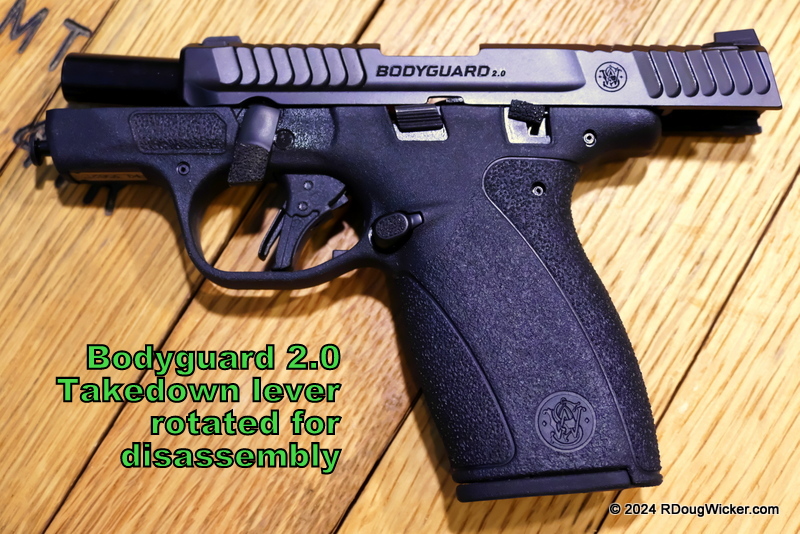
Bodyguard 2.0 ready for disassembly

To raise the ejector after reassembly, simply insert an empty magazine. If you don’t raise the ejector, the trigger will not engage the striker and you will be unable to function-check the firearm after getting it back together.

Bodyguard ejector in the raised position; make sure you lower it.

After removing the slide, everything else is a snap. Compress the guide rod and lift away from the barrel lug, then remove the barrel:
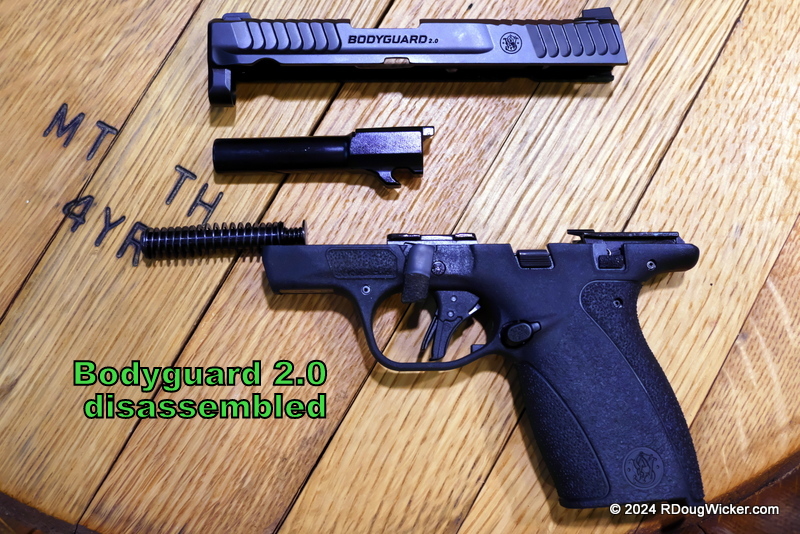
Disassembled Bodyguard 2.0
Slide with barrel and guide rod
Slide with barrel and guide rod removed
Frame with slide removed

Reassembly is not quite as easy. I had a dickens of a time reinstalling the guide rod. The darn spring just refused to compress. It was almost as if the spring was binding at the forward end of the rod when I placed it into the slide guide rod cutout. Several attempts to remove the guide rod and compress the spring with my fingers, and later a flathead screwdriver, took quite a bit of effort. But after repeated attempts I got the spring to move, and eventually got the guide rod back in, compressed, and reseated onto the barrel lug. I suspect I may have a faulty spring, but once I got it back in there was no binding.
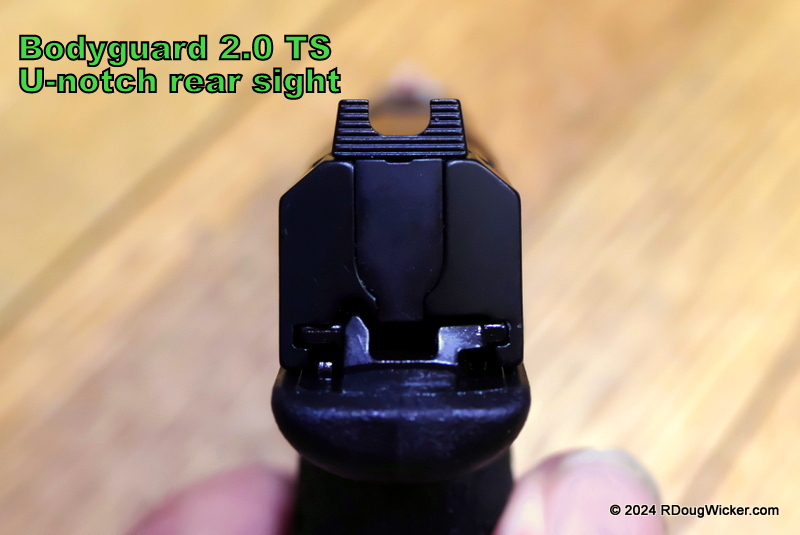
Bodyguard U-notch rear sight

The sights are a bit like a Spaghetti Western — There’s the good, the bad, and the ugly. The good is that the front sight is tritium with a high-visibility orange surround. The bad are that the tritium portion is very tiny. The ugly is the absolutely hideous U-notch rear sight — all black with no side indices for low-light acquisition and a ridiculously wide notch. There will be no match shooting with this handgun. But, then again, that’s not why it exists. Inside of 25 yards/23.8 meters I doubt I’ll have problems keeping on paper. I may not be as accurate in the dark, however. There’s simply no way to tell if I have the front sight within the notch, let alone have it centered left, right, up, or down. That’s certainly a minus in comparison with the P365’s Mepro FT Bullseye, even though the FT Bullseye also has its challenges in low-light situations.

Bodyguard 2.0 tritium front sight with orange surround

So, am I ready to swap out the P365? I think so. I’m definitely going to consider it after I’ve thoroughly checked out the Bodyguard for reliability. It’s smaller, much lighter, and holds the same number of rounds. The only downside is that I’ll be stepping down to .380 ACP/9mm kurz from the more powerful 9mm Luger. But, heck, I’ve even been known on occasion to carry .32 ACP/6.35 mm in a Beretta 3032 Tomcat or a Walther PPK and still not feel insufficiently armed.

S&W Bodyguard 2.0 vs Sig Sauer P365 SAS

I mentioned a moment ago that the S&W Bodyguard is considerably lighter than the Sig Sauer P365 SAS. I measured them today, both with empty 10-round magazines inserted. The P365 weighs 17.88 ounces/507 grams while the Bodyguard is a featherweight 11.48 ounces/326 grams.

S&W Bodyguard 2.0 vs Sig Sauer P365 SAS

S&W Bodyguard 2.0 TS Dimensions and Other Information:

  • Length: 5.5 inches/140mm
  • Height (with 10-round magazine): 4 inches/102mm
  • Width: 0.88 inches/22mm
  • Barrel length: 2.75 inches/70mm
  • Weight (with empty 10-round magazine): 11.48 ounces/326 grams
  • Capacity: 10+1 and 12+1 with included magazines
  • MSRP: $449
  • Street price: $399
S&W Bodyguard 2.0 vs Sig Sauer P365 SAS

Hopefully I’ll get out a range report soon. In the meantime, if you’ve any questions just leave me a comment.

Слава Україні! (Slava Ukraini!)

2 Comments

Filed under Firearms, R. Doug Wicker

Fun Firearm Friday — Answers to Wednesday’s Collectible S&W Revolver Quiz


S&W Revolvers — Which are Pinned, Recessed, Both, or Neither?

Did you take Wednesday’s quiz? If so, how do you think you did after that little lesson on classic collectible Smith and Wesson revolvers? Hopefully, if I did my job, you learned what is meant by S&W “pinned” barrels, “recessed” cylinders, and “dash” and “no-dash” models. As you may recall, a pinned barrel has this:

S&W Pinned Barrel

While this is an example of a nonrecessed cylinder:

S&W Nonrecessed Cylinder

And this is an example of a recessed one:

S&W Recessed Cylinder

You may recall that recessed cylinders are almost flush to the recoil plate:

Recessed Cylinder flush with Recoil Plate

While nonrecessed cylinders require a gap to accommodate the protruding cartridge rim:

Gap between Nonrecessed Cylinder and Recoil Plate

I then gave you a quiz with which you could test yourself. Just by identifying the year and caliber of any S&W revolver made from 1905 on, you should be able to use that information alone to tell if the revolver has a pinned barrel, a recessed chamber, both, or neither. Below is the answer sheet, with correct answers highlighted in red and underlined. Also included with each question is a note as to what makes that answer correct. Here you go:

  1. Model 10-5 with uncommon 6-inch barrel; .38 S&W Special; 1969 or ’70
    a. Pinned Barrel (NOTE: correct period for pinned and recessed Smith and Wessons, but wrong caliber for a recessed cylinder — no .38 S&W Special revolvers sported recessed cylinders)
    b. Recessed Cylinder
    c. Both
    d. Neither
  2. Model K-22 “Outdoorsman”; .22 LR; 1938
    a. Pinned Barrel
    b. Recessed Cylinder
    c. Both (NOTE: correct period for pinned barrels, and S&W recessed .22 LR cylinders starting in 1931 with the K-22 Ourdoorsman)
    d. Neither
  3. A no-dash Model 57; .41 Magnum; 1968 or ’69
    a. Pinned Barrel
    b. Recessed Cylinder
    c. Both (NOTE: correct period, and S&W recessed cylinders on all Magnum revolvers — .357 S&W Magnum, .41 Remington Magnum, and .44 Remington Magnum)
    d. Neither
  4. WWII “Victory” Model M&P; .38 Special; 1944
    a. Pinned Barrel (NOTE: correct period for pinned and recessed S&W, but wrong caliber for recessed a cylinder — no .38 S&W Special revolvers sported recessed cylinders)
    b. Recessed Cylinder
    c. Both
    d. Neither
  5. Model 10-5 with common 4-inch barrel; .38 S&W Special; 1966 or ’67
    a. Pinned Barrel (NOTE: correct period for pinned and recessed S&W, but wrong caliber for recessed a cylinder — no .38 S&W Special revolvers sported recessed cylinders)
    b. Recessed Cylinder
    c. Both
    d. Neither
  6. Model 60-7 “Ladysmith”; .38 S&W Special; 1994
    a. Pinned Barrel
    b. Recessed Cylinder
    c. Both
    d. Neither (NOTE: starting in 1982, and finishing the following year, S&W transitioned all their revolver lines away from pinned barrels and recessed cylinders)

Now that you’re knowledgeable on classic collectible Smith and Wesson revolvers, have fun hunting for one to add to your own collection.

Слава Україні! (Slava Ukraini!)

Comments Off on Fun Firearm Friday — Answers to Wednesday’s Collectible S&W Revolver Quiz

Filed under Fun Firearm Friday, R. Doug Wicker

Smith & Wesson Revolver Lesson/Quiz — What do “Pinned,” “Recessed,” and “No-Dash” mean?


Collectible Smith and Wesson revolvers

Collectors of firearms tend to specialize in a only a few firearms of interest. Ofttimes only one. My interests are a bit more eclectic than most, however. For instance, I have an interest in tip-barrel Berettas, Beretta Cheetahs, PP-series and P99 AS-type Walthers, Sig Sauer P22(x) variants, “Old” 1st Issue Ruger Bearcats and Super Bearcats, Model 1911 Colts, and a few other odds-and-ends — a trio of Russian Mosins, a couple of Swiss K-31 straight-pull bolt-action rifles, and some Old West-style shootin’ irons. But in 2019 I got bit by the classic Smith and Wesson revolver bug, starting with a very rare prewar K-22 “Outdoorsman” I found at the local Cabelas listed for a small fraction of its actual value. I suspected immediately it was a prewar variant because it sported a tapered “pencil” barrel. I did some quick research, identified it as an “Outdoorsman” rather than a postwar “Masterpiece,” and immediately headed back to Cabelas to snatch it up.

Since that first acquisition I’ve added five, as you can see above, and I have an eye toward acquiring a few more if the opportunities arise and the prices are right. As an example of what would entice me, I have S&W Model 10-5 revolvers in both the common 4-inch/102mm and uncommon 6-inch/152mm barrel lengths. It would be nice to acquire three more Model 10 “dash fives” with 2-inch, 3-inch, and 5-inch barrels for a complete set. At any rate, the Smith and Wessons that most interest me are “pinned” and, in some cases “recessed” versions. That means I’m pretty much limited to S&W revolvers built before 1982 (or 1983 a few models).

So… what do I mean by “pinned” and “recessed?” And while we’re at it, let’s throw in a couple other S&W collector terms — “dash” and “no-dash.” But first let’s look at the firearms featured in today’s article. You might want to pay attention if you wish to participate in the quiz at the end. Answers to that quiz will be featured on this week’s Fun Firearm Friday. For now, let’s take another look at that above photo, but this time with the revolvers identified:

Today’s Roster of Smith & Wesson Revolvers

Today’s Roster of Smith & Wesson Revolvers (hyperlinks below go to articles I wrote on the specific firearm pictured above):

  1. Model 10-5 with uncommon 6-inch barrel from 1969 or ’70; . .38 S&W Special
  2. Model K-22 “Outdoorsman” shipped from the factory on 1 September 1938; .22 LR
  3. A no-dash Model 57 from 1968 or ’69; .41 Magnum (yep, you read that correctly; .41 Magnum)
  4. WWII “Victory” Model M&P (Military and Police) circa mid-1944; .38 S&W Special
  5. Model 10-5 with common 4-inch barrel from 1966 or ’67; . .38 S&W Special
  6. Model 60-7 “Ladysmith” made in late 1994(?); .38 S&W Special

First, let’s start with “Dash” versus “No-Dash” Smith and Wessons:

  • You’ll notice that the Model 57 above is a “No-Dash,” which means it is the first variant of that particular model. In the case of the Model 57, that would include all examples made from its introduction in 1962 until 1982 (remember that last date; it’ll come in handy in a moment).
  • The two Model 10 revolvers listed above are 10-5 variants, meaning they represent the fifth engineering change of the Model 10. That would encompass standard “pencil” barrel Model 10s made from 1962 until it was superseded by the Model 10-7. The Model 10-6 and subsequent 10-8 would be for the concurrently produced heavy barrel variant.
  • The Model 60-7 would be the seventh engineering change of the Model 60, which would date this variant between 1990 and 1996. This, and the concurrently manufacture Model 60-8 (made for the NYPD) were the last Model 60s chambered solely for .38 S&W Special. Subsequent variants were designed to handle .357 Magnum (which means they would also accept .38 S&W Special).

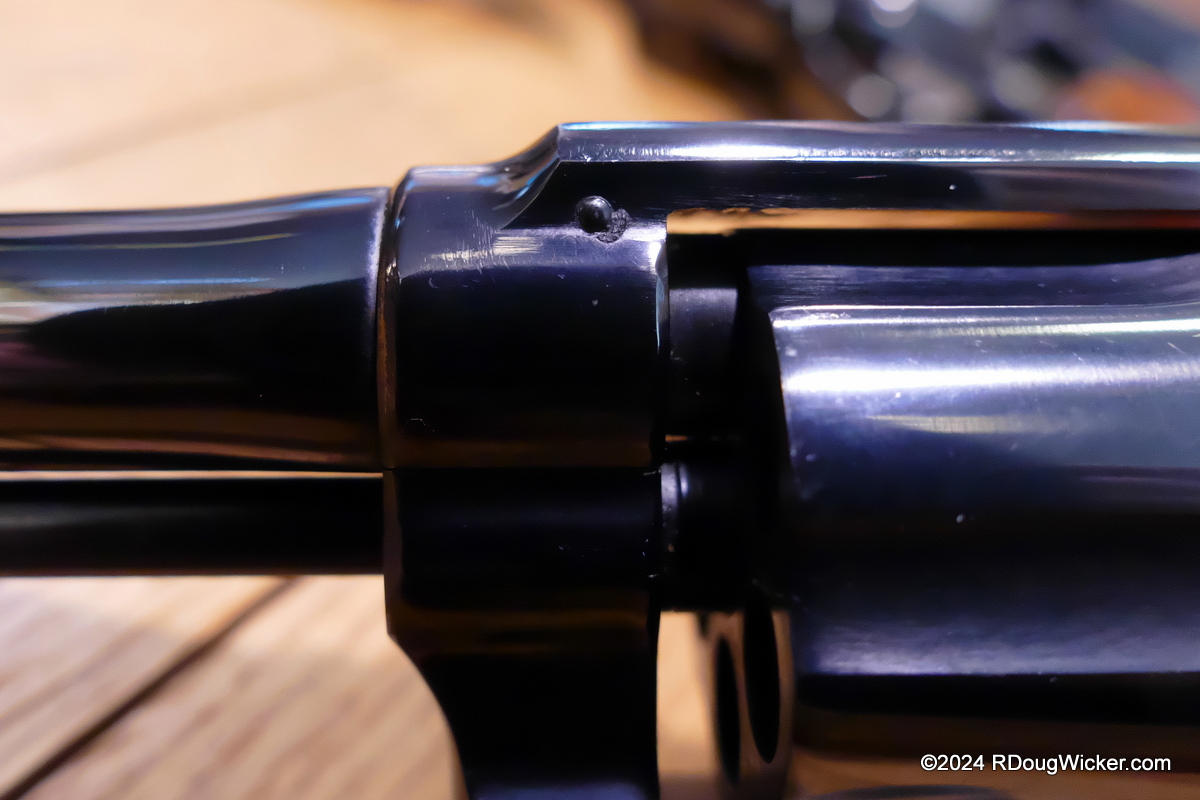
So, now that you know Dash from No-Dash, let’s move on to “pinned.” But first a brief primer on how Colt, Smith and Wesson, and many other manufacturers attach a barrel to a revolver frame. Believe it or not, the male-threaded barrel is mated into the female-threaded frame by simply screwing it in. But if the front sight is an integral non-removable part of the barrel that can pose a problem. If the barrel stops too soon, the front blade will be canted to the right. Too late and it gets canted left. Both situations will throw off the aim — left of target in the former case, and right of target in the latter. There’s also a remote possibility of a barrel coming loose, although that’s an exceedingly rare occurrence. But there is a solution, one which only Smith and Wesson ever used beginning in 1905 and stretching until 1982 (told you that date would come in handy later). S&W revolvers made during that span had a notch cut across the barrel screw threads. The barrel would then get screwed into the frame until that notch aligned with two holes drilled into the frame. At that point, a pin was inserted through the holes and across the barrel notch, giving your this:

A S&W “Pinned” Barrel

Pinning a barrel to a revolver frame is not cheap, which is probably why only Smith & Wesson, as far as I know, did this. By 1982 S&W began phasing this out, completing the transition to a strictly torqued barrel by sometime in 1983 for all models.

S&W Pin viewed from the right side

“Recessed” refers to something else entirely. It defines how Smith and Wesson made some of their revolver cylinders beginning in 1931, with the .22 LR K-22, and 1935 for their “Registered Magnum,” which was chambered for the then new .357 Magnum cartridge. And here’s where that gets confusing because while all recessed Smith and Wessons will sport a pinned barrel, but not all pinned S&W revolvers have a recessed cylinder.

Just to illistrate how confusing this situation can be, I once had a gun store owner say to me, “This Smith has a pinned barrel, but the cylinder is not recessed.” I then told him why, and now I’m going to tell you: It was because the gun was chambered for .38 S&W Special. I’ll explain that in a moment.

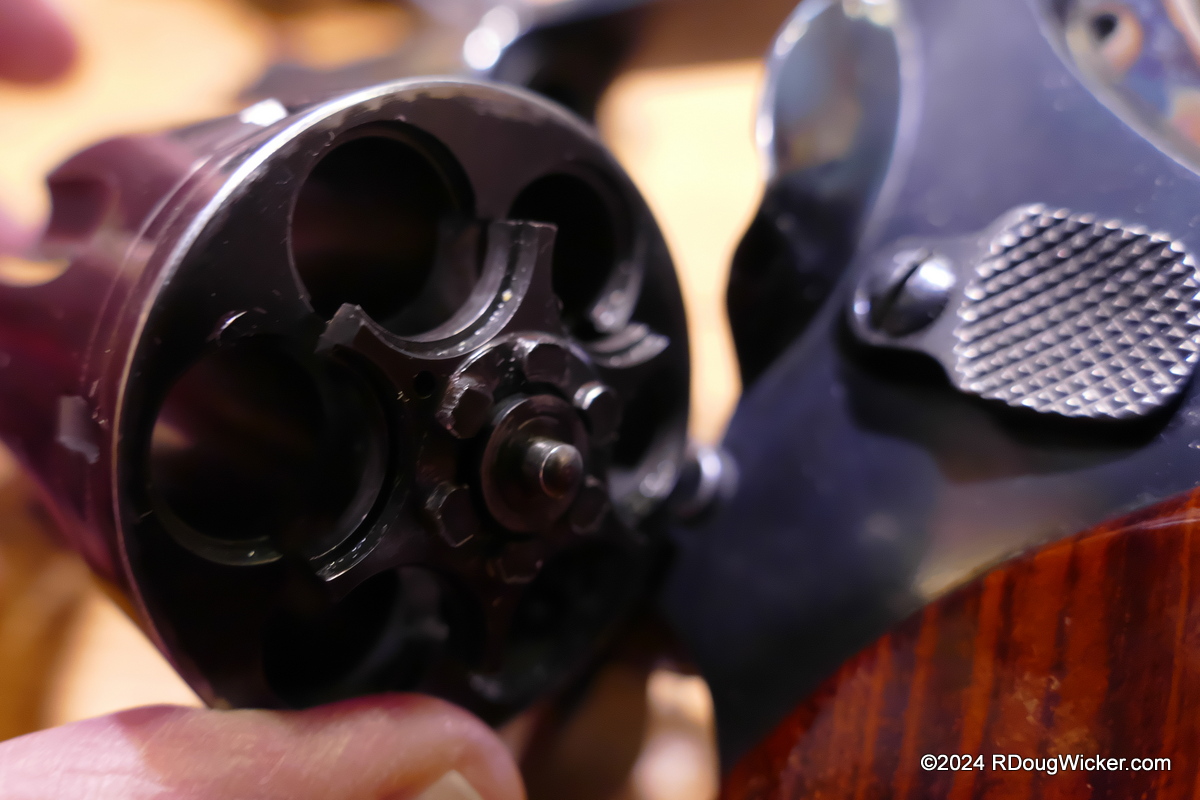
A S&W revolver with a recessed cylinder

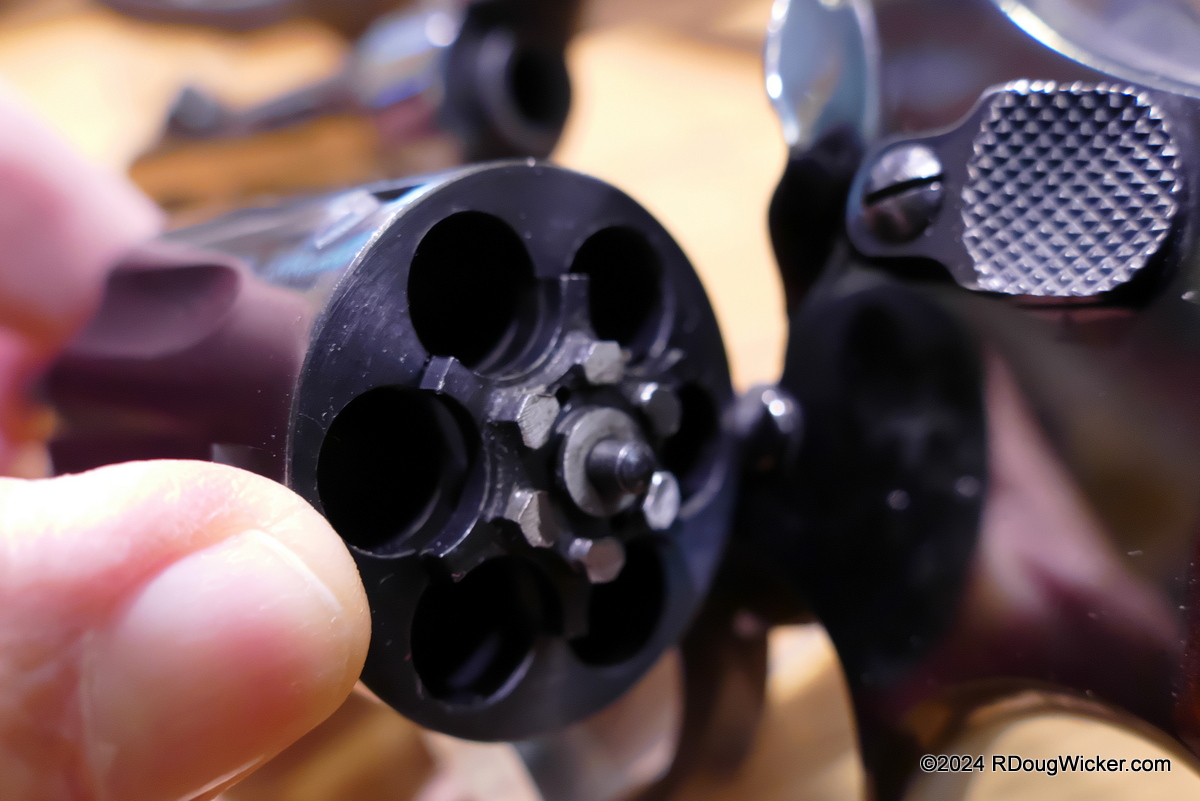
In a recessed cylinder, the chambers are counterbored so that the rim of the cartridge lies flush with the rear of the cylinder (see above). A cartridge rim on a nonrecessed cylinder will protrude from the chamber.

Nonrecessed S&W cylinder

There’s a lot that goes into recessing a cylinder, for much must be changed to accommodate this feature. For instance, the ejector for a recess cylinder must also be recessed:

Recessed ejector

Which is more expensive to manufacture than a simple nonrecessed ejector:

Nonrecessed ejector

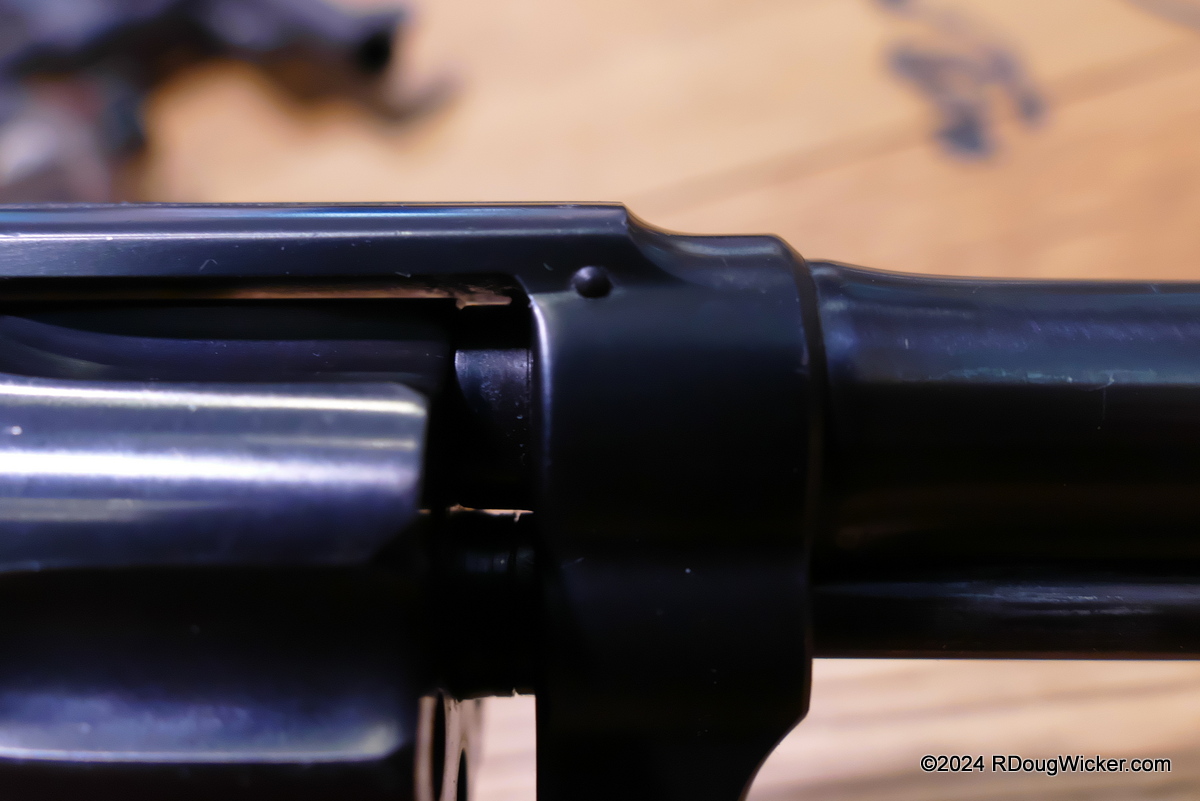
Even the cylinder-to-frame fit must be modified. On a recessed cylinder, the rear lies almost flush with the recoil plate:

Recessed cylinder flush mounted to frame

Whereas a nonrecessed cylinder must have a space between the rear of the cylinder and the recoil plate to accommodate the protruding rim of the cartridge:

Spacing for cartridge rim on a nonrecessed cylinder

So, why did Smith and Wesson recess the cylinders on some of their pinned revolvers, but not others? It has to do with caliber, and here I’m going to do some educated speculating on the reasoning. The only cylinders S&W recessed were for weapons chambered in .22 LR or for certain high-pressure rounds — .357 Magnum (Maximum SAAMI pressure 35,000 psi/240 MPa), .41 Magnum (Maximum SAAMI pressure 36,000 psi/250 MPa), and .44 Magnum (Maximum SAAMI pressure 36,000 psi/250 MPa).

For .22 LR it kind of makes sense. Recessing a rimfire cartridge mitigates the possibility that the rim will snag on something, which could potentially ignite the primer imbedded inside the rim and set off the cartridge. But if the frame behind the cylinder is properly made, there should be nothing there to snag that rim.

On Magnum revolvers I’m assuming it had to do with concern over power never before seen in a pistol. Elmer Keith developed the .357 Magnum in 1935, overtaking Colt’s .38 Super +P in sheer power (539 ft. lbs. for a 158gr Magnum bullet vs 426 ft. lbs. for a 130gr .38 Super bullet), but not quite in pure pressure (Maximum .38 Super SAAMI pressure 36,500 psi/251.66 MPa). If a cartridge case ruptures, especially at these pressures, the resulting explosion would be devastating to the weapon and potentially catastrophic for the shooter’s health and well-being. Fully enclosing the cartride all the way to the rim was probably a means of easing reluctance on the part of those transitioning from weaker cartridges, such as the .38 S&W Special, to the .357 Magnum. This “danger” was overblown, however. As long as a Magnum cartridge isn’t overloaded with powder, and the casing is enclosed to the rim, there is almost zero chance of such a rupture occurring. And in 1982 S&W made the decision to decrease manufacturing costs to eliminate this feature along with the pinned barrel.

So, are pre-1982 Smith and Wesson revolvers better that post-1983 revolvers? Probably not much, if any. Nevertheless, pinned-barrel Smiths are sought after by collectors because they represent craftsmanship and an attention to detail that is no longer a priority with many of today’s revolver manufacturers. I know that I have a special place in my heart for such revolvers.

Now for that promised quiz, the answers to which will appear on this week’s Fun Firearm Friday.

Below is a list of the revolvers featured in today’s article. Below each revolver listing choose whether that particular Smith and Wesson feature a pinned barrel, a recessed cylinder, both, or neither. No fair clicking on the images above to blow up the photo, either; you should have enough information from the descriptions in the quiz to figure it out. Please leave a comment to let me know how you did. Good luck!

  1. Model 10-5 with uncommon 6-inch barrel; .38 S&W Special; 1969 or ’70
    a. Pinned Barrel
    b. Recessed Cylinder
    c. Both
    d. Neither
  2. Model K-22 “Outdoorsman”; .22 LR; 1938
    a. Pinned Barrel
    b. Recessed Cylinder
    c. Both
    d. Neither
  3. A no-dash Model 57; .41 Magnum; 1968 or ’69
    a. Pinned Barrel
    b. Recessed Cylinder
    c. Both
    d. Neither
  4. WWII “Victory” Model M&P; .38 Special; 1944
    a. Pinned Barrel
    b. Recessed Cylinder
    c. Both
    d. Neither
  5. Model 10-5 with common 4-inch barrel; .38 S&W Special; 1966 or ’67
    a. Pinned Barrel
    b. Recessed Cylinder
    c. Both
    d. Neither
  6. Model 60-7 “Ladysmith”; .38 S&W Special; 1994
    a. Pinned Barrel
    b. Recessed Cylinder
    c. Both
    d. Neither

Слава Україні! (Slava Ukraini!)
Comments Off on Smith & Wesson Revolver Lesson/Quiz — What do “Pinned,” “Recessed,” and “No-Dash” mean?

Filed under Firearms, R. Doug Wicker