Tag Archives: historic firearms

Firearms Review — First look at the new Inland M1 Carbine


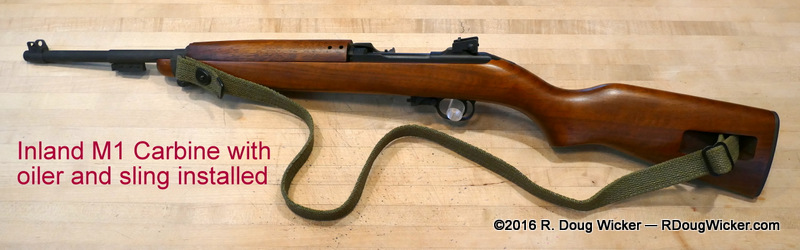
Inland M1 Carbine with oiler and sling (both sent free after registration)

Inland M1 Carbine with oiler and sling (both sent free after registration)

Today I’m going to present a first look at the new Inland M1 Carbine, or, as it was known in Army-speak — United States Carbine, Caliber .30, M1.  Inland is a storied name in the M1 Carbine story.  The Inland division of General Motors were the primary source for the M1 Carbine, making 2,362,097 of the 5,510,000 produced.  Inland were also the sole source for the M1A1 paratrooper model with folding metal stock, producing 140,591 copies.  The remaining versions of the M1 were made by Winchester (which developed the M1 Carbine), Underwood Elliot-Fisher (the typewriter company), the Saginaw Steering division of General Motors, IBM, Quality Hardware, National Postal Meter, and even Rock-Ola (yeah . . . the jukebox maker!).  Irwin-Pedersen made around 3,500 copies, but none were accepted by the War Department because of quality control issues.

Inland M1 Carbine with oiler and sling (both sent free after registration)

Inland M1 Carbine with oiler and sling (both sent free after registration)

Later full-automatic versions of the M1 Carbine were also made — the M2 Carbine (early 1945) and the M3 with infrared night scope — but all use the same rotating bolt and short-stroke piston design of the original M1 Carbine.

p1050887

U.S. Army Ordnance Corps cartouche

So, Inland Manufacturing is back in business and once again making U.S.-specification M1 Carbines?  Well, not so fast.  This Inland is not the GM division of old, but rather a new incarnation founded in 2013.  The original Inland merged with Delphi Automotive Systems back in 1989, and both were spun off from GM as a single independent company a decade later.  Bad news?  Not really.  This Inland’s iteration of the M1 Carbine remains so true to the original that the parts . . . all the parts . . . are fully interchangeable with the original.  And the oiler you see below is Army surplus.  That surplus oiler and a sling ship out to the customer at no charge when Inland Mfg. receive your registration form.  Yes, mine came with oil still in it, and I had to clean it off before installing it into the stock.  Things don’t get much more authentic than that.
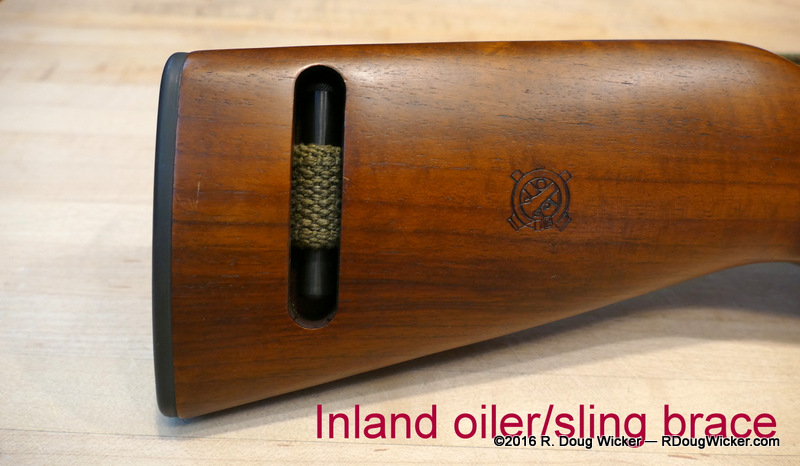
Inland M1 Carbine with oiler and sling (both sent free after registration)

Inland M1 Carbine with oiler and sling (both sent free after registration)

The version you see here is Inland’s 1945 model with a Type 3 barrel band that includes a bayonet lug mounted onto an 18-inch/45.7-centimeter barrel.  The 1945 also comes with one 15-round magazine (Really?  Just one, Inland?  Isn’t that being just a bit on the cheap side?).  The 1944 model comes with a Type 2 barrel band and one 10-round magazine to make it compliant in those states that believe only body guards protecting politicians should have access to “high-capacity” magazines (see: The Myths Driving the Magazine Capacity Debate — and How They Get You Killed), and that bayonets somehow present a clear and present danger to the public.

Inland 1944 M1 Carbine with 10-round magazine and Type-2 barrel band absent the bayonet lug

Inland 1944 M1 Carbine with 10-round magazine, an 18-inch/45.7-centimeter barrel and Type-2 barrel band absent the bayonet lug

Inland also make a paratrooper M1A1 version;

Inland M1A1 Paratrooper Carbine

Inland M1A1 Paratrooper Carbine with an 18-inch/45.7-centimeter barrel

as well as aJungle Carbine” with a 16.25-inch/41.3-centimeter barrel and flash hider;

Inland M1 Jungle Carbine with a 16-inch/40.6-centimeter barrel and a flash hider

Inland M1 Jungle Carbine with flash suppressor

a pistol version calledThe Advisor” (patterned after a model used by U.S. advisors in Vietnam);

Vietnam-era M1 Advisor pistol with 12-inch/30.5-centimeter barrel and flash hider

Vietnam-era Inland M1 Advisor pistol with a 12-inch/30.5-centimeter barrel and flash suppressor

and even a modernizedScout” version that comes with black polymer-and-textured wood stock, flash suppressor on a threaded barrel, and an upper handguard made of anodized aluminum and featuring a Picatinny rail for mounting a scope or other accessories.

Modernized Inland M1 Scout Carbine

Modernized Inland M1 Scout Carbine with 16.25-inch/41.3-centimeter barrel, anodized aluminum Picatinny rail, and flash suppressor

Attention to detail is the name of the game with Inland, clear down to a duplication of the stain used on the original Inland carbines.  On Friday I’ll be doing a side-by-side comparison with an inferior copy from the now defunct Universal Firearms.  Universal started out using surplus USGI parts, but as those items dried up they started making non-specification versions and cut some serious corners.

Inland M1 Carbine with oiler and sling (both sent free after registration)

Inland M1 Carbine with oiler and sling (both sent free after registration)

Inland M1 Carbine with oiler and sling (both sent free after registration)

Inland M1 Carbine with oiler and sling (both sent free after registration)

Let’s take a look at the Inland disassembled.  As with the original M1 Carbine, disassembly begins by loosening the screw below the barrel band, sliding the barrel band/bayonet lug forward, and then emoving the upper handguard.  The barrel band with bayonet lug is permanently affixed to the barrel.  The whole barrel assembly, and receiver and trigger groups lift out of the stock as a unit.

Taking apart the M1 Carbine

Taking apart the M1 Carbine

Next comes the removal of the recoil spring, which is easily accomplished by slightly compressing the spring and pulling it away from the housing containing the short-stroke piston.
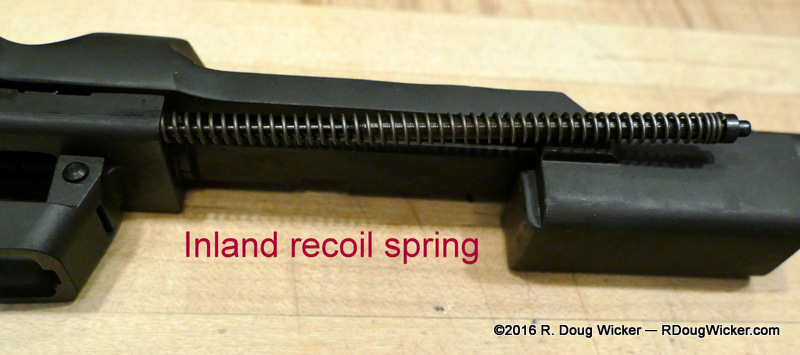
Recoil spring removed from the piston housing

Recoil spring removed from the piston housing

After that you punch out the pin holding in place the trigger group.

p1050902

Trigger group assembly and retaining pin

After the trigger group is removed from the receiver the slide can now be dismounted.
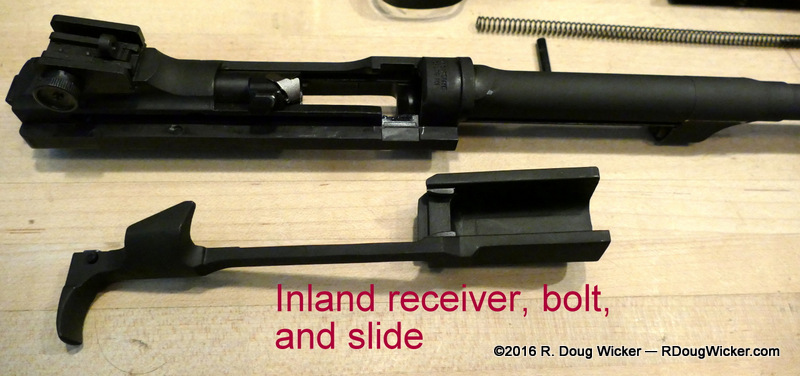
Slide removed from receiver, leaving the bolt in place

Slide removed from receiver, leaving the bolt in place

Inland disassembled

Inland disassembled

Good luck getting it back together.  Just kidding.  The most difficult reassembly task for me was getting the slide mounted back into the receiver while mating it to the rotating bolt.  But some detailed online tutorials eventually solved that predicament.  After that putting everything back into place was a snap.

Now would be a good time to explain how this marvelous piece of engineering works, so let’s take a look once again at the actual receive group removed from the carbine (see below).  As the .30-caliber carbine bullet travels down the barrel it passes a small hole (port) above the piston housing.  Pressurized gas flows down this port and into a small piston that then moves forcefully back a short distance, impacting the slide with sufficient force to overcome the tension of the recoil spring.  This cycles the slide back.
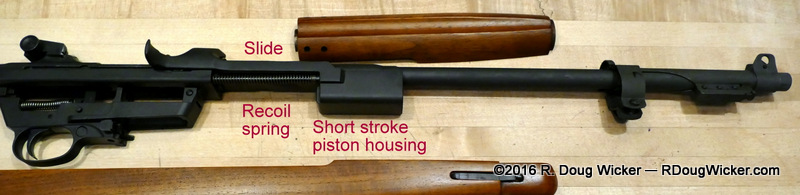
Inland receiver, slide, piston housing, and recoil spring

Inland receiver, slide, piston housing, and recoil spring

Below is an image of a Universal M1 Carbine receiver that I’m using here to show what you cannot see on the Inland.  The Universal has a slotted slide that engages the bolt lug of the rotating bolt, which is also how the Inland operates hidden from view behind a solid slide.  Until the slide goes back, the bolt of the weapon is securely locked in place because of it’s orientation.  As the slide travels rearward it rotates the bolt by engaging the bolt lug.  This rotation unlocks the bolt, allowing it to travel back to extract the spent cartridge, which is then ejected from the weapon.  The recoil spring then takes over, moving the slide forward taking the bolt with it.  The bolt strips the next round from the top of the magazine, chambers the round, and then rotates back into the locked position for the next firing.
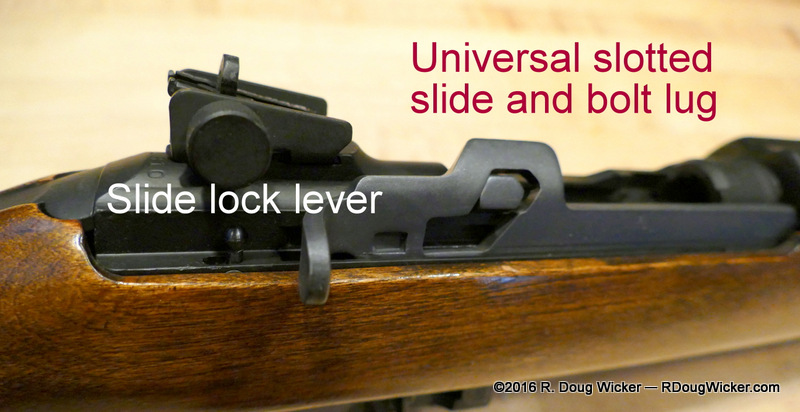
Rotating bolt, bolt lug, and slotted slide from a Universal M1 Carbine

Rotating bolt, bolt lug, and slotted slide from a Universal M1 Carbine

I hope I made that all clear as mud.

Now for the specifics on the Inland 1945 M1 .30 Carbine.  MSRP for the 1945 version is $1,079, but if you shop around you can snag one for under a grand.  Barrel length is 18 inches/46.7 centimeters.  The rifle is incredibly compact and extremely light weight, coming in at just under 36 inches/91.5 centimeters in length and weighing a feather-light 5 pounds 3 ounces/2.35 kilograms.  This weapon was, after all, designed to replace the M1911 pistol for officers, tank crews, and rear echelon troops, giving them a compact yet powerful alternative to a handgun.

For those wondering about the ballistics, the .30 carbine bullet weighs 110 grains/7.13 grams, travels at just under 2,000 feet/610 meters per second, and generates 964 foot-pounds/1,307 joules at the muzzle.  Energy-wise that puts the .30 carbine round on par with a .357 Magnum out of the same length barrel, and even exceeds the energy from a .44 Magnum round coming out of the six-inch/15.24-centimeter barrel of a typical .44 Magnum handgun (although out of an 18-inch barrel the .44 Magnum easily wins over both).

See you Friday for a comparison between the Inland and a 3rd generation Universal Firearms M1 Carbine.

Comments Off on Firearms Review — First look at the new Inland M1 Carbine

Filed under Firearms, R. Doug Wicker

U.S. Fire Arms Mfg. Co. — A Look at the Premier “Colt” Model 1873 Single Action


USFA Rodeo chambered in .45 Colt

U.S.F.A. Rodeo chambered in .45 Colt

Fans of my blog posts on firearms (by far my most popular) have probably guessed by now that I’ve recently been on a Western kick, most notably with Winchester lever action rifles and copies, and clones of the 1873 Colt Single Action revolver:

I rather thought I’d had enough of this trend, but a couple of months ago my favorite local gun store (Collector’s Gun Exchange) had on consignment something from a company with which I was unfamiliar — U.S. Fire Arms Manufacturing of Hartford, Connecticut.  If that town sounds familiar, it’s because Hartford is the original home of one of the most storied names in U.S. gun manufacturing — Colt’s Patent Firearms Manufacturing Company, later renamed by dropping “Patent” from their moniker.

USFA Rodeo

U.S.F.A. Rodeo

U.S. Firearms began as in importer of Uberti-made parts for the Model 1873 Single Action revolver, a Colt design best known as the “Single Action Army“, “Peacemaker”, or just “Colt 45”.  U.S.F.A would then hand-fit these Uberti parts into superlative copies of the Colt Model 1873.  But U.S.F.A. evolved, and later began making all their own parts.

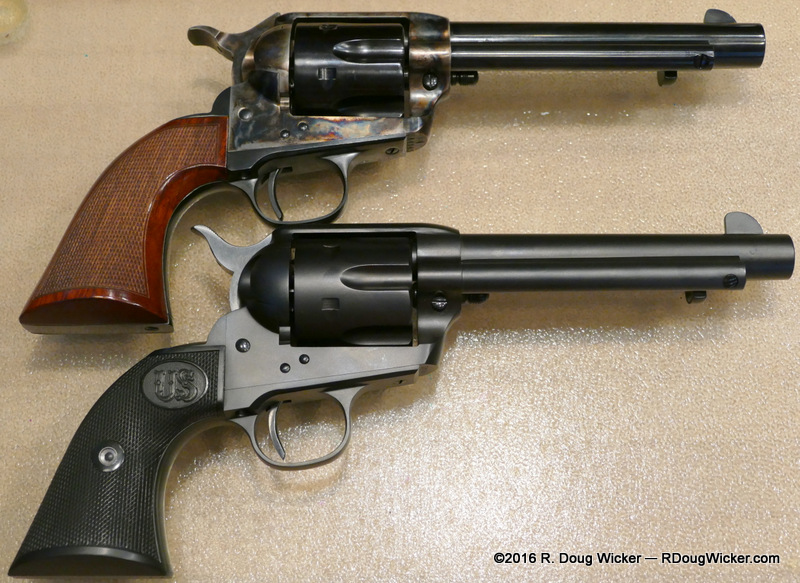
Uberti El Patrón; USFA Rodeo

Uberti El Patrón; U.S.F.A. Rodeo

These all-U.S.F.A. revolvers soon took on the reputation of being the best-made versions of the Model 1873 ever produced, exceeding in quality even the Colt originals, and far beyond anything Colt produces today.

Uberti El Patrón Competition; USFA Rodeo

Uberti El Patrón Competition; U.S.F.A. Rodeo

But when I first saw this U.S.F.A. “Rodeo” version I had no idea what I was seeing.  The matte “blue” (actually black to my eye) and the hard rubber grips made the weapon look uninspiring, to say the least.  It was only after I started researching U.S.F.A. and their later in-house products that I understood the significance.  Handling the revolver and operating the hammer, cylinder, and trigger confirmed what I’d read.  For instance, I have quite simply never handled a revolver on which the cylinder did not exhibit at least a very slight amount of “play” in the lock-up with the frame . . . up until I held this Rodeo.  The cylinder exhibited absolutely no play whatsoever, not even a hint.  It was the tightest cylinder-to-frame lock-up I have ever encountered, far beyond such highly prized revolvers as Colt’s Python, Ruger’s GP100 Match Competition, Uberti’s El Patrón Competition model, or even offerings from Smith & Wesson’s Performance Center.

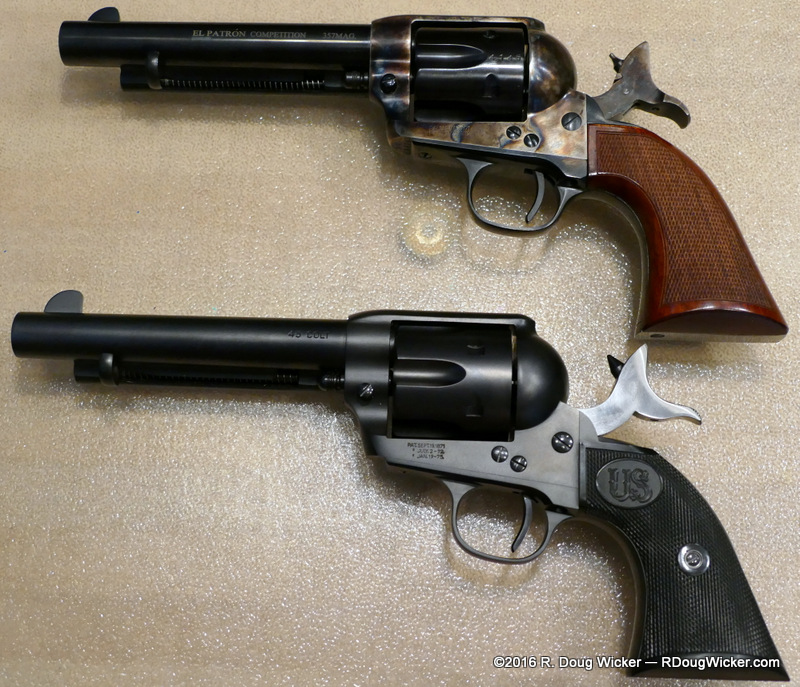
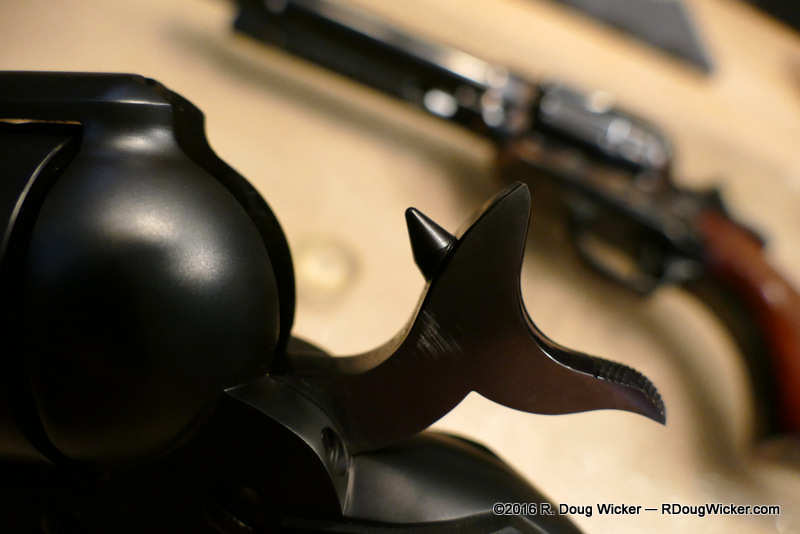
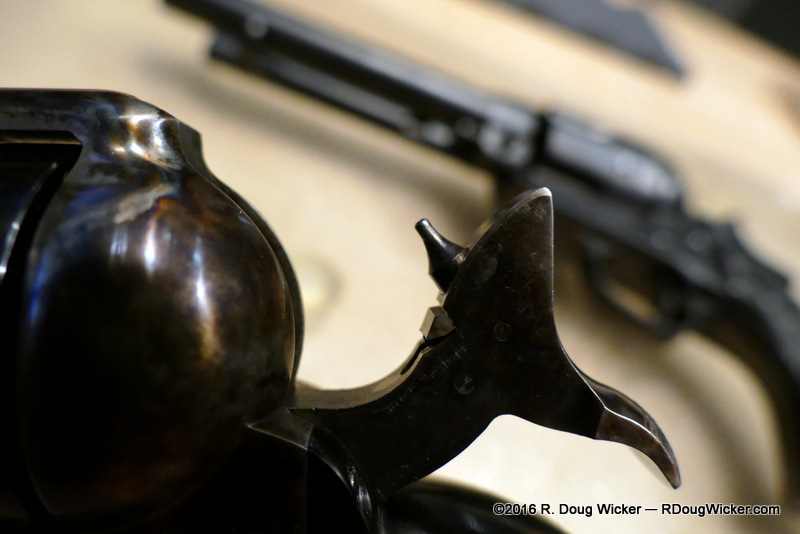
Uberti El Patrón Competition; U.S.F.A. Rodeo — Note the hammer/firing pin differences

Uberti El Patrón Competition; U.S.F.A. Rodeo — Note the hammer/firing pin differences

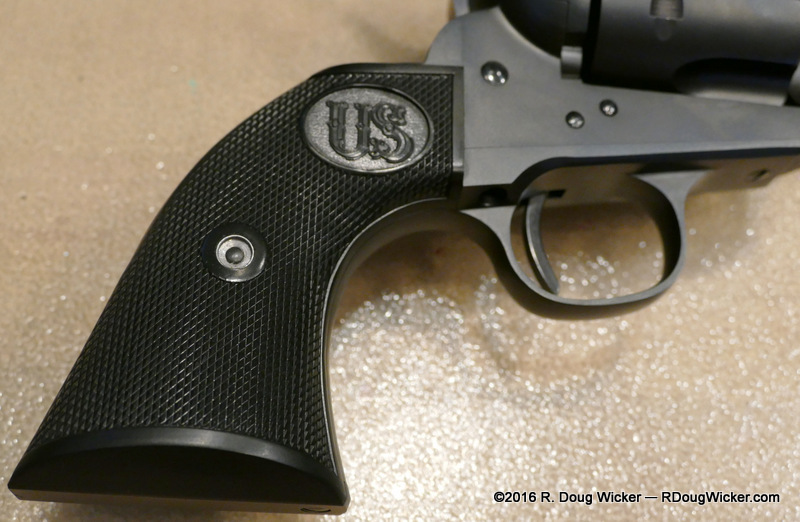
And the U.S.F.A. Rodeo was their “cheap” offering!  Not from any degradation in the fit and tight tolerances, but rather that matte finish and the hard rubber grips.  Considering when new these Rodeos went for several hundred less than their case-hardened brethren, I think that matte finish was a small price to pay for a pistol of this quality.  Apparently so, too, did Cowboy Action Shooters, who snatched these up whenever they could.

USFA Rodeo hard rubber grips

U.S.F.A. Rodeo hard rubber grips

And then there was the caliber.  This U.S.F.A. Rodeo was chambered for .45 Colt, which matched another weapon I had planned on having Mike DiMuzio convert for me, an early Interarms-Rossi M92 copy of the famed Winchester Model 1892.

"45 Colt", sometimes referred to as .45 'Long' Colt, or .45 LC

“45 Colt”, sometimes referred to as .45 ‘Long’ Colt, or .45 LC

Interarms Rossi M92 in .45 Colt

My intent, up until Mike’s unfortunate and very untimely death late last year, was to have the Rossi converted as I had the one pictured below, mimicking the Winchester Model 1892 used by Chuck Connors in the classic 1958-to-1963 television series The Rifleman.

Mike DiMuzio “Rifleman” conversion top; early Interarms Rossi M92 below

Rossi Ranch Hand pistol top; DiMuzion “Rifleman” conversion below

Well, Mike unfortunately has passed, and I was left with a .45 Colt Winchester clone.  As any cowboy will tell you, your rifle’s caliber should always match that of your sidearms, and my Uberti Single Action revolver is chambered in .38 Special/.357 Magnum, which matches my “Rifleman” conversion, but not my Interarms Rossi.  So, the Interarms Rossi simply required a similarly chambered .45 Colt revolver.  That’s the story I gave Ursula, and I’m sticking to it.  So, after much research and considerable “Do I really need this?” soul searching, the U.S.F.A. Rodeo finally followed me home like some abandoned puppy, complete with original foam-lined box and protective gun sock (top foam piece removed to show U.S.F.A. label).

U.S.F.A. Rodeo complete with box and gun sock

U.S.F.A. Rodeo complete with box and gun sock

I tried to date this weapon as best I could using the serial number, but that turned out to be an exercise in stupidity on my part.  I say stupidity, because I originally estimated this Rodeo as dating back to around 2002.  Then I noticed the fine print on the label.  U.S.F.A. revised their inner box label in July, 2006 (see lower left corner), and copyrighted the label that same year (lower center).

U.S.F.A. MFG. CO., Hartford, CT (Connecticut) label

U.S.F.A. MFG. CO., Hartford, CT (Connecticut) label

Now my revised estimate is a manufacturing date sometime between July 2006 (duh!) and the company’s demise sometime in 2011 (another duh!), with my best guess being late 2006 to sometime in 2007.

U.S.F.A. MFG. Co. HARTFORD C.T. U.S.A.

U.S.F.A. MFG. Co. HARTFORD C.T. U.S.A.

Why did U.S.F.A. fail?  It’s what I call “The Walmartization of the American Economy”, in which Americans grow increasingly addicted to lower prices at the expense of quality.  And, like all addictions, this one is also bad for us.  It depresses everything from standards to wages, but I digress.  Just quit Walmart for Target,  and exchange your Sam’s card for one from Costco is all I say on the matter.  You, your neighbors, your country, and your grandchildren will all eventually thank you in the future.

Bottom line:  U.S. Fire Arms could not price this high-quality, hand-fitted firearm to a point where it was profitable to continue making them, even with the cheaper matte finish.

Authentic Colt Patent Stamps: Sept. 19, 1871; July 2, 1872; July 19, 1875

Authentic Colt Patent Stamps: Sept. 19, 1871; July 2, 1872; July 19, 1875

What makes the U.S.F.A. better than, say, the Uberti?  Other than the incredibly tight tolerances and hand-fitting, I mean?  How about authenticity.  For one, the Uberti uses a low-profile style hammer for easier, quicker cocking; whereas the U.S.F.A. version has a more correct silhouette.  The U.S.F.A. firing pin is also conical, as was the original Colt, while the Uberti uses a tapered firing pin.

Period correct conical firing pin on the U.S.F.A. Rodeo

Uberti tapered firing pin

Uberti tapered firing pin

The trigger on the U.S.F.A. Rodeo is very good . . . but it’s not quite as good as that on Uberti’s El Patrón Competition.  Both exhibit minimal-to-nonexistent trigger movement and an exceptionally clean break, but the El Patrón Competition has, as you would expect from the name, a competition trigger that breaks at what I estimate to be barely over two pounds.  Most people would consider that a “hair-trigger”.  The Rodeo trigger requires slightly more force to trip the hammer, but not much.  Thus, the Uberti wins on three counts — trigger pull, price, and finish.

Uberti case-hardened finish; U.S.F.A. Rodeo matte blue finish

Uberti case-hardened finish; U.S.F.A. Rodeo matte blue finish

That’s not to say that this rodeo was exorbitantly priced.  Far from it.  Comparing to what other Rodeos in similar condition are commanding, it appears this one went for a little more than half what one would expect, especially as I suspect that this example is unfired.

U.S.F.A. Rodeo loading gate

U.S.F.A. Rodeo loading gate

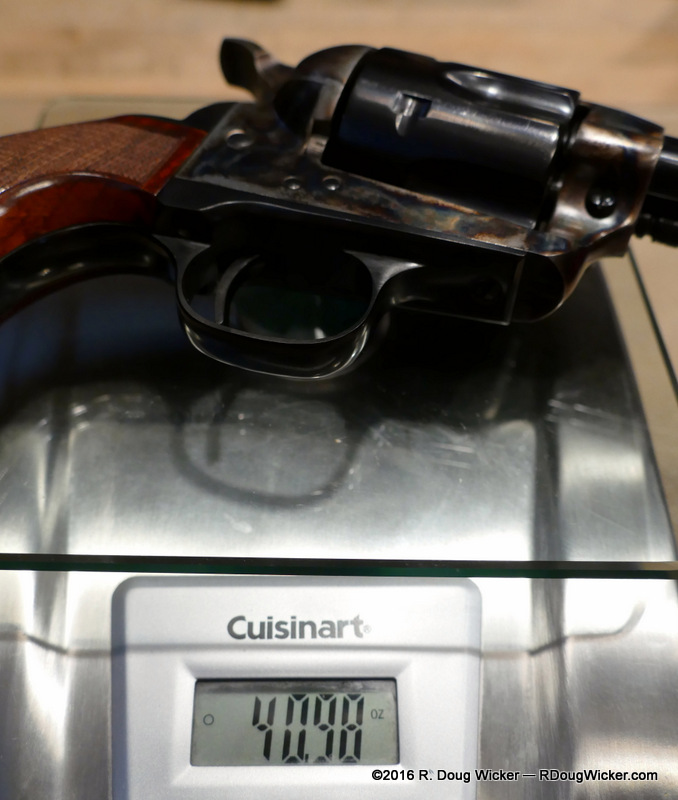
Now this next comparison is a bit of a shocker.  As tight and solid as the U.S.F.A. Rodeo feels in hand, it actually weighs in at nearly three ounces less than Uberti’s offering — 2.82 counces/80 grams less, to be precise.  It could be that the added weight on the Uberti results from beefing up both frame and cylinder to handle the higher pressures of the .357 Magnum round, or it could be the Uberti’s wood grips come at a weight premium over the U.S.F.A.’s rubber, but those are just guesses on my part.

U.S.F.A. Rodeo .45 Colt comes in at 38.16 ounces/1,082 grams

U.S.F.A. Rodeo .45 Colt comes in at 38.16 ounces/1,082 grams

Uberti El Patrón in .357 Magnum/.38 Special weighs 2.82 ounces/80 grams more

Uberti El Patrón in .357 Magnum/.38 Special weighs 2.82 ounces/80 grams more

There are two guns that vie for the title “The Gun that Won the West”.  Both were introduced to the American public in the year 1873.  One was a lever action rifle — the Winchester Model 1873.  The other was the original version of the revolver you’ve read about today — Colt’s Model 1873 “Peacemaker” Single Action Army.  I hope you’ve enjoyed today’s modern interpretation of this Colt classic.  Next week we return to the Chile-to-Santiago cruise aboard the Golden Princess.  Next stop — Nicaragua.

1 Comment

Filed under Firearms, R. Doug Wicker

A Tribute to Mike DiMuzio and a Look at the Interarms Rossi M92 in .45 Colt


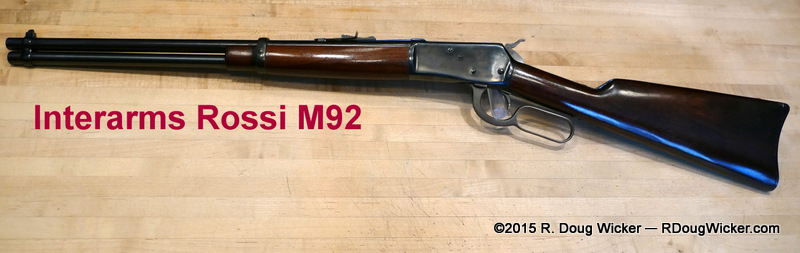
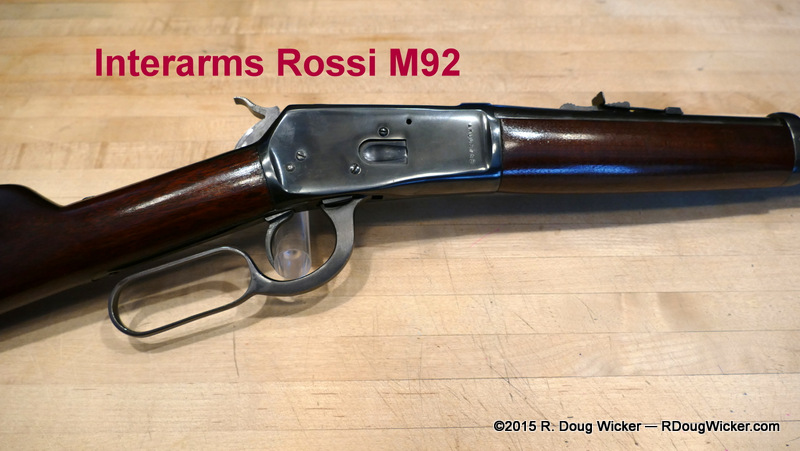
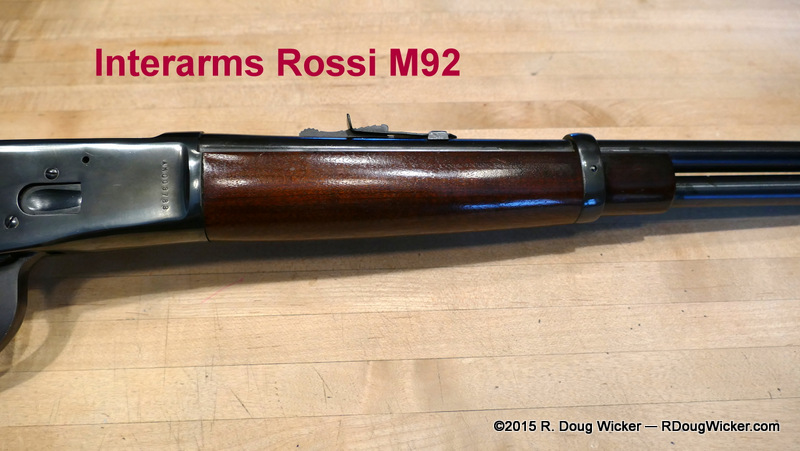
Interarms Rossi M92

Interarms Rossi M92

Many of you may remember my popular post on firearms from 1950s Television Westerns in general, and The Rifleman’s Winchester Model 1892 in particular.  You may also recall my YouTube video on spin-cocking a full size Model 1892 rifle, the “Flip Special”.

Interarms Rossi M92

Interarms Rossi M92

That very special “Flip Special” was custom made for me by Mike DiMuzio of North Carolina.  Alas, I am deeply saddened to report that Mike passed away less than a month ago.  Mike and I had exchanged emails and chatted several times over the course of the past year and a half.

Interarms Rossi M92

Interarms Rossi M92

This rifle from the late ’70s to early ’80s.  It was manufactured by Rossi of Brazil according to specifications outlined by Sam Cummings’ International Armament Corporation, otherwise known as Interarms (Sam Cummings, a very interesting character, was the basis for Sterling Heyward in my mystery novel The Globe).  This particular Rossi M92 is a fairly faithful rendition of the iconic Winchester Model 1892, a rifle used in countless television shows and movies because of its close resemblance to the Winchester Model 1873.  The Model 1892 was a favorite of the late John Wayne, and he used large loop variations of the M1892 in many films ranging from Stagecoach (1939) to True Grit (1969).

Interarms Rossi M92

Interarms Rossi M92

So, why weren’t Winchester Model 1873s used in television and movie productions?  Why instead this anachronism?  Up until fairly recently the only 1873s available were rare antiques too valuable for use in television and movies.  Now new M1873 rifles are being manufactured by Uberti of Italy and since 2013 under the Winchester name by Miroku of Japan.

Interarms Rossi M92

Interarms Rossi M92

I purchased this version of the Model 1892 with the sole intention of sending it to Mike for conversion into another Rifleman “Flip Special,” and I was rather excited to have found a .45 Colt example although a rifle in .44-40 Winchester would be more authentic.

Interarms Rossi M92

Interarms Rossi M92

I was immediately drawn to this firearm when I first laid eyes on it at my local favorite gun store Collector’s Gun Exchange.  While Rossi made M92 rifles for various U.S. importers back in the ’70s and beyond, the Interarms versions were a cut above the rest.

Interarms Rossi M92

Interarms Rossi M92

Let’s take a look at some of the reasons I was looking to acquire another converted Rossi, and how this rifle differs from the later model Rossi seen here:

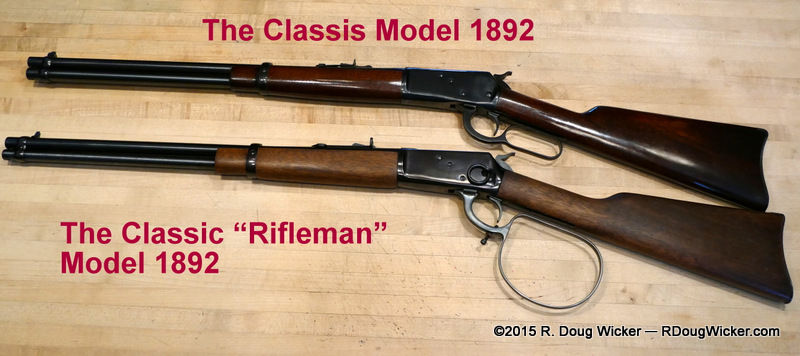
Classic "Rifleman" vs. Classic Model 1892

Classic “Rifleman” vs. Classic Model 1892

Most obvious is the finish on the wood:

Classic Model 1892 vs. Classic "Rifleman"

Classic Model 1892 vs. Classic “Rifleman”

The current Rossi M92 rifles sport a matte finish while the Interarms version displays a richer, high gloss.  Mike stained the “Flip Special” pictured here to better match the finish of an original antique Winchester.

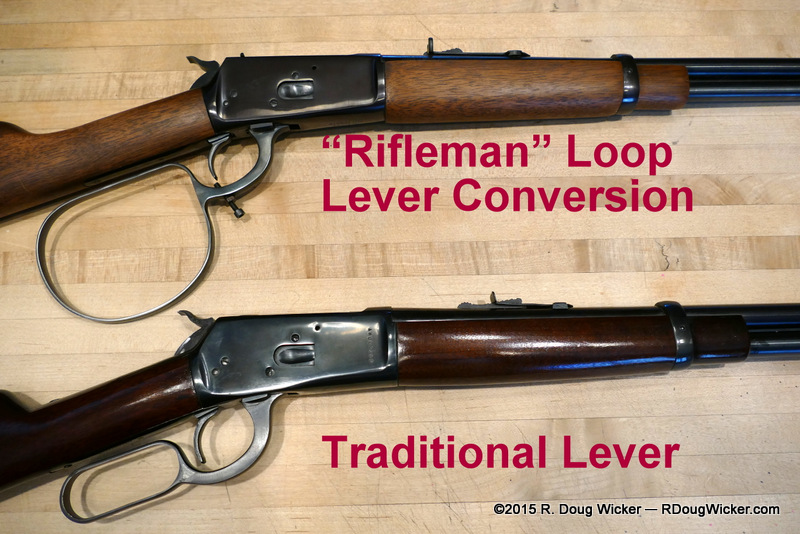
Loop Lever Conversion vs. Standard Lever

Loop Lever Conversion vs. Standard Lever

Another difference is the location of the front sight.  On the Interarms the front sight is part of the barrel band that affixes the magazine tube to the rifle barrel.  The recent Rossi has the front sight dovetailed directly into the barrel.

Front Sight Comparisons — Old (top) vs. New

Front Sight Comparisons — Old (top) vs. New

Now for the most important difference of all.  See if you can pick up on the difference in the next two photos.  Here is the Interarms Rossi:

Classic Model 1892

Classic Model 1892

And now the new “improved” version from Rossi:

New Rossi M92 with Safety

New Rossi M92 with Safety

As you can see Rossi now incorporates into the Model 1892 design a firing safety whereas the earlier Interarms Rossi stays truer to the original John Moses Browning/Winchester design.  Here the two are pictured together:

New Rossi with Safety vs. Classic Model 1892

New Rossi with Safety vs. Classic Model 1892

A safety is all fine and good . . . if you’re carrying a lever action Winchester design with a cartridge chambered, but that was never the intent of the design.  As with the Colt Single Action Army, the hammer should be resting on an empty chamber (for an explanation as to why see my look at the Uberti version of the 1873 Colt).  Alas, far too many gun owners today do not understand basic firearm operation and safety, so even later Winchesters were eventually dumbed down to compensate for careless firearms handling.

For now this Interarms Rossi will remain unconverted, although I have found two other sources to do the work for me.  I’m just not convinced that anyone can do as good a job as Mike DiMuzio, who learned his craft at the hands of Moe Hunt — personal gunsmith to Chuck Connors (Lucas McCainThe Rifleman).  Mike not only modified and installed levers on his conversions, he also smithed the internal action to beef it up and smooth it out to make spin-cocking the rifle possible.  Here’s one last look at Mike’s handwork:

Loop Lever Conversion vs. Standard Lever

Loop Lever Conversion vs. Standard Lever

And finally I leave you with two videos of Mike doing his thing and making it look simple (it isn’t, trust me).  So long, Mike.  You’ll be sorely missed.

1 Comment

Filed under Firearms, R. Doug Wicker