Tag Archives: firearms

Pocket Pistol Week — Colt Mustang


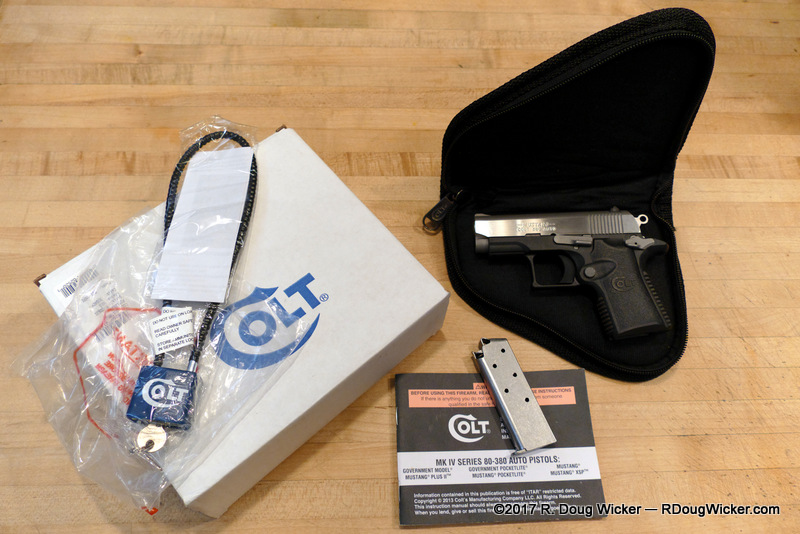
What’s in the Box: Colt Mustang Lite .380 ACP/9mm kurz, one magazine, safety lock, and a nice zippered gun pouch

This is Pocket Pistol Week. I’ll return to travel and photography next Monday, but today we’re taking an in-depth look at the latest iteration of the Colt Mustang. Wednesday’s mystery pocket pistol is going to be a bit of a surprise, especially if you’re one of the many people who believe that Wednesday’s pistol is no longer in production. And on Fun Firearms Friday both pistols are going head-to-head on the range for a direct comparison, as well as a size comparison to the most famous and probably the most prolific pocket pistols ever made, the Walther PPK and PPK/S (see: The Perfect Fashion Accessory—Walther PPK in .32 ACP).

Before the Mustang there was the Colt MK IV Series 80 Government Model 380, which first came to market in 1984.  This pistol was, not surprisingly considering the name, chambered in .380 ACP/9mm kurz. The Colt Government 380 was a scaled-down version of Colt’s famous M1911 design, but without the grip safety. Alas, the Colt Government wasn’t much of an improvement in either size or weight over other .380 ACP/9mm kurz pistols long established in this market segment. The competition included such .380 ACP stalwarts as Walther’s PPK and PPK/S, SIG’s P230/232 line, and Beretta’s slightly larger but elegantly satisfying Cheetah series. The milder recoil of the Colt’s locked breech design was nice, but not enough to become a serious contender in the .380 ACP market.

So, two years later Colt’s Government 380 underwent further reduction in both size and weight, but at the cost of losing one round of capacity in the process. The smaller pistol’s design was also simplified with the elimination of the barrel bushing and other changes. Thus was born a true “pocket pistol”, the lightweight Colt Mustang. But as interest in the .380 ACP/9mm kurz waned in the 1990s, so too did the fortunes of the Mustang. Add to this some serious quality control issues and a bad reputation for reliability, and the Mustang was discontinued without much remorse in the mid to late 1990s.

Under side of the slide; exposed frame

But a funny thing happened to the .380 ACP on the way toward obsolescence. Not only did older .380 ACP designs such as the Walther PPK/S and the SIG P230/232 continue somewhat steady sales, but by now Bersa’s Thunder had entered the market and began posing a serious, low-cost alternative to both Walther and SIG. Then, in 2003, a new pocket pistol was introduced that really ramped up the resurgence of the .380 ACP. That weapon was the Kel-Tec P-3AT double-action only pocket pistol. Whereas the PPK/S and Thunder were recoil unfriendly blow back-design beasts in .380 ACP, the P-3AT had a very controllable locked breach design that proved that the .380 ACP could be tamed to the point of pleasantness, reliable in a locked breach weapon, and much more easily concealed than its larger, heavier blow back cousins. The explosion in states allowing for concealed carry also paved the way for this resurgence, as many people simply don’t want conceal much larger weapons in the more powerful 9mm Parabellum cartridge.
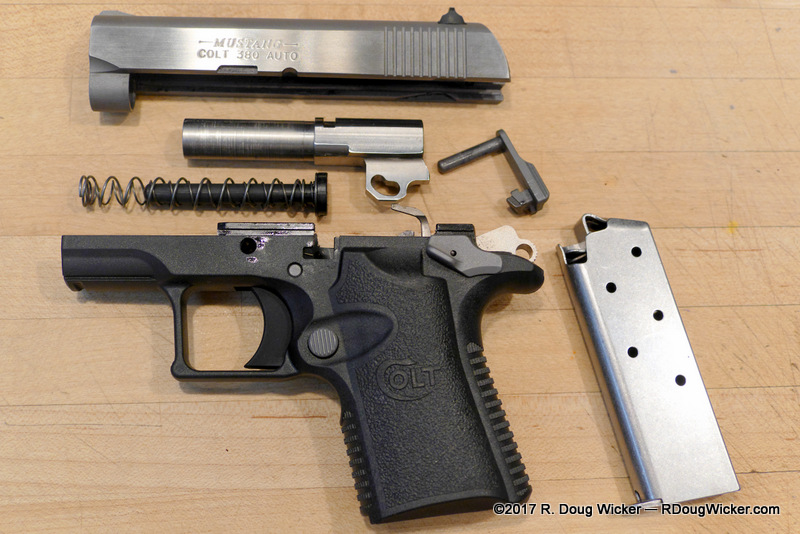
Disassembled Mustang Lite — breakdown and reassembly are a snap

To add even further insult to Colt, another manufacturer took that old Colt Mustang design and got it to work quite reliably. The SIG P238, an almost direct steal of the Mustang, made its debut in 2009. Like the Mustang that preceded it, the P238 was based on Colt’s 1911 and sported the same recoil-reducing locked breach design. The P238 even kept the Mustang’s original 6+1 capacity. Sales took off, enough so that SIG discontinued the previously popular P232 in 2015. The recoil from the .380 ACP in an 18.5-ounce/520-gram blow back P232 was simply no competition for the much softer recoil from the much lighter 15.2-ounce/430-gram SIG P238 and its locked breach design. The SIG P238 became an instant hit.

With the sudden popularity in SIG’s version of the old Mustang, Colt reintroduced their pistol in 2011. And Colt learned from their past mistakes, actually making a reliable version this time around using advanced CNC machining while instituting much better quality control over the final product.
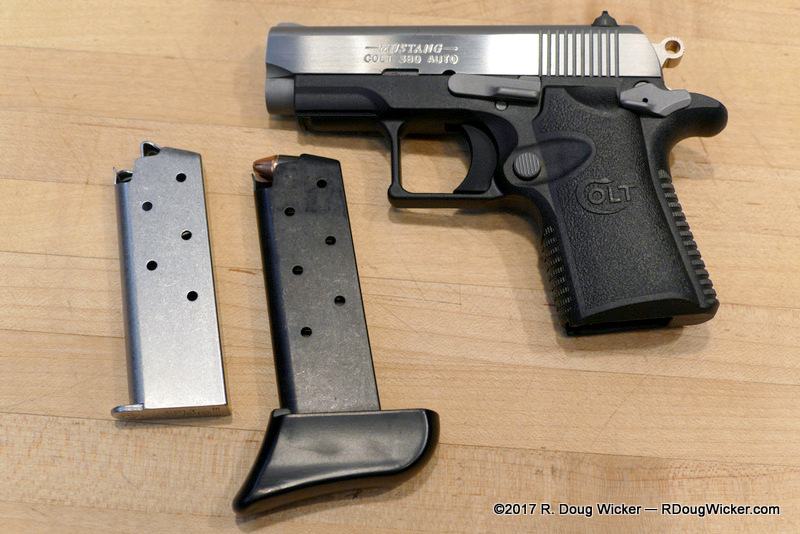
Factory 6+1 magazine and after-market 7+1 magazine

Not happy with merely improving the quality of the reintroduced Mustang, Colt now turned their attention to actually improving the design as well. Within two years Colt introduced a polymer framed Mustang called the Mustang XSP and sold it alongside the one-ounce/28-gram heavier alloy framed Mustang Pocketlite version.

The Mustang XSP is no more, but the polymer framed Mustang still exists today as the Mustang Lite. And since the Lite frame has steel rail inserts, the pistol should be more durable than the alloy frame Mustang Pocketlite despite the fact that the Lite is an ounce lighter.

The 7+1 adds an inch in height

I’ve not fired the Pocketlite, but I can tell you that the Lite is so tame and easily controlled that I don’t see the need for that extra ounce of weight. Let’s make a direct comparison with an earlier, heavier, blow back design. I have almost 35 years of experience shooting the .380 ACP version of the Walther PPK/S, which at 23.6 ounces/670 grams is almost twice the weight of the Mustang Lite’s 12.58 ounces/357 grams total weight including an empty magazine. The PPK/S has far more snap, demonstrates much more muzzle rise, and takes longer to reacquire the target for a follow-up shot than does the Mustang Lite. The PPK/S becomes a chore to shoot after only a few magazines. Although the long-tang redesign of the discontinued Smith & Wesson PPK/S variant helped immensely in this area, even that variation can become painful much over fifty rounds. Not so with the Mustang. This is an all-day shooter. There is simply no comparison. Not only is the Mustang smaller, lighter, and easier to conceal, it’s also a better shooter. Look for a description of the trigger performance on Friday’s comparison with Wednesday’s mystery gun.

Alas, all is not peaches-‘n’-cream. Every gun has a downside, and the Mustang has several.

First, the sights are horrendous. They are small and ridiculously difficult to see even under the best of lighting, and they’re certainly not adequate for anything beyond perhaps 21 feet/6.4 meters, the standard self-defense training distance. The front sight on my Mustang Lite is going to receive some high-visibility paint in the very near future, but for now I rate the sights as barely above worthless. Here you can see what I mean with my test target from the range:
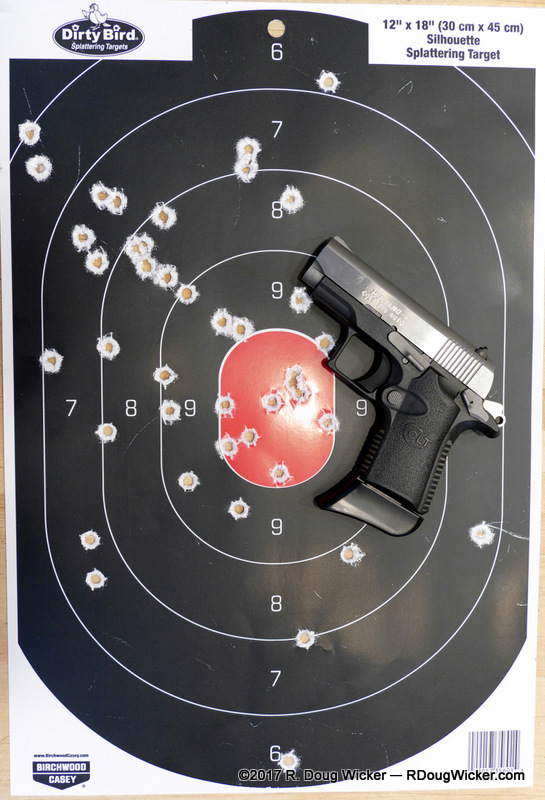
All over the place, but still on paper

Second is a problem with Colt’s Manufacturing. The Mustang only ships with one magazine, and the included six-round magazine didn’t even work. The top cartridge consistently nose-dived into the feed ramp, making chambering even one round impossible. Fortunately, I had ordered several after-market seven-round magazines from Metalform. Had those aftermarket magazines not arrived in time for my range trip comparison between the Mustang and Wednesday’s mystery pistol, the Colt would have received a failing grade by default. Colt was contacted almost seven weeks ago and said they would ship a replacement, but that shipment would be delayed awaiting availability. Here it is almost two months later and I’m still waiting. I’m glad I didn’t wait to acquire those three Metalform magazines ($18.99 through CDNNSports.com), or this firearm would be nothing more than an overpriced paperweight.
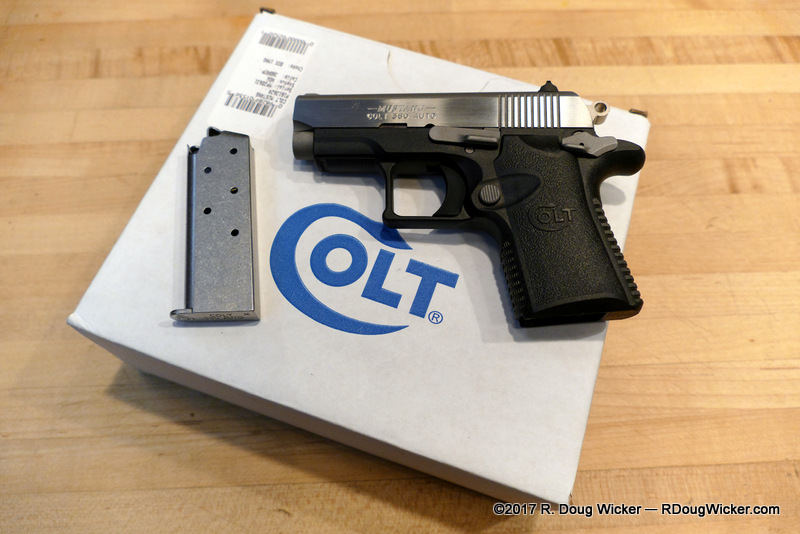
One magazine just doesn’t cut it, especially when it doesn’t work

A word about Metalform’s magazines: CDNNSports lists these magazines as “Original Equipment”, which leads me to suspect that Metalform may be the OEM supplier to Colt. The followers on the Metalforms appear identical to the magazine supplied by Colt, so that is a distinct possibility. Unfortunately, the 7+1 Metalforms come with a ridiculously long finger rest that adds an inch to the overall height of the weapon.

Mustang Lite specifications:

  • Trigger: Single-action
  • Caliber: .380 ACP/9mm kurz
  • Capacity: 6+1 (factory-included magazine)
  • Stainless steel slide, polymer frame
  • Length: 5.5 inches/140 millimeters
  • Width: 1.06 inches/27 mm
  • Height with flat-based 6-round magazine: 3.9 inches/99 mm
  • Weight with empty 6-round magazine (as measured by the author): 12.58 ounces/357 grams
  • Barrel length: 2.75 inches/70 mm

1 Comment

Filed under Firearms, R. Doug Wicker

U.S. Fire Arms Mfg. Co. — A Look at the Premier “Colt” Model 1873 Single Action


USFA Rodeo chambered in .45 Colt

U.S.F.A. Rodeo chambered in .45 Colt

Fans of my blog posts on firearms (by far my most popular) have probably guessed by now that I’ve recently been on a Western kick, most notably with Winchester lever action rifles and copies, and clones of the 1873 Colt Single Action revolver:

I rather thought I’d had enough of this trend, but a couple of months ago my favorite local gun store (Collector’s Gun Exchange) had on consignment something from a company with which I was unfamiliar — U.S. Fire Arms Manufacturing of Hartford, Connecticut.  If that town sounds familiar, it’s because Hartford is the original home of one of the most storied names in U.S. gun manufacturing — Colt’s Patent Firearms Manufacturing Company, later renamed by dropping “Patent” from their moniker.

USFA Rodeo

U.S.F.A. Rodeo

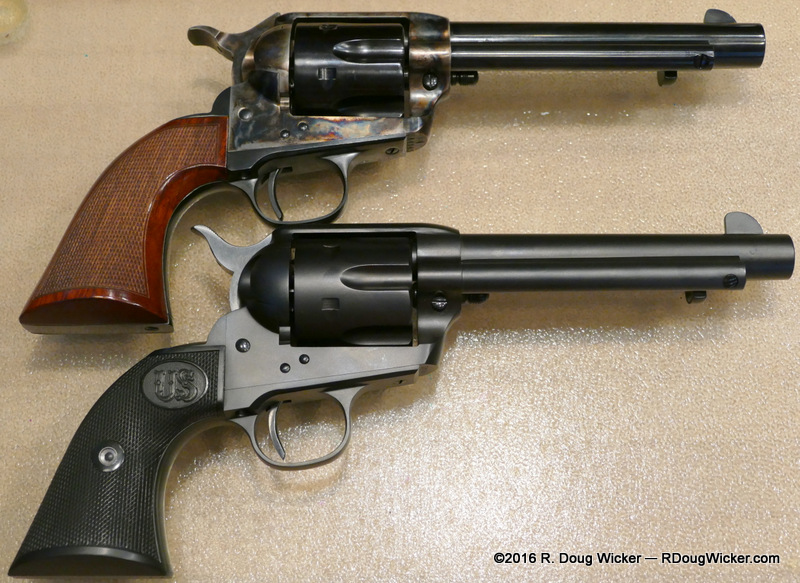
U.S. Firearms began as in importer of Uberti-made parts for the Model 1873 Single Action revolver, a Colt design best known as the “Single Action Army“, “Peacemaker”, or just “Colt 45”.  U.S.F.A would then hand-fit these Uberti parts into superlative copies of the Colt Model 1873.  But U.S.F.A. evolved, and later began making all their own parts.

Uberti El Patrón; USFA Rodeo

Uberti El Patrón; U.S.F.A. Rodeo

These all-U.S.F.A. revolvers soon took on the reputation of being the best-made versions of the Model 1873 ever produced, exceeding in quality even the Colt originals, and far beyond anything Colt produces today.

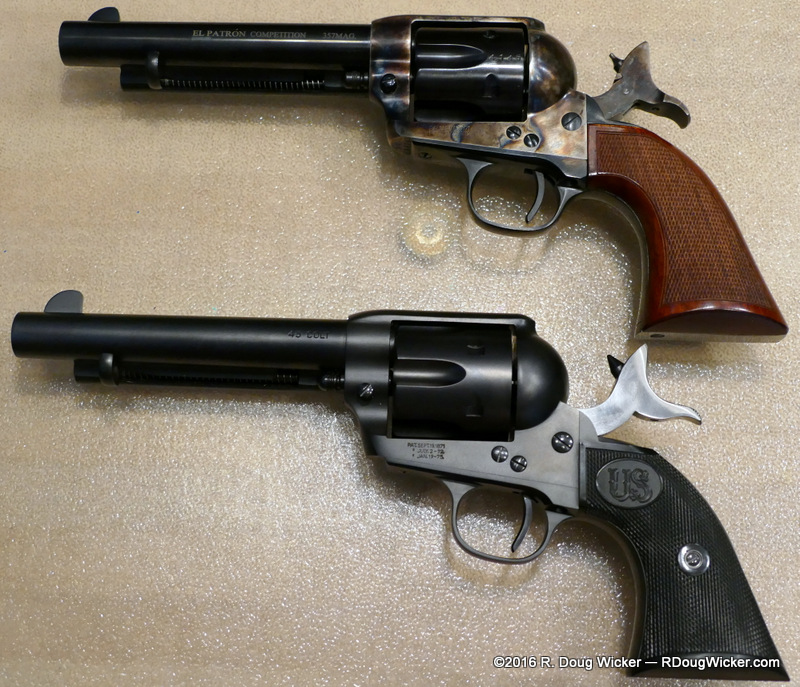
Uberti El Patrón Competition; USFA Rodeo

Uberti El Patrón Competition; U.S.F.A. Rodeo

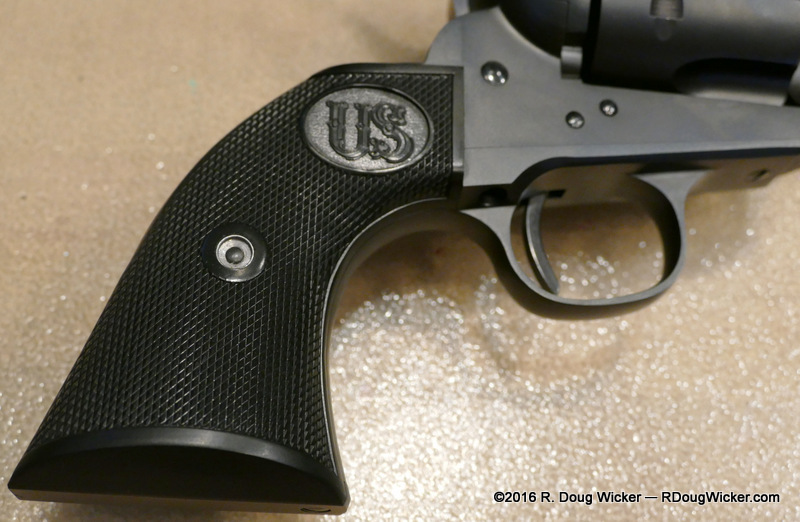
But when I first saw this U.S.F.A. “Rodeo” version I had no idea what I was seeing.  The matte “blue” (actually black to my eye) and the hard rubber grips made the weapon look uninspiring, to say the least.  It was only after I started researching U.S.F.A. and their later in-house products that I understood the significance.  Handling the revolver and operating the hammer, cylinder, and trigger confirmed what I’d read.  For instance, I have quite simply never handled a revolver on which the cylinder did not exhibit at least a very slight amount of “play” in the lock-up with the frame . . . up until I held this Rodeo.  The cylinder exhibited absolutely no play whatsoever, not even a hint.  It was the tightest cylinder-to-frame lock-up I have ever encountered, far beyond such highly prized revolvers as Colt’s Python, Ruger’s GP100 Match Competition, Uberti’s El Patrón Competition model, or even offerings from Smith & Wesson’s Performance Center.

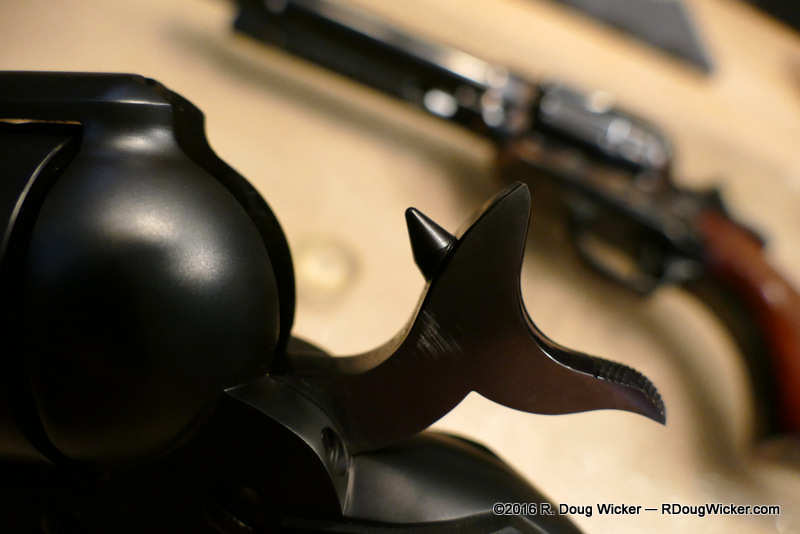
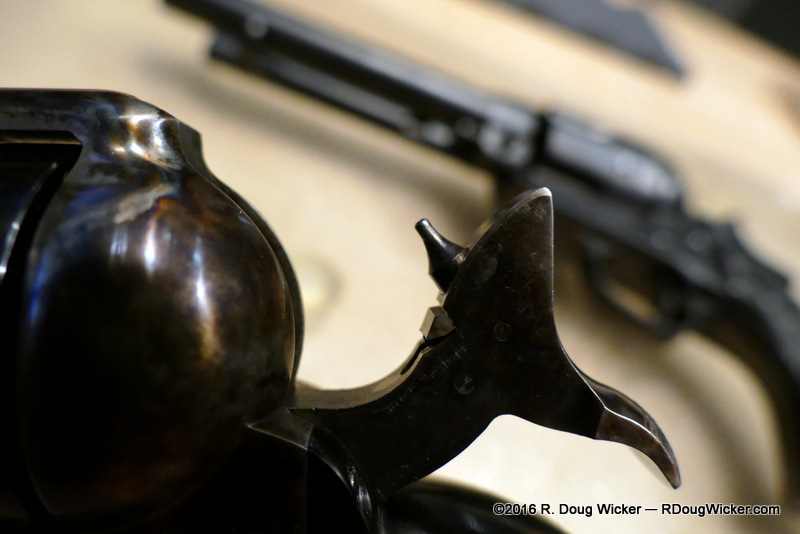
Uberti El Patrón Competition; U.S.F.A. Rodeo — Note the hammer/firing pin differences

Uberti El Patrón Competition; U.S.F.A. Rodeo — Note the hammer/firing pin differences

And the U.S.F.A. Rodeo was their “cheap” offering!  Not from any degradation in the fit and tight tolerances, but rather that matte finish and the hard rubber grips.  Considering when new these Rodeos went for several hundred less than their case-hardened brethren, I think that matte finish was a small price to pay for a pistol of this quality.  Apparently so, too, did Cowboy Action Shooters, who snatched these up whenever they could.

USFA Rodeo hard rubber grips

U.S.F.A. Rodeo hard rubber grips

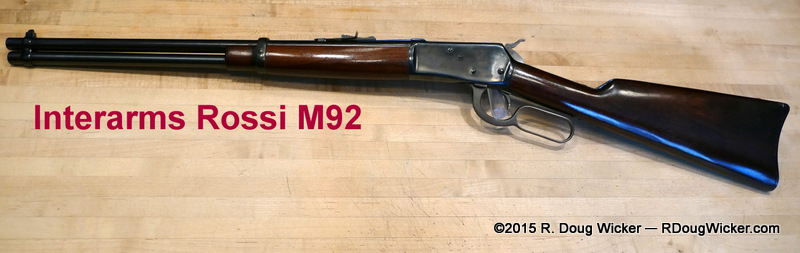
And then there was the caliber.  This U.S.F.A. Rodeo was chambered for .45 Colt, which matched another weapon I had planned on having Mike DiMuzio convert for me, an early Interarms-Rossi M92 copy of the famed Winchester Model 1892.

"45 Colt", sometimes referred to as .45 'Long' Colt, or .45 LC

“45 Colt”, sometimes referred to as .45 ‘Long’ Colt, or .45 LC

Interarms Rossi M92 in .45 Colt

My intent, up until Mike’s unfortunate and very untimely death late last year, was to have the Rossi converted as I had the one pictured below, mimicking the Winchester Model 1892 used by Chuck Connors in the classic 1958-to-1963 television series The Rifleman.

Mike DiMuzio “Rifleman” conversion top; early Interarms Rossi M92 below

Rossi Ranch Hand pistol top; DiMuzion “Rifleman” conversion below

Well, Mike unfortunately has passed, and I was left with a .45 Colt Winchester clone.  As any cowboy will tell you, your rifle’s caliber should always match that of your sidearms, and my Uberti Single Action revolver is chambered in .38 Special/.357 Magnum, which matches my “Rifleman” conversion, but not my Interarms Rossi.  So, the Interarms Rossi simply required a similarly chambered .45 Colt revolver.  That’s the story I gave Ursula, and I’m sticking to it.  So, after much research and considerable “Do I really need this?” soul searching, the U.S.F.A. Rodeo finally followed me home like some abandoned puppy, complete with original foam-lined box and protective gun sock (top foam piece removed to show U.S.F.A. label).

U.S.F.A. Rodeo complete with box and gun sock

U.S.F.A. Rodeo complete with box and gun sock

I tried to date this weapon as best I could using the serial number, but that turned out to be an exercise in stupidity on my part.  I say stupidity, because I originally estimated this Rodeo as dating back to around 2002.  Then I noticed the fine print on the label.  U.S.F.A. revised their inner box label in July, 2006 (see lower left corner), and copyrighted the label that same year (lower center).

U.S.F.A. MFG. CO., Hartford, CT (Connecticut) label

U.S.F.A. MFG. CO., Hartford, CT (Connecticut) label

Now my revised estimate is a manufacturing date sometime between July 2006 (duh!) and the company’s demise sometime in 2011 (another duh!), with my best guess being late 2006 to sometime in 2007.

U.S.F.A. MFG. Co. HARTFORD C.T. U.S.A.

U.S.F.A. MFG. Co. HARTFORD C.T. U.S.A.

Why did U.S.F.A. fail?  It’s what I call “The Walmartization of the American Economy”, in which Americans grow increasingly addicted to lower prices at the expense of quality.  And, like all addictions, this one is also bad for us.  It depresses everything from standards to wages, but I digress.  Just quit Walmart for Target,  and exchange your Sam’s card for one from Costco is all I say on the matter.  You, your neighbors, your country, and your grandchildren will all eventually thank you in the future.

Bottom line:  U.S. Fire Arms could not price this high-quality, hand-fitted firearm to a point where it was profitable to continue making them, even with the cheaper matte finish.

Authentic Colt Patent Stamps: Sept. 19, 1871; July 2, 1872; July 19, 1875

Authentic Colt Patent Stamps: Sept. 19, 1871; July 2, 1872; July 19, 1875

What makes the U.S.F.A. better than, say, the Uberti?  Other than the incredibly tight tolerances and hand-fitting, I mean?  How about authenticity.  For one, the Uberti uses a low-profile style hammer for easier, quicker cocking; whereas the U.S.F.A. version has a more correct silhouette.  The U.S.F.A. firing pin is also conical, as was the original Colt, while the Uberti uses a tapered firing pin.

Period correct conical firing pin on the U.S.F.A. Rodeo

Uberti tapered firing pin

Uberti tapered firing pin

The trigger on the U.S.F.A. Rodeo is very good . . . but it’s not quite as good as that on Uberti’s El Patrón Competition.  Both exhibit minimal-to-nonexistent trigger movement and an exceptionally clean break, but the El Patrón Competition has, as you would expect from the name, a competition trigger that breaks at what I estimate to be barely over two pounds.  Most people would consider that a “hair-trigger”.  The Rodeo trigger requires slightly more force to trip the hammer, but not much.  Thus, the Uberti wins on three counts — trigger pull, price, and finish.

Uberti case-hardened finish; U.S.F.A. Rodeo matte blue finish

Uberti case-hardened finish; U.S.F.A. Rodeo matte blue finish

That’s not to say that this rodeo was exorbitantly priced.  Far from it.  Comparing to what other Rodeos in similar condition are commanding, it appears this one went for a little more than half what one would expect, especially as I suspect that this example is unfired.

U.S.F.A. Rodeo loading gate

U.S.F.A. Rodeo loading gate

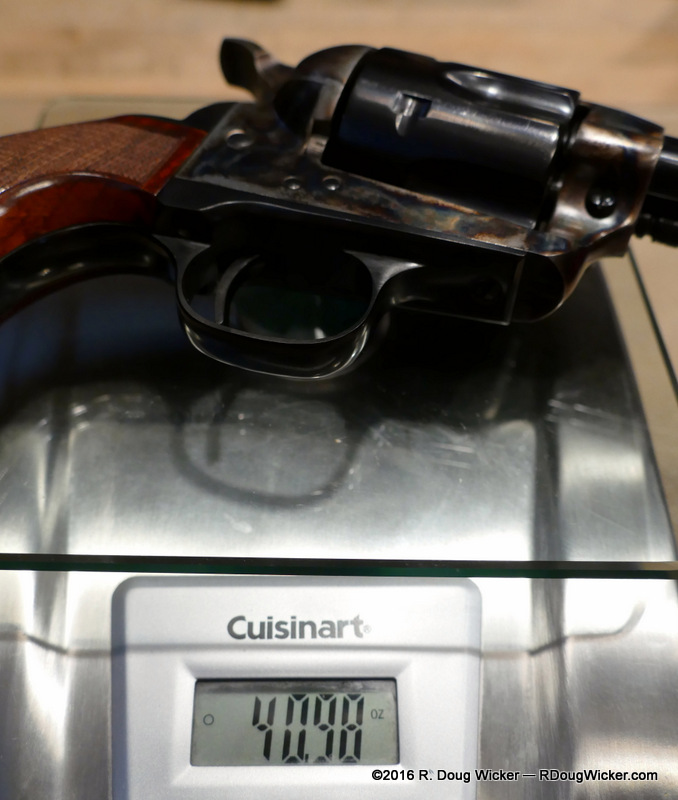
Now this next comparison is a bit of a shocker.  As tight and solid as the U.S.F.A. Rodeo feels in hand, it actually weighs in at nearly three ounces less than Uberti’s offering — 2.82 counces/80 grams less, to be precise.  It could be that the added weight on the Uberti results from beefing up both frame and cylinder to handle the higher pressures of the .357 Magnum round, or it could be the Uberti’s wood grips come at a weight premium over the U.S.F.A.’s rubber, but those are just guesses on my part.

U.S.F.A. Rodeo .45 Colt comes in at 38.16 ounces/1,082 grams

U.S.F.A. Rodeo .45 Colt comes in at 38.16 ounces/1,082 grams

Uberti El Patrón in .357 Magnum/.38 Special weighs 2.82 ounces/80 grams more

Uberti El Patrón in .357 Magnum/.38 Special weighs 2.82 ounces/80 grams more

There are two guns that vie for the title “The Gun that Won the West”.  Both were introduced to the American public in the year 1873.  One was a lever action rifle — the Winchester Model 1873.  The other was the original version of the revolver you’ve read about today — Colt’s Model 1873 “Peacemaker” Single Action Army.  I hope you’ve enjoyed today’s modern interpretation of this Colt classic.  Next week we return to the Chile-to-Santiago cruise aboard the Golden Princess.  Next stop — Nicaragua.

1 Comment

Filed under Firearms, R. Doug Wicker

The Myths Driving the Magazine Capacity Debate — and How They Get You Killed


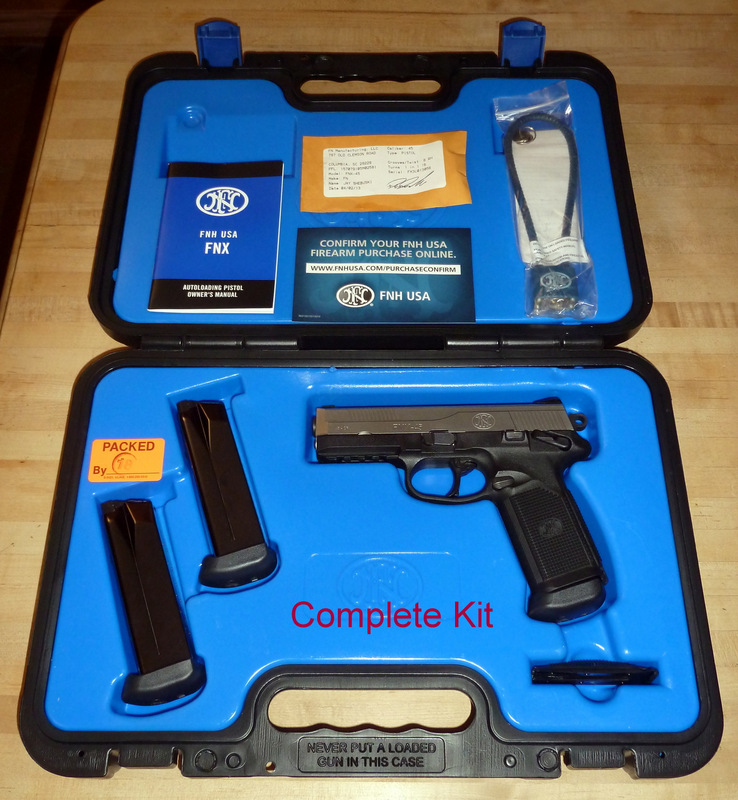
The FNH FNX9 comes standard with three 17-round magazines — Total capacity 52 rounds (51+1 in the chamber) 9mm

Several uninformed, firearms-ignorant, but highly opinionated gun control advocates have recently made magazine capacity their latest target (pun intended) in their attempt to disarm law abiding citizens rather than address the issue of firearms abuse by those who do not abide by laws.  Regular readers of my blog know where I stand on that (see:  When Will We Rein in these Deliverers of Death?) — denying the law abiding access to firearms because of law breakers is akin to denying the law abiding access to automobiles because of drunk drivers, or those who would use vehicles to kill and maim.  The rational among us realize that the former makes as much since as the latter.  Those with an irrational fear of firearms?  Not so much.

The FNH FNX45 comes standard with three 15-round magazines — Total capacity 46 rounds (45+1 in the chamber) of .45 ACP

Recently New York and Colorado became among the latest to jump on the magazine capacity bandwagon.  But how informed was this legislation?  How much safer are the citizens of these states because of these bans on arbitrarily defined “high-capacity” magazines?  What have citizens been asked to give up in return for this supposed increase in safety?

The first video below demonstrates very convincingly the myths behind magazine capacity limits.  It was produced by Ken Campbell, Sheriff of Boone County, Indiana.  The first 1:44 is a bit slow so you can skip ahead if you don’t want to read through the background, but I highly encourage you to watch the remainder to do something Michael Bloomberg and others have not — to actually get educated on the issue:

This second video demonstrates the principle point made by Sheriff Campbell in his video — limiting magazine capacity limits the ability of the law abiding to defend themselves.  The scenario in this video is not only realistic, it’s actually more common than you think — people defending themselves really do run out of ammunition, and six-round or even ten-round limits on magazines really are unrealistic in a self-defense situation no matter how good your training:

I’ll be returning to my Paracas, Peru, travel series after this week, so please bear with me all you travel and photography fans.  Tuesday, Wednesday, Thursday, and Friday will be devoted to repeats of some really great recipes for Super Bowl Sunday.  That’s right — this week will feature two bonus blogs.

4 Comments

Filed under Firearms, R. Doug Wicker