Tag Archives: .30 caliber M1 Carbine

Firing Review — The new Inland .30 M1 Carbine


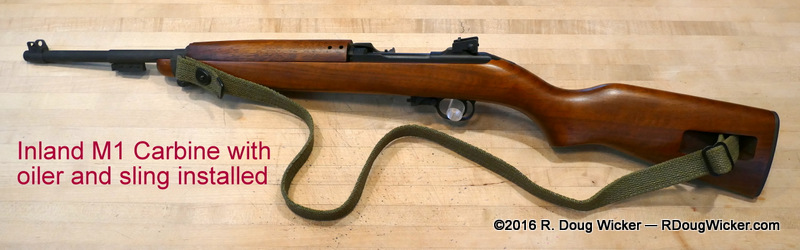
.30 Inland M1 Carbine, 1945 version with oiler and sling

.30 Inland M1 Carbine, 1945 version with oiler and sling

About a month ago I gave you a first look at the new .30-caliber M1 Carbine, 1945 version.  You can read that first look review here:

Firearms Review — First Look at the new Inland M1 Carbine

Seldom have I experienced as much anticipation in advance of test firing a weapon as with the new Inland.  I simply could not wait to get it out to the range, and I finally had an excuse when a friend asked me to instruct him in firearms handling following his first gun purchase.  So, I loaded up my two Beretta Cheetahs (Monday’s review), my Colt M1991A1 .38 Super +P (Wednesday’s review), and the recently acquired Inland M1 Carbine and headed to the indoor shooting range at my second favorite local gun store — Sportsman’s Elite.

The new Inland M1 Carbine — A faithful reproduction of a WWII classic firearm

The new Inland M1 Carbine — A faithful reproduction of a WWII classic firearm

I saved for last the firing of the Inland, and I was not disappointed.  This is, quite simply, one of the most fun centerfire rifles I’ve ever had the pleasure to shoot, coming in right alongside the fantastically fun Beretta CX4 9mm Carbine.

This is attention to detail

This is attention to detail

I took with me this day four 15-round magazines — the one that came with the rifle, two after-market Korean-made KCI magazines, and another Inland magazine.

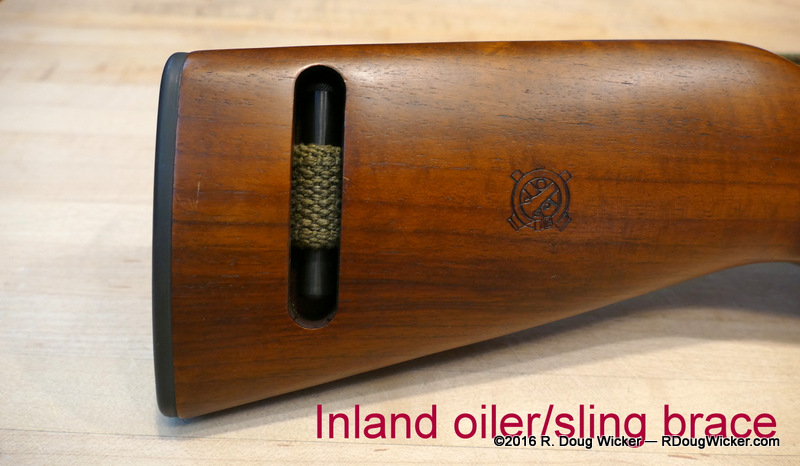
Inland oiler/sling brace installed into slotted butt stock

Inland oiler/sling brace installed into slotted butt stock

I initially set the target out to 25 feet and ran the magazine that came with the Inland.  The rifle functioned flawlessly, and the aperture peep sight proved far too good for so short a range.  Recoil was incredibly mild, with the rifle experiencing negligible muzzle rise.  Target reaquisition was very rapid, and followup shots could be conducted on target in fractions of a second.  Try that with a 30.06 Garand!  It’s no wonder many G.I.s in WWII found creative ways to “lose” the M1 Garand when they came across the much lighter, faster to shoot, higher capacity M1 Carbine.

Barrel band and sling swivel

Barrel band and sling swivel

My friend ran the target out to fifty feet.  Same result — incredible accuracy with a free-standing, unbraced hand hold.  Groups for both of us measured under two inches even though neither of us were firing for accuracy and were more interested in function checking the weapon.  No adjustment was needed to achieve this on the fully adjustable rear sight.  This was out-of-the-box accuracy like you wouldn’t believe.

Fully adjustable aperture peep sight

Fully adjustable aperture peep sight

Now a word about magazines, and the one sour note on the range:  The included Inland magazine and the two KCI Korean magazines all functioned flawlessly.  The second post-purchase Inland did not.  Despite repeated attempts to chamber a round from the fully loaded Inland magazine, nothing worked.  I later read that another reviewer had a similar problem, but he had it narrowed down to a specific side.  He pinpointed the problem as occurring when a round was being chambered from the left side of the magazine, which just so happens to be the side upon which a cartridge sits in a fully loaded 15-round magazine.  I’m going to see if this happens when loading a cartridge from the right side . . . unless I can get Inland to exchange this magazine first.  Until then, watch out on magazines.  The KCI magazines from Korea ran flawlessly, whereas the Inland magazines were .500.  That’s an unacceptable batting average for a firearm.

Rear sling buckle

Rear sling buckle

Trigger review:  The Inland trigger is stiff, but no more so than other personal defense carbines such as the Beretta CX4.  It’s more than adequate for the intended purpose, which is hitting your target inside 100 yards.  Indeed, the trigger did not adversely affect either of us in staying on target and inside the bulls-eye.  I suppose I could get it worked on and improved, but why bother?  The rifle is probably more accurate than I as is out to probably 150 to 200 yards, but that test will have to wait for an outdoor excursion.

Traditional wood upper hand guard

Traditional wood upper hand guard

My rating:  The new Inland M1 Carbine is a winner in nearly every regard.  It’s pricey, but in my view the price of admission ($1,079 MSRP; an even $1,000 through my local favorite gun store) is worth having a faithful reproduction of the original GM Inland M1 Carbine.  At 5.3 pounds, 15+1 rounds of .30 carbine (muzzle energy equivalent to .357 Magnum), in a compact, easy to maneuver package makes this a great rifle for everything from ranch to a home defense alternative.
1 Comment

Filed under Firearms, R. Doug Wicker

Comparing M1 Carbines — The new Inland vs. the 3rd Generation Universal


Today we compare the new Inland Manufacturing M1 Carbine:

Inland M1 Carbine with oiler and sling (both sent free after registration)

Inland M1 Carbine with oiler and sling

to the third generation M1 Carbine produced by Universal Firearms:

Universal M1 Carbine — 3rd Generation

Universal M1 Carbine — 3rd Generation

The new Inland M1 Carbine (discussed on Wednesday’s blog article) is a true copy of the original M1 Carbines manufactured during World War II.  Indeed, all parts going into Inland Manufacturing’s new iteration are compatible with U.S.G.I. (U.S. Government Issue) examples made by Winchester, the original Inland division of General Motors, Rock-Ola, IBM, and others.  After the war many returning servicemen longed for M1 Carbines for their own, as the rifle was lightweight, suitable for hunting medium-sized game, and easy to shoot with remarkably light recoil.  And so it was that surplus M1 Carbines were released by the government onto the civilian market, but demand eventually outstripped supply.  At this point various civilian manufacturers stepped forward to fill the void, most often using leftover parts to assemble new M1 Carbines, or to refurbish older ones.  These companies included Bullseye Gun Works; ERMA; Global Arms; H&S; HOWA (Japan); Johnston-Tucker Arms; Millville Ordnance; National Ordnance, Plainfield Machine; Rowen, Becker Company; Steelville Manufacturing, Tiroler Sportwaffenfabrik und Apparatenbau (Austria), Tri-State Tool & Die; William’s Gun Sight Company; and, of course, Universal Firearms.

Universal M1 Carbine with metal handguard

Universal M1 Carbine with non-U.S.G.I. metal handguard

Universal began producing their Universal M1 Carbine using surplus parts, but as supplies dried up they began manufacturing in-house.  Unfortunately, in-house means increased cost.  Universal thus redesigned the basic M1 Carbine to cut manufacturing cost, resulting in a reduction in quality, reliability, and according to some, safety.

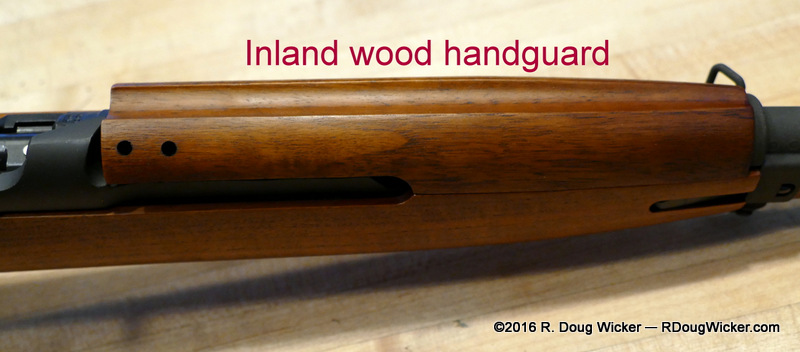
Inland with U.S.G.I.-style wood handguard

Inland with U.S.G.I.-style wood handguard

An abject lesson for the uneducated gun collector: Stick with what you know, and research what you don’t.  I’ve always wanted an M1 Carbine, so when I found the Universal 3rd Generation pictured here at what I thought was a good price, I snatched it up.  Yes, it was a good price . . . for a U.S.G.I. original.  For a Universal it was not.  After I took it home and began researching M1 Carbines, I found that the 3rd generation Universals bore little in common with the original design, and even far less in quality and reliability.

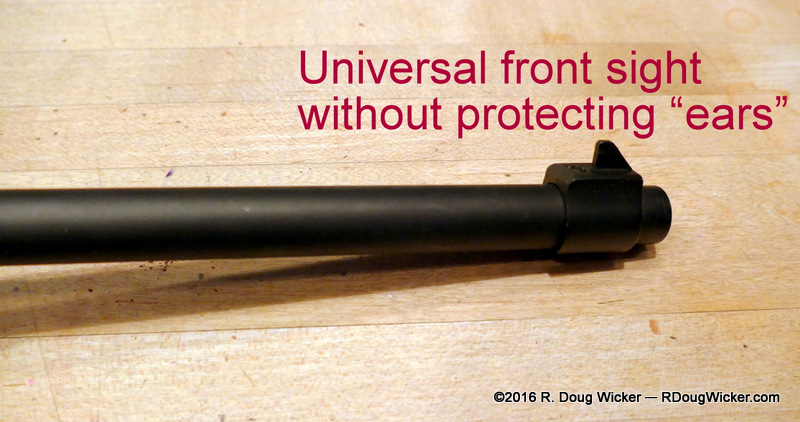
Universal M1 Carbine front sight lacks protective "ears"

Universal M1 Carbine front sight lacks protective “ears”

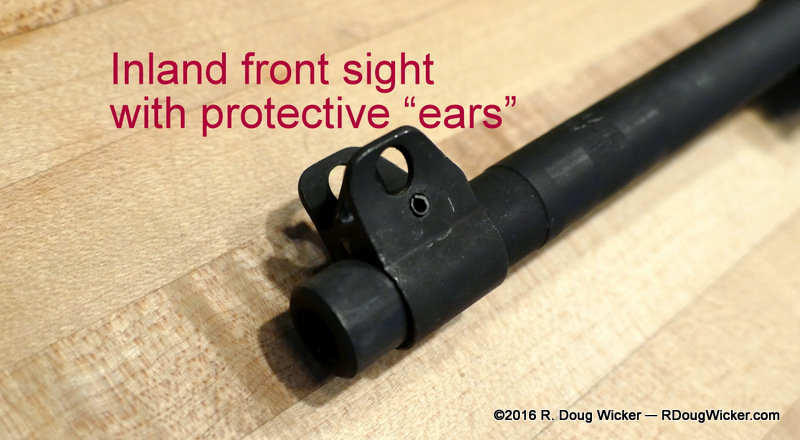
There are of course the little things, such as the use of a metal handguard rather than the more expensive wood piece of the original.  Then there’s the front sight, which lacks the protective “ears” characteristic of military weaponry of the era.

Inland front sight protective "ears"

Inland front sight protective “ears”

This is not to say that the M1 Carbine design was perfect straight out of the starting gate.  There was room for improvement.  For instance, the original design had a push-button safety.

Inland with original push-button safety disengaged

Inland with original push-button safety

Soldiers in the field hated it, because in the heat of battle it was too easily mistaken for the nearby magazine release.  In a firefight it’s just considered bad form to drop you fully loaded magazine onto French soil when you’re supposed to be firing your weapon.  Pretty embarrassing, actually.

Inland push-button safety (depressed) next to the magazine release button

Inland push-button safety (depressed) next to the magazine release button

Later M1 Carbines substituted this push-button with a flip-lever, and this is the design incorporated on the Universal.

Universal flip safety

Universal flip safety

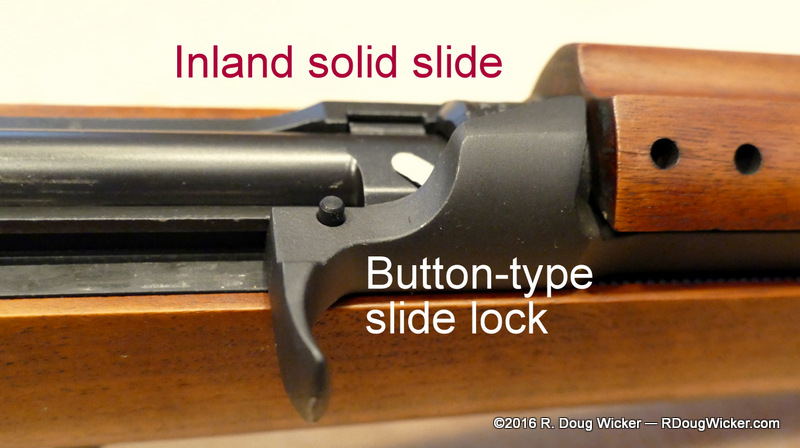
Other changes really don’t make any sense, at least to this manufacturing novice, and one would think some changes would actually increase manufacturing costs.  One example is the slide lock.  On the U.S.G.I. this is a simple push-button mounted atop the slide.

Inland push-button slide lock

Inland push-button slide lock

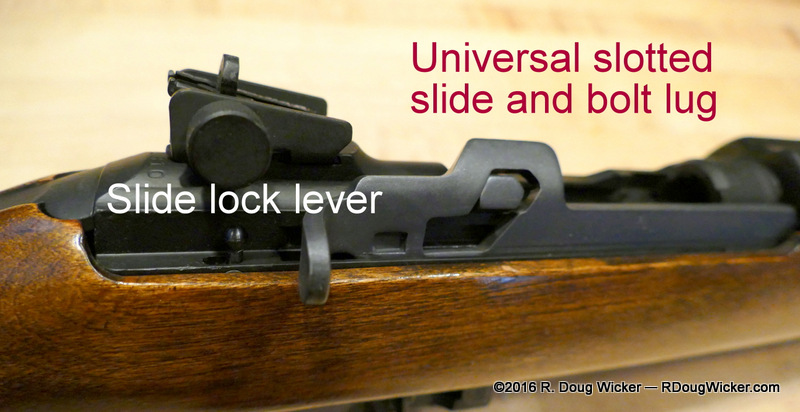
Universal decided to replace this simple, effective, and cheap system of locking back the slide with a lever mounted behind the slide directly onto the receiver.

Universal M1 Carbine lever-type slide lock; also pictured are the slotted slide and bolt lug

Rotating bolt, bolt lug, and slotted slide from a Universal M1 Carbine

Other cost-cutting measures seem too trivial to have warranted implementation.  Take for instance the slide at the point were it mates up with the lug on the rotating bolt.  On the U.S.G.I M1 Carbine this is a solid piece.  Universal thinned out this area, which resulted in a slotted slide wherein the connection to the bolt lug is clearly visible.  You can see this slotted slide-and-bolt lug configuration above, and here below is the Inland with it’s true-to-the-original slide:

U.S.G.I. button-type slide lock

U.S.G.I. solid slide

Some parts appear relatively unchanged.  The U.S.G.I. had a rear sight that was fully adjustable for both elevation and windage.

Inland fully adjustable rear sight

Inland fully adjustable rear sight

This is one feature retained on the later versions of the Universals.

Rotating bolt, bolt lug, and slotted slide from a Universal M1 Carbine

Universal adjustable rear sight

As for the wood furniture, the Universal example pictured here has a relatively shiny finish, as you can see in the closeup image below of the forestock and Type-2 barrel band/sling swivel:

Universal M1 Carbine barrel band and sling swivel

Universal M1 Carbine barrel band and sling swivel

The new Inland Manufacturing, however, pride themselves on not only retaining the matte finish, but even matching the wood grain and the stain of the original to duplicate as close as possible the look of the guns that came out of the old Inland division.  Even the U.S. Armory Ordnance cartouche is replicated on the stock.

Inland M1 Carbine with oiler and sling (both sent free after registration)

Inland stock duplicating the original Inland’s grain patterns and stain.

One last difference that I find particularly unnecessary and even galling, and I don’t even know if this was original to the Universal or if this change was made by a previous owner.  That would be the screw used to tighten the barrel band around the handguard and the forestock.  On this copy the screw is a hex-head, which is something one would never find on a combat weapon as it makes disassembly and cleaning dependent upon a tool that would normally not be available to the soldier, or otherwise easily lost.

Universal M1 Carbine Type-2 barrel band with hex-head screw

Universal M1 Carbine Type-2 barrel band with hex-head screw

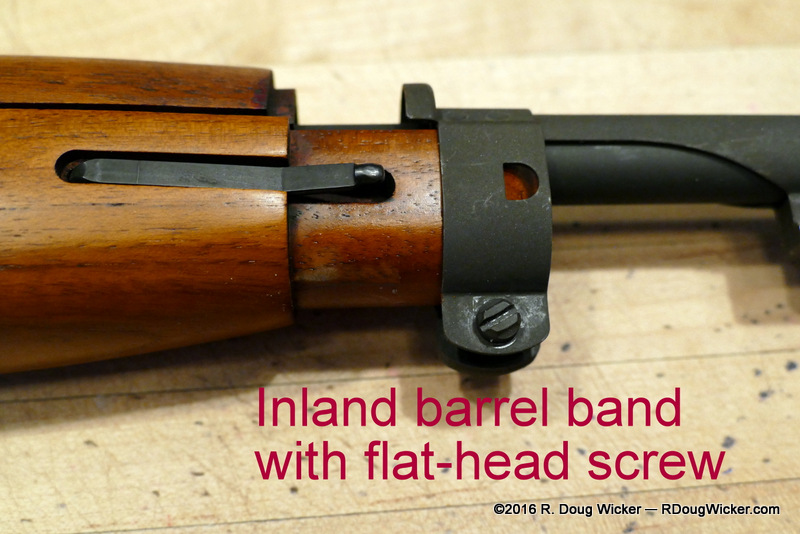
The U.S.G.I. barrel band was tightened into place with a flat-head, which could easily be turned using anything from a coin to the lip of a spent cartridge.  Below is an image of this barrel band screw on a barrel band that has been loosened and moved forward in preparing to remove the handguard.

Flat-head screw on barrel band

Flat-head screw on a loosened barrel band

To my gun followers, I hope you’ve enjoyed this week’s look at two very different versions of the .30 M1 Carbine.

As for my travel friends, starting next week I’ll be presenting a closer-to-home road trip into an area of New Mexico I’ve not yet presented — the area around Silver City, into the Gila National Forest, and along the famous Cat Walk.  Also in that upcoming series we’re going to review a charming hole-in-the-wall gourmet restaurant with a twist — not only must you make reservations in advance, you just also go online at least a day in advance to peruse the chef’s ever-changing daily menu and place your order at that time.

Until then, have a great weekend.

1 Comment

Filed under Firearms, Photography, R. Doug Wicker

Firearms Review — First look at the new Inland M1 Carbine


Inland M1 Carbine with oiler and sling (both sent free after registration)

Inland M1 Carbine with oiler and sling (both sent free after registration)

Today I’m going to present a first look at the new Inland M1 Carbine, or, as it was known in Army-speak — United States Carbine, Caliber .30, M1.  Inland is a storied name in the M1 Carbine story.  The Inland division of General Motors were the primary source for the M1 Carbine, making 2,362,097 of the 5,510,000 produced.  Inland were also the sole source for the M1A1 paratrooper model with folding metal stock, producing 140,591 copies.  The remaining versions of the M1 were made by Winchester (which developed the M1 Carbine), Underwood Elliot-Fisher (the typewriter company), the Saginaw Steering division of General Motors, IBM, Quality Hardware, National Postal Meter, and even Rock-Ola (yeah . . . the jukebox maker!).  Irwin-Pedersen made around 3,500 copies, but none were accepted by the War Department because of quality control issues.

Inland M1 Carbine with oiler and sling (both sent free after registration)

Inland M1 Carbine with oiler and sling (both sent free after registration)

Later full-automatic versions of the M1 Carbine were also made — the M2 Carbine (early 1945) and the M3 with infrared night scope — but all use the same rotating bolt and short-stroke piston design of the original M1 Carbine.

p1050887

U.S. Army Ordnance Corps cartouche

So, Inland Manufacturing is back in business and once again making U.S.-specification M1 Carbines?  Well, not so fast.  This Inland is not the GM division of old, but rather a new incarnation founded in 2013.  The original Inland merged with Delphi Automotive Systems back in 1989, and both were spun off from GM as a single independent company a decade later.  Bad news?  Not really.  This Inland’s iteration of the M1 Carbine remains so true to the original that the parts . . . all the parts . . . are fully interchangeable with the original.  And the oiler you see below is Army surplus.  That surplus oiler and a sling ship out to the customer at no charge when Inland Mfg. receive your registration form.  Yes, mine came with oil still in it, and I had to clean it off before installing it into the stock.  Things don’t get much more authentic than that.

Inland M1 Carbine with oiler and sling (both sent free after registration)

Inland M1 Carbine with oiler and sling (both sent free after registration)

The version you see here is Inland’s 1945 model with a Type 3 barrel band that includes a bayonet lug mounted onto an 18-inch/45.7-centimeter barrel.  The 1945 also comes with one 15-round magazine (Really?  Just one, Inland?  Isn’t that being just a bit on the cheap side?).  The 1944 model comes with a Type 2 barrel band and one 10-round magazine to make it compliant in those states that believe only body guards protecting politicians should have access to “high-capacity” magazines (see: The Myths Driving the Magazine Capacity Debate — and How They Get You Killed), and that bayonets somehow present a clear and present danger to the public.

Inland 1944 M1 Carbine with 10-round magazine and Type-2 barrel band absent the bayonet lug

Inland 1944 M1 Carbine with 10-round magazine, an 18-inch/45.7-centimeter barrel and Type-2 barrel band absent the bayonet lug

Inland also make a paratrooper M1A1 version;

Inland M1A1 Paratrooper Carbine

Inland M1A1 Paratrooper Carbine with an 18-inch/45.7-centimeter barrel

as well as aJungle Carbine” with a 16.25-inch/41.3-centimeter barrel and flash hider;

Inland M1 Jungle Carbine with a 16-inch/40.6-centimeter barrel and a flash hider

Inland M1 Jungle Carbine with flash suppressor

a pistol version calledThe Advisor” (patterned after a model used by U.S. advisors in Vietnam);

Vietnam-era M1 Advisor pistol with 12-inch/30.5-centimeter barrel and flash hider

Vietnam-era Inland M1 Advisor pistol with a 12-inch/30.5-centimeter barrel and flash suppressor

and even a modernizedScout” version that comes with black polymer-and-textured wood stock, flash suppressor on a threaded barrel, and an upper handguard made of anodized aluminum and featuring a Picatinny rail for mounting a scope or other accessories.

Modernized Inland M1 Scout Carbine

Modernized Inland M1 Scout Carbine with 16.25-inch/41.3-centimeter barrel, anodized aluminum Picatinny rail, and flash suppressor

Attention to detail is the name of the game with Inland, clear down to a duplication of the stain used on the original Inland carbines.  On Friday I’ll be doing a side-by-side comparison with an inferior copy from the now defunct Universal Firearms.  Universal started out using surplus USGI parts, but as those items dried up they started making non-specification versions and cut some serious corners.

Inland M1 Carbine with oiler and sling (both sent free after registration)

Inland M1 Carbine with oiler and sling (both sent free after registration)

Inland M1 Carbine with oiler and sling (both sent free after registration)

Inland M1 Carbine with oiler and sling (both sent free after registration)

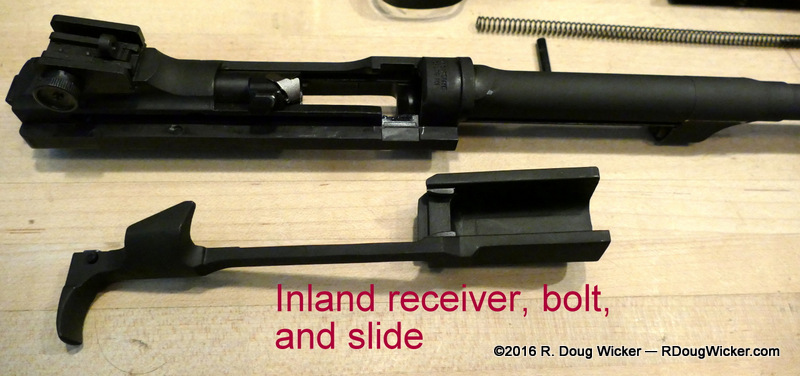
Let’s take a look at the Inland disassembled.  As with the original M1 Carbine, disassembly begins by loosening the screw below the barrel band, sliding the barrel band/bayonet lug forward, and then emoving the upper handguard.  The barrel band with bayonet lug is permanently affixed to the barrel.  The whole barrel assembly, and receiver and trigger groups lift out of the stock as a unit.

Taking apart the M1 Carbine

Taking apart the M1 Carbine

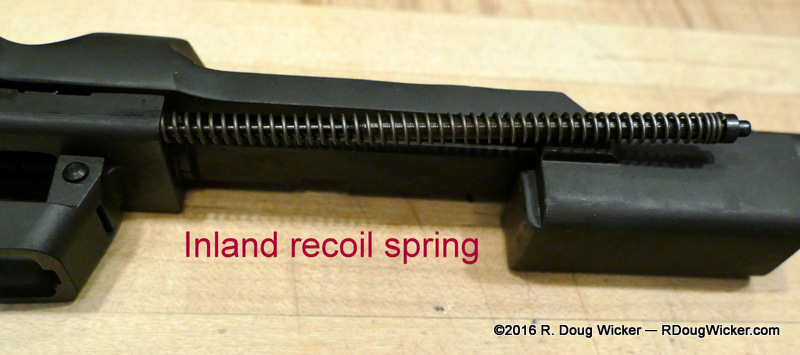
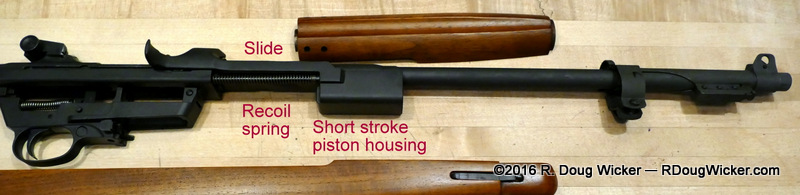
Next comes the removal of the recoil spring, which is easily accomplished by slightly compressing the spring and pulling it away from the housing containing the short-stroke piston.

Recoil spring removed from the piston housing

Recoil spring removed from the piston housing

After that you punch out the pin holding in place the trigger group.

p1050902

Trigger group assembly and retaining pin

After the trigger group is removed from the receiver the slide can now be dismounted.

Slide removed from receiver, leaving the bolt in place

Slide removed from receiver, leaving the bolt in place

Inland disassembled

Inland disassembled

Good luck getting it back together.  Just kidding.  The most difficult reassembly task for me was getting the slide mounted back into the receiver while mating it to the rotating bolt.  But some detailed online tutorials eventually solved that predicament.  After that putting everything back into place was a snap.

Now would be a good time to explain how this marvelous piece of engineering works, so let’s take a look once again at the actual receive group removed from the carbine (see below).  As the .30-caliber carbine bullet travels down the barrel it passes a small hole (port) above the piston housing.  Pressurized gas flows down this port and into a small piston that then moves forcefully back a short distance, impacting the slide with sufficient force to overcome the tension of the recoil spring.  This cycles the slide back.

Inland receiver, slide, piston housing, and recoil spring

Inland receiver, slide, piston housing, and recoil spring

Below is an image of a Universal M1 Carbine receiver that I’m using here to show what you cannot see on the Inland.  The Universal has a slotted slide that engages the bolt lug of the rotating bolt, which is also how the Inland operates hidden from view behind a solid slide.  Until the slide goes back, the bolt of the weapon is securely locked in place because of it’s orientation.  As the slide travels rearward it rotates the bolt by engaging the bolt lug.  This rotation unlocks the bolt, allowing it to travel back to extract the spent cartridge, which is then ejected from the weapon.  The recoil spring then takes over, moving the slide forward taking the bolt with it.  The bolt strips the next round from the top of the magazine, chambers the round, and then rotates back into the locked position for the next firing.

Rotating bolt, bolt lug, and slotted slide from a Universal M1 Carbine

Rotating bolt, bolt lug, and slotted slide from a Universal M1 Carbine

I hope I made that all clear as mud.

Now for the specifics on the Inland 1945 M1 .30 Carbine.  MSRP for the 1945 version is $1,079, but if you shop around you can snag one for under a grand.  Barrel length is 18 inches/46.7 centimeters.  The rifle is incredibly compact and extremely light weight, coming in at just under 36 inches/91.5 centimeters in length and weighing a feather-light 5 pounds 3 ounces/2.35 kilograms.  This weapon was, after all, designed to replace the M1911 pistol for officers, tank crews, and rear echelon troops, giving them a compact yet powerful alternative to a handgun.

For those wondering about the ballistics, the .30 carbine bullet weighs 110 grains/7.13 grams, travels at just under 2,000 feet/610 meters per second, and generates 964 foot-pounds/1,307 joules at the muzzle.  Energy-wise that puts the .30 carbine round on par with a .357 Magnum out of the same length barrel, and even exceeds the energy from a .44 Magnum round coming out of the six-inch/15.24-centimeter barrel of a typical .44 Magnum handgun (although out of an 18-inch barrel the .44 Magnum easily wins over both).

See you Friday for a comparison between the Inland and a 3rd generation Universal Firearms M1 Carbine.

Comments Off on Firearms Review — First look at the new Inland M1 Carbine

Filed under Firearms, R. Doug Wicker