
Time to continue our series on barbecue lessons. As you’ll recall, barbequing is distinctly different from grilling, although most people erroneously interchange the two terms. Grilling involves fairly rapid cooking directly over a heat source (usually a high-heat source). Barbecue is slow, high-humidity, indirect cooking at very low temperatures over a period of many, many hours. Barbecue smoking is the use of hardwood chunks or chips to impart a smoky flavor to meats during the barbecue process. Rubs are used to impart additional flavor to meats during either grilling or barbequing, but are truly effective when applied several days before placing the meat into a smoker.
So far we’ve explored the Smoked Pork Butt using a relatively simple “rub” of just sea salt and pepper. After some twelve hours or so, here was the result of that blog post:

Smoked Boston Butt, aka, Pork Shoulder
Afterward, we showed how to take that second Boston butt and turn it into delectable Carolina-style Mustard Barbecue Hash:

Carolina-style Mustard Barbecue Hash
From there we took on the more advanced and much more time-consuming project of Smoked Brisket using a more complex rub made from equal amounts of the following (which is what we’ll use today for our ribs):
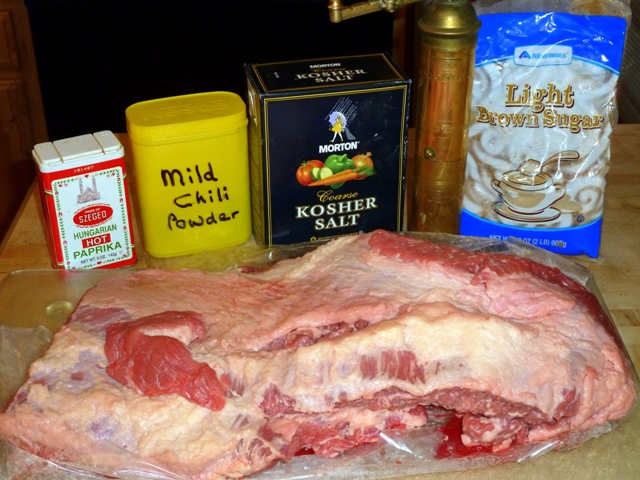
Paprika, Chili Powder, Kosher Salt, Black Pepper, Brown Sugar
That particular 18-hour project resulted in this little bit of Heaven:

18-Hour Smoked Brisket
So, to day, we’re going to try something that’s both simpler and which requires less time. That’s the delightful Pork Rib, in this case the Baby Back.
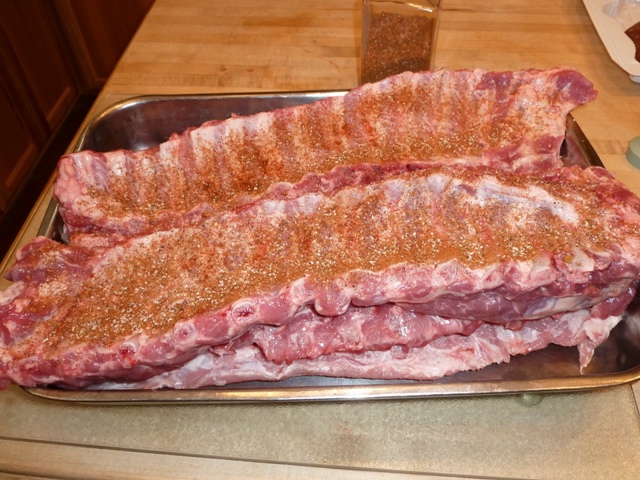
Baby Back Pork Ribs
Remember that rub you made for the brisket (ingredients pictured above)? Hope you saved some. If not, make some more. Rub that spice mixture into the ribs.
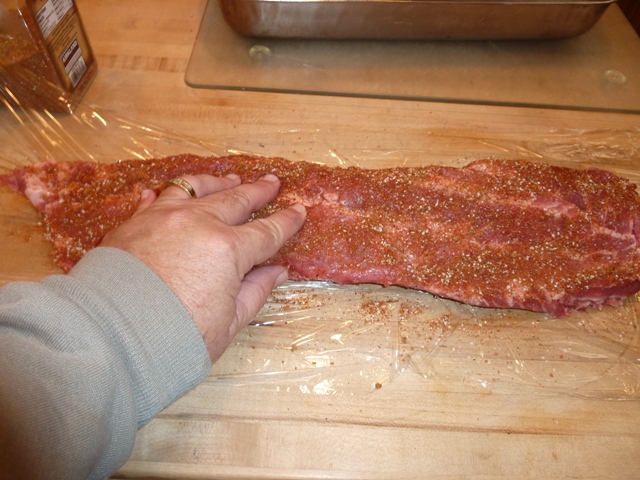
Rubbing the Ribs with Rib Rub
After rubbing the ribs, wrap them individually in plastic wrap and refrigerate for a day or two.

Wrapped Rubbed Ribs
Unlike Boston Butt (12-hour project) or brisket (18-hour project), pork ribs require considerably less time because of their thin size and tendency to dry out of smoked for too long. Thus, this is about a five-hour project. So, let’s get started. Preparation for the smoker for both Boston butt and pork ribs can be found in that blog post at this link: Smoked Boston Butt.
A word about wood choices: This being pork, fruit woods such as apple and cherry will work very well. Hickory and pecan will also give the ribs a great flavor, with hickory being the more traditional of the two. Stay away from mesquite, which is more at home with beef and better suited for quick grilling. You’ll probably find mesquite far too overpowering for barbecued pork.
Take your ribs out of the refrigerator and unwrap them. Then cut them in half so as to fit into some rib racks (only necessary if you’re going to smoke a considerable amount and need to place them edgewise, otherwise don’t bother to divide the ribs).

Rubbed Ribs in Rib Racks
Check your water level after about 2½ hours. As for the wood chips/chunks, you can discontinue with replenishing them after the first batch of chips/chunks as long as you got at least ninety minutes to two hours worth of smoke out of them. Any more than that will result in too much smoke flavor, imparting a bitterness to the meat that you’ll want to avoid. As always, put into the smoking box only enough wood to produce a barely visible stream of smoke coming out of the upper vent of the smoking chamber.

Barely Visible Smoke
After five hours here’s what you’ll get, perfectly seasoned and smoked pork ribs:

Finished Smoked Ribs
From this point you can go one of two ways: First, you can serve the fresh from the smoker relying solely upon that rub and the smoky flavor (i.e., “naked”):
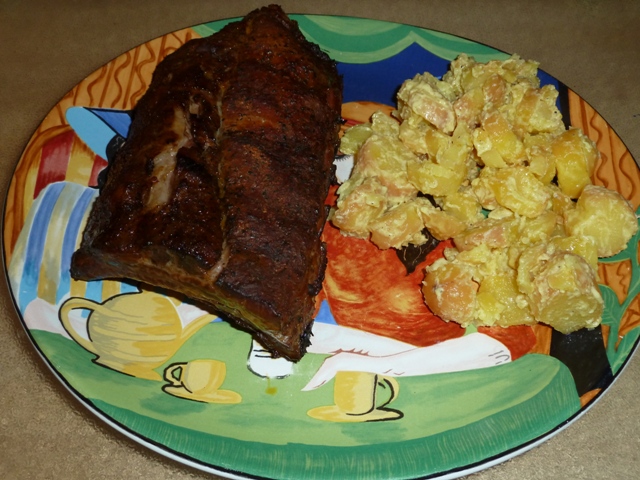
“Naked” Rubbed Ribs with Swiss-style Potato Salad
Or, you can sparingly brush on some barbecue sauce and “burn” it into the meat either using a grill or underneath your oven broiler. Be careful using the second option — you want to dry out the sauce and slightly caramelize it without drying out the ribs or blackening the sauce. My recommendation is to serve the freshly smoked ribs naked, and sauce the rest when you serve them as leftovers. Burning into the leftovers some barbecue sauce is a great way to reheat the ribs without drying them out, and the sauce helps disguise that “reheated pork” taste. If, on the other hand, you want to retain that great original flavor, the best way to reheat them so as to avoid that “reheated pork” taste is to place the ribs on a rack and into a roasting pan containing a shallow amount of water, tightly sealing the pan with heavy-duty foil (carefully tenting the foil so as to avoid having it touch the meat), and slowly oven-heating the ribs at low temperature (around 220° Fahrenheit/105° Celsius) for about an hour to ninety minutes.
Wine selection: This is barbecue. It is — by definition and through the presence of all that black pepper and chili powder — spicy. That hints at the customary wine for both barbecue and grilling. Try a peppery shiraz from Australia, preferably one from the Barossa Valley. Other good choices include Châteauneuf-du-Pape or the Australian GSM (Grenache, Shiraz, Mourvèdre) equivalent. Argentine Malbec would also work well with this style of cooking.


 Decisions — Murder in Paradise
 The Globe — Murder in Luxury

