We have here in El Paso an absolutely marvelous local restaurant chain called Carnitas Queretaro, which oddly enough specializes in carnitas. And we do love our carnitas, or “little meats” as that translates. Traditionally this is done with chunks of fatty pork deep fried, but today I’m going to present a delicious and hopefully healthier alternative that I think comes out even better. Here’s what you’ll need:
One large Boston Butt (pork shoulder) cut in half. It’s okay to work the knife around the bone and leave it in, or you can go boneless.
Chipotle powder. Lots of it. I get mine, as well as all my other chile powders, from El Potrero Trading Post in Chimayo, New Mexico. Well worth the expense, believe me.
Salt. Lots of it.
Freshly ground black pepper. Lots of it.
Boston butt, chipotle powder, salt, freshly ground black pepper
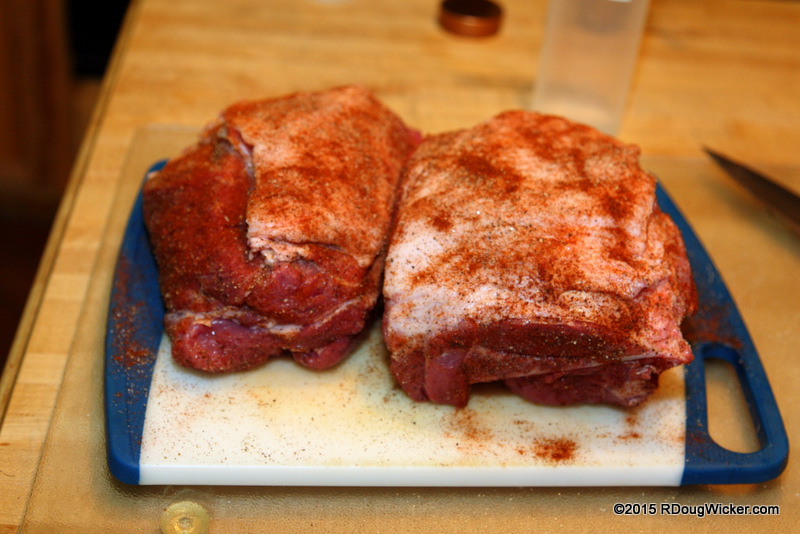
Season the pork liberally with the chipotle, salt, and black pepper.
Halve the pork shoulder and season well
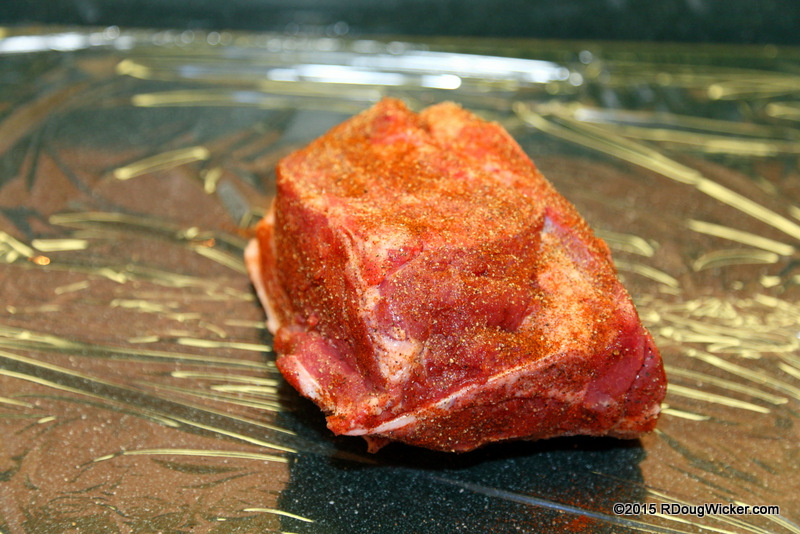
Place each half onto a generous amount of plastic wrap.
Ready to wrap
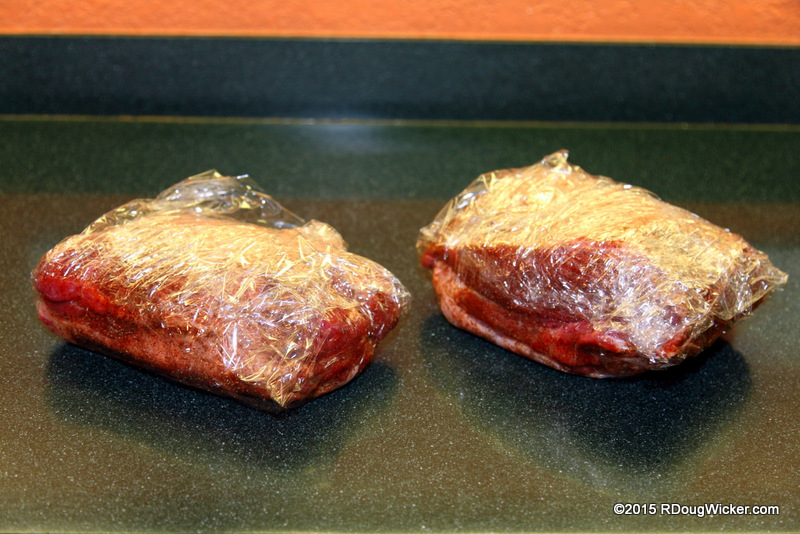
Tightly wrap each half and refrigerate overnight.
Tightly wrapped and ready for the refrigerator
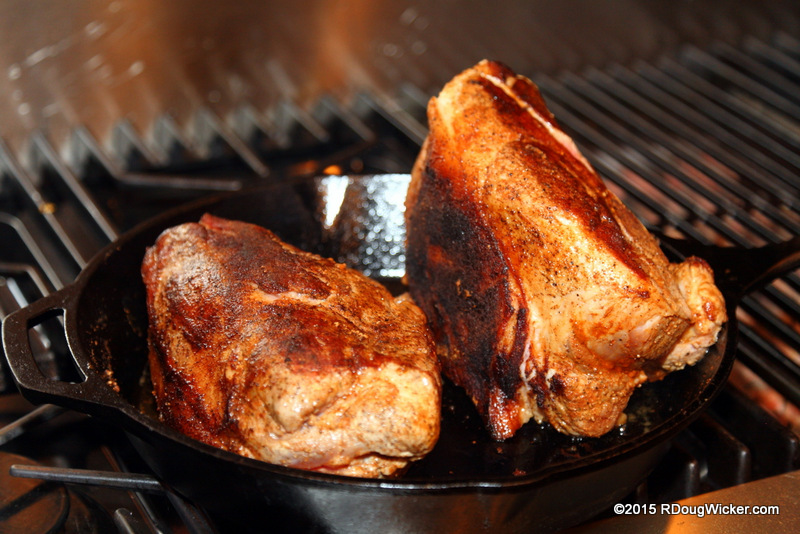
The next morning start heating a cast iron skillet while you retrieve the pork from the refrigerator and unwrap them. Get that skillet very, very hot, but not “blackening” hot. Now place the halves into the skillet, initially fat side down to render out some of the fat and to “grease” the skillet.
Place halves into a very hot skillet fat side down
Once the fat side is darkly browned start rotating the halves to sear the remaining sides.
Turn and brown on all sides
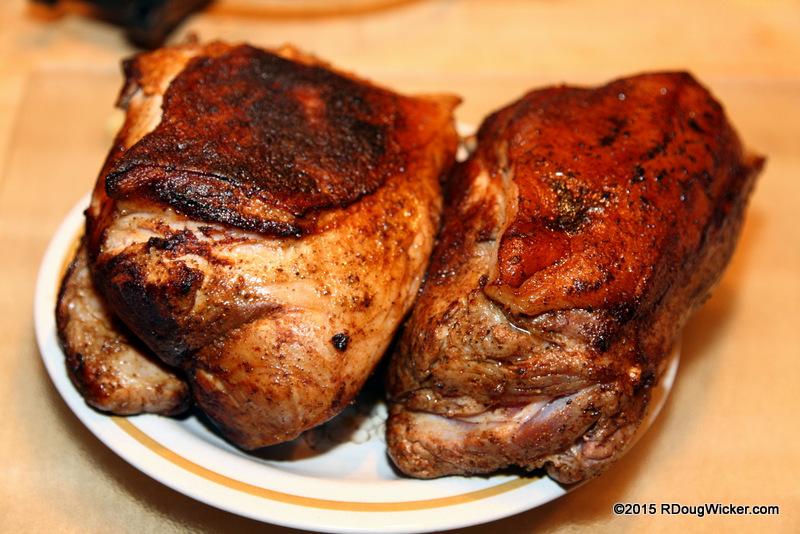
That step should result in your pork looking like this:
Ready for the next step
Place the halves into your slow cooker. Just the pork, nothing else. Do not add any liquid. You’ll see why later.
Into the slow cooker — don’t add any liquid! You won’t need it.
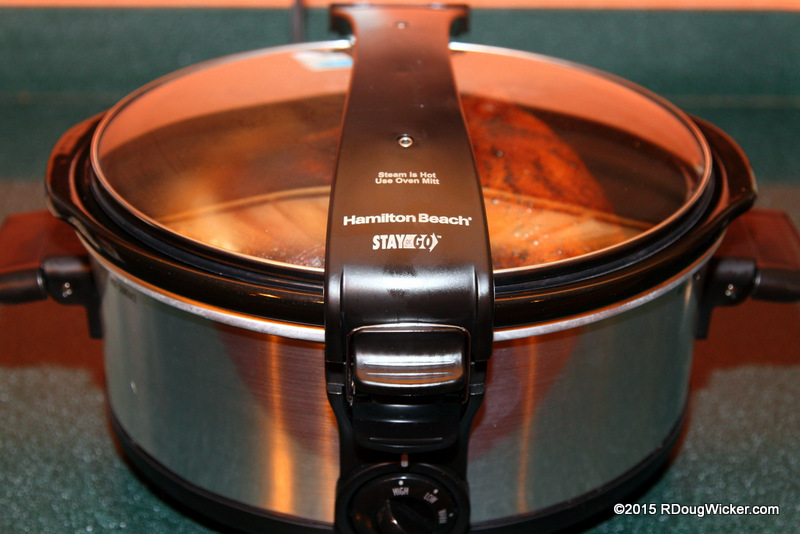
Cover the slow cooker (I do this to get the crockery up to temperature), turn it on high for an hour, then back off to low for an additional six to seven hours.
High for an hour, then go to low for seven more
Later that afternoon you’ll find out why adding liquid wasn’t necessary when you open up the lid. By the way, don’t throw out that liquid. De-fat and save it for something else, like perhaps stock for posolé or menudo.
See? Told you no additional liquid was necessary.
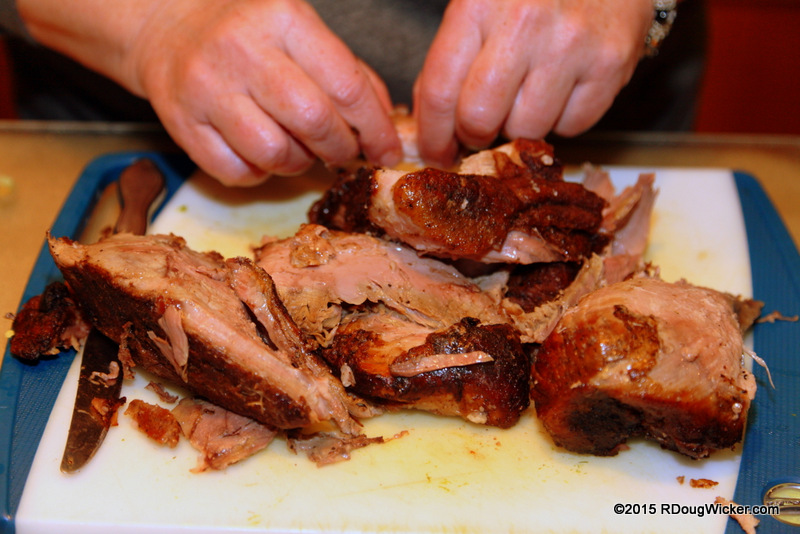
Remove the pork from the slow cooker and allow it to cool enough to cut, shred, and remove excess fat by hand.
Shredding the meat and removing the fat
After this step here’s what you should have on hand:
Shredded pork ready for crisping
Now heat up again that cast iron skillet. Once it’s searing hot lightly spray it with cooking oil and add one layer of the meat.
Into the hot skillet
Crisp one side, then flip and crisp the other. Remove and continue with additional layers of meat one layer at a time.
Toasting nicely
Now serve with fresh corn tortillas and your favorite sides. I recommend guacamole, red sauce or salsa, and my world-famous jalapeño “pesto” dip.
Guacamole, red sauce, and my famous jalapeño “pest” sauce
And what would one of my recipe blogs be without a wine selection? If you go with spicy accompaniments then a slightly sweet white or rosé suggests itself. Think along the lines of a Riesling, Viognier, or Gewürztraminer for white; a white zinfandel or perhaps a Spanish rosado for a blush pairing.
Model 1892 Pistol (Wanted: Dead or Alive) and Model 1892 Rifle (The Rifleman)
American television in the 1950s were rife with thirty-minute black-and-white Westerns. Among the more famous and enduring: The Lone Ranger, Have Gun — Will Travel, The Deputy, and Gunsmoke (yep, originally only 30 minutes for the first six seasons). And that’s just some of the more successful ones. There were many, many more because they were cheap to produce, fun to watch, and in demand. Two of the more successful such series were The Rifleman and Wanted: Dead or Alive, the latter catapulting relatively unknown actor Steve McQueen to fame. What do these last two have in common? The main character in both shows (Lucas McCain, The Rifleman; Josh Randall, Wanted: Dead or Alive) used unique variations of the Winchester Model 1892 rifle, although Josh Randall’s version is more accurately a “pistol”). To see more on Winchester lever-action rifles check out Winchester Rifles — Part 1 and Winchester Rifles — Part 2:
Matched, consecutively numbered pair of Centennial Edition Winchester Model 1894 Rifles in .30-30 and .44 Magnum
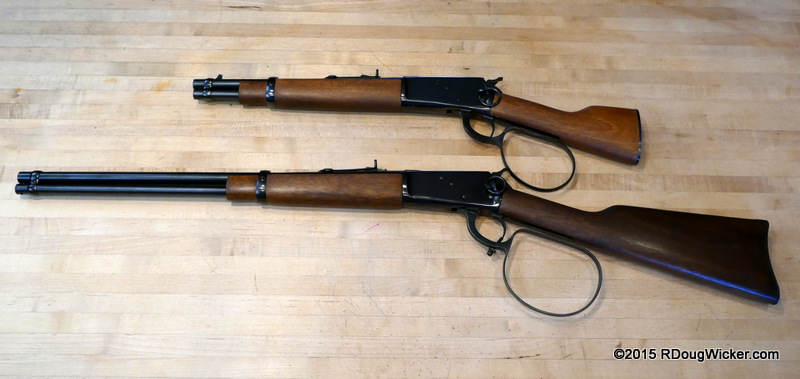
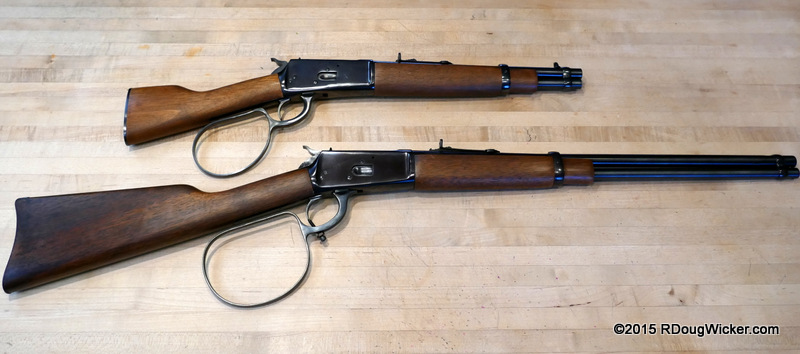
The first two firearms featured above are the Rossi Ranch Hand pistol and a highly customized Rossi R92 rifle, both equipped with loop levers, and both modeled after the famed Winchester Model 1892 pistol-caliber rifle. The two examples here are both chambered for the .38 Special/.357 Magnum, and are thus not historically correct in that regard. The original Model 1892 was chambered for black powder pistol cartridges, such as the .44-40 and .38-40, which were in wide-spread use at the end of the 19th Century.
Upper — Rossi Ranch Hand in .38 Special/.357 Magnum; Lower — Rossi R92 by Mike DiMuzio in .38 Special/.357 Magnum
The Rossi Ranch Hand is not a true scale replica of the “Josh Randall Special” — also knows as a “Mare’s Leg — used in Wanted: Dead or Alive. Both the barrel and stock are slightly longer than the one used by Steve McQueen’s character in that show. The Rossi is also not the only Mare’s Leg on the market. The Henry Repeating Arms company also makes a version which they sell as the Mare’s Leg Lever Action Pistol:
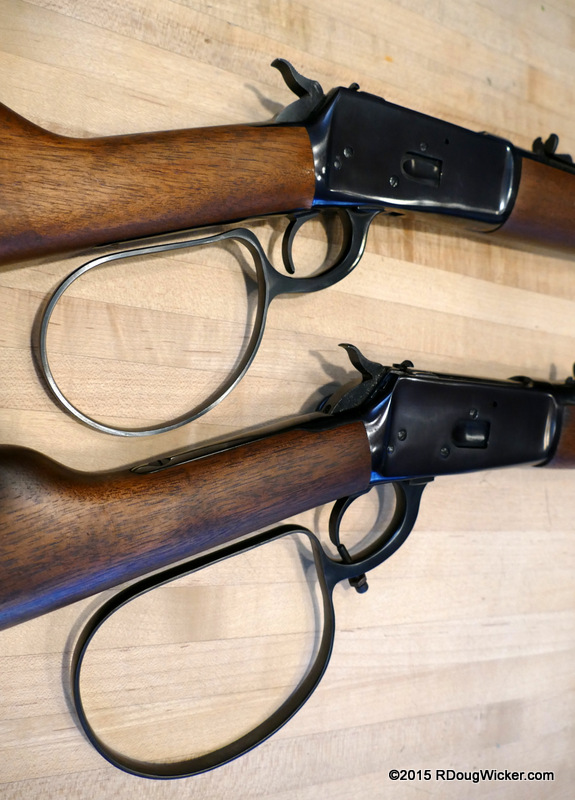
So what about that intriguing “Lucas McCain Special” pictured beneath the Rossi Ranch Hand; how close a replica is it? Pretty darned close, as it turns out. This particular weapon — also known as “The Flip Special” — was custom-made by Mike DiMuzio of North Carolina. And if the Rossi R92 basis isn’t accurate enough for you, he’ll even customize a true, antique Winchester Model 1892 chambered in the historically accurate .44-40 cartridge depicted in The Rifleman. He even installs that special trigger tripping set screw in the loop for rapid firing.
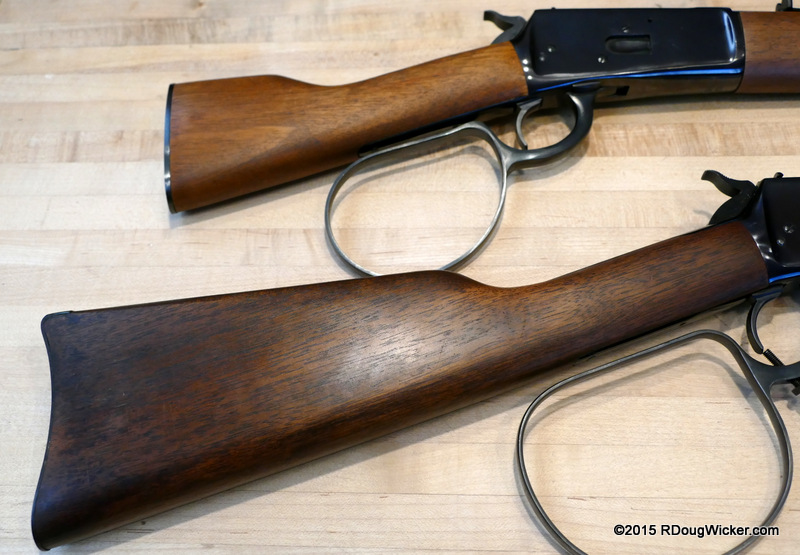
If you’re interested in owning such a weapon then visit Mike’s website and then give him a call at 704-915-2325: Mike does a good job not only reproducing the loop lever and trigger trip of the Winchester Model 1892 used in The Rifleman, he’ll also upon request add the saddle ring (additional charge) and darken the stock to match Winchesters of the era. And if you’re really hungry for that authentic look he’ll even age the rifle to make it appear a century old. Take a look at the stock he darkened compared to the original finish that came on the Ranch Hand:
“Rifleman” conversion includes upon request darker staining to match era Winchesters
Now all this may sound like nostalgia at the cost of practicality, and in a sense it is. I mean, after all, no one can spin cock a Winchester rifle with a 20-inch/51-centimeter barrel unless you’re 6-foot 5½ inches/197 centimeters tall like Chuck Connors, right? Well, not quite. I’ll demonstrate what I mean in a short video below. But spin cocking a Model 1892 is impractical nevertheless. Using snap caps (don’t even think of trying this highly dangerous maneuver with live ammunition; as the grownups in the classic movie A Christmas Story told Ralphie, “Kid, you’ll shoot your eye out”) I proved to myself what I’d always heard. If you spin cock an 1892 the cartridge will be flung clear of the ejection port well before it can be chambered. Your “bullet” then goes skittering either across your living room floor or winds up burying itself into the dusty streets of North Fork, New Mexico (fictional town of The Rifleman)
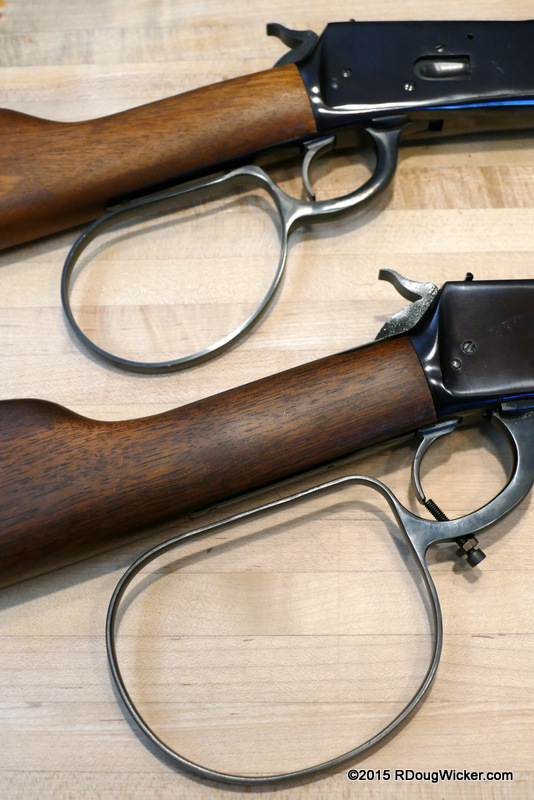
Loop comparison — Ranch Hand “small” loop vs. Rifleman large loop
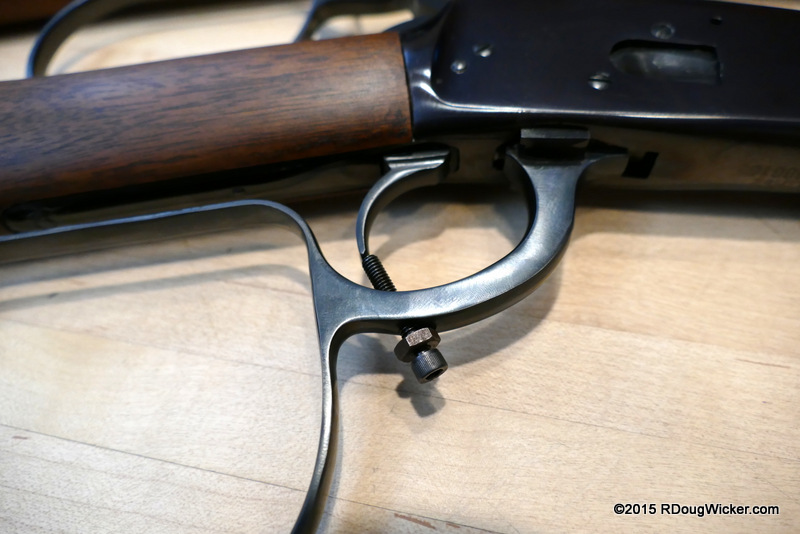
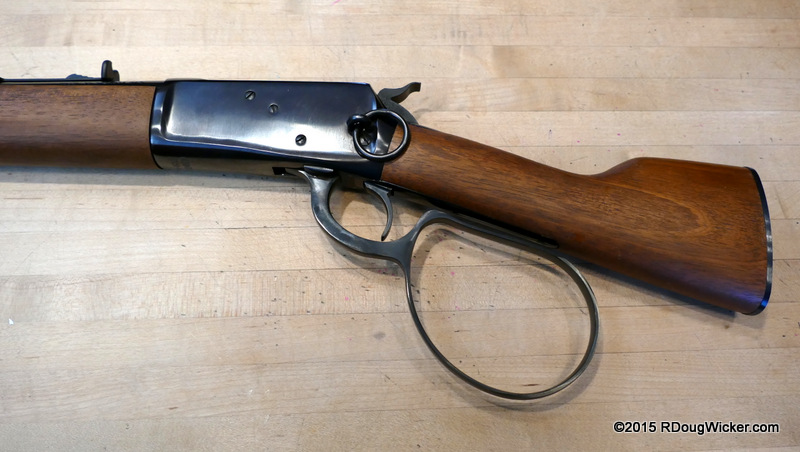
On the practical side, that trigger trip does work. But you must be careful in setting the depth of the set screw and then in locking it into place with the nut. If the trip is set too far back it won’t reach the trigger. If it contacts the trigger too soon the hammer will trip while the rifle is still out of battery, meaning that the chamber will not be completely closed and the bullet casing fully encased. If the hammer contacts the firing pin and the firing pin reaches the bullet primer while the rifle is out of battery there’s a potential for a burst cartridge with resulting damage to both firearm and shooter. So, be careful! To fire the rifle normally, just back the screw out and lock it into position with the lock nut.
“Lucas McCain Special” Loop-levered M1892 rifle with trigger trip
The loop is still large enough to perform the spin cock maneuver made famous by Chuck Connors, although I can find no reference that Steve McQueen ever attempted this in Wanted: Dead or Alive. Probably because it takes practice and is not an easy thing to do, especially as the front-heavy Mare’s Leg configuration throws the whole contraption terribly out of balance. It can be done (as I’ll demonstrate later), but a dozen repetitions or so will make your bicep feel as though you just finished up with some serious weight training. Consequently I’m trying to learn this left-handed for some upper body strength training. No, seriously. It’s fun exercise, or “Rifle Therapy,” as Mike DiMuzio refers to it.
Loop comparison — Ranch Hand “small” loop vs. Rifleman large loop
Still, if you think twirling the Ranch Hand is fun, wait until you try a full size rifle with a 20-inch barrel. Just don’t let your face get in the way like John Wayne purportedly did. John Wayne was the first film actor to spin cock a Winchester. He did it in a movie in Stagecoach way back in 1939. He repeated that stunt in at least two other films — El Dorado (1966) and True Grit (1969). But take a look at the rifles he’s spinning in those films. In each case that large loop rifle has a short 16-inch/41-centimeter barrel. Wonder why the 6-foot, 4-inch/193-centimeter actor would only spin a shortened rifle? Reportedly it’s because when he first attempted the stunt with a full-size rifle back in 1939 the barrel struck him squarely in the jaw, knocking him out cold.
Loop comparison — Stock Ranch Hand vs. DiMuzio conversion
Well, heck, I’m only 5’9″ (175 centimeters). If The Duke can’t do it with a full size rifle, then what chance have I? Not much, right? Well, Mike DiMuzio does it with two rifles at once, and he tells me that he’s not even my height. So let’s see what I can do after first perfecting the maneuver with that much smaller Rossi Ranch Hand and its the 12-inch/30.5-centimeter barrel. Oh, and while we’re at it, let’s see that trigger trip in action as well:
So, what’s the trick? Well, it isn’t easy, but it’s also not impossibly difficult. On the upside the full size rifle is much better balanced than the Rossi Ranch Hand pistol, as the longer butt stock helps offset the fore stock and barrel despite the barrel’s longer length. But, still, twenty-inches of cold, hard steel swinging back toward your head? At a pretty good clip with a lot of inertia? This is where full arm extension becomes an absolute must. You’ll note very little bend in my elbow — just enough to snap down the loop lever and start the rifle along it’s arc, at which point the elbow is straightened out even further to increase distance. Even so, the tip of the barrel clears me by somewhere around an inch or so. Yes, I hit myself in the chest a couple of times, but not the face! Take that, Duke. By the way, if that long barrel scares you then Mike will make your replica using a shorter 16-inch/41-centimeter barrel.
At some point I’ll be firing both these firearms and offering up an actual shooting review. Until then, I can still say that the Mike’s Rifleman’s Rifle conversion makes the Rossi M92 the most fun weapon in my collection even though I’ve yet to fire it.
How can that be? Simple. I’ve been practicing the art of spin cocking both the Ranch Hand and the Rossi M92, and I spin-cock the M92 nearly every day.
Hope you enjoyed this post, as it was an absolute blast producing it as well as producing for it my first blog video clip. I’ve created my own YouTube channel just to create video links such as the one in today’s post, so watch for more video’s in the future. Meanwhile, I’m going to leave you with two more video links, neither of which I made. The first is Mike DiMuzio demonstrating his prowess with his own creations, performing two simultaneous spin cocks and two simultaneous swing cocks as well as demonstrating rapid fire marksmanship. The second is a brief history of Hollywood-style spin cocking in both the movies as well as television, including the king of spin cocking Chuck Connors.















 Decisions — Murder in Paradise
 The Globe — Murder in Luxury
