
1938 Smith & Wesson K-22 “Outdoorsman”
Today I’m going to present a first look and firing review of a very special firearm. This is a highly collectible prewar Smith & Wesson K-22 ‘Outdoorsman’. So, just how rare is this target-grade .22 LR pistol? The first edition K-22 was introduced in 1931, and in 1940 the ‘Outdoorsman’ was superseded by a second generation version marketed as the K-22 ‘Masterpiece’. In 1941 production ceased altogether as Smith & Wesson geared up to support the war effort.
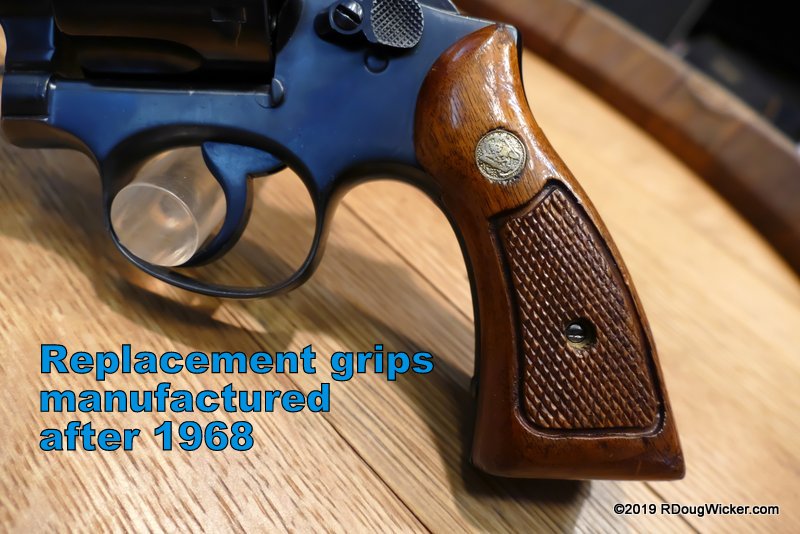
When I first saw this handgun I had an inkling that it was probably prewar because it lacked the ribbed barrel of every postwar K-Frame (medium frame) Smith & Wesson I’ve ever seen. That pencil-thin tapered barrel just looked so elegant compared to the later ribbed barrels. But I wasn’t sure, as the gun was merely tagged for sale as a, “Smith & Wesson .22,” with no further information. So, I went home and did some research, started getting excited when I thought I recognized what it was, called the store for a reading of the serial number, and verified that this was indeed a rare prewar K-22, probably with incorrect grips installed as they lacked the familiar diamond pattern surrounding the screw holes.
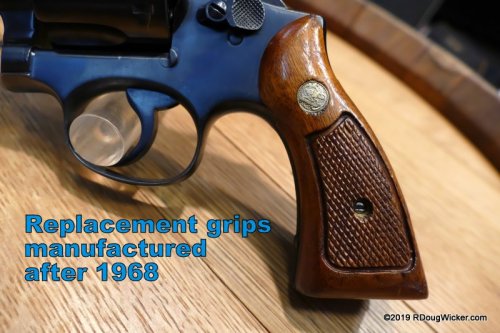
Replacement S&W grips
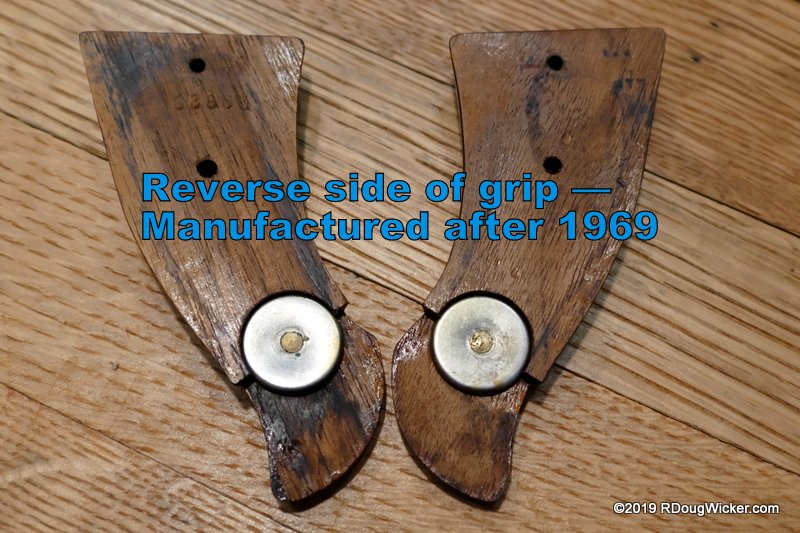
Once I got the K-22 home I removed the grips and verified that they were indeed not the originals. The factory-installed grips would have the gun’s serial number marked on the insides:

Period-incorrect grips — Made after 1969
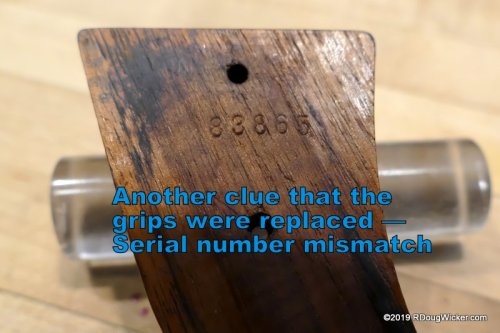
Grips not serial numbered to this gun
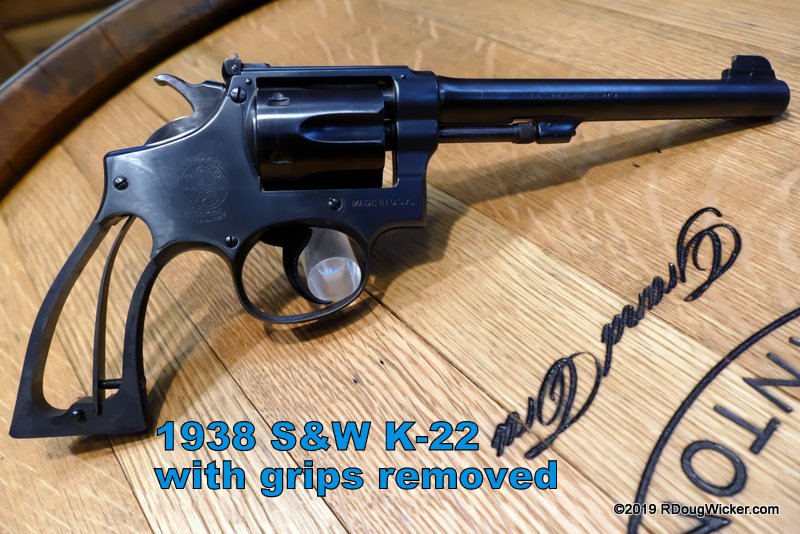
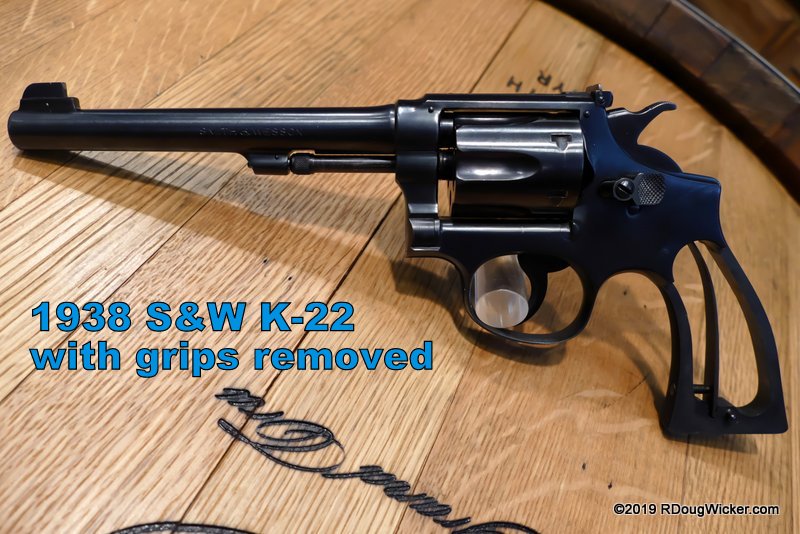
While we have the grips off this K-22, let’s take a look at what’s beneath them on the frame:

S&W K-22 grips removed
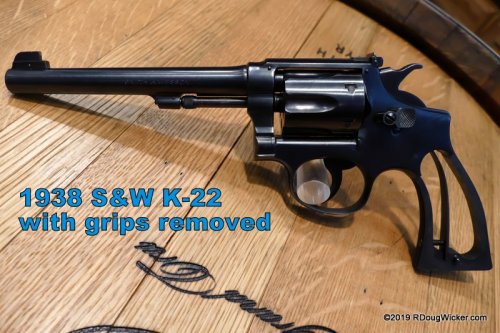
S&W K-22 grips removed
Production of the K-22 ‘Outdoorsman’ ended December 28, 1939. The total number made was 17,117 before the launch of the improved ‘Masterpiece’ K-22 in early 1940. The prewar K-22s, both the ‘Outdoorsman’ and the second generation ‘Masterpiece’, sported a non-ribbed 6-inch/152mm round barrel, adjustable rear sights, a trigger set between three and four pounds/1.4 to 1.8 kilograms, checkered Circassian walnut grips, all in a package weighing in at about 35 ounces/990 grams. With the K-22 came a Smith & Wesson claim that the gun was capable of shooting 1.5-inch/38mm groups at an astounding 50 yards/45.7 meters. That’s a lot better than I’m capable of as you can see from the two targets presented below (but in all fairness I shot free-handed rather than bench-resting the pistol). The targets I used were ones I printed on 8.5×11-inch/216x279mm standard letter-size paper.
The first target displays 18 rounds fired in single-action at a distance of 10 yards/9.1 meters:

8.5×11 target, 10 yards, 18 rounds, single-action
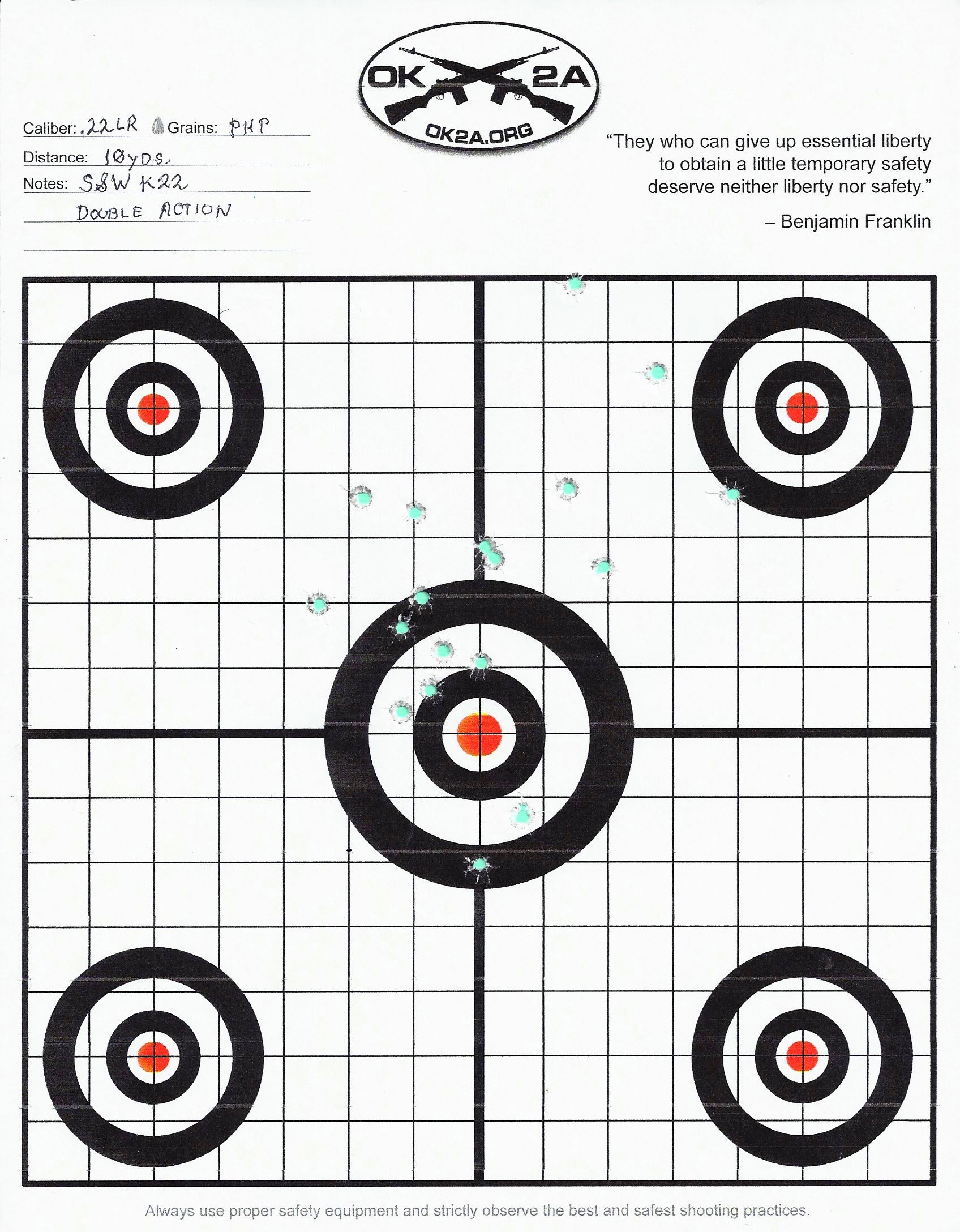
This next target shows 18 rounds fired in double-action at a the same distance:

8.5×11 target, 10 yards, 18 rounds, double-action
Oddly enough, I did better at double-action, but I’ve found over the years that the longer, heavier trigger pull in double-action forces me to maintain tighter concentration and control when I’m firing — pretty much the opposite of the rest of the shooting world, I’m sure. Plus, I’d just completed testing a single-action only 1973 Ruger Super Bearcat with a much lighter trigger, so I may have been thrown off by that as well.
As far as I can tell, the K-22 retailed for around $40 (S&W billed dealers $22.19 for them in 1935). In today’s money, that $40 works out to $624. Keeping in mind that this was in the midst of the Great Depression, it’s a wonder the K-22 found the audience that it did. Being billed as pistol suitable for both hunters and marksmen, the K-22 came equipped with an adjustable rear sight:
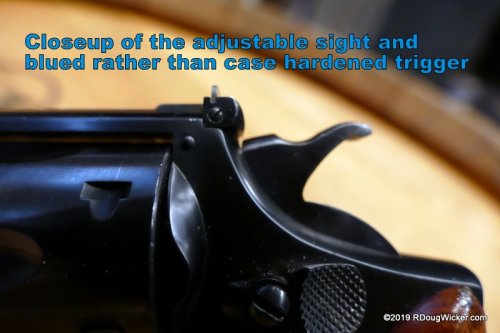
Adjustable rear sight and blued hammer
The K-22 initially came with a Call gold bead front sight (named after Charles Call), but that was changed to a higher-visibility ‘silver’ (actually stainless steel) bead about 500 pistols into production:

Silver bead front sight used after first year of production
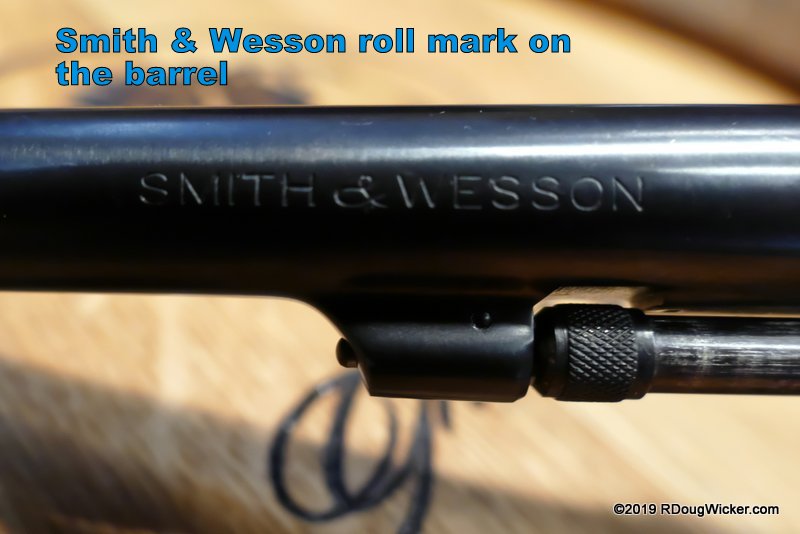
Typical roll marks and stamps on the K-22 ‘Outdoorsman’ include the following:

Smith & Wesson roll mark
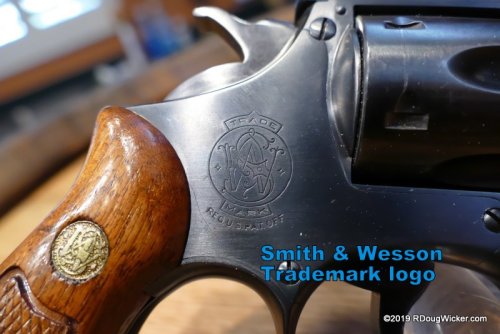
S&W trademark logo
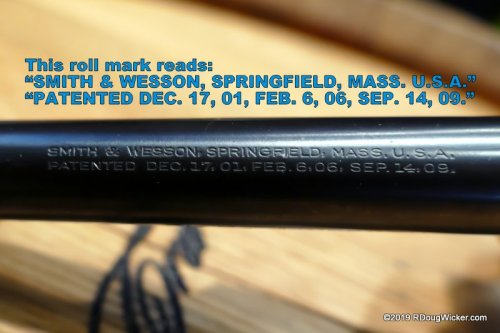
S&W patent markings
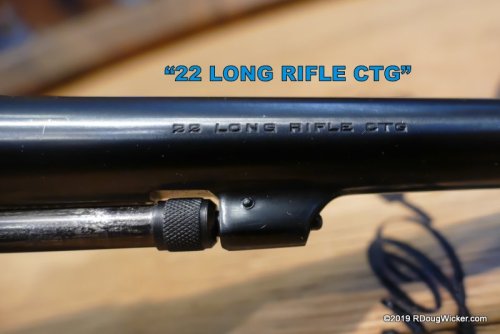
K-22 caliber mark

“MADE IN U.S.A.” stamp
I already mentioned that the grips that came with this example were not original to the gun. There is one other anomaly that I saw as well. On every K-22 I’ve found pictured on the internet, both prewar and postwar, all are equipped with case hardened triggers and hammers. Not so this example. Both are blued, and I suspect they did not come this way from the factory:
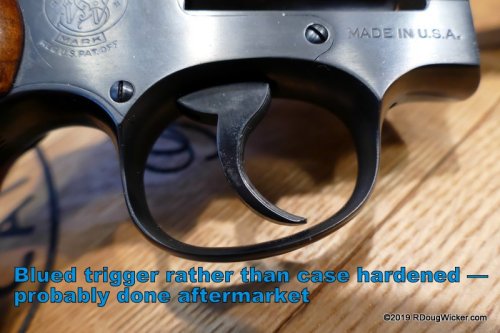
Trigger blued rather than case hardened

Hammer blued rather than case hardened
The reason that I only suspect this is because I did not receive from the Smith & Wesson historian confirmation on this even though I pointed out the bluing when I sent in photographs along with a request for the gun’s history.
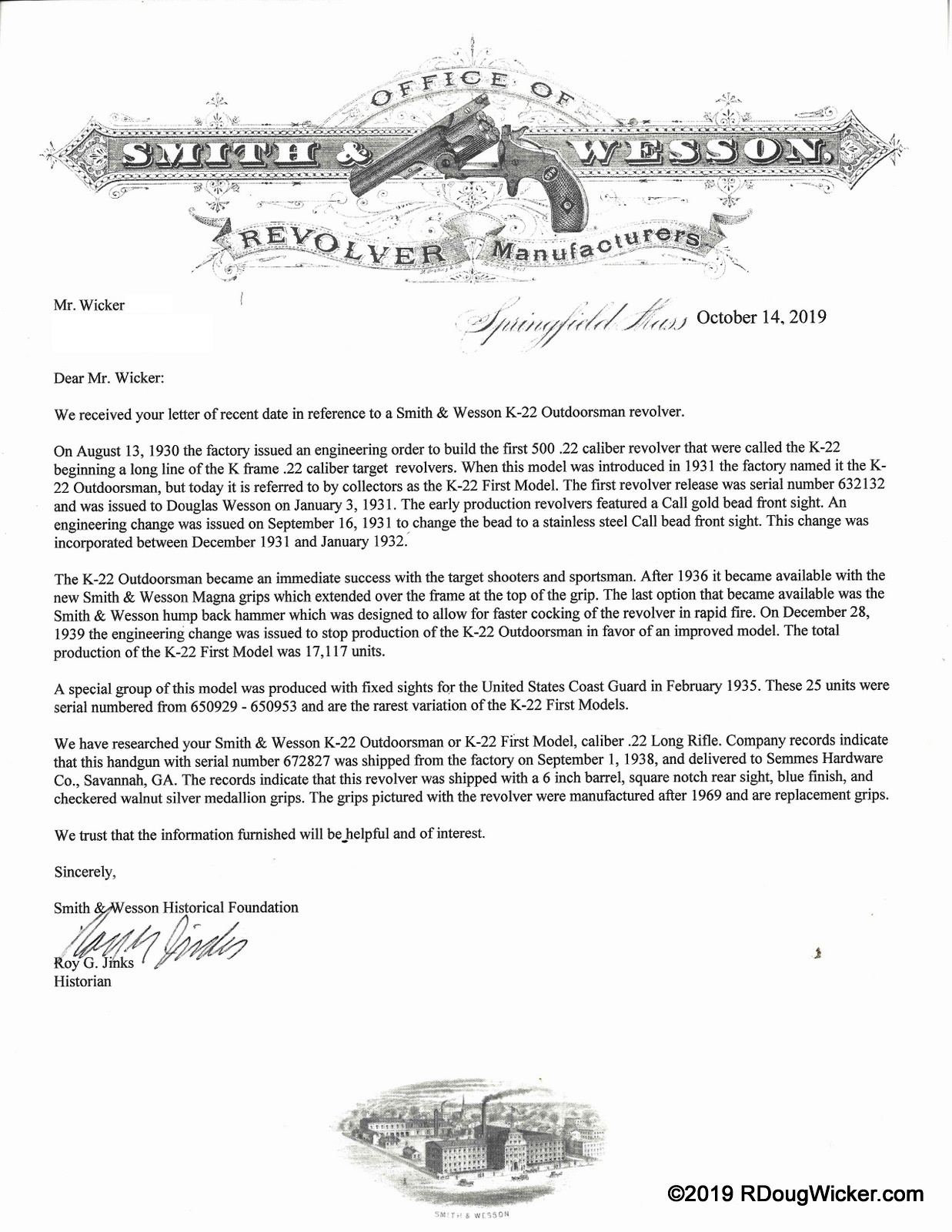
Most of the letter sent back from the S&W historian is boilerplate typical of other S&W history letters I’ve seen:
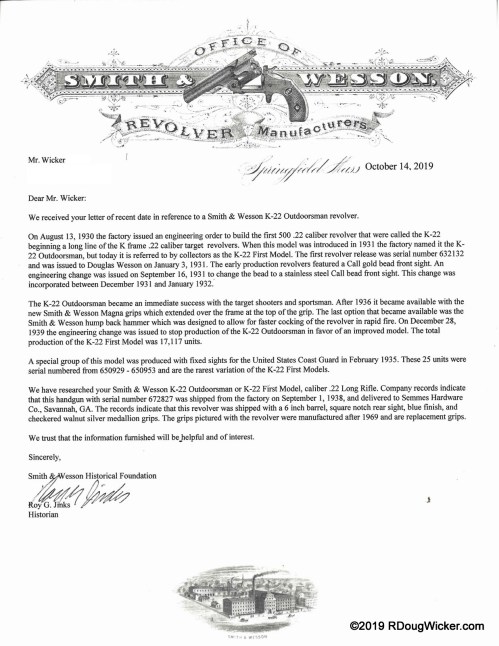
S&W Historical Foundation letter for this specific K-22
You have to get past the first four paragraphs to get to the specifics of this particular K-22, which I’ve cropped out below:

S&W Historical Foundation letter — Information specific to this K-22
A quick note about these Smith & Wesson Historical Foundation letters. If you have a Smith & Wesson firearm made between 1920 and 1966, obtaining a history on that firearm is something you should really consider. It’s fun researching where your gun first headed from the factory, and you may even get more history on it. I’ve seen at least one letter for a pristine, like-new K-22 with original box and manual that turned out to have been shipped to a police department for training purposes.
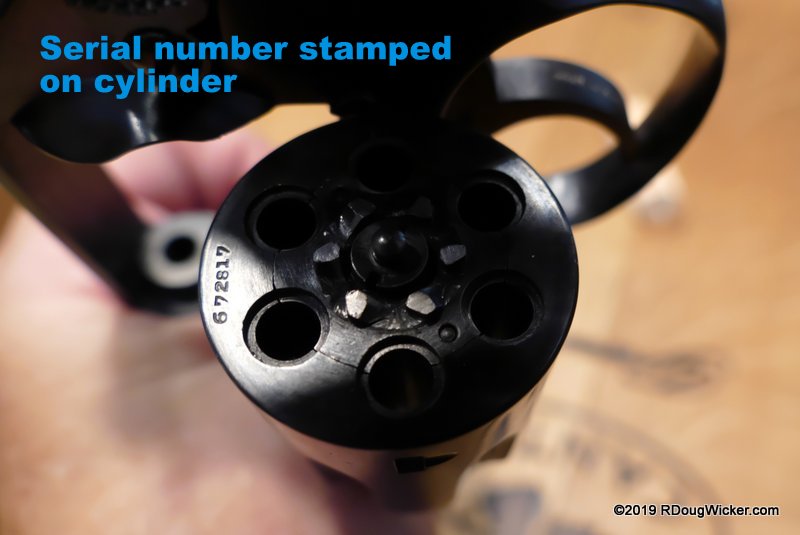
Now onto the subject of serial numbers for these pieces of prewar history. Any collector will tell you that the value of a collectible falls considerably if the gun is not fully ‘matching’. By matching, I mean all parts are original to the gun. On the K-22 Outdoorsman there are three places you need to check for this match. The first place to look is to turn over the gun and check out the primary serial number on the base of the frame butt:

Serial number stamp — Frame grip butt
Now it’s time to check the cylinder for a match:
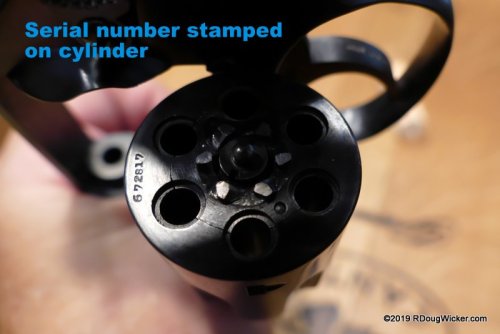
Serial number stamp — Cylinder
And, finally, as we have the cylinder swung out away from the frame, let’s turn over the gun and look at the flat portion at the base of the barrel for one more match:

Serial number stamp — Under barrel
There is one more number stamped on these weapons, but it is not related in any way to the serial number. Again, with the cylinder swung out, look at the frame just below where the pinned barrel is mounted. Here you will find a number that was used internally at Smith & Wesson. The purpose of this number was to assist the craftsmen who handcrafted these works of art. This is an assembly number that assisted in keeping together until final assembly the parts meant for a particular gun:
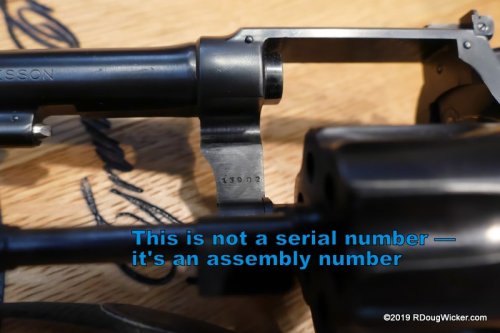
This number was used by the factory to facilitate hand fitting of parts
I hope you enjoyed this little bit of firearm history at least half as much as I enjoyed researching it. For additional information, may I suggest the following articles:
American Rifleman article: A Look Back at the Smith & Wesson K-22 written by Dave Campbell; November 13, 2012
Gunblast article: Smith & Wesson K-22s written by Mike Cumpston; January 8, 2003
One last look at this nice example of a prewar (1938) Smith & Wesson K-22 Outdoorsman:

Prewar Smith & Wesson K-22 “Outdoorsman”




















 Decisions — Murder in Paradise
 The Globe — Murder in Luxury
 R. Doug Wicker — Author