Tag Archives: recipe

Blackened Pork Chops — Or Blackened Anything Else for That Matter


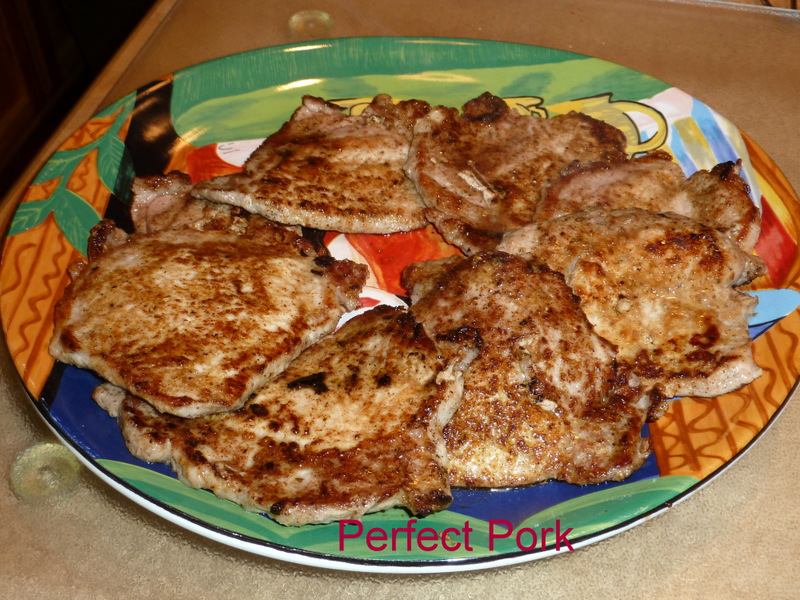
Perfect Pork

Perfect Pork

Okay, you’re simply not going to believe how quick and simple this main course is.  Meanwhile, your dinner guests aren’t going to believe how tasty it is.

But before we get started let’s talk about the blackening seasoning.  This seasoning will remind you of the pricy premade stuff that comes in containers emblazoned with the likeness of certain celebrity chefs, but it’ll cost you a fraction of the amount and taste a whole lot fresher because you make it that way.  This blackening seasoning by the way is good for a whole lot more than just pork chops.  It also works exceptionally well with flattened chicken breast, fish (especially wild salmon), thinner-cut beef steaks, and other meats using the same basic cooking principles described below, although you wouldn’t want to pound fish.

Blackening Seasoning:

  • 2 tsp. salt
  • 1 tbsp. garlic powder
  • 1 tbsp. onion powder
  • 2 tsp. white peppercorns
  • 2 tsp. black peppercorns
  • 1 ½ tsp. cayenne pepper
  • 2 tsp. whole thyme leaves
  • ½ tsp. oregano leaves
  • 1 ½ tsp. paprika

Put the seasoning ingredients list above into a heavy-duty blender, preferably one such as the Vitamix with the dry ingredient blender.  You can use the blender that originally comes with your Vitamix, but over time hardened spices such as peppercorns will scratch up the inside of your container and make it cloudy.  It’s better in my view to just go ahead and get the attachment to take that abuse.

Blend the seasoning ingredients at high speed until everything is the consistency of a fine powder, including the peppercorns and the thyme and oregano leaves.  Put the seasoning into an old spice jar that comes with a top containing shaker holes.  This blend retains its freshness for at least a couple of months, but don’t make more than you’ll use much beyond that time as the complex fragrances will diminish over time.

What You'll Need

What You’ll Need

The Rest:

  • 2 thick-cut pork chops, frozen (The ones photographed for this blog were 1 ½ inches thick)
  • 2 to 3 tbsp. butter, melted

About an hour before you’re ready to begin take the frozen chops out of the freezer.  You want the chops to still be frozen when you slice them, but not so hard as to make it difficult.  Place the chops on edge and slice in half, then slice the halves yet again resulting in four cutlet-style medallions.  Set the cutlets aside to fully defrost, about ten minutes or so.

Frozen Meats Slice Easier

Frozen Meats Slice Easier

While you’re waiting for the pork to defrost start heating a cast iron skillet on highest heat.  Don’t forget to turn on your exhaust fan!  This is going to get smoky.  You want that pan hotter than you’ve probably ever had it before.

Super Hot Searing

Super Hot Searing

Now go melt that butter.  While the butter is melting pound both sides of the pork cutlets with a tenderizer until they are very, very thin.

Pound Into Submission

Pound Into Submission

Pour melted butter onto the cutlets and smear the butter using the backside of a spoon.

Buttery Goodness

Buttery Goodness

Sprinkle liberal amounts of your fresh blackening seasoning.  Flip the cutlets over and repeat on the opposite side.

Seasoning with Gusto

Seasoning with Gusto

Is your skillet smoking hot?  I mean really smoking?  Can you feel the heat radiating off it from a foot or two away?  I mean really radiating?  If so, then you’re ready.  You might want to open the doors and windows now, too, because that exhaust fan is going to need all the help it can get.

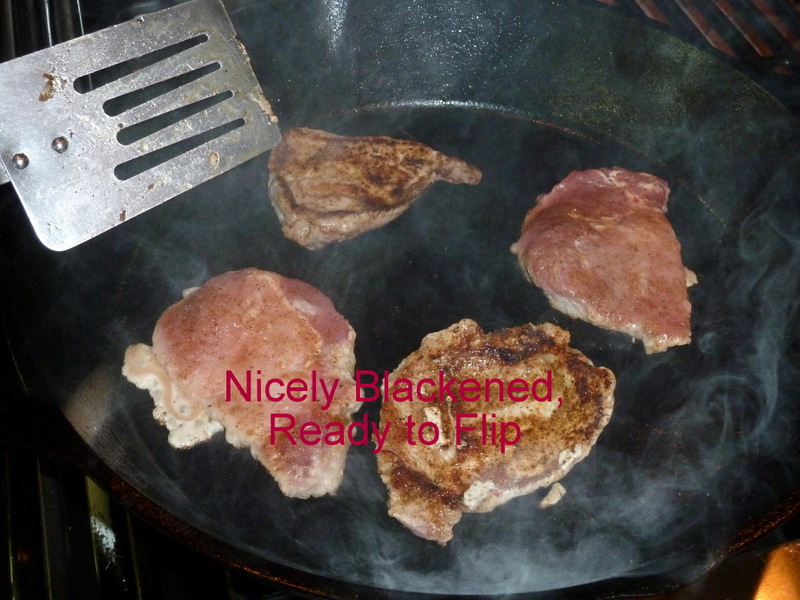
Place some of the pork cutlets directly onto the sizzling hot skillet.  Don’t crowd the pan.  After no more than a couple of minutes check the underneath side of one.  If it’s nicely browned then flip the lot and brown on the opposite side.  Remove and keep warm as you repeat the process for the remaining cutlets.
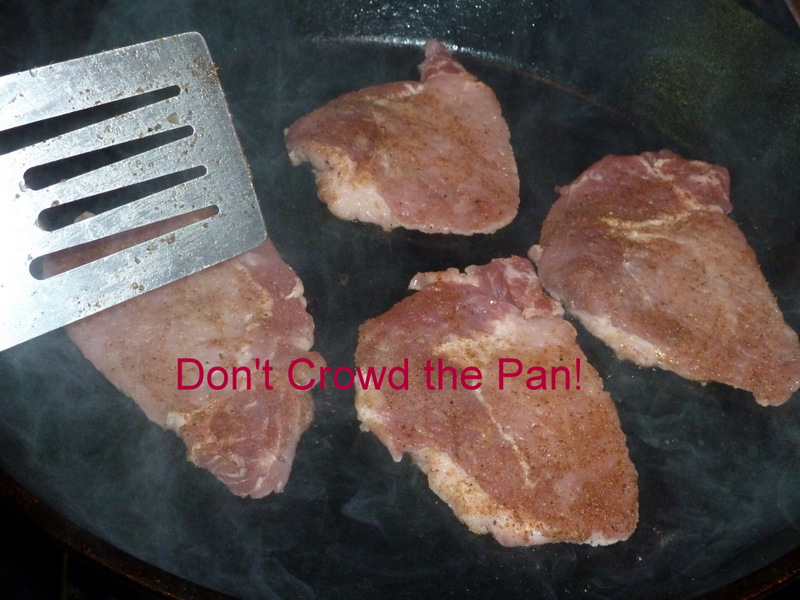
Don''t Crowd Me

Don”t Crowd Me!

Blackened and Ready to Flip

Blackened and Ready to Flip

Wine selection:  You can go a couple of ways with this mildly spicy dish.  My preference would be an Australian Shiraz to compliment the peppery flavor of the seasonings used.  You could however get by with a slightly sweet white such as a Gewürztraminer or perhaps even a Johannesburg Riesling.  If you wanted to cut the difference, I would probably go with a Pinot Noir or perhaps even a mildly sweet rosé.  I would definitely stay away from Bordeaux-style reds, oaked Chardonnays, or anything either too tannic or too hearty in flavor, although a good GSM or Châteauneuf-du-Pape just might hold up to these complex assortment of flavors.

3 Comments

Filed under Wine & Food

“Fried” Eggplant Parmigiana without the Frying


The End Result!

The End Result!

Eggplant parmigiana.  Who doesn’t just love a really good one?  Problem is that all good parmigianas are fried in oil, right?  After all, if it’s not fried it’s not crisp.  If it’s not crisp it’s not good.

Wrong.  Here’s my version of this classic dish.  It’s crisp, light, not greasy, reheats well, and once it comes out of the oven you can serve it any way you want:  As is either as a side or the main star; individually topped with marinara and mozzarella and baked again; layered lasagna-style, again with marinara and perhaps ricotta and parmesan and topped with mozzarella.

I’m also going to show you the secret to removing the bitter flavor some people taste when eating eggplant.  So, if eggplant normally tastes on the bitter side to you, you may still want to give this a try.

What You'll Need

What You’ll Need

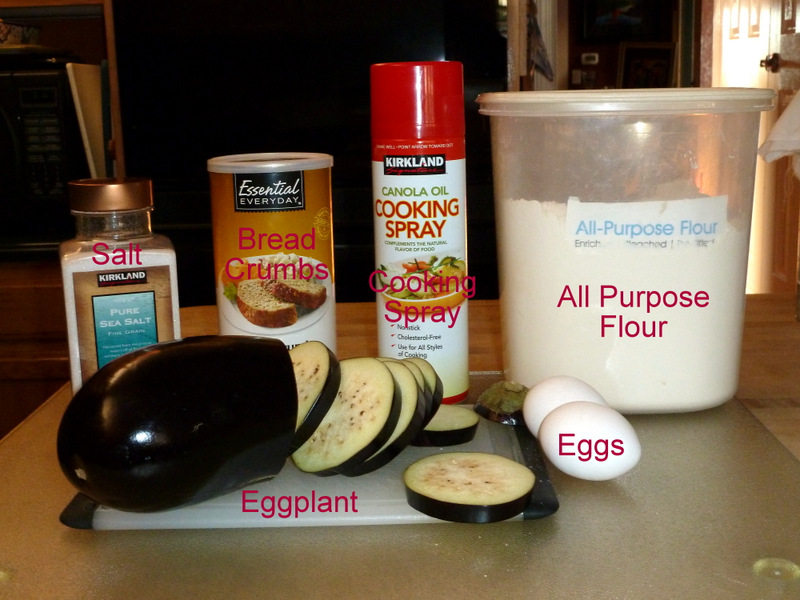
What you’ll need:

  • One large, firm, fresh eggplant
  • Salt . . . lots of salt
  • All purpose flour
  • Egg wash (2 eggs beaten with four tablespoons of water)
  • Breadcrumbs (I prefer plain, although you may like Italian)
  • Cooking spray
  • Optionally — grated parmesan cheese

Cut the eggplant into thick slices — from ⅓- to ½-inch thick.

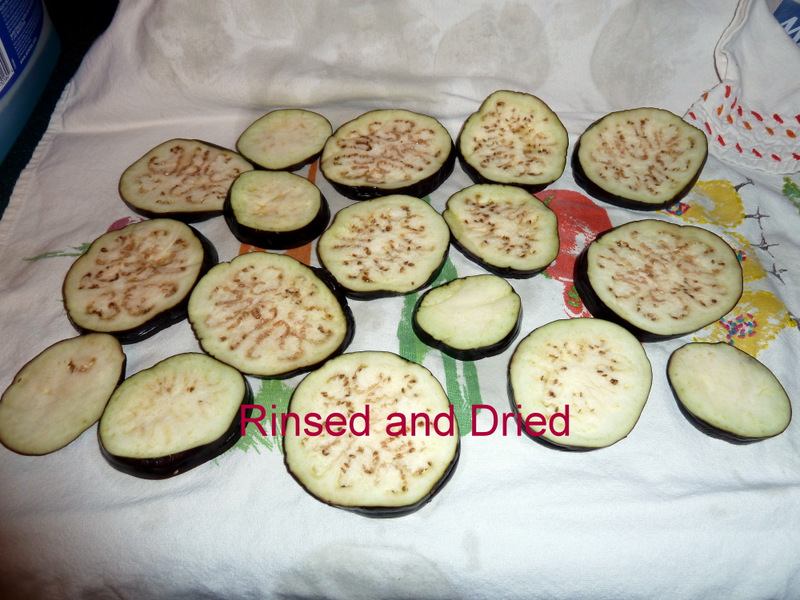
Now for that secret trick to remove the bitterness that some people seem to taste in eggplant:  Liberally coat both sides of each slice with lots of salt, place the slices into a bowl or colander, and just let the slices sit for about an hour.  You’ll notice that the salt seems to extract from the eggplant a darkish liquid.  That’s what we’re looking to draw out.  After the salt has done its job just rinse it away along with the bitterness and pat dry the slices.

Salt Away the Bitterness

Salt Away the Bitterness

Rinsed and dried

Rinsed and dried

At this point you may want to mildly salt the slices again, but there will be some residual salt inside the slices so go sparingly.  Dredge the slices through the flour.

Floured

Floured

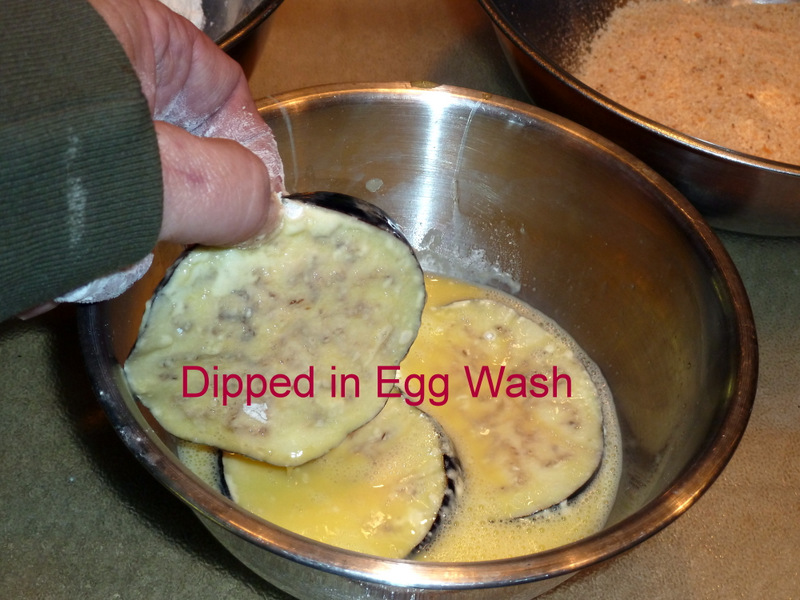
Coat both sides of each floured slice with the egg wash.

Dipped in Egg Wash

Dipped in Egg Wash

Toss the eggplant with breadcrumbs until thoroughly coated.  Here’s where the optional parmesan cheese comes in — mix some into the breadcrumbs for additional flavor if desired.

Coated in Bread Crumbs

Coated in Bread Crumbs

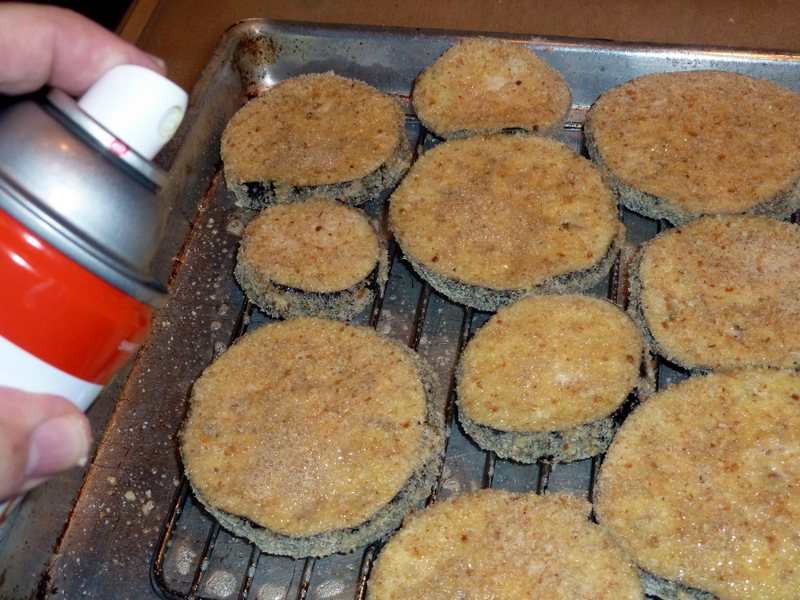
Arrange the slices onto a rack placed inside a shallow oven-proof tray.  Spray the top of the slices with a layer of oil.

Sprayed with Cooking Oil

Sprayed with Cooking Oil

Place the eggplant, rack, and tray under the broiler, but not too close.  You want the slices at least eight inches to a foot away.  If your oven has a “Convection Roast” feature (in which the convection fan blows while the broiler element supplies the heat) so much the better.  This is the method I use with the oven set to about 400° to 425°.

Check the slices frequently.  Once they start to brown they can burn pretty quickly.  When the slices are nicely and evenly browned remove the tray from the oven.  Flip the eggplant slices and spray another layer of oil on the newly exposed side.  Return to the oven and brown.

Flip and Repeat

Flip and Repeat

Once the oven “frying” is complete remove the eggplant and use in any of several ways as mentioned above.

Wine pairing:  Hey, it’s Italian.  You certainly can’t go wrong with Sangiovese or Chianti Classico, right?  Other options include Shiraz if you’re using a spicy marinara.  Pinot Noir makes another good choice, especially if you’re going to serve the slices straight out of the oven.  Tempranillo would make for a creative but workable pairing.  I would tend to stay away from Super Tuscans, Bordeaux-style reds, or heartier Zinfandels as they would probably overpower the delicate eggplant flavor.

3 Comments

Filed under Wine & Food

Easy Parker House Rolls — Expertly Adapted by R. Doug Wicker


400° at About 16 Minutes

Fresh from the Oven

Another Baking Day at the Casa de Wicker.  I recently came across an internet article for something that looked interesting — Parker House Rolls.  Problem was that the recipe provided used six cups of flour and made way too many rolls, 3½ dozen to be precise.  The original Parker Omni recipe also seemed unnecessarily complicated and tedious.  For instance I hate hand-kneading when I can get the same results much more quickly and efficiently through mechanical means.

Thus it was time to get inventive.  First I would have to reduce the amounts.  Then I would need to come up with an alternative method of mixing all the ingredients together.  What I came up with is super simple, incredibly easy, and very tasty.  The amount came out to a baker’s dozen, a perfect amount for a family of two for breakfast with a half-dozen more available for freezing and later use.

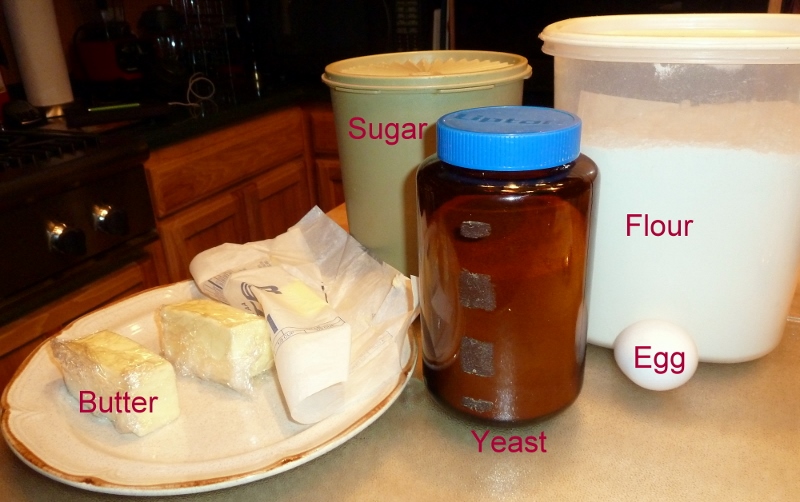
Parker House Rolls Ingredients

Parker House Rolls Ingredients

What you’ll need:

  • 2 cups general purpose flour
  • 2 ½ tbsp. sugar
  • ¾ tsp. salt
  • 1 ½ tsp. yeast
  • 3 tbsp. softened butter
  • 1 ½ tbsp. beaten egg
  • ⅔ cups hot water straight from the tap
  • Another 3 to 4 tbsp. butter for later in the recipe
  • More flour for rolling out the dough and forming the rolls

Step 1:  Assemble your food processor with the plastic dough blade.  Place the flour, sugar, salt, yeast, and 3 tablespoons of softened butter into the food processor.  Pulse the food processor until all ingredients are combined.

Step 2:  Pulse into the above ingredients the ⅔ cups of hot water and the 1 ½ tablespoons of beaten egg.  Scrape sides as necessary.  Keep pulsing until the liquids are completely incorporated and the mixture forms a uniform dough.

In the Food Processor

In the Food Processor

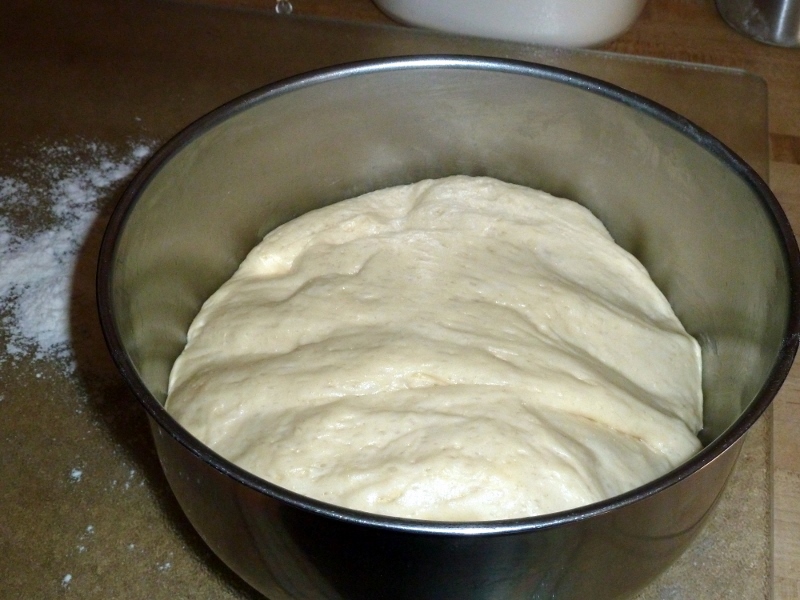
Step 3.  Place the dough into a buttered bowl and turn the dough so that it is fully greased on all sides.  Cover the bowl and allow the yeast to do its work at a temperature of between 80° and 85° (27° to 29° Celsius).  I place mine in a warmed oven and regulate the temperature accordingly.  Let the dough rise for about 1 ½ hours.

Buttered Bowl

Step 4.  Turn the dough out onto a floured surface and form into a tight ball.  Cover the dough ball with the inverted bowl and let rest for about ten minutes or so.

After Proofing — Form into a Ball

After Proofing — Form into a Ball

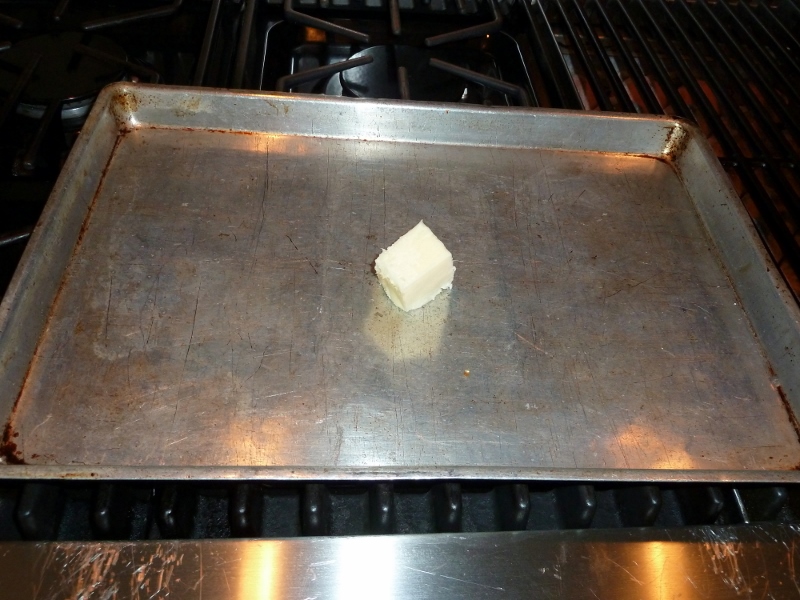
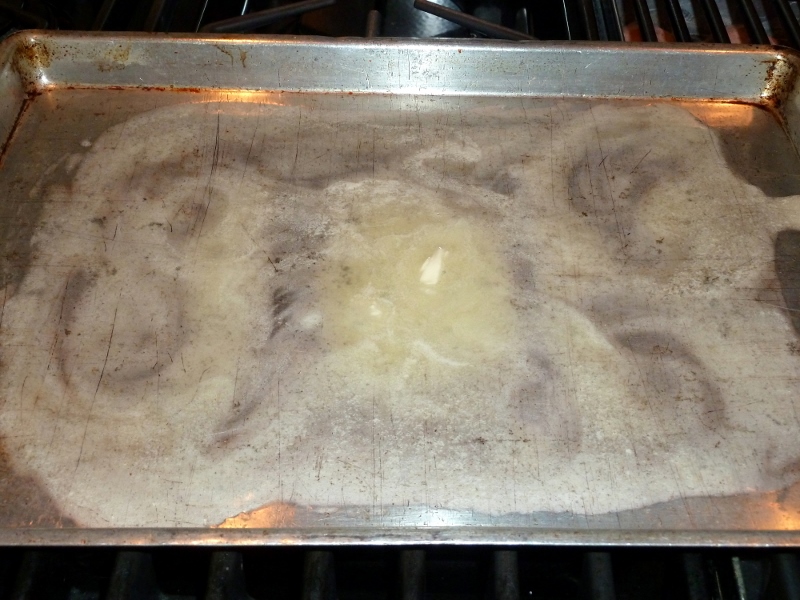
Step 5.  While the dough is resting, place a baking sheet over low heat and melt onto it about 3 tablespoons of butter.  Smear the melted butter around the baking sheet.

Heating a Baking Pan

Heating a Baking Pan

Melting the Butter

Melting the Butter

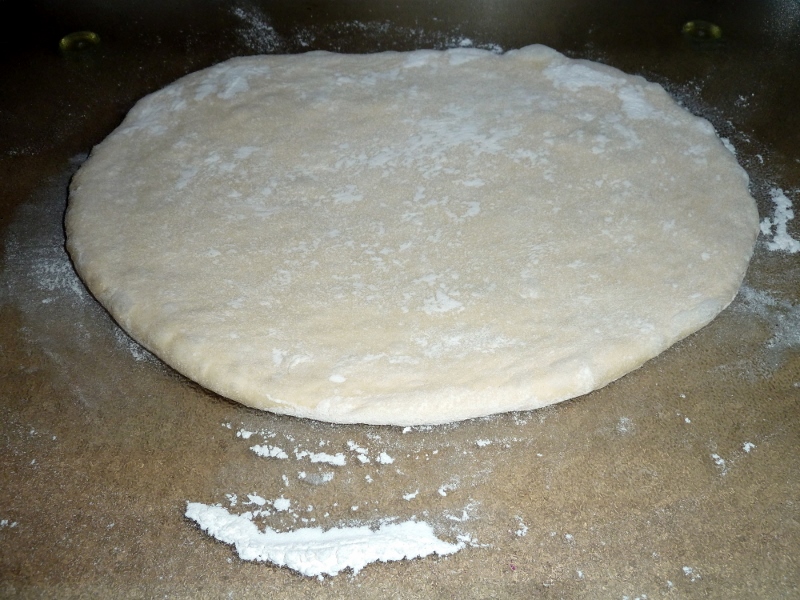
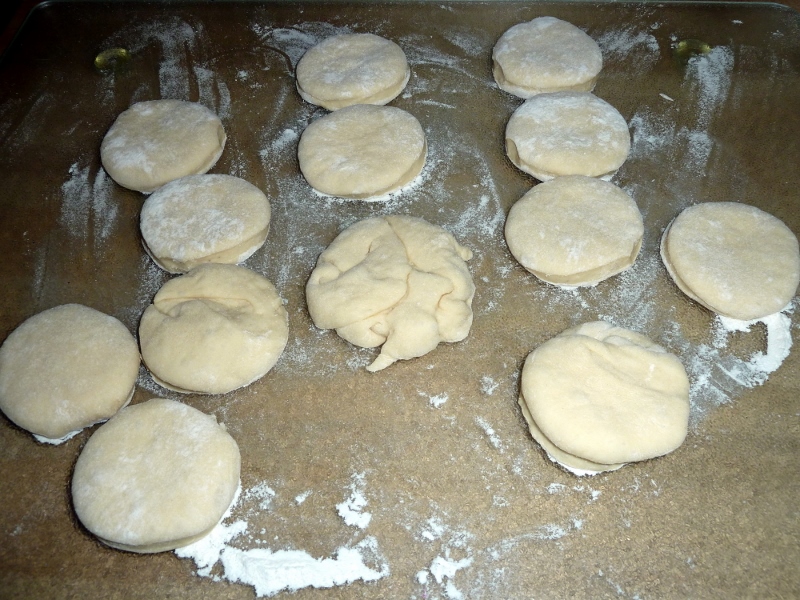
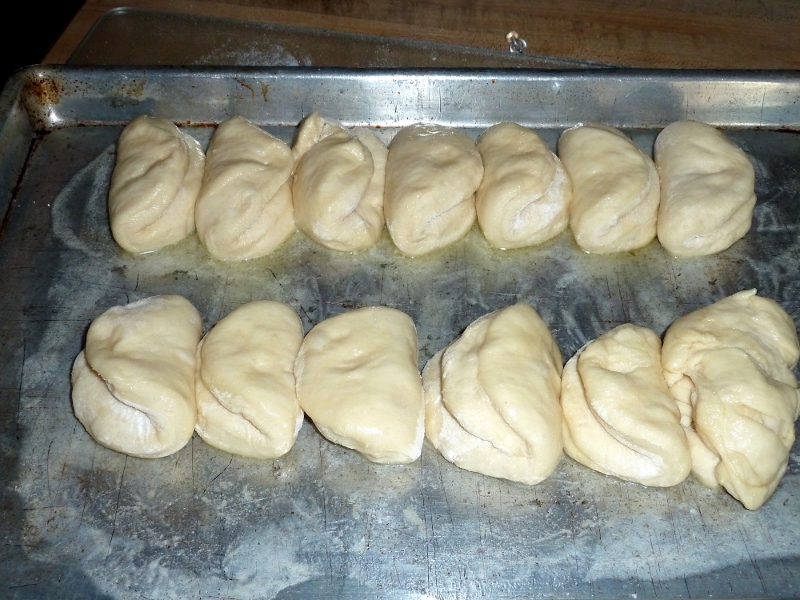
Step 6.  Roll the dough out to a thickness of ½ inch (1.25 centimeters).  Cut the dough into 2 ¾-inch (7 centimeter) rounds.  Dip the rounds into the melted butter, coating both sides, and fold.  I find the rounds fold a bit more nicely and hold together better if I stretch them slightly into an oval shape.  Arrange the folded rolls in rows with the rolls slightly touching.  Don’t worry about the rolls sticking together.  They come apart quite nicely after the baking.

Roll Dough to ½-Inch

Roll Dough to ½-Inch

Cut into 2¾-Inch Rounds

Cut into 2¾-Inch Rounds

Ready to Fold

Ready to Fold

Step 7.  Cover the rolls and return them to the warmed oven for another rise of about forty minutes.  While this is going on heat your other oven to 400° (205° Celsius).

Dipped in Butter and Folded

Dipped in Butter and Folded

Step 8.  Uncover the risen rolls and place into the hot oven for between 15 and 18 minutes (16 minutes worked perfectly for me) until the rolls are nicely and uniformly browned.

40-Minute Rise

40-Minute Rise

You’re done.  Serve warm with more butter, your favorite jam or jelly, or dripping in honey.

400° at About 16 Minutes

400° at About 16 Minutes

My Swiss-born and raised wife Ursula who lives for European-style breads positively loved these light, fluffy, and slightly sweet rolls.  The buttery taste is vaguely reminiscent of the French croissant, but Ursula actually preferred the taste of these rolls.  That’s high praise indeed coming from a European.

Going Fast!

Going Fast!

At any rate I would use these rolls in place of most biscuit applications not involving gravy.  As such they’re definitely going to find a place at our table come next Thanksgiving Day.  They’re just too easy to make and too tasty to forgo for a meal that special.

Freezing and Reheating Tips:  Tightly cover each individual roll in plastic wrap and place them into a freezer bag.  When ready to use defrost overnight in the refrigerator or on the counter for about an hour.  Unwrap and place the defrosted rolls into a steamer basket and steam for five minutes.  Place the steamed rolls onto a tray and put them into a 250° oven for about five minutes to take care of any residual sogginess from the steaming process.

5 Comments

Filed under Wine & Food