Tag Archives: New Mexico

Trinity, Jumbo, and the Gadget


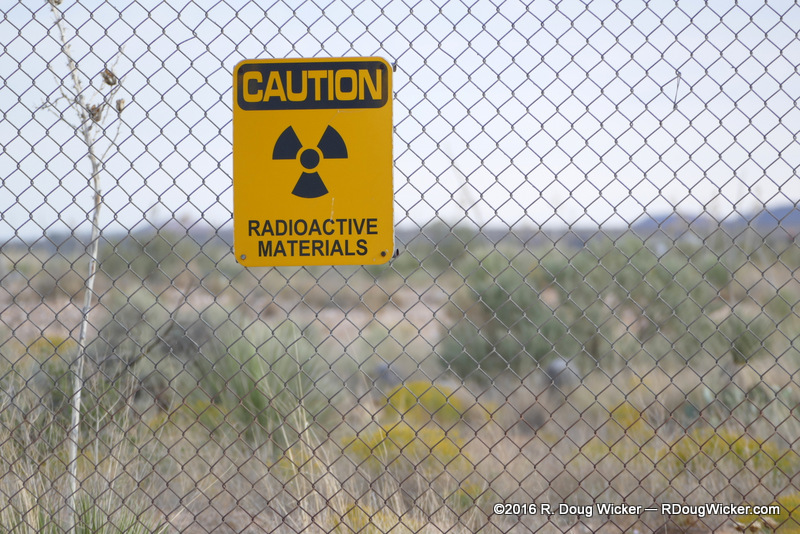
Still radioactive over seventy years later

Still radioactive over seventy years later

Twice a year there’s an obscure area of scrubland at the north end of the White Sands Missile Range that is opened to the public.  Access is tightly controlled.  Vehicles are monitored.  Guards are posted along the way to direct you.  Photography en route to and from this remote site is prohibited.  You are about to tour Ground Zero for the world’s first nuclear bomb, a.k.a., “The Gadget“.  Welcome to Trinity Site:
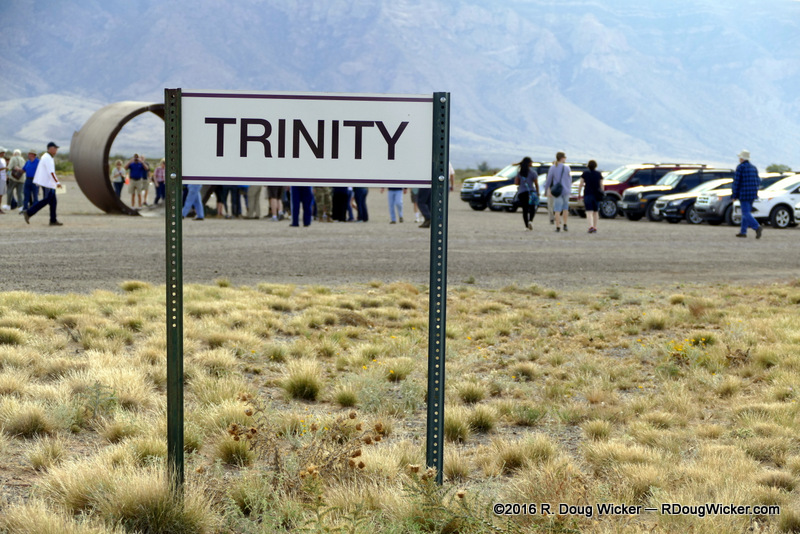
Trinity Site

Trinity Site

Trinity is open for public access annually on the first Saturday in April and October.  For this year — 2016 — that would be Saturday, April 2 and October 1.  The easiest way to get to Trinity is on U.S. Route 380 eastbound off Interstate 25 just south of Socorro, New Mexico, or westbound on U.S. Route 380 from Carrizozo, New Mexico, to the Stallion Gate entrance (12 miles east of San Antonio, NM; 53 miles west of Carrizozo, NM) sometime between the hours of 8:00 A.M. and 2:00 P.M., at which time that entrance is closed.  The alternative is to arrive early in the morning at the Tularosa High School before 8:00 A.M. and caravan in to Trinity under escort, which requires another escorted caravan back out from the site at between 12:30 and 1:00 P.M.  The site is closed to all visitors at 3:30.  As you can see, that makes the unescorted Stallion Gate route the more visitor friendly route.  A word of caution:  measure the distances I cited from San Antonio or Carrizozo.  The entrance is poorly marked and easily missed.
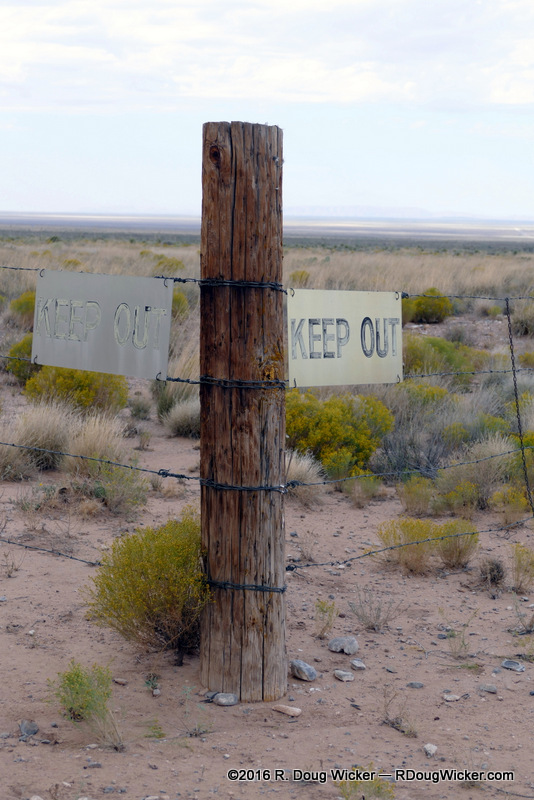
That means YOU!

Starting today and over both this week and next I’ll be showing you not only Trinity Site, but also the McDonald Ranch House where the project scientists stayed, and where the plutonium assembly room for the bomb is located.  I’ll also show you trinitite — glass-like, greenish, mildly radioactive fused sand and earth created by the heat of the nuclear explosion.
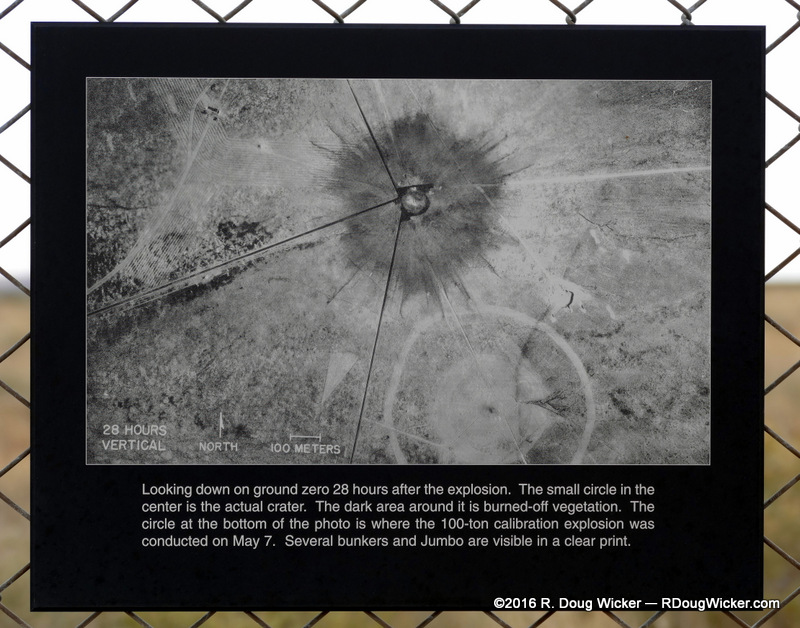
Trinity Site-029

Ground Zero

Today I’m go to show you Jumbo.  Jumbo was a gigantic steel container that originally weighed 214 tons/194 metric tons and measured ten feet/three meters wide by 25 feet/7.6 meters long.  It’s not that big anymore, and neither does it still weigh 214 tons.  It was also much thicker than you see here.  This is the six-inch thick inner container.  Originally bonded to that were another nine inches of steel plating.

The remains of Jumbo

The remains of Jumbo

Jumbo was originally designed as a containment for The Gadget, in case the conventional explosive failed to set off the plutonium core.  But as Manhattan Project scientists grew more confident that The Gadget would indeed work, Jumbo was instead suspended from a tower some 2,600 feet/800 meters from Ground Zero just to see what would happen to it.  It survived relatively intact, although you wouldn’t know that looking at these pictures.  That damage to Jumbo was done two years later when the Army attempted to destroy their $12,000,000 unused container to keep Congress from asking embarrassing questions about the unnecessary expense.  Eight 500-pound/227-kilogram bombs were placed inside Jumbo and detonated, but that only succeeded in blowing off the ends.
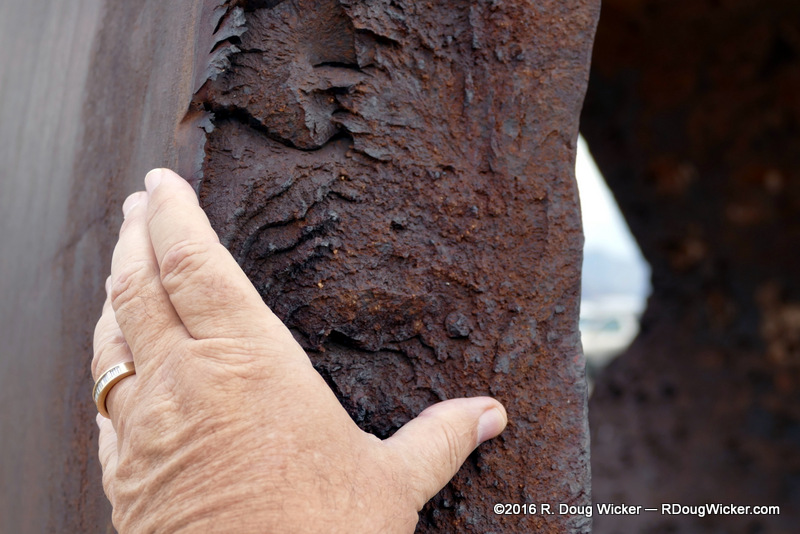
Jumbo's six-inch thick inner steel wall

Jumbo’s six-inch thick inner steel wall

We’ll continue our tour on Wednesday.  Meanwhile, remember The Twilight Zone?
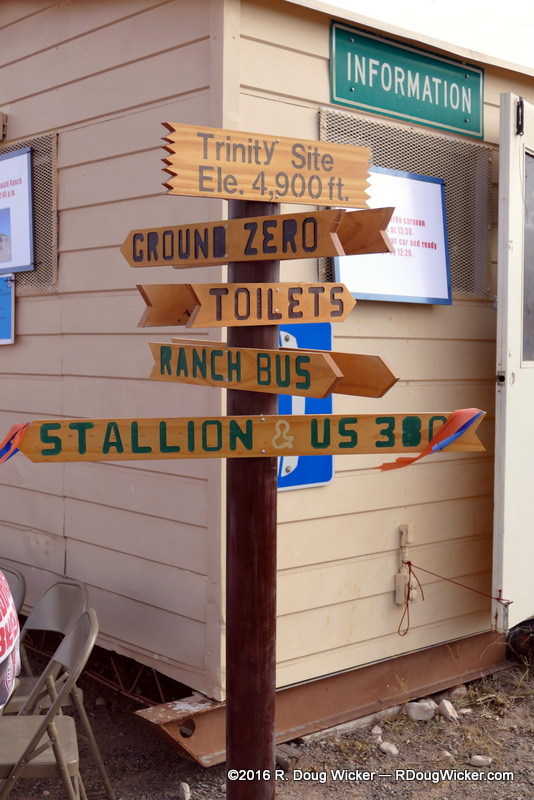
There's a Sign Post up ahead; Your Next Stop — The Twilight Zone
There’s a Sign Post up ahead; Your Next Stop — The Twilight Zone
4 Comments

Filed under Photography, R. Doug Wicker, travel

Fun Photo Friday — David Williams at Cloudcroft, Mexican Canyon, and the Franklins


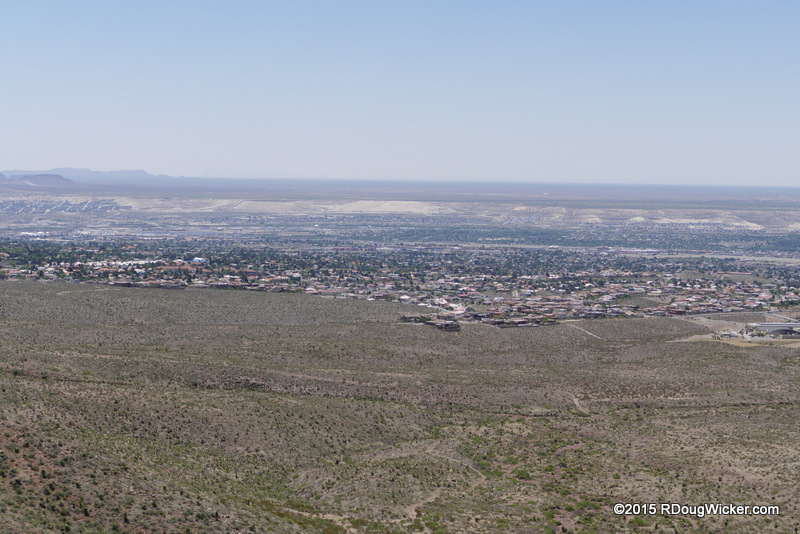
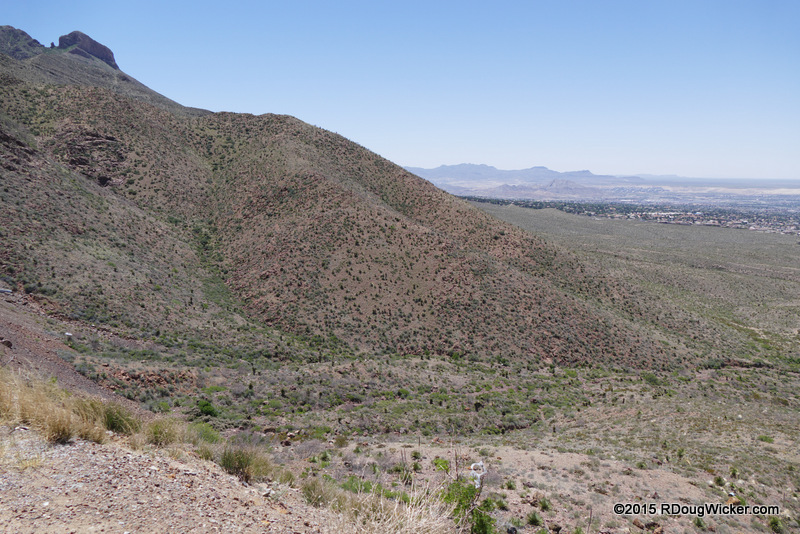
View from Transmountain Pass

View from Transmountain Pass

Don’t go away from the past two weeks’ worth of blog posts thinking the only things to see in the El Paso area are outside El Paso.  Far from it.  El Paso is  a major city — 19th in the country in terms of population, and fifth largest in Texas.  And it’s unique.  It’s the only major U.S. city I know that is divided by a mountain chain.  The Franklin Mountains divide West El Paso from the Northeast portion of town.  Only a narrow strip of land between the south end of the Franklins and Juarez Mountains, through which the U.S.-Mexican border meanders, allow routine passage from west to east.  This gap between the Franklins and the Juarez Mountains is the “Paso” (pass) in “El Paso”.  The only other route is along Transmountain Road, which cuts through the Franklins and crests at an altitude of one mile/1.6 kilometers above sea level.  That 5,280-foot/1,609-meter elevation puts you some 1,300 feet/400 meters above the surrounding desert, so from here you can get really fantastic views of two countries (U.S. and Mexico) and three states (Texas, New Mexico, and Chihuahua).

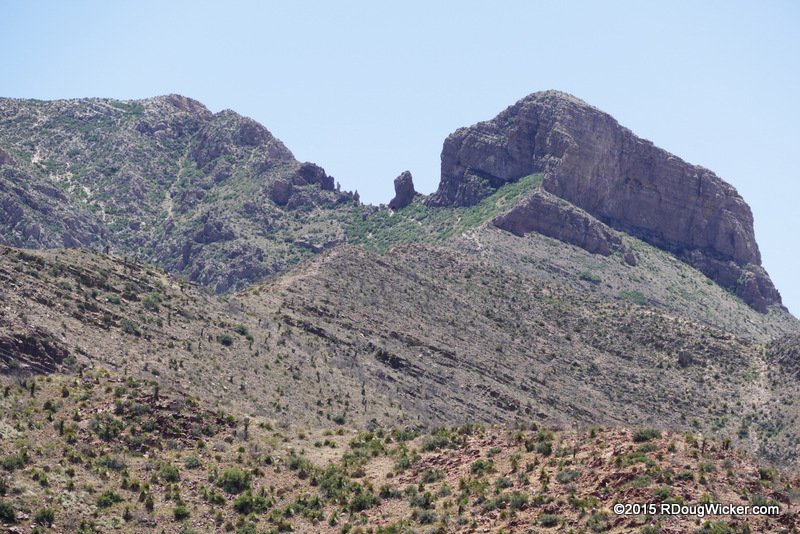
The Franklins themselves offer some very interesting sights as well.  For instance, here’s a shot of Elephant Rock as seen from Transmountain Road:

Elephant Rock — Franklin Mountains

Elephant Rock — Franklin Mountains

As for this excursion to Cloudcroft and our stop at Mexican Canyon, here are my two favorite shots from that portion of our David Williams Tour:

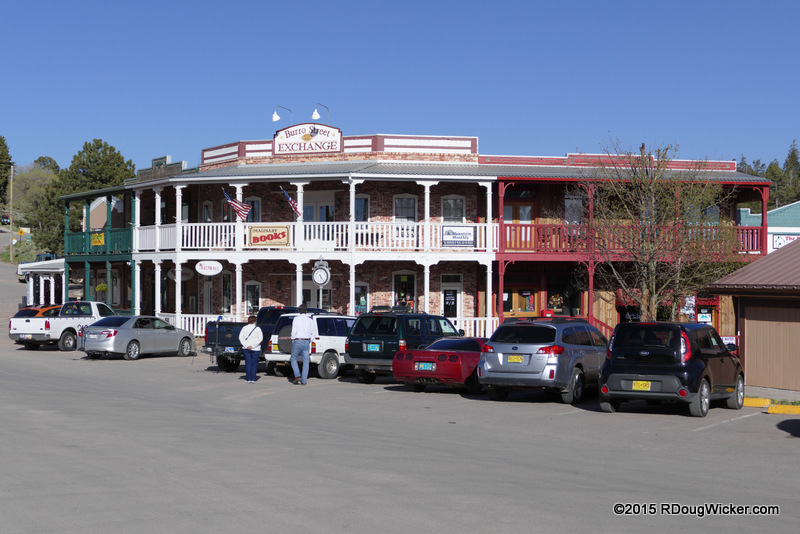
The Burrow Exchange, Cloudcroft

The Burrow Exchange, Cloudcroft

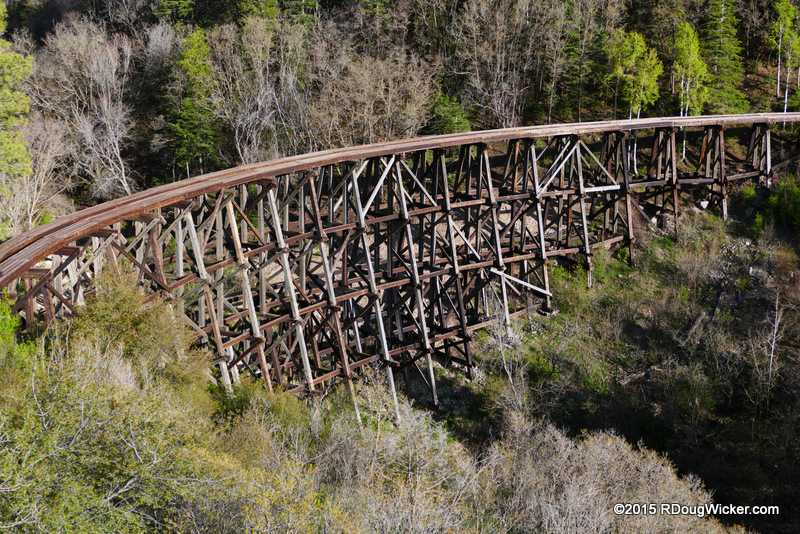
Last, favorite look at Mexican Canyon Trestle

Last, favorite look at Mexican Canyon Trestle

By the way, if you’re reading this and other material authored by me on The Destinary website, this post was not “Posted on (fill in the date) | By destinary” as they’ve been erroneously claiming; this material was in fact reposted.  The Destinary have also been claiming the right to do so, without links back to the original and without full attribution (“by RDoug” and a nonworking link is not proper attribution) with a rather bizarre interpretation of U.S. copyright law in which they claim I’m responsible for changing my RSS feed settings so that they cannot skim my material for commercial purposes.  That would make reading my blog less convenient for you, which I’m not willing to do.  As such, I’ll be running this little diatribe on all travel related posts until they cease and desist, along with this:

© 2015 R. Doug Wicker (RDougWicker.com)
All right reserved — that includes you, Destinary

Final note:  Considering The Destinary is a site listed as owned by Sonia Bosquez-Platt of Indianapolis Tour & Travel, you may want to rethink doing business with her or her company.

2 Comments

Filed under Fun Photo Friday, Photography, R. Doug Wicker, travel, vacation

The Williams Tour Part 6 — Cloudcroft, Mexican Canyon, and back to El Paso


Burro Street Exchange, Cloudcroft

Burro Street Exchange, Cloudcroft

On Monday I gave you a little of the Lincoln-area history, with an emphasis on the infamous — Billy the Kid.  Today we’ll take a look at history more closely associated with Cloudcroft.  At 8,668 feet/2,642 meters above sea level, Cloudcroft is one of the highest villages in the United States.  As with many Old West towns, the railroad is what built Cloudcroft and it’s the timber that brought the railroad to this lofty locale.  In the late 1890s the El Paso and Northeaster Railroad reached Togaggan Canyon just outside present day Cloudcroft, and by 1900 Cloudcroft — “Pasture in the Clouds” — was born with the completion of a train depot.

"Cloud Climbing Railroad"

“Cloud Climbing Railroad”

This section of the rail was called the Cloud-Climbing Railroad because the trains frequently entered into dense fog on the trek to and from Cloudcroft.  It was far from a safe journey, however.  The Cloud-Climbing Railroad climbed and descended along a steep 5.2% grade that navigated some 330 curves, and the rails ran over 122 box bridges and 58 timber-framed trestles.  The tallest trestle, towering 60 feet/18 meters above the terrain, was over Mexican Canyon.  The Mexican Canyon Trestle also spanned some 323 feet/98 meters.  How dangerous was this trip?  As former train engineer Tom Shorten so eloquently put it, ““Well, if I go too slow the logs jump off, and if I go too fast the cars jump off.”

Mexican Canyon Trestle — Built in 1899

Mexican Canyon Trestle — Built in 1899

While timber may have brought the railroads, it was El Pasoans and other nearby desert dwellers seeking to escape the summertime desert heat that helped to sustain it for many decades.  The average high temperature in Cloudcroft during June and July is 73.5°F/23.1°C (June) and 71.2°F/21.8°C (July).  At night those average temperatures plunge to a refreshing 44.2°F/6.8C (June) and 47.3°F/8.5C (July).  Tourism became a major factor for Cloudcroft’s economy, and still is to this day.  But by 1938 roads and automobiles brought an end to passenger rail service, and the Cloud-Climbing Railroad closed for good by 1948.

After snapping some pictures of Mexican Canyon Trestle, Ursula and I escorted David Williams back to El Paso in preparation for our next excursion the following day (more on that next week).  On this week’s Fun Photo Friday I’ll present my favorite shots from this portion of our David Williams Tour and our return through Transmountain Pass within El Paso’s Franklin Mountains.  Until then, here’s a view from Transmountain Road of West El Paso looking into neighboring both Old and New Mexico in the distance:

View from Transmountain Pass of West El Paso and both Old and New Mexico

View from Transmountain Pass of West El Paso and both Old and New Mexico

By the way, if you’re reading this and other material authored by me on The Destinary website, this post was not “Posted on (fill in the date) | By destinary” as they’ve been erroneously claiming; this material was in fact reposted.  The Destinary have also been claiming the right to do so, without links back to the original and without full attribution (“by RDoug” and a nonworking link is not proper attribution) with a rather bizarre interpretation of U.S. copyright law in which they claim I’m responsible for changing my RSS feed settings so that they cannot skim my material for commercial purposes.  That would make reading my blog less convenient for you, which I’m not willing to do.  As such, I’ll be running this little diatribe on all travel related posts until they cease and desist, along with this:

© 2015 R. Doug Wicker (RDougWicker.com)
All right reserved — that includes you, Destinary

Final note:  Considering The Destinary is a site listed as owned by Sonia Bosquez-Platt of Indianapolis Tour & Travel, you may want to rethink doing business with her or her company.

3 Comments

Filed under Photography, R. Doug Wicker, travel, vacation