Invergordon offered up a lot of murals for me to photograph. And I love local color. So, today’s Fun Photo Friday will be heavy on Invergordon, but will also offer up some favorites of Inverness as well. Next week I’ll take you to our next Voyage 2 Scotland destination, Greenock.
Jewel of the Seas left Cobh, Ireland on 6 June 2022. We arrived back in Amsterdam two days later, and on 10 June during the second of three voyages, we made port in Invergordon, Scotland. From Invergordon Ursula and I took the bus into Inverness for a self-guided foot tour. On this week’s Fun Photo Friday, I’ll show favorites of both Invergordon and Inverness, but today and Wednesday I’ll be concentrating on the city of Inverness. We alighted from the bus at the bus station on Margaret Steet and headed out southwest. After some twists and turns — Margaret St., right onto Academy St., then left School Ln. (a narrow pedestrian street), we arrived at our first picture stop, Old High Church and its graveyard.
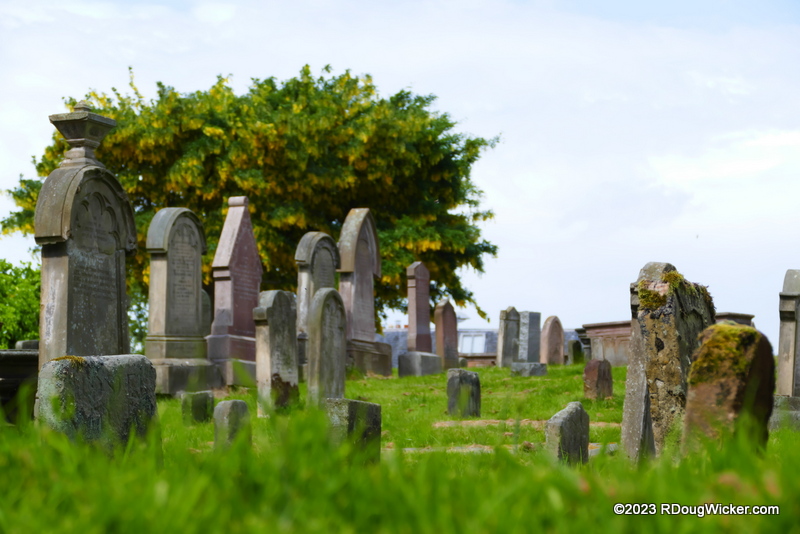
Old High Street Church Graveyard
The first documented church located on this site dates back to 1171. Construction of the current structure began in 1770, but the base of the belltower is much older. That part is from the 14th century, making that portion of the church the oldest structure still standing in Inverness.
Old High Church
Unfortunately, I did not know that when I took these photographs. So, my photo of the belltower lacks the historic base:
Old High Church belltower
Old High Church is not the only great church façade near here. Turn left onto Bank Street and you’ll immediately see two more. First, you’ll see the Gothic-styleFree North Church built in 1893:
Free North Church at 7 Bank Street
And just a short distance beyond Free North Church is the Junction Church, formerly the St Columba High Church building completed in 1852:
The Junction Church; formerly St Columba High Church
And what’s that I spy across the River Ness? Why, yes, it’s another church! This is St. Mary’s:
St Mary’s Catholic Church at 30 Huntly Street
St Mary’s opened for business in 1837, and the exterior details are magnificent:
St Mary’s Church, 30 Huntly Street along River Ness
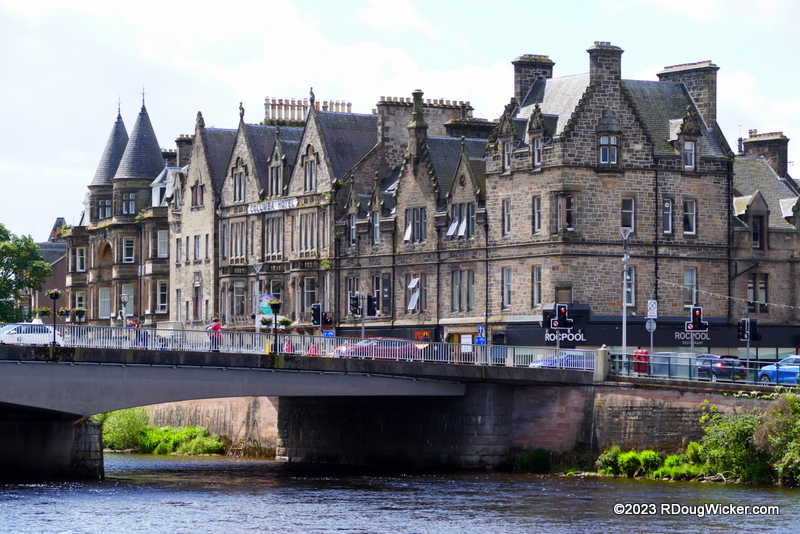
Standing on Bank Street along River Ness across from the Junction Church, face south for these views of Ness Bridge and the Best Western Palace Hotel and Spa:
Ness Bridge (foreground) Best Western Palace Hotel (left) Columba Hotel (left-center)
These old buildings just south of Ness Bridge are fun to photograph. The Columba Hotel was built in 1881, and the Palace dates from about a decade later.
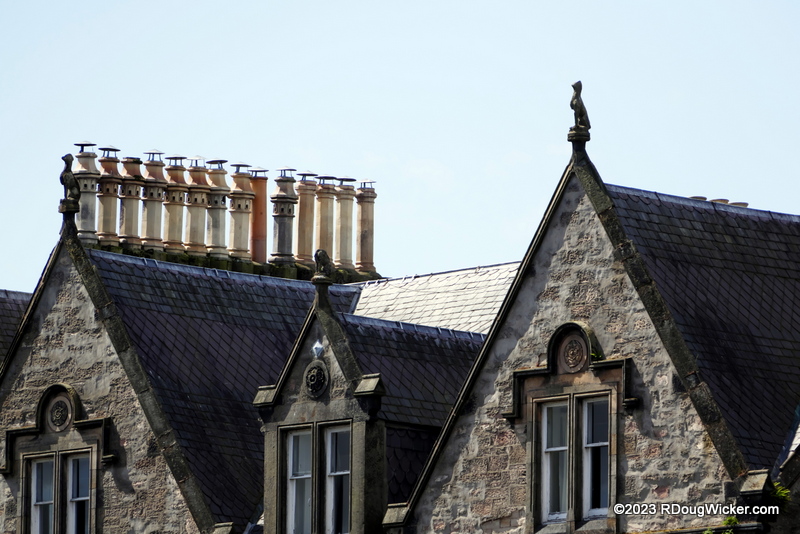
Columba Hotel details
The building adjoining Columba Hotel also has an interesting roofline:
Columba Hotel (far left) on Ness Walk
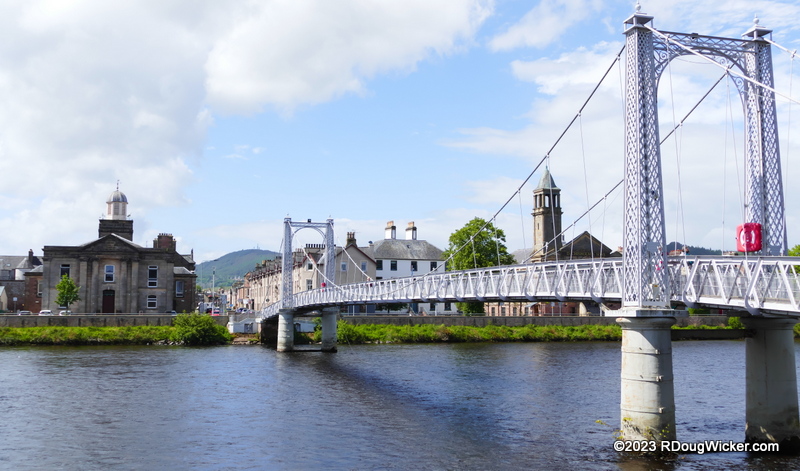
At this point Ursula and I decided to cross River Ness, leaving behind Bank Street for Huntly Street. Fortunately, just across from North Free Church, is Greig Street Bridge. This pedestrian suspension bridge was built in 1880-’81:
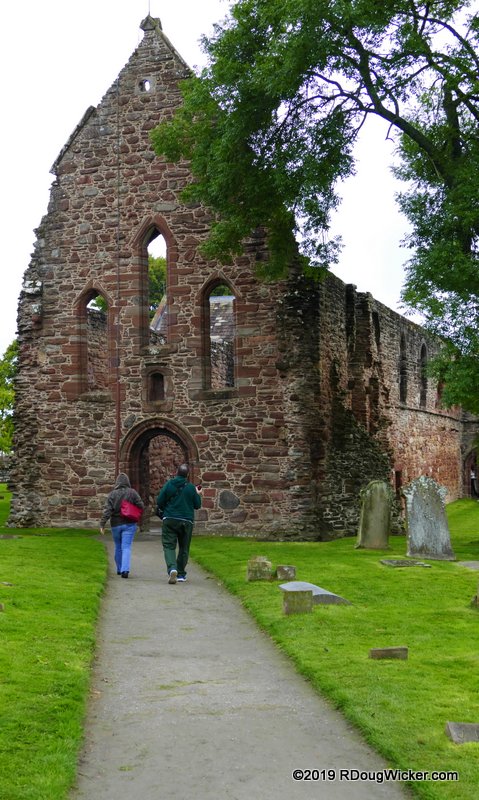
When we first signed up for this transatlantic voyage, Vision of the Seas was slated to make a rather exciting (to us, anyway) call into Lerwick, Scotland, located in the Shetlands. Ursula and I were really up for this one, as we’d already done a self-driving tour of Scotland many years before. We even primed ourselves by binge watching the British television series Shetland, starring Douglas Henshaw. Alas, Royal Caribbean cancelled that destination on the pretext that the port was unable to handle the ship, even though the new docking facilities were completed quite some time beforehand. Instead, we found ourselves steaming toward Invergordon, and Ursula had us lined up for a bus tour inland toward Inverness and Loch Ness (yep . . . I got a picture of a strange creature which you’ll see on this week’s Fun Photo Friday). Anyway, our bus headed inland, and our first stop was to the ruins of Beauly Priory near the town of Beauly.
But on April 16, 1510, the Valliscaulian Order was suppressed by Pope Julius II, and the order was gradually absorbed into the Cistercian Order.
Thus, Beauly Priory spent the last 124 years of its monasterial existence in the Cistercian Order, until October 20, 1634, when it was disestablished and its lands turned over to John Maxwell, the Bishop of Ross (1633-1638). So much for the history lesson. Here are more images of this historic ruin and its grounds (click on any image to enlarge and bring up today’s slide show):











 Decisions — Murder in Paradise
 The Globe — Murder in Luxury
 R. Doug Wicker — Author