Tag Archives: handgun

Western Wednesday — Collectible 1973 Ruger Super Bearcat Shooting Review


Ruger Super Bearcat with box, manual, warranty card

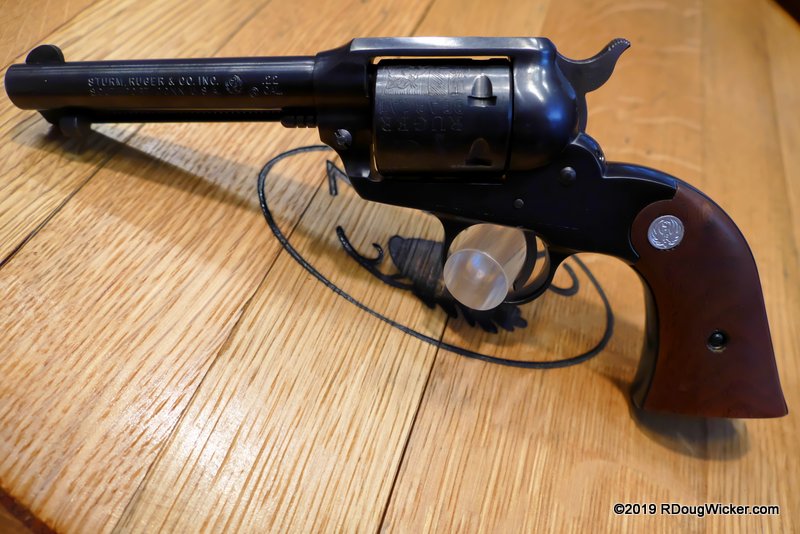
It’s time for a Western Wednesday firearm review, and today’s shooting review is on a gun that Ruger made for less than three years (June 1971-January 1974)! I’ve already discussed Ruger’s alloy framed 1st edition Bearcat (see: Interesting Collectables: “Old” 1st issue Ruger Bearcats), in which I presented a rare ‘Alpha Cat’ Bearcat and one of the very first Bearcats (624th off the line) produced with oiled walnut grips rather than the previous rosen-impregnated rosewood grips. Here is an image of those early Bearcats:

Rare 1960 “Alpha Cat” (top); very early (1964) Bearcat with oiled walnut grips

‘Unmodified’ means that both of those Bearcats were never sent back to Ruger for the transfer bar modification that would make safe the loading all six cylinders. That is why I’m referring to these pistols as Old West-style firearms, as they adhere closely to the design of the Colt 1873 Single-Action Army ‘Peacemaker. Below shows a comparison of a copy of the original Colt 1873 design along with an old issue three-screw Ruger Single Six (also unmodified) and an old issue Bearcat, all of which are only safe when the hammer rest over an unloaded cylinder chamber (more on that below):

USFA Single-Action Army; unmodified 3-screw Ruger Single Six; 1960 Ruger Bearcat

These classics may have been called ‘Six-shooters’, but disregard what you saw on television and in the movies. Nobody in their right mind would holster one of these guns with all six chambers loaded.

1973 Ruger Super Bearcat with Super Bearcat box

That means, unless you are physically at the range, on the firing line, and preparing to fire the weapon, the cylinder should be loaded so that the hammer rests upon an empty chamber. How do you do that? Here’s a recap from my previous article on the original (1958-1970) Ruger Bearcat:

Proper (safe) loading sequence for any Single-Action Army-type pistol or unmodified (no transfer bar) Ruger single-action revolver:

  1. Count out and place five (for a six-round weapon) bullets before you
  2. Five rounds only!
  3. Put the rest of the ammunition out of reach
  4. Thumb back the hammer two clicks, to the half-cock position; this frees the cylinder for rotation by hand
  5. Open the loading gate
  6. Visually inspect all cylinder chambers, making certain no bullets are loaded, by rotating the cylinder while peering down through the open loading gate
  7. After verifying all chambers are empty, place one round in the chamber exposed through the open loading gate (we’ll call this “Chamber 5”)
  8. Rotate the cylinder, bypassing the next empty chamber (Chamber 6) and proceeding to the second empty chamber (Chamber 1—why the skip will become evident in a moment); load one bullet into Chamber 1
  9. Continue loading the next three chambers in order (Chambers 2, 3, and 4)
  10. Close the loading gate
  11. Loaded Chamber 5 is next in line for the barrel, a.k.a., firing position
  12. Thumb back the hammer to the fully cocked position; doing this rotates loaded Chamber 5 away from the barrel
  13. Empty Chamber 6 is now in the firing position
  14. Holding the hammer back with your thumb, squeeze the trigger until the hammer releases
  15. Keeping the trigger pulled, gently lowering the hammer all the way to the frame with your thumb; failure to keep pulling the trigger will result in the hammer stopping at the half-cock loading position, which is not safe

You’re done. Your “six shooter” is now properly loaded with five bullets, and if you followed these directions the hammer is safely resting over an empty chamber and the weapon is safe to carry.

1973 Ruger Super Bearcat

Production of Ruger’s alloy-framed Bearcat was terminated in 1970 as the company retooled production in favor of an all-steel frame, and in June of 1971 the Super Bearcat was introduced. Initially, the Super Bearcat retained the anodized aluminum trigger guard, but even this was converted to steel after old stock was exhausted. Here you can see the Super Bearcat with steel frame and trigger guard beneath two previous Bearcats with alloy frames and anodized trigger guards:

Ruger “Alpha” Bearcat (top); Bearcat (middle); SuperBearcat (bottom)

During Ruger’s two-year seven-month run of the Super Bearcat, approximately 64,000 were produced. Of that number, the first 37,000 used the previous anodized trigger guard. Thus, beginning in early 1972, only the last 27,000 Super Bearcats produced had trigger guards of blued steel.

Super Bearcat with blued steel trigger guard

Ruger’s roll marks between the Bearcat and the Super Bearcat differed slightly, with addition to the latter of the weapon’s caliber and an ® indicating a registered trademark:
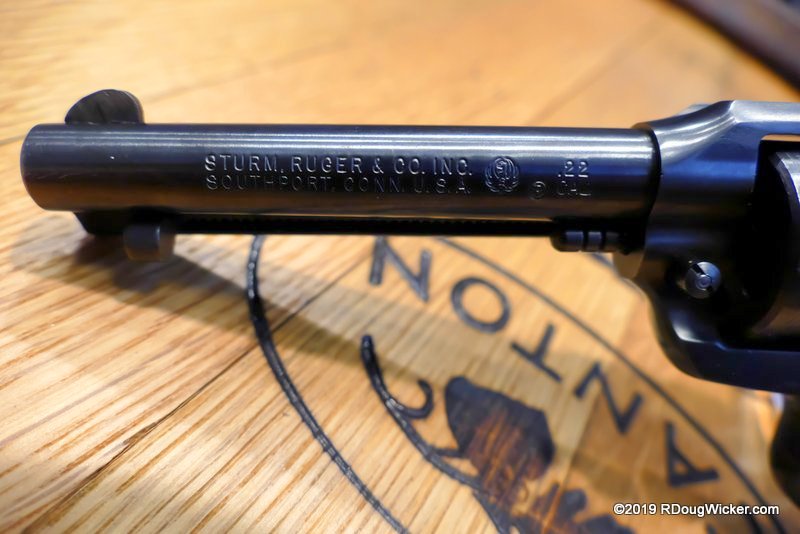
Ruger Super Bearcat roll mark

The Super Bearcat retained the lightly stamped Ruger eagle medallion and oiled grips that began with the previous Bearcat line beginning in 1964.
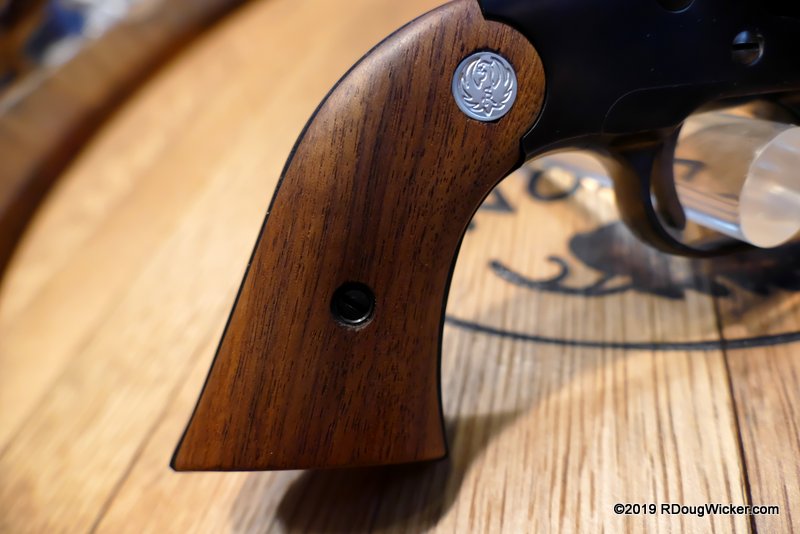
Super Bearcat oiled walnut grip with stamped medallion

And one touch that started with the original 1st edition Bearcats in 1958, continued through the 2nd edition Super Bearcat era ending in 1974, and carried on beginning with the reintroduction of the 3rd edition Bearcat in 1993 through today is an engraved cylinder:

Engraved cylinder common to all three Bearcat editions

So, how does this weapon shoot? The trigger is incredibly light, and initially the breaking of the trigger took me by surprise, but I soon got past that. I set at 10 yards/9.1 meters a target printed onto 8.5×11-inch/216x279mm standard letter-sized paper. I then loaded up and fired three full cylinders’ worth of Remington 36-grain .22 LR Plated Hollow Points, for a total of eighteen total shots. Here are the results:

Eighteen rounds at 10 yards/9.1 meters

For additional reading on both the 1st edition Ruger  Bearcat and 2nd edition Super Bearcat, I highly recommend the following great articles:

Unmodified 1973 Ruger Super Bearcat

3 Comments

Filed under Uncategorized

First look at a Rock Island Armory Ultra FS in 10mm


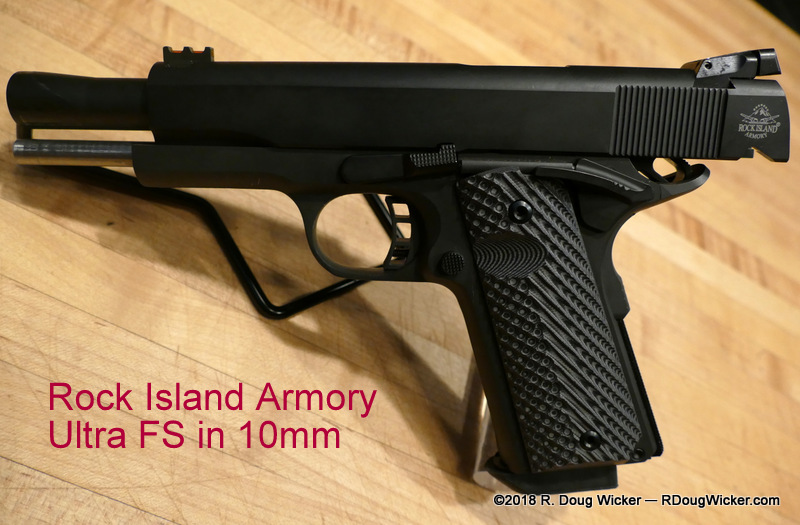
Rock Island Armory Ultra FS 10mm

People tell me that 10mm is a fun cartridge to shoot, especially out of a 1911-style pistol. I’ll let you know when I get around to trying it, but for now I’m just going to give my first impressions an a used 10mm 1911 from Rock Island Armory. Rock Island Armory have no connection with the famed U.S. Army Rock Island Arsenal. This Rock Island Armory is a subsidiary of Armscor, and is located in Marikina, Philippines.

Rock Island Armory Ultra FS 10mm

Rock Island Armory (RIA) is known for making an affordable (read: cheap) yet reliable 1911 copy. In other words, it’s a good bargain, and if you’re buying something for only occasional use and which you don’t care if it gets beat up in a holster while hiking in the woods, then cheap and used are the way to go. Thus, the RIA Ultra FS 10mm you see here today.

Rock Island Armory Ultra FS 10mm

That’s not to say that there aren’t problems with the RIA’s 10mm. Fortunately, reliability isn’t one of them, according to most reviews. What reliability issues I have seen reported appear to be what would normally be expected during break in of a new pistol using a very powerful cartridge. Finish, however, isn’t up to Colt standards. But, then, neither is the price. A new RIA Ultra FS 10mm comes in at around $300 to $400 less (street price) than the Colt Delta Elite. And for that cost advantage you get the added benefit of having a fully supported chamber, which may hold up better when firing full-powered 10mm loads. There are reports of catastrophic case failures with the unsupported chambers of some 10mm pistols such as the Delta Elite, but I’m not convinced that isn’t more attributable to home reloaders pushing the envelop on an already powerful cartridge.

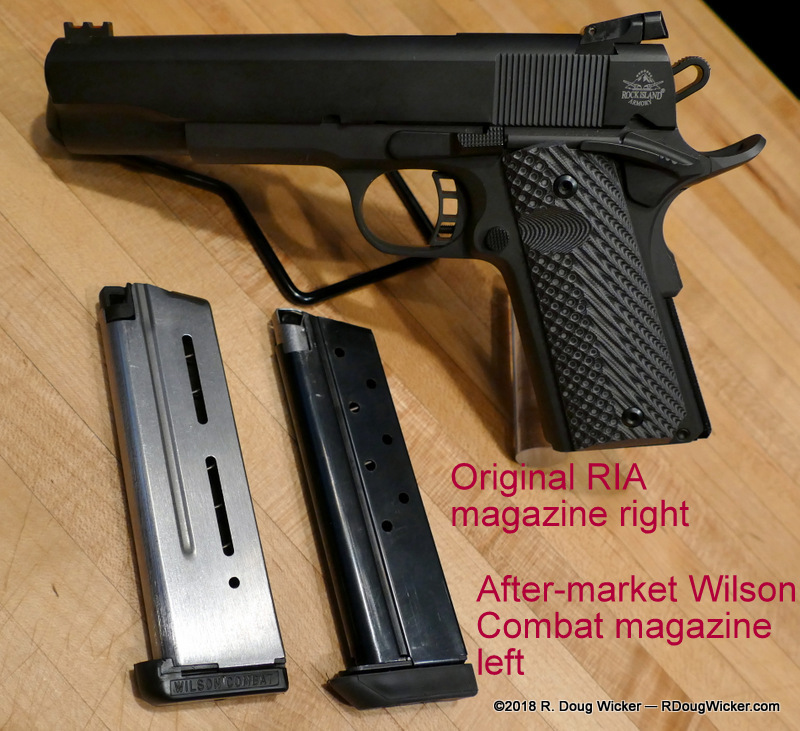
Rock Island Armory Ultra FS comes with only one magazine

Another difference compared to the Colt Delta Elite is the addition of a bushingless barrel, which supposedly improves barrel-to-slide fit, thus increasing accuracy. The bushingless design also requires a wider “bull” barrel, which slightly increases mass and thus may reduce felt recoil. However, I doubt that the very slight increase in mass here would be enough to result in any real benefit in this regard.

Bushingless design

Note the wider bull barrel at the muzzle end

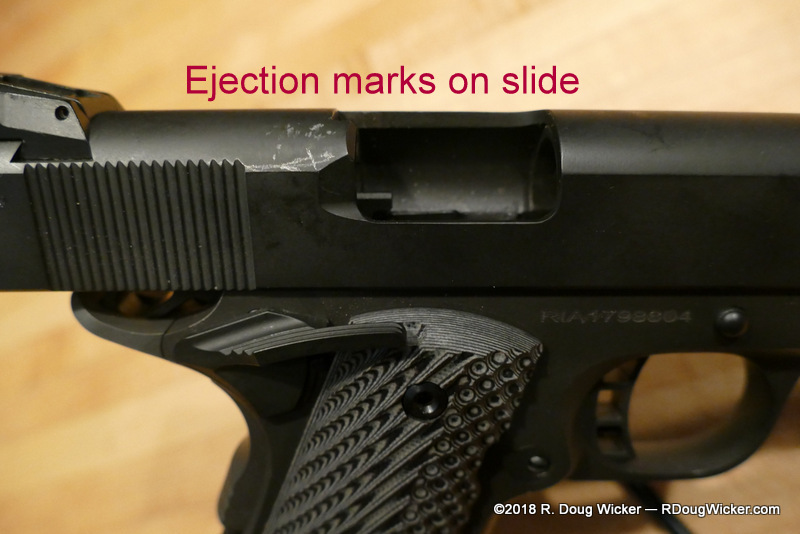
You can see from the following photograph this particular 1911 has a tendency to eject the casings in such a manner that they strike the upper portion of the slide behind the ejection port. Again, not something I’m very worried about, and I could probably remove those marks without marring the Parkerization.

Ejection marks

Rear sights are adjustable.

Adjustable rear sight

The front sight is fiber optic. Nice touch! Together, here is what you see looking down the slide:

Rear sight

Fiber optic front sight

Watch for a firing review after I get this thing to the range.

Comments Off on First look at a Rock Island Armory Ultra FS in 10mm

Filed under Firearms, R. Doug Wicker

Fun Photo Friday — 1940 Zella-Mehlis Walther PP


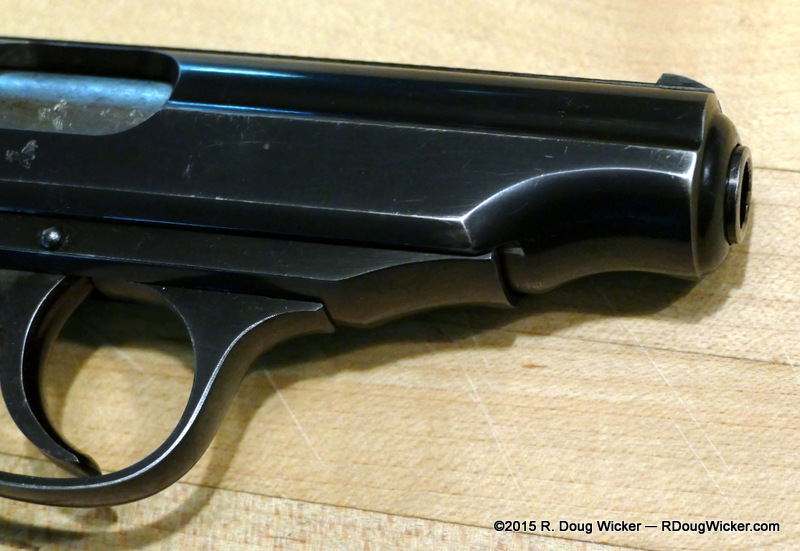
1940 Walther PP

1940 Walther PP

Well, it is firearm week.  So of course this week’s Fun Photo Friday had to contain a fun firearm photo session.

1940 Walther PP

1940 Walther PP

It pays to establish a good relationship with your favorite locally owned gun store.  It really does.  Indeed, for a collector it is vitally important to do so.

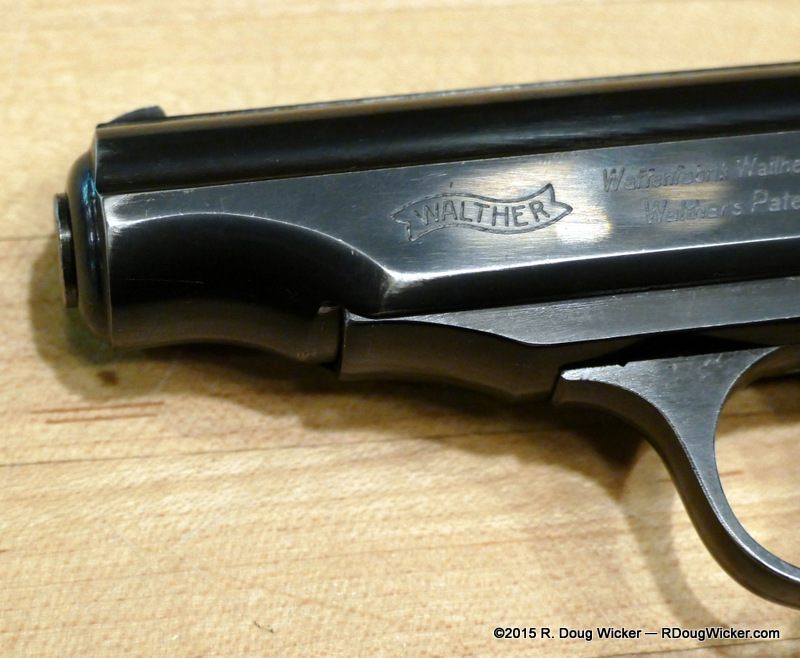
Zella-Mehlis roll mark

Zella-Mehlis roll mark

Part of that bonding is to convey to your dealer your tastes in collecting.  In my case, it’s a weakness for all things Walther.

Nazi Germany proof marks

Nazi Germany proof marks

What you see pictured here is not particularly rare, except for the condition of this 70-year-old artifact from 1940 Nazi Germany.  This is not a war piece, but rather a commercial version of the venerable 7.65mm/.32 ACP Walther PP double-action/single-action semiautomatic pistol.  It is perhaps the first truly successful DA/SA semiautomatic produced, and it was a mainstay of European military and police forces from its introduction in 1929 well into the 1980s.  Indeed, the shortened PPK version became the weapon of choice for everyone’s favorite fictional MI6 agent, the one with the Double-0 number.

Minor holster wear

Minor holster wear

As you can see, most of the original bluing remains intact with only minor holster wear and a few scratches marring the finish.

Minor holster wear

Minor holster wear

But the pistol did not come alone.  It came with a period-correct AKAH holster as well.

AKAH Holster

AKAH Holster

I took this AKAH to El Paso Saddlery for an examination to see if the leather was in need of maintenance.  It isn’t.

AKAH Holster

AKAH Holster

The boys at El Paso Saddlery said to leave it alone.  The leather is still supple and not in any danger of drying out as long as it is stored properly.

A little history here, if I could read it

A little history here, if I could read it

Unfortunately, the gun is not quite complete.  It came with a period-correct flat-base magazine, but was not accompanied by one with the finger rest extension.  That will have to wait while I find one at a reasonable price.

Period-correct magazine

Period-correct magazine

Internally the Walther PP is sound, and now clean.  I stripped away a lot of accumulated gunk and grime, but I may have a bit more work to do.

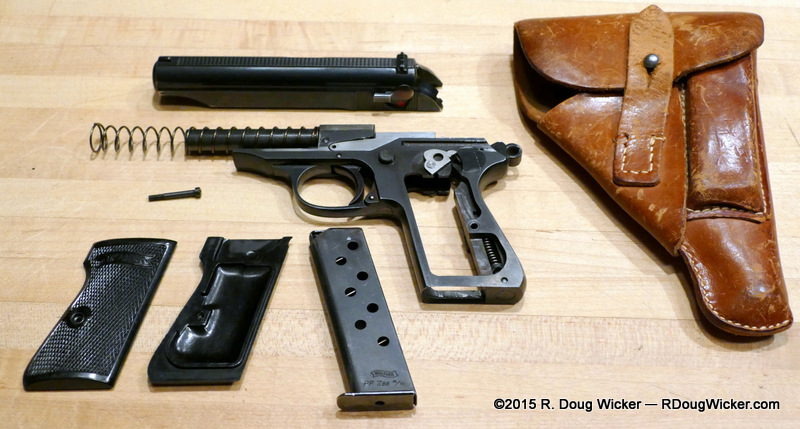
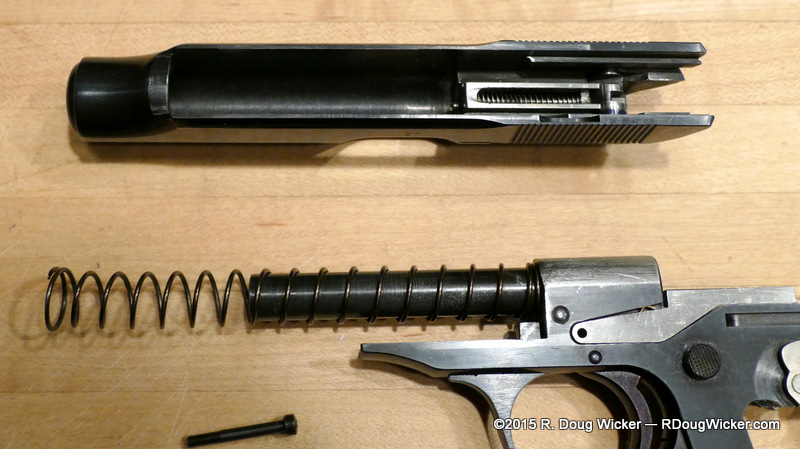
Disassembled view with AKAH Holster

Disassembled view with AKAH Holster

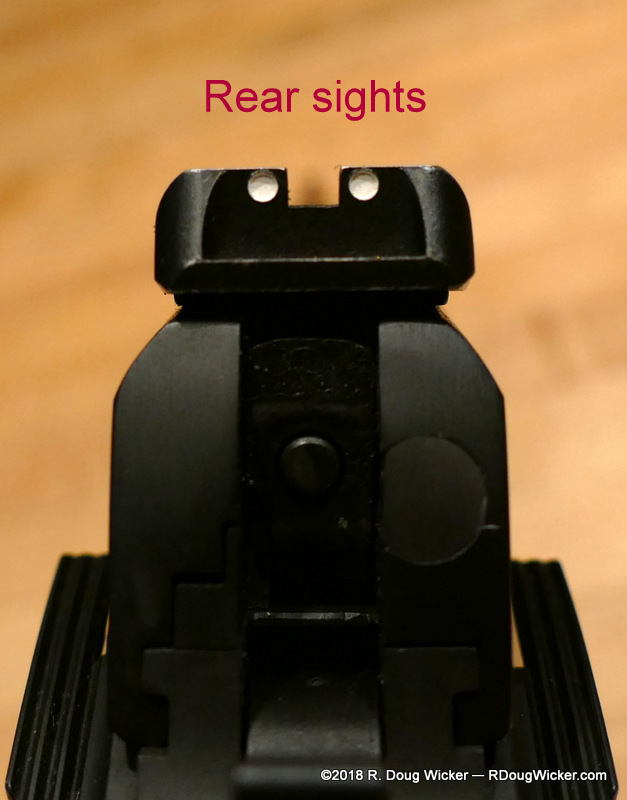
The loaded chamber indicator pin doesn’t seem to be under tension.  This could be because of a broken spring, or it could be something as simple as more gunk clogging up the channel above the firing pin even though the firing pin is operating normally.  To make sure I’ll need to do something I’ve not had to do before on any of my many PP-series Walthers, which is to remove the safety drum, firing pin, and loaded chamber indicator assembly.  If the spring is intact and functional, I’ll scrub out the channel and reassemble everything.  If not, it’s time to find a new spring — which I may go ahead and do anyway.

Firing pin and loaded chamber indicator channel

Firing pin and loaded chamber indicator channel

Enjoy one more look at this gorgeous pistol’s internal design:

Disassembled view

Disassembled view

3 Comments

Filed under Firearms, R. Doug Wicker