Tag Archives: handgun review

U.S. Fire Arms Mfg. Co. — A Look at the Premier “Colt” Model 1873 Single Action


USFA Rodeo chambered in .45 Colt

U.S.F.A. Rodeo chambered in .45 Colt

Fans of my blog posts on firearms (by far my most popular) have probably guessed by now that I’ve recently been on a Western kick, most notably with Winchester lever action rifles and copies, and clones of the 1873 Colt Single Action revolver:

I rather thought I’d had enough of this trend, but a couple of months ago my favorite local gun store (Collector’s Gun Exchange) had on consignment something from a company with which I was unfamiliar — U.S. Fire Arms Manufacturing of Hartford, Connecticut.  If that town sounds familiar, it’s because Hartford is the original home of one of the most storied names in U.S. gun manufacturing — Colt’s Patent Firearms Manufacturing Company, later renamed by dropping “Patent” from their moniker.

USFA Rodeo

U.S.F.A. Rodeo

U.S. Firearms began as in importer of Uberti-made parts for the Model 1873 Single Action revolver, a Colt design best known as the “Single Action Army“, “Peacemaker”, or just “Colt 45”.  U.S.F.A would then hand-fit these Uberti parts into superlative copies of the Colt Model 1873.  But U.S.F.A. evolved, and later began making all their own parts.
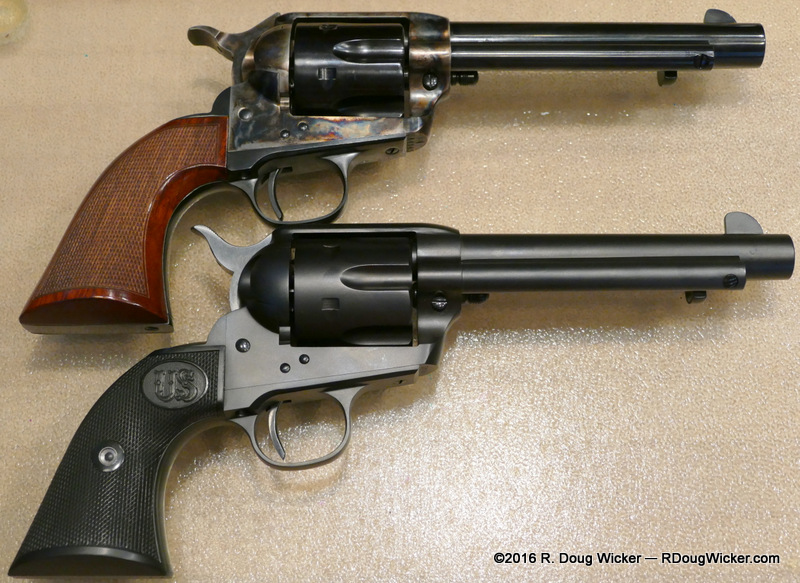
Uberti El Patrón; USFA Rodeo

Uberti El Patrón; U.S.F.A. Rodeo

These all-U.S.F.A. revolvers soon took on the reputation of being the best-made versions of the Model 1873 ever produced, exceeding in quality even the Colt originals, and far beyond anything Colt produces today.

Uberti El Patrón Competition; USFA Rodeo

Uberti El Patrón Competition; U.S.F.A. Rodeo

But when I first saw this U.S.F.A. “Rodeo” version I had no idea what I was seeing.  The matte “blue” (actually black to my eye) and the hard rubber grips made the weapon look uninspiring, to say the least.  It was only after I started researching U.S.F.A. and their later in-house products that I understood the significance.  Handling the revolver and operating the hammer, cylinder, and trigger confirmed what I’d read.  For instance, I have quite simply never handled a revolver on which the cylinder did not exhibit at least a very slight amount of “play” in the lock-up with the frame . . . up until I held this Rodeo.  The cylinder exhibited absolutely no play whatsoever, not even a hint.  It was the tightest cylinder-to-frame lock-up I have ever encountered, far beyond such highly prized revolvers as Colt’s Python, Ruger’s GP100 Match Competition, Uberti’s El Patrón Competition model, or even offerings from Smith & Wesson’s Performance Center.
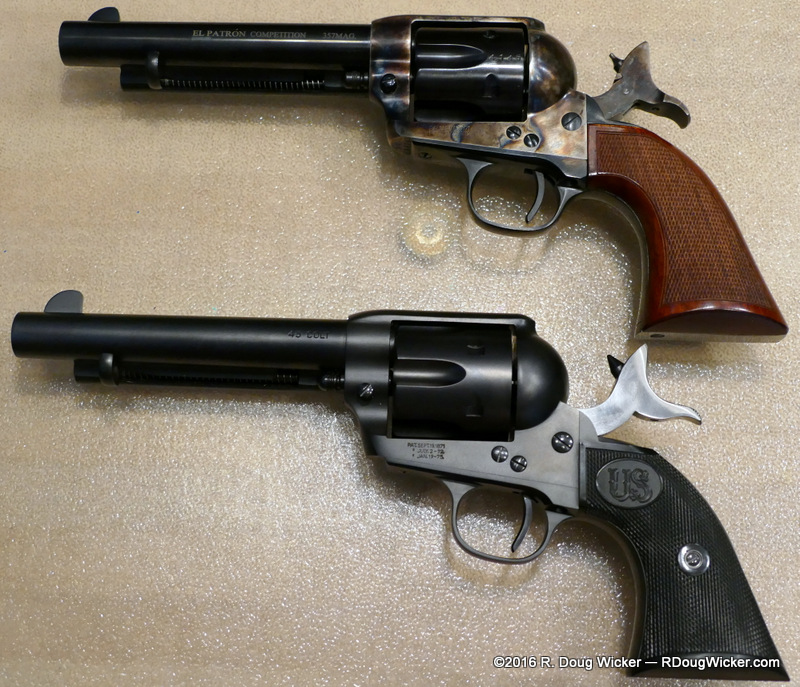
Uberti El Patrón Competition; U.S.F.A. Rodeo — Note the hammer/firing pin differences

Uberti El Patrón Competition; U.S.F.A. Rodeo — Note the hammer/firing pin differences

And the U.S.F.A. Rodeo was their “cheap” offering!  Not from any degradation in the fit and tight tolerances, but rather that matte finish and the hard rubber grips.  Considering when new these Rodeos went for several hundred less than their case-hardened brethren, I think that matte finish was a small price to pay for a pistol of this quality.  Apparently so, too, did Cowboy Action Shooters, who snatched these up whenever they could.
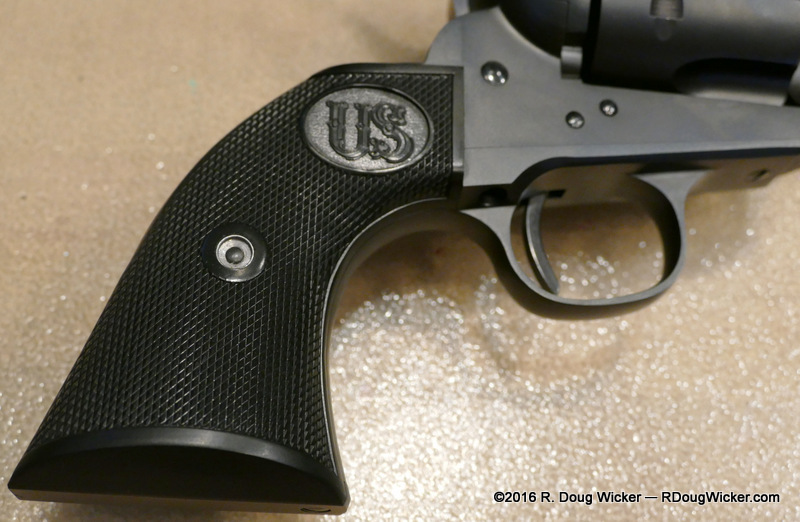
USFA Rodeo hard rubber grips

U.S.F.A. Rodeo hard rubber grips

And then there was the caliber.  This U.S.F.A. Rodeo was chambered for .45 Colt, which matched another weapon I had planned on having Mike DiMuzio convert for me, an early Interarms-Rossi M92 copy of the famed Winchester Model 1892.

"45 Colt", sometimes referred to as .45 'Long' Colt, or .45 LC

“45 Colt”, sometimes referred to as .45 ‘Long’ Colt, or .45 LC
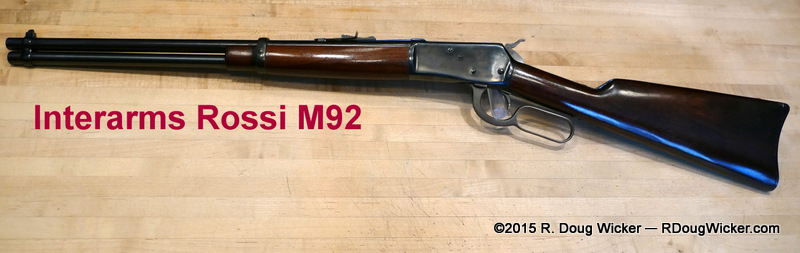
Interarms Rossi M92 in .45 Colt

My intent, up until Mike’s unfortunate and very untimely death late last year, was to have the Rossi converted as I had the one pictured below, mimicking the Winchester Model 1892 used by Chuck Connors in the classic 1958-to-1963 television series The Rifleman.

Mike DiMuzio “Rifleman” conversion top; early Interarms Rossi M92 below

Rossi Ranch Hand pistol top; DiMuzion “Rifleman” conversion below

Well, Mike unfortunately has passed, and I was left with a .45 Colt Winchester clone.  As any cowboy will tell you, your rifle’s caliber should always match that of your sidearms, and my Uberti Single Action revolver is chambered in .38 Special/.357 Magnum, which matches my “Rifleman” conversion, but not my Interarms Rossi.  So, the Interarms Rossi simply required a similarly chambered .45 Colt revolver.  That’s the story I gave Ursula, and I’m sticking to it.  So, after much research and considerable “Do I really need this?” soul searching, the U.S.F.A. Rodeo finally followed me home like some abandoned puppy, complete with original foam-lined box and protective gun sock (top foam piece removed to show U.S.F.A. label).

U.S.F.A. Rodeo complete with box and gun sock

U.S.F.A. Rodeo complete with box and gun sock

I tried to date this weapon as best I could using the serial number, but that turned out to be an exercise in stupidity on my part.  I say stupidity, because I originally estimated this Rodeo as dating back to around 2002.  Then I noticed the fine print on the label.  U.S.F.A. revised their inner box label in July, 2006 (see lower left corner), and copyrighted the label that same year (lower center).

U.S.F.A. MFG. CO., Hartford, CT (Connecticut) label

U.S.F.A. MFG. CO., Hartford, CT (Connecticut) label

Now my revised estimate is a manufacturing date sometime between July 2006 (duh!) and the company’s demise sometime in 2011 (another duh!), with my best guess being late 2006 to sometime in 2007.

U.S.F.A. MFG. Co. HARTFORD C.T. U.S.A.

U.S.F.A. MFG. Co. HARTFORD C.T. U.S.A.

Why did U.S.F.A. fail?  It’s what I call “The Walmartization of the American Economy”, in which Americans grow increasingly addicted to lower prices at the expense of quality.  And, like all addictions, this one is also bad for us.  It depresses everything from standards to wages, but I digress.  Just quit Walmart for Target,  and exchange your Sam’s card for one from Costco is all I say on the matter.  You, your neighbors, your country, and your grandchildren will all eventually thank you in the future.

Bottom line:  U.S. Fire Arms could not price this high-quality, hand-fitted firearm to a point where it was profitable to continue making them, even with the cheaper matte finish.

Authentic Colt Patent Stamps: Sept. 19, 1871; July 2, 1872; July 19, 1875

Authentic Colt Patent Stamps: Sept. 19, 1871; July 2, 1872; July 19, 1875

What makes the U.S.F.A. better than, say, the Uberti?  Other than the incredibly tight tolerances and hand-fitting, I mean?  How about authenticity.  For one, the Uberti uses a low-profile style hammer for easier, quicker cocking; whereas the U.S.F.A. version has a more correct silhouette.  The U.S.F.A. firing pin is also conical, as was the original Colt, while the Uberti uses a tapered firing pin.
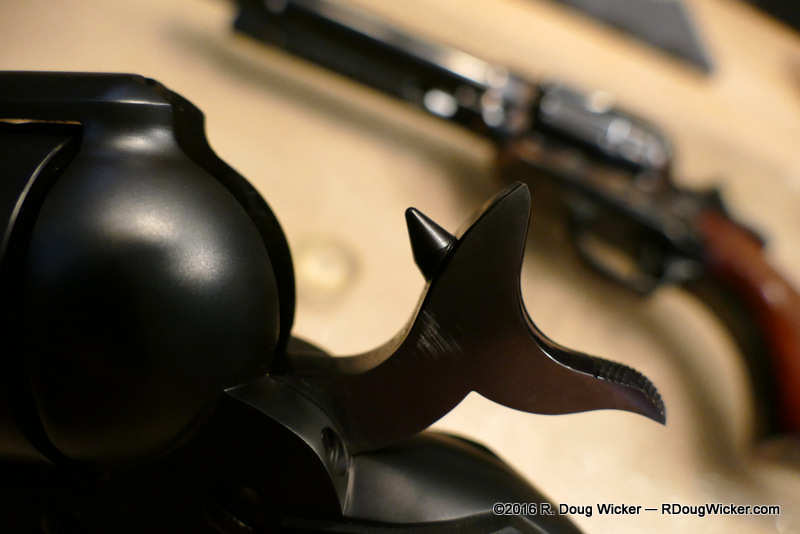
Period correct conical firing pin on the U.S.F.A. Rodeo
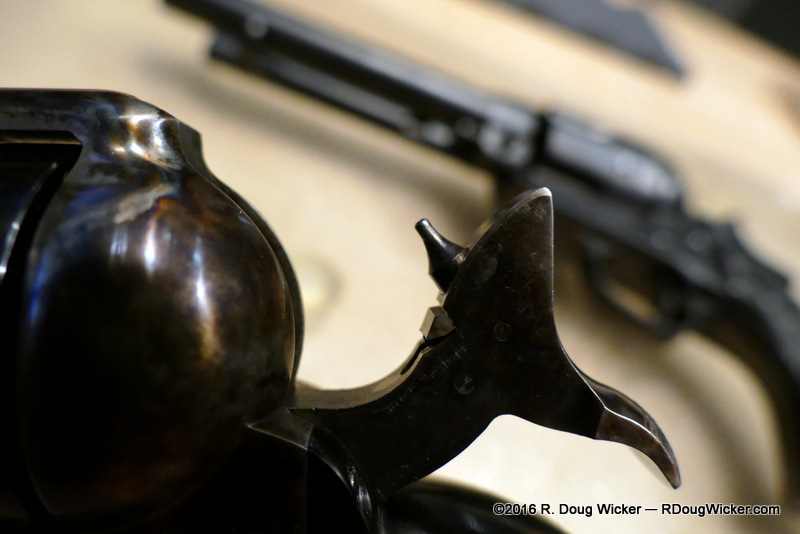
Uberti tapered firing pin

Uberti tapered firing pin

The trigger on the U.S.F.A. Rodeo is very good . . . but it’s not quite as good as that on Uberti’s El Patrón Competition.  Both exhibit minimal-to-nonexistent trigger movement and an exceptionally clean break, but the El Patrón Competition has, as you would expect from the name, a competition trigger that breaks at what I estimate to be barely over two pounds.  Most people would consider that a “hair-trigger”.  The Rodeo trigger requires slightly more force to trip the hammer, but not much.  Thus, the Uberti wins on three counts — trigger pull, price, and finish.

Uberti case-hardened finish; U.S.F.A. Rodeo matte blue finish

Uberti case-hardened finish; U.S.F.A. Rodeo matte blue finish

That’s not to say that this rodeo was exorbitantly priced.  Far from it.  Comparing to what other Rodeos in similar condition are commanding, it appears this one went for a little more than half what one would expect, especially as I suspect that this example is unfired.

U.S.F.A. Rodeo loading gate

U.S.F.A. Rodeo loading gate

Now this next comparison is a bit of a shocker.  As tight and solid as the U.S.F.A. Rodeo feels in hand, it actually weighs in at nearly three ounces less than Uberti’s offering — 2.82 counces/80 grams less, to be precise.  It could be that the added weight on the Uberti results from beefing up both frame and cylinder to handle the higher pressures of the .357 Magnum round, or it could be the Uberti’s wood grips come at a weight premium over the U.S.F.A.’s rubber, but those are just guesses on my part.

U.S.F.A. Rodeo .45 Colt comes in at 38.16 ounces/1,082 grams
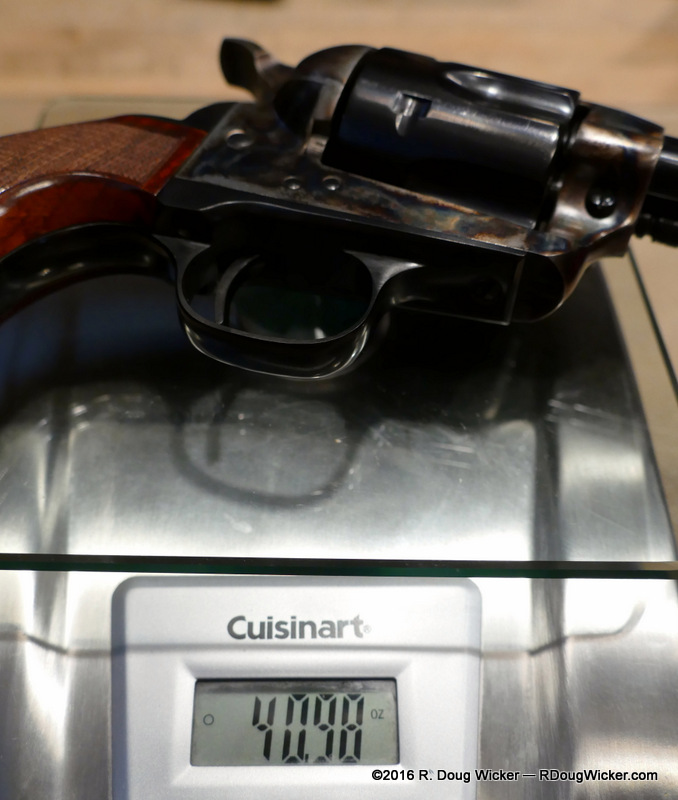
U.S.F.A. Rodeo .45 Colt comes in at 38.16 ounces/1,082 grams

Uberti El Patrón in .357 Magnum/.38 Special weighs 2.82 ounces/80 grams more

Uberti El Patrón in .357 Magnum/.38 Special weighs 2.82 ounces/80 grams more

There are two guns that vie for the title “The Gun that Won the West”.  Both were introduced to the American public in the year 1873.  One was a lever action rifle — the Winchester Model 1873.  The other was the original version of the revolver you’ve read about today — Colt’s Model 1873 “Peacemaker” Single Action Army.  I hope you’ve enjoyed today’s modern interpretation of this Colt classic.  Next week we return to the Chile-to-Santiago cruise aboard the Golden Princess.  Next stop — Nicaragua.
1 Comment

Filed under Firearms, R. Doug Wicker

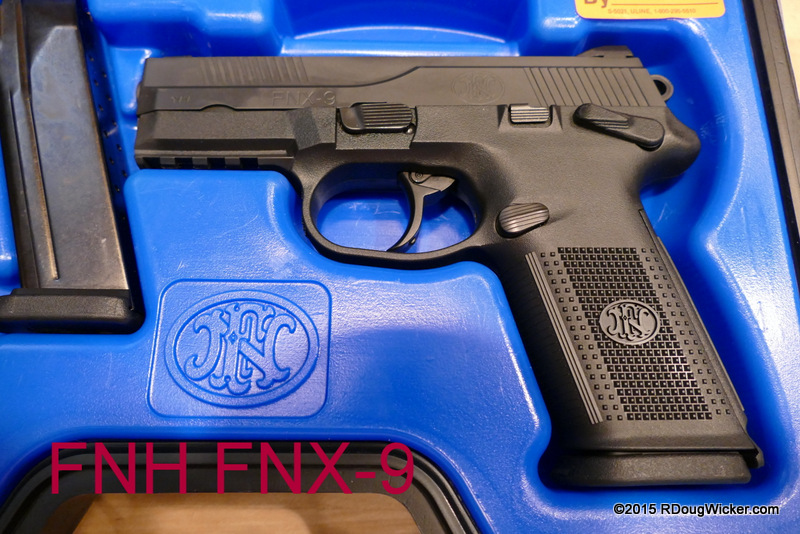
FNH FNX-9 — A Shooting Review


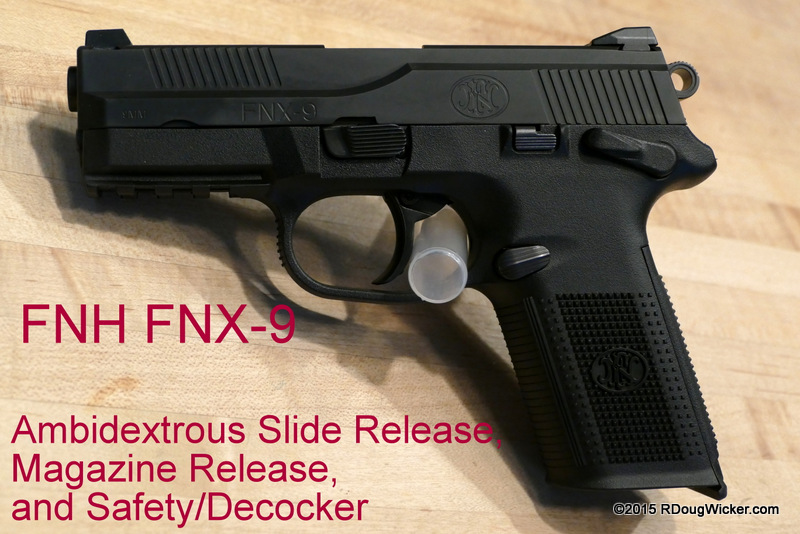
FNH FNX-9

FNH FNX-9

One of my favorite modern weapons is the FNH FNX-45.  And I suspect I’m not the only one, as my review of the FNX-45 is one of my most frequently searched for and read blog posts.  In the past year alone that review has garnered nearly 5,600 hits, second only to my review of the classic Walther PP chambered in .32 ACP.  The FNX-45 is, quite simply, a near-perfect home defense weapon especially when combined with a Beretta CX4 9mm Carbine.  If you’re a rancher located two hours or more from the nearest sheriff substation, these are the two weapons you want guarding the ol’ homestead against any potential two-legged predators.

So, imagine my delight when my local favorite gun storeCollector’s Gun Exchange owned by my good friend Paul Lee — had a slightly used FNH FNX-9 on sale for about $150 below typical new prices.  Apparently the previous owner only ran a couple of magazines’ worth of 9mm ammunition through it before he discovered that the FNX wasn’t on the El Paso Police Department’s list of approved duty weapons.  Subsequently, the previous owner traded it in on a Glock.  That’s too bad for the EPPD, because in my view the FNX is far superior to the Glock in every respect.

FNH FNX-9 complete kit

FNH FNX-9 complete kit

FNH products come with a substantial number of goodies that you’ll pay extra for with other brands, including even my beloved Walthers and SIGs.  With the FNX series you get not two, but rather three 17-round magazines.  That’s a lot of firepower at no additional cost to the buyer.  The FNX-9 also comes with four interchangeable back straps — two different sizes in two differing textures — each incorporating lanyard attachments.

Three magazines and four back straps included

Three magazines and four back straps included

The pistol itself comes equipped with a MIL STD 1913 rail and a serrated trigger guard.  Internally, as with the FNX-45, the slide rails attached to the frame are replaceable in the unlikely event that you wear them out.

FNH FNX-9 disassembled view

FNH FNX-9 disassembled view

Controls are simple, straightforward, intuitive, and easy to manipulate.  These include fully ambidextrous slide releases, magazine release buttons, and safety/decocker levers.  The FNX-9 is a hammer-fired, double-action/single-action pistol that also allows for cocked-and-locked carry using the ambidextrous safety.  Depressing the safety lever downward beyond the firing position safely decocks the hammer to place the weapon into double-action mode.

FNX FNX9-003

FNH FNX-9 ambidextrous controls

That is simply a lot of versatility for the money, and in this the FNX exceeds by a wide margin most other modern polymer handguns currently on the market, even those approaching twice the FNX’s price.

Disassembly is SIG-simple.  Just lock back the slide, rotate the take-down lever above the trigger (the one control not ambidextrous), unlock the slide while while firmly holding it, then ease the slide forward off the frame.  Once the slide is dismounted, simply remove the recoil spring assembly and barrel.  Reassembly is just the reverse, and can either can be accomplished in mere seconds.

FNH FNX-9 disassembled view

FNH FNX-9 disassembled view

So, how does the FNH FHX-9 shoot?  Once again, as with the FNX-45, the barrel and slide remain locked for far longer travel distance than with any other semi-automatic handguns I’ve handled.  This in conjunction with the low bore access seems to result in an extremely light and controllable recoil that allows for very quick target reacquisition and fast follow-up shots.  Aim is intuitive, but point of impact seems just a tad high.  I wasn’t really trying to evaluate aim on this outing, as I was firing this day at a target previously set up for the new Ruger Mini-14 Tactical 300 AAC Blackout.  That target sat about 60 feet/18 meters downrange.  But with that in mind, not only was I on the paper, I was also only somewhat high and just slightly left of my point of aim.  Groupings were good for a handgun (and my rather pathetic level of talent) for the distance, but I definitely want to give the FNX-9 a more controlled look at the standard 21-foot/6.4-meter defensive shooting range before delving any further into this pistol’s accuracy.

The trigger is good, but not great.  The FNX-9 is a combat weapon, and the trigger reflects that. Double-action is long and moderately heavy, but probably less so than the SIG P22(x) series of double-action/single-action pistols.  The FNX trigger also lacks any real tactile feedback before the hammer trips.  At defensive ranges that’s not really what I would consider a factor, and the trigger is not overly heavy to the point where you wouldn’t be able to keep aim on target at any reasonable range.  For instance I have no problem keeping on target out to a range of 15 yards with the FNX-45 in double-action, and the triggers between these two pistols are pretty much identical in most respects.

Single-action is okay, but it’s not match grade by any stretch.  You’ll get a better single-action trigger out of a SIG P22(x), and certainly much better out of the Walther  PP-series or a P99 AS.  Don’t even think of comparing the FNX single-action trigger to the Colt M1991A1; they’re not even close.

Still, the FNX single-action trigger is far better than partially cocked striker-fired pistols such as the Glock.  Trigger take-up is about ⅜”/10mm before your finger encounters any resistance.  After that point the trigger mushes along for around ⅛”/3mm before tripping.  These numbers are again nearly identical but ever-so-slightly better than what I measured on the FNX-45.  The trigger reset point equals the FNX-45 at around ½”/13mm with a positive tactile indication and barely audible click, but then you’re back to the previously mentioned slightly mushy trigger creep before reaching the trip point.

While the FNX-45 is too bulky and hefty for concealed carry, not so much with the FNX-9.  And at 17+1 rounds, that’s a good thing.  I’ve not yet carried the FNX-9, but I have obtained a Don Hume H721 Double Nine holster (my favorite for both the Walther P99c AS and the PPK/S).

Don Hume H721 Holsters for Walther PPK or PPK/S and Walther P99c AS

Still, the FNX-9 is somewhat larger than what I would classify as a compact firearm.  It’s closer to a full-size concealable carry weapon.  Dimensions are:

  • Length 7.4″/188mm
  • Height 5.43″/138mm
  • Width 1.55″/39mm
  • Barrel length 4.02″/102mm
  • Weight is an incredibly light (unloaded) 21.9 oz/621 grams
  • Capacity 17+1 of 9mm ammunition

In comparison here are the dimensions of what is in my opinion the single best concealed carry pistol currently on the market, the Walther P99c AS:

  • Length 6.61″/168mm
  • Height 4.33″/110mm
  • Width 1.26″/32mm (1.34″/34mm if you can find the ambidextrous model)
  • Barrel length 3.5″/89mm
  • Weight (unloaded) 19.0 oz/540 grams
  • Capacity 10+1 of 9mm ammunition

So, in comparison to a truly compact 9mm, the FNX-9 comes in .79″/20mm longer, 1.1″/28mm taller, 0.3″/7mm wider, and weighs 2.9 oz./81 grams more.  On the plus side, you get an added half-inch/13mm of barrel performance, and the FNX-9 gives you seven more rounds for that additional inch of height.

The FNX-9 is just as much a winner as is its larger FNX-45 brother.  If you’re looking for an affordable, concealable, high-capacity 9mm, you could certainly do a lot worse than this offering from FNH.

2 Comments

Filed under Firearms, R. Doug Wicker

A 1911 by Any Other Name Would Be . . . an M1991A1 — Shooting Review


Colt M1991A1 Government Model

Colt M1991A1 Government Model

A word for the shooting enthusiast:  This review is geared toward novices in general and writers of fiction in particular.  If you’re a shooter or a fan of the M1911 you’ll still enjoy it, but please bear with some of the more extraneous background stuff.  For someone looking for a review of the M1991A1 with a purchase in mind, read through to the end for a detailed look at the fit, finish, and other particulars for this model.

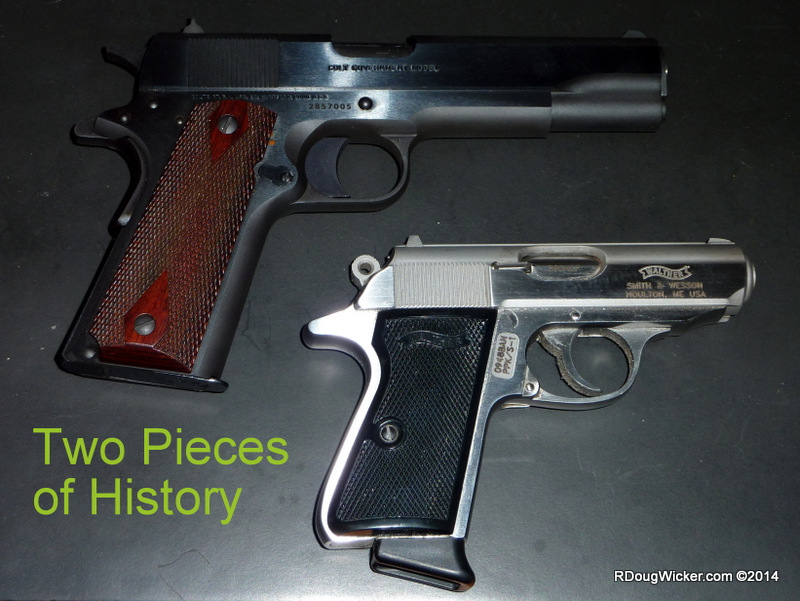
Last Monday we took a look at John Browning’s handgun masterpiece — the Colt Model 1911 — and later advancements made to his original design by the company that commissioned him to develop it.  Today we’ll take a look at what it’s like to operate and actually fire a modern version of this century-old design.  But before we do, let’s make a size comparison of the M1911 with another favorite of mine, the Walther PPK/S.  The PP-series of pistols are much smaller, and they are straight blow-backs designed for smaller calibers such as the .32 ACP/7.65mm and .380 ACP/9mm kurz.

Two Pieces of History — Colt M1911 and Walther PP-series

Two Pieces of History — Colt M1911 and Walther PP-series

That “ACP” designation in .45 ACP, .32 ACP, and .380 ACP stands for Automatic Colt Pistol, and all ACP cartridges were designed for either Fabrique Nationale de Herstal (FNH) of Belgium or the U.S. Colt’s Manufacturing Company by one man — again, John Browning.  Other Browning designed ACP cartridges are the .25 ACP and the all but discontinued.38 ACP.

If you compare the size of the M1911 to something considerably more concealable you’ll find that the M1911 is by no means a small pistol.  It is in fact quite large and very heavy.  The PPK/S you see below weighs in at around 22.4 ounces/635 grams, including an empty magazine.  The M1911 on the other hand tips the scales at almost 2½ pounds — 39 ounces/1.1 kilograms with an empty magazine for the original government model.  The modern M1991A1 in standard configuration beats that, but just barely at 37.78 ounces/1071 grams according to my kitchen scales.

Size comparison with a Walther PPK/S

Size comparison with a Walther PPK/S

Does that make the standard M1911 impractical for concealed carry?  Not at all.  I know several people who conceal the full-size version, and others who pack smaller versions.  Despite it’s 8.6-inch/217mm length the M1911 is particularly well suited for inside-the-waistband carry because it is relatively narrow — around 1.34 inches/34mm at the grip and an almost unbelievably narrow .91 inches/23mm at the slide.  The only real downside to concealed carry would have to be a hefty weight which requires a very good belt.

Surprisingly Thin

Surprisingly Thin

The M1911 is normally carried in the cocked-and-locked configuration (also called “condition one).  Cocked-and-locked means that there is a live round in the chamber and the hammer is fully cocked and ready to fire.  A thumb-operable external safety is engaged in condition one to prevent accidental discharge.

"Cocked-and-Locked"

“Cocked-and-Locked”

So, should you consider adding an M1911 to your collection?  Absolutely.  It’s the iconic U.S. semiautomatic, and has been since, well, 1911 (see: Historical Firearms — The Colt Model 1911).  It’s simply a wonderful range toy even if you opt to carry something more modern — intuitive to aim, fun to shoot, easily controlled despite being chambered in .45 ACP, and it’s one of the most accurate handguns ever devised.

Cocked and ready to fire — Safety off

Cocked and ready to fire — Safety off

Which brings us to some of the features incorporated into the M1911.  In addition to the external thumb safety there is an additional safety built into the grip.  If the grip is not properly held and the grip safety depressed, the weapon will not fire.  In what has become a familiar standard here in the U.S., the magazine is released via manipulation of the magazine release button located on the frame just aft of the trigger.  Internally, at least since 1983 on Colt Series 80 pistols such as the M1991A1 depicted here, there is also a firing pin block that only disengages when the trigger is pulled, which in turn can only occur if the external safety is disengaged and the grip safety is squeezed into the grip.

Standard M1911 controls

Standard M1911 controls

That last Series 80 feature is a bit controversial.  Some claim that it unnecessarily complicated the original design, degraded the trigger by making it stiffer and adding an almost imperceptible (in my view) amount of trigger creep before the hammer trips, and gunsmiths complained that the new design is more difficult to tune to competition standards.  My personal opinion?  It’s still one of the best triggers out there, and according to my research any gunsmith worthy of the title will be able to tune your trigger with just a bit more effort.  But even out of the box, I’d be hard pressed to understand why anyone would think this weapon needs any tuning whatsoever.  If the shooter can’t hold this weapon on target, then it’s the shooter who has a problem rather than the trigger and firing system on this weapon.

Range review:  I’ve fired other M1911 models in the past, including a Series 70 Gold Cup with National Match barrel.  And while it’s been awhile since then, I have no complaints concerning the current M1991A1 Series 80.  Trigger take-up is in the neighborhood of ⅛ inch/3mm.  The aforementioned trigger “creep” is less than even that.  As such, the hammer trip is very clean and exceedingly crisp, especially when compared to most modern trigger designs.  Trigger reset is equally short with a very positive tactile feedback and audible “click.”  Reliability is superb with the two ammo types I fed through it — full metal jacket and jacketed hollow points.  As for accuracy, this pistol without any modification whatsoever is capable of better accuracy than most any shooter who will fire one, and you can’t ask for better than that.  Indeed, take a look at this demonstration video from one of my favorite handgun reviewers, Hickok45:

Don’t Fear the Recoil:  Many people unfairly in my view criticize the .45 ACP cartridge as being “uncontrollable,” and thus fairly inaccurate especially on followup shots.  A lot of that is not born out by the physics, however.  The original .45 ACP design called for a 230-grain/.526-ounce/14.9-gram bullet traveling subsonically at around 830 feet/253 meters per second.  That works out to around 352 foot-pounds/477 Joules of force.  Compare that to the original specifications of the “much more controllable” 9mm Parabellum.  That cartridge was designed around a 115-grain/.263-ounce/7.45-gram bullet traveling at the supersonic velocity of 1,300 feet/390 meters per second.  Total energy from that round is 420 foot-pounds/570 Joules.  Bear in mind that 9mm weapons are for the most part considerably lighter than the M1911, yet as you can see they transmit more recoil force back through the weapon and ultimately to the shooter’s hand.  In my opinion the 9mm has a sharper, quicker recoil whereas the .45 ACP imparts a steady, even, thrust-like reaction.  Recoil management is thus easy to accomplish and target reacquisition is very quick.

A little side story on that slower .45 ACP velocity.  Back in my younger uncorrected vision days I could actually follow with my eye a .45 ACP bullet heading downrange, especially when shooting in bright sunlight at long ranges against a light-colored backdrop.  It was a truly bizarre experience, and I cannot recall being able to do that with any other bullet I’ve ever fired.

But back to what it’s like to fire an M1911 in .45 ACP (fiction writers in particular take note):  The noise from a .45 ACP is unlike most smaller caliber handguns such as the 9mm in that it imparts a slightly deeper, almost cannon-like “boom” rather than a sharp “bang.”  That’s not to say the .45 ACP is louder.  It isn’t.  What I’m describing is just a slightly deeper, lower frequency with less “crack,” probably as a result of comparing a subsonic round (.45 ACP) to one that will emit the “crack” of a sonic boom (9mm).  Recoil is surprisingly light.  Muzzle flip is negligible, especially with a proper grip.  Target reacquisition is quick and efficient, and followup shots are easily managed.

Now a look at the current fit-and-finish of the “New Roll Mark” post-2001 version of the Colt M1991A1:  If you’re considering adding an M1911 variant to your collection you can do a lot worse than this particular version.  This is first and foremost a real Colt and not a pretender.  Slide-to-frame fit is extremely tight with almost no perceptible play.  Barrel-to-bushing tolerance is so tight that I cannot induce any wobble at all in my example.

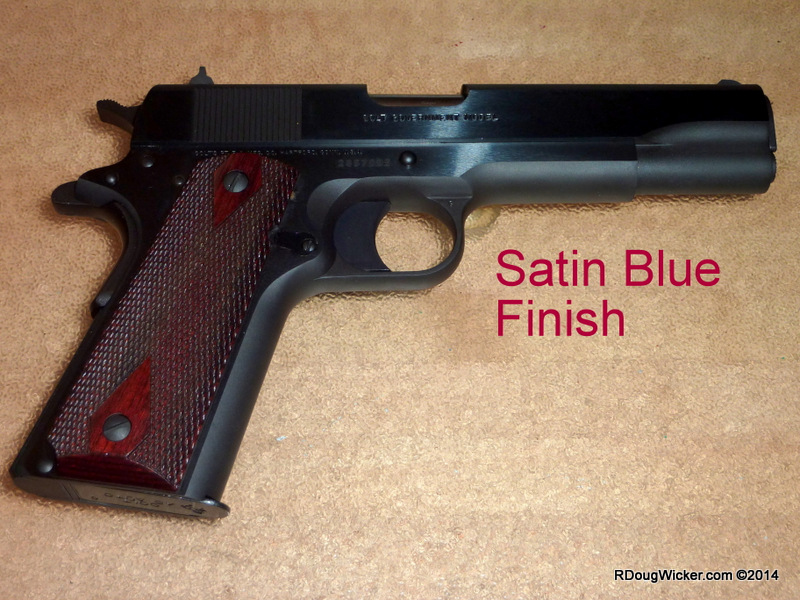
As for finish, the satin bluing is one of the prettiest I’ve ever seen in recent years, and light-years beyond the Parkerized finish of the original “Old Roll Mark” version of the M1991A1:

Satin Blue Finish

Satin Blue Finish

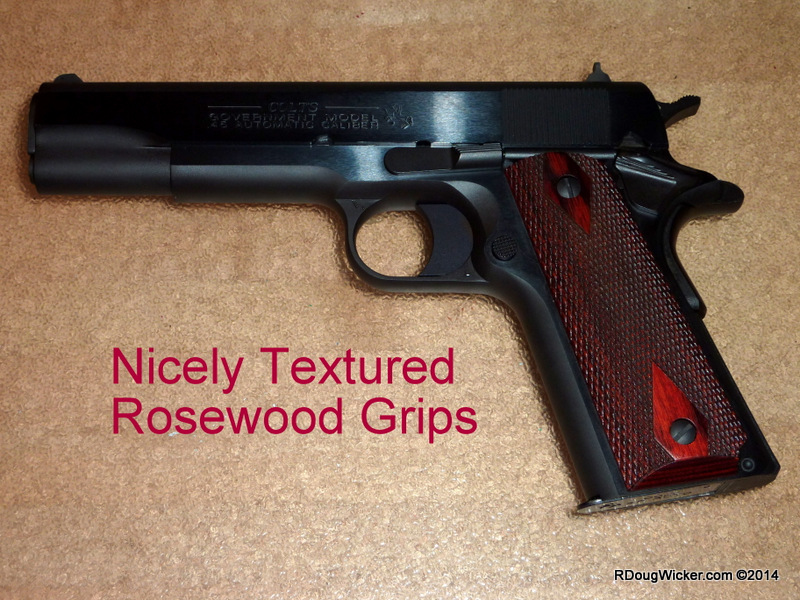
The grips that come with the Colt M1991A1 are nicely textured, beautifully stained, semi-gloss rosewood:

Textured Rosewood Grips

Textured Rosewood Grips

Specifications:

  • Length: 8.54 inches/217mm
  • Barrel Length: 5.03 inches/128mm
  • Slide Width: .91 inches/23mm
  • Maximum Width: 1.34 inches/34mm
  • Weight with empty magazine: 37.78 ounces/1,071 grams
  • Capacity: 7+1

Pricing:  This particular Colt M1991A1 with blued finish and rosewood grips is Colt model number O1991.  The manufacturer’s suggested retail price (MSRP) is $974, but you can find them available for under $900 and Bud’s Gun Shop is listing one at $834 as of this writing.

Comments Off on A 1911 by Any Other Name Would Be . . . an M1991A1 — Shooting Review

Filed under Firearms, R. Doug Wicker