Tag Archives: firearms

Western Wednesday — Marlin® Model 1894C


It’s still “M” Week at the blog, and today’s “M” stands for that classic American maker of lever-action rifles — Marlin.
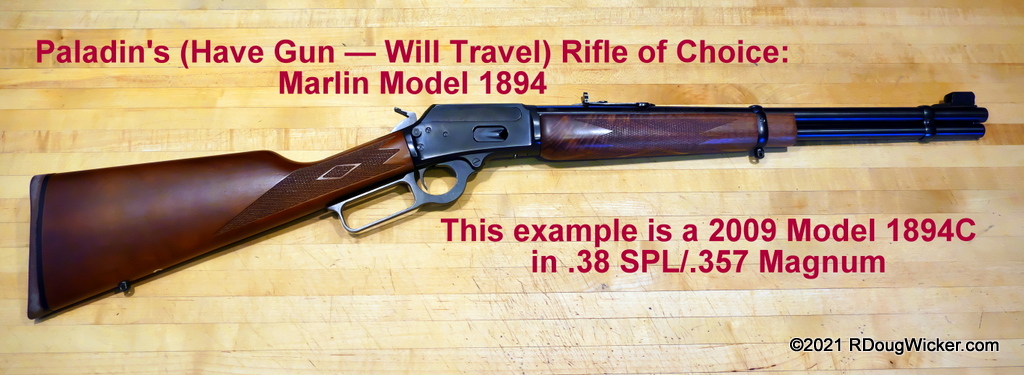
Marlin Model 1894C in .38 SPL/.357 Magnum

Yes. It’s true. I have a soft spot for Old West-style firearms, as you may have surmised by now with my numerous articles on them (Winchester Rifles — Part 1; Winchester Rifles — Part 2; The Rifleman’s Rifle; Firearms — Television Westerns from the 1950s; A Tribute to Mike DiMuzio and a Look at the Interarms Rossi M92 in .45 Colt; USFA Rodeo; AWA Peacekeeper). Today we’re going to look at another firearm with roots in the 1800s. It’s a lever-action rifle, but this time it’s neither a Henry nor a Winchester. It’s a Marlin Model 1894C pistol-caliber carbine chambered in .38 Special/.357 Magnum.

Marlin 1894C Particulars:

  • Length: 36 inches/91.4 cm
  • Barrel Length: 18.5 inches/46.7 cm
  • Length of pull: 13.7 inches/34.7 cm
  • Weight: 6 pounds, 8.55 ounces (104.55 ounces)/2.96 kg
  • Caliber: .38 SPL/.357 Magnum
  • Capacity: 9-round tubular magazine
  • Trigger pull (measured by author; average of five): 2 pounds, 14.8 ounces/1.328 kilograms

My impressions upon handling the rifle: The lever action is stiff, bordering on mediocre. The rifle appears little to have been very lightly used, so this may be a break-in situation. The 1894C has a superlative, crisp trigger with no take up whatsoever, and it breaks consistently at just under three pounds. The crossbolt safety (if you’re into such things on a lever action) is easy to manipulate, positively blocks the hammer, and allows for safe decocking of the rifle. I may very well decide to take the Marlin out to the range and compare it against my Rossi R92 (Winchester Model 1892 clone) in the same caliber.

Marlin 1894C — Stiff lever; exceptional trigger

A little history on Marlin and the Model 1894: John Marlin founded the Marlin Fire Arms Company in 1870 in New Haven Connecticut (the company would in 1968 move to nearby North Haven). In 1881 Marlin expanded from single-shot rifles into the lever-action market, and in 1888 Marlin engineer Lewis Lobdon “L.L.” Hepburn revolutionized the concept with a lever-action rifle that ejected cartridges through the side of the receiver rather than via the top.

Marlin 1894C

In 1893 Mr. Hepburn continued to improve and strengthen his design, resulting in two new rifles — the Marlin Models 1894 and 1895. The Model 1894 with its solid-top/side-eject concept was an immediate hit in cold inclement environments such as Alaska and Canada, as the absence of an open-top ejection port prevented snow, rain, leaves, dirt, and other contaminants from dropping into the rifle. The design had the added benefit of being much stronger than the competing Winchester designs of the era.

Marlin 1894C

The Model 1894 differs from Marlin’s Model 1895 in that the 1894 is chambered in pistol calibers, while the 1895 was designed for more powerful rifle cartridges. In the Winchester world, it would be like comparing a Winchester Model 1892 (pistol calibers) to a Winchester Model 1894 (rifle rounds — although some past 1894 rifles were chambered in .44 Rem Mag and other pistol calibers).

Marlin 1894C

As a quick aside, today’s Model 1895 rifle is not quite the same as the original, which was discontinued in 1917. The reintroduction of the Model 1895 name in 1972 is based upon the Marlin 336 rifle dating from 1936, which further improved upon Mr. Hepburn’s 1893 developments.

Marlin 1894C

Marlin’s history has been a bit convoluted since 2007. It was in that year that Marlin fell into the evil clutches of the equity firm Cerebrus Capital Management via their holding company Freedom Group. Freedom Group would eventually try to hide this evil nature by changing its name to Remington Outdoor Group. But true to form, Remington collapsed into bankruptcy last year, taking with it Marlin, which had already been mismanaged into oblivion beginning in 2008 (more on that shortly).

Marlin 1894C

We’ve seen this scenario playout before with the iconic American brand Colt’s Manufacturing and Colt Defense. Then we have Winchester Repeating Arms Company; lever-action rifles bearing the Winchester brand are now manufactured in Japan. Yes, I despise predatory equity management firms, and I feel that’s with good reason.

Marlin 1894C

Fortunately, Remington’s recent (and entirely too predictable) bankruptcy has resulted in Marlin coming under the umbrella of my favorite U.S. firearms company — Sturm, Ruger & Co. If anyone can rescue and restore this historic brand, it’ll be Ruger.

On an unrelated side note: we can all breathe easier knowing that Colt’s Manufacturing now belongs to Česká zbrojovka Group (Czech armory Group — CZG), a company that understands the firearms business. It would have been better in my view if Colt had remained an entirely U.S. company, but at least this way Colt shall survive and prosper.

So, what has all this to do with a Marlin 1894C that dates to 2009? A lot if you’re a collector. Remington (a.k.a., Freedom Group, a.k.a., Cerebrus Capital Management) purchased Marlin in 2007, and took over both ownership and management the following year. Production initially continued at Marlin’s North Haven, Connecticut plant, using experienced Marlin craftsmen who understood the designs they were handcrafting, and who collectively had generations of experience among them.
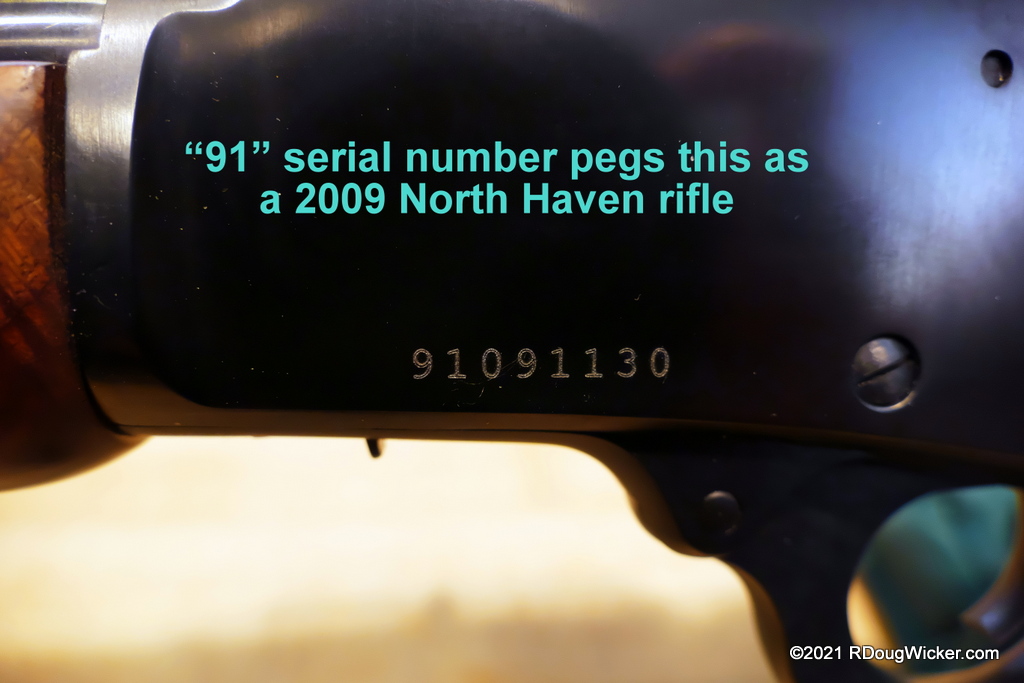
“91” serial number should mean this rifle was made in North Haven in 2009

Marlin’s workers were also unionized. See where this is going now? Yep. In March 2010 Remington announced it would be closing Marlin’s historic North Haven plant, ending 141 years of continuity and experience. In April the following year, the Marlin plant was closed. The unionized craftsmen were terminated. The manufacturing equipment for the lever-action line was boxed up and shipped to a Remington facility in Ilion, New York. Manufacture of other Marlin rifles transferred to Remington’s Mayfield, Kentucky facility. And inexperienced, non-unionized workers began misassembling firearms they had no clue how to put together.

Quality collapsed, of course. Marlins went from being coveted rifles to a bad joke, with unsuspecting consumers supplying the punchline. Eventually, Remington employees would start to turn things around a few years later as they gained experience with the nuances of the designs. But Marlin rifles never fully regained the quality they once exhibited, and the reputational damage was by then complete.

Which brings us to today’s Model 1894C. And this is a weird one. The serial number indicates that the rifle was made in 2009. Production continued at the North Haven Marlin plant at least through the end of 2010, with the doors being locked one final time in April 2011. The barrel displays the North Haven roll mark. The fit and finish, particularly the mating of the walnut stocks to the receiver and barrel, scream Marlin quality. So, too, does the deep, rich bluing of the metal on both the barrel and the receiver.

North Haven roll mark on the barrel

But then there’s the proof mark. If you have a Marlin with a “JW” proof mark, then you have a true Marlin-made Marlin. If your serial number doesn’t start with “RM”, then you have a true Marlin-made Marlin. On the other hand, if you have a Marlin with an “REP” inside an oval-shaped stamp, or the serial number starts with “RM”, then you supposedly have a Remington-made Marlin.

But what if your rifle’s serial number isn’t prefixed with “RM”, the “91” at the beginning of the serial number indicates the rifle was made in 2009, the rifle has a barrel displaying the North Haven roll mark, the fit and finish all give the appearances of a clean, well-made North Haven example, yet your rifle bears the dreaded “REP” on the right side of the barrel? What do you have? Is it a Marlin, a Remlin, a Marlington, or an insidious Remington cleverly disguised as a quality Marlin?

REP-in-Oval is a Remington proof

So, what exactly is going on here? Well, there are several possibilities. Toward the end of production, North Haven produced receivers with serial numbers in the “92” (2008) “91” (2009), “90” (2010), and even a few in the “89” (2011) range.

Notes for determining the manufacture date from the serial number:

  • For serial numbers starting with 27 through 00, just subtract those first two digits from 2000; example: 2000 – 22 = 1978
  • For numbers 99 through 89, subtract the first two digits from 2000 then change the first two numbers in the result from “19” to “20”; example: 2000 – 91 = 1909; change 19 to 20; final result = 2009
  • Manufacture dates prior to 1973 used various other schemes)

Sometime in 2011 serial numbers changed from “89” to the “RM” format. “RM” stood for “Remington-Marlin”. Marlin barrels may have changed prior to that, and it appears Ilion still used the North Haven roll mark for a time after Ilion took over at least some of the manufacturing. As to when precisely that occurred, I’ve not been able to discern. Additionally, some North Haven receivers and barrels were shipped to Ilion for final assembly, which would explain very neatly the “REP” on today’s example. There is also the possibility that North Haven sent completed rifles to Ilion, whereupon the “REP” stamp was then applied, but I somehow doubt that is the answer. I believe it’s probably more likely that North Haven transitioned to the “REP” stamp prior to operations moving to Ilion, but I cannot substantiate that as fact.

So, bottom line for the collector:

  • “JW” is the proof mark you want for maximum value.
  • Pre-crossbolt safety is also a big plus among lever action purists. For that you must get a Marlin made in 1982 or earlier.
  • “93” on the serial number (2007 manufacture) gets you out of this who-made-what-when mess altogether. Freedom Arms made the purchase of Marlin that year, but it wasn’t finalized until 2008.
  • “92” (2008) means you still definitely have a North Haven rifle, and it most certainly will have a “JW” proof as well. But that’s also the year Remington stepped into the mix. Things started getting dicey, I’m sure, and morale probably started falling at North Haven.
  • “91” (2009) — You’re probably still good, but watch out. Hopefully, you have a “JW” proof, but even so quality will be hit-or-miss with the decline in morale. Inspect that prospective acquisition carefully before laying down cash.
  • “90” (2010) is the year Freedom Group decided to eviscerate whatever was left of North Haven morale by telling the workforce to train their replacements and prepare for unemployment. At this point any incentive to provide a quality build had long since evaporated.
  • “89” (2011) — By now I’m going to say you might as well have an “RM” serial number. Who the heck knows what was going on in North Haven by then?
  • “RM” means you’re too late. You may have a shooter, or you may have a major gunsmithing project.

I’m not disappointed in this “91”. Not even close. It appears to be a quality rifle. Most, if not all, the parts are North Haven. I do wish it sported the “JW” proof, and if I knew then what I know now that “REP” stamp might have given me a bit more pause. I balked at the time only because the consignee didn’t bring into the gun shop the original box. He said he didn’t know where it was. I passed to the consignee through the shop owner a low-ball offer for the rifle without the box, and a slightly higher “incentive” offer if he located it. The incentive worked. The owner found the original box and took the latter offer, which was still below his initial asking price.

A Colt Cavalry (7½-inch barrel) Single Action Army just like Paladin’s and I’m all set

Comments Off on Western Wednesday — Marlin® Model 1894C

Filed under Firearms, R. Doug Wicker, Writing

Military Monday — A trio of Mosins


A 1938 Mosin Model 91/30 (bottom) and a 1943 Model 91/30

Travel and photography resume next week. Until then:

Welcome to “M” Week at the blog: Mosins, Marlins, and MPRs.

First it’s Military Monday, and we’re going to spend some quality time looking over a trio of Mosin’s 3-Line Rifles Model 1891. Russian versions only today, because there are just too many other variants out there to cover in one short blog article — Finnish, Polish, Chinese, Czech, Estonian, Hungarian, Romanian, and there are even two U.S.-made variants, Remington Arms and New England Westinghouse. Two of the rifles presented today are of the type with which most of you are probably familiar — The so-called “Mosin-Nagant” (more on that later) M91/30, which is short for Model 1891/1930. The other may surprise you, but we’ll get to that shortly.

But first, a little history:

This rifle goes by a lot of names. Most people here in the U.S. incorrectly refer to these bolt-action rifles as Mosin-Nagants. The official Russian designation however is translated as Three-Line Rifle Model 1891. The Russians also call these Mosin’s Rifles, with not a hint of “Nagant” to be found anywhere. As for “91/30”, that’s shorthand referencing the major 1930 redesign of the original Model 1891 Mosin’s Rifle.

The “Nagant” in Mosin-Nagant derives from Belgian firearm designer and manufacturer Émile Nagant. When the Imperial Russian Army issued a bid for a new 3-line rifle, Émile Nagant put forth a 3.5-line design that competed against true 3-line designs from Captain (later Major General) Sergei Ivanovich Mosin and Captain (later Colonel) Ivan Dmitrievich Zinoviev. At the time of the competition Captain Mosin was working at Imperial Russia’s Tula Arms Plant.

Captain Zinoviev’s design did not make the cut. Neither in the end did Émile Nagant’s. It was Captain Mosin who won the day; but not initially, and only after he “borrowed” some ideas from Émile Nagant’s 3.5-line entry. Specifically at issue was an “interrupter” that prevented the double-feeding of bullets stripped from the magazine. Émile Nagant held the patent for the interrupter, even though he himself “borrowed” the idea from Captain Mosin. The only reason Mr. Nagant was able to file an international patent on it was because Captain Mosin’s design technically belonged to the Russian government, and neither Captain Mosin nor the Russian government bothered to file. Also, Captain Mosin’s interrupter was officially a Russian military secret at the time Mr. Nagant claimed the design as his own. The other two Nagant designed features “borrowed” by Captain Mosin were a five-round clip for loading the magazine, and an attachment on the magazine base plate to hold the magazine spring.

Émile Nagant sued for royalties. The Russians settled, paying Mr. Nagant the same fee granted to Captain Mosin for winning the competition. But Émile Nagant’s name was never officially attached to the rifle. Neither was Captain Mosin’s as it turns out. Thus, the true designation of the so-called Mosin-Nagant was “3-line Rifle, Model 1891”.

By the way, that “interrupter” never even made it into the 1930 redesign. It proved both troublesome and unreliable, and it was replaced with a completely new two-piece design. As for the clip, the ease with which the magazine is loaded made it redundant. So, the only thing “Nagant” about the 91/30 “Mosin-Nagant” is the way the magazine spring is attached to the base of the magazine. And now you know why “Mosin-Nagant” is not a thing except in the U.S.

Okay, now you’re wondering what the heck is a three-line? This may shock you (I know it shocked me), because it goes back to the Imperial Russian way of measuring the diameter of the rifle bore back in 1891, which was in “lines”. Lines were measured in (are you ready for this?) tenths of an inch!

So:

  • 1 line = 0.1 inches = 2.54mm
  • 3 lines = 0.3 inches = 7.62mm

Since Mosin’s rifle technically had a bore of 0.3 inches, or three “lines”, it became the “Three-Line Rifle, Model 1891”.

However, even though the cartridge for this rifle is designated as the 7.62x54mmR (for Rimmed), the actual diameter of the bullet is .312 inches/7.92 millimeters. If you’re like me, then right about now you’re completely confused as to how a 7.92 mm bullet received a designation of 7.62 mm. I guess it’s sort of like the 7.5×55 mm Swiss (see: Military Monday — Swiss K31 “Straight-Pull” Bolt Action Rifle), which actually comes in at 7.78 mm/.306 inches.Now you may be wondering how a military rifle designed in 1891 has any relevance to today beyond the collector community. Mosin’s rifles were manufactured from 1891 until 1973, with the last of Mosin’s rifles being made in Finland. As previously mentioned, design was modernized in 1930, hence the designation 91/30. Russian-produced 91/30 rifles were manufactured at the Imperial Tula Arms Plant and the Izhevsk Mechanical Plant (now part of the Kalashnikov Group). All three rifles presented in today’s article came from Izhevsk and are known colloquially here in the U.S. as “Izzies”. Total production numbers are not available, but it is assumed that over the rifle’s 82-year production run some 37 to 38 million examples were made.

These rifles are built like tanks, and many are still used today in armed conflicts around the world. That makes the Mosin probably the longest serving military rifle ever produced. Here are the particulars on the Model 91/30 Rifles you’re seeing today:

Mosin “Three-Line” Model 1891/30:

  • Length (without bayonet): 48.5 inches/1,232 mm
  • Length (with bayonet): 65.6 inches/1,666 mm
  • Approximate Weight (without bayonet): 8 pounds 13 ounces/4 kg
  • Approximate Weight (with bayonet): 9 pounds 10 ounces/4.36 kg
  • Barrel: 28.7 inches/73 cm
  • Capacity: Non-detachable 5-round magazine

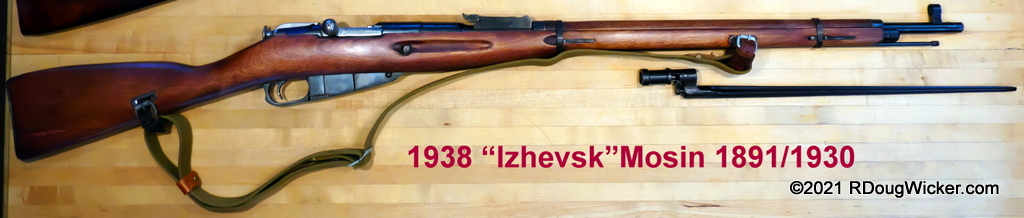
This first rifle is an “Izzie” (Izhevsk) from 1938. Serial numbers are a true match, not a “forced” match, which is unusual for an arsenal refurbished example. The arsenal refurbishment stamp on this 1938 Izzie is the square with the diagonal line through it stamped on the butt of the weapon, which indicates that this rifle was refurbished at the 1st GAU (later GRAU) Arsenal in Balakleya, Ukraine.

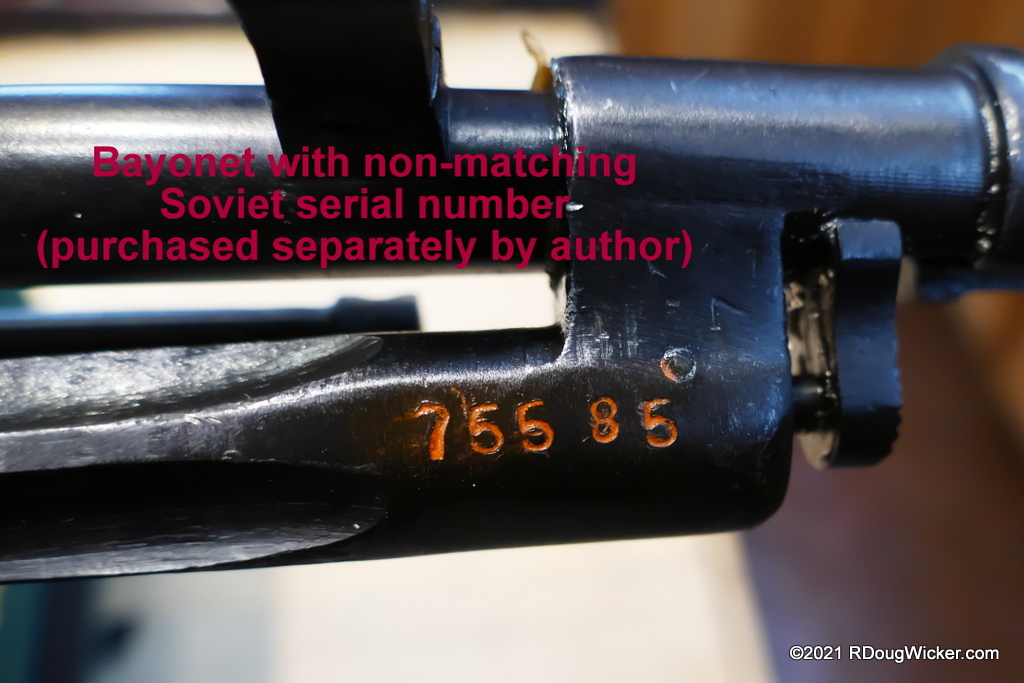
1938 “Izzie” Mosin Model 91/30 with separately paired bayonet
GRU Arsenal Refurbishment Stamp

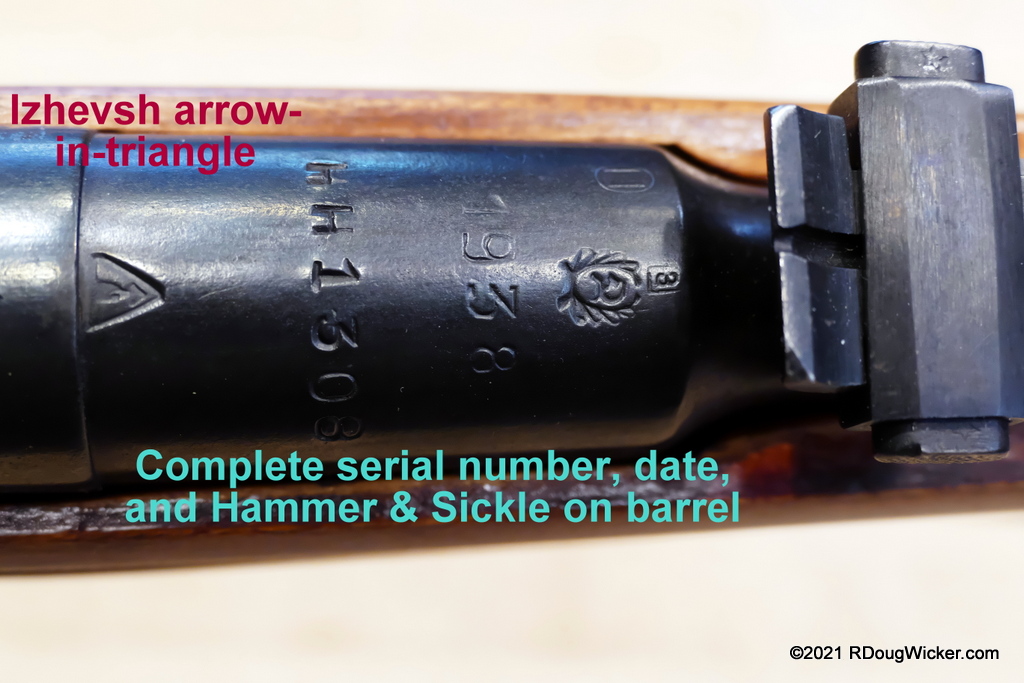
Being imports, these rifles have two serial numbers. The one BATFE are concerned with is the U.S. importer’s serial number, which in this case was assigned by Century Arms International (C.A.I.) in Georgia, Vermont. The important serial number for collectors however is the one in Cyrillic. On this rifle the Russian serial number is НН1308. And, no, those are not the letter “H”. They are the Cyrillic characters for the English “N”.

Russian serial number is НН1308
U.S. importer-assigned (Century Arms Int’l) serial number

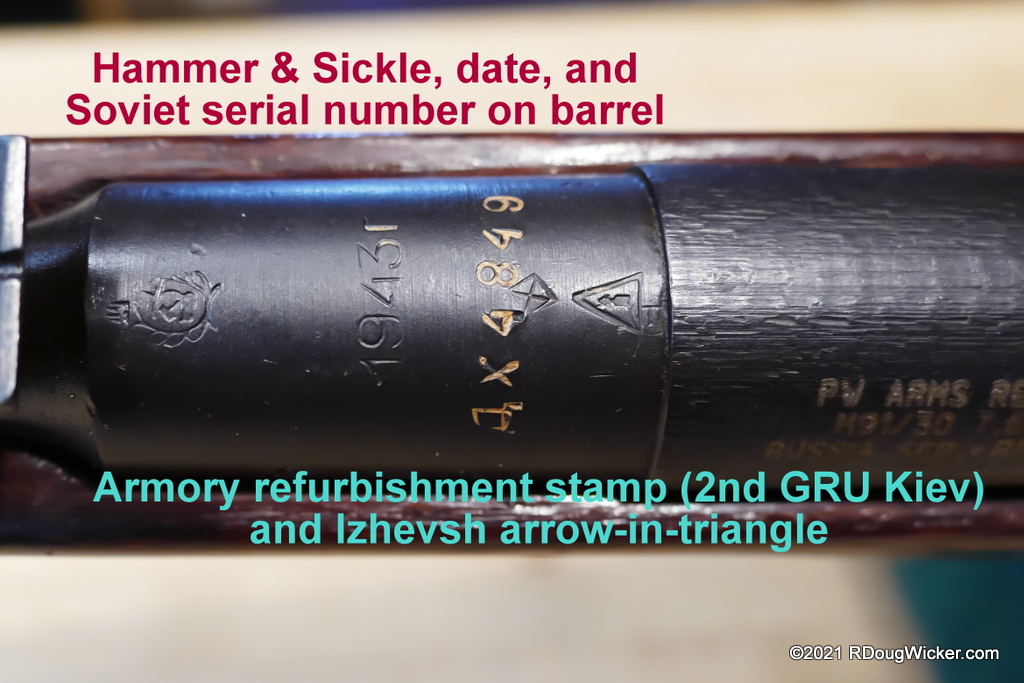
The next Model 1891/30 on display today is another “Izzie”, but this one was manufactured in 1943. It, too, contains matched serial numbers, but in this case it’s the more common “forced” match that frequently occurred during refurbishment. Typically, during refurbishment, these rifles were disassembled with little regard toward keeping serialized parts together. So, when it came time to reassemble the weapons, if the part numbers did not match then the magazine number was struck through, and the magazine was restamped with a serial number matched to the rifle. Oddly enough, this rifle does not bear an arsenal refurbishment stamp, but we know it went through the process because of the forced matching of the serial number.

1943″Izzie” Mosin Model 91/30 with serial matched bayonet
Matching serial number on bayonet

In this 1943 example the rifle has the Cyrillic serial number ДХ4849, but when you look at the magazine you’ll note that part was originally serialized to a different rifle. The importer’s serial number, the one with which BATFE are concerned, was assigned by U.S. importer PW Arms of Redmond, Washington.

Cyrillic serial number ДХ4849
U.S. importer-assigned (PW Arms) serial number

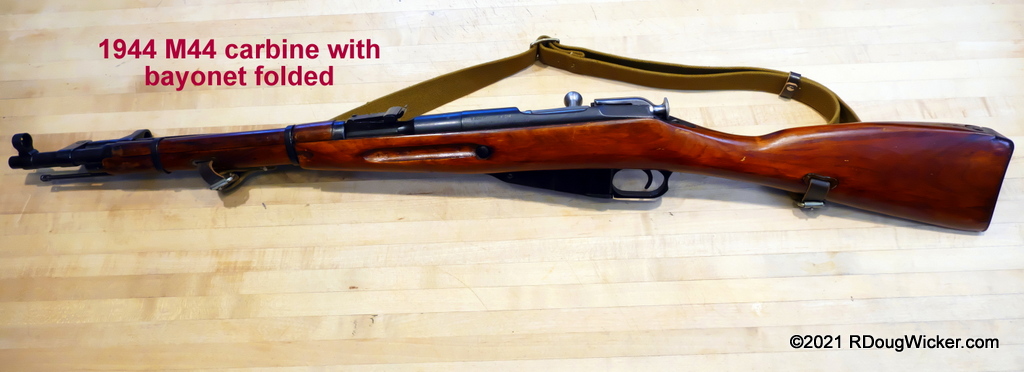
Now let’s peek at the third of today’s Mosin trio. It’s a bit of a rare beast, although not that rare. This is a carbine version that was first produced in 1943, but which did not enter broad service until the following year. Officially, this 91/30 variant is a Model 1944. Preceding the M44 was another carbine version known as the Model 1938. Both the M38 and M44 have 39.9-inch/1,013 mm barrels.

1944 “Izzie” Mosin 91/30 Model 44 carbine

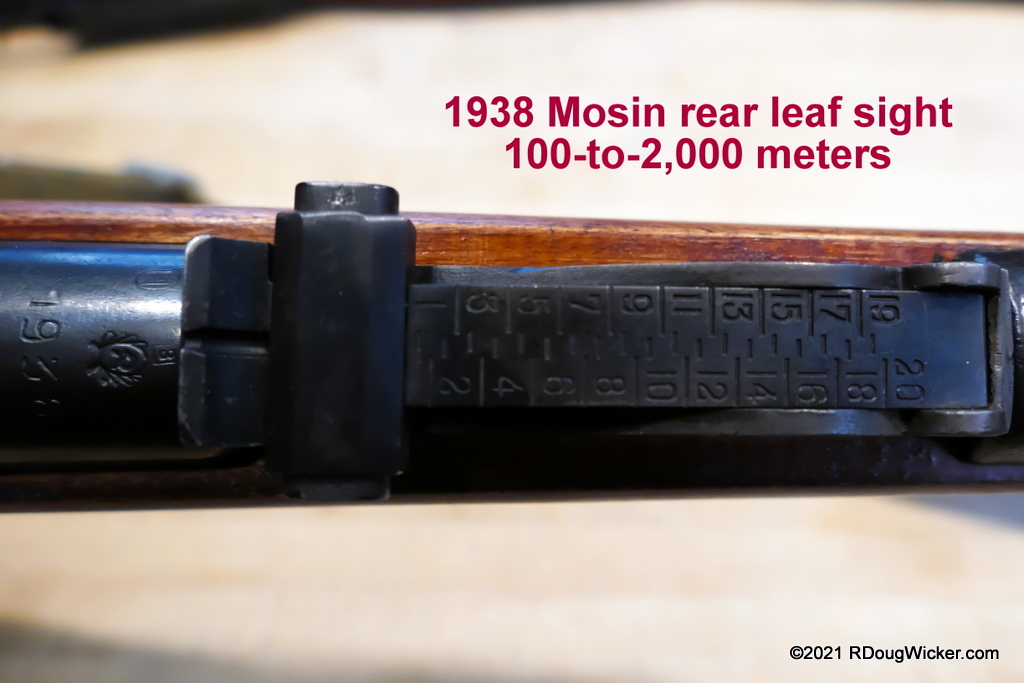
While ladder sights on the 91/30 are graduated from 100 to 2,000 meters, the maximum range on the M38 and M44 sights are halved. Whereas the 91/30 went to frontline troops, where maximum range was considered a plus, the M38 went to rear echelons such as artillery, radio operators, and combat support.

M44 reduced-range rear leaf spring sight

The M44 however was designed for another job altogether. And that goes back to the brutal urban warfare that broke out in the later stages of World War II. The considerable length of the original 91/30 proved too cumbersome in that environment, so 8.6 inches/219 mm were shaved off the rifle.

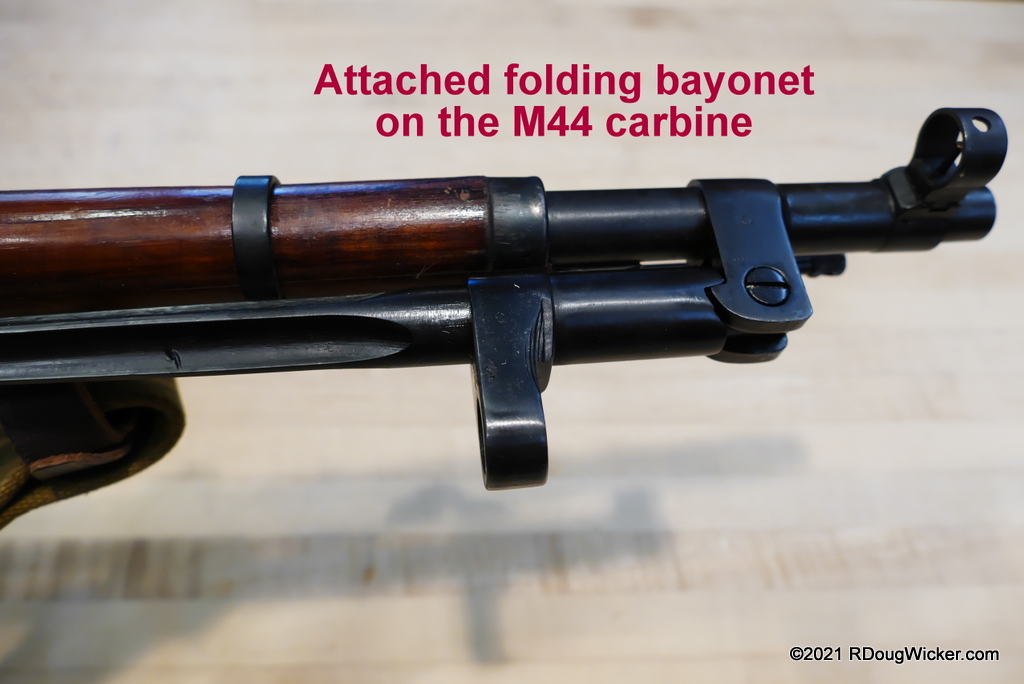
M44 folding bayonet locked into extended position

Unlike the M38, the M44 came with a bayonet. And on the M44 the bayonet significantly improved upon the major shortcoming of the 91/30 design by mounting a pivoting bayonet affixed to the rifle via a special barrel bayonet lug. This allowed the bayonet to be folded to the right alongside the forestock when it was not needed. I call this a huge improvement because the 91/30 bayonet is notoriously difficult to dismount once it’s affixed to the barrel. Removal may require any or all combinations of the following accessories: a hefty hammer, a sacrificial flathead screwdriver, Hercules, and a prodigious four-letter vocabulary. At any rate, having heard firsthand some of the horror stories, I’ve avoided actually trying to install and remove a bayonet on either of today’s 91/30 examples.

Let’s look at the particulars for the Mosin M44 carbine:

  • Length (bayonet folded): 39.9 inches/1,013 mm
  • Length (bayonet extended): 52.4 inches/1,330 mm
  • Approximate Weight (if the bayonet is missing): 8 pounds 9 ounces/3.9 kg
  • Approximate Weight (with bayonet): 9 pounds/4.1 kg
  • Barrel: 20.2 inches/514 mm
  • Capacity: Non-detachable 5-round magazine
1944 “Izzie” Mosin 91/30 Model 44 carbine

This particular example dates from 1944 which, despite the “M44” designation, was actually the second year of production. As with the two 91/30 rifles above, this one is also an “Izzie”. The Cyrillic serial number is ГФ4900. Like the 91/30 from 1938 in today’s article, this M44 is another C.A.I. import. Parts are matched, but as with the 1943 91/30 the magazine is an arsenal refurbishment “forced” match.

Cyrillic serial number is ГФ4900
Arsenal refurbishment magazine “forced matched” to the rifle
U.S. importer-assigned (Century Arms Int’l) serial number

There is one other carbine variant that I’ll bring up now, and I’ve held one and briefly considered purchasing it. That is the Model 1891/59. These carbines began life as full-length 91/30 rifles that were sent to Bulgaria. There, the rifles were cut down into what was basically a Model 1938 clone. Being clones of the M38, they do not have the M44’s bayonet.

Some collector points:

  • Any 91/30 variant made prior to 1945 almost certainly saw combat. Extensive combat in most cases.
  • As such, many 91/30s have seen a lot of rounds, and WWII-era Russian ammunition was notoriously corrosive. Check for corrosion damage.
  • The exception to that “saw combat” rule is the M44. These did not see wide use during World War II. They were however considered frontline equipment during the early stages of the Cold War.
  • Almost any 91/30 you get will have gone through post-war refurbishment, regardless of whether or not the butt displays an arsenal refurbishment stamp.
  • If the rifle you’re looking at was refurbished, chances are the magazine will be force-matched to the serial number of the rifle. This is not uncommon and doesn’t adversely affect value. Indeed, finding an example with a non-forced matched magazine is the exception.
  • Most refurbished rifles have been counterbored to mitigate wear at the muzzle. Done properly, this does not adversely impact accuracy, nor does it greatly impact value. Most examples were done properly.
  • A good friend, fellow collector, former Green Beret, and salesman at my second favorite local gun shop showed me this neat trick without using a borescope or looking down the barrel to see if that gun store find is counterbored, and if so, how deep:
    • Take a 7.62x54r round and insert it bullet first into the muzzle.
    • If he bullet stops at the widest part, the muzzle has not been counterbored.
    • If the bullet slides in beyond the widest part, the muzzle has been counterbored.
    • The depth at which the bullet slides in beyond the widest part will give you a clue as to how deeply the muzzle was counterbored. If it goes in easily all the way to the casing, you may want inspect further, or pass on that particular rifle altogether.
Family Portrait (from top): 1944 M44; 1943 91/30; 1938 91/30

A great site for collector information is 7.62x54r.net. Some of the pages at that site relevant to today’s examples and other mentioned variants:

Comments Off on Military Monday — A trio of Mosins

Filed under Firearms, R. Doug Wicker, Writing

SIG Sauer P365 SAS — First Look and a Shooting Review


If you are here for the continuation of my fall foliage cruise series, I’ll be continuing those articles starting December 30. This week, however, I owe my firearms fans some long-promised handgun reviews. And after that I go to two weeks of Christmas-themed reruns.

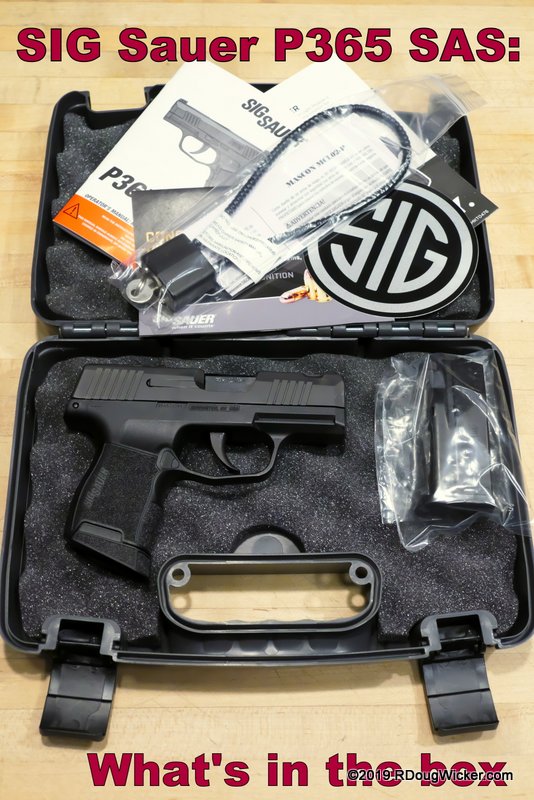
SIG Sauer P365 SAS — What’s in the box

Today I’ll be giving a first look and shooting review of the SIG Sauer P365 SAS with the Meprolight FT Bullseye sighting system equipped with an innovative tritium-illuminated sight using  fiber optic light tubes. Take a look below and at first glance you’ll wonder where the front and rear sights are located:

SIG Sauer P365 SAS (SIG Anti-Snag): Too much of a good thing?

First, the handgun. SIG Sauer’s P365 subcompact 9mm arrived to the market in 2018. What amazed the concealed carry world was the 10+1 capacity in a handgun very nearly the size of a .380 ACP/9mm kurz 6+1 Colt Mustang. My personal favorite concealed carry pistol since 2009 also holds 10+1 rounds of 9mm, but by P365 standards my trusty ol’ Walther P99c AS is positively gargantuan in comparison even though the P99c (compact) was quite a breakthrough when it was introduced some twenty years ago.

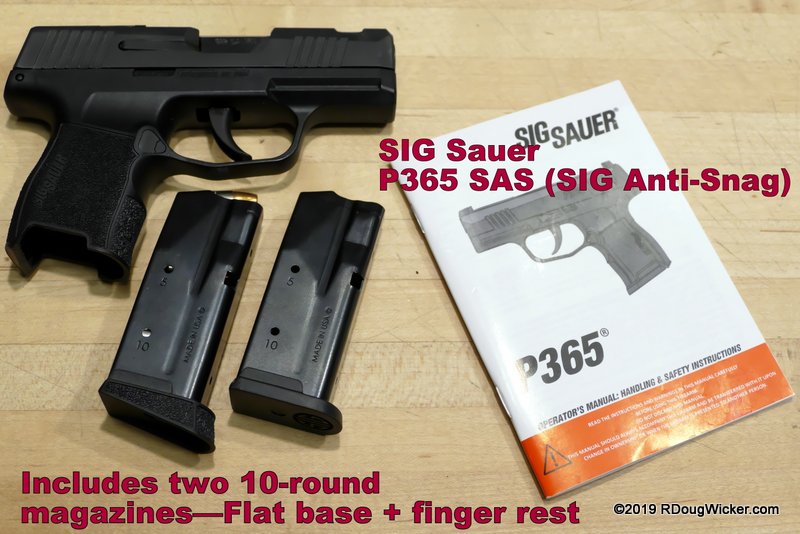
SIG Sauer P365 SAS comes two 10-round magazines; flat-base and finger-rest

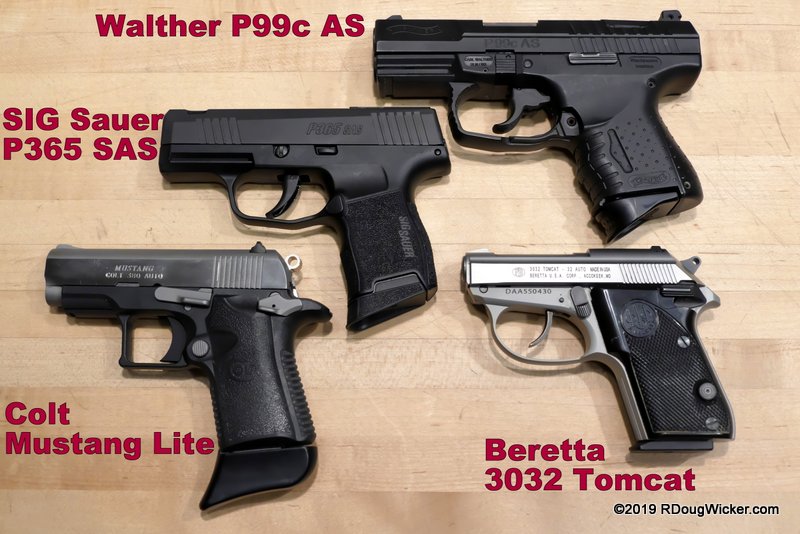
Let’s take a look at some images showing the size differences among the P365 SAS, Walther P99c AS, a Colt Mustang Lite sporting an aftermarket 7+1 magazine, and the incredibly small Beretta 3032 Tomcat holding 7+1 rounds of .32 ACP/7.65mm:

From top: Walther P99c AS, SIG P365 SAS, Colt Mustang Lite, Beretta Tomcat

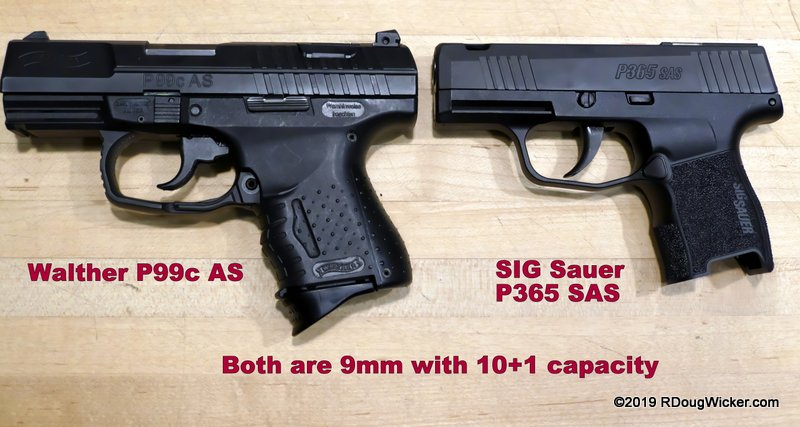
First up, SIG P365 SAS versus Walther P99c AS:

SIG P365 vs. Walther P99c

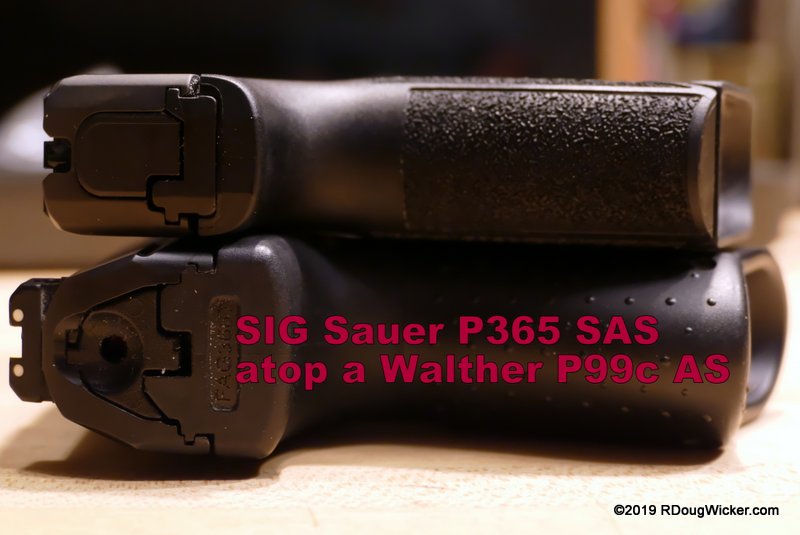
Let’s take a look at the differences in grip width, even though both guns have a 10+1 capacity:

Grip comparison — Walther P99c vs. SIG P365


SIG P365 atop a Walther P99c AS

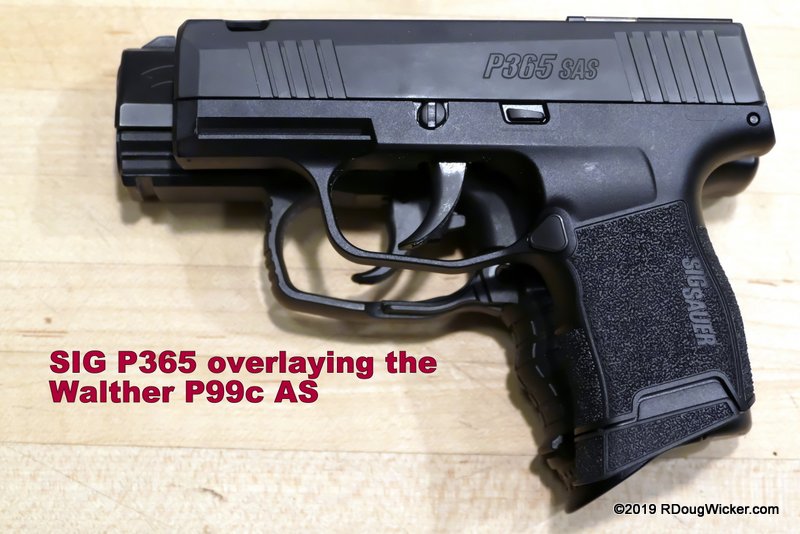
Now for a shot of the P365 overlaying the P99c, which weighs about two ounces more than the SIG:

SIG P365 overlaying a Walter P99c

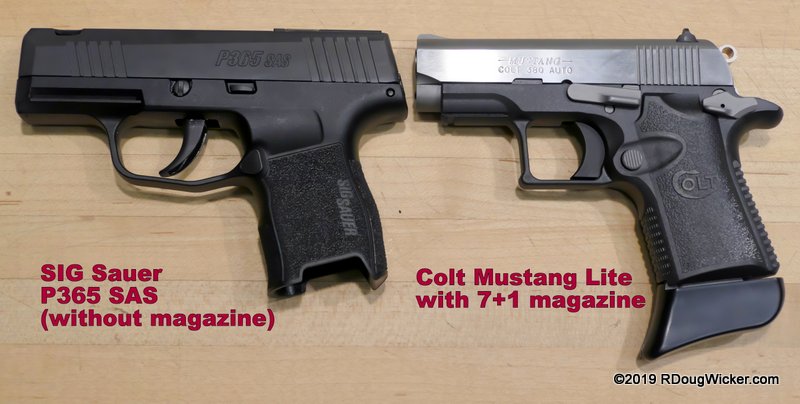
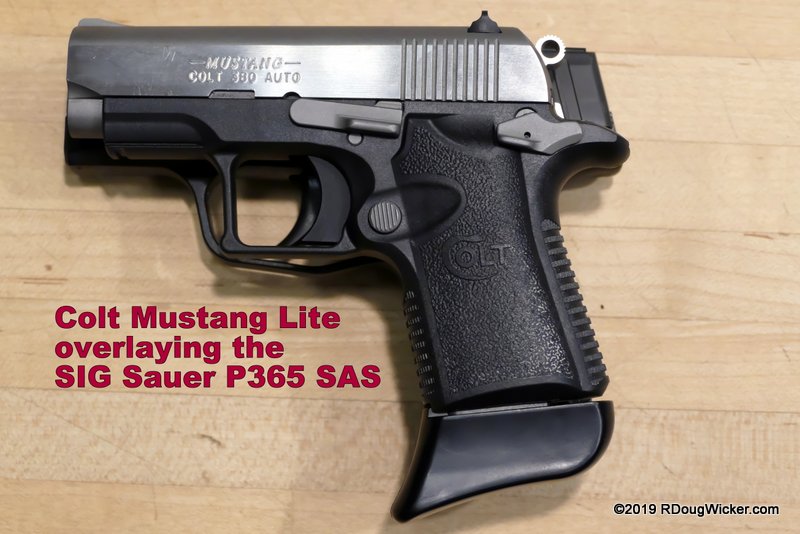
I know I was certainly impressed, but how does the SIG stack up against a .380 ACP/9mm kurz Colt Mustang Lite with an aftermarket 7+1 magazine with a finger rest? I forgot to insert a magazine into the P365 before taking these shots, but even with the finger rest SIG magazine the height still would have come out far less than the Colt’s. Let’s take a gander:

P365 next to a Colt Mustang Lite

Mustang overlaying the P365

Finally, let’s compare the P365 against one of the smallest practical pocket pistols around, the Beretta 3032 Tomcat with 7+1 rounds of .32 ACP/7.65mm:

Beretta Tomcat overlaying the P365 with finger rest magazine inserted

Now that’s impressive. The P365 SAS has the ‘SIG Anti-Snag (SAS) treatment, more so than any other SIG SAS pistol I’ve yet seen. Perhaps too much. The takedown lever is gone, replaced by a latch that requires a coin or flat-head screwdriver to manipulate. The slide stop is now completely useless, although I don’t miss that because I always slingshot the slide to chamber a round rather than depress the slide stop.

SIG SauerP365 SAS (SIG Anti-Snag)

SIG Sauer P365 SAS (SIG Anti-Snag)

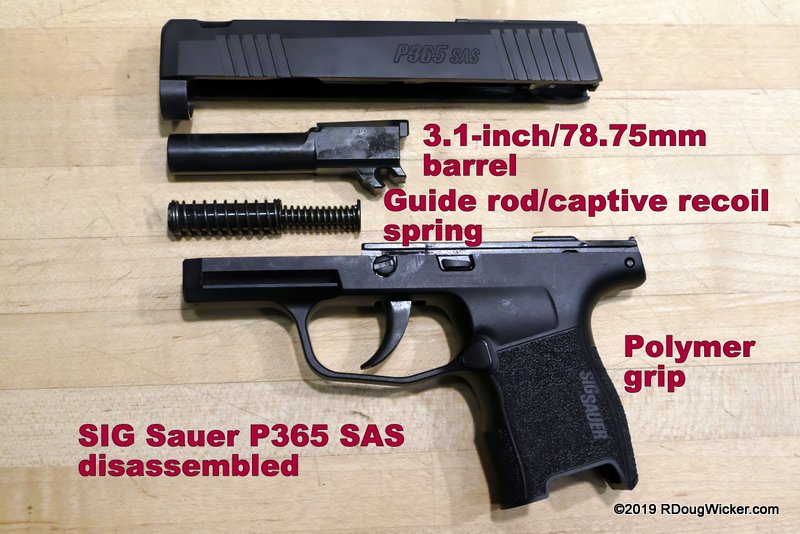
Fortunately, though, I found one pleasant surprise upon reassembling the weapon. Attaching the slide and moving it back to the slide-lock position, then engaging the slide lock upward into the slide notch, the slightest of touches causes the takedown latch to snap back to the ready position. That’s a neat feature, for sure, and one that negates some criticism of the original P365 takedown lever being difficult to rotate back upon reassembly. Speaking of disassembly, let’s take a look at the innards of the P365 SAS:

P365 SAS frame and inverted slide

Disassembled P365 SAS

The P365 is a very light weapon chambered for a not-so-subtle 9mm round. But don’t worry. The gun is not that snappy. First of all, the barrel sits very low over the frame, giving an incredibly low bore axis. Then, as part of the SAS treatment, SIG went further and ported both the slide and barrel. This porting directs gasses upward in a V-shaped pattern about 15mm from the muzzle. The result is that recoil is somewhat mitigated, which also helps to negate the tendency for the muzzle to rise.

SIG P365 SAS ported barrel and slide

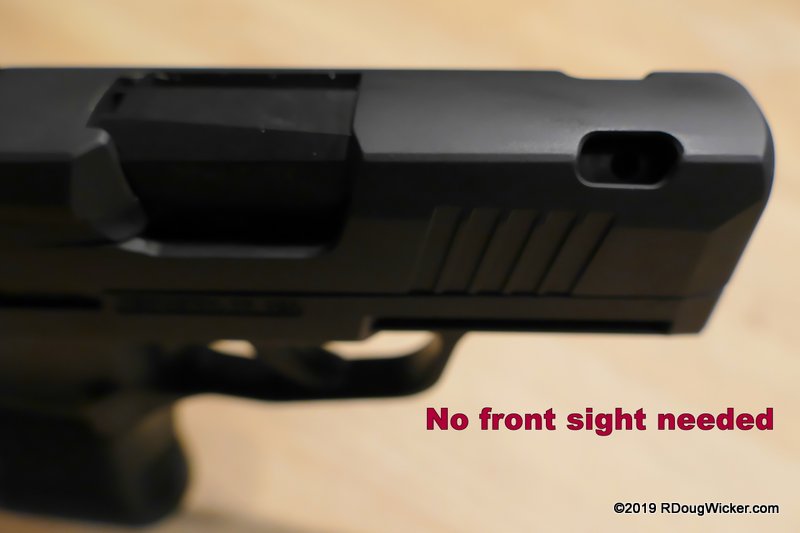
I found the P365 very controllable, with easy and quick target reacquisition despite my unfamiliarity with the Meprolight FT Bullseye sight. You’ll note that I said ‘sight’ rather than ‘sights’. That’s because the traditional front sight is completely missing from this system. Observe:

Meprolight FT Bullseye tritium/fiber-optic sight

No front sight needed . . . or wanted

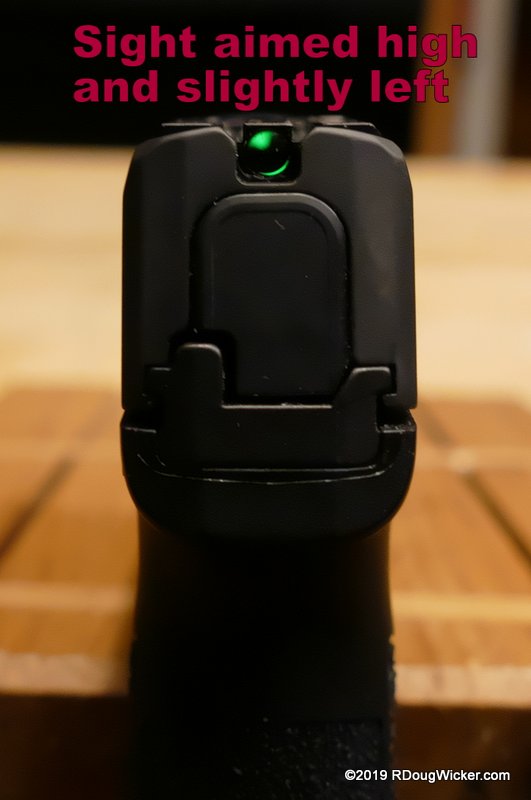
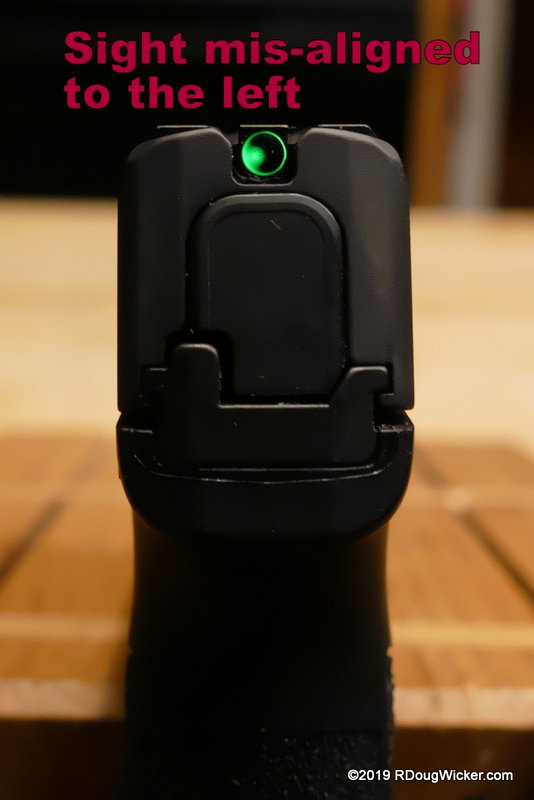
It takes a little time to get accustomed to the FT Bullseye sight, but for a defense pistol used inside of, say, twenty yards or so, they’re simply fantastic. Before I took the P365 SAS to the range, I spent about two weeks practicing target acquisition at various ranges. The brighter the light striking the top of the gun, the better the illumination, but bringing the gun aligned with your line-of-sight is critical, or you wind up hunting for the magic bullseye to appear. This is especially critical in low light situations, as the tritium on this particular sight is nowhere near as bright as on SIG’s other tritium night sights, and far less than SIG’s superlative X-Ray sights. The best way I’ve found to practice this is to have the unloaded P365 nearby, and then on occasion snatch it up level to your dominate shooting eye, then looking to see if the bullseye is visible. If you’re off on the alignment, you may not see anything, but if you’re close enough you’ll get this:

P365 aimed high and to the left

FT Bullseye misaligned right

FT Bullseye misaligned left

Once you’ve mastered getting the top of the P365 slide aligned with your dominate shooting eye, however, centering the bullseye is done rapidly as long as you were close enough initially to see some green. When it all comes together, this is what you see as you squeeze the trigger:

FT Bullseye sight properly aligned.

One more word about sighting: I found that initially, despite lots of dry-fire practice, I was shooting low. That’s because I’m used to either a six-o’clock sight picture, or placing the intended point-of-impact at the top of the front sight post, depending on how the particular gun is sighted in. That’s not going to happen with the FT Bullseye, and you have to train yourself out of that habit. It’s much closer to a combat sight picture. With this sight you place the bullseye directly over the intended point-of-impact. Do that, and you’re dead on target. Revert back to your prior training, and you’re going low.

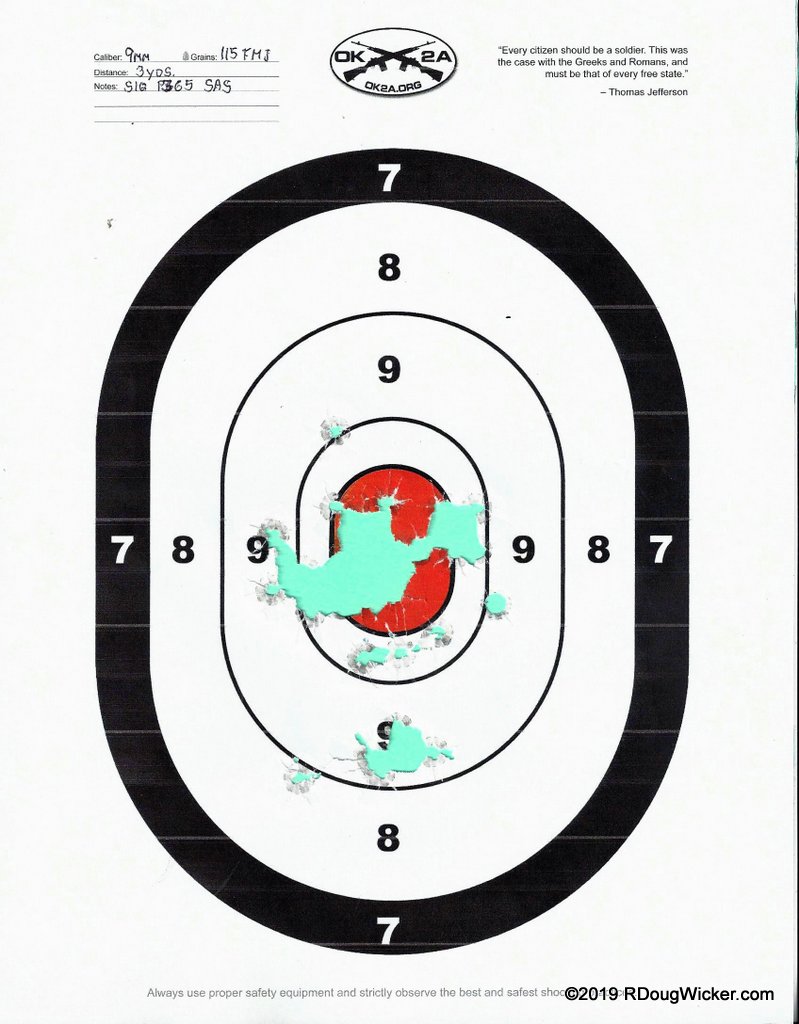
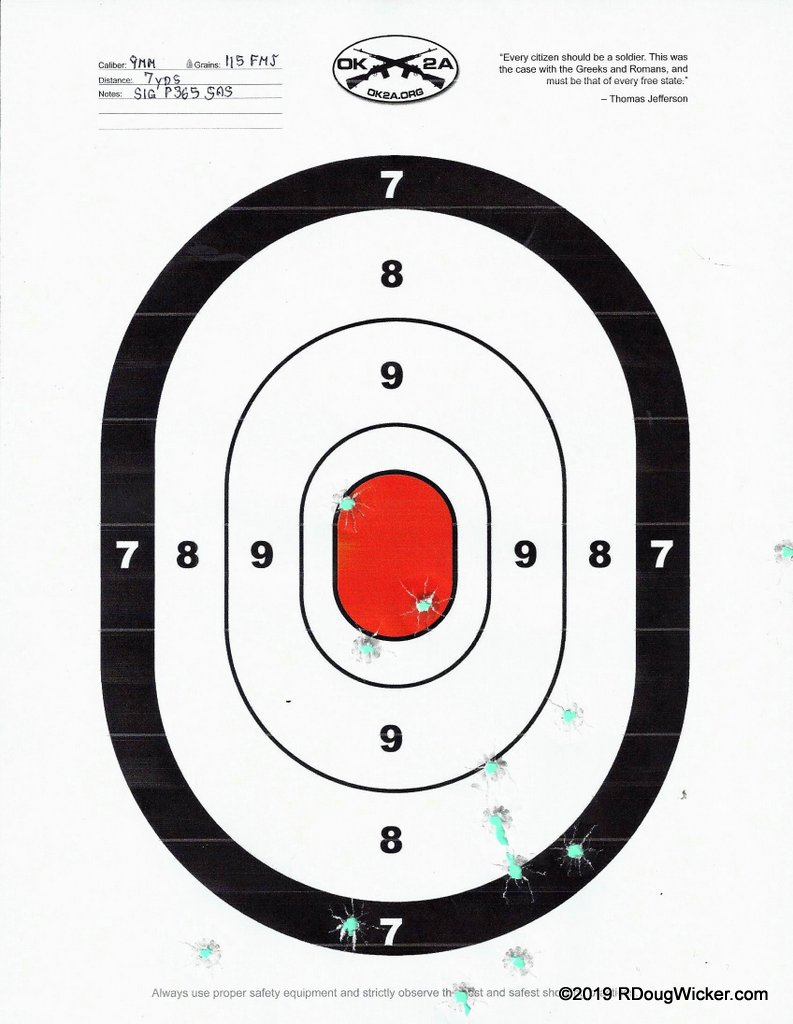
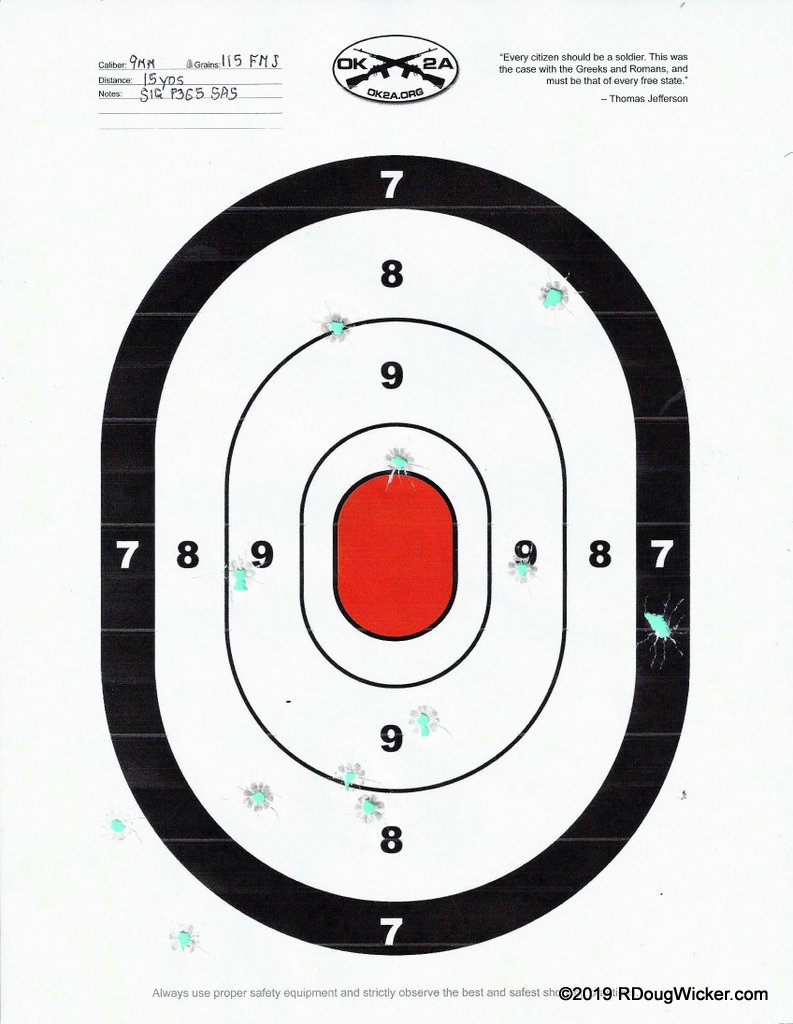
So, how does this sighting system work in conjunction with a handgun specifically designed around it? Quite well once you work it all out. Below are the targets I used. All are printed on 8.5×11-inch/216x280mm paper. The first three targets simulate the distance requirements for Texas state qualification for a license to carry — 20 shots at 3 yards/2.74 meters; 20 shots at 7 yards/6.4 meters; 20 shots at 15 yards/13.7 meters (Texas requirement at 15 yards is 10 shots, but I doubled that). And while these requirements are with a much larger B27 silhouette target, again I was using targets printed on standard letter-size paper:

P365 3yds 20 rounds

P365 7yds 20 rounds

P365 15yds 20 rounds

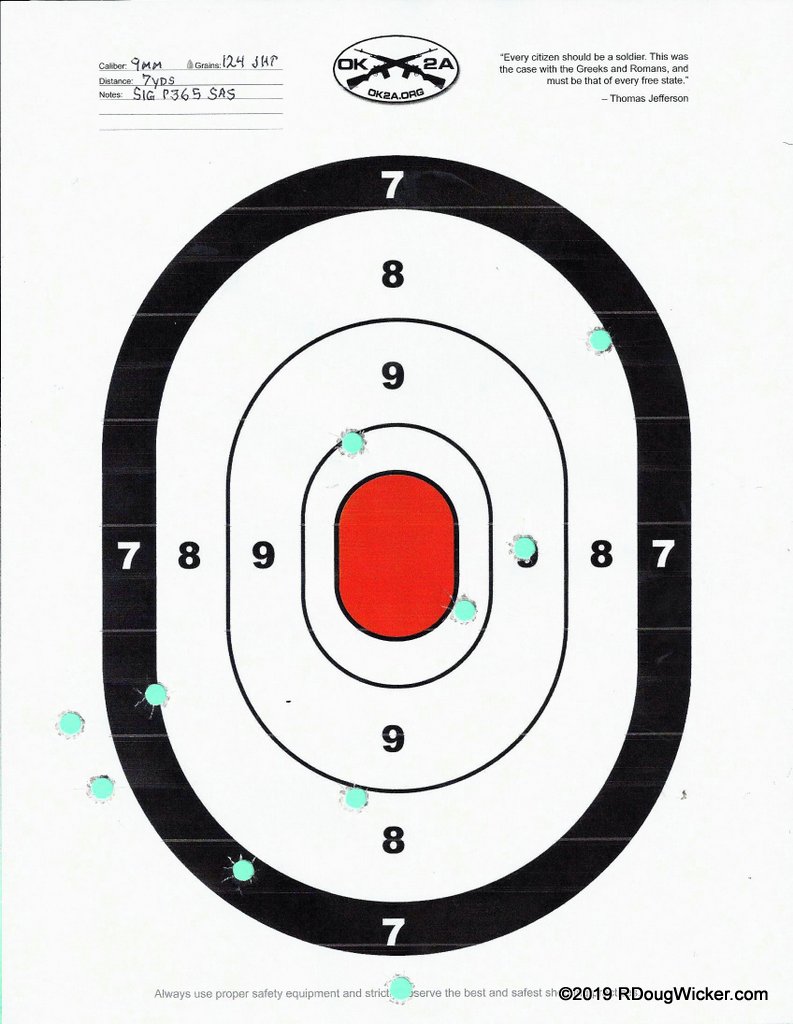
Next up is ten rounds of 124-grain JHP at a distance of 7 yards, followed by eleven rounds of 115-grain FMJ at 7 yards one-handed:

P365 7yds 10 rounds 124gr JHP

P365 7yds 10+1 round One-Handed

Finally, here are twenty rounds at 5 yards/4.6 meters shot in a rapid-fire exercise at about one-second intervals to see how quickly I could get back on target. Those holes marked ‘FB’ were fired from the included flat-base magazine, while ‘FR’ stands for the finger rest magazine, as I wanted to see if the additional purchase afforded by the finger rest allowed for better rapid-fire accuracy. I’ll let you judge that one:

P365 20-round Rapid Fire Test (FB=flat base; FR=finger rest)

Test notes and observations:

  • Out of 101 rounds fired I experienced very early in the testing one failure to extract using 115-grain Winchester White Box target ammunition. Subsequent testing using mostly Magtech 115-grain ammunition failed to duplicate that failure.
  • When chambering a round on a freshly inserted magazine with the slide locked back, I twice experienced a failure of the slide to go fully into battery. I believe these failures may have been due to me applying insufficient rearward force when slingshotting the slide back, or perhaps I may have briefly ridden the slide forward before releasing it. In either case, the gun did not fire while out of battery (a good thing), and a light tap on the back of the slide remedied the problem.
  • The flash from the ported barrel and slide was impressive in the dim light of the indoor range, but not overly distracting. I didn’t much notice it after about twenty rounds or so. But I certainly appreciated those ports for the reduction in recoil and muzzle flip in a gun that weighs in at 17.6 ounces/499 grams with empty magazine, or 22.3 ounces/632 grams fully loaded.
  • The magazine release took some getting used to, as depressing it with my thumb caused the back side of the button to protrude into the first joint of my middle finger. It was also incredibly stiff initially. After working the release, the stiffness has gone away, and as long as I don’t relax my grip when engaging the release, the back side no longer fights against the middle finger joint. Magazines now eject without drama.
  • The rail is proprietary, so lights and lasers are not going to be readily available. But, then, that FT Bullseye sight kind of negates the need for a laser at any rate.
  • The grip is nicely textured without being overly aggressive about it. The P365 SAS is comfortable in the hand, and putting 100+ rounds down range was not fatiguing in the least. Unlike most comparably sized blow back pistols in .380 ACP/9mm kurz (Walther PPK/S for example), this is an all-day shooter.
  • I don’t have a trigger measuring device, but I place the P365’s trigger pull at between the P99’s 8.8-pound double-action pull and its 4.4-pound single-action pull. My best guess is right around six pounds, although SIG claims closer to 5.5. Trigger take up is about 4mm, with another 2mm to go beyond that to the trigger trip. Reset is very positive, giving both audible and tactile indications at about 3mm. All in all, an entirely acceptable combat trigger, but one that is lacking for anyone thinking this is a target pistol.
  • Accuracy is completely acceptable for the intended purpose of this weapon — self-defense at ranges inside of twenty yards or so. With practice, that FT Bullseye sight is probably good for perhaps another ten yards beyond that against a man-sized target, but the sight does begin to block out the intended point-of-impact fairly quickly. This is not a target pistol. But at defense ranges, this is probably the quickest and most accurate sight I’ve used, as you no longer need to focus on a front sight while simultaneously getting half-way decent depth-of-field and resolution on both the rear sight and the target. With the FT Bullseye you lock in on centering the bullseye and placing that bullseye over the intended point-of-impact. This is, in my view, a much better system for close ranges inside of twenty yards, but it takes time to master.

Additional notes:

  • My carry weapons have in the past always been either double-action/single-action, equipped with a manual safety, or both. The P365 gives me pause in that the trigger is lighter than my comfort level for concealed carry, but no overly so. I already feel comfortable carrying the P365 in a Don Hume H721 “Double Nine” belt holster.
  • SIG offers higher capacity magazines for the P365. You can get 12-round and 15-round magazines, although the fifteen  rounders appear to start negating the height advantage of the weapon. I’ve yet to handle a twelve-round magazine, but looking at side-by-side photos next to the finger rest ten-rounder, there isn’t that much difference between the two. I suspect three 12-rounders will be in my future, and perhaps a 15-rounder would make a good, high-capacity spare magazine for pocket carry.

SIG Sauer P365 SAS dimensions:

  • Length: 5.8 inches/147mm
  • Barrel length: 3.1 inches/78.7mm
  • Height (with flat-base magazine): 4.1 inches/104mm
  • Width: 1.0 inch/25.4mm
  • Weight (measured with empty flat base magazine): 17.6 ounces/499 grams
  • Weight, loaded (measures with 10+1 rounds and finger rest magazine: 22.3 ounces/632 grams
  • Capacity: 10+1 (included magazines); 12+1 (optional magazine); 15+1 (optional magazine)

Conclusion:

  • SIG Sauer have a concealed carry winner with this handgun. Before acquiring this pistol my every day carry for the past decade was the Walther P99c AS, with the .380 ACP/9mm kurz Colt Mustang used for deeper concealment needs during winter months, and the .32 ACP/7.65mm Beretta Tomcat performing that duty during warmer weather. The P365 has made both the Walther and the Colt redundant. The Tomcat still beats it in casual summer attire, however, on the rare occasions when something more compact will be needed.

2 Comments

Filed under Firearms, R. Doug Wicker