How to Get Promoted to Captain (Movie Review)


Captain America: The First Avenger

Action, SciFi-Fantasy; U.S.; 2011; 121 minutes; directed by Joe Johnston

Medium:  Netflix Blu-Ray (Available on DVD)

Rating:  3.5 (5-point system)

I thought perhaps that maybe, just maybe, Marvel Studios had finally hit their stride when they came out with the exceptional Iron Man  and followed that up with The Incredible Hulk all in the same wonderful year—2008.  I mean, after all, what’s to argue with Robert Downey, Jr’s, exquisitely narcissistic Tony Stark or Edward Norton’s brooding portrayal of Bruce Banner?  And real scripts with actual character develpment?  Had Marvel finally rediscovered what Warner Bros./DC Comics had unearthed before with Batman Begins (2005), and then followed up with the superlative The Dark Knight (2008)—that real characters with real emotions and real problems will sell real movie tickets and real popcorn with fake butter, even when the subject is a comic book hero?

Alas, if 2011 is any indication, then no.  The lessons we all hoped Marvel had learned just three short years ago were apparently soon lost.  First we had the passable but effects-overburdened X-Men: First Class.  Next up was the tepid and overbearing Thor.  And finally this year we got the best of the bunch which, unfortunately, isn’t saying a whole lot.

It’s not that Captain America wasn’t entertaining.  It was, in a silly, retro sort of way reminiscent of the movie serials of the 1940s.  It’s just that I was expecting so much more, especially considering the favorable reviews this movie garnered.  Unfortunately, it appears that this film only looked good in comparison with this year’s previous two Marvel offerings.

The back story was actually pretty good.  Steve Rogers (Chris Evans) wants to enlist in the darkest days of World War II, but the asthmatic weakling with the irregular heartbeat who gets pummeled by assorted bullies with distressing regularity keeps getting rejected for service (hey, Stevie boy, don’t mouth off to someone twice your size, telling them to shut up in the movie theater; it’s bad for your health, dude).  But European refugee scientist Dr. Abraham Erskine (Stanley Tucci) sees in Rogers an internal fortitude that others lack, and thus chooses the scrawny kid from Brooklyn to partake in a research program to develop the ultimate super soldier.

Obviously the procedure worked, or we wouldn’t be having this conversation.

From this point on, things start out a bit slow.  Not necessarily a bad thing if the slow points are used to advance some cinematic objective such as, say, plot or character development.  Alas, they do not.  When the film finally reengages the viewer, the momentum is lost and the subsequent action seems out of context with the rest of the movie.  Further hampering the film are the silly high-tech weaponry and delivery systems that are far too advanced for the era in which the movie is set.

There are things to like about this film, however, such as the acting.  Chris Evans does an adequate job, but he pales in comparison to such heavyweights as Tommy Lee Jones and Stanley Tucci, perhaps the most underrated character actor of this generation.  Even Hugo Weaving manages to outshine our intrepid hero as the film’s properly menacing villain Johann Schmidt, aka, The Red Skull.  In comparison, all I can say is that Chris Evans is all dressed up with no place to glow.

As with the past Iron Man films, the last Hulk movie, and this year’s Thor, Captain America is merely a buildup to the main event—next year’s The Avengers, which ties together all these Marvel heroes into one ensemble blockbuster.

But a word of warning to Marvel:  Don’t forsake what made the first Iron Man and the last Hulk so entertaining.  Try to throw in some actual plot and character development this time.  Yes, Captain America was better than X-Men: First Class, but just barely.  Indeed, I gave both a 3.5, but that’s only because I don’t give 3.75s and the Captain just wasn’t worthy of a 4.0.

He never should have been promoted from private.
2 Comments

Filed under Movies

It’s in the Bag(uette)


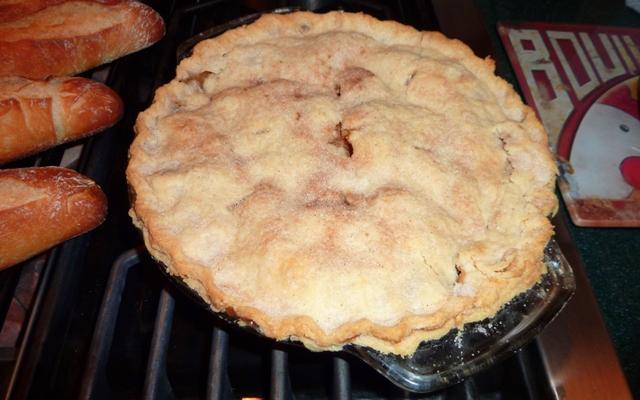
Baking Day at the Casa de Wicker.  I usually bake three baguettes on weekends and then cut them in half and freeze them wrapped in aluminum foil for sandwiches during the workweek.  This weekend I was called upon for a bit more—a double batch of baguettes and an apple pie.

With the downturn in temperatures, Ursula was in the mood for one of her favorite Swiss winter cheese specialties—Raclette or fondue and fondue won out as we were hosting our good next-door friends, Randi and Jim Brewer for dinner Sunday.  Jim’s favorite desert also just happens to be apple pie, and I’d just discovered a new recipe I wanted to try.  So . . . .

But a really good, traditional cheese fondue requires a good, traditional, crusty French baguette.  Time to go to work, and work began the day before—on Saturday.

This recipe, borrowed and modified slightly from Alton Brown’s Knead Not Sourdough recipe (and very similar to my related pizza dough recipe), is just too simple to waste time and money going to the local bakery for a product that is probably inferior in taste, texture, and crunch.

Ingredients:

One pound, two ounces (18 ounces total avoirdupois—as in weight—ounces) bread flour

1 tbs. course Kosher salt (half that amount if using fine-grain table salt)

¼ tsp. yeast

12 fluid ounces of warm tap water

Step 1:

In a large pan or Dutch oven, stir together the salt and flour.  Dissolve the yeast in the water or also stir into the flour (your choice; both work).  Stir water into the flour mixture and combine until the water is completely incorporated into the flour.  Cover the dough and let ferment for nineteen hours, folding or stirring occasionally (I do this using a dough scrapper once before going to bed and once again after awakening in the a.m.) to redistribute the yeast, make sure the flour is completely incorporated, and to ensure that there are not dry spots.  No kneading necessary.  Yep—it’s that simple!

Step 2:

Sprinkle more flour onto the counter, a glass cutting board, or a marble or granite pastry board.  Measure out the dough into three equal amounts.  I usually get around 856 grams (30.2 ounces) of dough which, when divided by three, give me three portions of dough weighing approximately 285 grams (10 ounces) each.

Step 3.

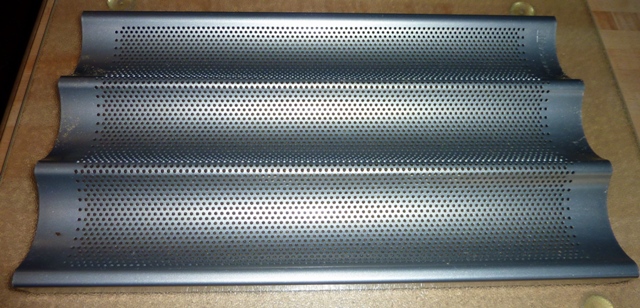
Using your hands, roll the dough portions into three long, thin ropes approximately eighteen inches in length (use lots of flour here or the dough will be too sticky to work).  Place the dough ropes onto a three-trough, nonstick, perforated baguette pan (see a picture of mine below).  Cover the baguette pan with a large roasting pan to keep the dough from drying out while the loaves rise.  Let the loaves rise for one and a half (warm kitchen) to two hours (cooler kitchen) until at least doubled in bulk.

Step 4.

When the loaves have at least one hour more to rise, place a cast iron skillet into your oven on a rack in its lowest position.  Place another rack into place above the skillet, just high enough to clear the skillet.  Preheat the oven to 450° F (230° Celsius).  You want that skillet and the inside of the oven heated thoroughly, so err on the side of longer time rather than shorter.

Step 5.

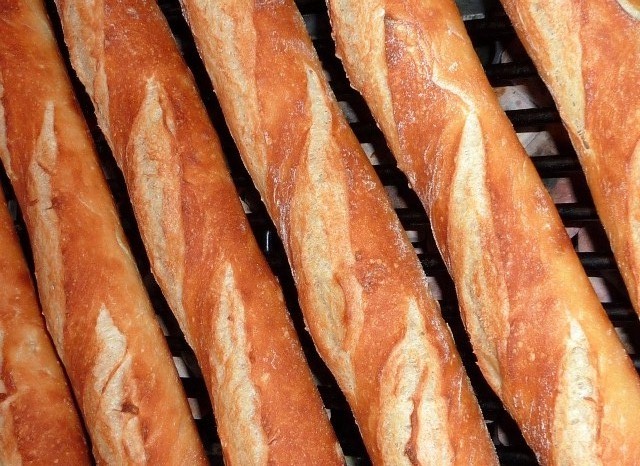
With ten minutes or less in rising time to go, take a razor, hobby knife (such as an Exacto), or other extremely sharp implement and make three to four long, half-inch deep slashes down the center of the loaves, offsetting each slash slightly from one side to the other.  Just before the loaves go into the oven, pour one cup of water into the heated skillet.  Caution:  Steam will burn you.  Rapidly.  That flash of steam is water vapor that was suddenly heated to 450°, so get your hands away from that steam immediately.  Shut the oven door for a couple of minutes to build up the humidity in the oven.  This humidity, contrary to expectations, is what will give your baguettes that incredible, crunchy crust.

Step 6.

Quickly open the oven door and slide the baguette pan onto the upper rack above the skillet (I use a pizza spatula for this to keep my hand from being steam burned).  Shut the door as soon as possible.  Bake the baguettes for 20 minutes.  Remove the skillet and bake the baguettes for another five minutes.  Removing the skillet allows direct heat to brown the underside of the loaves.

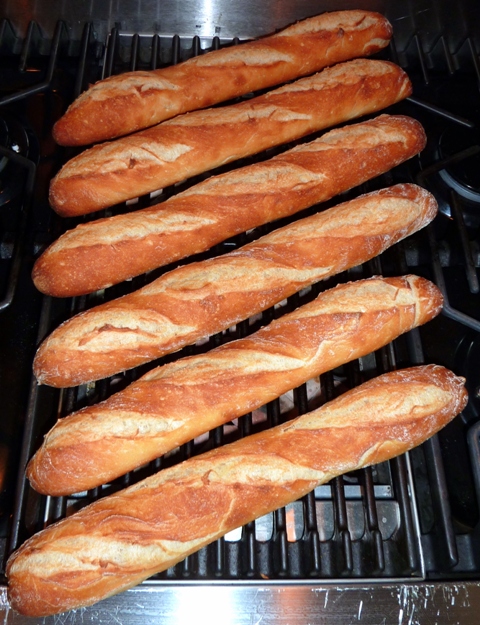
You’re done.  Remove the baguette pan and your crispy, homemade baguettes should have a nice, evenly browned patina on all sides.  Let the baguettes cool atop a rack, or even leave them on the baguette tray to cool if you desire.

If you’re going to freeze the loaves, wrap them in heavy-duty aluminum foil.  When you’re ready to serve the bread, unwrap the loaf and place it directly into a preheated 400° F (200° Celsius) oven for ten minutes to crisp up the crust again.  Remove and allow to cool (and the inside to completely defrost) for twenty minutes, then serve.

Cast iron seasoning tip:  While your skillet is still hot, remove it from the oven and pour out any remaining water and quickly dry the surface.  Take a good, high-temperature cooking oil (peanut, corn, safflower, sunflower, or soybean, for example) and thoroughly coat the pan on all sides and the bottom, but especially on the inside rim and along the bottom cooking surface.  Because of the intense heat, the oil will seal the iron for a rust-resistant coating on the outside and a relatively nonstick surface on the inside.  Remember—never wash a good, well-seasoned cast iron pan in soapy water.  Doing so will strip away the protective, nonstick oil coating.  To scrub out a cast iron skillet, Dutch over, or pan, use salt mixed with cooking oil as an abrasive and wipe away the salt-oil mixture once the pan is scrubbed clean.  If your cast iron is ever exposed to soap or detergent, you’ll have to start the seasoning process all over again, so be careful.

1 Comment

Filed under Wine & Food

Another Canyon that’s Grand—Canyon de Chelly


The Desert Southwest is just hard to beat for great road trips.  We did this trip in July of 2004, and I had my very first digital camera—a Sony DSC-F707.  My, how digital technology has advanced since those days.

The subject of today’s photographs is Canyon de Chelly.  I’ll let this national treasure’s natural beauty do my travelogue for me:

Comments Off on Another Canyon that’s Grand—Canyon de Chelly

Filed under Photography, travel