A Super Dip for the Super Bowl


I first printed this recipe about one week too late for last year’s Super Bowl, but this year it’ll be right on time to absolutely WOW your guests.   In addition to the suggested uses below (besides as a chip dip), I’ve since taken to using it also as a pizza sauce and in macaroni and cheese.

So, reprinted from last year, here is my soon to be world famous Jalapeño Pesto Dip:

The great things about this recipe are:

  • It’s healthy as all get out.
  • It’s so tasty you’ll completely forget how healthy it is.
  • It’s not as spicy hot as it sounds (although it’s definitely not for the timid of tongue, either).
  • It goes great with anything from tortilla chips to corn chips to potato chips to even pretzels.
  • It’s so simple to make even a husband can do it.
  • The leftover jalapeño pesto is great on a whole variety of dishes ranging from omelets to burgers (use as a topping)  and even mixed with ground beef for tacos or chili.  By all means use your imagination with the leftover pesto, because you’ll probably think up dozens of uses for it.

Ingredients:

  • 2 pounds fresh whole  jalapeño peppers
  • 2 tsp. ground cumin
  • 1 tsp. granulated or fresh crushed garlic
  • 1 tsp. sea salt
  • ⅓ cup good extra virgin olive oil or other healthy monounsaturated oil

Step 1. Bring to boil just enough water to immerse the jalapeños.  Once the water is boiling, add the jalapeños and bring the water back to boiling.  Gently boil the jalapeños, stirring occasionally, for fifteen minutes.  Drain the jalapeños and set aside until they are cool enough to handle.

Step 2. Slice the jalapeños in half lengthwise and remove the stems.  Now, this next procedure is where you control the heat to some extent.  On most of the jalapeños, remove the seeds and the ribs to which those seeds are attached.  Keep the seeds and ribs on approximately one-third of the jalapeños, choosing in particular those jalapeños with very white, healthy-looking seeds and discarding those seeds that are dingy or brown in color.  Increasing the number of seeds and ribs retained will increase the heat; decreasing that number will help to tame it.

Step 3. Place the jalapeños, cumin, garlic, and salt into a food processor.  While pulsing, slowly drizzle in the olive oil.  Do no overdo the processing or you’ll destroy those beautiful white seeds and lose texture, but you do want a fairly smooth consistency.

Serve with either warm or cold with your favorite chips. Warm is particularly interesting, especially if you contrast that with a well-refrigerated California onion dip (one envelope of Lipton’s Onion Soup Mix combined with one pint of reduced-fat sour cream).  Serve these two dips side-by-side and watch eager fans alternate between the two of them.

And since this is listed under Wine & Food the next question would have to be, what kind of wine would you serve with this?  Well, first of all, this is definitely an accompaniment to beer, especially a good, fairly strong ale.  But if you would like wine with this, it’ll have to be one that helps tame the fire.  That suggests a semisweet white.  Think:  Johannisberg or German Rieslings, Chenin Blanc, or Gewürztraminer.  The cooler white wine serving temperatures supply immediate relief and the sweetness helps neutralize the capsaicin (the compound that gives peppers their “heat”) in the long term.

Comments Off on A Super Dip for the Super Bowl

Filed under Wine & Food

Another Day, Another Sunset—Friday, January 27, 2012


Well, it happened again:

Another spectacular West Texas Sunset:

And, once again, these photographs were taken in raw and converted into JPEG via Google’s free Picasa photo editing software.  Tweaks were made in contrast, color, and saturation using the “I’m Feeling Lucky” button and the Saturation control.

I saved the best for last, of course:

Just gotta love that great view from my backyard!

6 Comments

Filed under Photography

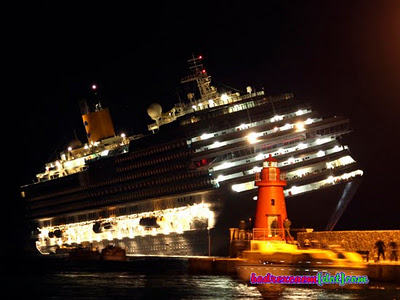
Costa Concordia—My Guess on What Was Really Happening on the Bridge


Image Linked from CruiseLawNews

On Monday’s blog I gave you the reported timeline for the Costa Concordia disaster.  Let me be very clear that what follows today is entirely speculation on my part and is not be to considered in any way established fact.

Referring back to Monday’s timeline, at 22:00 the Costa Concordia’s bow thrusters were used to turn the ship to the right, initially heading it away from the island of Giglio.  This maneuver reportedly aggravated the flooding below decks, substantially increasing the flow of water pouring into the five compromised compartments.  But even before this maneuver the ship had already begun listing dangerously to one side.  The thrusters were left operating until the ship had turned almost completely around and was very nearly facing in the direction from which it came.

While there remains much for which to blame Captain Schettino, this maneuver is probably the one thing he actually did right that fateful night . . . or did he?  Even with the loss of engine power, the Costa Concordia’s momentum kept the ship sailing past the main port on the island of Giglio.  Reportedly to slow down the ship, Captain Schettino initially turned the Costa Condordia into the nautical equivalent of a car in a sideways skid, using the natural resistance of the water pushing broadside against the ship to reduce inertial momentum to the point where the thrusters could be used to maneuver.  Then, turning the ship broadside to both the current and the prevailing wind, it is speculated that he used both natural forces to assist the thrusters in bringing the Costa Concordia closer into shore and running it aground.

Yet it seems to me unfathomable that Captain Schettino remained levelheaded enough to intentionally perform this maneuver considering all the bad decisions he made leading up to the disaster and, especially, in the aftermath that followed.  All his post-collision decision-making to me reeks of panic (and, trust me, having been an air traffic controller for over 34 years and watching how people handle pressure during an emergency, I know panic when I see it).  So, while there are many who are crediting Captain Schettino’s ship skidding and thruster maneuver with an attempt to minimize the danger to both passengers and crew, I remain both unconvinced and skeptical that this was indeed the intention.

Yes, I’m a novelist.  Yes, it’s my job to spin fantastic tales.  So, what follows may very well be a fiction manufactured out of an overactive imagination, but here is my take on what Captain Schettino may have been attempting to do.  While the aforementioned maneuver may be consistent with an attempt to beach the ship, it can also be seen at least initially as an attempt to swing the Costa Concordia out into deeper water.  And why would someone want to do that considering that the passengers and crew had not been instructed to prepare for evacuation, nor had the lifeboat crews been ordered to their muster stations?

There are reports that officers aboard the Concordia, in what could be construed an act of mutiny, ordered the lifeboat stations manned before authorization came from the bridge.  Italian Coast Guard reports would seem to confirm this, as lifeboats were seen fleeing the ship some ten minutes after the order to abandon ship was finally given by the recalcitrant captain.  Ten minutes would have been insufficient for such an act even under ideal conditions, and conditions aboard the Costa Concordia were anything but ideal considering the angle at which it was by then listing to the side.  That begs the question:  If a mutiny did in fact occur, how high did it reach up the chain of command?  Did Captain Schettino order the thrusters to remain on once the ship had turned back out away from Giglio, or did someone else on the bridge keep those thrusters activated in an attempt to swing around the Costa Concordia and run it aground?

Considering Captain Schettino’s actions both before and after the actual maneuver, it seems not very far beyond the realm of possibility that Captain Schettino fully intended that the Costa Concordia go down in deep water in a desperate attempt to hide his responsibility for the initial collision.  This seems even more probable when considered in the context of his initial and totally false claims that the collision occurred with an uncharted obstruction when in fact the rock the Costa Concordia struck was clearly on his navigation charts.  And the failure to prepare for an evacuation would also seem to indicate that he didn’t want a lot of witnesses around to contradict his multitudinous and mutually contradictory stories.

Speculatory?  Perhaps.  But it will indeed be interesting to see the testimony of the bridge crew at Captain Schettino’s trial in any case.

The above positioning graphics are linked from this site, which does a marvelous job of explaining the actual maneuver described above.  Thank you for the perspective, Mr. James Hamilton.

3 Comments

Filed under travel