
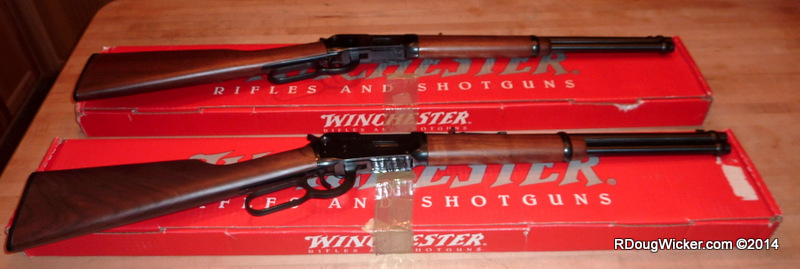
A Pair to Draw to — Winchester Model 1894 Rifles
Today begins Part 1 of a two-part special weekend blog on post-Civil War Wild West rifles in general, and Winchester lever-action rifles in particular. This will not be a shooting review, for the weapons depicted here are twenty years old and still unfired outside of the original proofing before leaving the now defunct Winchester plant in New Haven, Connecticut back in 1994.

Centennial Version of the Model 1894
Yes, that means these particular rifles are centennial editions. The receivers are stamped “1894-1994.” That doesn’t really increase the value much, as post-1964 Winchester Model 1894 rifles are not as in demand as those that stuck to the original design and manufacturing techniques dating back to the 19th Century.

And It’s Matched Partner
But the story doesn’t end with the demise of Winchester or Winchester’s Connecticut facility. The Winchester brand is still alive, and new Winchester-branded lever-action rifles are being made in Japan courtesy of our Belgian friends at FNH (see my review here of their exquisite FNX-45). But be prepared to spend upwards of $1,200 for one of these new versions.
Not only can you still obtain a Winchester-branded Model 1894 and other lever-action rifles, you can also acquire off-brand examples of some of Winchester’s earlier rifles, such the pistol-caliber Model 1892 favored by John Wayne and used in equally anachronistic fashion by Lucas McCain (played by the late Chuck Connors) in The Rifleman (1958 to 1963). I say “anachronistic” because the Model 1892 was used in many Westerns set in years far earlier than 1892 — the year it was first produced. Indeed, the Rifleman was set in the New Mexico Territory in the early 1880s, so his rifle should have been the Winchester Model 1873!
By the way, check out the bibliography links below to see how to purchase a version of Lucas McCain’s Winchester ’92. Or, click on this link:

However, lest you think you’re getting a true Winchester when you get a new Model 1873, 1886, or 1892, think again. These copies are made by several companies totally unrelated to the original Winchester Company — Rossi of Brazil and Chiappa of Italy to name a couple.

What you see here are two Winchester Model 1894 Trapper carbines with 16-inch barrels. The Model 1894 produced by Winchester from 1894 through 2006 has sold more copies than any other sport hunting rifle ever produced — over 7,000,000 copies. One rifle is chambered in .30-30 (originally called .30 WCF for Winchester Center Fire). This cartridge was specifically designed for the Model 1894, and arrived on the scene in 1895. The other example shown is not nearly as common. That one is chambered in the .44 Magnum handgun cartridge.
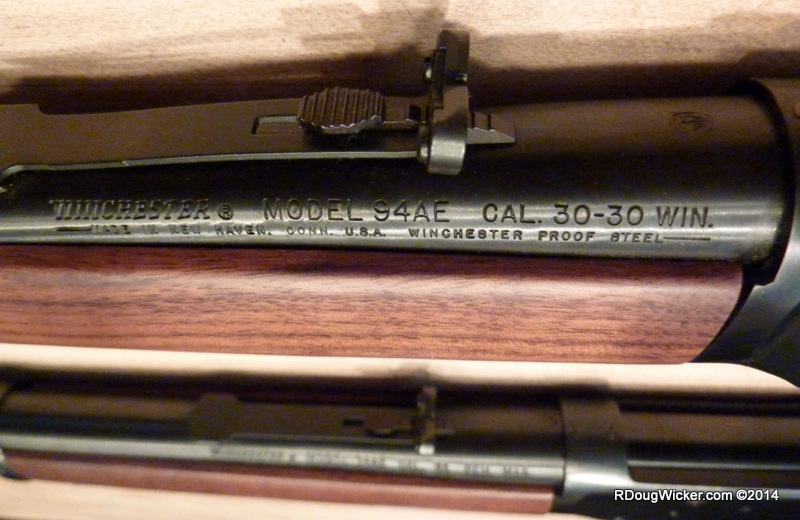
.30-30 (.30 WCF)
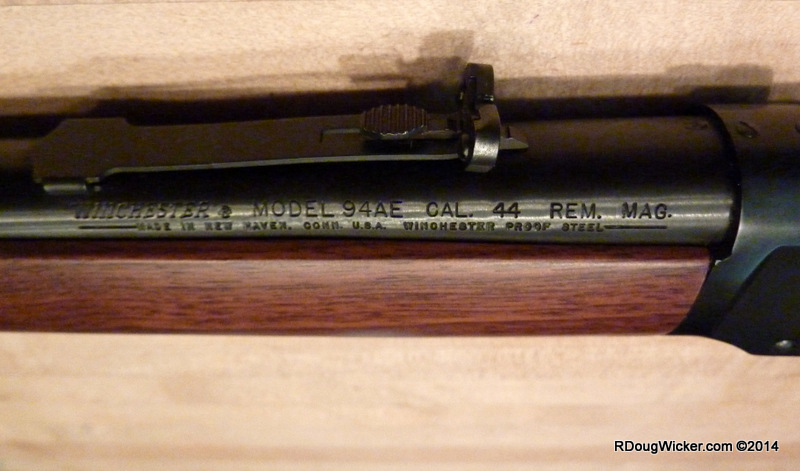
.44 Magnum
Now for a little lever-action history lesson: The first lever-action design dates back to the mid-1850s and inventor Walter Hunt, who briefly tried to develop his “Volition Repeating Rifle” in a joint venture with famed gun makers Horace Smith and Daniel B. Wesson.
The first truly successful lever-action rifles would come about in 1860, with the introduction of the Spencer Repeating Rifle and the much more famous Henry Repeating Rifle invented by Benjamin Tyler Henry for his employer Oliver Winchester. It is this rifle that spawned Winchester’s dominance in the lever-action rifle market for decades to come.
Which brings us to the line of rifles that tamed the Wild West. The title “The Rifle that Won the West” rightly belongs to the Winchester Model 1873, the first Winchester lever-action rifle to chamber much more reliable center-fire cartridges rather than the rim-fire ammunition used by its predecessor, the Winchester Model 1866. The Winchester 1873 would become one of the most successful Winchester products of all time and would even star in its own movie — Winchester ’73, co-starring Jimmy Stewart.
The Winchester Model 1873 was designed for pistol ammunition — .32-20, .38-40, and the famous .44-40 rounds. There was a huge advantage to having a rifle chambered in the same round as was used in your handgun, and that was the need to only purchase and carry one type of ammunition for both your short-range and long-range weapons.
The first true rifle cartridge lever-action would have to wait until the Winchester Model 1876 some three years later, and it was a hearty beast indeed. The Winchester Model 1876 could be had in the awesome (for its day) .50-95 buffalo cartridge.
Links to people, companies, and weapons mentioned in this article are produced below the closeup photos below.
Tomorrow: The inimitable John Moses Browning graces Winchester with his brilliance.

“Trapper” length 16-inch barrels
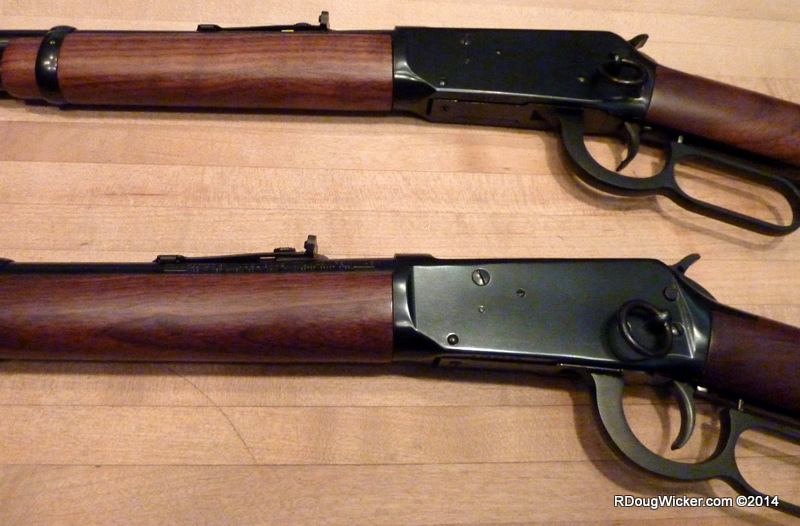
Forestock
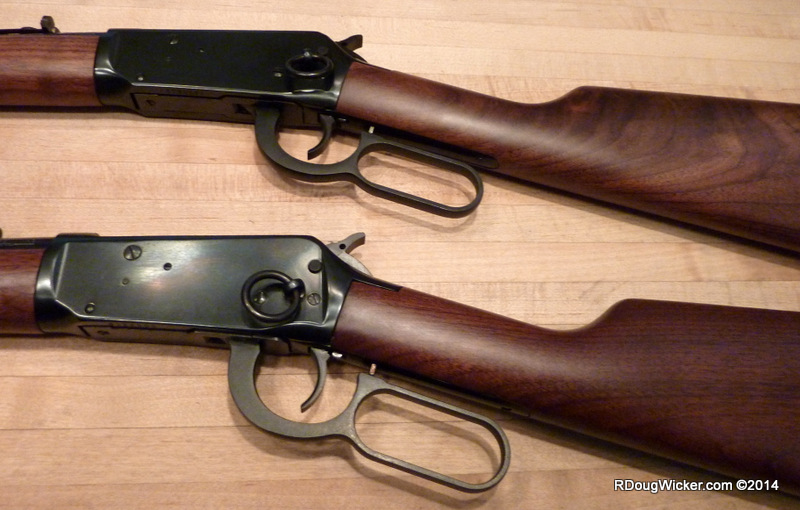
Receivers and Levers

Stocks
Bibliography for Today’s Topic:
- Volcanic Repeating Arms
- Lever-Action
- Spencer Repeating Rifle
- Henry Repeating Rifle
- Benjamin Tyler Henry
- Oliver Winchester
- Winchester Repeating Arms Company
- Winchester Rifle
- Winchester Model 1866
- Winchester Model 1873
- Winchester Model 1876
- U.S. Repeating Arms Company
- Rossi Firearms (lever-action)
- Chiappa Firearms (rifles)
- Cimarron Firearms (repeating rifles)
- John Wayne
- El Dorado (movie)
- True Grit (movie, 1969)
- Jimmy Stewart
- Winchester ’73 (movie)
- Chuck Connors
- Lucas McCain
- The Rifleman (television)
- The Rifleman’s Rifle (how to purchase one)


 Decisions — Murder in Paradise
 The Globe — Murder in Luxury

