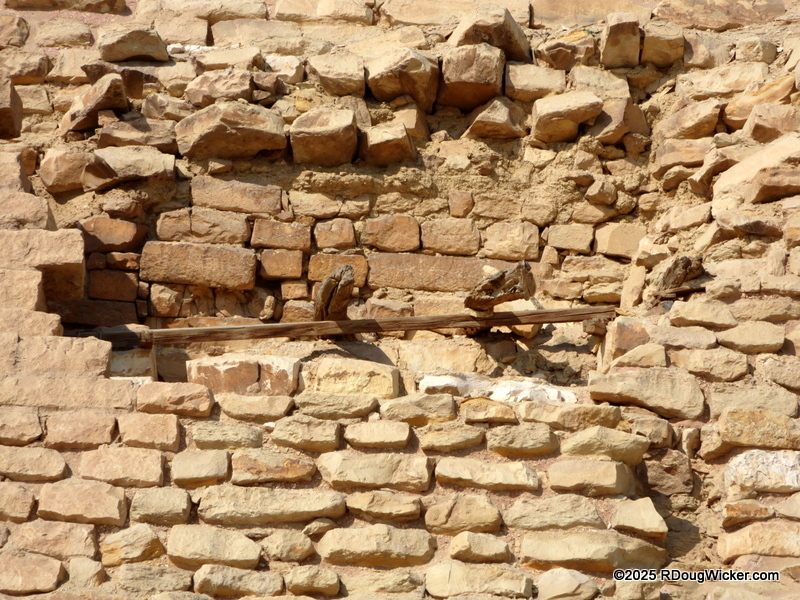
Mastaba (tomb) in the foreground; Pyramid of Queen Henutsen behind
Perhaps the most iconic image at the Giza Pyramid Complex (after the Pyramid of Khafre for me) is the Great Sphinx of Giza. From paw to tail this half man/half lion measures 240 feet/73 meters, and it rises 66 feet/20 meters above the ground. So, even though it appears smallish, especially in comparison to the three large pyramids at this site, it is indeed a very large structure:
The Great Sphinx of Giza
And it would look even more impressive if Napoleon’s troops hadn’t blasted off its nose with cannon fire. That’s a myth, by the way. Drawings of the Great Sphinx predating Napolean show it was missing long before “Le Petit Caporal” (The Little Corporal) came along in 1798.
No… Napoleon did not cut off its nose to spite its face
Here’s a side of the Great Sphinx one seldom sees:
The tail-end of the Great Sphinx
Now, normally I hate selfies, but our guide offered, so here we are:
Silly Selfie Suffered at the Sphinx
Looking back to the west I captured a three-fer — the Pyramid of Khafre, Pyramid of Menkaure, and one of the three Pyramids of the Queens located just south of Menkaure:
Left to Right: Pyramid of the Queens, Pyramid of Menkaure, Pyramid of Khafre
And that is where I’ll leave you for today, with these remaining photos:
After our visit to Saqqara and stops at various shops I told you about last week, our next tour stop was the Giza Pyramid Complex. Here you’ll find three very large pyramids, the Great Sphinx of Giza, and an assortment of smaller pyramids, all of which were built during the 4th Dynasty of the Old Kingdom. Of the three larger pyramids, the Great Pyramid (also known as the Pyramid of Cheops or Khufu) is the most famous because it is the largest — currently 454 feet/138.5 meters high, which is some 27 feet/18 meters shorter than its original height. Seen in the Wikipedia diagram below, it is the large pyramid in the upper right quadrant:
But, oddly enough, when I picture the Giza Pyramids it’s not the Great Pyramid that forms a mental picture in my mind. Like many people, that mental image is of the middle Pyramid of Khafre. I suppose that’s because it has steeper sides, which make it appear taller, and it is the only one of the three that retains at least some of its original cladding. Here’s a comparison of the two:
The Great Pyramid of Giza
The Pyramid of Khafre
Not that there’s a whole lot of difference in height between the two. Khafre stands 448 feet/136.4 meters at its current height. But it just looks so much more impressive. The difference in the tops alone make it so:
The Great Pyramid
The Pyramid of Khafre
On Wednesday I’ll concentrate more on the Great Sphinx. Until then I shall leave you with this photo gallery/slide show:
Saqqara — All that remains of statues on a pedestal
Today we’ll finish up with Saqqara, then head on out for some local culture. By culture, I’m referring to the making of papyrus, by hand, and then we’ll go into a shop specializing in essential oils, if you’re into that kind of thing. We’ll begin to day with another view of the Pyramid of Djoser:
Pyramid of Djoser
One thing I did not touch upon on Monday is Djoser, the pharoah for whom this comlex was built. Djoser ruled for somewhere between 19 and 28 years, depending on how the ancient texts are interpreted, but 28 years is probably the more accurate of the two guesses judging from the buildings for which he had built. That would put him in the Second Dynasty in the Old Kingdom. And that would place him at the beginning of the “Age of the Pyramids,” which is appropriate since the Step Pyramid was Egypt’s first.
Saqqara — North and South Pavilions
Looking at the picture above, you may notice a pyramid-shaped pile of rubble in the background. Well, that pile of rubble truly is another pyramid within Saqqara. It’s the Pryamid of Userkaf, and it was constructed some 200 years after the Pyramid of Djoser. It fell into so much disrepair that it wasn’t even officially identified as a royal burial pyramid until 1842. It appears that 5th DynastyKing Userkaf’s pyramid just didn’t get the same respect as the pyramid erected by his 3rd Dynasty predecessor King Djoser. So, let’s leave Saqqara behind with one last image of the Rubble Pyramid of Userkaf:
Pyramid of Userkaf
After Saqqara, our tour guide took us to the ever-present, forever-required tourist stops that nearly every guide seems intent upon including because they get a kickback. The first was a total nonstarter, an essential oils proprieter. But it did give me at least two colorful fun shots:
Colorful Essential Oils in Dainty Glass Bottles
Not a Kaleidoscope
Before that, however, we actually had a fun visit with at a papyrus art shop. This is the Egypt Papyrus Museum and it’s not an actual museum, but rather a nice store. Here the proprietors actually make their own papyrus paper by hand. First, our demonstrator took water-soaked stems from the papyrus plant and rolled them out:
Making papyrus paper
Afterward, she laid the stems in a crisscross fashion, but always flat with the edges slightly overlapping. The stems are never twined together, as braiding or weaving the stems would result in an uneven surface unsuitable for writing and drawing. After assembling, the papyrus paper is pounded, dried under pressure, such as weights or a vice. The paper is then hand polished to smooth it out even more.
Making papyrus paper
If you do it properly, this is the beautiful end result after trimming:
Papyrus paper
And, yes, there’s a lot of very interesting art to purchase here:
Papyrus art
Next week, after this week’s first of several Fun Photo Fridays featuring Cairo favorites, of I’ll show you the Giza Pyramid Complex.