Category Archives: Firearms

Winchester Rifles — Part 1


A Pair to Draw to — Winchester Model 1894 Rifles

A Pair to Draw to — Winchester Model 1894 Rifles

Today begins Part 1 of a two-part special weekend blog on post-Civil War Wild West rifles in general, and Winchester lever-action rifles in particular. This will not be a shooting review, for the weapons depicted here are twenty years old and still unfired outside of the original proofing before leaving the now defunct Winchester plant in New Haven, Connecticut back in 1994.

Centennial Version of the Model 1894

Centennial Version of the Model 1894

Yes, that means these particular rifles are centennial editions. The receivers are stamped “1894-1994.” That doesn’t really increase the value much, as post-1964 Winchester Model 1894 rifles are not as in demand as those that stuck to the original design and manufacturing techniques dating back to the 19th Century.

And It's Matched Partner

And It’s Matched Partner

But the story doesn’t end with the demise of Winchester or Winchester’s Connecticut facility. The Winchester brand is still alive, and new Winchester-branded lever-action rifles are being made in Japan courtesy of our Belgian friends at FNH (see my review here of their exquisite FNX-45). But be prepared to spend upwards of $1,200 for one of these new versions.

Not only can you still obtain a Winchester-branded Model 1894 and other lever-action rifles, you can also acquire off-brand examples of some of Winchester’s earlier rifles, such the pistol-caliber Model 1892 favored by John Wayne and used in equally anachronistic fashion by Lucas McCain (played by the late Chuck Connors) in The Rifleman (1958 to 1963). I say “anachronistic” because the Model 1892 was used in many Westerns set in years far earlier than 1892 — the year it was first produced. Indeed, the Rifleman was set in the New Mexico Territory in the early 1880s, so his rifle should have been the Winchester Model 1873!

By the way, check out the bibliography links below to see how to purchase a version of Lucas McCain’s Winchester ’92. Or, click on this link:


However, lest you think you’re getting a true Winchester when you get a new Model 1873, 1886, or 1892, think again. These copies are made by several companies totally unrelated to the original Winchester Company — Rossi of Brazil and Chiappa of Italy to name a couple.

P1060392

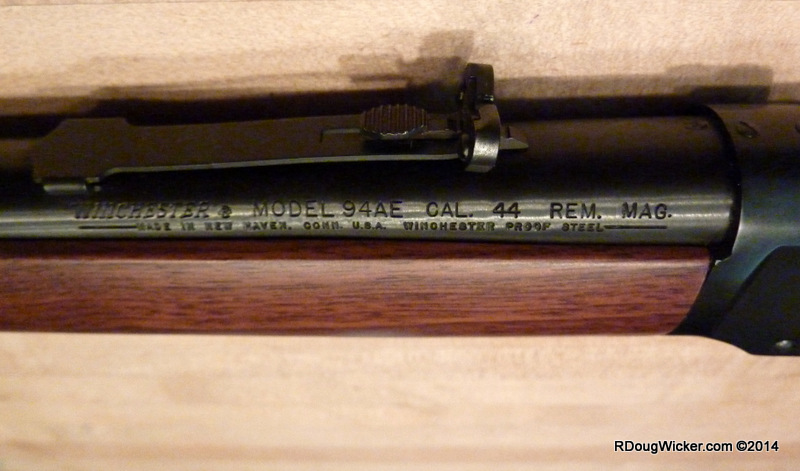
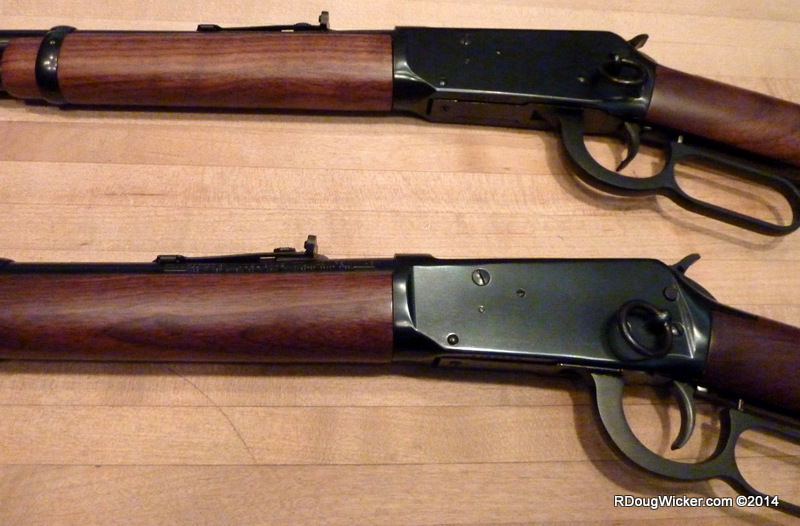
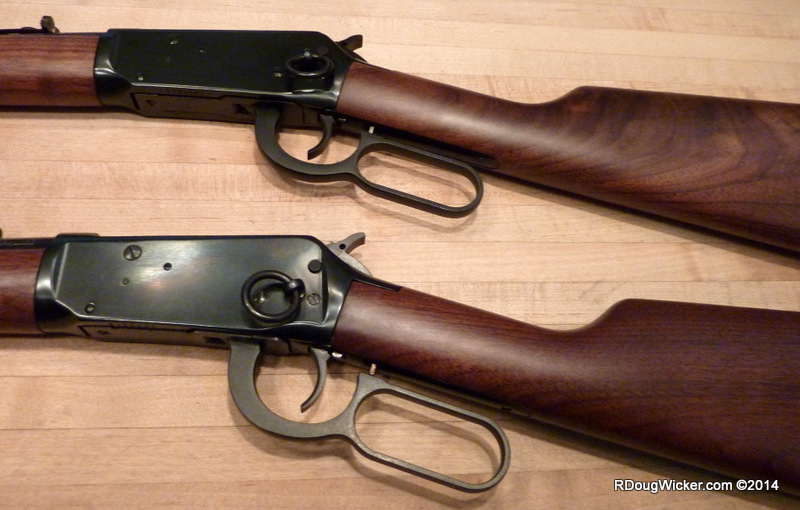
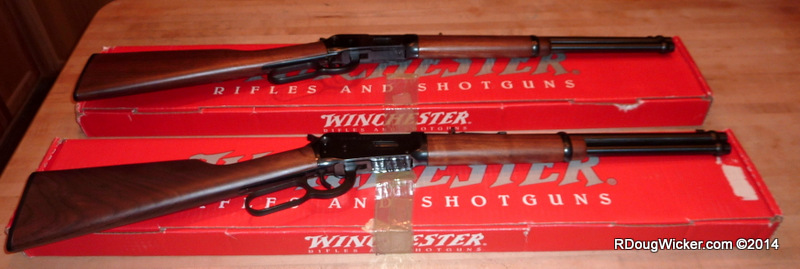
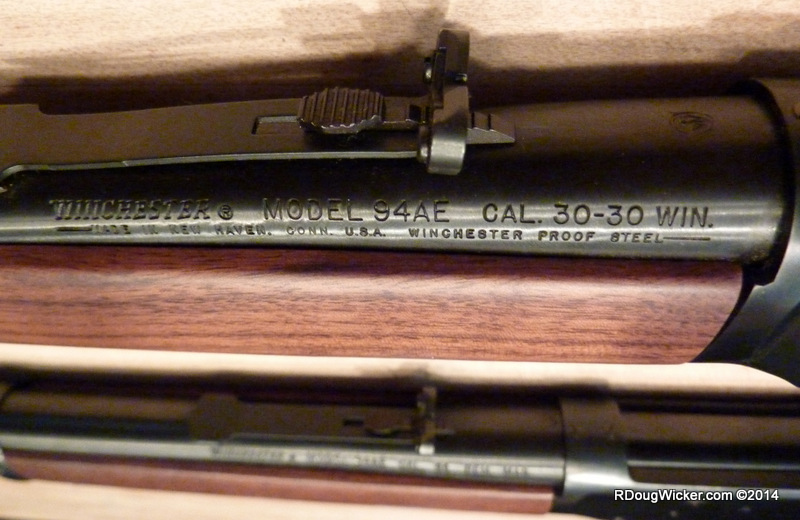
What you see here are two Winchester Model 1894 Trapper carbines with 16-inch barrels. The Model 1894 produced by Winchester from 1894 through 2006 has sold more copies than any other sport hunting rifle ever produced — over 7,000,000 copies. One rifle is chambered in .30-30 (originally called .30 WCF for Winchester Center Fire).  This cartridge was specifically designed for the Model 1894, and arrived on the scene in 1895. The other example shown is not nearly as common. That one is chambered in the .44 Magnum handgun cartridge.
P1060383

.30-30 (.30 WCF)

.44 Magnum

.44 Magnum

Now for a little lever-action history lesson: The first lever-action design dates back to the mid-1850s and inventor Walter Hunt, who briefly tried to develop his “Volition Repeating Rifle” in a joint venture with famed gun makers Horace Smith and Daniel B. Wesson.

The first truly successful lever-action rifles would come about in 1860, with the introduction of the Spencer Repeating Rifle and the much more famous Henry Repeating Rifle invented by Benjamin Tyler Henry for his employer Oliver Winchester. It is this rifle that spawned Winchester’s dominance in the lever-action rifle market for decades to come.

Which brings us to the line of rifles that tamed the Wild West. The title “The Rifle that Won the West” rightly belongs to the Winchester Model 1873, the first Winchester lever-action rifle to chamber much more reliable center-fire cartridges rather than the rim-fire ammunition used by its predecessor, the Winchester Model 1866. The Winchester 1873 would become one of the most successful Winchester products of all time and would even star in its own movie — Winchester ’73, co-starring Jimmy Stewart.

The Winchester Model 1873 was designed for pistol ammunition — .32-20, .38-40, and the famous .44-40 rounds. There was a huge advantage to having a rifle chambered in the same round as was used in your handgun, and that was the need to only purchase and carry one type of ammunition for both your short-range and long-range weapons.

The first true rifle cartridge lever-action would have to wait until the Winchester Model 1876 some three years later, and it was a hearty beast indeed. The Winchester Model 1876 could be had in the awesome (for its day) .50-95 buffalo cartridge.

Links to people, companies, and weapons mentioned in this article are produced below the closeup photos below.

Tomorrow: The inimitable John Moses Browning graces Winchester with his brilliance.

"Trapper" length 16-inch barrels

“Trapper” length 16-inch barrels

Forestocks

Forestock

Receivers and Levers

Receivers and Levers


Stocks

Stocks

Bibliography for Today’s Topic:

3 Comments

Filed under Firearms, R. Doug Wicker

SIG P229 Enhanced Elite — An Exercise in Indulgence


SIG Sauer's P229 Enhanced Elite in 9mm

SIG Sauer’s P229 Enhanced Elite in 9mm

 We’ll be getting back to travel and photography on Wednesday (more on that at the end of today’s blog post).  However before I start another photo travel series, I wanted to get in one quick entry of my highly popular firearms reviews.  Indeed, such reviews hold five of my top ten most popular posts, and this year’s review of the FNH FNX-45 is currently at number eleven and rapidly gaining ground.

Today I’m presenting to you another SIG Sauer — this time the P229 Enhanced Elite chambered for the 9x19mm Parabellum cartridge.  This is actually the second SIG I’ve reviewed, the first being the SIG P220 Equinox chambered in .45 ACP, which is functionally pretty much the same.  The differences between these two, besides the caliber and magazine capacity, are in the reach of the trigger, SIG’s new E² enhanced grip, and in cosmetic treatments.

SIG Sauer .45 ACP P220 Equinox

One of the first things the observant reader will notice about the Enhanced Elite is the enormous beavertail extension above the grip.  Many guns incorporate this feature as a way to minimize or eliminate slide bite and hammer bite.  Slide bite occurs when the hand is too high on the grip, allowing the bottom of the slide under recoil operation to potentially bruise the shooter’s hand or even gouge out two parallel tracks along the top of the hand behind the area between the thumb and index finger.  Not fun.

Indeed, this is often referred to asWalther bite” by fans of the Walther TPH and PP-series pistols, and is the primary reason that Smith & Wesson redesigned the beavertail on the PPK and PPK/S pistols that they manufacture (the other reason being to assist in recoil control for quicker follow-up shots).  Hammer bite occurs when this same area of the hand is pinched or otherwise injured by the rapid rearward movement of the hammer being cocked under recoil operation.  Hammer bite was common in the original Model 1911, but later redesigns extended the beavertail on this weapon to eliminate the problem.

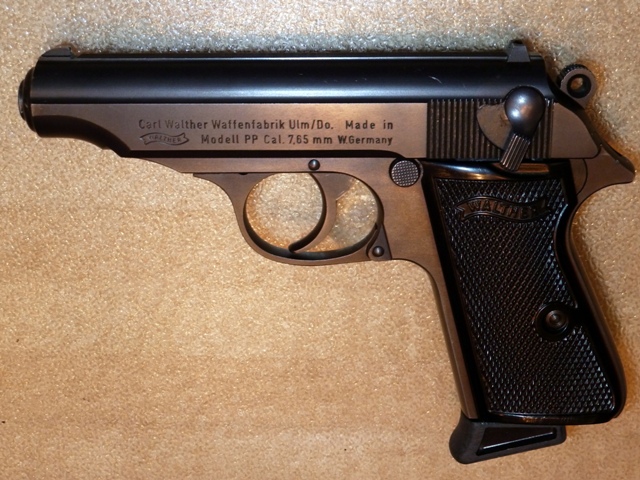
Here are a pair of images comparing the original Walther PP-series beavertail to the Smith & Wesson redesign:

German-made 7.65mm (.32 ACP) Walther PP with original beavertail

Smith & Wesson redesigned extended beavertails on the Walther PPK and PPK/S

Let me assure you that the beavertail (the “Elite” part of “Enhanced Elite) on the SIG P229 is for cosmetic purposes only.  Having fired SIGs for some time now, I can assure you that a properly held P22(x) series pistol does not inflict injury through either slide or hammer bite, and that these weapons have a mass that is more than sufficient to tame the recoil to a very manageable level.  Bottom line:  It just looks darn good, but it is an exercise in indulgence.

SIG Sauer P229 Enhanced Elite in carrying case

SIG Sauer P229 Enhanced Elite in carrying case

Now that you know to what “Elite” refers, let us take a look at the “Enhanced” part of “Enhanced Elite.  That simply means that the P229 Enhanced Elite comes equipped with SIG’s modular, one-piece E² Enhanced Ergonomic grip in conjunction with a revised trigger that reduces the distance between the face of the trigger and the grip.  Here is a comparison image of the standard versus E² grip configurations on the P229:

Standard SIG P229 versus P229 with E² enhancement

Standard SIG P229 versus P229 with E² enhancement

While this may not seem like much of an improvement, this is huge for anyone with small to medium size hands or short fingers.  My hands are by no means small, and even I find this enhancement a noticeable improvement over the original SIG P22(x) design.

By the way, the one-piece E² grip is not held in place by the traditional screws.  SIG includes a special tool that helps pry the grip from the frame should you need to remove the E² for a more detailed cleaning of the weapon.

Included E² grip removal tool on left side of image

Included E² grip removal tool on left side of image

The SIG P229 Enhanced Elite also comes equipped with tritium-filled night sights:

Tritium night sights are standard on this SIG

One great thing about the SIG P22(x) line of pistols is the ease with which they disassemble.  As I described in my review of the P220 Equinox, it’s simply locking back the slide, rotating the take-down lever, releasing the slide, and pulling the slide forward off the rails.  Once that’s done you just strip out the guide rod, recoil spring, and barrel for cleaning.  Putting SIGs back together is just as quick and easy.

Disassmbled P229 Enhanced Elite

Disassmbled P229 Enhanced Elite

And how does this weapon perform at the range?  With the class, grace, verve, and aplomb befitting its pedigree, and without the drama and tantrums of many of its lighter polymer-framed competition.  This is, after all, a design for the rigors of police work and the harsh environment of combat, combined with the reliability and ease of use demanded by both.  SIG simply makes, in my opinion, the best pistols on the market for the price whether you are an experienced shooter or someone new to handguns.

SIG Sauer P229 Enhanced Elite

SIG Sauer P229 Enhanced Elite

This particular P229 is the type of double-action/single-action weapon which I personally prefer.  I find that the added safety benefits of a heavy, long double-action first pull of the trigger suits my comfort level, and mastering that first shot is not at all difficult.  Besides, if I need the accuracy of a lighter, shorter single-action shot, it takes but a fraction of a second to thumb the hammer back into its cocked position.

Accuracy is superb, and SIG’s 4.5-pound single-action trigger pull is one of the best on the market short of a customized handgun.  Slack take-up occurs in about 5/16ths of an inch, with the trigger breaking both cleanly and crisply with no slop after that initial travel.  Double-action is rated at a 10-pound pull, and takes about three-quarters of an inch to accomplish — the first quarter-inch for take-up of trigger slack, and another half-inch to bring the hammer back to its trip point.  Trigger reset after a shot is about a quarter-inch with an audible “click” and a positive tactile indication.  That quarter-inch reset is a tad less than what I measured on the SIG P220.

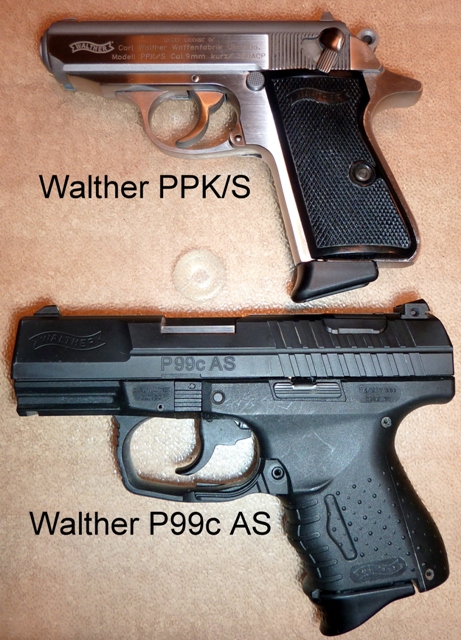
As far as concealment, the SIG P229 is not as much of a challenge as you might expect from a weapon weighing in at 32 ounces (with an empty magazine) and measuring 7.4 inches long, 5.1 inches high, and 1.6 inches wide.  The P229 hasn’t replaced my Walther P99c AS as my primary roaming companion, but it does get taken for a walk every now and then.  After all, 15+1 rounds 0f 9mm is sometimes more of a comfort than the Walther’s 10+1 capacity.  Just remember to use a high-quality holster and a good, stiff gun belt and you should have no problems.

My trusty 9mm P99c AS alongside my equally trusty and frequently carried .380 ACP PPK/S

Originally I had planned for my next photo travel blog series to be our 28-day transpacific crossing from Sydney, Australia, and Seattle, Washington.  Instead, I’m going to delay a look at that cruise until later (about the time the ships reposition from Alaska back to Sydney).  Starting Wednesday I’ll present to you a cruise that is currently making the rounds until fall — the Montreal-Boston run on Holland America’s MS Maasdam.

11 Comments

Filed under Firearms, R. Doug Wicker

The Word for the Day is: Hoplophobia


A SIG Sauer Semiautomatic Pistol

Many of you may be wondering why nearly all my blogs have been travel photography related for the past several months at the expense of other areas of personal interest such as aviation safety (and Malaysia Air 370 in particular) and handguns (and the most recent high-profile mass shootings). The reason is simple: I’ve been out of the country more than in it from mid-April through the first week of June, and almost all the blogs for the past several months were prewritten and scheduled well in advance of current events.

Since last I addressed gun control there have been several high-profile shootings accompanied by the inevitable calls to strip from the law abiding tools that were misused by, let’s face it, criminals and the insane. And readers of this blog are aware of my stand on that — The rationale for taking away handguns from those who do not misuse them because of those who do is the same rationale that at some point may be used to strip from you the ability to own a car or even possess a kitchen knife (and, yes, there really is a movement currently gathering momentum in the United Kingdom to do away with chef knives beyond an arbitrarily decided upon length).

While you’re at it, take a look at this incredibly misinformed anti-knife individual:

Let us now discuss the 2014 Isla Vista killings (not to be confused with the 2001 Isla Vista killings, more of which you’ll read about shortly). You would be forgiven for thinking that I should refer to them as the Isla Vista shootings, but that would ignore the facts. Despite the media’s fixation on the three deaths that occurred through the use of perpetrator Elliot Rodger’s three 9mm weapons — a Glock 34 and two SIG Sauer P226 handguns — the implements used in the other three deaths received far less press coverage. That’s because there are far more Hoplophobics (people with an irrational fear of firearms) in this world than there are people who are deathly afraid of knives (aichmophobia), machetes, hammers, and BMWs (ochophobia).

You’ll notice how a slyly snuck in that reference to Mr. Rodger’s BMW 328i Coupe. And if you’ve been reading my blog posts for any length of time you know that I routinely post parodies of gun control arguments when someone misuses a vehicle to mow down some unsuspecting victim, either through impairment or intentional assault and murder. (See: When Will We Reign in these Deliverers of Death? and Hate to Say I Told You So, But . . . )

Which brings us to the 2001 Isla Vista killings, the abuse of Freedom of the Press, and the media’s role in copycat atrocities. Elliot Rodgers killed six people on May 23 of this year. Only three died by gunfire. Three others were reportedly killed by stabbing. Although police have not yet identified the implement used, they did confiscate a knife, a machete, and a hammer from the scene of the stabbings. An additional thirteen people were wounded — eight by gunfire, four by BMW, and one unattributed injury.

So, what has this to do with a mass killing in Isla Vista some thirteen years earlier? Ever wonder about the route Elliot Rodger took when he decided to turn a ton and a half of metal into an instrument of assault and mayhem? It just so happens to coincide with the route taken by mass murderer David Attias when he took his deadly 1991 Saab onto the same street — Sabado Tarde — and mowed down five defenseless pedestrians. Final toll: Four dead, one critically injured with crushed legs and severe head injuries.

Think that’s a coincidence? Neither do I. But as long as the media grant psychos “fame” and “glory” (at least in their eyes) lunatics will continue striving for recognition in the only way they can get it in the most expeditious manner available to them.

So, is the press to blame? While you’re pondering that question, remember this: Although Adam Lanza’s motive for the Sandy Hook shooting was never stated in the final report, those close to the investigation stated quite adamantly that Mr. Lanza considered himself in competition with Norwegian mass murderer Anders Breivek, and wanted to better Mr. Breivek’s “score” of 77 dead and 319 wounded.  By the way, Mr. Breivek did not need a gun for his first 217 victims (eight dead, 209 wounded); he used fertilizer and fuel oil for that.

At any rate, while I feel for Mr. Richard Martinez, father of Rodger gunshot victim Christopher Michaels-Martinez, I vehemently disagree with his assertion that, “Chris died because of craven, irresponsible politicians and the NRA.” No, Mr. Martinez. Your son died because an insane person took his life. That same person took lives with a stabbing implement as well, and attempted to murder others with a BMW. Let’s put the blame squarely where it belongs, because as Mr. Rodger proved that day, he didn’t need a gun to kill, maim, or injure. He merely needed the will to do so and a media stage upon which to perform.

As I’ve noted before, I find it odd that those in the media now advocating for restrictions on Amendment 2 offer nothing in terms of restraint on their part (such as refusing to publicly identify by name the perpetrators of such crimes) in the exercise of Amendment 1.

2 Comments

Filed under Firearms, R. Doug Wicker