
El Patrón — “The Boss”
Regular readers of my firearms posts may have detected a slight deviation from my usual affinity toward semiautomatics. Lately I’ve come to appreciate the firearms that tamed the Wild, Wild West, particularly Winchester lever actions. Here are a rare pair of consecutively numbered, “Centennial Edition” Winchester Model 1894s, unfired and chambered in .30-30 and .44 Magnum. (see: Winchester Rifles — Part 1 and Winchester Rifles — Part 2)

Centennial Edition Winchester 1894 rifles — .30-30 and .44 Magnum
I also have a childhood fascination with the old black-and-white television westerns of the 1950s. In those shows, the Winchester Model 1892 often substituted for the more era-appropriate Model 1873 because new 1873 weren’t being made (as they are now) and existing ones were rather pricey. Two favorites from the Golden Age of Television were The Rifleman and Wanted: Dead or Alive. (see: Firearms — Television Westerns from the 1950s for more on the weapons pictured below)
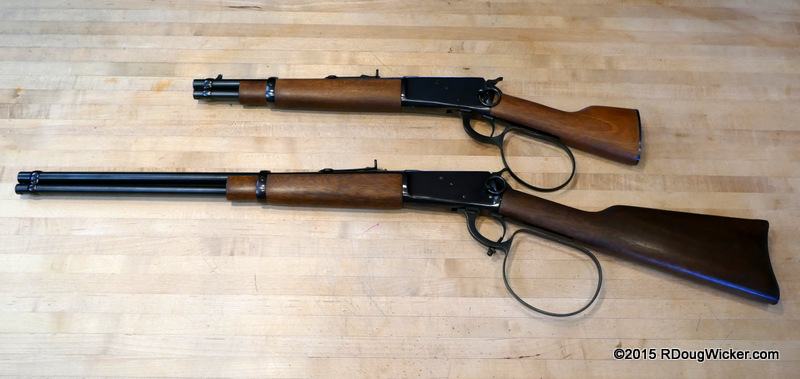
Mare’s Leg (top) — Pistol version of the M1892; Rifleman’s Rifle — Modified M1892 for trick handling and rapid fire
Two weapons bore the title of “The Gun that Won the West”. The first was the aforementioned Winchester Model 1873. The second was a pistol that coincidentally also made its debut in the year 1873 — the famous Colt Model 1873. The Colt M1873 also went by several other names depending on configuration and caliber — two of the more common versions being the Single Action Army (.45 “Long” Colt), the Frontier Six Shooter (.44-40), and “The Peacemaker”. Today, most people just refer to the Colt M1873 and its clones as Peacemakers, 1873s, or the SAA, short for Single Action Army.

El Patrón — “The Boss”
The M1873 you are looking at today is from Italian manufacturer Uberti, a maker of replica firearms that supplies re-branded Old West rifles and handguns to Benelli (Uberti’s direct owner), Beretta (owner of Benelli), Cimarron Firearms Company, and Taylor’s and Company.

Uberti Single Action Army box
Uberti’s El Patrón box comes with the following goodies —Instruction Manual, Instruction (be careful or you’ll shoot your eye out, kid) Sheet, Cylinder Lock, and, of course, an El Patrón Competition six-shooter.

Uberti Single Action Army — What’s inside the box
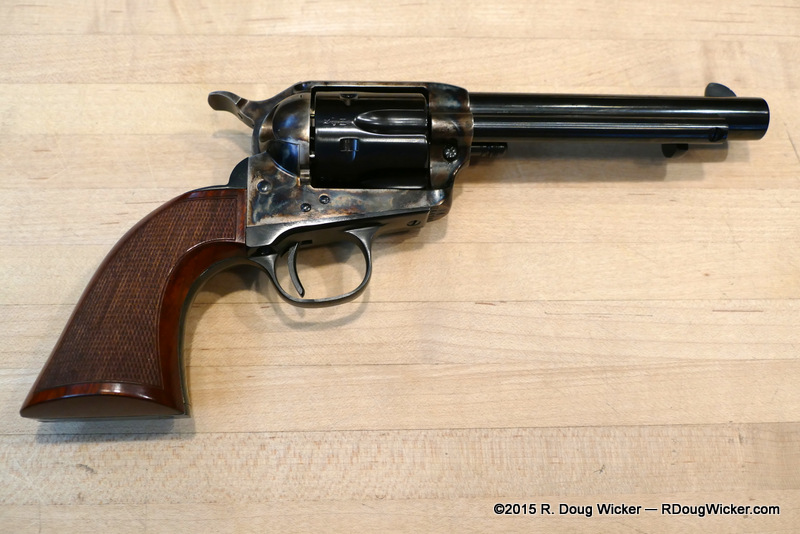
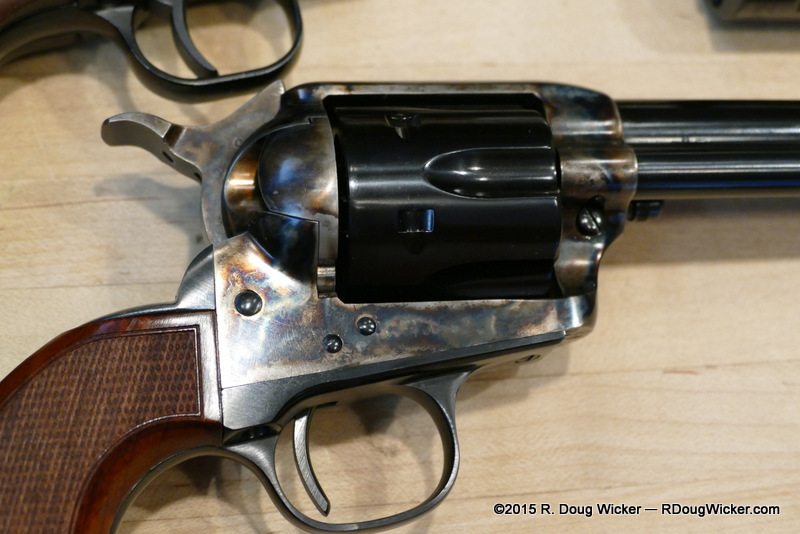
This particular Uberti is a special factory-tuned Cattleman “El Patrón Competition” model with lowered hammer for easier one-handed cocking and a very light trigger for competition shooting. Other features include a blued cylinder, case-hardened frame, steel trigger guard and backstrap, and nicely textured walnut grips. A stainless steel version is also available. But, really? This is an Old West firearm. Stainless just wouldn’t look right.

Blued cylinder set in a case-hardened frame
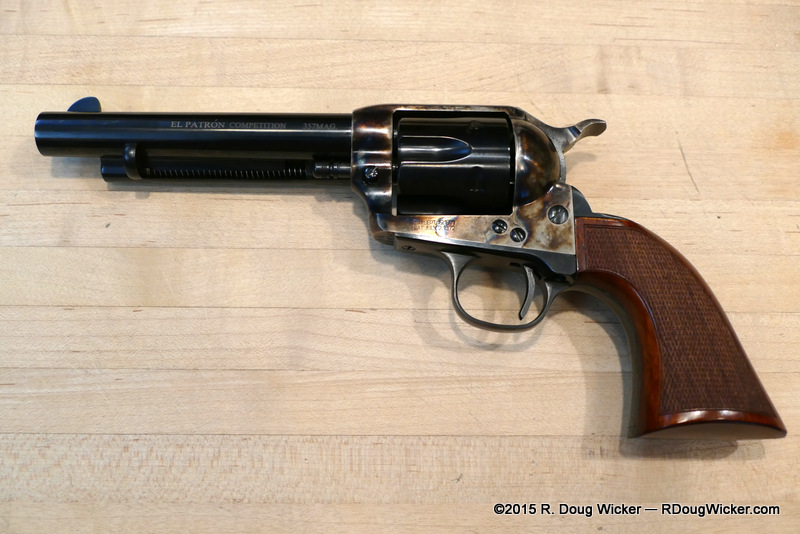
Stamped into the barrel is the model name and caliber, in this case .357 Magnum. That means this weapon will also handle the lower-powered, cheaper to fire .38 Special without a hitch.

Uberti El Patrón Competition barrel markings
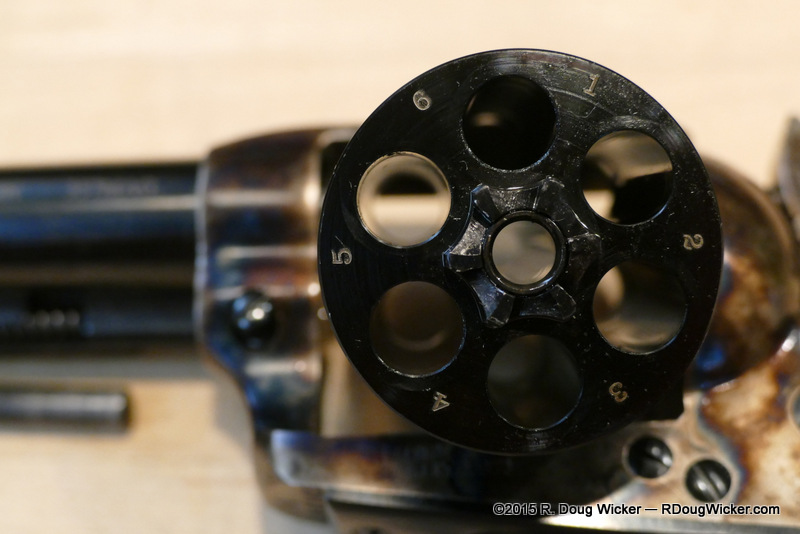
I find the numbered cylinder an interesting and useful touch. Since this is an almost exact replica of the original Colt, it is imperative that you leave the hammer down on an empty chamber for safety, and numbering the chambers makes that a snap.

Numbered Chambers — a nice touch
As anyone with experience will tell you, the proper way to accomplish this with the 1873 is to pull the hammer back to the half-cock position (don’t confuse that with a “safe” position; it isn’t), open the loading gate, rotate the cylinder to chamber 1, and load a bullet. Now, skip chamber 6, then load in order chambers 5, 4, 3, and 2. Loaded chamber five is now beneath the half-cocked hammer, and empty chamber six is the next in line. Close the loading gate and cock the hammer to the firing position. This will rotate empty chamber six into firing position. With your thumb on the hammer, pull the trigger until the sear trips and then gently ride the hammer completely down against the frame. Don’t release the trigger prematurely or the hammer will stop at the half-cock position.
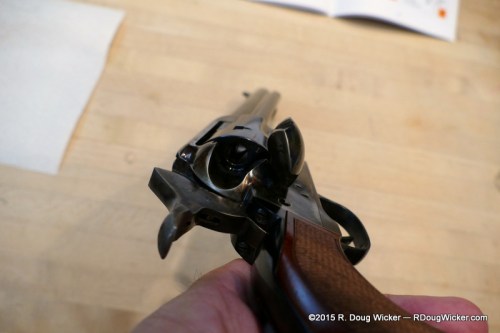
Chamber #1 ready to load
It is possible to load five chambers in sequence, close the gate, and then carefully pull the trigger while gently pulling back the hammer until the hammer disengages from the half-cock position, then lower hammer onto the empty chamber. But the problem with this method is that you then have to wiggle the cylinder until it locks up with the cylinder bolt, which was disengaged when the hammer was previously in the half-cocked position. Rotating the cylinder and hopefully not inadvertently placing a loaded chamber beneath the hammer just doesn’t work for me. I simply cannot recommend this method.

Loading gate, blued cylinder, and case-hardened frame
There is a third method that supposedly allows for safely carrying an 1873 with all six chambers loaded, but I’m certainly not going to do it. That requires additional manipulation so that the firing pin built into the face of the hammer rests directly on the cylinder between the rims of two loaded cartridges. Yeah . . . right. I’m not doing it.
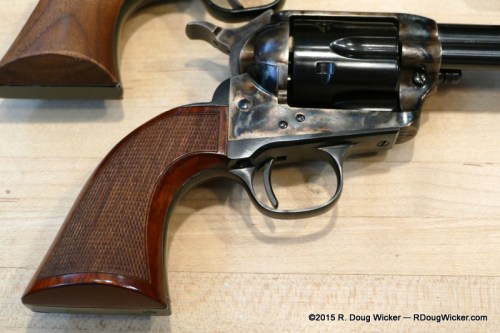
Case-hardened mottling
Disassembly is a snap. Just pull the hammer to the half-cocked position, open the loading gate, push the spring loaded base pin latch, pull out the base pin (the long metal rod below), and remove the cylinder through the gate opening. Reassembly is not quite as easy, at least for me. You have to get the cylinder into just the right position before pushing the base pin latch and reinserting the base pin. If it doesn’t all go together perfectly, the hammer cannot be pulled back beyond the half-cock position. The trick here is to keep pushing on the base pin while wiggling the cylinder until the base pin snaps fully back into the frame.
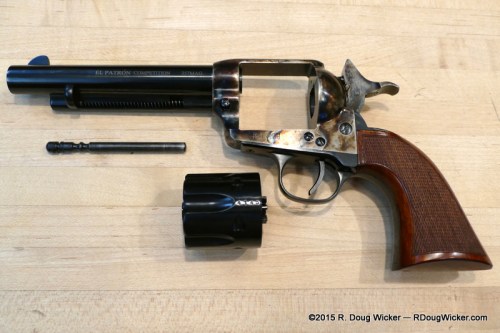
Simple breakdown; reassembly not so much
Now for my impressions. Bear in mind I’ve yet to fire this weapon. That being said I can tell you that cylinder lockup is incredibly tight with barely any movement. Both fit and finish are superb. The Uberti emits the legendary ‘C-O-L-T’ cocking sound — that’s four distinct “clicks”, one for each letter in “Colt”, as the hammer is cocked back into firing position. Because of the low-angle hammer and the custom Wolff springs, the Uberti is incredibly easy to thumb cock with no shifting of the hand required. The trigger is by far the best I’ve encountered in any weapon. There is absolutely no slack take-up, the break is clean and crisp with almost zero (less than a millimeter) creep, and the trigger weight feels to me as though it has to be well under three pounds.

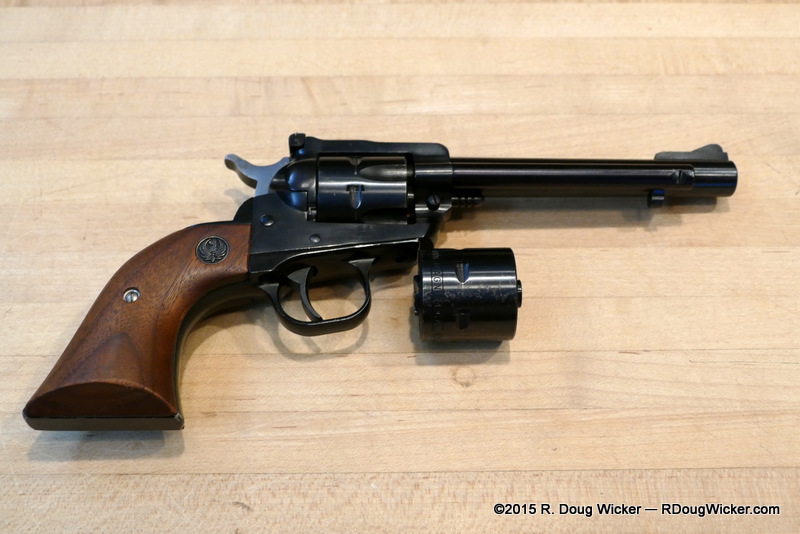
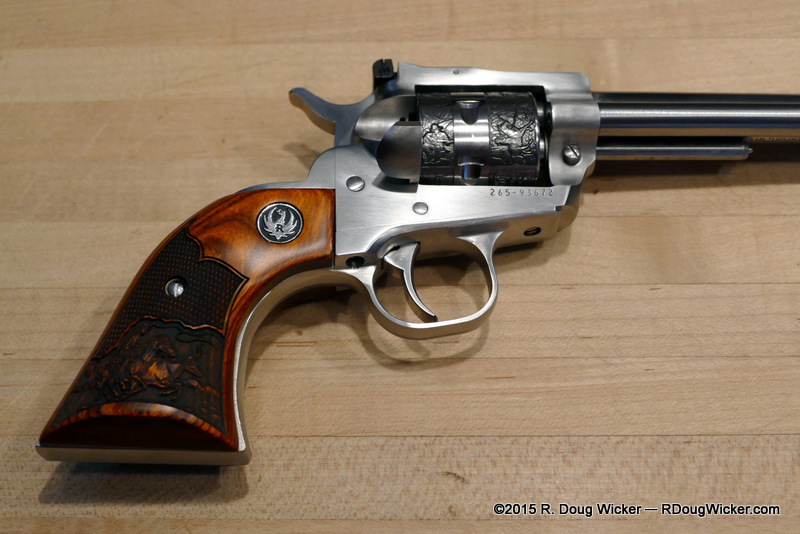
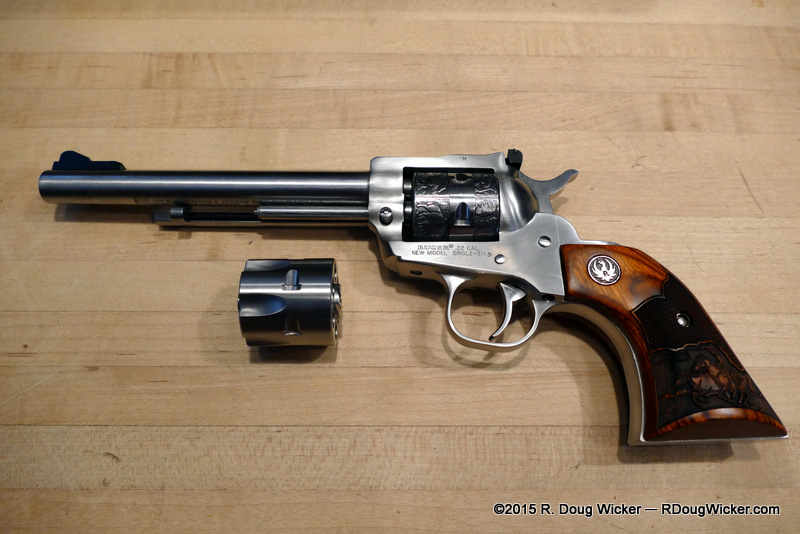
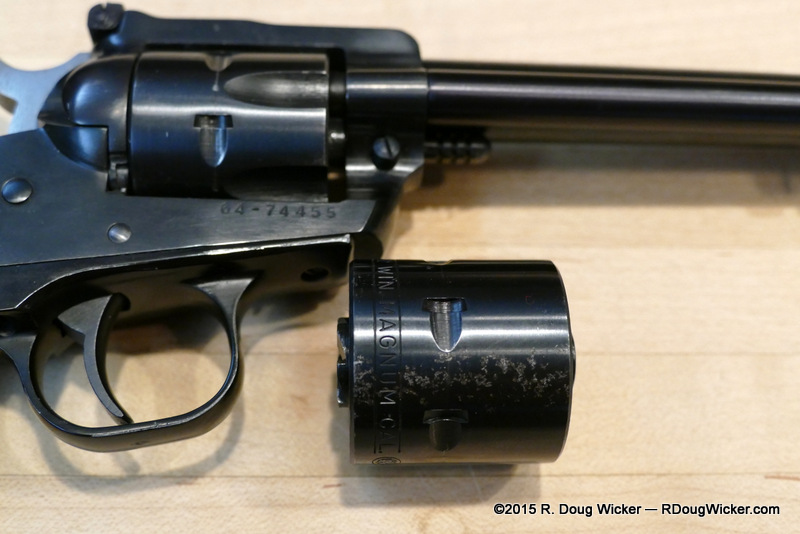
Uberti Single Action Army and a Ruger Single-Six
So, show me favorably impressed. The Uberti 1873 Cattleman El Patrón Competition is a solid, well-built, tight example of the classic, original Colt 1873 design. Suggested retail is currently $669, or $799 for the blasphemous stainless model. Calibers include .38SPL/.357 Magnum and .45 Colt, and barrel lengths come in 4.75 inches/120 mm, 5.5 inches/140mm, and a CMS (Custom Mounted Shooter) at 3.5 inches/90mm.
Now, if only Uberti would offer a Paladin Have Gun — Will Travel version with a 7.5-inch/190-millimeter “Cavalry” length. Well, I can dream, can’t I?













 Decisions — Murder in Paradise
 The Globe — Murder in Luxury
 R. Doug Wicker — Author