Category Archives: Aircraft

El Paso International Airport and Biggs Army Airfield Histories — Part 1


El Paso Military Aviation and Biggs Army Airfield:

In 1919 the first permanent aviation presence arrived at Fort Bliss Aviation Field. The U.S. Army deployed to Fort Bliss the 104th Aero Squadron, which operated the Geoffrey de Havilland-designed Dayton-Wright DH-4. These aircraft patrolled the border between the United States and Mexico, becoming the first aerial Border Patrol operation.

Dayton-Wright DH-4, based on the Airco D.H.4

Meanwhile, in December of that same year, the Army relocated airship operations from Brooks Field, San Antonio, to a location two miles northeast of Bliss Aviation Field, on National Guard Camp Owen Bierne. On January 5, 1925, Bliss Aviation Field was renamed Biggs Field in honor of El Paso native Lt. James B. Biggs, who lost his life flying a pursuit aircraft in France during World War I, and on July 1, 1926, Biggs Field relocated to Camp Owen Beirne, which to this day is the present location of Biggs Army Airfield.
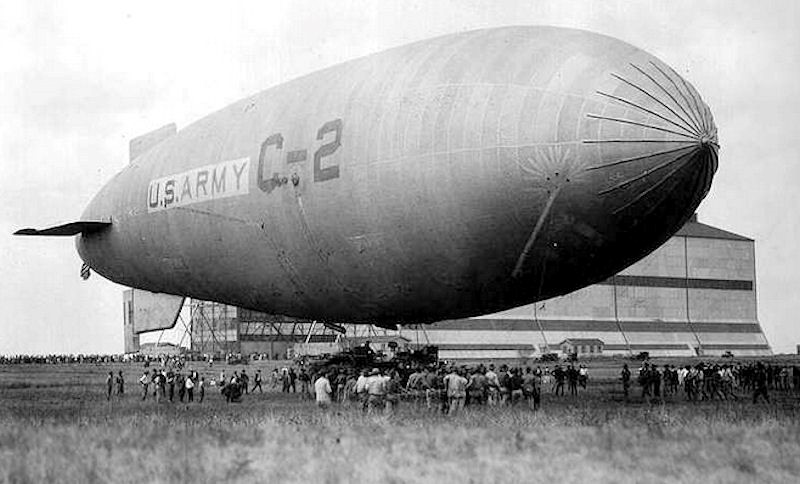
U.S. Army C-2 blimp at Brooks Field, San Antonio, 1922

During World War II Biggs Field would take on a new, expanded role. Bombers arrived, and aircrews began training for the conflict by learning to operate the Boeing B-17 Flying Fortress, Consolidated B-24 Liberator, and later in the war the Boeing B-29 Superfortress.

Consolidated B-24 Liberator

In 1947, command of Biggs Field transferred to the newly formed United States Air Force, which operated Biggs Air Force Base as a heavy bomber base under control of the Strategic Air Command (SAC). During its days as a SAC base, Biggs Air Force Base hosted the Boeing B-50 Superfortress (post-war advancement of the WWII era B-29 Superfortress), the massive 10-engine (six propellers, four jet engines) Convair B-36 Peacemaker, Boeing B-47 Stratojet, Boeing KC-97 Stratofreighter, Boeing B-52 Stratofortress, and the Boeing KC-135 Stratotanker. Biggs Air Force Base closed in 1966, at which time control of the field reverted to the U.S. Army. However, Biggs Field would remain closed for seven years, resuming operations as Biggs Army Airfield in 1973.

Convair B-36 Peacemaker

Today Biggs Army Airfield has one runway. Runway 21/03 is one of the longest in the Western United States, measuring 13,554 x 150 feet (4, 131 x 46 meters).
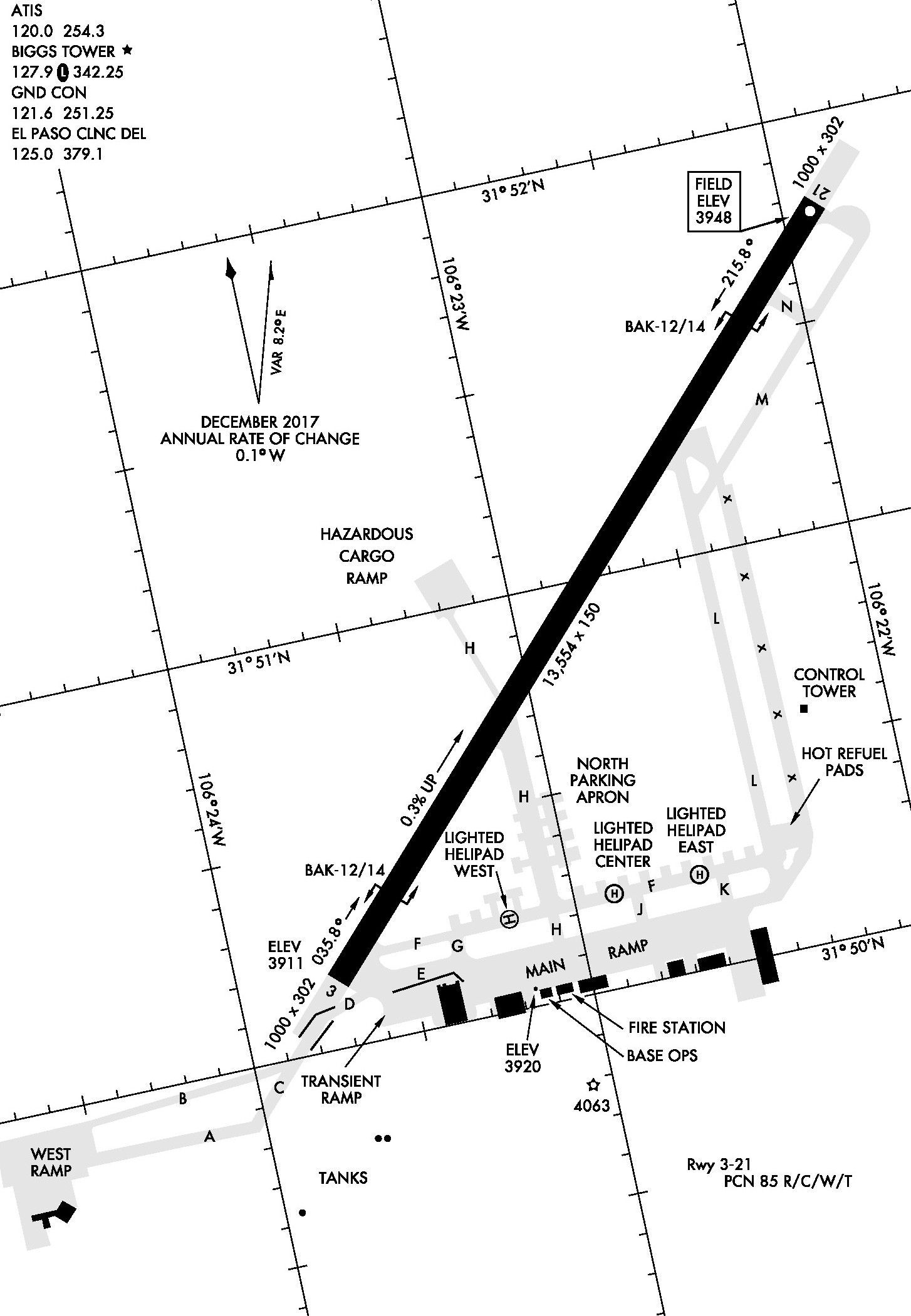
Biggs Army Airfield diagram

Wednesday — El Paso Civil Aviation

© 2018 R. Doug Wicker

Comments Off on El Paso International Airport and Biggs Army Airfield Histories — Part 1

Filed under Aircraft, Author, R. Doug Wicker, Writing

Fun Photo Friday — WhiteKnightTwo Favorites


WhiteKnightTwo Panoramic

WhiteKnightTwo Panoramic

WhiteKnightTwo doesn’t only act as a launch platform.  Something I didn’t mention in Wednesday’s blog is that WhiteKnightTwo is also built to handle the stresses of parabolic flight, which results in something approaching zero gravity.

Parabolic flight profile from Wikipedia article on Reduced Gravity Aircraft

You’ll notice that this is not for the faint of heart.  While that Zero-G portion of the flight may look like fun, take a look at what awaits you and both ends of that experience — a force approaching twice that of Earth gravity.  That’s a pretty scary thought.  But this capability also means that WhiteKnightTwo can also double as a training environment to prepare travelers for the effects of micro-gravity.

But enough about WhiteKnightTwo’s other talents.  Here is today’s photo gallery:

Comments Off on Fun Photo Friday — WhiteKnightTwo Favorites

Filed under Aircraft, Fun Photo Friday, Photography, R. Doug Wicker

What We Now Know About Malaysia Airlines 370, and What We Still Do Not


9M-MRO, the aircraft that would become Flight 379

Many of you will recall that I said it was just far too early to determine what happened to Malaysia Airlines Flight 370. (See: Malaysia Airlines Flight 370 — What We Know and What We Don’t and Malaysia Airlines Flight 370 — It’s STILL All About What We Don’t Know)  Guess what: It’s still too early And it will be until the aircraft is located and the black boxes recovered.  We may all be scratching our heads over this a decade from now, and probably will be.

Any “expert” on CNN telling you otherwise is only displaying their total ignorance. Indeed CNN’s reputation took at least as big a hit as Malaysia Airlines did during this entire fiasco, but in the case of CNN all that remains of their journalistic credibility is a smoking crater with a bunch of people standing around it, scratching their heads, wondering when they went from being respected journalists to being merely silly, uninformed, and unworthy of the profession.  At least they now know that they’re of Fox News caliber if they ever lose their jobs at CNN.

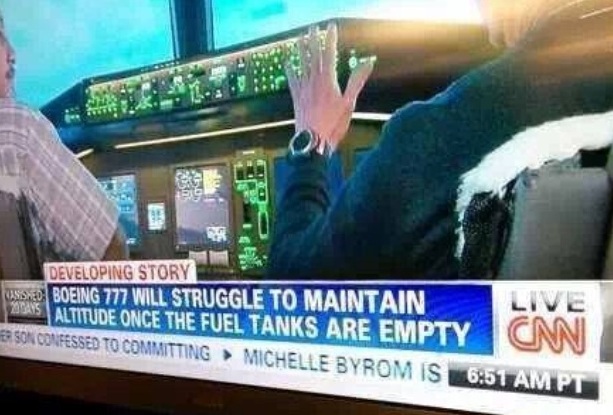
News Flash: Boeing 777 won’t fly without fuel. REALLY?!

 So, what do we know?  We know the Boeing 777 did not land on some remote airfield.  We know that the Malaysia Air Force defense radar was not sufficiently accurate enough to justify the earlier report of the aircraft climbing to 45,000 feet — several thousand feet higher than the Boeing 777’s certified ceiling.  We know that the Australians were searching in the wrong location based on an erroneous “ping” detection that turned out to not be from MAS370.  (no, I’m not faulting the Aussies; they did what they had to do because of the reported detection)  We know that Inmarsat told the Australians that the most likely final resting place is several hundred miles south southwest of where they were looking.  We know that this new search area is 23,000 square miles (the previous search area, which took a month to cover, was only 330 square miles — do the math on that one).  And we know that we have long missed our chance of picking up those black box pingers in this new location, so the search is going to be painfully slow, exceedingly tedious, and ridiculously expensive.

What we have surmised.  The Boeing 777 was probably on autopilot from the time it turned south to the time it impacted in the waters of the Southern Indian Ocean after fuel exhaustion (see CNN headline above for what most likely happens when the fuel runs out).  It appears that no one attempted to open the cabin doors after impact and escape, suggesting that no one survived the impact.

What we do not know (despite the “experts” on the telly, and especially over at CNN).  We do not know if the aircraft was hijacked.  We do not know if one or both of the pilots commandeered the aircraft.  We do even know if the crew were conscious after the initial “event” that led us to this point, which would make for a lot of red faces if this is indeed the case.  If they were unconscious, we’re suddenly looking at a whole host of very different possibilities including unintentional gradual depressurization from a hull leak or rapid decompression from an explosion or major catastrophic structural failure.

So, once again, disregard all those “experts” telling y0u what happened or may have happened.  Listen instead to the true experts who are telling you to sit tight and wait . . . and that wait could be for a very, very long time.

4 Comments

Filed under Aircraft, Aviation Safety