Monthly Archives: December 2012

The Brag Blog


The following is not one of my thrice-weekly regularly scheduled blogs:

I haven’t been writing much lately, and that’s unfortunate because I have three suspense novels originally written back in the 1990s on which I need to complete editing and get out for sale to keep up that name-recognition thing that is so important to an author’s success.

But even so, I still manage to receive every now and again a little surprise from an unexpected source.  The latest surprise came from R.W. Bennett, a fellow author about whom I knew nothing before yesterday, when he published on his blog a very complimentary review of The Globe.  Mr. Bennett gave The Globe his highest rating — five stars.

The Globe — a Murder Mystery set in Luxury

I’ve not yet made contact with Mr. Bennett to thank him (although I have subsequently sent to him an eMail and posted a comment on his review), but here’s what I’ve discovered about him so far:

Robert (RW) Bennett is the author of the book Love.com, available for the Amazon Kindle or the Barnes & Noble Nook or on any device using free, downloadable Kindle or Nook reading application.  It’s also available in paperback.  Mr. Bennett also maintains his own blog, the cleverly named Robert’s Rules of Order .

I’ve not read Love.com, but Mr. Bennett’s site tells us that it is, “. . . my first novel, published in April, 2011. It’s a fresh look at the internet dating scene, and contains romance, murder, mystery and suspense. Parts are laugh out loud funny.”

And while I’m in brag mode (sorry about that), there are the latest figures for this blog.  Last month RDougWicker.com shattered the previous monthly hit record (6,211 set back in April 2011) by over 1,800 hits.  This month appears on track to shatter even last month’s record, having surpassed 6,200 hits yesterday!

To all my blog readers — thank you so very much for your continued support.  And to readers and fans of my novels, hang in there; I’ll get back to work soon, and I’m certain you’ll find that your patience will have been aptly rewarded with these upcoming gems (the Ian Drake trilogy — investigations of  aircraft sabotage):

  • An On-Time Departure
  • And the Games Begin
  • Grand Slam

For those who’ve not yet read my novels, they’re still available on both Amazon and Barnes & Noble.  If you love mysteries with a touch of comic absurdity, give Decisions a try.  If you’re more into the hard-boiled type, get The Globe.  Just click on the links below:


2 Comments

Filed under Author, Books, eReaders, Social Networking, Writing

Photographing Outdoor (and Indoor) Christmas Lights


It’s the Christmas season.  That means it’s camera time, because you won’t see this much nighttime splashing of color again until July 4, and that’s only if we’re all still around come Mayan dawn on December 21 (remember — those west of the International Dateline get it first).

Taking pictures of Christmas lights requires special care and preparation.  Regular readers of my blog know that I don’t usually advocate taking the camera out of JPEG and shooting in your camera’s Raw format (especially for beginners or those who haven’t the time to fool with post-processing the conversion), but this may be an exception.  The biggest reason for this is White Balance and the transition from incandescent (tungsten) lighting to the newer high-tech LED lights becoming increasingly more common, but more on that in a moment.

Equipment you’ll need:  A camera that allows you to control white balance, and preferably one that allows storing images in Raw format for processing later.  You’ll also need a good tripod.  If you don’t have a tripod, then review my article on Available Light Photography Without a Tripod for tips on how to get around long exposures without camera shake and resulting image blur.  A remote camera release makes things easier, but if don’t have one then just use the time-delay feature on your camera so that your finger is off the shutter release button when the picture is taken.

Camera settings:  Use the highest ISO your camera can handle without giving you too much noise or too little resolution.  The pictures below were taken with a Canon G1 X at ISO 800.  That’s pushing it for most cameras smaller than a DSLR, so my may need to set ISO 400 or lower.  Use Raw format if your camera has that capability.  If it doesn’t, see the White Balance Considerations section below.  Set your camera to Evaluative Metering and the shooting mode to Program — today’s cameras can probably judge the exposure much better than can you, so take advantage of that.  You can try bracketing the exposure, but if you don’t know what that means then forget I said anything about it.

White Balance Considerations:

  • The older style incandescent Christmas lights emit to the eye a rather warm-looking light.  Even the white incandescent lights are actually in the yellow to orange range, but your eye automatically corrects for this which is why they appear white.  When you set your camera’s white balance to the Tungsten setting (often pictorially indicated by a light bulb), the camera takes this into account and corrects the colors accordingly.
  • LED lights have the opposite problem.  They emit cooler light biased toward the blue end of the spectrum.  Older LED systems are the worst offenders, but even the newer “true white” LEDs are not really that close to neutral (defined as sunlight, or about 5200 Kelvin).  Your camera most likely doesn’t have an LED balance.  White Fluorescent will get you close, but Raw and manually setting the white balance in post-processing is the real answer to getting the best looking color.

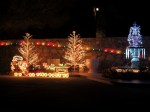
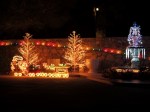
Below are three different white balance settings of the same image.  The image itself is rather challenging in that the left-side lights are incandescent and very warm in color, and the right-side LED lights are far into the blue spectrum.  The picture on the left is incandescent balanced using the camera’s default Tungsten setting.  Note how blue and LEDs are as a result.  The picture on the right was manually balanced by me to neutralize the blue tint of the LEDs.  I did this by setting the color temperature to 6800 K (Kelvin).  How do I know that this setting is LED-neutral?  Check out the now tint-free aluminum foil encasing the fountain.  The problem here, however, is that now the incandescent lights are horrendously in the red.  Check out the rock wall behind and the cement on the driveway to see what I mean.  The trick in post-processing is to find a happy medium, which is represented by the middle example set to 4800 K.  The blue tint has returned to the foil, and red is slightly in evidence on the light reflected off the wall and driveway to the left, but both are now much closer to acceptable and the colors between these two very dissimilar light sources are much more in harmony as a result.  As always, click on an image to view it enlarged:

Another white balance tip:  Sometimes balancing incandescent bulbs to true white appearance doesn’t look quite right.  Sometimes, you want a slightly warmer appearance.  In these cases, take your pictures with the camera set to Tungsten, but add a little warmth in the color balance later to warm up the lights should they appear too cool.  Below is an example of that.  The picture on the left is technically “balanced,” but it’s rather stark and cold looking.  The image on the right has been warmed up a bit, and is much more visually appealing.

One more tip:  Many of the techniques used here for outdoor lights will also work quite well for those indoor Christmas Tree shots.  Just make sure you turn down other room lighting so as to not distract from the tree lights.

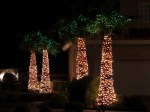
But enough of the technical stuff.  Now let’s just enjoy the show from this year’s Christmas lighting displays:


7 Comments

Filed under Photography

Spätzle is Spätzli is Spaetzle is Knöpfle


It’s spätzle in Germany.  In Switzerland it’s spätzli.  Here in the U.S., where we lazy Americans despise umlauts and other funny puncuations, it’s spelled spaetzle.  And in Hungary, which seems to always be a contrarian troublemaker, it’s knöpfle.

So, what is spaetzle?  It’s a pasta that cooks like a dumpling and tastes like a little bit of heaven.  It’s a side dish accented with cheese.  It’s the tidy little bed for a hearty main course.  It’s a breakfast with eggs.  It is, in short, a wonderfully tasty, amazingly versatile, incredibly easy dish that you’ll want to pair in culinary experiments with many of your favorite dishes.

What you’ll need:

  • 2 ½ cups flour
  • 1 tsp. salt (and more for salted water in which to boil the spaetzle)
  • 1 ½ cups water
  • 2 eggs
  • Butter for toasting the spaetzle
Flour, salt, water, eggs, butter, and spaetzle maker

Flour, salt, water, eggs, butter, and spaetzle maker

Step 1:

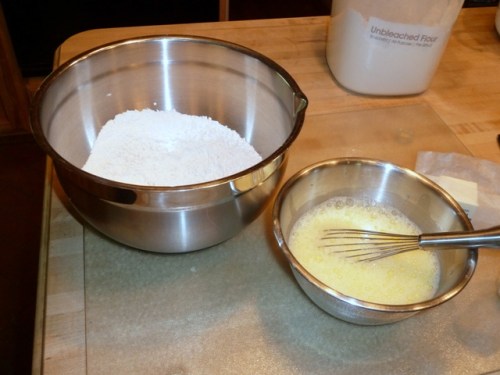
Mix or sift together the flour and salt.  Whisk together the eggs and water.  Blend the egg/water mixture into the flour and salt.  The result should be the consistency of pancake batter (see photograph below).  If too thick, thin with water.  If too thin, thicken with additional flour.  Let your batter sit for thirty minutes.

Mix together flour and salt; whisk together egg and water

Mix together flour and salt; whisk together egg and water

Blend egg and water into flour and salt

Blend egg and water into flour and salt

Step 2:

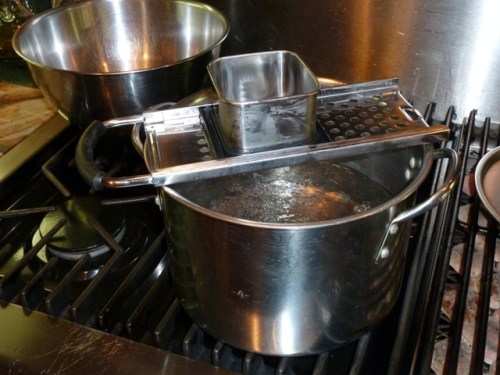
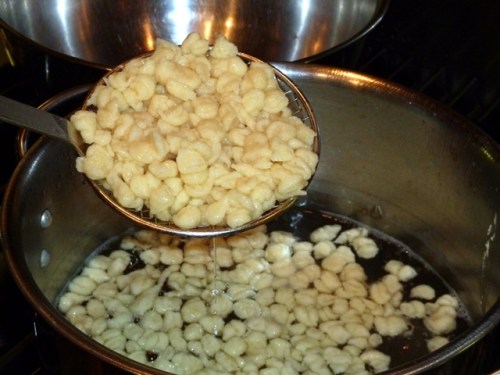
While resting the batter for that thirty minutes, bring a large pot of salted water to a rolling boil.  Place your spaetzle maker over the pot (you may want to wear mitts; steam can burn!).  Working in batches, pour batter into the spaetzle maker’s bin.  Slide the spaetzle bin back and forth across grate, causing thick drops of batter to fall into the boiling water.  The spaetzle will rise after two or three minutes.  With a slotted spoon or other draining device, scoop out the spaetzle as it floats to the top.  Drain well and set aside in a large bowl as you continue with subsequent batches.

Place spaetzle maker over salted, rapidly boiling water

Place spaetzle maker over salted, rapidly boiling water

Pour batter into spaetzle maker bin

Pour batter into spaetzle maker bin

Slide bin to and fro to drop spaetzle batter into water

Slide bin to and fro to drop spaetzle batter into water

Spaetzle will float to the top when done — about two to three minutes

Spaetzle will float to the top when done — about two to three minutes

Scoop out and drain well the spaetzle

Scoop out the spaetzle and drain well

Step 3:

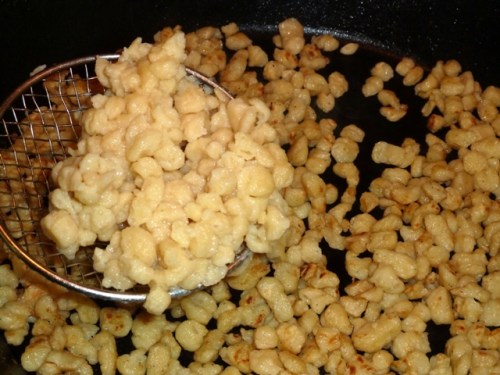
Heat a large cast iron skillet to medium hot.  Toss in some butter and some of the spaetzle.  Don’t crowd the pan — once again you’ll be working in batches.  Breaking apart any clumps, toss the spaetzle in the butter until nicely browned and slightly toasted.  Remove the batch and continue with the remaining spaetzle until all of it is toasted.

Toast batches of spaetzle with butter

Toast batches of spaetzle with butter

Toast until lightly browned

Toast until lightly browned

Before and after difference between toasted and untoasted spaetzle

Before and after difference between toasted and untoasted spaetzle

Step 4:

If this spaetzle is to be used as a side dish, consider tossing it with freshly grated Parmesan or a flavorful Swiss Emmentaler or Gruyère cheese.  If this is part of your main course, use the spaetzle in place of rice, pasta, or even potatoes.  This is especially effective with hearty, thick-sauced dishes such as Hungarian goulash, German sauerbraten, or dark gravy-based dishes.

What else can you do with it, especially the leftovers?  Try serving it the next day for breakfast by topping it with a sunny side up or over easy eggs in place of grits or hash browns.

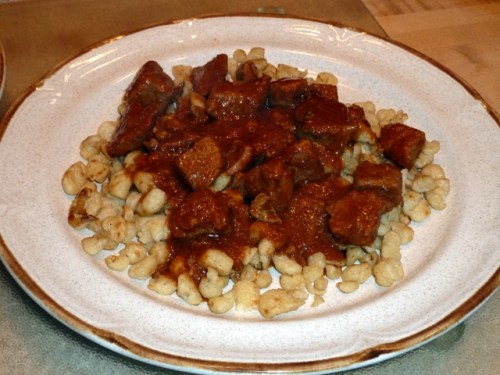
So, just how versatile is spaetzle?  Take a look at the dish below.  Looks like Hungarian goulash, doesn’t it?  It isn’t.  It’s actually my not-yet-world-famous New Mexico-style chili colorado con puerco (translation: pork in red chili).  Remind me sometime and I might give you that recipe as well.

Spaetzle with chili colorado con puerco

Spaetzle with chili colorado con puerco

3 Comments

Filed under Photography, Wine & Food