Tag Archives: recipe

Flat Turkey Enchiladas


On Monday I presented my favorite recipe for red enchilada sauce, as well as my heretofore secret source for the perfect chili powder.  Today, I’m going to show you what to do with it using that leftover turkey breast that’s been sitting in your freezer since shortly after Thanksgiving.

Most of you are probably familiar with the rolled red enchilada filled either with cheese or ground beef.  Some of you may be familiar with rolled chicken enchiladas smothered in green chili sauce.  But unless you’ve lived in the Southwestern U.S. or have spent any length of time in Mexico other than the usual tourist spots, chances are that you’ve yet to become acquainted with the flat enchilada — the Mexican answer to lasagna, in a sense.  The advantage to the flat enchilada is primarily one of reduced calories and fat, since rolling a corn tortilla is hard to do unless the tortilla is first dipped in hot oil.  As we’re not going to roll these enchiladas, there’s no reason to first dip the tortilla in all that fat.

What you’ll need for this recipe:

Turkey breast, enchilada sauce, onion, corn tortillas, cheese

Turkey breast, enchilada sauce, onion, corn tortillas, cheese

Turkey breast, coarsely chopped
Red Enchilada Sauce (from Monday’s blog)
Finely dices onion
Cheese, shredded (Colby, longhorn, cheddar, and/or Monterrey Jack)
Fresh corn tortillas

And, optionally:

Freshly roasted green chiles diced into large pieces (This was Ursula’s idea):

And, optionally, green chile

And, optionally, green chile

If you do decide to add green chile here’s a quick refresher on how to prep them (we did this before with Chile Rellenos).  Roast the chiles over flame or hot charcoal until the skin is charred, but the flesh remains firm.
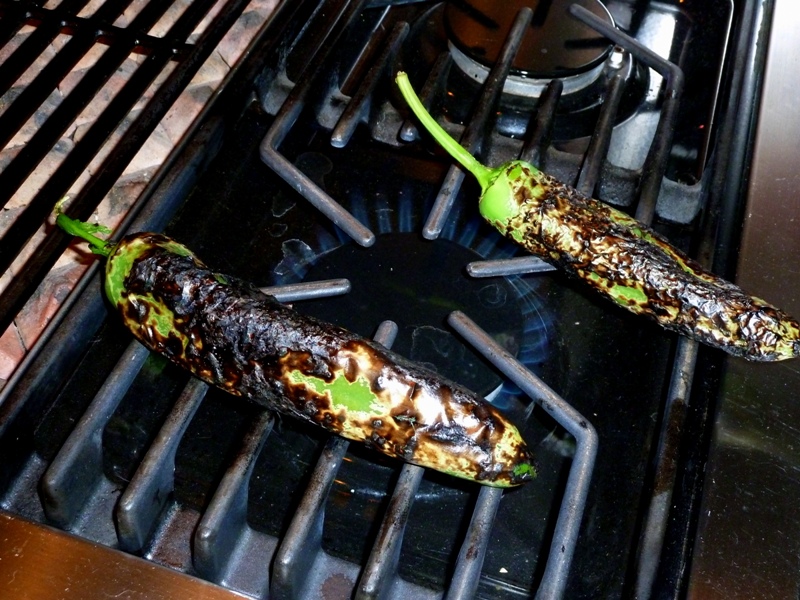
Roast chiles until charred

Roast chiles until charred

Steam the skins for easier removal by placing the still warm chiles into a plastic bag and leaving them to sweat for about five minutes.
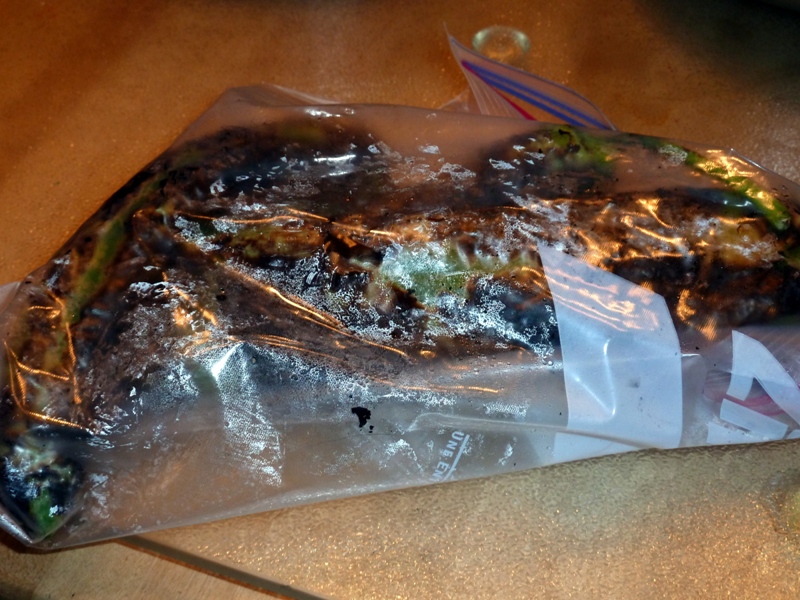
Allow chiles to steam in a bag

Allow chiles to steam in a bag

Scrap off the charred skin with a knife, cut off the stems, slice open and remove the seeds, and then dice into fairly large pieces.


Scrap off the skin, seed and slice

Scrap off the skin, seed and slice

Now that we have the optional stuff out of the way let’s return to the heart of this recipe.  Spray a large baking tray with cooking spray.  You’ll be glad you did later when it comes time to clean it.

Makes later cleanup easier

Makes later cleanup easier

Dip corn tortillas into Monday’s red enchilada sauce and allow the excess to drain off.  Arrange tortillas into a single layer.  Top with turkey breast.
Coat both sides of the corn tortillas

Coat both sides of the corn tortillas

Arrange the first layer of tortillas; top with turkey breast

Arrange the first layer of tortillas; top with turkey breast

Add some of the grated cheese, diced onion, and green chile (if you decided to use it).

Add cheese, onion, and (optional) green chile

Add cheese, onion, and (optional) green chile

Make a second layer of coated tortillas.
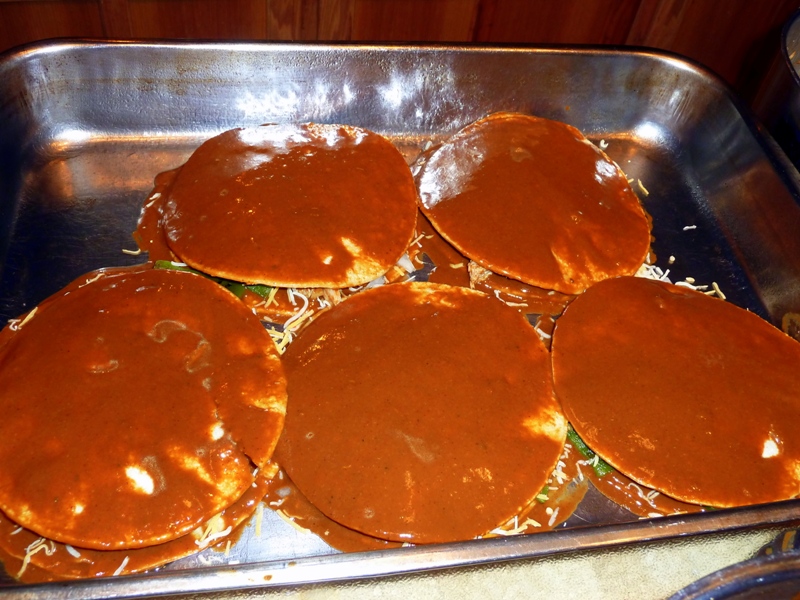
Arrange second layer of tortillas

Arrange second layer of tortillas

Top that layer as you did the first — with turkey, onion, cheese, and green chile.

Top again with turkey, cheese, onion, and chile

Top again with turkey, cheese, onion, and chile

Now add a third and final layer of coated tortillas, but this time top the uppermost layer with only cheese and onion.  Turkey on the top layer would dry out, and the green chile might overcook and lose texture.

Add third and final layer, and top only with cheese and onion

Add third and final layer, and top only with cheese and onion

Bake at 375° (190° Celsius) for fifteen minutes or so, until the enchiladas are fully heated throughout, the cheese is completely melted, and the sauce steaming hot and almost bubbly.
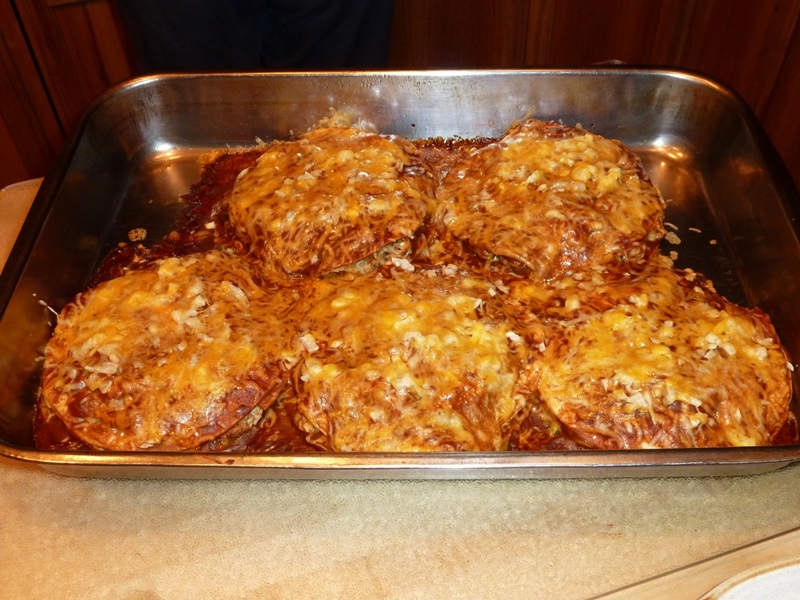
Bake at 375° (190° Celsius) for 15 to 20 minutes

Bake at 375° (190° Celsius) for 15 to 20 minutes

Serve alongside a nice salad with cooling ranch-style dressing to quench the spiciness of the enchilada sauce.

A popular and very traditional variation to the flat enchilada is to top the whole concoction with an egg, either sunny-side up or over easy.

Wine Selection:  This is of course an inherently spicy dish, even if you chose to make it with mild chili powder.  It’s also a white-meat dish.  Both of these characteristics imply a white wine, with the spiciness suggesting one on the slightly sweet side (sweetness counteracts spicy heat on the tongue; white wine complements lighter bird meats such as chicken and turkey).  That criteria gives us a selection of wines from which to choose — Gewurtztraminer, Chenin Blanc, some of the German-style Rieslings, and on the drier side (and one of my favorite all-round whites),  a New Zealand Sauvignon Blanc, or perhaps a Pinot Grigio.

Comments Off on Flat Turkey Enchiladas

Filed under Wine & Food

Enchilada Sauce


El Santuario de Chimayo — read on to see what this has to do with red enchilada sauce

I’ll be running this week a two-part enchilada series, culminating on Wednesday with what to do with that leftover turkey breast sitting in your freezer — Flat turkey enchiladas, of course.  But today we’ll concentrate on what gives enchiladas their flavor, the sauce.  After that and Fun Photo Friday we’ll continue with our series on that recent 29-day transatlantic cruise.

Purists will insist that enchilada sauce is best made with dried red chile pods that have been stripped of seeds and ribs and then rehydrated in hot water.  Camelo (that’s “baloney” in Spanish).  If the traditionalists are having trouble making a superb enchilada sauce from powdered red chile, it’s because they’re using the insipid, adulterated stuff from the local grocery store rather than pure red chile powder without the added spices, garlic, salt, and other ingredients.

El Potrero Trading Post next to El Santuario de Chimayo

For me that means chile powder from one source, which I’ve mentioned before:  El Potrero Trading Post next to El Sactuario de Chimayo in Northern New Mexico.  In addition to mild, medium, and hot red chili, they also stock green chile powder and the best chipotle powder (smoked red jalapeño pepper) you’ll ever tasted.  Here’s a sampling of what they have to offer (and they SHIP!):

Sun Dried Chile on the Left; Oven Roasted Chile on the right

Powdered Oven-Dried Red Chile on the left; Crushed Red Chile “Caribe” on the Right

Crushed Green Chile Left; Green Chile Powder Right

For today’s recipe I’m going to use El Portrero’s hot red chile powder.  You may want to start with their mild and perhaps the medium mixed with mild, as even the medium exceeds the tolerance of many.

Here’s what you’ll need:

The Ingredients on Parade

The Ingredients on Parade

¼ cup vegetable oil
1 large yellow onion, finely diced
1 whole head of garlic, finely chopped
1 ½ tsp. dried oregano (Hint:  rub the oregano vigorously between the palms of your hands to crush the leaves and release the essential oils and fragrances)
1 ½ tsp. ground cumin
¼ tsp. ground cinnamon (Yep, you read that correctly)
¼ cup general purpose flour
5 tbsp. pure, good quality red chile powder
5 cups low-sodium chicken stock or broth
½ square unsweetened baker’s chocolate (Yep, another shocker, but trust me)

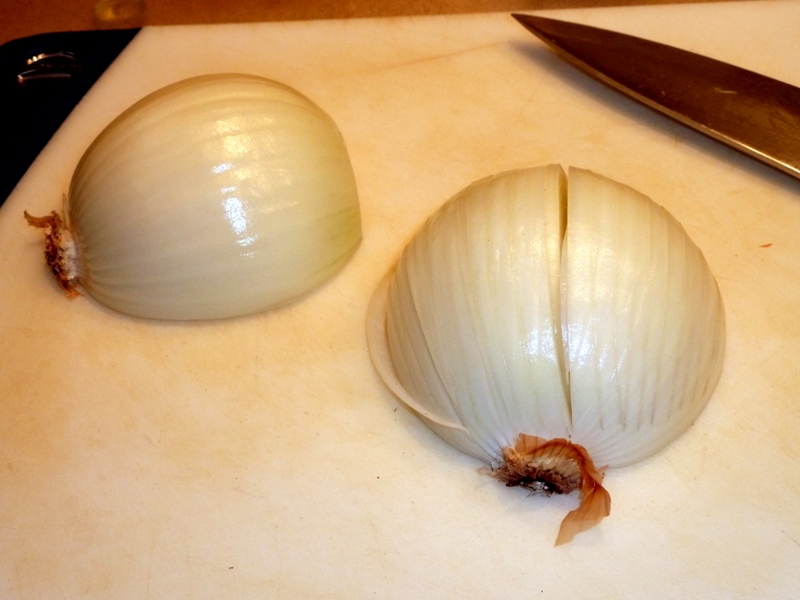
A quick tutorial on the easy, almost tearless way to finely dice onions.  First, sharpen your kitchen knife.  I mean really sharp.  A dull knife crushes the onion cells and releases the sulfenic acids that cause your eyes to react.  If you’re crying, your onion is telling you that your knife needs sharpening.  Now, slice the onion in half, peel off the outer layers, and chop off the top.  Leave for now the lower root portion, as that will hold the onion together as you make the dice.  Now make a series of slices from the cut end toward the root end, but don’t finish the slice.

How to finely dice an onion — Step 1

How to finely dice an onion — Step 1

Rotate the onion 90° and start the dice.  Throw away the root end (it’s completed its task of holding things together and now it’s time to go).

How to finely dice an onion — Step 2

How to finely dice an onion — Step 2

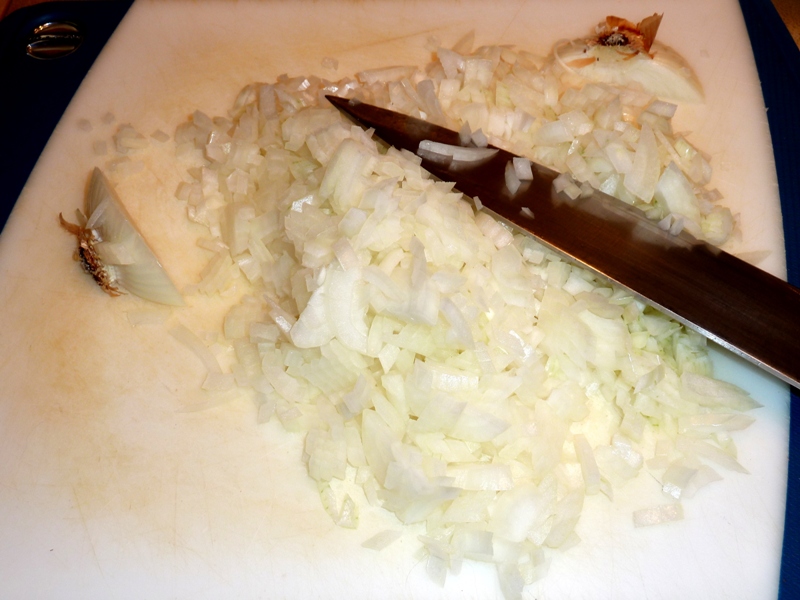
Now take your chef’s knife and rock the sharp edge though the dices to break up any remaining larger slices.

Nice, fine dice with no tears

Nice, fine dice with no tears

Reserve between a quarter and a third of that diced onion for Wednesday.  You’re going to need the reserved onion for the actual enchiladas.

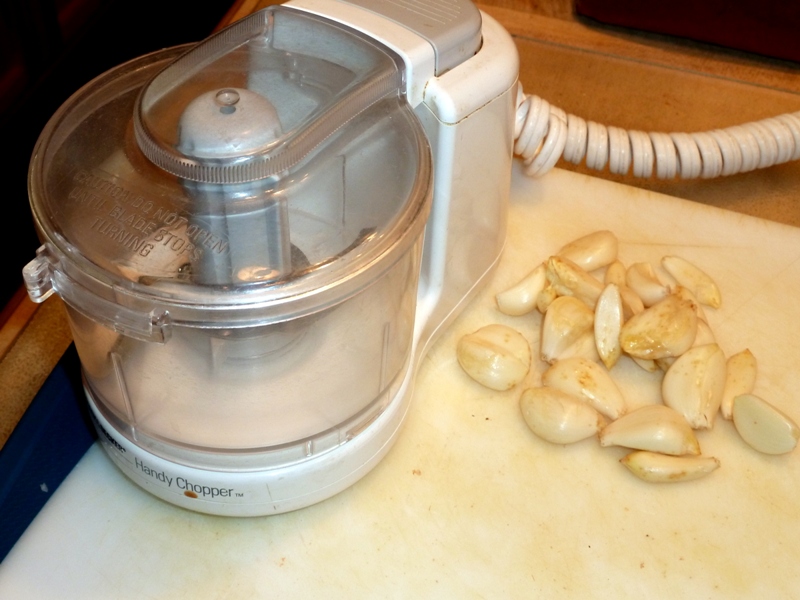
Break apart your head of garlic and remove the outer skin.

One Head of Garlic Ready to Chop

One Head of Garlic Ready to Chop

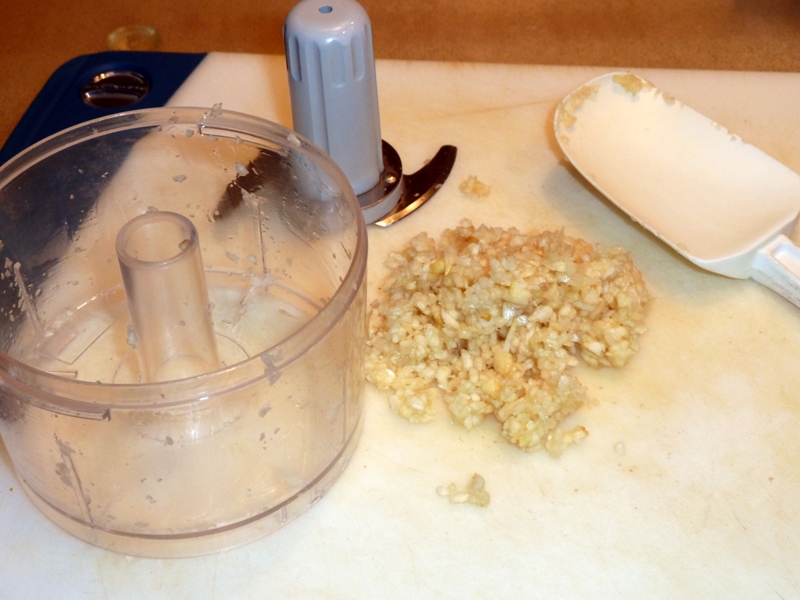
Finely chop the garlic either by hand or cheat with a mini-food processor/food chopper.

Chopped Garlic

Chopped Garlic

Heat the oil over medium-high heat.

Heat the oil

Heat the oil

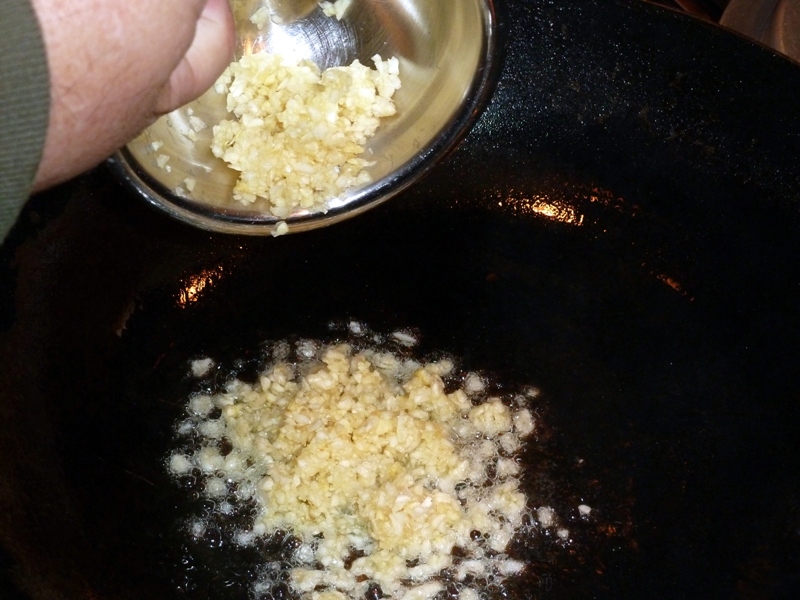
Add in quick succession the garlic followed by the diced onion.

Add the garlic

Add the garlic

Add most of the onion — reserve the rest for Wednesday's enchiladas

Add most of the onion — reserve the rest for Wednesday’s enchiladas

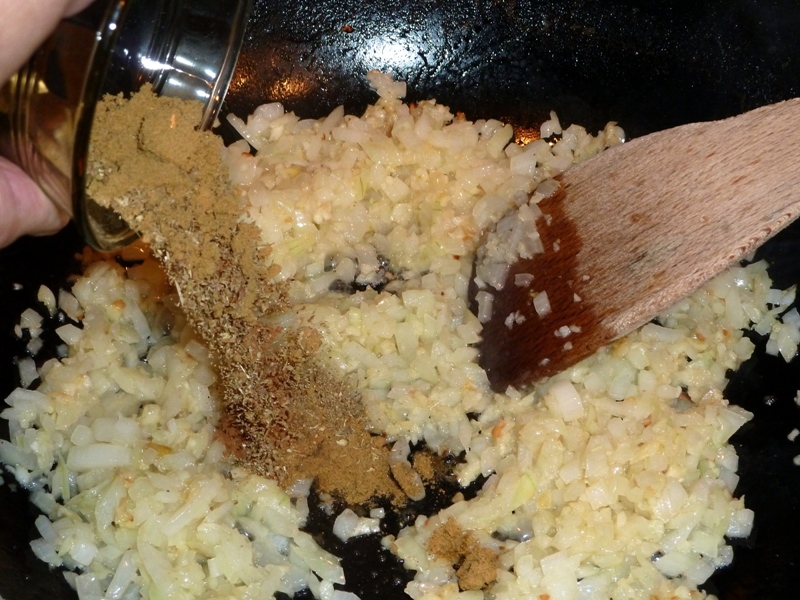
Sauté the onion and garlic until translucent and almost tender, then stir in and toast your cumin, oregano, and cinnamon.

Add oregano, cumin, and cinnamon — toast until fragrant while stirring constantly

Add oregano, cumin, and cinnamon — toast until fragrant while stirring constantly

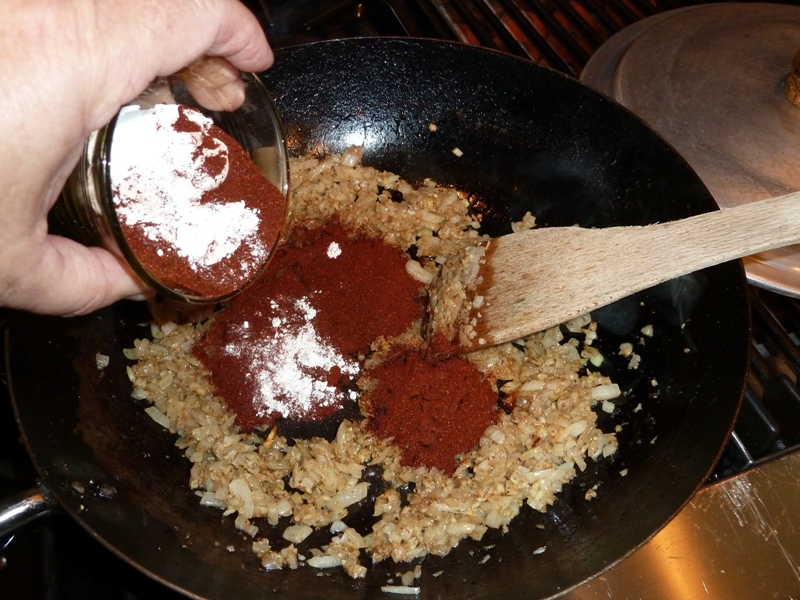
Add the red chile powder and flour and stir until the onion and garlic are completely coated.  Continue stirring for a couple of minutes until the mixture is nicely thickened and the chile starts giving off its fragrant aroma.

Add chile powder and flour — stir until thick

Add chile powder and flour — stir until thick

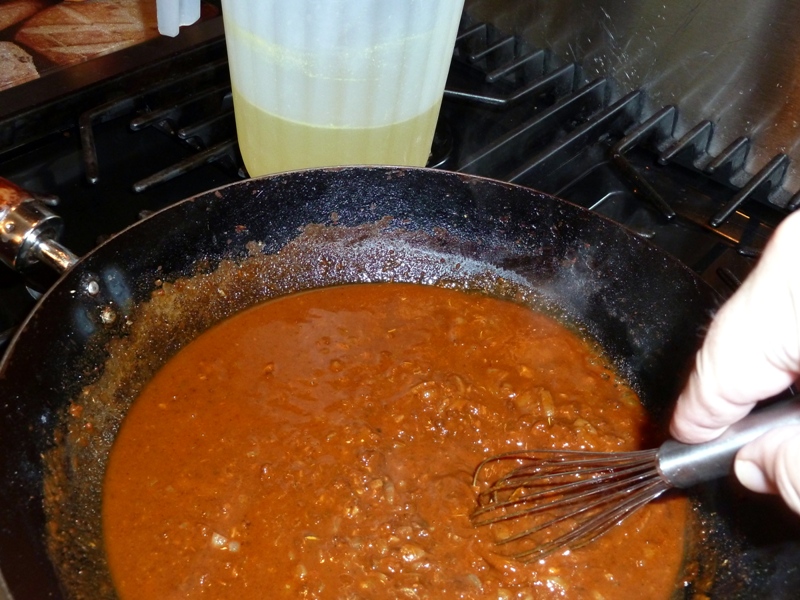
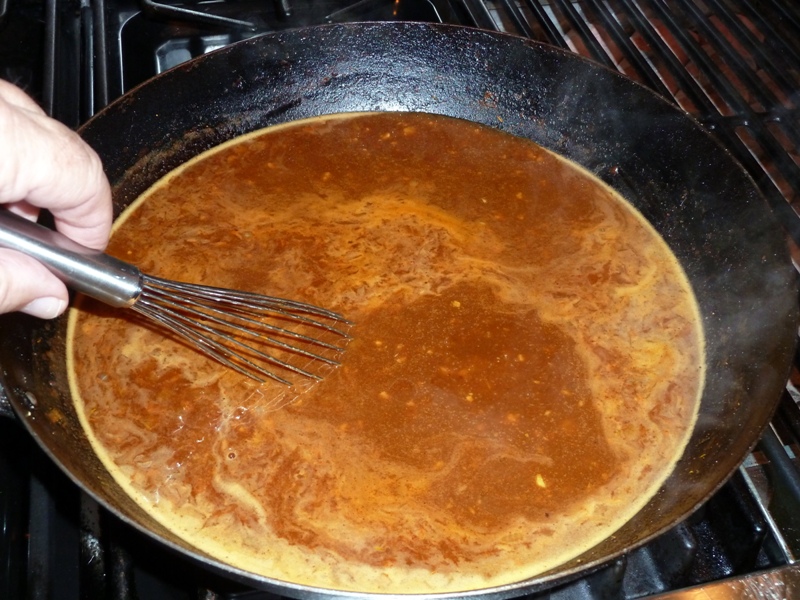
While whisking continuously, slowly pour in your chicken stock.

Slowly add the stock, whisking continuously as you do

Slowly add the stock, whisking continuously as you do

If you think you just made a roux-based gravy, you’re not far off the mark.  That’s precisely what red enchilada sauce is.  Now continue whisking as you bring this delectable “gravy” up to a rolling simmer.

Heat until simmering nicely

Heat until simmering nicely

Continue whisking until the enchilada sauce is reduced to the right consistency.

Whisk and reduce

Whisk and reduce

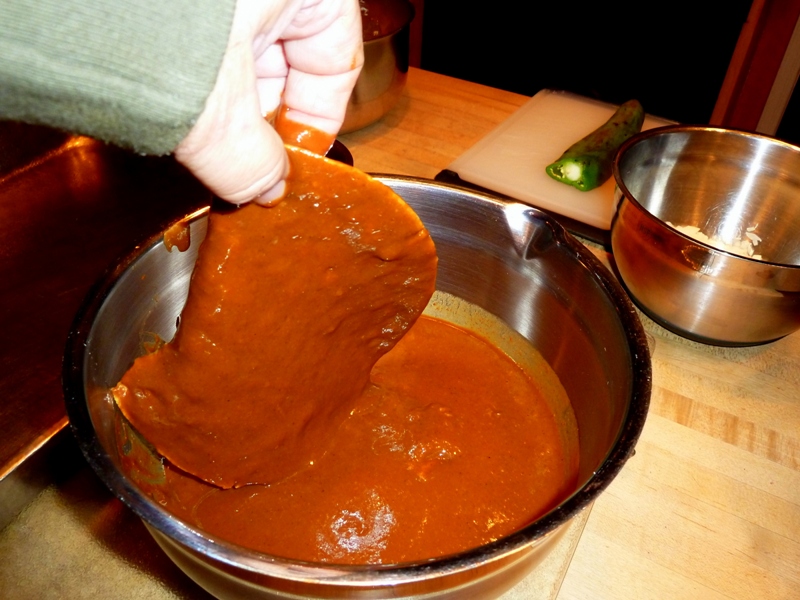
What is the right consistency?  Let’s do the spoon test to find out.  Dip a spoon into the sauce and see if it coats the back of the spoon or if it just runs right off it.

Too thin — runs almost completely off the spoon

Too thin — runs almost completely off the spoon

Continue whisking and reducing until the spoon test gives you a thin but consistent coating.  Don’t worry if that still seems thin to you as we still have two more thickening steps to go.

Thick enough for now

Thick enough for now

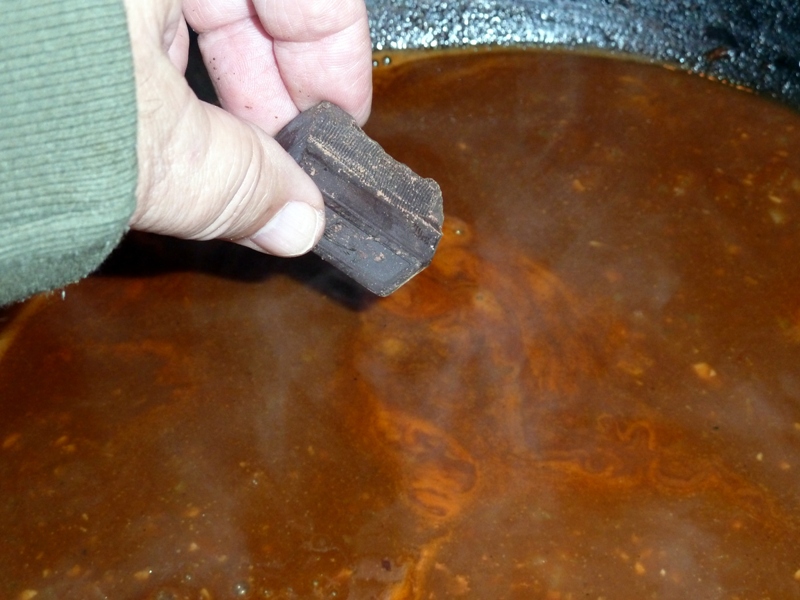
Turn off the heat and put in that half square of unsweetened baker’s chocolate.  Whisk away until the chocolate is completely melted and fully incorporated into the sauce.  This will take awhile, so be patient.

Turn off hear and add unsweetened baker's chocolate; whisk until completely melted and incorporated

Turn off hear and add unsweetened baker’s chocolate; whisk until completely melted and incorporated

Now try the spoon test if you want.  Thicker, but we still have one step to go for the proper consistency.

Much better after the addition of the chocolate

A little thicker after the addition of the chocolate

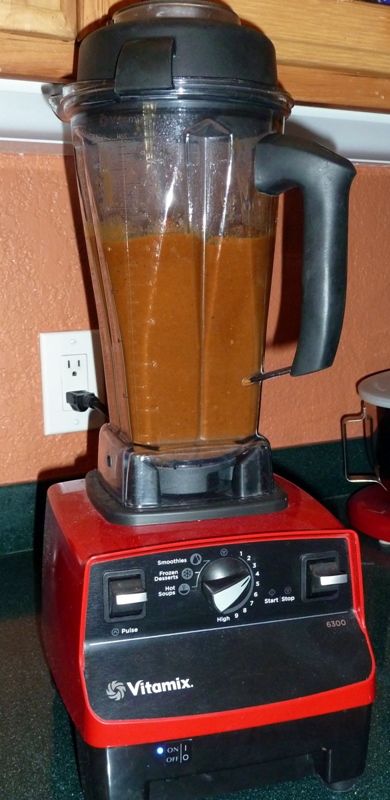
Put the whole concoction into a blender and process until completely smooth.  For a little additional flavor you might want to consider adding at this point one additional clove of uncooked garlic.

Blend until smooth; Optionally, you may want to add one additional clove of garlic at this point

Blend until smooth; Optionally, you may want to add one additional clove of garlic at this point

Is it as thick now as you would expect a good red enchilada sauce to be?  Let’s find out.

After blending — the perfect consistency

After blending — the perfect consistency

On Wednesday we’ll take this rich, red enchilada sauce and start assembling flat, stacked turkey enchiladas using leftover Thanksgiving turkey breast from the freezer.  By the way, this sauce is the basis for several dishes.  For instance, take away the cinnamon and chocolate and increase the cumin and garlic and you have the basic sauce of chili colorado con puerco (red chili with pork), or with the addition of vinegar and other minor modifications that very similar quintessential New Mexican dish known as carne adobado.

2 Comments

Filed under Wine & Food

American-Style Steak and Baked Potato without the Grill


Steaks, Dressed Potatoes, Garlic Green Beans, and California Zinfandel

Steaks, Dressed Potatoes, Garlic Green Beans, and California Zinfandel

If you’re European then you’re probably wondering how to make that classic American steak and potato.  If you’re American, you’re probably doing it all wrong.  You’ve been told to grill that steak, but most grills simply do not get hot enough for the task.  For instance, many of you may have heard that the steak ovens used in the Ruth’s Chris chain of restaurants obtain temperatures of 1,800° Fahrenheit (over 980° Celsius).  Think you can get your grill that hot without it melting?  Additionally, many of you wrap your potato in foil, but that results in a steamed potato rather than a properly baked one.

Today you’ll find out the proper technique for both.  As an added bonus I’m going to give you a tasty and easy to make vegetable side dish — green beans and garlic.

A properly baked potato takes time, so we’ll start with those.  Thoroughly wash the potato, dry it, lightly coat with olive oil, and then sprinkle on a very liberal amount of course salt.  Do not make the typical mistake of wrapping your potatoes in foil — you want them baked for a light and fluffy texture, not steamed into an insipid and mushy submission.

Baked Potatoes need Salt, Pepper, Butter, and Sour Cream

Baked Potatoes need Salt, Pepper, Butter, and Sour Cream

I like to place my potatoes onto a piece of foil to avoid oil dripping onto the bottom of the oven.  Bake the potatoes at 375° (190° Celsius) in a convection oven or 400° (205° Celsius) in a conventional oven for at least one hour fifteen minutes.  You can go a little over that time, but don’t go under.  Indeed, for a very large potato you may need to do so.

Russet Potatoes in the Oven

Russet Potatoes in the Oven

While the potatoes are baking, take out the steaks to bring them up to room temperature.

USDA Prime New York Strip

USDA Prime New York Strip

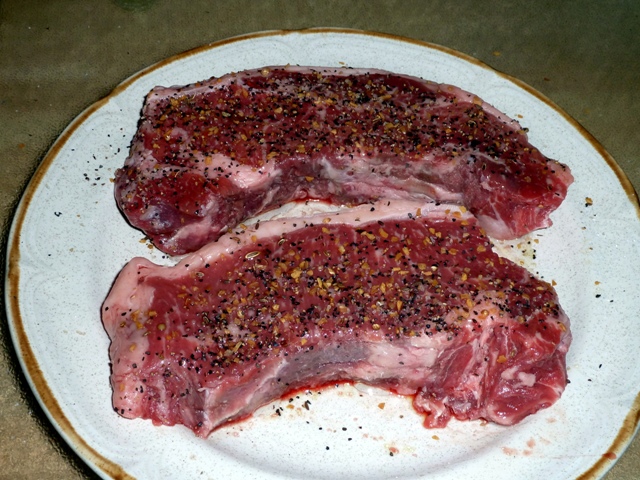
Coat the steaks in light olive oil (extra virgin will not survive the high temperatures later).  When it comes to seasoning a steak, less is a lot more.  You want to enhance the natural flavor rather than mask it (people who use steak sauce would be well advised to just switch to ground beef rather than ruin a perfectly good steak).  Salt and pepper is all you need, but I’ve also found that Montreal Steak Seasoning imparts a delicious complimentary flavor without overpowering the steak.  Set the steaks aside while you move on to the next dish.

Well Seasoned with Montreal Steak Seasoning

Well Seasoned with Montreal Steak Seasoning

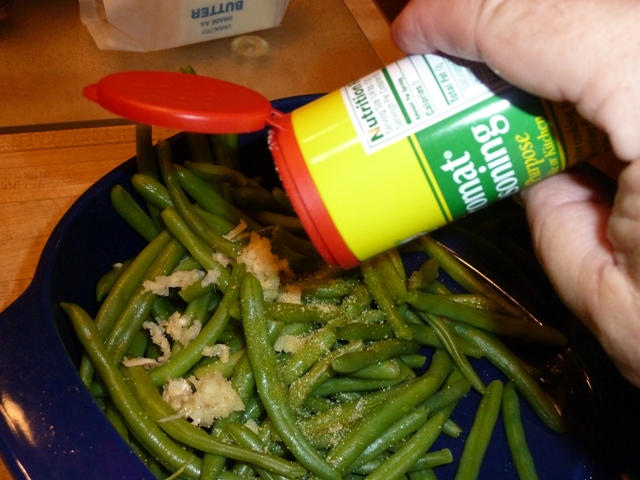
Next up is the green beans with garlic.  The secret to a flavorful green bean is steaming rather than boiling or, worse, microwaving.  You’ll need either fresh or frozen green beans, some freshly crushed garlic, either butter or extra virgin olive oil, and my favorite vegetable seasoning — Aromat by Knorr of Germany (and very popular in Switzerland as my Swiss wife Ursula can attest).  If you’re sensitive to monosodium glutamate (MSG) you may want to forgo the Aromat in favor of just a touch of salt.

Garlic and Aromat

Garlic and Aromat

Put water in the bottom of your steam pot, but keep the level below the level of the steamer basket.  Bring the water to a rolling boil, then place the green beans in the steamer basket and insert the basket into the pot and cover.  Reduce the heat enough to maintain a steam-developing boil, but not high enough that your steamer goes dry through evaporation.  Steam for ten (still crisp) to fifteen (more done) minutes.  While you’re steaming those green beans start heating up that cast iron skillet on high heat.

Steamer Basket for Vegetables — You Can't Beat It

Steamer Basket for Vegetables — You Can’t Beat It

When the green beans are done to your taste, pour them into a container.  Toss them with either butter or olive oil, then mix in the crushed garlic and Aromat (or salt).  Set aside covered to keep warm.

Green Beans, Garlic, and Knorr Aromat Seasoning

Green Beans, Garlic, and Knorr Aromat Seasoning

Once your cast iron skillet is smoking hot (as in almost hot enough for Louisiana-style blackened dishes) you’re ready to start the steaks, but don’t let them hit the skillet until the potatoes are within ten minutes of finishing.    Turn the heat down slightly (if you have a commercial grade stove, or keep on high otherwise).  First on the agenda is to get some grease into that skillet, and that’s why your steak comes with a strip of fat on one side.  Sear the steaks fat side down initially to render out some of the fat into the pan.  Once the fat strip is nicely carmelized — about one to two minutes for a rare steak and round three for a medium rare — rotate the steaks along the remaining edges.  For a rare steak keep the nonfat edges down to a minute or less; for medium rare go about two.

Steaks 5

Sear the fat side first followed by the other edges

At this point set the rare steak off to the side for a moment and flip the medium rare steak onto one of its sides.  A typical one-inch thick steak will need about three minutes per side (increase to four and a half minutes if you’re lucky enough to have a two-inch thick steak).  Do not cover the pan — we’re doing this by direct heat to both sides rather than indirect.

Searing the Medium Rare

Searing the Medium Rare

When the first side is done and the steak flipped, add the rare steak to the skillet.  Now you have three minutes to go on the medium rare, so time the flip of the rare steak at the one and half minute mark (increase time accordingly for thicker steaks).  Both sides of the rare steak will be done in the time it takes to do the second side of the medium rare steak.

Timing the Rare with the Medium Rare

Timing the Rare with the Medium Rare

While the steaks are finishing up remove the potatoes from the oven. Make a series of diagonal slashes along the top of the potato followed by a deep length-wise cut.  Spread the potato apart, season with salt and pepper, add a couple of pats of butter directly on top of the potato, and then bury the butter under a couple of dollops of good sour cream (I like low fat sour cream — gotta cut some of the saturated fat somewhere in this opulent feast).

Remove the steaks from the skillet and let them rest for about five minutes to finish cooking inside and to set the natural juices.

Put it altogether — steak, beans and potatoes, add a robust red wine (for this particular meal I used a 2004 California Zinfandel that I’d been storing for many years — properly, of course, at 57° Fahrenheit/14° Celsius) and you get the delightful results pictured at the top of this post.

Wine pairings for steak dinners are pretty much what you would expect.  Beef protein and tannic reds were made for each other.  Bordeaux-style red blends are the traditional tried-and-true pairing, but tannic Malbec or Petite Shirah will also complement your steak.  Not quite as tannic but still a personal favorite for this particular pairing are the GSM-based wines such as Châteauneuf-du-Pape.

So, enjoy your perfectly prepared steak and potato dinner and expertly paired red wine selection, then come back here and leave a comment letting me know how it all turned out.

6 Comments

Filed under Wine & Food