Tag Archives: M1911

A Look at the Colt MK IV Series 70


Colt's Custom Shop Mk. IV Series 70 in stainless

Colt’s Custom Shop MK IV Series 70 in stainless

This week we’re taking a break from travel and photography and concentrating on another of my varied areas of interest — firearms. We’ll begin with a rather rare bird, a new Colt MK IV Series 70. The example you see here is in stainless steel.

But first a history lesson on the Colt “Government Model” M1911 Series 70 versus the Series 80, and the controversy surrounding the latter.

Colt's Custom Shop Mk. IV Series 70 in stainless

Colt’s Custom Shop MK IV Series 70 in stainless

The MK IV Series 70 dates from the year 1970. It differed from the previous M1911A1 (1924) in that the pistol had installed a split barrel bushing (sometimes referred to as a “collet bushing”) to increase accuracy of an already very accurate handgun. The following photos from Hooper Gun Works illustrate the difference between the two bushings. The first show the differing bushings installed onto a Colt barrel, and the second is a close-up of the actual bushings:
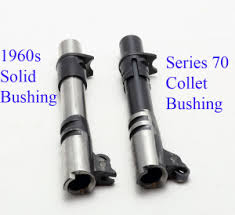
Traditional bushing (left); Series 70 split barrel

Traditional bushing (left); Series 70 split barrel “collet” bushing (right); both installed on barrels


Traditional bushing left; split barrel bushing right

Traditional bushing left; split barrel bushing right

To be brutally frank about it, the split barrel “collet” bushing was a bit of a disaster. The fingers had a tendency to break off and jam the pistol. So, by 1988 the split barrel bushing gave way to a return to the solid bushing in later iterations of the Colt M1911 line.

Colt Mk IV roll mark

Colt Mk IV roll mark

Colt ended the MK IV Series 70 in 1983 with the introduction of the Series 80. This M1911 initially retained the split barrel bushing, but it incorporated a new feature hated by M1911 purists. It is theoretically possible that if a cocked-and-locked M1911 is dropped onto a hard surface in such a way that the muzzle strikes first, the free-floating firing pin may have enough inertia to overcome the tension of the firing pin spring and thus impact the bullet primer. This could produce an unintended discharge.

M1991A1 roll mark

M1991A1 roll mark

Colt addressed this concern in 1983 by redesigning the firing system to incorporate a firing pin block. The firing pin block is disengaged by the trigger mechanism as the trigger is pulled. So, why the controversy among 1911 purists? After all, isn’t increased firearm safety a good thing?

Apparently, not if it adversely impacts a great single-action trigger . . . or even if it’s merely imagined to do so.

Mk IV reverse side

Mk IV reverse side

Many claim that this trigger-deactivated firing pin block increased trigger weight and friction. I’ll be testing this claim on Wednesday with a video of a test I performed that pits the MK IV Series 70 pictured here up against a Colt M1991A1 with the so-called Series 80 trigger. Not in the video but outlined in the text on Wednesday are additional comparisons I performed with a stainless Colt M1991A1 chambered in .38 Super and another .45 ACP Colt M1991A1 identical to the one used in the video. I believe you’ll find the results most enlightening, and I’m sure very controversial among M1911 purists.

M1991A1 reverse side

M1991A1 reverse side

By now you’re asking, how the heck did Series 70 come to mean a trigger that dates from 1911 to 1983, while Series 80 describes the trigger system with a firing pin block incorporated in 1983? Good question, since the Series 70 was so designated not because of the trigger system, but rather because of the split barrel “collet” bushing — a bushing that continued on in the Series 80 pistol for some five years. The answer is convenience. It’s just easier to differentiate between the original internal trigger design of the M1911 to the later firing pin block design by referring to the two designs as “Series 70” and “Series 80” firing systems.

Here is another photo from Hooper Gun Works that illustrates one of the modifications made, in this case to the hammer:
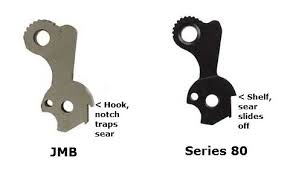
Notched Series 70 hammer on left; shelved Series 80 hammer on right

Notched Series 70 hammer on left; shelved Series 80 hammer on right

(Note: There is a competing firing pin block design out there for the M1911 in which the firing pin block is deactivated by the grip safety rather than the trigger. It’s called the Swartz Firing Pin Safety, and it’s used by some competing M1911 producers such as Kimber and Smith & Wesson. Ironically, Colt pioneered the Swartz system in 1938, but dropped it after only three years because the U.S. military balked at the added expense, as did the civilian market. Modern manufacturing processes have allowed the economical reintroduction of the Swartz system, but Colt have stuck with the Series 80 firing system.)

Around the turn of the century it began to dawn on Colt that M1911 purists were leaving the fold for competing M1911s produced without the “trigger degrading” Series 80 firing pin block. This resulted in Colt reintroducing a “MK IV Series 70” that really isn’t much like the one produced from 1970 to 1983. For one thing, there was no return to the split barrel bushing. The Series 80 slide and frame were also retained, even if the firing pin block was removed. Of interest to some may be the fact that Colt continues to use in the reintroduced Series 70 the internals of the Series 80. That means the shelved hammer pictured above is still used rather than the earlier notched hammer. What Colt is giving you with the new MK IV Series 70 is in fact a Series 80 pistol with Series 80 trigger system parts, only without the actual firing pin block. This removes from the trigger-feel equation the internal movement that disengages the firing pin block.

Well, there is one other difference. The new MK IV Series 70 is produced in very limited runs in the Colt Custom Shop. That means if you find one, you’re laying your hands fairly rare pistol. My source puts the annual production numbers of Colt Custom Shop MK IV Series 70s at between 500 and 1,000. Additionally, as these pistols originate from the Custom Shop, they ship in the famous blue “Colt Custom Shop” box, which alone is worth probably north of a hundred bucks.

Standard Colt plastic case next to Colt Custom Shop box

Standard Colt plastic case next to Colt Custom Shop box

Colt Mk. IV Series 70

Colt MK IV Series 70

Colt M1991A1

Colt M1991A1

Colt Custom Shop close-up

Colt Custom Shop close-up

Now let’s compare a MK IV Series 70 to an M1991A1 Series 80. Externally they appear much the same. Both are roll marked as “Government Models”. Both have nicely checkered rosewood grips. Finish is equally nice on these two examples, and slide-to-frame fit is exceedingly tight, as is the barrel-to-bushing fit. These are very tight pistols which I personally would not hesitate to put up against pistols costing two and three times as much.

Now for the differences:

  • The most obvious are the sights. Both pistols come equipped with High-Profile sights, but the M1991A1 sights use the three-dot system while the MK IV Series 70 is absent any such visual cue.
Combat sights vs. three-dot sights

Combat sights vs. three-dot sights

  • Less obvious is the trigger placement. The aluminum M1991A1 trigger is a longish affair protruding almost half way across the span inside the trigger guard. The stainless MK IV Series 70 is much shorter in length.
Short Mk. IV Series 70 trigger (top) next to the M1991A1 long trigger

Short MK IV Series 70 trigger (top) next to the M1991A1 long trigger

  • Least obvious of all is the backstrap below the grip safety. Both backstraps are grooved in this area, but the M1991A1 backstrap is straight while the MK IV Series 70 backstrap has a slight curve.
Mk. IV Series 70 curved backstrap (bottom); M1991A1 flat backstrap (top)

MK IV Series 70 curved backstrap (bottom); M1991A1 flat backstrap (top)

On Wednesday we’ll test conventional wisdom and put the Series 70 trigger to the test against the Series 80.

I would like to take this time to acknowledge the fine photo work of Hooper Gun Works, to which I linked in this blog.  Hooper probably explain the Series 70 and Series 80 difference better than I, so please give their wonderful article a look as well by clicking on the link below:

Hooper Gun Works article on the Colt Series 70

3 Comments

Filed under Firearms, R. Doug Wicker

Stainless Colt .38 Super +P M1991A1 — How do you go bankrupt making something this good?


Colt .38 Super

Colt .38 Super

Before we get to the Colt M1991A1 chambered in .38 Super +P, there will first be a giant rant on Colt’s mismanagement team:

In case you hadn’t heard the news, Colt Defense, which owns Colt’s Manufacturing Company, last week went into Chapter 11 bankruptcy. Chapter 11 theoretically means that Colt will continue to operate, reorganize and restructure its huge debt load, and eventually emerge as a viable company.

Don’t bet on it.

Sciens Capital Management has pretty much looted the company into unsustainability. Sciens even went so far as to put Colt’s $300 million into recapitalized debt. And where did that money go? Growing the company? Positioning Colt to take advantage of the recent unprecedented surge in consumer demand for firearms? Hardly. That money was “redistributed” right back into Sciens’ coffers. That means it lined pockets. In other words, Samuel Colt’s company dating back to 1855 (1836 if you trace back to Colt’s first attempt at a firearm company) is merely another victim of yet one more slash-and-burn private equity firm more concerned with turning a quick buck rather than actually producing anything of lasting value.

Colt .38 Super

Colt .38 Super

It takes a special kind of greed to bankrupt an American firearms icon during a period when nearly every other manufacturer of firearms in the U.S. is reporting record sales and record profits, but congratulations, Sciens. You managed it! Or, rather, mismanaged it. Too bad we don’t reward this type of “investment” with jail time. If we did, Wall Street would be a ghost town and AIG and Citibank would be synonymous with Alcatraz. Instead, we leave others holding the now-empty bag and throw more U.S. labor out of work while these robber barons make off with enough booty for a third vacation home on some island and a yacht.

Oh, how I so despise these private equity plunderers.

Look for Sciens to now cash in by breaking up Colt Defense and Colt’s Manufacturing into separate entities (again), selling off assets from both, and very possibly even auctioning off the single biggest asset still left to Colt — the right to the Colt name itself. This is what happened to the iconic Winchester name, which was sold off to the Belgians while current production of Winchester lever action rifles — the rifles that tamed the Wild West — moved to Japan of all places.

Colt .38 Super

Colt .38 Super

Now some background on the .38 Super round, or to be technically correct, the .38 Super +P.

In the beginning Gun God John Moses Browning created .38 ACP. And it was good. But .38 ACP was too powerful for the Colt M1900 for which it was originally designed. So .38 ACP (not to be confused with that other John Moses Browning creation, the similarly sounding .380 ACP) was downgraded in power.

Colt .38 Super

Colt .38 Super

Then Gun God Browning created the incredibly powerful .45 ACP and the more robust Colt Model 1911. And it was good. So good that it was discovered that the original power of the .38 ACP could once again be restored to its former all-powerful glory and chambered into the tank-like M1911 without undue concern with damaging both pistol and shooter.

Thus was born in the year of 1928 (and shipped in January of 1929) a new variant of the M1911 called the Colt .38 Super. So, you see, .38 Super wasn’t originally the name of the round. It was, rather, the name for the pistol in which the now fully charged .38 ACP went. But to avoid potentially devastating and dangerous firearm destruction in earlier .38 ACP weapons, a new designation was created and thus today we have the term .38 Super +P to differentiate a round that is dimensionally identical to, and visually indistinguishable from, the original .38 ACP.

Colt .38 Super

Colt .38 Super

So, how powerful is the .38 Super +P round? Powerful enough that it could do something even the heavier yet slower .45 ACP round could not do with reliability and consistency. It could penetrate the thick steel bodies of cars produced in that era (much to the chagrin of Bonnie Parker and Clyde Barrow), granting to law enforcement officers a capability they simply did not have in any other handgun round of that era. The .38 Super could also penetrate contemporary “padded vest” body armor.

In other words, the .38 Super +P round was the .357 Magnum of its day, and it had the additional advantages of giving law enforcement more rounds (9+1 vs. 6 for a revolver or 7+1 for an M1911 chambered in .45 ACP) in a quick-loading (or reloading) semiautomatic with the inherent increased shooter accuracy of a single-action trigger.

A Pair to Draw to

A Pair to Draw to

Unfortunately for the .38 Super +P (and for today’s shooters it turns out), that round only had five years to catch on before the slightly more powerful .357 Magnum round debuted. I say “unfortunately” because the .38 Super +P was designed for semiautomatic weaponry whereas the .357 Magnum is almost strictly a revolver round (excluding Magnum Research’s Desert Eagle of course). And .357 SIG? It fits in between .38 Super +P and .357 Magnum, but it’s expensive and sometimes hard to find. You’re better off to stick with the .357 Magnum if revolvers float your boat, or the .38 Super +P if semiautomatics ring your chimes. The .357 SIG was an answer to a question that had already been answered by the previous two rounds, and I doubt it’ll be around over the long haul.

By the way, what was the whole raison d’être for the .40 S&W? Oh, I remember now — vehicle penetration. Good going, FBI. You managed to force the reinvention of a capability that’s existed for around a century, and you still managed to get a round that doesn’t have the energy of the .38 Super +P from 1928.

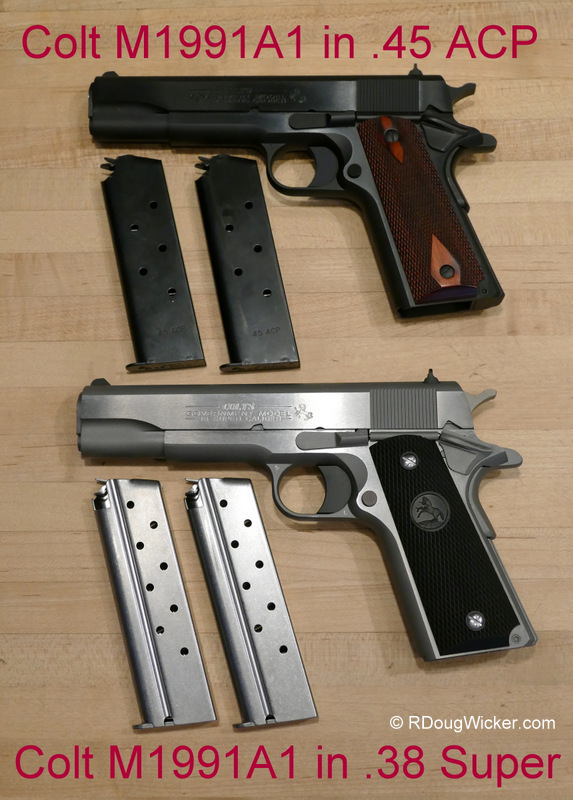
Colt .38 Super vs. Colt .45 ACP

Colt .38 Super vs. Colt .45 ACP

Here are some comparisons of the original .38 ACP, the later downloaded .38 ACP, the original .38 Super +P load, and the original .357 Magnum load (bullet weight in grains; velocity in feet per second; muzzle energy in foot-pounds):

.38 Super +P Ballistics Comparison

.38 Super +P Ballistics Comparison

You’ll note that the original .357 Magnum data is from a ridiculously long barrel, so let’s take a look at what you can expect coming out something a bit more reasonable using a modern load:

.357 Magnum Ballistics — 4

.357 Magnum Ballistics — 4″ barrel

And how do .40 S&W and .357 SIG stack up to the .38 Super +P and .357 Magnum from 1928 and 1935?  Let’s take a look:

.357 SIG and .40 S&W Ballistics

.357 SIG and .40 S&W Ballistics

As you can see, the .40 S&W originally didn’t have a lot going for it in comparison to even the original .38 ACP loads, hence the derisive nickname, “.40 Short & Weak.”  Newer loadings have upped the performance a bit, but I’m still not impressed.  The .357 SIG looks good using its original development load, but those numbers don’t hold up with with most commercial loads available today.  In practice, .357 SIG falls just above .38 Super +P and well below .357 Magnum in muzzle energy.

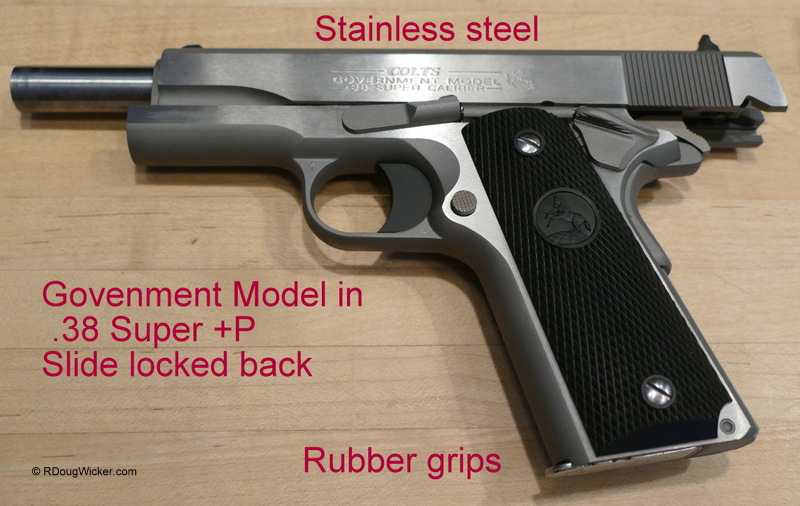
Now let us look at today’s firearm — a stainless steel version of the original Colt Model 1911 chambered in the uncommon .38 Super +P round, modified with the Series 80 trigger, redesignated officially as an M1991A, and sold under the model designation of O2091 (that first character being the letter “O” rather than the number zero). The blued version is the O2991.

Colt .38 Super

Colt .38 Super

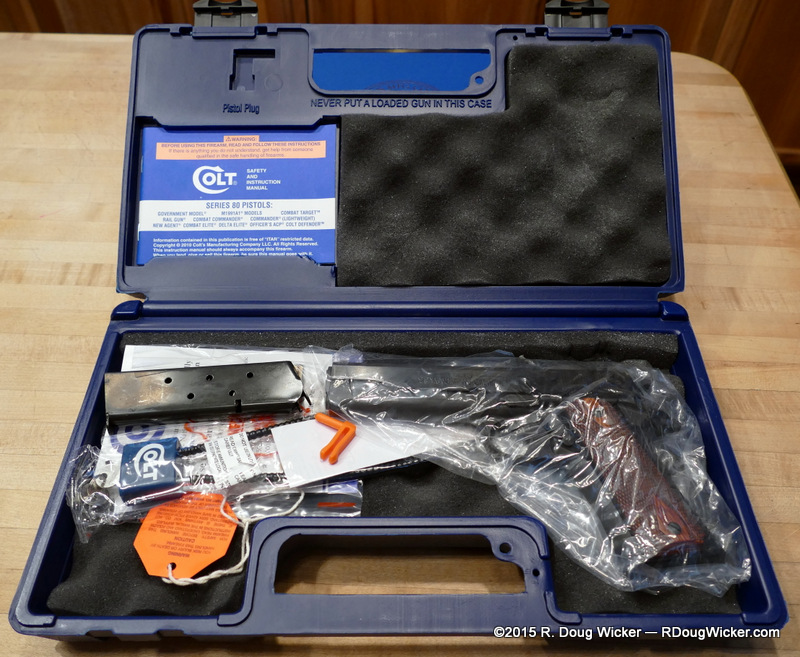
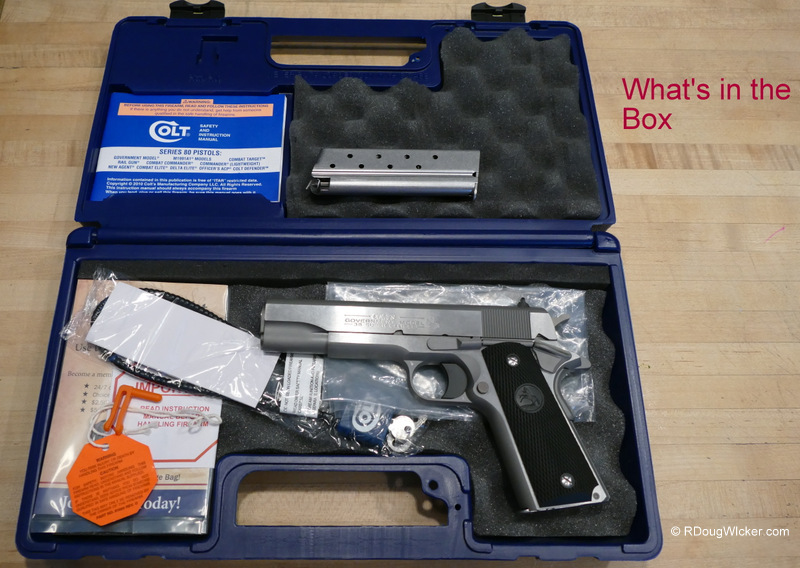
What’s included:

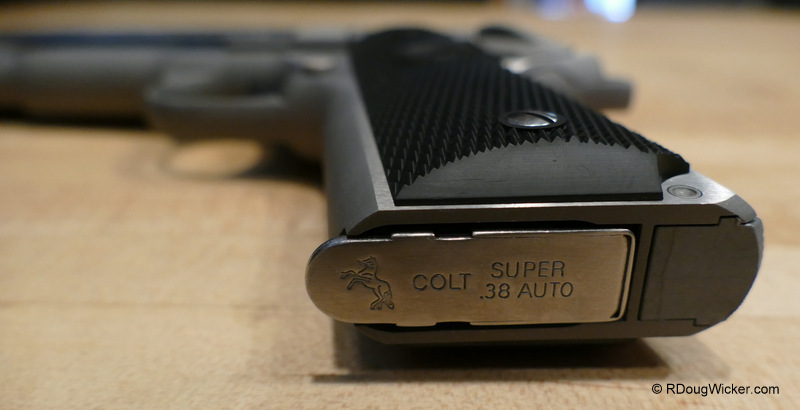
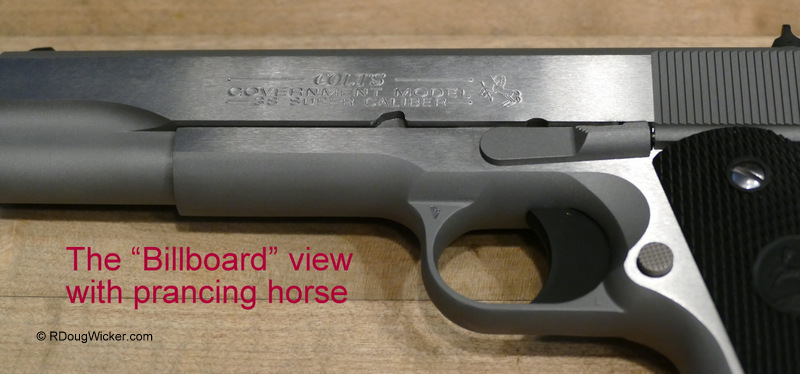
  • Colt .38 Super “Government Model” M1991A1 with brushed stainless slide and frame flats (vertical sides) and matte finish elsewhere; solid aluminum trigger; spur hammer; composite rubber grips; lowered ejection port; single-action only Series 80 firing system
  • Two 9-round magazines
  • Firearm lock
  • Plastic “empty chamber” flag
  • Instruction manual
  • Attractive Colt blue hard-sided, foam-lined case
  • Bright orange, stop sign-shaped, Christmas Story-type “You’ll shoot your eye out, kid” warning tag
  • The ubiquitous “Join the NRA or you’ll lose all your guns and be imprisoned for life by a week from Friday” enlistment package (Note to NRA in general and Wayne LaPierre specifically: If you want to be taken seriously as an advocate for gun ownership rights then don’t endorse for president the one candidate with the worst gun-rights record in the history of presidential elections. That just makes you look silly. Stupid silly. And quit hyping phony fear stories while you’re at it.)
Colt .38 Super

Colt .38 Super

M1991A1 (Model O2091) dimensions:

  • Length: 8.54 inches/217mm
  • Barrel Length: 5.03 inches/128mm
  • Slide Width: .91 inches/23mm
  • Maximum Width: 1.34 inches/34mm
  • Weight with empty magazine: 38 ounces/1,077 grams
  • Magazine Capacity: 9+1

I’ve already reviewed a .45 ACP version of this weapon in A 1911 by Any Other Name Would Be . . . an M1991A1 — Shooting Review. As such I won’t be giving a firing review here. The trigger is the same as in the .45 ACP M1991A1, so I’ll just repeat here what I said about the trigger on the M1991A1 in .45 ACP:

Internally, at least since 1983 on Colt Series 80 pistols such as the M1991A1 depicted here, there is also a firing pin block that only disengages when the trigger is pulled, which in turn can only occur if the external safety is disengaged and the grip safety is squeezed into the grip.

That last Series 80 feature is a bit controversial.  Some claim that it unnecessarily complicated the original design, degraded the trigger by making it stiffer and adding an almost imperceptible (in my view) amount of trigger creep before the hammer trips, and gunsmiths complained that the new design is more difficult to tune to competition standards.  My personal opinion?  It’s still one of the best triggers out there, and according to my research any gunsmith worthy of the title will be able to tune your trigger with just a bit more effort.  But even out of the box, I’d be hard pressed to understand why anyone would think this weapon needs any tuning whatsoever.  If the shooter can’t hold this weapon on target, then it’s the shooter who has a problem rather than the trigger and firing system on this weapon.

I’ve fired other M1911 models in the past, including a Series 70 Gold Cup with National Match barrel.  And while it’s been awhile since then, I have no complaints concerning the current M1991A1 Series 80.  Trigger take-up is in the neighborhood of ⅛ inch/3mm.  The aforementioned trigger “creep” is less than even that.  As such, the hammer trip is very clean and exceedingly crisp, especially when compared to most modern trigger designs.  Trigger reset is equally short with a very positive tactile feedback and audible “click.”

Colt Government Model

Colt Government Model

Now on to recoil.  Handgunners with M1911 pistols in both calibers report similar perceived recoil characteristics, with the .45 ACP described as more of a “push” and the .38 Super +P imparting a “quicker” but overall slightly more controllable impulse. Let’s face facts here, though — we’re talking about all-metal pistols weighing in at a whopping 38 ounces (with empty magazine). That’s a lot of mass, so either weapon is going to be more manageable than a miniscule 22.4-ounce Walther PPK/S firing the much lower powered .380 ACP round coming in at around half the energy of either the .38 Super +P or the .45 ACP.

Colt .38 Super

Colt .38 Super

Fit and finish are nearly as good as on my previously reviewed blued M1991A1. Slide-to-frame fit is exceedingly tight. If you vigorously shake the weapon there is one minor rattle emanating from the grip safety, but otherwise the entire assembly is tight, tight, tight. In other words, it’s a modern Colt through and through, and it shows in the quality.

Colt .38 Super

Colt .38 Super

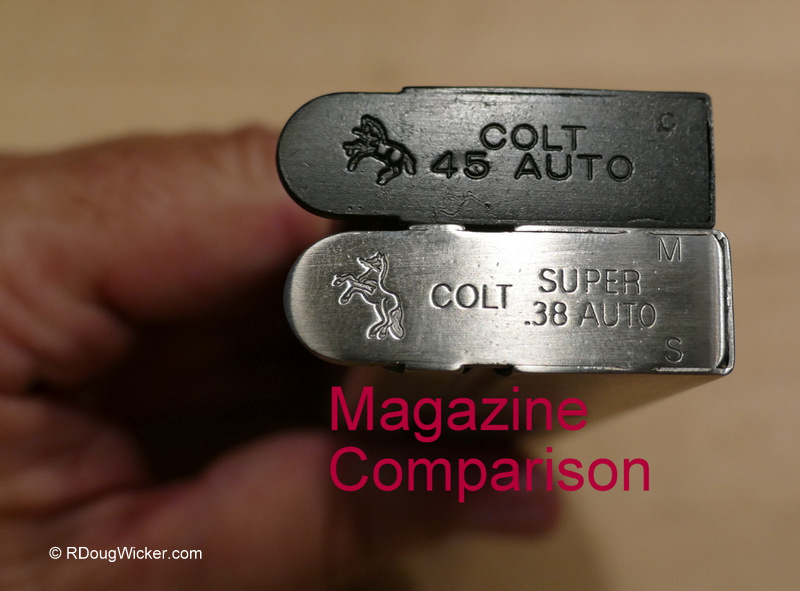
Magazine insertion is another story. Both magazines slide smoothly into the magazine well until about 1 9/16 inches/39.69mm to go, then stop hard. It requires either a hearty slap at the base of the magazine or a hefty push to complete insertion. I don’t recall this being the case on my .45 ACP M1991A1, so I checked. Resistance is met at the same point of insertion, but it required only a fraction of the force to overcome and fully insert the .45 ACP magazine into the magazine well. This may be a break-in issue, but that’s not going to happen with this example. It’s not going to be fired.

Colt .38 Super

Colt .38 Super

So, why no shooting review? Because this particular example was acquired more as an investment. If Colt does break apart, or if quality suffers because production is ramped up to cover creditors, or (shudder) the Colt name gets auctioned off to some maker of cheap 1911 knock-offs in China, then pre-bankruptcy Colts will command a premium over post-bankruptcy examples.

Colt .38 Super

Colt .38 Super

Hey, the robber barons at Sciens Capital Management shouldn’t be the only ones to capitalize on their own mismanagement, right? Now if only I could get Ursula to spring for blued and perhaps a stainless Colt M1911A1 to keep this safe queen company, also never to be fired.

Firing Review — The stainless Colt M1991A1 .38 Super +P

For another take on the .38 Super +P cartridge and a competing 1911 design:

The Rock Island 1911 and a History of the .38 Super Cartridge

6 Comments

Filed under Firearms, R. Doug Wicker

A 1911 by Any Other Name Would Be . . . an M1991A1 — Shooting Review


Colt M1991A1 Government Model

Colt M1991A1 Government Model

A word for the shooting enthusiast:  This review is geared toward novices in general and writers of fiction in particular.  If you’re a shooter or a fan of the M1911 you’ll still enjoy it, but please bear with some of the more extraneous background stuff.  For someone looking for a review of the M1991A1 with a purchase in mind, read through to the end for a detailed look at the fit, finish, and other particulars for this model.

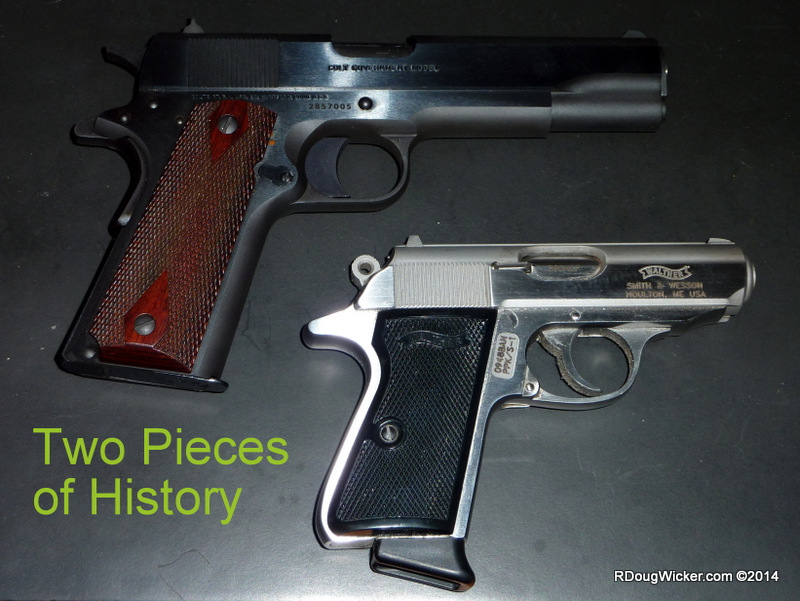
Last Monday we took a look at John Browning’s handgun masterpiece — the Colt Model 1911 — and later advancements made to his original design by the company that commissioned him to develop it.  Today we’ll take a look at what it’s like to operate and actually fire a modern version of this century-old design.  But before we do, let’s make a size comparison of the M1911 with another favorite of mine, the Walther PPK/S.  The PP-series of pistols are much smaller, and they are straight blow-backs designed for smaller calibers such as the .32 ACP/7.65mm and .380 ACP/9mm kurz.

Two Pieces of History — Colt M1911 and Walther PP-series

Two Pieces of History — Colt M1911 and Walther PP-series

That “ACP” designation in .45 ACP, .32 ACP, and .380 ACP stands for Automatic Colt Pistol, and all ACP cartridges were designed for either Fabrique Nationale de Herstal (FNH) of Belgium or the U.S. Colt’s Manufacturing Company by one man — again, John Browning.  Other Browning designed ACP cartridges are the .25 ACP and the all but discontinued.38 ACP.

If you compare the size of the M1911 to something considerably more concealable you’ll find that the M1911 is by no means a small pistol.  It is in fact quite large and very heavy.  The PPK/S you see below weighs in at around 22.4 ounces/635 grams, including an empty magazine.  The M1911 on the other hand tips the scales at almost 2½ pounds — 39 ounces/1.1 kilograms with an empty magazine for the original government model.  The modern M1991A1 in standard configuration beats that, but just barely at 37.78 ounces/1071 grams according to my kitchen scales.

Size comparison with a Walther PPK/S

Size comparison with a Walther PPK/S

Does that make the standard M1911 impractical for concealed carry?  Not at all.  I know several people who conceal the full-size version, and others who pack smaller versions.  Despite it’s 8.6-inch/217mm length the M1911 is particularly well suited for inside-the-waistband carry because it is relatively narrow — around 1.34 inches/34mm at the grip and an almost unbelievably narrow .91 inches/23mm at the slide.  The only real downside to concealed carry would have to be a hefty weight which requires a very good belt.

Surprisingly Thin

Surprisingly Thin

The M1911 is normally carried in the cocked-and-locked configuration (also called “condition one).  Cocked-and-locked means that there is a live round in the chamber and the hammer is fully cocked and ready to fire.  A thumb-operable external safety is engaged in condition one to prevent accidental discharge.

"Cocked-and-Locked"

“Cocked-and-Locked”

So, should you consider adding an M1911 to your collection?  Absolutely.  It’s the iconic U.S. semiautomatic, and has been since, well, 1911 (see: Historical Firearms — The Colt Model 1911).  It’s simply a wonderful range toy even if you opt to carry something more modern — intuitive to aim, fun to shoot, easily controlled despite being chambered in .45 ACP, and it’s one of the most accurate handguns ever devised.

Cocked and ready to fire — Safety off

Cocked and ready to fire — Safety off

Which brings us to some of the features incorporated into the M1911.  In addition to the external thumb safety there is an additional safety built into the grip.  If the grip is not properly held and the grip safety depressed, the weapon will not fire.  In what has become a familiar standard here in the U.S., the magazine is released via manipulation of the magazine release button located on the frame just aft of the trigger.  Internally, at least since 1983 on Colt Series 80 pistols such as the M1991A1 depicted here, there is also a firing pin block that only disengages when the trigger is pulled, which in turn can only occur if the external safety is disengaged and the grip safety is squeezed into the grip.

Standard M1911 controls

Standard M1911 controls

That last Series 80 feature is a bit controversial.  Some claim that it unnecessarily complicated the original design, degraded the trigger by making it stiffer and adding an almost imperceptible (in my view) amount of trigger creep before the hammer trips, and gunsmiths complained that the new design is more difficult to tune to competition standards.  My personal opinion?  It’s still one of the best triggers out there, and according to my research any gunsmith worthy of the title will be able to tune your trigger with just a bit more effort.  But even out of the box, I’d be hard pressed to understand why anyone would think this weapon needs any tuning whatsoever.  If the shooter can’t hold this weapon on target, then it’s the shooter who has a problem rather than the trigger and firing system on this weapon.

Range review:  I’ve fired other M1911 models in the past, including a Series 70 Gold Cup with National Match barrel.  And while it’s been awhile since then, I have no complaints concerning the current M1991A1 Series 80.  Trigger take-up is in the neighborhood of ⅛ inch/3mm.  The aforementioned trigger “creep” is less than even that.  As such, the hammer trip is very clean and exceedingly crisp, especially when compared to most modern trigger designs.  Trigger reset is equally short with a very positive tactile feedback and audible “click.”  Reliability is superb with the two ammo types I fed through it — full metal jacket and jacketed hollow points.  As for accuracy, this pistol without any modification whatsoever is capable of better accuracy than most any shooter who will fire one, and you can’t ask for better than that.  Indeed, take a look at this demonstration video from one of my favorite handgun reviewers, Hickok45:

Don’t Fear the Recoil:  Many people unfairly in my view criticize the .45 ACP cartridge as being “uncontrollable,” and thus fairly inaccurate especially on followup shots.  A lot of that is not born out by the physics, however.  The original .45 ACP design called for a 230-grain/.526-ounce/14.9-gram bullet traveling subsonically at around 830 feet/253 meters per second.  That works out to around 352 foot-pounds/477 Joules of force.  Compare that to the original specifications of the “much more controllable” 9mm Parabellum.  That cartridge was designed around a 115-grain/.263-ounce/7.45-gram bullet traveling at the supersonic velocity of 1,300 feet/390 meters per second.  Total energy from that round is 420 foot-pounds/570 Joules.  Bear in mind that 9mm weapons are for the most part considerably lighter than the M1911, yet as you can see they transmit more recoil force back through the weapon and ultimately to the shooter’s hand.  In my opinion the 9mm has a sharper, quicker recoil whereas the .45 ACP imparts a steady, even, thrust-like reaction.  Recoil management is thus easy to accomplish and target reacquisition is very quick.

A little side story on that slower .45 ACP velocity.  Back in my younger uncorrected vision days I could actually follow with my eye a .45 ACP bullet heading downrange, especially when shooting in bright sunlight at long ranges against a light-colored backdrop.  It was a truly bizarre experience, and I cannot recall being able to do that with any other bullet I’ve ever fired.

But back to what it’s like to fire an M1911 in .45 ACP (fiction writers in particular take note):  The noise from a .45 ACP is unlike most smaller caliber handguns such as the 9mm in that it imparts a slightly deeper, almost cannon-like “boom” rather than a sharp “bang.”  That’s not to say the .45 ACP is louder.  It isn’t.  What I’m describing is just a slightly deeper, lower frequency with less “crack,” probably as a result of comparing a subsonic round (.45 ACP) to one that will emit the “crack” of a sonic boom (9mm).  Recoil is surprisingly light.  Muzzle flip is negligible, especially with a proper grip.  Target reacquisition is quick and efficient, and followup shots are easily managed.

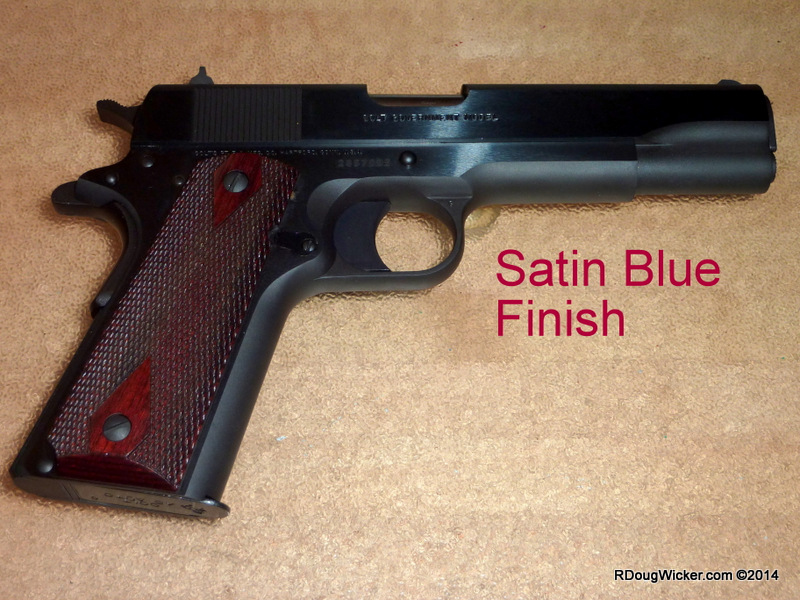
Now a look at the current fit-and-finish of the “New Roll Mark” post-2001 version of the Colt M1991A1:  If you’re considering adding an M1911 variant to your collection you can do a lot worse than this particular version.  This is first and foremost a real Colt and not a pretender.  Slide-to-frame fit is extremely tight with almost no perceptible play.  Barrel-to-bushing tolerance is so tight that I cannot induce any wobble at all in my example.

As for finish, the satin bluing is one of the prettiest I’ve ever seen in recent years, and light-years beyond the Parkerized finish of the original “Old Roll Mark” version of the M1991A1:

Satin Blue Finish

Satin Blue Finish

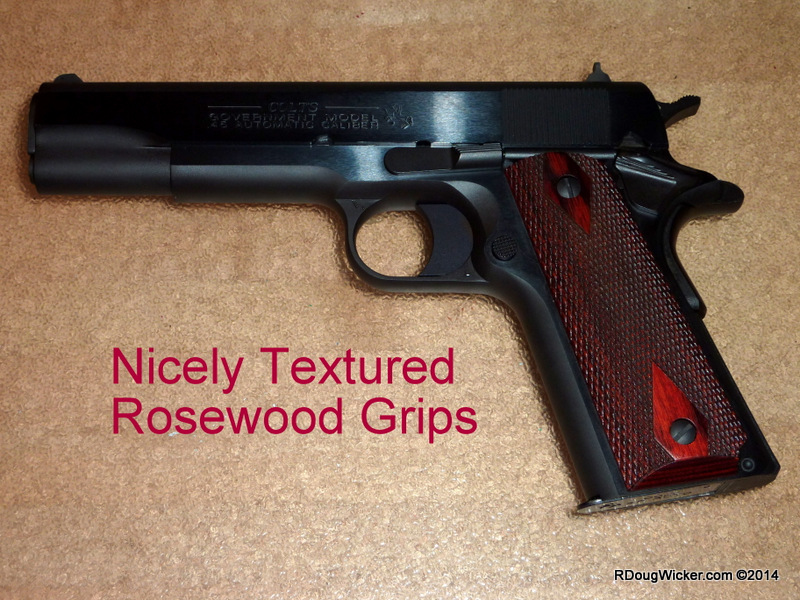
The grips that come with the Colt M1991A1 are nicely textured, beautifully stained, semi-gloss rosewood:

Textured Rosewood Grips

Textured Rosewood Grips

Specifications:

  • Length: 8.54 inches/217mm
  • Barrel Length: 5.03 inches/128mm
  • Slide Width: .91 inches/23mm
  • Maximum Width: 1.34 inches/34mm
  • Weight with empty magazine: 37.78 ounces/1,071 grams
  • Capacity: 7+1

Pricing:  This particular Colt M1991A1 with blued finish and rosewood grips is Colt model number O1991.  The manufacturer’s suggested retail price (MSRP) is $974, but you can find them available for under $900 and Bud’s Gun Shop is listing one at $834 as of this writing.

Comments Off on A 1911 by Any Other Name Would Be . . . an M1991A1 — Shooting Review

Filed under Firearms, R. Doug Wicker