Tag Archives: handguns

A Look at the Colt MK IV Series 70


Colt's Custom Shop Mk. IV Series 70 in stainless

Colt’s Custom Shop MK IV Series 70 in stainless

This week we’re taking a break from travel and photography and concentrating on another of my varied areas of interest — firearms. We’ll begin with a rather rare bird, a new Colt MK IV Series 70. The example you see here is in stainless steel.

But first a history lesson on the Colt “Government Model” M1911 Series 70 versus the Series 80, and the controversy surrounding the latter.

Colt's Custom Shop Mk. IV Series 70 in stainless

Colt’s Custom Shop MK IV Series 70 in stainless

The MK IV Series 70 dates from the year 1970. It differed from the previous M1911A1 (1924) in that the pistol had installed a split barrel bushing (sometimes referred to as a “collet bushing”) to increase accuracy of an already very accurate handgun. The following photos from Hooper Gun Works illustrate the difference between the two bushings. The first show the differing bushings installed onto a Colt barrel, and the second is a close-up of the actual bushings:
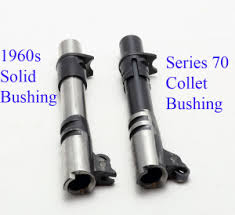
Traditional bushing (left); Series 70 split barrel

Traditional bushing (left); Series 70 split barrel “collet” bushing (right); both installed on barrels


Traditional bushing left; split barrel bushing right

Traditional bushing left; split barrel bushing right

To be brutally frank about it, the split barrel “collet” bushing was a bit of a disaster. The fingers had a tendency to break off and jam the pistol. So, by 1988 the split barrel bushing gave way to a return to the solid bushing in later iterations of the Colt M1911 line.

Colt Mk IV roll mark

Colt Mk IV roll mark

Colt ended the MK IV Series 70 in 1983 with the introduction of the Series 80. This M1911 initially retained the split barrel bushing, but it incorporated a new feature hated by M1911 purists. It is theoretically possible that if a cocked-and-locked M1911 is dropped onto a hard surface in such a way that the muzzle strikes first, the free-floating firing pin may have enough inertia to overcome the tension of the firing pin spring and thus impact the bullet primer. This could produce an unintended discharge.

M1991A1 roll mark

M1991A1 roll mark

Colt addressed this concern in 1983 by redesigning the firing system to incorporate a firing pin block. The firing pin block is disengaged by the trigger mechanism as the trigger is pulled. So, why the controversy among 1911 purists? After all, isn’t increased firearm safety a good thing?

Apparently, not if it adversely impacts a great single-action trigger . . . or even if it’s merely imagined to do so.

Mk IV reverse side

Mk IV reverse side

Many claim that this trigger-deactivated firing pin block increased trigger weight and friction. I’ll be testing this claim on Wednesday with a video of a test I performed that pits the MK IV Series 70 pictured here up against a Colt M1991A1 with the so-called Series 80 trigger. Not in the video but outlined in the text on Wednesday are additional comparisons I performed with a stainless Colt M1991A1 chambered in .38 Super and another .45 ACP Colt M1991A1 identical to the one used in the video. I believe you’ll find the results most enlightening, and I’m sure very controversial among M1911 purists.

M1991A1 reverse side

M1991A1 reverse side

By now you’re asking, how the heck did Series 70 come to mean a trigger that dates from 1911 to 1983, while Series 80 describes the trigger system with a firing pin block incorporated in 1983? Good question, since the Series 70 was so designated not because of the trigger system, but rather because of the split barrel “collet” bushing — a bushing that continued on in the Series 80 pistol for some five years. The answer is convenience. It’s just easier to differentiate between the original internal trigger design of the M1911 to the later firing pin block design by referring to the two designs as “Series 70” and “Series 80” firing systems.

Here is another photo from Hooper Gun Works that illustrates one of the modifications made, in this case to the hammer:
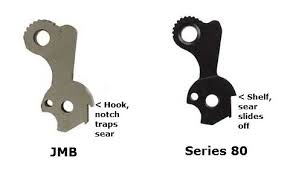
Notched Series 70 hammer on left; shelved Series 80 hammer on right

Notched Series 70 hammer on left; shelved Series 80 hammer on right

(Note: There is a competing firing pin block design out there for the M1911 in which the firing pin block is deactivated by the grip safety rather than the trigger. It’s called the Swartz Firing Pin Safety, and it’s used by some competing M1911 producers such as Kimber and Smith & Wesson. Ironically, Colt pioneered the Swartz system in 1938, but dropped it after only three years because the U.S. military balked at the added expense, as did the civilian market. Modern manufacturing processes have allowed the economical reintroduction of the Swartz system, but Colt have stuck with the Series 80 firing system.)

Around the turn of the century it began to dawn on Colt that M1911 purists were leaving the fold for competing M1911s produced without the “trigger degrading” Series 80 firing pin block. This resulted in Colt reintroducing a “MK IV Series 70” that really isn’t much like the one produced from 1970 to 1983. For one thing, there was no return to the split barrel bushing. The Series 80 slide and frame were also retained, even if the firing pin block was removed. Of interest to some may be the fact that Colt continues to use in the reintroduced Series 70 the internals of the Series 80. That means the shelved hammer pictured above is still used rather than the earlier notched hammer. What Colt is giving you with the new MK IV Series 70 is in fact a Series 80 pistol with Series 80 trigger system parts, only without the actual firing pin block. This removes from the trigger-feel equation the internal movement that disengages the firing pin block.

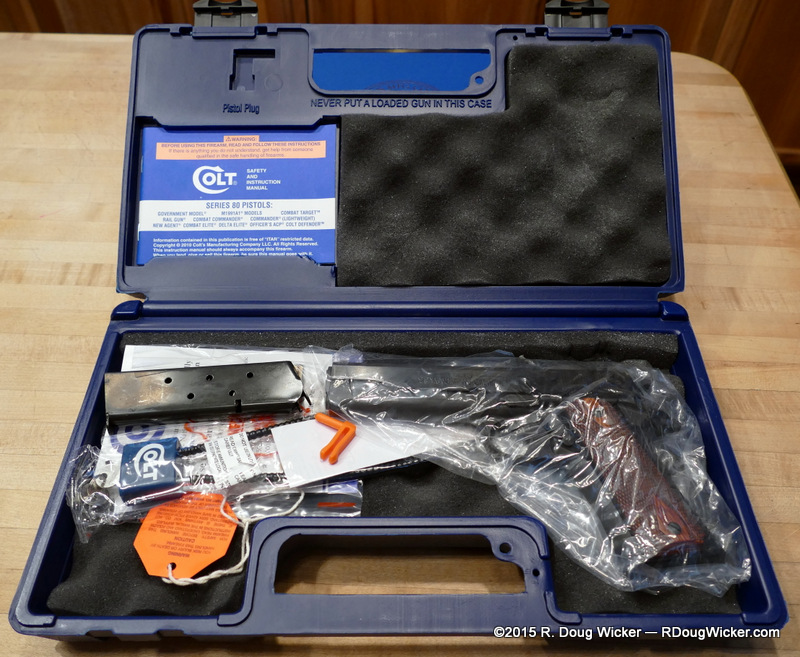
Well, there is one other difference. The new MK IV Series 70 is produced in very limited runs in the Colt Custom Shop. That means if you find one, you’re laying your hands fairly rare pistol. My source puts the annual production numbers of Colt Custom Shop MK IV Series 70s at between 500 and 1,000. Additionally, as these pistols originate from the Custom Shop, they ship in the famous blue “Colt Custom Shop” box, which alone is worth probably north of a hundred bucks.

Standard Colt plastic case next to Colt Custom Shop box

Standard Colt plastic case next to Colt Custom Shop box

Colt Mk. IV Series 70

Colt MK IV Series 70

Colt M1991A1

Colt M1991A1

Colt Custom Shop close-up

Colt Custom Shop close-up

Now let’s compare a MK IV Series 70 to an M1991A1 Series 80. Externally they appear much the same. Both are roll marked as “Government Models”. Both have nicely checkered rosewood grips. Finish is equally nice on these two examples, and slide-to-frame fit is exceedingly tight, as is the barrel-to-bushing fit. These are very tight pistols which I personally would not hesitate to put up against pistols costing two and three times as much.

Now for the differences:

  • The most obvious are the sights. Both pistols come equipped with High-Profile sights, but the M1991A1 sights use the three-dot system while the MK IV Series 70 is absent any such visual cue.
Combat sights vs. three-dot sights

Combat sights vs. three-dot sights

  • Less obvious is the trigger placement. The aluminum M1991A1 trigger is a longish affair protruding almost half way across the span inside the trigger guard. The stainless MK IV Series 70 is much shorter in length.
Short Mk. IV Series 70 trigger (top) next to the M1991A1 long trigger

Short MK IV Series 70 trigger (top) next to the M1991A1 long trigger

  • Least obvious of all is the backstrap below the grip safety. Both backstraps are grooved in this area, but the M1991A1 backstrap is straight while the MK IV Series 70 backstrap has a slight curve.
Mk. IV Series 70 curved backstrap (bottom); M1991A1 flat backstrap (top)

MK IV Series 70 curved backstrap (bottom); M1991A1 flat backstrap (top)

On Wednesday we’ll test conventional wisdom and put the Series 70 trigger to the test against the Series 80.

I would like to take this time to acknowledge the fine photo work of Hooper Gun Works, to which I linked in this blog.  Hooper probably explain the Series 70 and Series 80 difference better than I, so please give their wonderful article a look as well by clicking on the link below:
Hooper Gun Works article on the Colt Series 70

3 Comments

Filed under Firearms, R. Doug Wicker

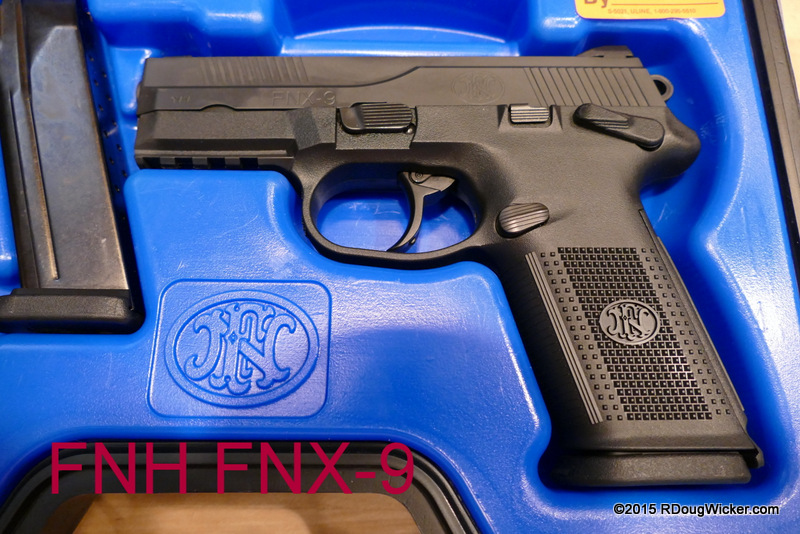
FNH FNX-9 — A Shooting Review


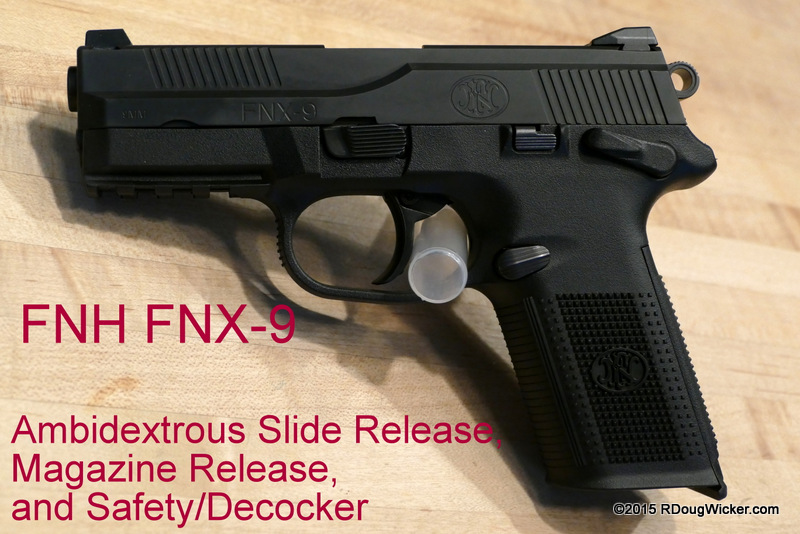
FNH FNX-9

FNH FNX-9

One of my favorite modern weapons is the FNH FNX-45.  And I suspect I’m not the only one, as my review of the FNX-45 is one of my most frequently searched for and read blog posts.  In the past year alone that review has garnered nearly 5,600 hits, second only to my review of the classic Walther PP chambered in .32 ACP.  The FNX-45 is, quite simply, a near-perfect home defense weapon especially when combined with a Beretta CX4 9mm Carbine.  If you’re a rancher located two hours or more from the nearest sheriff substation, these are the two weapons you want guarding the ol’ homestead against any potential two-legged predators.

So, imagine my delight when my local favorite gun storeCollector’s Gun Exchange owned by my good friend Paul Lee — had a slightly used FNH FNX-9 on sale for about $150 below typical new prices.  Apparently the previous owner only ran a couple of magazines’ worth of 9mm ammunition through it before he discovered that the FNX wasn’t on the El Paso Police Department’s list of approved duty weapons.  Subsequently, the previous owner traded it in on a Glock.  That’s too bad for the EPPD, because in my view the FNX is far superior to the Glock in every respect.

FNH FNX-9 complete kit

FNH FNX-9 complete kit

FNH products come with a substantial number of goodies that you’ll pay extra for with other brands, including even my beloved Walthers and SIGs.  With the FNX series you get not two, but rather three 17-round magazines.  That’s a lot of firepower at no additional cost to the buyer.  The FNX-9 also comes with four interchangeable back straps — two different sizes in two differing textures — each incorporating lanyard attachments.

Three magazines and four back straps included

Three magazines and four back straps included

The pistol itself comes equipped with a MIL STD 1913 rail and a serrated trigger guard.  Internally, as with the FNX-45, the slide rails attached to the frame are replaceable in the unlikely event that you wear them out.

FNH FNX-9 disassembled view

FNH FNX-9 disassembled view

Controls are simple, straightforward, intuitive, and easy to manipulate.  These include fully ambidextrous slide releases, magazine release buttons, and safety/decocker levers.  The FNX-9 is a hammer-fired, double-action/single-action pistol that also allows for cocked-and-locked carry using the ambidextrous safety.  Depressing the safety lever downward beyond the firing position safely decocks the hammer to place the weapon into double-action mode.

FNX FNX9-003

FNH FNX-9 ambidextrous controls

That is simply a lot of versatility for the money, and in this the FNX exceeds by a wide margin most other modern polymer handguns currently on the market, even those approaching twice the FNX’s price.

Disassembly is SIG-simple.  Just lock back the slide, rotate the take-down lever above the trigger (the one control not ambidextrous), unlock the slide while while firmly holding it, then ease the slide forward off the frame.  Once the slide is dismounted, simply remove the recoil spring assembly and barrel.  Reassembly is just the reverse, and can either can be accomplished in mere seconds.

FNH FNX-9 disassembled view

FNH FNX-9 disassembled view

So, how does the FNH FHX-9 shoot?  Once again, as with the FNX-45, the barrel and slide remain locked for far longer travel distance than with any other semi-automatic handguns I’ve handled.  This in conjunction with the low bore access seems to result in an extremely light and controllable recoil that allows for very quick target reacquisition and fast follow-up shots.  Aim is intuitive, but point of impact seems just a tad high.  I wasn’t really trying to evaluate aim on this outing, as I was firing this day at a target previously set up for the new Ruger Mini-14 Tactical 300 AAC Blackout.  That target sat about 60 feet/18 meters downrange.  But with that in mind, not only was I on the paper, I was also only somewhat high and just slightly left of my point of aim.  Groupings were good for a handgun (and my rather pathetic level of talent) for the distance, but I definitely want to give the FNX-9 a more controlled look at the standard 21-foot/6.4-meter defensive shooting range before delving any further into this pistol’s accuracy.

The trigger is good, but not great.  The FNX-9 is a combat weapon, and the trigger reflects that. Double-action is long and moderately heavy, but probably less so than the SIG P22(x) series of double-action/single-action pistols.  The FNX trigger also lacks any real tactile feedback before the hammer trips.  At defensive ranges that’s not really what I would consider a factor, and the trigger is not overly heavy to the point where you wouldn’t be able to keep aim on target at any reasonable range.  For instance I have no problem keeping on target out to a range of 15 yards with the FNX-45 in double-action, and the triggers between these two pistols are pretty much identical in most respects.

Single-action is okay, but it’s not match grade by any stretch.  You’ll get a better single-action trigger out of a SIG P22(x), and certainly much better out of the Walther  PP-series or a P99 AS.  Don’t even think of comparing the FNX single-action trigger to the Colt M1991A1; they’re not even close.

Still, the FNX single-action trigger is far better than partially cocked striker-fired pistols such as the Glock.  Trigger take-up is about ⅜”/10mm before your finger encounters any resistance.  After that point the trigger mushes along for around ⅛”/3mm before tripping.  These numbers are again nearly identical but ever-so-slightly better than what I measured on the FNX-45.  The trigger reset point equals the FNX-45 at around ½”/13mm with a positive tactile indication and barely audible click, but then you’re back to the previously mentioned slightly mushy trigger creep before reaching the trip point.

While the FNX-45 is too bulky and hefty for concealed carry, not so much with the FNX-9.  And at 17+1 rounds, that’s a good thing.  I’ve not yet carried the FNX-9, but I have obtained a Don Hume H721 Double Nine holster (my favorite for both the Walther P99c AS and the PPK/S).

Don Hume H721 Holsters for Walther PPK or PPK/S and Walther P99c AS

Still, the FNX-9 is somewhat larger than what I would classify as a compact firearm.  It’s closer to a full-size concealable carry weapon.  Dimensions are:

  • Length 7.4″/188mm
  • Height 5.43″/138mm
  • Width 1.55″/39mm
  • Barrel length 4.02″/102mm
  • Weight is an incredibly light (unloaded) 21.9 oz/621 grams
  • Capacity 17+1 of 9mm ammunition

In comparison here are the dimensions of what is in my opinion the single best concealed carry pistol currently on the market, the Walther P99c AS:

  • Length 6.61″/168mm
  • Height 4.33″/110mm
  • Width 1.26″/32mm (1.34″/34mm if you can find the ambidextrous model)
  • Barrel length 3.5″/89mm
  • Weight (unloaded) 19.0 oz/540 grams
  • Capacity 10+1 of 9mm ammunition

So, in comparison to a truly compact 9mm, the FNX-9 comes in .79″/20mm longer, 1.1″/28mm taller, 0.3″/7mm wider, and weighs 2.9 oz./81 grams more.  On the plus side, you get an added half-inch/13mm of barrel performance, and the FNX-9 gives you seven more rounds for that additional inch of height.

The FNX-9 is just as much a winner as is its larger FNX-45 brother.  If you’re looking for an affordable, concealable, high-capacity 9mm, you could certainly do a lot worse than this offering from FNH.

2 Comments

Filed under Firearms, R. Doug Wicker

Historic Firearms — The Colt Model 1911


Colt M1991A1 — The "Modern" Model 1911 with Series 80 firing system

Colt M1991A1 — The “Modern” Model 1911 with Series 80 firing system

Next Monday I’ll be presenting a review of the firearm pictured here, but today I want to devote this blog to one of the most iconic and historically important handguns ever produced — John Moses Browning’s superlatively designed, stunningly beautiful achievement the Colt Model 1911 designed for the potent .45 ACP cartridge.

You’ve seen the 1911 before, by the way.  In fact, whether you know it or not, you’ve seen it literally thousands of times over the years.  And, as a purveyor of fiction, I simply must note that you’ve seen it mentioned in countless novels as well — Even agent 007 used it in Ian Fleming‘s novel Moonraker and in the short story From a View to a Kill in the For Your Eyes Only collection of works.  You simply cannot escape it’s ubiquitous presence in television, movies, literature, and any serious history on the U.S. military over the past 100+ years.

For instance it was Thomas Sullivan Magnum’s favorite weapon.

 Image from Internet Movie Firearms Database (www.imfdb.org)

Tom Magnum on the case with his trusty Series 70 M1911— Image from Internet Movie Firearms Database (www.imfdb.org)

Mike Hammer called his 1911 “Betsy.”

Mickey Spillane’s Mike Hammer (Stacy Keach) with “Betsy”

And even John Shaft used one.

John Shaft’s M1911 — For those times when his Colt Detective Special just wasn’t enough firepower

Indeed, you’ll see an M1911 used by either the hero or a bad guy in almost any film or television show in which firearms play a prominent roll in the storyline.  In real life the M1911 was used by various law enforcement agencies (and still in use by some, including certain FBI units), mobsters, gangsters, and spies.

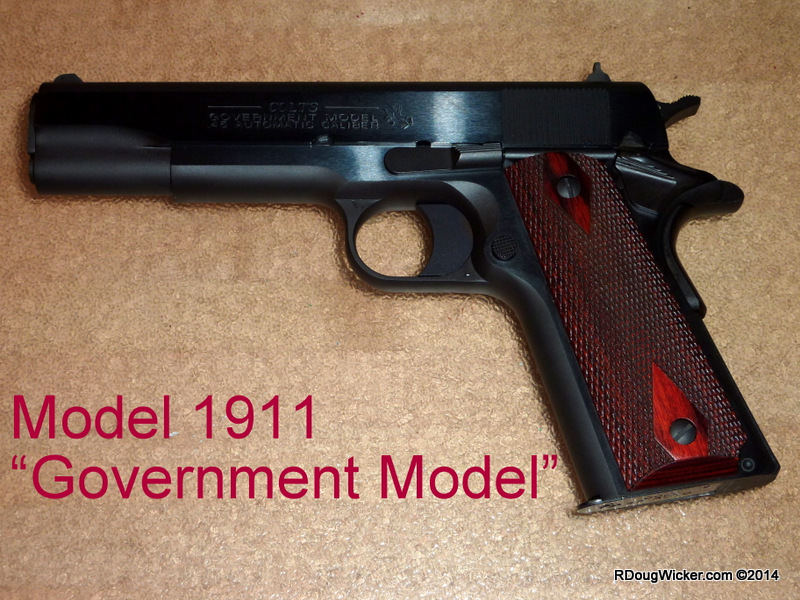
M1911 "Government Model"

M1911 “Government Model”

But the Model 1911 (M1911 for short) gained its fame on the battlefields of World War I, World War II, Vietnam, Korea, etc., etc., etc.  Indeed the M1911 was first adopted by the U.S. Army in early 1911 — hence the name — and was the primary sidearm of the U.S. military until it was replaced by the vastly inferior 9mm Beretta M9 (military version of the Beretta 92) in 1985.

9mm Beretta M9 — The Army’s idea of a “replacement” for the M1911

The M1911’s story with the U.S. military did not end there, however.  It continues in service to this day with  U.S. Marine Expeditionary Units under its new designation as the M45 MEU(SOC) pistol.  More recently the USMC has acquired directly from Colt a railed version of the 1911 designated the M45A1 CQBP — Close Quarter Battle Pistol — for use by both the Marine Expeditionary Unit (MEU) and Marine Special Operations Command (MARSOC).

M45A1 CQBP — Made by Colt and equipped with an accessory rail

Between the original M1911 and the M1911A1 version  that succeeded it in 1924, the U.S. military acquired an astounding 2.7 million copies made by Colt, Springfield Armory (the former U.S. government arsenal, and not the current company using that name), Remington, North American Arms, Ithaca Gun Company (known for shotguns), Remington Rand (the typewriter/computer company), Singer (another typewriter manufacturer), and even a maker of railroad signalling gear — Union Switch & Signal.

M1911 "Government Model"

M1911 “Government Model”

After World War II the U.S. military had enough M1911s on hand to last until their ultimate replacement some forty years later by the aforementioned M9 Beretta.  These M1911s were refurbished as needed at the Rock Island Arsenal (not to be confused with Armscor’s Rock Island Armory brand name), the U.S. Government Springfield Armory, and other military depots and arsenals.

In other words, if you’ve seen a war movie involving U.S. troops set in time from 1911 until at least 1986, chances are you saw an M1911 in the picture.  And if you’ve watched a movie concerning the U.S. Marine Corps after 1985, there’s still a good chance you’ve seen a version of the M1911.

Today everybody and his fourth cousin twice removed make some version of the M1911 — Colt (the true original), Springfield Armory (the company, not the original U.S. government armory), SIG, Kimber, Wilson Combat, Ruger, Smith & Wesson, Remington, Para Ordinance, Taurus (Brazil), Rock Island Armory (the Armscor Filipino subsidiary), and even a .22 version marked under the Walther banner but made in Turkey for parent company Umarex. That’s just a partial list, by the way.  Past and present there have been well over 100 companies that have made versions of the M1911 in some form or another, and in calibers ranging from the original .45 ACP to at least ten other calibers from the diminutive (.22) to the ridiculous (.460 Rowland).

And who came up with this still popular design?  Why, John Moses Browning, of course.  You’ll recall that name from my series on Winchester lever-action rifles (see: Winchester Rifles — Part 1;  and Winchester Rifles — Part 2), another iconic series of historic firearms.  But to make a semiautomatic pistol that was still somewhat compact and relatively light, yet would stand up to the power of the .45 ACP cartridge, John Browning would have to invent an entirely new recoil mechanism.  Existing locked breech mechanisms of the era were complex, costly to manufacture, and unreliable.  So, what Browning came up with was a short-recoil, tilting barrel, locked breech design.  A simplified form of that Browning invention is still used to this day in nearly every semiautomatic handgun made for powerful calibers beginning with the 9mm Parabellum.  This short-recoil locked-breech mechanism works by briefly locking the barrel and slide together as a unit after the firing of the bullet.  The slide and barrel recoil back a short distance until the barrel tilts and disengages from the “locking” mechanism affixing it to the slide.  The slide continues reward, opening the breech, at which time the spent cartridge is extracted from the chamber and ejected through the now exposed port at the top of the pistol.  The slide then reverses, strips a fresh round from the magazine, and forces it into the chamber before reengaging the barrel and returning to battery (meaning the slide and barrel seated fully forward into firing position atop the frame of the weapon).

Here’s a demonstration to put all that mumbo-jumbo together for you:

http://www.youtube.com/watch?v=Frv7IUm1A3c

As the M1911 was originally developed by John Browning under contract to Colt, I’ll now stick specifically to Colt civilian models rather that even thinking of touching upon the 100+ other manufacturers and their variants.  The most common Colt civilian variants of the full-size M1911 (not Commander nor Officer models with reduced length barrels and slides) are:

  • Colt Government Mk. IV Series 70 (1970 to 1983) — Revised “Collet” barrel bushing that supposedly increased accuracy, but was also prone to breakage thus reducing reliability.
  • Colt Government Mk. IV Series 80 (two basic versions)
    1. 1983 to 1988 — New internal firing pin block for additional safety against accidental discharges resulting from dropping the weapon; retained the Series 70 Collet barrel bushing.
    2. 1988 to present — same internal firing pin block; return to the solid bushing pre-Series 70.
  • Colt Government Mk. IV Series 70 (2001 to present) — A return to the original design that drops the internal firing pin safety of the Series 80; earlier 70 Series Collet bushing replaced with original-style solid bushing
    Note:  The return to the Series 70 firing system without the internal firing pin block was in response to criticism that it was more difficult to perform a trigger job on the Series 80.
  • Colt GovernmentM1991A1 (two basic versions)
    1. “Old Roll Mark” (ORM) version 1991 to 2001 — Series 80 firing pin block and original, pre-Series 70 barrel bushing; plastic trigger; cheap Parkerized finish; large and, to some, ugly “COLT M1991A” roll mark on slide.
    2. “New Roll Mark” (NRM) version 2001 to present — As with ORM above except an anodized aluminum trigger; much more attractive brushed-blue finish (stainless steel version also available); smaller, more sedate “COLT’S GOVERNMENT MODEL .45 AUTOMATIC CALIBER” slide roll mark.

Here’s a link list to the current Colt models mentioned immediately above as well as other variations I’ve not mentioned (including the .380 ACP variant known as the Colt Mustang):

  • Colt M1991A1
  • Colt XSE (a high-end Series 80 derivative)
  • Colt Combat Elite (tactical version of the Series 80 also available in 10mm)
  • Colt Rail Gun (Series 80 version with Picatinny accessory rail)
  • Colt Gold Cup (Series 80 target model with match-grade barrel, adjustable sights, and other enhancements)
  • Colt Series 70
  • Colt Defender (short-barrel Series 80 version optimized for concealed carry)
  • Colt New Agent (another short-barrel Series 80 version)
  • Colt Special Combat Government (larger, long-barrel Series 80 variant for open carry, law enforcement, and home defense)
  • Colt CQBP (current railed military version of the Series 80)
  • Colt .380 Mustang (extremely compact pocket pistol chambered for the .380 ACP/9mm kurz and using a Series 80 firing system and about ⅓ the weight of a typical M1911 pistol)

Remember to return next Monday to find out what it’s like to operate an M1911 (specifically an M1991A1 version) at the range, and find out why this firearm is still so popular over 100 years after its development.

Bibliography:

3 Comments

Filed under Firearms, R. Doug Wicker