Tag Archives: firearm

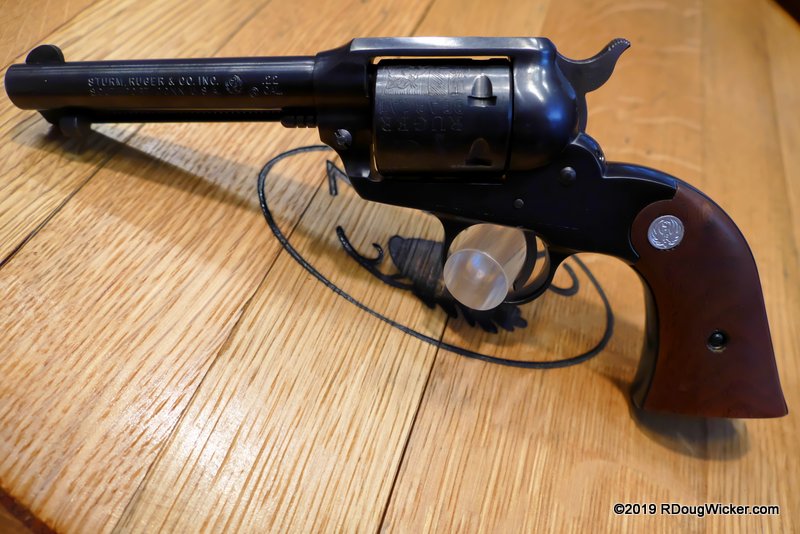
Western Wednesday — Collectible 1973 Ruger Super Bearcat Shooting Review


Ruger Super Bearcat with box, manual, warranty card

It’s time for a Western Wednesday firearm review, and today’s shooting review is on a gun that Ruger made for less than three years (June 1971-January 1974)! I’ve already discussed Ruger’s alloy framed 1st edition Bearcat (see: Interesting Collectables: “Old” 1st issue Ruger Bearcats), in which I presented a rare ‘Alpha Cat’ Bearcat and one of the very first Bearcats (624th off the line) produced with oiled walnut grips rather than the previous rosen-impregnated rosewood grips. Here is an image of those early Bearcats:

Rare 1960 “Alpha Cat” (top); very early (1964) Bearcat with oiled walnut grips

‘Unmodified’ means that both of those Bearcats were never sent back to Ruger for the transfer bar modification that would make safe the loading all six cylinders. That is why I’m referring to these pistols as Old West-style firearms, as they adhere closely to the design of the Colt 1873 Single-Action Army ‘Peacemaker. Below shows a comparison of a copy of the original Colt 1873 design along with an old issue three-screw Ruger Single Six (also unmodified) and an old issue Bearcat, all of which are only safe when the hammer rest over an unloaded cylinder chamber (more on that below):

USFA Single-Action Army; unmodified 3-screw Ruger Single Six; 1960 Ruger Bearcat

These classics may have been called ‘Six-shooters’, but disregard what you saw on television and in the movies. Nobody in their right mind would holster one of these guns with all six chambers loaded.

1973 Ruger Super Bearcat with Super Bearcat box

That means, unless you are physically at the range, on the firing line, and preparing to fire the weapon, the cylinder should be loaded so that the hammer rests upon an empty chamber. How do you do that? Here’s a recap from my previous article on the original (1958-1970) Ruger Bearcat:

Proper (safe) loading sequence for any Single-Action Army-type pistol or unmodified (no transfer bar) Ruger single-action revolver:

  1. Count out and place five (for a six-round weapon) bullets before you
  2. Five rounds only!
  3. Put the rest of the ammunition out of reach
  4. Thumb back the hammer two clicks, to the half-cock position; this frees the cylinder for rotation by hand
  5. Open the loading gate
  6. Visually inspect all cylinder chambers, making certain no bullets are loaded, by rotating the cylinder while peering down through the open loading gate
  7. After verifying all chambers are empty, place one round in the chamber exposed through the open loading gate (we’ll call this “Chamber 5”)
  8. Rotate the cylinder, bypassing the next empty chamber (Chamber 6) and proceeding to the second empty chamber (Chamber 1—why the skip will become evident in a moment); load one bullet into Chamber 1
  9. Continue loading the next three chambers in order (Chambers 2, 3, and 4)
  10. Close the loading gate
  11. Loaded Chamber 5 is next in line for the barrel, a.k.a., firing position
  12. Thumb back the hammer to the fully cocked position; doing this rotates loaded Chamber 5 away from the barrel
  13. Empty Chamber 6 is now in the firing position
  14. Holding the hammer back with your thumb, squeeze the trigger until the hammer releases
  15. Keeping the trigger pulled, gently lowering the hammer all the way to the frame with your thumb; failure to keep pulling the trigger will result in the hammer stopping at the half-cock loading position, which is not safe

You’re done. Your “six shooter” is now properly loaded with five bullets, and if you followed these directions the hammer is safely resting over an empty chamber and the weapon is safe to carry.

1973 Ruger Super Bearcat

Production of Ruger’s alloy-framed Bearcat was terminated in 1970 as the company retooled production in favor of an all-steel frame, and in June of 1971 the Super Bearcat was introduced. Initially, the Super Bearcat retained the anodized aluminum trigger guard, but even this was converted to steel after old stock was exhausted. Here you can see the Super Bearcat with steel frame and trigger guard beneath two previous Bearcats with alloy frames and anodized trigger guards:

Ruger “Alpha” Bearcat (top); Bearcat (middle); SuperBearcat (bottom)

During Ruger’s two-year seven-month run of the Super Bearcat, approximately 64,000 were produced. Of that number, the first 37,000 used the previous anodized trigger guard. Thus, beginning in early 1972, only the last 27,000 Super Bearcats produced had trigger guards of blued steel.

Super Bearcat with blued steel trigger guard

Ruger’s roll marks between the Bearcat and the Super Bearcat differed slightly, with addition to the latter of the weapon’s caliber and an ® indicating a registered trademark:
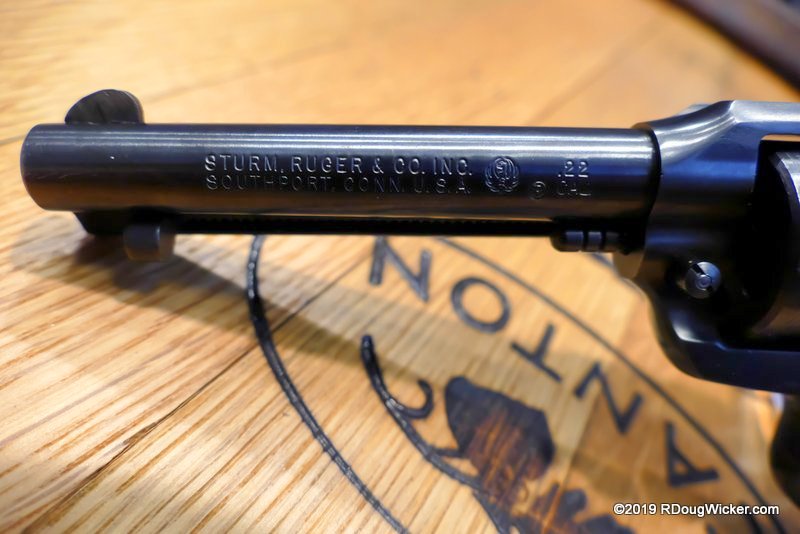
Ruger Super Bearcat roll mark

The Super Bearcat retained the lightly stamped Ruger eagle medallion and oiled grips that began with the previous Bearcat line beginning in 1964.
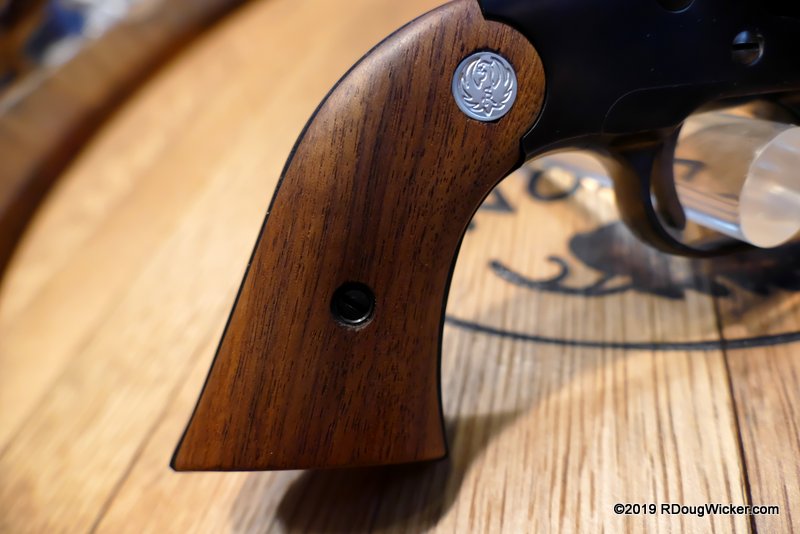
Super Bearcat oiled walnut grip with stamped medallion

And one touch that started with the original 1st edition Bearcats in 1958, continued through the 2nd edition Super Bearcat era ending in 1974, and carried on beginning with the reintroduction of the 3rd edition Bearcat in 1993 through today is an engraved cylinder:

Engraved cylinder common to all three Bearcat editions

So, how does this weapon shoot? The trigger is incredibly light, and initially the breaking of the trigger took me by surprise, but I soon got past that. I set at 10 yards/9.1 meters a target printed onto 8.5×11-inch/216x279mm standard letter-sized paper. I then loaded up and fired three full cylinders’ worth of Remington 36-grain .22 LR Plated Hollow Points, for a total of eighteen total shots. Here are the results:

Eighteen rounds at 10 yards/9.1 meters

For additional reading on both the 1st edition Ruger  Bearcat and 2nd edition Super Bearcat, I highly recommend the following great articles:

Unmodified 1973 Ruger Super Bearcat

3 Comments

Filed under Uncategorized

Fun Firearm Friday — Colt MK IV/Series’ 80 Mustang Plus II


Colt’s MK IV/Series 80′ Mustang Plus II

In May, 2017, I ran a three-article series on pocket pistols. The pistols viewed that week were the Beretta 3032 Tomcat (.32 ACP/7.65mm) and the Colt Mustang Lite (.380 ACP/9mm kurz). That series culminated in a shoot off between the two, as well as a size/weight comparison between them of the Walther PPK and PPK/S.

Colt’s MK IV/Series 80 Mustang Plus II

While researching that article, I found information on the Colt MK IV/Series 80 Government Model 380 (a scaled down version of the Series 80 Model 1911 introduced in 1984), and the even smaller early Colt Mustangs, which arrived two years later and continued in the market until around 1998 (reintroduced in 2011). What I did not include in that article was information on another Colt .380 ACP/9mm kurz pistol that starting in 1988 bridged the size gap between the Government Model 380 and the Mustang.

Colt’s MK IV/Series 80 Mustang Plus II

That pistol is the Colt MK IV/Series 80 Mustang Plus II. The Mustang Plus II took the all steel 7+1 capacity frame of the Government Model 380, and mated to it the shorter slide and barrel from the 5+1 (later increased to 6+1 after 1992) capacity Mustang — two additional rounds, hence the name Mustang Plus II. These original Mustang Plus II pistols were blued steel, but sometime around 1990 Colt came out with a stainless version. Production of the stainless Mustang Plus II was thus only around seven or eight years, making this a bit of a rarity. At least I’d never seen one, up until July of last year.

Colt’s MK IV/Series 80 Mustang Plus II

The MK IV/Series 80 Mustang Plus II you see here today was manufactured in 1991, and appears very lightly used with no holster wear marring the stainless slide. It came with three factory magazines, which on the base are stamped with the Rampant Colt trademark, the letter ‘M’ on all three magazines, and the letter ‘S’ also on the nickel plated magazine, and the words ‘Colt .380 Auto.’ on all three.

Original Mustang Plus II/Government Model 380 magazines

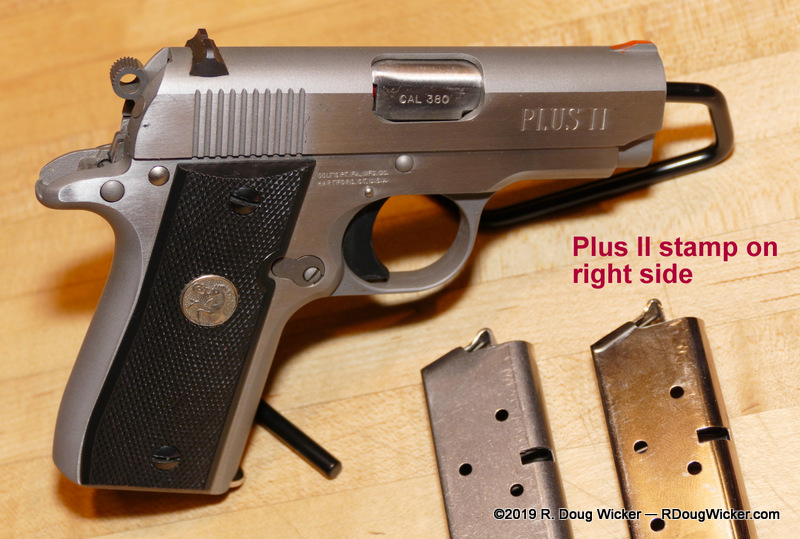
The left side of the slide top line reads, “COLT MK IV/SERIES’ 80.” Below that in a smaller font is, “—MUSTANG-380 AUTO—.” The Rampant Colt is to the right of both lines. On the reverse side ahead of the ejection port, the slide is stamped, “PLUS II.” The barrel inside the ejection port reads, “CAL 380.”

Colt Mustang Plus II — Slide stamp

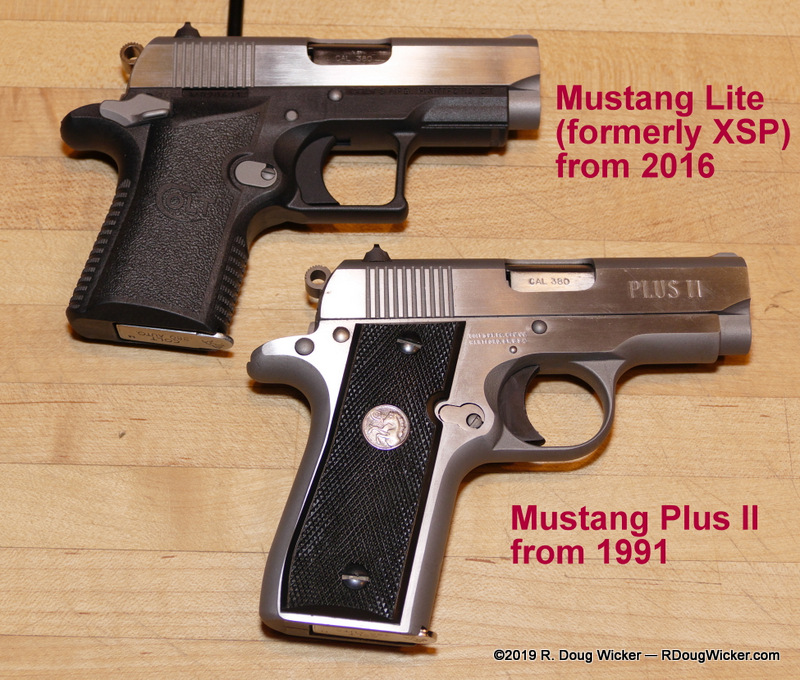
Comparing the slide markings to a more recent (circa 2016) polymer-frame Mustang Lite, the two lines on the left side read, “—MUSTANG—,” and “COLT 380 AUTO.” The right side of the newer Mustang Lite is blank, but, “CAL 380,” is stamped on that portion of the barrel visible through the ejection port.

Mustang Plus II and Mustang Lite (formerly XSP)

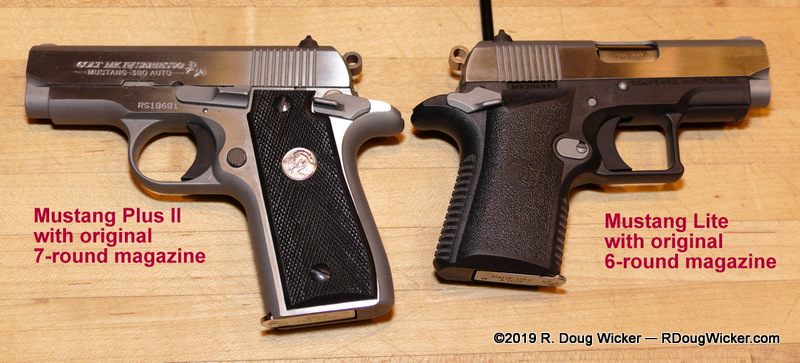
Dimensionally, the two guns are very similar. Slide and barrel length are, of course, the same, but the slightly longer beavertail of the Mustang Plus II adds perhaps a millimeter of length. The height differs, as one would expect. The Mustang Lite comes in at 3.9 inches/99mm, whereas the Mustang Plus II measures about 4.5 inches/114mm.

Mustang Plus II and Mustang Lite — Height comparison

But it’s the weight that most distinguishes the two. The Mustang Lite with it’s lightweight polymer frame, is a mere 12.54 ounces/356 grams including a empty magazine 11.2 ounces/318 grams without magazine). The slightly larger, all steel Mustang Plus II tips my scale at 19.42 ounces/551 grams (17.9 ounces/508 grams without magazine).

Colt’s MK IV/Series 80 Mustang Plus II

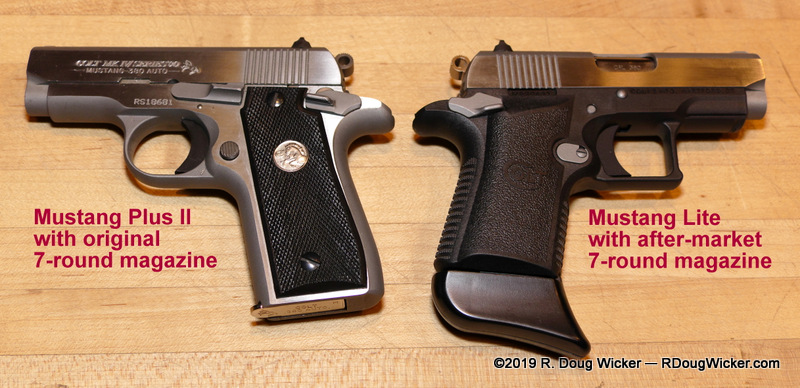
Magazine capacity only differs by a grand total of one—7+1 for the Mustang Plus II vs. 6+1 for the Mustang Lite when using the included (but in my case nonfunctioning) factory magazine. There are aftermarket (and more importantly reliable) magazines that give the Mustang Lite 7+1 capacity, but at the expense of an extra full inch/25mm of height because of the magazine’s finger rest configuration. Comparing the Plus II magazine to the extended aftermarket magazine for the Lite, it appears Metalform could knock off a half-inch/12.5mm of that penalty if they just left off the finger rest extension. But that extra length does allow for a more secure grip, as the pinky finger is no longer left dangling beneath the frame when the extended magazine is used.

Mustang Plus II and Mustang Lite — Height comparison

I’ve yet to fire the Mustang Plus II, and I look forward to a direct comparison with the Mustang Lite. The additional weight probably won’t help much in the recoil department, as I find the Mustang Lite already very controllable even without the 6.88 ounces/195 grams of added mass.

Mustang Plus II (1991) and Mustang Lite (2016)

So, if I were to choose between the two for a concealed carry piece, which would I pick? Hard choice. The Mustang Lite has the advantage of an ambidextrous safety, which is not really relevant to me as a right-hander (unless I had to use it with my left hand, of course), and the Mustang Plus II wins out in the height department by a small amount if you equip the Mustang Lite with an extended magazine to match the capacity of the Plus II. Weight difference isn’t really a factor on something already under 18 ounces, but I’ll admit that I do enjoy the additional heft and overall balance in the hand of the marginally heavier Plus II.

Colt Mustang Plus II — Rear sight

There is, however, a subtle difference in the triggers. The Mustang Lite takes up quickly and consistently, then has perhaps an eight of an inch of creep before breaking. The Plus II, on the other hand, displays more resistance on the longer take up, almost to the point of feeling mushy. And there’s a tactile, almost second-stage feel during the take-up pull. But the break requires less pull and feels cleaner with no creep at the end. Both triggers are exceptional, but I believe I prefer the feel of the Plus II in this department.

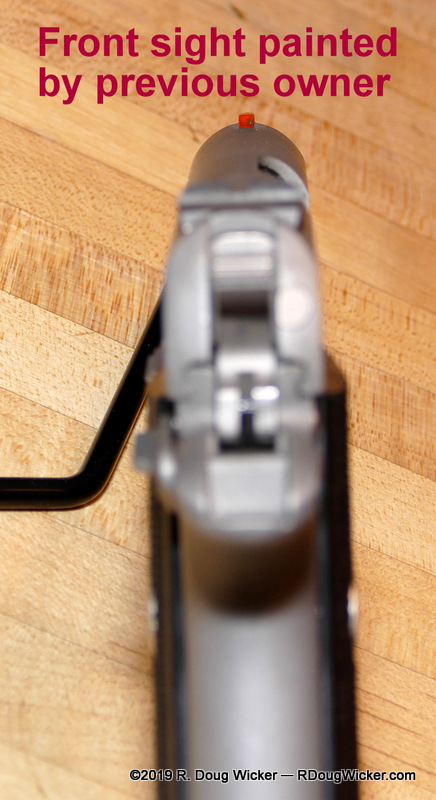
Mustang Plus II — Front sight

Comments Off on Fun Firearm Friday — Colt MK IV/Series’ 80 Mustang Plus II

Filed under Firearms, Fun Firearm Friday, R. Doug Wicker

Ruger (original) Police Carbine PC9 — A First Look


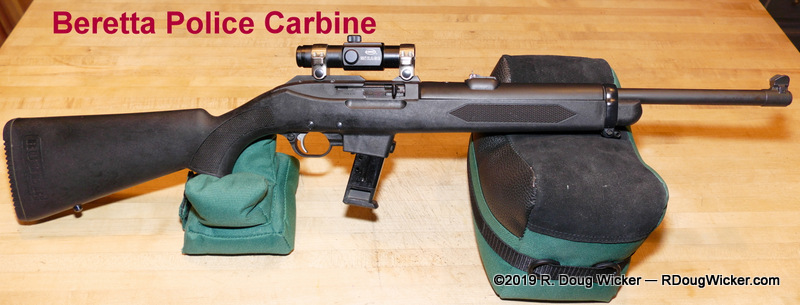
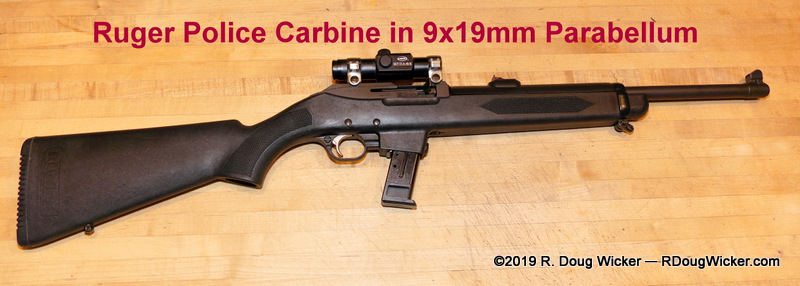
Ruger Police Carbine from 1996

As many readers of my firearms articles may have surmised by now, I’m an unapologetic fan of pistol-caliber carbines. Why pistol calibers in a rifle? Because it just makes sense for a whole host of reasons, unless perhaps you’re a hunter of large game. A 9mm carbine, such as the Beretta CX4 Storm, is a perfect longer-range compliment to a handgun chambered for the same round. If your carbine accepts the same magazines as your handgun, such as a CX4 paired with a Beretta 92, so much the better.

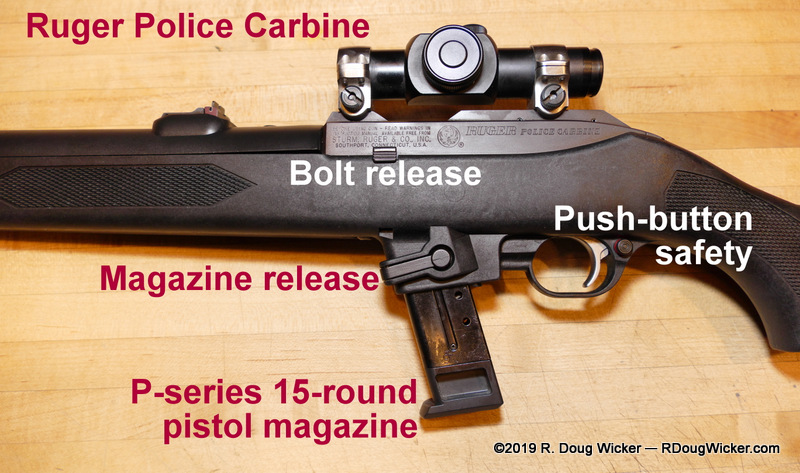
Ruger Police Carbine — 15-round P-series magazine

Back in 1996, Ruger tried to convince U.S. police departments to do just that. Ruger came out with two Police Carbines based on a scaled-up, beefed-up version of the blowback design used in their bestselling .22 LR 10/22 rifle line. The Ruger PC9 Police Carbine was chambered in 9mm, and accepted magazines from their Ruger P89, P93, P94, and P95 semiautomatic handguns. The .40 SW PC4 used magazines compatible with Ruger’s P91 and P944D handguns. The idea was that an officer would have a Ruger P-Series pistol strapped to his hip, and have in the trunk of the patrol car a fully compatible carbine using both the same ammunition and magazines as did the sidearm. The advantage of the Police Carbine being a longer effective range (100+ yards/90+ meters), greater accuracy, and marginally more power because of the longer barrel.

Ruger Police Carbine

That was not a new concept back in 1996, by the way. The American cowboy realized the advantages of owning a rifle chambered for the same round as his pistol shortly after the Civil War. The famous Winchester Models 1866, 1873, and 1892 were all chambered in popular handgun cartridges of the era. The most famous of these pairings would be a Winchester Model 1873 (“The Rifle that Won the West) and an 1873 Colt Peacemaker/Single Action Army (“The Gun that Won the West”) both chambered in .44-40 WCF (Winchester Center Fire).

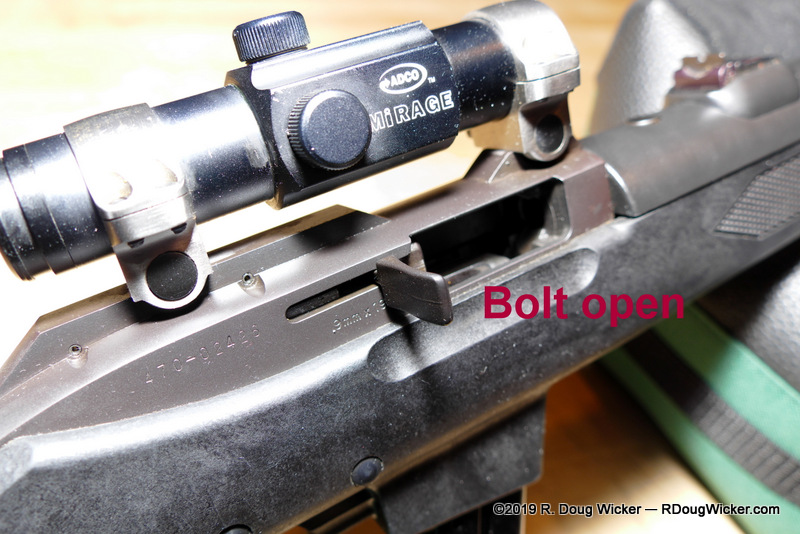
Ruger Police Carbine — Controls

Alas, the Ruger Police Carbine came out about the same time that police departments started fielding AR-style rifles, and the Ruger P-Series was by then fighting obsolescence from lighter, cheaper, polymer-framed handguns with similar, or in some cases even greater, capacity magazines. The Police Carbine was also weighty, coming in at around seven pounds; and had a heavy trigger that, in the hands of someone who didn’t train a lot, tended to negate the accuracy benefits normally associated with a rifle. The PC9 and PC4 designs were also hamstrung by what some considered a tactically inferior traditional rifle stock rather than the more modern pistol-style grip of the AR.

Ruger Police Carbine

At the same time, the Ruger Police Carbine was considered over-engineered for the civilian market. It’s a very robust design, for sure. The Police Carbine was nearly sturdy as a block of granite, and about as reliable as grandma in the store candy aisle. That engineering comes at a cost, and the Ruger simply could not compete with cheaper pistol caliber carbines coming to market shortly after it debuted, such as the Kel-Tec Sub-2000, or the Hi-Point 995TS at nearly one-third the cost (2002 prices: Hi-Point $199 vs. $575 for the Ruger).

Ruger Police Carbine

So, the Ruger Police Carbine died in 2006, just ten short years after its introduction. It would be greatly missed, however, and prices for used examples started shooting upwards.

Ruger Police Carbine — 9mm PC9 version

The PC9 is back as of late 2017, but in a slightly different form and at a cheaper price. Magazines are now paired to the Ruger Series-9 and SR-Series pistols, and the box includes an interchangeable magazine well that allows the new PC9 to accept Glock magazines if you prefer. It’s also a takedown design that comes with a Picatinny rail.

Ruger Police Carbine

Where does that leave the original Ruger Police Carbine? It’s still a much sought-after firearm, but prices have probably stabilized, or perhaps even fallen slightly since the reintroduction of the PC9 (there is no new PC4, as the .40 SW is dying a not-so-slow death). If you can find an original Ruger Police Carbine for under $800, that’s probably a good deal. But I would expect to pay perhaps a couple hundred more for a very nice example. Throw in the original box and owner’s manual and you’re probably north of $1,200, but I’m no expert on that.

Ruger Police Carbine

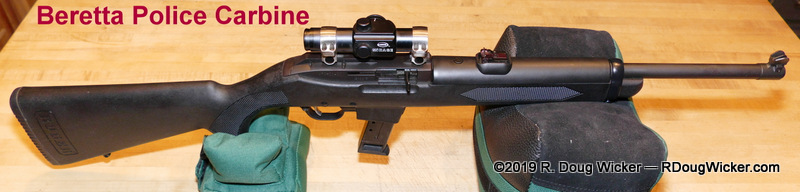
So, it was a pleasant surprise when, during a recent visit to my second favorite local gun store (Sportsman’s Elite, managed by my good friend Henry Bone), I found an excellent condition original 9mm Ruger Police Carbine which included a cheap but serviceable red dot held by Ruger scope rings mounted to the receiver, for less than half what I would consider a good deal. No box, no manual, but for $350 I’m not about to quibble. Then, when I ran the serial number, I discovered that this was a first-year production example, which pleased me even more. Assuming the serial numbers are sequential with no skips, this particular PC9 was the 2,225th carbine off the production line out of a first-year run of 4,189.

Ruger Police Carbine — First year production example

Inspection of the Ruger Police Carbine reveals that it is indeed the robust, slightly heavy design many have noted before me. With an empty magazine and the mounted red dot and rings, I measured 7.5 pounds/3.4 kilograms. But the real surprise to me was the trigger. It was not nearly as bad as I’d been led to believe reading the contemporaneous reviews. Take-up is about .2 inches/5mm with no creep afterward. I estimate the trigger weight to be less than six pounds, but not much less, with a crisp break at the end. Trigger reset is less that a sixteenth of an inch/<2mm, with both audible and positive tactile cues. I’ll know more when I hit the range with it and compare it to the Beretta CX4, but the trigger seems to me more than adequate for the intended purpose — a pistol caliber carbine that extends the range of a standard 9mm round out to 100 yards/90 meters or so with relative ease.

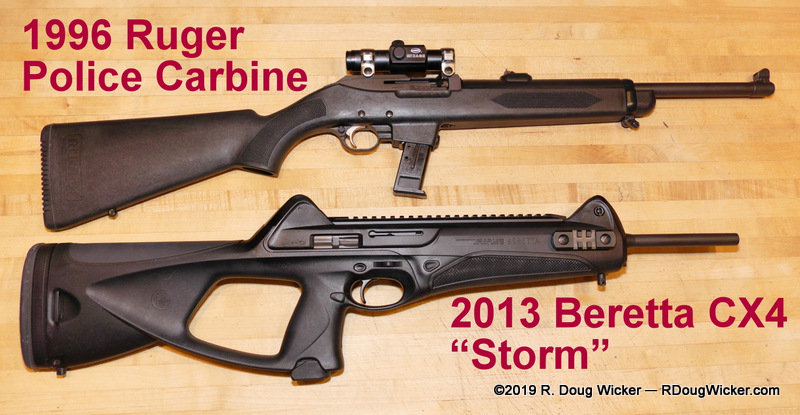
Ruger Police Carbine and Beretta CX4 Carbine

I’m also confident that the nearly 1 ½-pound additional heft will give the PC9 an even milder kick than that of the already mild Beretta CX4.

Red dot sight

At any rate, and without the benefit of having actually fired the Ruger Police Carbine, I rate this rifle a winner in quality. It appears to indeed be every bit as over-engineered as its civilian-market critics claim, which to me is not a bad thing at all. In firearms, I’m a believer that you truly get what you’re willing to pay for. The trigger, while not match-grade by any stretch, seems completely adequate to the intended purpose of the design. I can see this as a very good urban home-to-backwoods cabin defense weapon, as well as a fun and affordable range plinker using relatively inexpensive 9mm ammunition. But the Ruger’s almost five additional inches of length over the CX4 would, in my view, make it somewhat less maneuverable in the close quarters of a home.

Ruger Police Carbine — Front sight

My only regret? I would have preferred an original PC9GR, which substituted ghost ring rear sight for the standard Patridge open sight of the PC9/PC4.

Ruger Police Carbine — Adjustable Patridge rear sight

Comments Off on Ruger (original) Police Carbine PC9 — A First Look

Filed under Firearms, R. Doug Wicker