Tag Archives: firearm review

Firearms Review — First look at the new Inland M1 Carbine


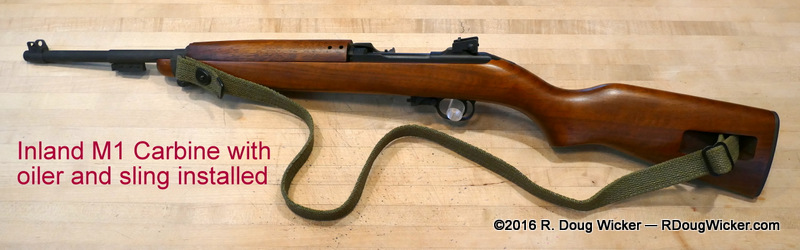
Inland M1 Carbine with oiler and sling (both sent free after registration)

Inland M1 Carbine with oiler and sling (both sent free after registration)

Today I’m going to present a first look at the new Inland M1 Carbine, or, as it was known in Army-speak — United States Carbine, Caliber .30, M1.  Inland is a storied name in the M1 Carbine story.  The Inland division of General Motors were the primary source for the M1 Carbine, making 2,362,097 of the 5,510,000 produced.  Inland were also the sole source for the M1A1 paratrooper model with folding metal stock, producing 140,591 copies.  The remaining versions of the M1 were made by Winchester (which developed the M1 Carbine), Underwood Elliot-Fisher (the typewriter company), the Saginaw Steering division of General Motors, IBM, Quality Hardware, National Postal Meter, and even Rock-Ola (yeah . . . the jukebox maker!).  Irwin-Pedersen made around 3,500 copies, but none were accepted by the War Department because of quality control issues.

Inland M1 Carbine with oiler and sling (both sent free after registration)

Inland M1 Carbine with oiler and sling (both sent free after registration)

Later full-automatic versions of the M1 Carbine were also made — the M2 Carbine (early 1945) and the M3 with infrared night scope — but all use the same rotating bolt and short-stroke piston design of the original M1 Carbine.

p1050887

U.S. Army Ordnance Corps cartouche

So, Inland Manufacturing is back in business and once again making U.S.-specification M1 Carbines?  Well, not so fast.  This Inland is not the GM division of old, but rather a new incarnation founded in 2013.  The original Inland merged with Delphi Automotive Systems back in 1989, and both were spun off from GM as a single independent company a decade later.  Bad news?  Not really.  This Inland’s iteration of the M1 Carbine remains so true to the original that the parts . . . all the parts . . . are fully interchangeable with the original.  And the oiler you see below is Army surplus.  That surplus oiler and a sling ship out to the customer at no charge when Inland Mfg. receive your registration form.  Yes, mine came with oil still in it, and I had to clean it off before installing it into the stock.  Things don’t get much more authentic than that.
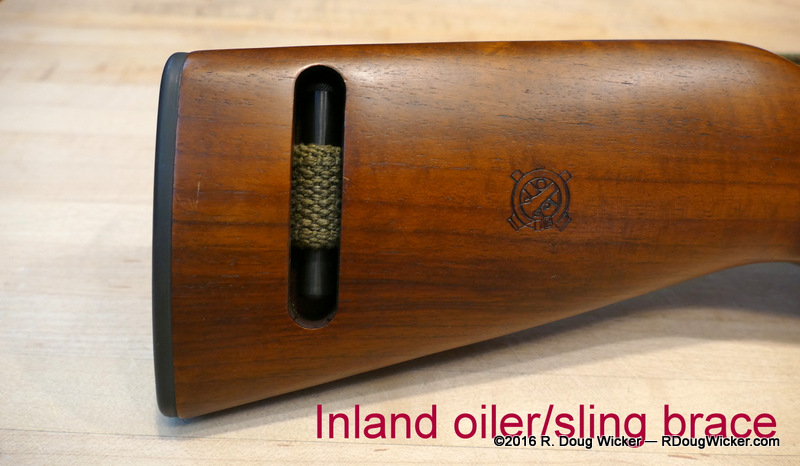
Inland M1 Carbine with oiler and sling (both sent free after registration)

Inland M1 Carbine with oiler and sling (both sent free after registration)

The version you see here is Inland’s 1945 model with a Type 3 barrel band that includes a bayonet lug mounted onto an 18-inch/45.7-centimeter barrel.  The 1945 also comes with one 15-round magazine (Really?  Just one, Inland?  Isn’t that being just a bit on the cheap side?).  The 1944 model comes with a Type 2 barrel band and one 10-round magazine to make it compliant in those states that believe only body guards protecting politicians should have access to “high-capacity” magazines (see: The Myths Driving the Magazine Capacity Debate — and How They Get You Killed), and that bayonets somehow present a clear and present danger to the public.

Inland 1944 M1 Carbine with 10-round magazine and Type-2 barrel band absent the bayonet lug

Inland 1944 M1 Carbine with 10-round magazine, an 18-inch/45.7-centimeter barrel and Type-2 barrel band absent the bayonet lug

Inland also make a paratrooper M1A1 version;

Inland M1A1 Paratrooper Carbine

Inland M1A1 Paratrooper Carbine with an 18-inch/45.7-centimeter barrel

as well as aJungle Carbine” with a 16.25-inch/41.3-centimeter barrel and flash hider;

Inland M1 Jungle Carbine with a 16-inch/40.6-centimeter barrel and a flash hider

Inland M1 Jungle Carbine with flash suppressor

a pistol version calledThe Advisor” (patterned after a model used by U.S. advisors in Vietnam);

Vietnam-era M1 Advisor pistol with 12-inch/30.5-centimeter barrel and flash hider

Vietnam-era Inland M1 Advisor pistol with a 12-inch/30.5-centimeter barrel and flash suppressor

and even a modernizedScout” version that comes with black polymer-and-textured wood stock, flash suppressor on a threaded barrel, and an upper handguard made of anodized aluminum and featuring a Picatinny rail for mounting a scope or other accessories.

Modernized Inland M1 Scout Carbine

Modernized Inland M1 Scout Carbine with 16.25-inch/41.3-centimeter barrel, anodized aluminum Picatinny rail, and flash suppressor

Attention to detail is the name of the game with Inland, clear down to a duplication of the stain used on the original Inland carbines.  On Friday I’ll be doing a side-by-side comparison with an inferior copy from the now defunct Universal Firearms.  Universal started out using surplus USGI parts, but as those items dried up they started making non-specification versions and cut some serious corners.

Inland M1 Carbine with oiler and sling (both sent free after registration)

Inland M1 Carbine with oiler and sling (both sent free after registration)

Inland M1 Carbine with oiler and sling (both sent free after registration)

Inland M1 Carbine with oiler and sling (both sent free after registration)

Let’s take a look at the Inland disassembled.  As with the original M1 Carbine, disassembly begins by loosening the screw below the barrel band, sliding the barrel band/bayonet lug forward, and then emoving the upper handguard.  The barrel band with bayonet lug is permanently affixed to the barrel.  The whole barrel assembly, and receiver and trigger groups lift out of the stock as a unit.

Taking apart the M1 Carbine

Taking apart the M1 Carbine

Next comes the removal of the recoil spring, which is easily accomplished by slightly compressing the spring and pulling it away from the housing containing the short-stroke piston.
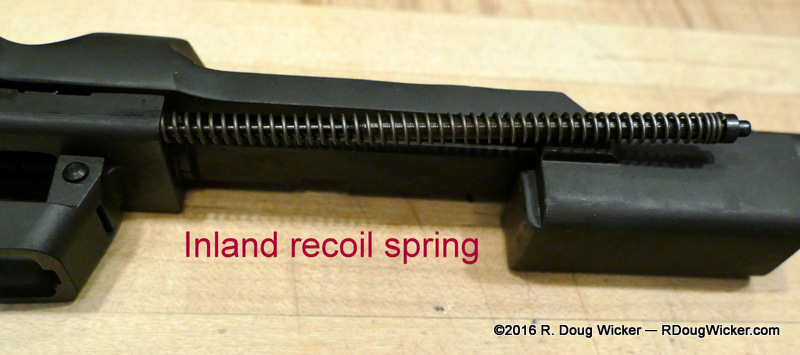
Recoil spring removed from the piston housing

Recoil spring removed from the piston housing

After that you punch out the pin holding in place the trigger group.

p1050902

Trigger group assembly and retaining pin

After the trigger group is removed from the receiver the slide can now be dismounted.
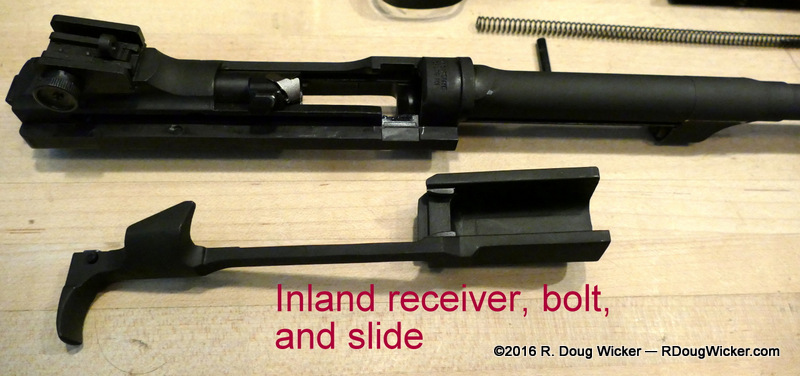
Slide removed from receiver, leaving the bolt in place

Slide removed from receiver, leaving the bolt in place

Inland disassembled

Inland disassembled

Good luck getting it back together.  Just kidding.  The most difficult reassembly task for me was getting the slide mounted back into the receiver while mating it to the rotating bolt.  But some detailed online tutorials eventually solved that predicament.  After that putting everything back into place was a snap.

Now would be a good time to explain how this marvelous piece of engineering works, so let’s take a look once again at the actual receive group removed from the carbine (see below).  As the .30-caliber carbine bullet travels down the barrel it passes a small hole (port) above the piston housing.  Pressurized gas flows down this port and into a small piston that then moves forcefully back a short distance, impacting the slide with sufficient force to overcome the tension of the recoil spring.  This cycles the slide back.
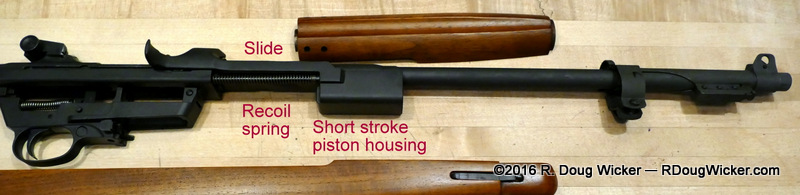
Inland receiver, slide, piston housing, and recoil spring

Inland receiver, slide, piston housing, and recoil spring

Below is an image of a Universal M1 Carbine receiver that I’m using here to show what you cannot see on the Inland.  The Universal has a slotted slide that engages the bolt lug of the rotating bolt, which is also how the Inland operates hidden from view behind a solid slide.  Until the slide goes back, the bolt of the weapon is securely locked in place because of it’s orientation.  As the slide travels rearward it rotates the bolt by engaging the bolt lug.  This rotation unlocks the bolt, allowing it to travel back to extract the spent cartridge, which is then ejected from the weapon.  The recoil spring then takes over, moving the slide forward taking the bolt with it.  The bolt strips the next round from the top of the magazine, chambers the round, and then rotates back into the locked position for the next firing.
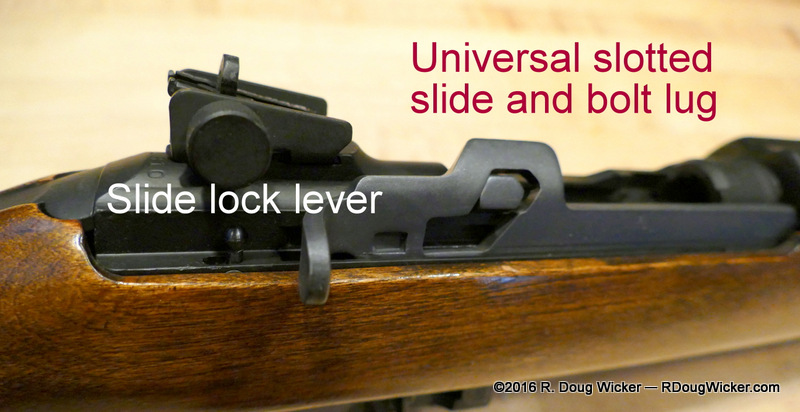
Rotating bolt, bolt lug, and slotted slide from a Universal M1 Carbine

Rotating bolt, bolt lug, and slotted slide from a Universal M1 Carbine

I hope I made that all clear as mud.

Now for the specifics on the Inland 1945 M1 .30 Carbine.  MSRP for the 1945 version is $1,079, but if you shop around you can snag one for under a grand.  Barrel length is 18 inches/46.7 centimeters.  The rifle is incredibly compact and extremely light weight, coming in at just under 36 inches/91.5 centimeters in length and weighing a feather-light 5 pounds 3 ounces/2.35 kilograms.  This weapon was, after all, designed to replace the M1911 pistol for officers, tank crews, and rear echelon troops, giving them a compact yet powerful alternative to a handgun.

For those wondering about the ballistics, the .30 carbine bullet weighs 110 grains/7.13 grams, travels at just under 2,000 feet/610 meters per second, and generates 964 foot-pounds/1,307 joules at the muzzle.  Energy-wise that puts the .30 carbine round on par with a .357 Magnum out of the same length barrel, and even exceeds the energy from a .44 Magnum round coming out of the six-inch/15.24-centimeter barrel of a typical .44 Magnum handgun (although out of an 18-inch barrel the .44 Magnum easily wins over both).

See you Friday for a comparison between the Inland and a 3rd generation Universal Firearms M1 Carbine.

Comments Off on Firearms Review — First look at the new Inland M1 Carbine

Filed under Firearms, R. Doug Wicker

Six Shooter Week — Ruger Single-Six Convertible


Ruger Single-Six Convertible Talo Distributor Exclusive

Ruger Single-Six Convertible Talo Distributor Exclusive

I’m not much into distributor exclusives.  There is not much reason in my view to pay extra for a weapon you simply don’t want to shoot and which may not hold much collector value in the long run.  This Ruger Single-Six Convertible Talo Distributor Exclusive appears to be the exception.  It was just too beautiful a piece to decline.

Ruger Single-Six Convertible case

Ruger Single-Six Convertible case

But this isn’t the only Single-Six you’re going to see today.  Despite it’s exclusivity I had every intention of shooting this Talo edition.  Let’s face it, you can’t really hurt stainless all that much anyway, so why not?  But you know Ursula.  “It’s too pretty to shoot.”  “You shouldn’t shoot that one.”  “Please don’t shoot that gorgeous pistol.”  And so it goes.

Engraved .22LR cylinder

Engraved .22LR cylinder

So, a mere week later I stumbled across yet another Ruger Single-Six Convertible.  This one was in very good condition — the barrel even more so.  It had wear, but honest wear.  It had both cylinders, but not box or manual.  It did, however, have a nice leather holster with obvious wear.  But what sealed the deal was the price — $150.  Ursula insisted.  I relented.  The Talo Exclusive will remain unfired.  The Single-Six below will take its place at the range:

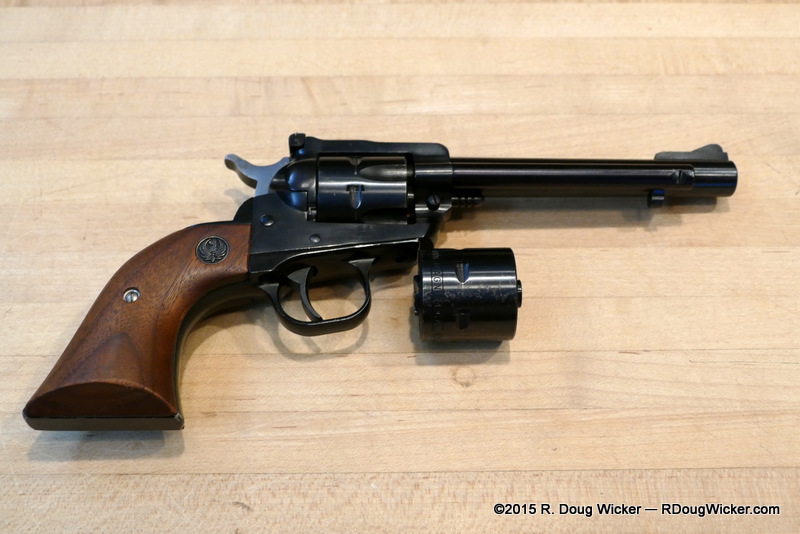
Ruger Single-Six Convertible from 1976

Ruger Single-Six Convertible from 1976

I had already disassembled the used Single-Six at the store and did a careful examination, including checking the barrel for wear.  On getting it home I researched the serial number.  It’s a “Pre-Warning” (meaning no “Careful or you’ll shoot your eye out, kid” stamp on the barrel) “New” (meaning it has the safer transfer bar system) Single-Six manufactured in 1976.  It looks to be in remarkable shape for a 39-year-old weapon that was obviously carried on hikes and perhaps camping.

Used holster came with used Single-Six

Used holster came with used Single-Six

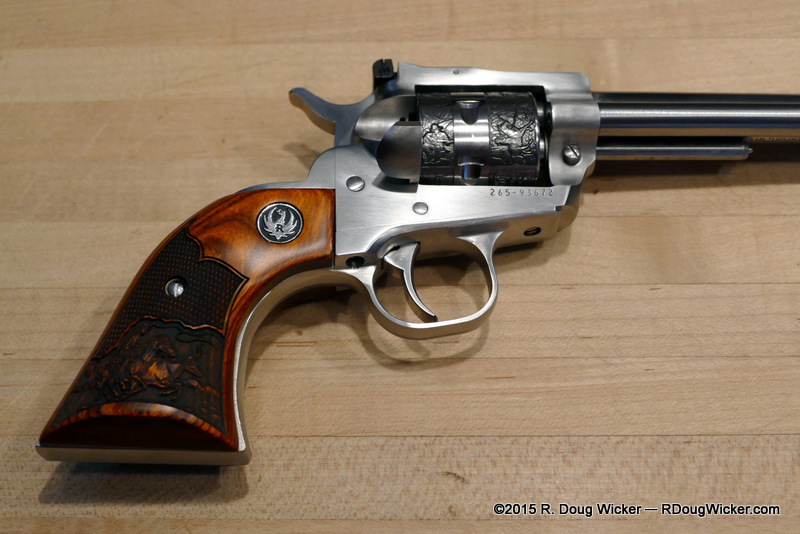
More on the old Single-Six later.  Let’s get back to the Talo Exclusive.  The model number for this particular exclusive is 0676, and Talo has christened it the Single-Six Cowboy design.  It’s easy to see why.  I’ll save the details of the multiple scenes engraved on the cylinder for this week’s Fun Photo Friday, but here is a taste of both that engraving and the engraving on the finely crafted wood grips:

Engraved .22LR cylinder

Engraved .22LR cylinder

Highly detailed engraved grips

Highly detailed engraved grips

I cannot find in any literature where this version had a trigger job coming out of the Ruger Custom Shop, but I can tell you that it certainly feels as though it has.  Both Single-Sixes have great single-action triggers, but the Talo Exclusive is much lighter in feel.  It doesn’t beat the Uberti El Patrón from Monday’s review, but it certainly outclasses the Colt Mk. IV Series 70.  I would estimate the trigger pull at around 3.5 pounds, with no slack take-up and about a millimeter of trigger creep.  In other words very, very good.  The Single-Six from 1976 trigger differs only in a tad less creep and in having a slightly heavier pull, which I would guess is about a pound more.  Still an excellent trigger.

Ruger Single-Six with .22LR and .22WMRF cylinders

Ruger Single-Six with .22LR and .22WMRF cylinders

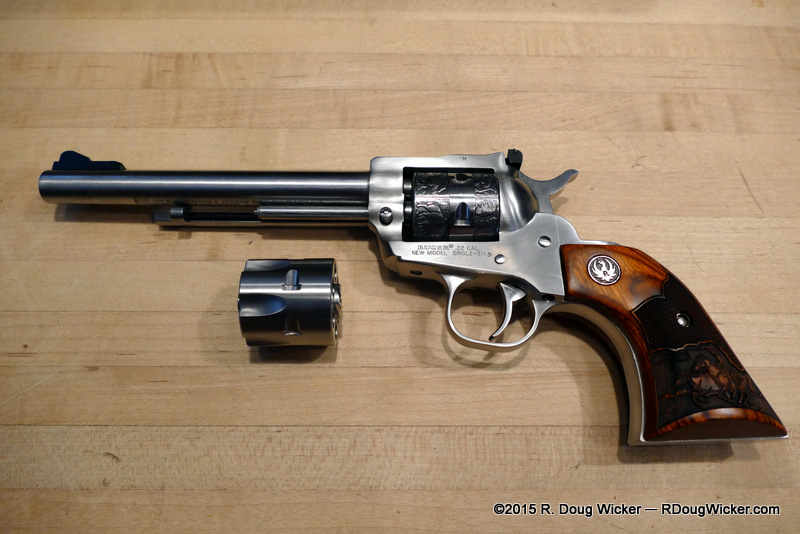
The “Convertible” in the name “Single-Six Convertible” refers to the fact that these weapons come with two cylinders.  One is chambered in .22LR and the other is for use with .22 Magnum, a.k.a., .22WMR and .22WMRF for Winchester Magnum Rim Fire.

Two Single-Sixes each chambered in two rounds — .22LR and .22WMRF

Two Single-Sixes each chambered in two rounds — .22LR and .22WMRF

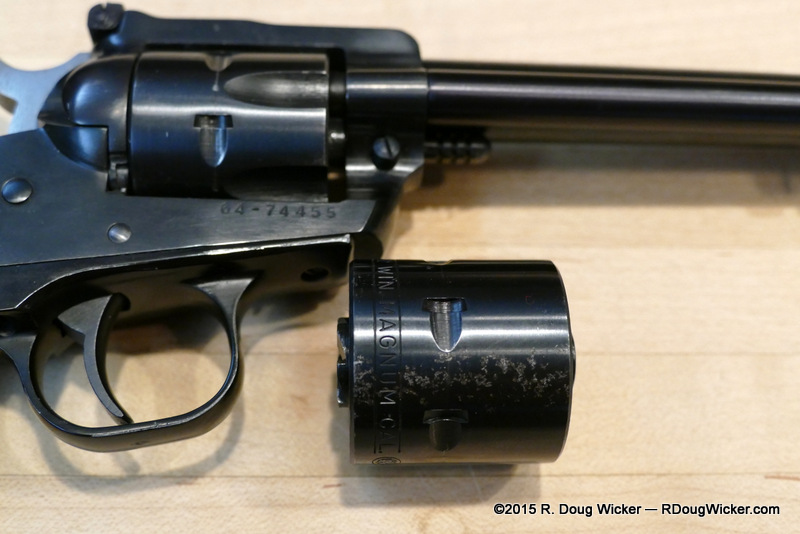
But be careful.  Don’t confuse the two cylinders because .22LR will fit into the .22WMRF cylinder, but the wider chambers will allow the .22LR casing to split and possible damage your weapon.  Ruger’s instruction manual advises that the .22LR cylinder is fluted and that the .22WMRF cylinder is smooth and marked “.22 WIN.MAGNUM CAL.”  While this is true with the standard Single-Six, it is not with the Talo Exclusive.  The non-fluted cylinder on the Talo is for .22LR, and the fluted cylinder houses .22WMRF.  Additionally, the fluted cylinder is not prominently stamped along the outside with “.22 WIN.MAGNUM CAL.” as is the standard version.  Rather, there is an inconspicuous and easily missed single letter “M” stamped on the loading side of the fluted cylinder.

Ruger Single-Six with .22LR and .22WMRF cylinders

Ruger Single-Six with .22LR and .22WMRF cylinders

I can understand Ruger’s reluctance to author and print a new instruction manual for a one-off exclusive, but it is inexcusable in my book that they didn’t at least insert a single sheet warning that the fluted and smooth cylinders have reverse functions, and the fluted cylinder is insufficiently marked.  Bad move, Ruger.  Take two safety demerits.

Note the correct ".22 WIN MAGNUM CAL." stamp in the smooth cylinder

Note the correct “.22 WIN MAGNUM CAL.” stamp in the smooth cylinder

Let’s take a look at what comes in the Ruger Single-Six case.  You get a fired casing in envelope, a firearm lock, a yellow cylinder disabling flag (you must remove the cylinder to remove this disable device, and it does come installed), two cylinders for .22LR and .22WMRF (the engraved, non-fluted .22LR cylinder is comes installed); a “Thank You for Shopping Ruger” 20% off for accessories card, a “Visit SHOPRUGER.COM” card, an “old” model Ruger recall card, and an instruction manual.

Ruger Single-Six Convertible — what's in the case

Ruger Single-Six Convertible — what’s in the case

The Single-Six itself is a handsome weapon with excellent fit and finish, adjustable high-profile target sights and finely detailed engraving on the beautifully stained Altamont wood grips.  Inserted into the Altamont grips on both sides is the Sturm Ruger crest.

On Fun Photo Friday I’ll have a gallery of all three of this week’s featured firearms, and you’ll see closeups of the cylinder engraving on the Talo Exclusive featured here.  Until then, these should tide you over:

3 Comments

Filed under Firearms, R. Doug Wicker

Six Shooter Week — Uberti 1873 El Patrón Competition


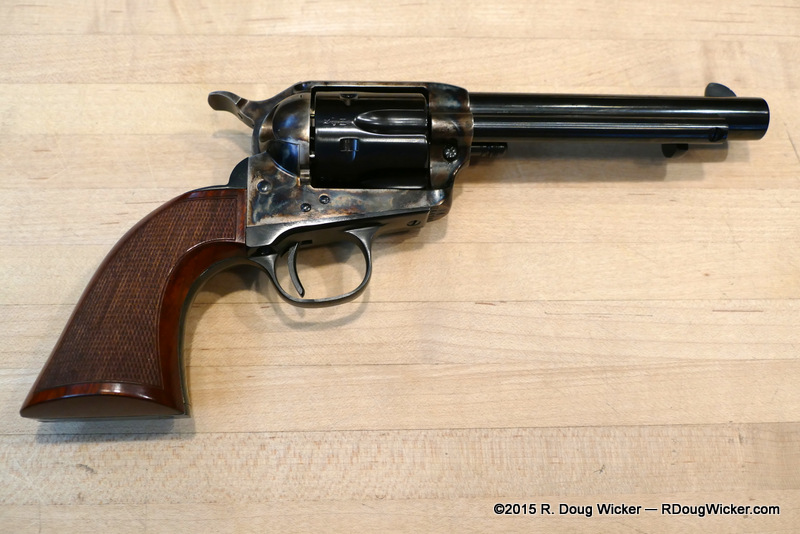
El Patrón — "The Boss"

El Patrón — “The Boss”

Regular readers of my firearms posts may have detected a slight deviation from my usual affinity toward semiautomatics.  Lately I’ve come to appreciate the firearms that tamed the Wild, Wild West, particularly Winchester lever actions.  Here are a rare pair of consecutively numbered, “Centennial Edition” Winchester Model 1894s, unfired and chambered in .30-30 and .44 Magnum.  (see:  Winchester Rifles — Part 1 and Winchester Rifles — Part 2)

Centennial Edition Winchester 1894 rifles — .30-30 and .44 Magnum

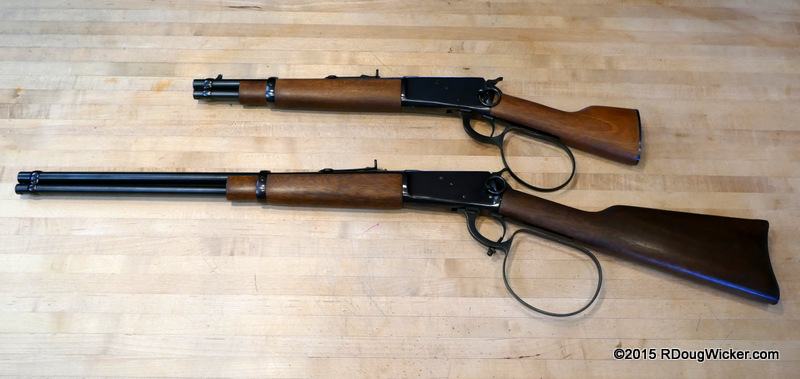
I also have a childhood fascination with the old black-and-white television westerns of the 1950s.  In those shows, the Winchester Model 1892 often substituted for the more era-appropriate Model 1873 because new 1873 weren’t being made (as they are now) and existing ones were rather pricey.  Two favorites from the Golden Age of Television were The Rifleman and Wanted: Dead or Alive.  (see:  Firearms — Television Westerns from the 1950s for more on the weapons pictured below)

Mare’s Leg (top) — Pistol version of the M1892; Rifleman’s Rifle — Modified M1892 for trick handling and rapid fire

Two weapons bore the title of “The Gun that Won the West”.  The first was the aforementioned Winchester Model 1873.  The second was a pistol that coincidentally also made its debut in the year 1873 — the famous Colt Model 1873.  The Colt M1873 also went by several other names depending on configuration and caliber — two of the more common versions being the Single Action Army (.45 “Long” Colt), the Frontier Six Shooter (.44-40), and “The Peacemaker”.  Today, most people just refer to the Colt M1873 and its clones as Peacemakers, 1873s, or the SAA, short for Single Action Army.

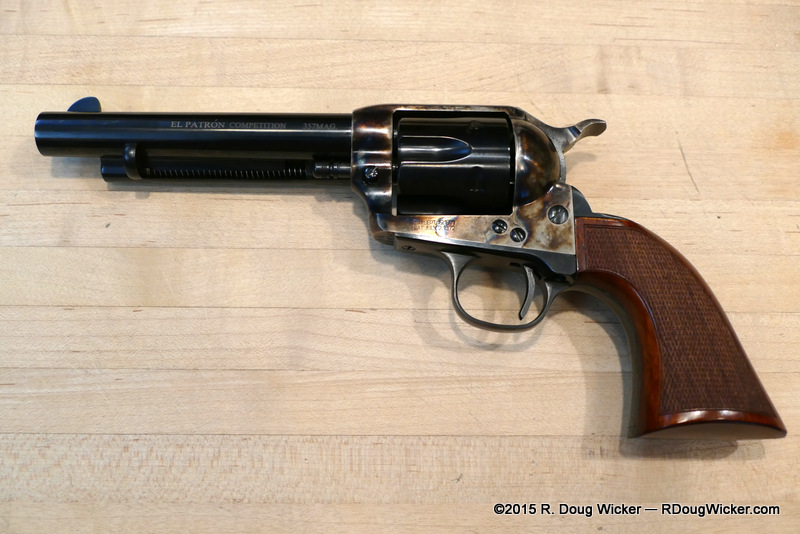
El Patrón — "The Boss"

El Patrón — “The Boss”

The M1873 you are looking at today is from Italian manufacturer Uberti, a maker of replica firearms that supplies re-branded Old West rifles and handguns to Benelli (Uberti’s direct owner), Beretta (owner of Benelli), Cimarron Firearms Company, and Taylor’s and Company.

Uberti Single Action Army box

Uberti Single Action Army box

Uberti’s El Patrón box comes with the following goodies —Instruction Manual, Instruction (be careful or you’ll shoot your eye out, kid) Sheet, Cylinder Lock, and, of course, an El Patrón Competition six-shooter.

Uberti Single Action Army — What's inside the box

Uberti Single Action Army — What’s inside the box

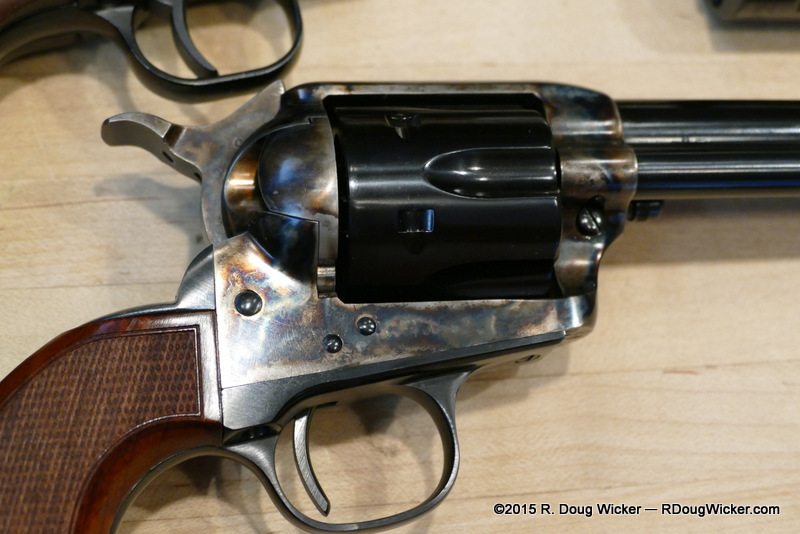
This particular Uberti is a special factory-tuned Cattleman “El Patrón Competition” model with lowered hammer for easier one-handed cocking and a very light trigger for competition shooting.  Other features include a blued cylinder, case-hardened frame, steel trigger guard and backstrap, and nicely textured walnut grips.  A stainless steel version is also available.  But, really?  This is an Old West firearm.  Stainless just wouldn’t look right.

Blued cylinder set in a case-hardened frame

Blued cylinder set in a case-hardened frame

Stamped into the barrel is the model name and caliber, in this case .357 Magnum.  That means this weapon will also handle the lower-powered, cheaper to fire .38 Special without a hitch.

Uberti El Patrón Competition barrel markings

Uberti El Patrón Competition barrel markings

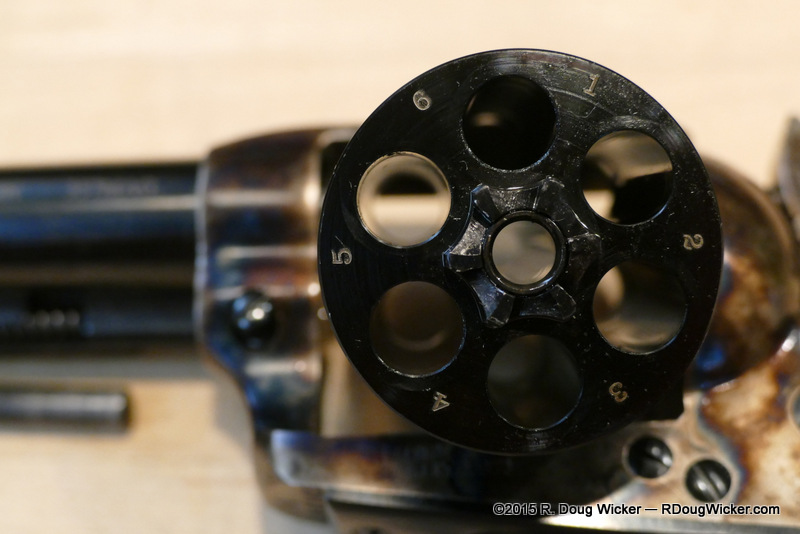
I find the numbered cylinder an interesting and useful touch.  Since this is an almost exact replica of the original Colt, it is imperative that you leave the hammer down on an empty chamber for safety, and numbering the chambers makes that a snap.

Numbered Chambers — a nice touch

Numbered Chambers — a nice touch

As anyone with experience will tell you, the proper way to accomplish this with the 1873 is to pull the hammer back to the half-cock position (don’t confuse that with a “safe” position; it isn’t), open the loading gate, rotate the cylinder to chamber 1, and load a bullet.  Now, skip chamber 6, then load in order chambers 5, 4, 3, and 2.  Loaded chamber five is now beneath the half-cocked hammer, and empty chamber six is the next in line.  Close the loading gate and cock the hammer to the firing position.  This will rotate empty chamber six into firing position.  With your thumb on the hammer, pull the trigger until the sear trips and then gently ride the hammer completely down against the frame.  Don’t release the trigger prematurely or the hammer will stop at the half-cock position.

Chamber #1 ready to load

Chamber #1 ready to load

It is possible to load five chambers in sequence, close the gate, and then carefully pull the trigger while gently pulling back the hammer until the hammer disengages from the half-cock position, then lower hammer onto the empty chamber.  But the problem with this method is that you then have to wiggle the cylinder until it locks up with the cylinder bolt, which was disengaged when the hammer was previously in the half-cocked position.  Rotating the cylinder and hopefully not inadvertently placing a loaded chamber beneath the hammer just doesn’t work for me.  I simply cannot recommend this method.

Loading gate, blued cylinder, and case-hardened frame

Loading gate, blued cylinder, and case-hardened frame

There is a third method that supposedly allows for safely carrying an 1873 with all six chambers loaded, but I’m certainly not going to do it.  That requires additional manipulation so that the firing pin built into the face of the hammer rests directly on the cylinder between the rims of two loaded cartridges.  Yeah . . . right.  I’m not doing it.

Case-hardened mottling

Case-hardened mottling

Disassembly is a snap.  Just pull the hammer to the half-cocked position, open the loading gate, push the spring loaded base pin latch, pull out the base pin (the long metal rod below), and remove the cylinder through the gate opening.  Reassembly is not quite as easy, at least for me.  You have to get the cylinder into just the right position before pushing the base pin latch and reinserting the base pin.  If it doesn’t all go together perfectly, the hammer cannot be pulled back beyond the half-cock position.  The trick here is to keep pushing on the base pin while wiggling the cylinder until the base pin snaps fully back into the frame.

Simple breakdown; reassembly not so much

Simple breakdown; reassembly not so much

Now for my impressions.  Bear in mind I’ve yet to fire this weapon.  That being said I can tell you that cylinder lockup is incredibly tight with barely any movement.  Both fit and finish are superb.  The Uberti emits the legendary ‘C-O-L-T’ cocking sound — that’s four distinct “clicks”, one for each letter in “Colt”, as the hammer is cocked back into firing position.  Because of the low-angle hammer and the custom Wolff springs, the Uberti is incredibly easy to thumb cock with no shifting of the hand required.  The trigger is by far the best I’ve encountered in any weapon.  There is absolutely no slack take-up, the break is clean and crisp with almost zero (less than a millimeter) creep, and the trigger weight feels to me as though it has to be well under three pounds.

Uberti Single Action Army and a Ruger Single-Six

Uberti Single Action Army and a Ruger Single-Six

So, show me favorably impressed.  The Uberti 1873 Cattleman El Patrón Competition is a solid, well-built, tight example of the classic, original Colt 1873 design.  Suggested retail is currently $669, or $799 for the blasphemous stainless model.  Calibers include .38SPL/.357 Magnum and .45 Colt, and barrel lengths come in 4.75 inches/120 mm, 5.5 inches/140mm, and a CMS (Custom Mounted Shooter) at 3.5 inches/90mm.

Now, if only Uberti would offer a Paladin Have Gun — Will Travel version with a 7.5-inch/190-millimeter “Cavalry” length.  Well, I can dream, can’t I?

1 Comment

Filed under Firearms, R. Doug Wicker