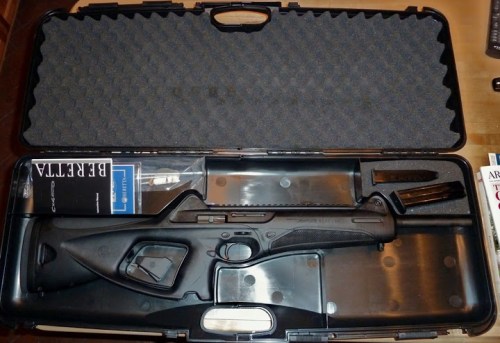
Beretta Cx4 Storm 9mm Carbine
Last week we took a look at the amazing .45 ACP FNX-45 from Belgian firearms manufacturer Fabrique Nationale d’Herstal, otherwise known as FNH or even just FN. Today we’ll look at another home defense option from Europe — Beretta’s CX4 Storm.
The Cx4 is a pistol-caliber carbine that comes with several options that make this a rather unique weapon. First is caliber choice: 9mm, .40 S&W, or .45 ACP (if you live in a country where military calibers are banned from the civilian market — Italy readily comes to mind — you can also opt for 9x21mm IMI). The second choice is a truly intriguing one; you can match your carbine’s magazine choice to your Beretta pistol.
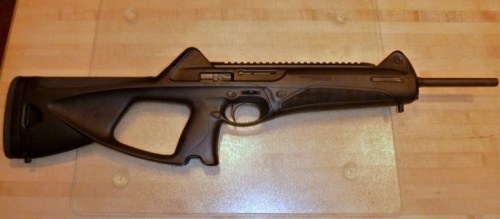
Beretta Cx4 Storm
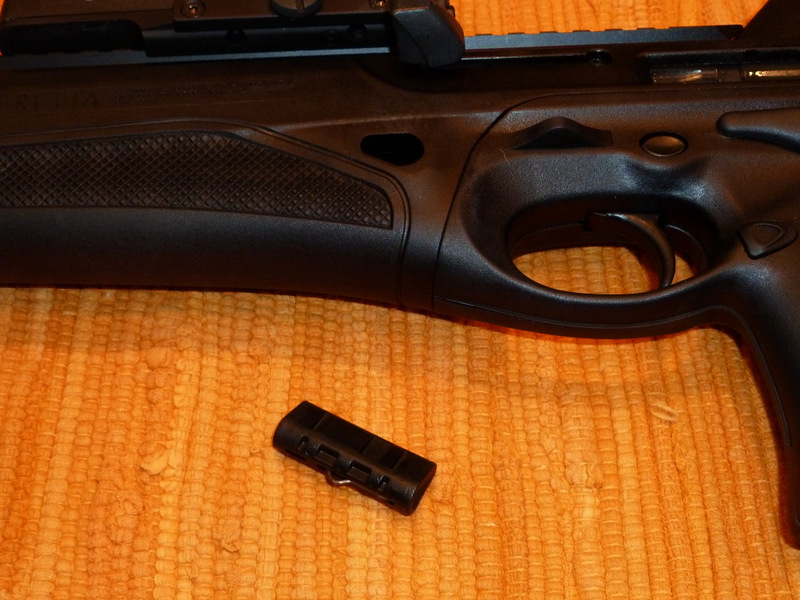
That means if you own a Beretta M9/92/96 you can get a Cx4 that accepts those same magazines, or you can purchase a magazine release button and magazine well insert that will convert your Cx4 to match your existing handgun magazines. The same goes for owners of the following Beretta pistols: Px4 Storm, Cougar 8000/8040.
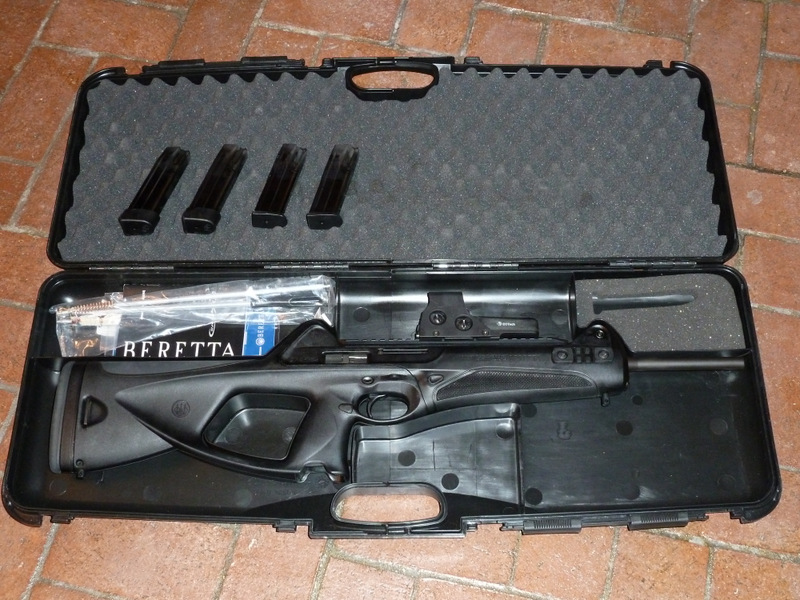
The Cx4 being reviewed today is a 9mm that came from the factory equipped to handle magazines compatible with the Px4. It came with two 17-round Px4 magazines, and I’ve since acquired two more 20-round Px4 magazines. Today’s bonus review is on the EOTech 512 laser diode holographic sight. Together these two make for a formidable defensive combination.
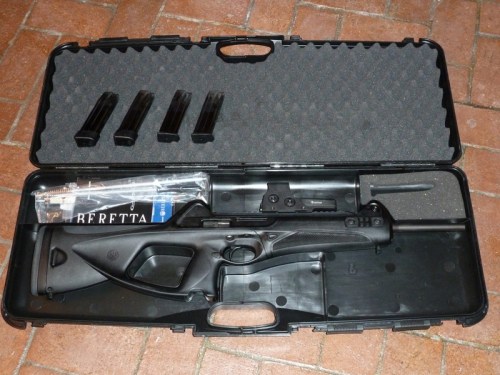
Cx4 with mounted EOTech 512 holographic sight
The Cx4 matched to Px4 magazines comes in a hard plastic carrying case with padded top lid, two 17-round Px4 magazines, instruction manual, lock, cleaning rod with attachments, full-length aluminum Picatinny rail along the top, retractable single-notch Picatinny rail that extends from the forestock directly beneath the barrel, and a two-notch Picatinny rail that can be attached to either side of the forestock. A spacer is included to extend the butt by .60 inches (15mm). Additional spacers can be purchased and up to three total can be stacked in place to extend the butt even further. A two-position aperture rear sight gives both long and short ranging options. It’s an impressive kit which, with all the rail options, allows for considerable customization — an optical sight, a laser sight, and even a tactical flashlight can all be attached just with the included hardware.

Front Picatinny rail retracted; Included side-mount rail installed on right side
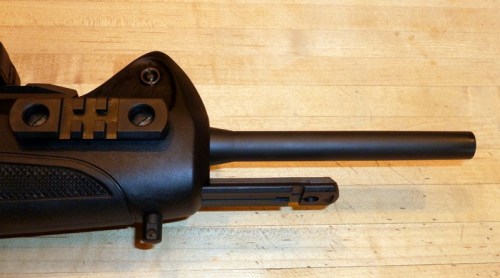
Front Picatinny rail extended and ready for a tactical light
And as if all that weren’t enough, you can take the weapon apart and reassemble it to make the Cx4 truly compatible to your needs should you be a left-handed shooter. By that I mean not only reversing the charging handle, magazine release, and manual cross-bolt safety button, I’m also referring to the extraordinary fact that you can reverse the ejection port so that spent casings are tossed to your left rather than the normal right.
But how does it shoot? First of all this is most assuredly not a hunting rifle (although I suppose it could reasonably be used for small game out to a range of perhaps 100 yards). Thus, this is not your run-of-the-mill rifle trigger. It leans toward the heavy side with more effort to trip the internal hammer than even most handguns require. That’s not a problem however when one considers the roll Beretta envisioned for this weapon when they designed it. The Cx4 is a civilian semiautomatic defense variation of Beretta’s fully automatic Mx4 Storm designed for both military and police forces.
In other words the Cx4 is derived from a weapon that was designed for close-quarters combat and room-to-room sweeping. As such I wouldn’t expect for it to have a three- or four-pound trigger as that would render the weapon much less safe for its intended use. Yes, the factory trigger parts and hammer are plastic, but so what? They work, and they work very well. Oh, sure, you can buy all metal trigger and internal hammer after-market component kits for the Cx4 that will greatly improve the trigger weight and feel, but why bother? Certainly not for accuracy, as I’ll demonstrate.
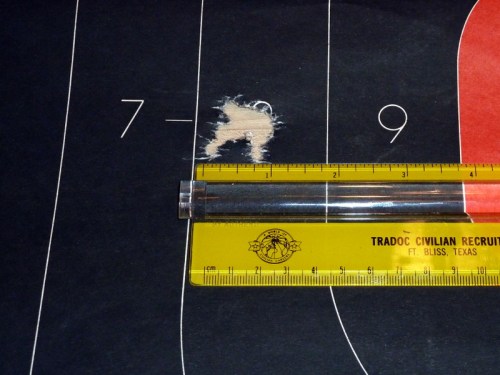
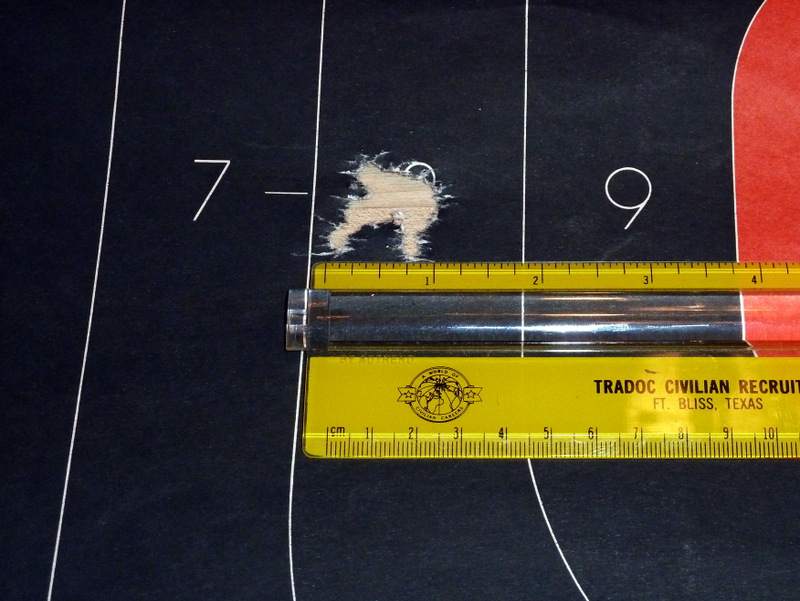
Twenty rounds went through that small hole!
The above image is a photograph of a 20-round grouping I managed with the Cx4 at a distance of about 15 yards (about 14 meters) using an EOTech 512 holographic sight (more on that sight later). You will note that after properly sighting in the EOTech I was able to place all twenty rounds inside of one ragged hole approximately one inch (2.54cm) in diameter (I was sighting in on the “8”, in case you’re wondering). All shots were made from a standing, unbraced, handheld position. I wish I could manage a grouping six times that large with any of my handguns at that range, but that’s beyond my abilities.
As one would expect from a weapon firing 9mm while weighing in at nearly 5.7 pounds (about 2.58 kilograms) recoil is exceedingly manageable. Muzzle rise is almost nonexistent, and target reacquisition is nearly immediate. In my view this characteristic alone more than negates those “heavy” trigger concerns expressed by others.
So, now you know where I’m going with this review, and it’s contrary to many of the reviews you read about the Cx4 and its reportedly “heavy” trigger. The Cx4 is more than adequate for the purpose for which it was designed — close-quarter defense in an urban environment. In other words it’s great bordering perhaps on perfect for home defense. This would also be the weapon I would want around if I were a rancher out in the boonies two hours away from the nearest sheriff substation. It’s just that versatile and that well made. Unfortunately the Beretta Cx4 Storm is also considered “bad” by Senator Dianne Feinstein (as well as Michael Bloomberg and others), and thus made her proposed list of weapons to be banned. For an explanation of the completely arbitrary nature of what it took to get on Senator Feinstein’s list and her equally arbitrary definition of “assault” weapon please refer to: Hate to Say, “I Told You So,” But . . . .
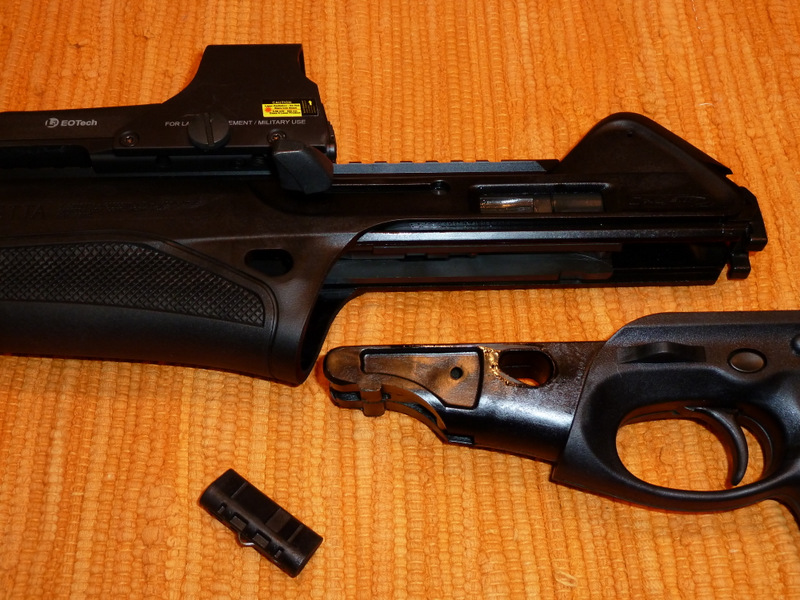
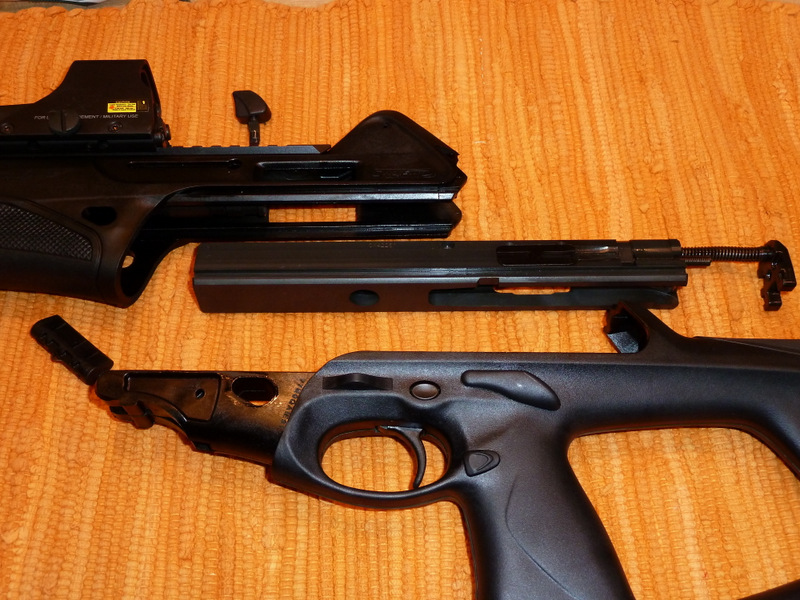
Disassembly is certainly not as easy as a modern handgun such as the FNX-45 or SIG P22(X), but it’s not bad either.

Remove the disassembly latch by pushing it out of the frame
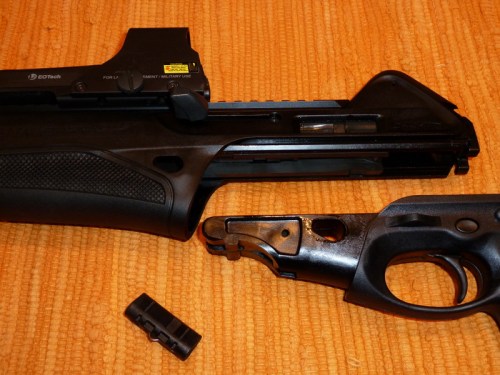
Slide the barrel and bolt assembly off the receiver
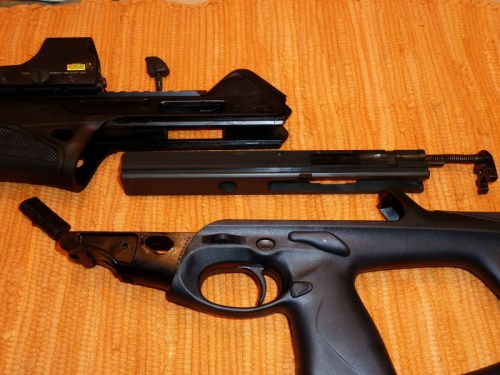
Remove the charging handle and slide out the bolt
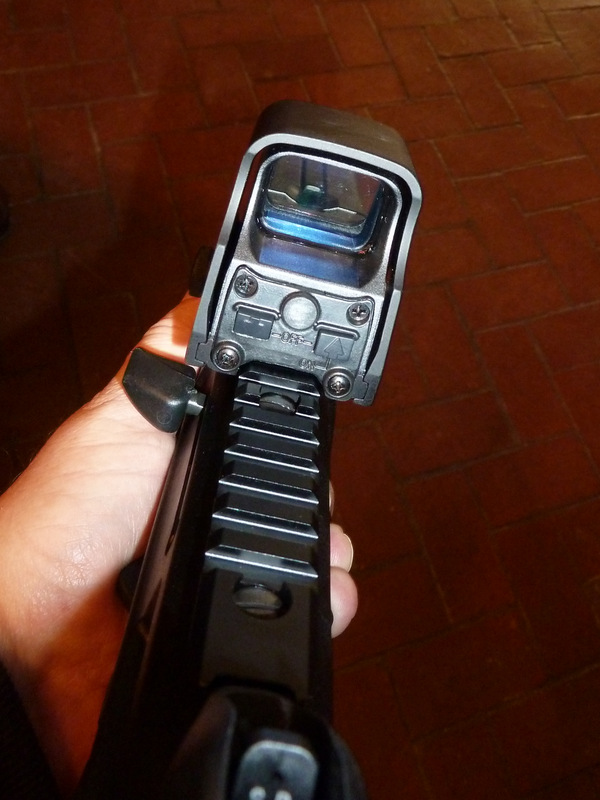
Now for a word or two about the EOTech 512 that allowed the Cx4 to achieve those impressive accuracy results. The EOTech 512 projects a laser image onto what is basically a small “Head-Up Display.” The eye relief is for all practical purposes infinite, which is great for those of us who wear glasses (note how far down I placed this particular EOTech 512 on the reviewed Cx4). It’s also perfect for both-eyes-open shooting, which is a skill you definitely want to acquire before you ever find yourself in a defensive situation.

EOTech 512 sight mounted atop the Cx4 Picatinny rail
The EOTech 512 is powered by two AA alkaline (good for 600 hours of use) or AA lithium (1,000 hours) batteries, but I’ve read that battery drain does occur when the sight is supposedly turned off so make sure you check it once a week or so, or remove the batteries altogether if storing the weapon for long periods. This is easy to do since the top-mounted battery compartment disengages from the main unit without having to remove 512 after it’s sighted. Battery check is accomplished by watching the laser reticle during activation — if it flashes when the unit is first turned on then the batteries need replacement.
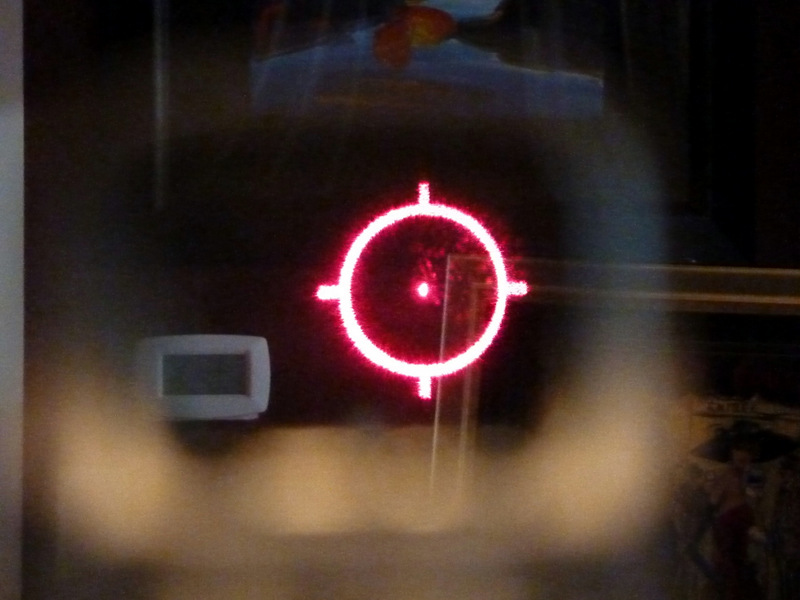
The laser reticle displays a circle that is 65 minutes-of-arc in diameter (MOA) with a 1 MOA dot in the center. That 1 MOA equates to approximately 1 inch at 100 yards — much more than the accuracy required of a defensive weapon, but only half to a quarter of the accuracy you’d want from a good, high-power hunting rifle.

What you see peering through the EOTech 512
The 512 is fully adjustable for both azimuth and elevation at a rate of 0.5 MOA per click. Brightness level range is 110,000-to-1, making the 512 adaptable for anything from the brightest sunlight to the darkest room late at night. The automatic shut-off is either eight or four hours depending on how the unit is activated. Using the brightness increase button to turn on the 512 gives you the full eight hours while using the brightness decrease button for activation cuts that time in half.
The EOTech 512 is far from cheap, however. It is after all military-grade. Indeed, the example reviewed here retails for close to half the cost of the weapon upon which it is mounted. Still, I believe that’s money well spent considering the quality, features, and the proven inherent ruggedness of the design.
This will be the last firearm review for at least the next several weeks. Over the next two weeks (following this week’s Fun Photo Friday) we’ll be returning to the topics of travel and photography as we take a look at the town of the moment — Sochi, Russia.











 Decisions — Murder in Paradise
 The Globe — Murder in Luxury
 R. Doug Wicker — Author