Only 382 to Go . . .


. . . until Elizabeth Trudgeon Brown’s The Frugal eReader reaches the goal of 2,000 Facebook Fans.  And you know what that means, don’t you?  It means that if you haven’t become a Facebook Fan of The Frugal eReader and you want a shot at winning a free Kindle WiFi, you have only a short window of opportunity remaining before the contest closes.

Entry is super simple.  Go to the link above, read the directions, and then “Friend” The Frugal eReader on Facebook.  How much simpler can it be?  But act now.  Once that magic 2,000 number is reached, the winner will be randomly selected.

Comments Off on Only 382 to Go . . .

Filed under Books, eReaders, Giveaways

Reflecting on Photography


Let’s pause to reflect for a moment. Reflection is good.  Self-reflection is even better.  Reflecting on your significant other’s faults can be really satisfying, especially during a heated argument (come on, ladies, you know it’s true).  But image reflections simply cannot be beat.

We’ve discussed The Rule of Thirds, and we’ve touched on Breaking the “Law” of the Rule of Thirds.  Today let’s look at another example of when you would want to throw the Rule of Thirds under the bus, drive over it, then back up and drive over it again.  The interesting thing about this little trick is that it can result in some of the most beautiful, interesting, abstract and artistic shots you will probably ever take.  In many cases these aren’t only keepers; they’re often Blow-Up-To-Poster-Size-And-Buy-A-Frame good.

Reflections are everywhere. They’re all around you.  You can’t escape them, so why not use them?  They’re in the windows of lofty skyscrapers.  They’re in the calm, cold waters of Glacier Bay, Alaska.  They’re in your car’s paint and in shiny metal.  They can even be found in the highly polished bar of a cruise ship.

The funny thing about most reflections in photography is that the Rule of Thirds usually works against you in taking the best and most interesting photographs.  Indeed, using the exact middle of the frame to split the main subject from its reflection can frequently give your photograph unparalleled visual impact.

But not always. Sometimes you can combine the Rule of Thirds with reflective photography, as you can see in two of the examples included with today’s photography tip.  Can you pick them out?  Take a look for the lion rampant perched atop the brick building and note its Rule of Thirds positioning along the right side vertical composition line.  Note how the reflections behind the lion help to frame it and to act as a counterpoint to it.  But technically this photograph is a bit flawed in that the lion is nearly lost in the foreground because the background is visually too strong, so you do have to be careful with such shots.  The other Rule of Third photograph I included is of course the Boeing 737 winglet reflected in the metallic upper surface of the wing.

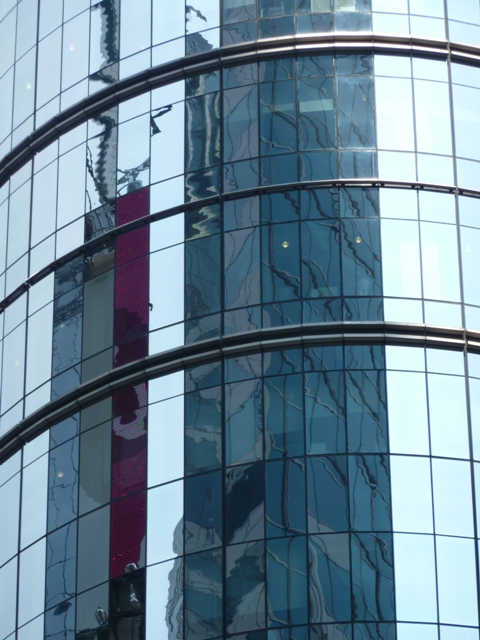
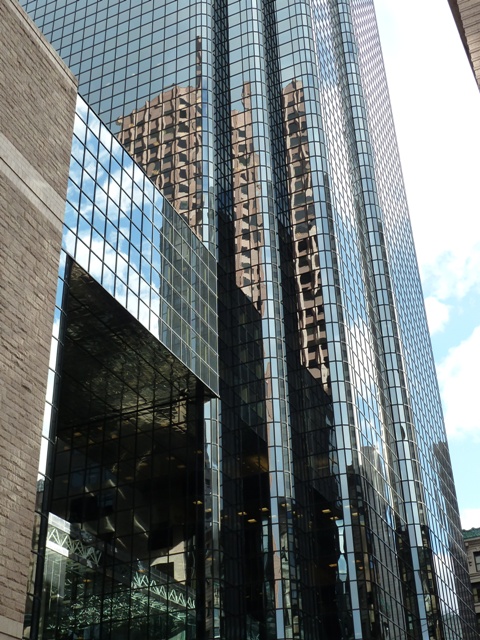
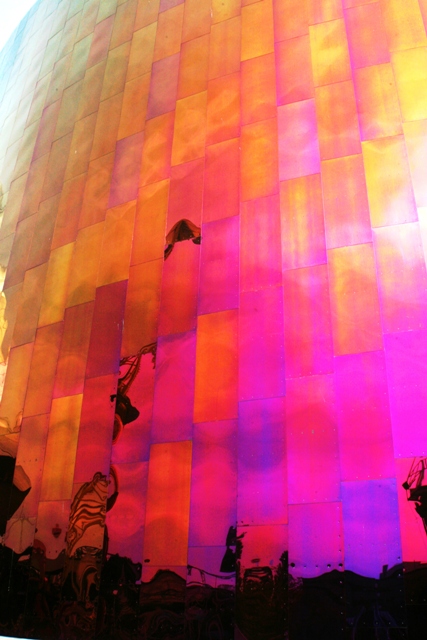
Other photographs forego both the Rule of Thirds and the centered horizontal or vertical split.  These are several of the pictures of reflections in skyscraper windows and the reflection in the red metal skin of the Music Experience Project/Science Fiction Hall of Fame in Seattle.  In these cases the reflections are only a part of the photograph’s interest.  Also adding to the visual impact of these photographs are the grid-like patterns of the window frames or, in the case of the Music Experience, the individual metal panels.  In these cases neither the Rule of Thirds nor a perfect split along the horizontal or vertical center would have done anything to enhance the subject.

As you can see by now the Rule of Thirds, despite what I told you in the first of this series, is hardly a “Law.”  It is a rule and, as with all good rules, the trick is to know how, when, and why to break it.  Remember, the automatic mode on your camera is there to assist you in determining focus, aperture, shutter speed, ISO, and white balance (although you would do well to learn how to change any and all combinations of these settings when the situation dictates).  It remains your job to find interesting subjects and to frame them in intriguing and artistic ways.  Hopefully there will never be a camera invented that will do that for you, because that is when photography ceases to be an art form.

Comments Off on Reflecting on Photography

Filed under Photography

QR (Code) Does Not Stand For . . .


. . . Quickie on Retainer. Rather, it stands for Quick Response, and these strange-looking boxes are rapidly becoming ubiquitous.  Increasingly, you see them on coupons, advertisements, products, websites, magazine articles, books, real estate For Sale signs, business cards, websites, etc.  Indeed, you will probably see these little boxes on just about everything you can imagine in the next few years.  This is already the case in Japan, and has been for some time now.

So, what do these little boxes do? What do they contain?  Why should you care?

Imagine you’re in the neighborhood We Be Groceries® store and you want to know if that spinach you’re about to buy is from an area that recently reported a salmonella outbreak.  You use your smartphone’s built-in camera to take a quick picture of the QR code on the package.  The smartphone reads the QR code and decodes it.  Almost immediately on your smartphone appears all the information you need and maybe a lot more that you don’t—where the spinach was grown, when it was picked, how it was shipped, etc.

Or, perhaps you’re shopping at the local MegaAppliance SuperMart® and you’d like a little more information on that 65-inch LED flat-panel television.  You see a QR code on the price tag.  You snap a picture of QR code, the smartphone decodes it, and the next thing you know your smartphone is logging onto the MegaAppliance SuperMart® website where you can read customer reviews before deciding your wife really doesn’t care that the Super Bowl is next Sunday.

Try this one: You’re standing in line at the movie ticket counter and your wife points out a poster for an upcoming feature film she’d love to see next Saturday.  Warily (and surreptitiously), you photograph the QR code.  Your smartphone brings up the studio website and starts playing the trailer.  Your worst fears are confirmed—combination hardcore chick flick and four-hanky tear-jerker.  “Gee, honey, I was going to take you to your favorite restaurant that night, but we can’t do both.”  Whew, that was close!  As with the spinach, another bullet dodged just in the knick of time.

Some of the information that can be encoded into these little gems include storing geo-coordinates (great for mapping your home or business location), adding bookmarks to your smartphone web browser, storing electronic business card (vCard) information, dialing a phone number, sending an eMail, opening a webpage (URL link), even generating a text message (SMS).

I downloaded today a neat little combination QR Code generator and reader called QuickMark and I’ve been playing around with it.  QuickMark is easy to use and it seems to work exceedingly well.  In addition to QR codes, QuickMark also generates and reads Quick Code and Data Matrix—two competing matrix (2D) barcode standards.  Have fun decoding the QR codes included with this article, including this special message:

Off Topic: I don’t know about you people, but here in El Paso we’re having our coldest onslaught of Winter weather in years, if not decades.  Right now we’re already down to 13° (-4.5 Celsius) and headed for a low of 8° (-13° Celsius) or lower.  Worse, we’re not expected to get above freezing until sometime FRIDAY! We have a word for that here:  BRRRrrrrr!!! Anyway, if your hometown is like El Paso, you should probably download a really good book and just stay home.  Look over to the top right page here for a suggestion.  (You just had to know that was coming)

4 Comments

Filed under Social Networking, Technology/New Stuff