Category Archives: Wine & Food

The Crown Grill on the Star Princess


Unlike Trattoria Sabatini, the Crown Grill is more off-the-menu rather than a non-stop, course-intensive exercise in binge dining.  And while I recommended Trattoria Sabatini as a worthwhile expenditure at $20 a person, the Crown Grill experience is far and above a better choice for the same price.  Not only was the food a bit higher on the gourmet level, the wine list was also superior.  Indeed, I found one of my favorite varietals, Zinfandel (old vine no less), from my favorite Zinfandel vintners, the extraordinary Seghesio family.  This particular bottle came from the Sonoma appellation, vintage 2008, and it bore all the great body and character I’ve come to expect from Seghesio’s often overlooked and underrated Zins.  So good was the Crown Grill that we actually went back a second time.  The same cannot be said of Sabatini’s.

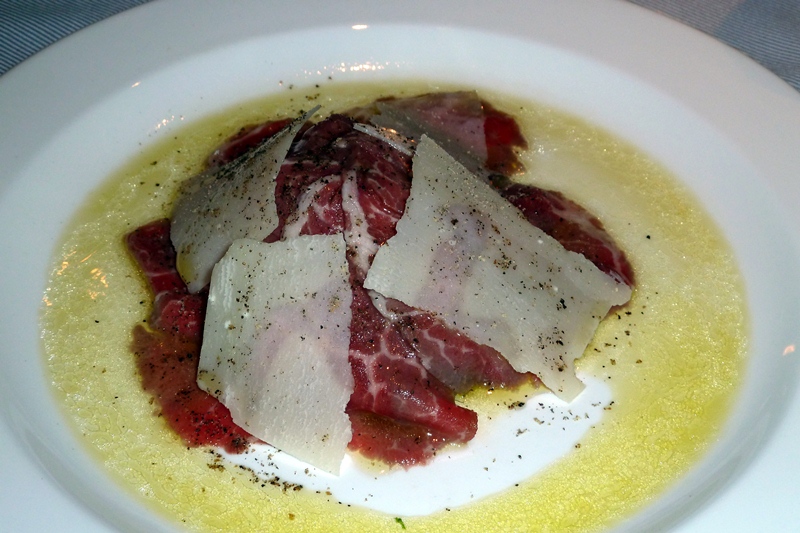
Our appetizer selections included beef carpaccio with Parmesan shavings, scallops served with foie gras, and tiger prawns set atop a papaya salpicon.  The carpaccio, a raw, thinly sliced tenderloin, was exquisite, although I found the olive oil drizzle a bit uninspired over the more traditional vinaigrette.  I, for one, love experimenting with different vinaigrettes when I serve this dish (pomegranate vinaigrette being one of my personal favorites), and it strikes me as a bit tepid on the part of the chef who doesn’t use this appetizer as an excuse to show off a little.  But if this is a shortcoming, the foie gras more than made up for it.  Indeed, I found it so good that, after sampling Ursula’s, I ordered my own sans the scallops.  The foie gras came swimming in butter, perfectly seared on the outside to a nice, almost crusty layer, while the interior retained the rich, creamy consistency for which this dish is known when properly prepared.  The tiger prawns were expertly prepared but, let’s face it, how difficult is it to get right the cooking time for shrimp?  Where this dish excelled was in the “papaya” salpicon, which I found to be a treasure trove of crab and small shrimp perfectly bound together in a rather tasty mayonnaise-based concoction that merged the various flavors exquisitely.

We both tried on our first visit the Black & Blue Onion Soup, an interesting take on this traditional French offering.  Most restaurants invariably fail to caramelize the onions properly during the making of this dish.  I know it takes me sometimes up to two hours to do this, and I guess that’s not a very good use of time in a commercial establishment.  Nevertheless, the Crown Grill took the time to get it righ and I was pleasantly surprised.  Unfortunately, I was not as enamored with the choice of using a Roquefort cheese to top the traditional crouton.  The sharpness of the cheese overpowered the sweet, delicate balance of the caramelized onion.

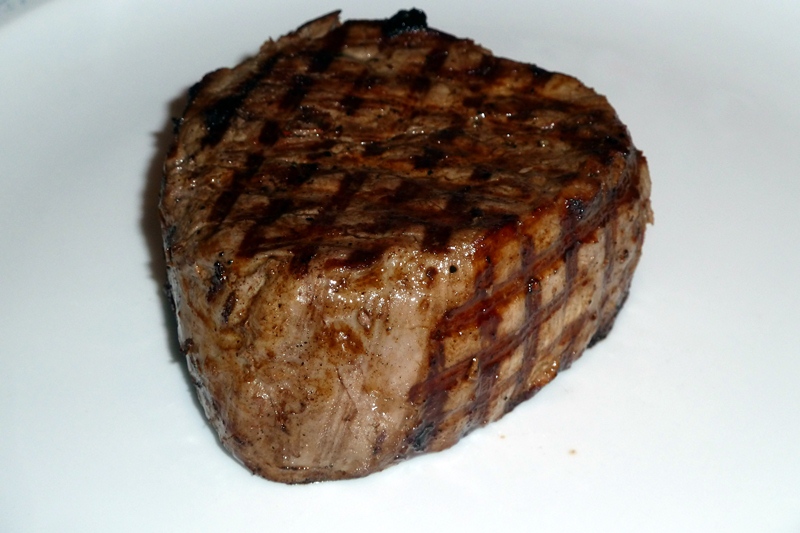
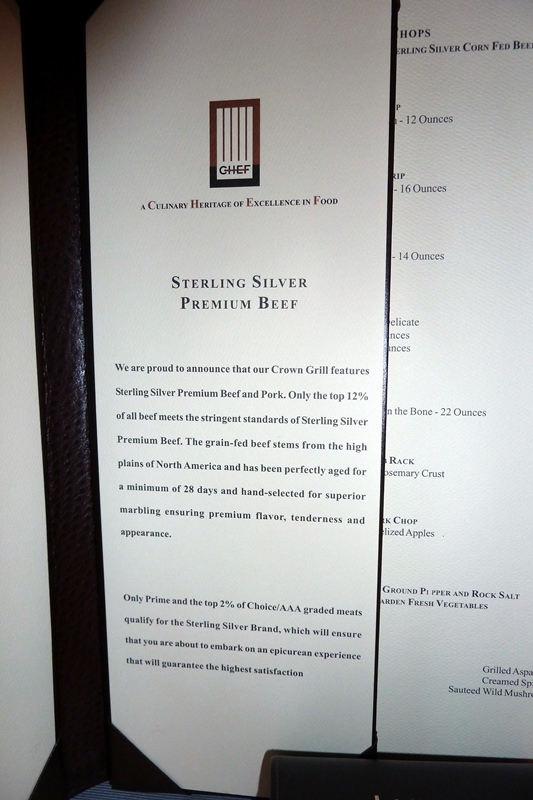
Our biggest disappointment came when Ursula’s filet mignon arrived overdone, and we were not the only couple to experience this problem.  On our second visit a diner at the adjoining table sent back steaks twice for the same unforgiveable offense.  True, you can’t make steak rare enough for Ursula, but even so I find it inexcusable to send out a medium rare filet to a diner who specifically instructed that they wanted their steak bleu, with the center not even at the warm stage.  I even warned the waiter to, “Just pat the cow on the butt and send it out our way,” but that still failed to result in a rare steak.  But when they got it right, that 28-day aging really showed.  The meat practically melted in our mouths.  Unfortunately, on our second trip I went from the porterhouse to the rib eye, which resulted in a steak on which over a quarter was inedible fat and the remaining meat being a bit on the chewy side in some parts of the cut.  No matter how much the waiter pushes the rib eye, steer clear based on my experience.

Side dishes included a rather tasty creamed spinach, asparagus cooked ever so slightly beyond the right amount of crunch, and sautéed mushrooms that were perhaps a bit bland but still a good accompaniment to the steak.  Your only real choice here is in the potato—baked, red-skinned garlic mashed, or garlic herb fries.  The rest of the sides are delivered automatically.

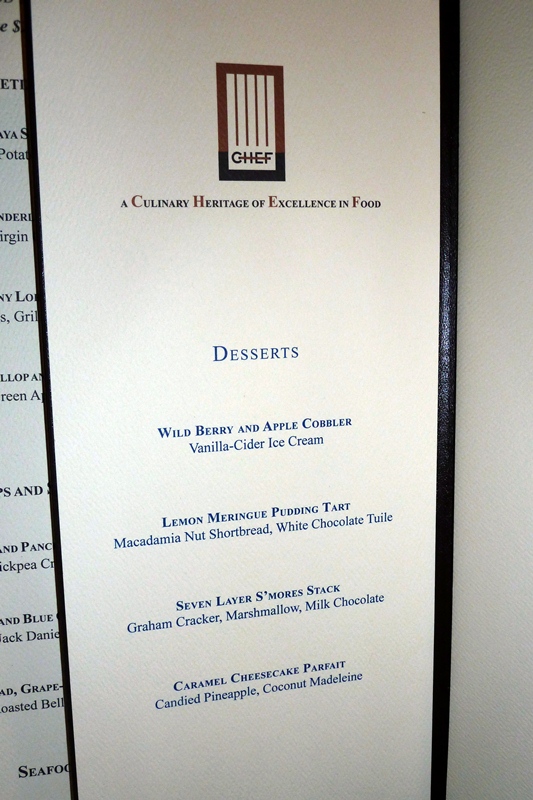
As for desert, the wild berry and apple cobbler was interesting, but the crust was far too much after such a large meal.  Skip the seven level s’mores stack; it’s barely edible.  The caramel cheesecake parfait was good, but the best of the bunch was the lemon meringue pudding tart.

Finally, before I go, tomorrow is the 25th or March.  Happy Birthday to our dear, dear friend Anita Diego.  Thanks for taking care of business.

3 Comments

Filed under travel, Wine & Food

Trattoria Sabatini—A 17-Course Meal


Yep.  You read correctly.  Seventeen courses.

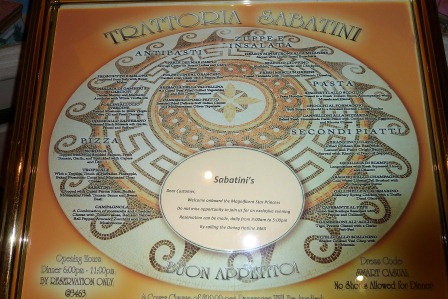
Cruise ships nowadays have specialty restaurants which attempt to separate cruise ship clients from their money by offering an enhanced dining experience over and above that which is available in the main dining rooms or the buffet.  On the Star Princess there are two such restaurants—The Crown Grill for upscale dining including high-end cuts of meat, and Sabatini’s for an Italian experience.  Ursula and I are scheduled to try The Crown Grill later in the voyage, but tonight it was Sabatini’s turn.

For $20 per person, Sabatini’s offers the aforementioned seventeen courses with the patron basically being called upon to make only one selection—the main course, or the Secondi Piatti (second plate) as it is called.  The courses come in six basic waves, and you really need to pace yourself if you’re going to escape the dining room relatively unscathed.

The first wave was the Antipasti, and it included prosciutto with cantaloupe; shrimp and marinated artichoke with white truffle oil; porcini mushrooms with tarragon; black mussels steamed with fennel, garlic, and saffron; Sevruga caviar served on potato latkes; deviled crab cakes with salmon roe; air-dried beef with grilled zucchini, eggplant, red peppers, mushrooms, and sundried tomato; and a small wedge of fried brie cheese.

The second bombardment came in the form of pizza, four slices each with a different topping.  The toppings included wild salmon; prosciutto with pineapple (an interesting twist on the old Hawaiian-style ham); Parma ham with tomato, buffalo mozzarella, and fresh, sweet basil; and a vegetarian offering with lots of peppers, mushrooms, and grilled zucchini.

The third assault was the Zuppe e Insalata (Soup & Salad) course. Ursula opted for the Seafood Cioppino.  I had the Minestrone alla Milanese.  Neither of us wanted to tempt fate with the fresh Mesclun Greens with Balsamic Vinaigrette.

Next up was pasta on parade. Mussels and claims accompanied spaghetti tossed in a creamy tomato sauce.  Gnocchi (a type of potato dumpling) were served in a smoked Fontina fondue.  And bringing up the rear were the cannelloni filled with ground veal.

Finally the main course arrived. Available selections were sea bass in a Pinot Gris/lemon sauce with squid inked risotto and broccoli; langoustines in lime and cilantro; cold-water lobster tail with pilaf and broccoli; rosemary-infused chicken with a truffle demi-glace; jumbo sea scallops; tiger prawns with a garlic peri-peri glaze; and a veal chop in a shallot crust cooked in marsala.  Ursula went for the sea bass while I attacked the lobster.

And then there was dessert—that ever-present Italian mainstay, tiramisu; a cappuccino crème brulée; white chocolate mousse; and at least three other offerings whose descriptions escape me now but which are photographed below.

Overall the meal was well worth the cost of admission.  I would definitely recommend trying this at least once on your cruise.  My biggest quibble was, why so seafood-intensive, especially on the main course selections?  There was only one four-legged creature in the bunch.  That made a bit of a mockery of the red wine selections offered in the wine list.  Nevertheless, we settled for a Pinot Noir that was touted as being on someone’s (didn’t specify who’s) 100 top wines list.  Alas, it was all right but certainly wouldn’t make my personal 100 best list.  It was a bit sweet for a Pinot Noir, which is probably why it found itself recommended as a possible selection for all that seafood.  But although it had the classic Pinot Noir nose, it certainly fell a bit short in the taste department.  If I had it to do all over again, I’d have stuck with a medium-bodied white or, more likely, skipped the wine altogether.

Here are a few photographs of Sabatini’s as well as a couple of other pictures I took after dinner while walking off those seventeen courses:

5 Comments

Filed under Photography, travel, Wine & Food

To Quote Homer: “Pizza? DOH!”


This is simply the ultimate and easiest No-Need-to-Knead pizza dough recipe on the planet. You simply will not believe how easy this is to make.  The idea came to me as a logical offshoot from Alton Brown’s Knead Not Sourdough recipe (Good Eats, The Food Network).  Once you try this thin-crust pizza you’ll never again order out.  It’s just that easy and simple to make.

You’ll need:

17 ½ dry ozs. of unbleached flour, either general purpose or bread (that’s one pound plus 1 ½ ounces in weight, not to be confused with fluid ounces)

Note: If you don’t have a good kitchen scale, do yourself a favor and get one.  If you’re serious about baking good yeast-based breads an accurate scale in vital, as it’s much more precise than attempting to measure flour by volume.  Breads using other leavening agents such as baking powder are not nearly as critical, so you can usually get by with volume measurements in those cases.

⅓ cup cornmeal

1 tbs. Kosher salt (if using table salt instead, halve the amount of salt; Kosher salt is has a much coarser grain, and thus takes up twice the volume as an equivalent amout of table salt)

¼ tsp. active-dry yeast (an unbelievably small amount but trust me, it works)

12 fluid ozs. cool water (tap, filtered, bottled . . . it all works)

More flour for rolling the crust

Step 1. The night before you want to make your pizza, mix well the weighed flour, cornmeal, salt, and yeast.  It’s imperative to mix this very well, as the yeast will die if it comes into contact with straight salt after the water is added.  Stir in the water and work it in until the dry ingredients are fully incorporated.  There’s no need to go wild here; you’re only looking to get the dry mixture wet enough to stick together.

Step 2. Place the dough into a large covered pan (I use a Dutch oven with a heavy lid), or into a large bowl covered with plastic wrap.  Let the yeast do its thing.  The natural fermentation process will do all the “kneading” for you.  The only time you’ll need to touch the dough is to give it a quick couple of punch-downs and turns just before you go to bed and once again when you get up in the morning.  After each punch-down/turn session, make sure you once again cover the dough or it will dry out.

Step 3. Approximately 19 hours into the fermentation process, divide the dough into four equal portions and form each portion into a tight ball.  Cover the balls you are not yet ready to roll out to prevent drying.  Take one ball of dough at a time and, using copious amounts of flour, roll it out into a 12- to 14-inch circle.  You must use a lot of flour to prevent stickiness and to get a truly thin, thin crust.  At this point you can go one of two ways:

Step 4a (method 1). Place your rolled-out pizza dough into a rimmed pizza pan with holes in the bottom and prebake the crust at 450° for two to three minute, until it just starts to puff.  Remove the crust and let it cool while you roll out and bake the subsequent crusts.  When you’re done, you will have four crusts either ready for the freezer or onto which you can place your toppings and bake for dinner later that evening.  To freeze, wrap each crust separately in heavy-duty aluminum foil.  To bake, load the crust with your favorite toppings and place the pizza straight onto a rack in the lower third of a preheated 450° oven for 13 to 15 minutes.  The crust edges should get a rustic, dark brown, the bottom evenly browned, and the cheese nice and bubbly.  Pull the pizza out of the oven and let set for a few minutes before cutting into slices.

Step 4b (method 2). The other way you can go with this, for that truly authentic feel, is to preheat a pizza stone at 450° for at least forty-five minutes.  Roll out the crust as above (one at a time of course, and don’t forget to cover the ones you’re not working), place the unbaked, well-floured crust on a peel sprinkled with either cornmeal or course semolina flour (the cornmeal or semolina will act as mini ball bearings to help ease sliding the crust off the peel), top the pizza with your chosen ingredients and slide it from the peel onto the pizza stone using a series of quick, short jerking motions so the toppings don’t fall off the crust as it slides onto the stone.  Bake at 450° for at least 15 minutes or until the edges are a dark, rustic brown and, when carefully lifted with a spatula, when the underside appears evenly browned beneath.

If you did everything correctly and didn’t put the more soggy ingredients directly onto the crust, it will have a crispy, almost cracker-like crunch and rustic French bread-like flavor that is indescribable.

Additional Tips: If you use a pizza sauce, go sparingly to preclude getting a soggy crust.  If it’s a homemade sauce, make sure it’s thick enough not to get watery.  Another interesting sauce to try is my jalapeño pesto recipe, but go lightly because it can be spicy.  If you use tomato slices rather than sauce (Margherita-style pizza), place the slices above a protective layer of cheese.  You might want to consider seeding the tomatoes first for some added assurance against sogginess.  Pepperoni slices should first be defatted by sandwiching them between paper towels and briefly microwaving beforehand (but don’t overdo this or the pepperoni will be overdone by the time the pizza comes out of the oven).  This also gives the pepperoni a nice crunchiness when the pizza is finished and keeps excessive fat from depositing onto the pizza.  Place fresh, sliced mushrooms above the cheese and below the pepperoni or other meats.  The fat from the meat will help cook the mushrooms, and the cheese will keep the moisture from the mushrooms from reaching the crust.

Wine Pairings: Wine pairings for pizza are pretty much dependent upon the toppings and even the choice of cheeses.  Heavy, tomato sauce-based pizzas loaded with meat go well with Chiantis, California Sangioveses, and even Super Tuscans.  Lighter Margherita-style, vegetarian, and other white-type pizzas (meaning they lack a tomato sauce base) need a lighter red such as a Pinot Noir or a heavier white such as Chardonnay, Sauvignon Blanc, or Pinot Grigio.  A spicy pizza using my jalapeño sauce or perhaps a barbecue chicken topping will pair well with anything from a peppery Shiraz to a slightly sweet white Riesling or perhaps even a Gewurztraminer in the case of something particularly hot.

Please feel free to drop by and list some of your own favorite toppings. I’m sure other readers of this recipe would love to get some new and creative ideas.

1 Comment

Filed under Wine & Food