S&W Revolvers — Which are Pinned, Recessed, Both, or Neither?
Did you take Wednesday’s quiz? If so, how do you think you did after that little lesson on classic collectible Smith and Wesson revolvers? Hopefully, if I did my job, you learned what is meant by S&W “pinned” barrels, “recessed” cylinders, and “dash” and “no-dash” models. As you may recall, a pinned barrel has this:
S&W Pinned Barrel
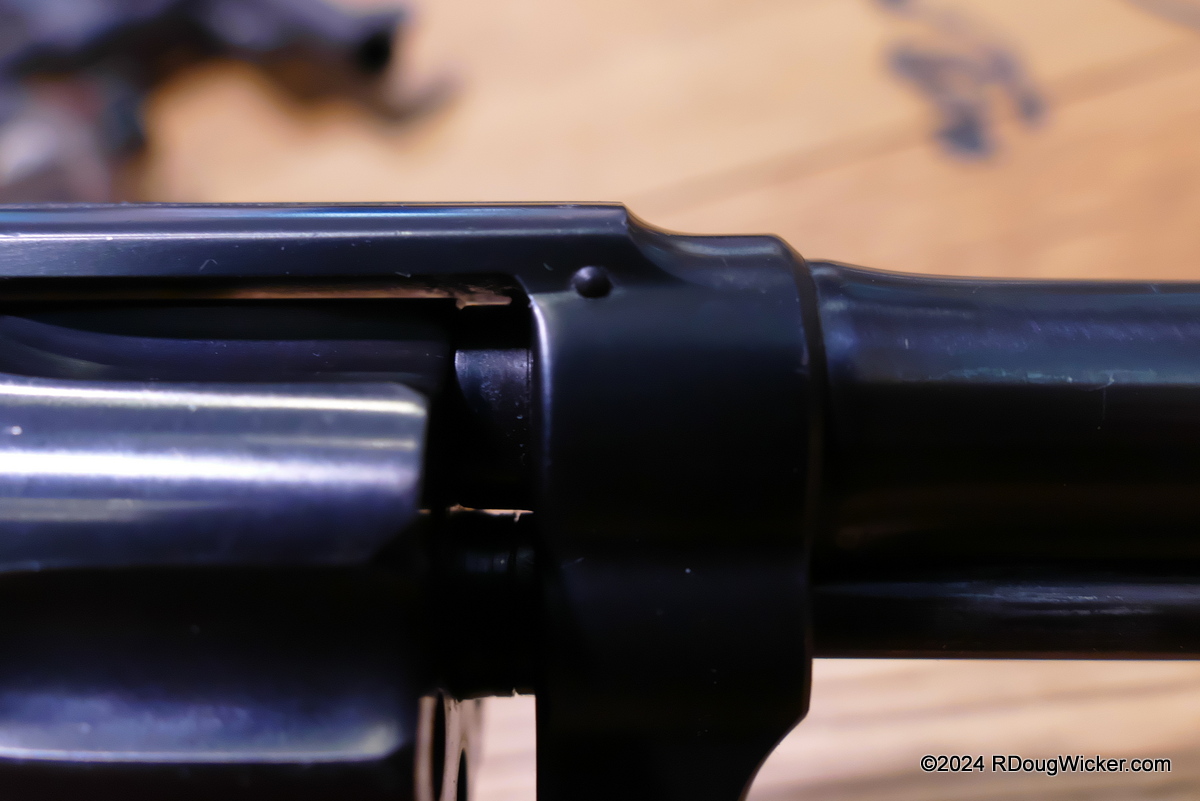
While this is an example of a nonrecessed cylinder:
S&W Nonrecessed Cylinder
And this is an example of a recessed one:
S&W Recessed Cylinder
You may recall that recessed cylinders are almost flush to the recoil plate:
Recessed Cylinder flush with Recoil Plate
While nonrecessed cylinders require a gap to accommodate the protruding cartridge rim:
Gap between Nonrecessed Cylinder and Recoil Plate
I then gave you a quiz with which you could test yourself. Just by identifying the year and caliber of any S&W revolver made from 1905 on, you should be able to use that information alone to tell if the revolver has a pinned barrel, a recessed chamber, both, or neither. Below is the answer sheet, with correct answers highlighted in red and underlined. Also included with each question is a note as to what makes that answer correct. Here you go:
Model 10-5 with uncommon 6-inch barrel; .38 S&W Special; 1969 or ’70 a. Pinned Barrel(NOTE: correct period for pinned and recessed Smith and Wessons, but wrong caliber for a recessed cylinder — no .38 S&W Special revolvers sported recessed cylinders) b. Recessed Cylinder c. Both d. Neither
Model K-22 “Outdoorsman”; .22 LR; 1938 a. Pinned Barrel b. Recessed Cylinder c. Both(NOTE: correct period for pinned barrels, and S&W recessed .22 LR cylinders starting in 1931 with the K-22 Ourdoorsman) d. Neither
A no-dash Model 57; .41 Magnum; 1968 or ’69 a. Pinned Barrel b. Recessed Cylinder c. Both(NOTE: correct period, and S&W recessed cylinders on all Magnum revolvers — .357 S&W Magnum, .41 Remington Magnum, and .44 Remington Magnum) d. Neither
WWII “Victory” Model M&P; .38 Special; 1944 a. Pinned Barrel(NOTE: correct period for pinned and recessed S&W, but wrong caliber for recessed a cylinder — no .38 S&W Special revolvers sported recessed cylinders) b. Recessed Cylinder c. Both d. Neither
Model 10-5 with common 4-inch barrel; .38 S&W Special; 1966 or ’67 a. Pinned Barrel (NOTE: correct period for pinned and recessed S&W, but wrong caliber for recessed a cylinder — no .38 S&W Special revolvers sported recessed cylinders) b. Recessed Cylinder c. Both d. Neither
Model 60-7 “Ladysmith”; .38 S&W Special; 1994 a. Pinned Barrel b. Recessed Cylinder c. Both d. Neither(NOTE: starting in 1982, and finishing the following year, S&W transitioned all their revolver lines away from pinned barrels and recessed cylinders)
Now that you’re knowledgeableon classic collectible Smith and Wesson revolvers, have fun hunting for one to add to your own collection.
Walther’s superlative, innovative P99 AS and P99c AS
The Walther P99 AS died in 2021. Or was it 2022? Many sources site the former year, but I’ve recently seen one P99 AS with a CC date code, which translates to 2022. Or did the P99 AS die this year? In February, while Ursula and I were on our most recent travels, Walther announced the “Final Edition” of what is, in my view, the best striker-fired polymer-framed pistol ever devised. And that’s a real shame, but not unexpected. Walther has been one of the most innovative manufactures of firearms over the past century. Alas, incompetent marketing has always been Walther’s undoing. The P99 AS was no exception to this propensity to make great weapons, and then fail to follow up on actually selling the darned things. The double-action/single-action semiautomatic? Walther invented that entire genre with its PP in 1929, then let the design gather dust until it was too late to salvage it with the far superior PP Super that came out 43 years later. The dropping block locking system? Walther pioneered that concept in the P38, but when you think of the dropping block today it’s the Beretta 92 that comes to mind. A double-action/single-action striker-fired pistol? Others claim to make such a beast, but the P99 possesses the only true DA/SA system with two different trigger pulls… or is it three?
A Walther P99 AS (Anti-Stress trigger) made in 2017 (BH date code)
The AS (Anti-Stress) trigger developed for the P99 has a double-action mode that rates at 8.8 pounds/4 kilograms and a .55-inch/ 14mm trigger pull length, and a single-action mode measuring exactly half that amount — 4.4 pounds/2 kilograms — and a much shorter .31-inch/8mm trigger pull length. Channeling Ron Popeil, “But wait! There’s more!” There is in fact a third trigger mode, the Anti-Stress mode. That mode mates the single-action’s 4.4-pound trigger with the double-action’s longer .55-inch pull length. The intent of this design was to give police departments and military personnel a margin of safety in stressful situations should they opt to carry the P99 AS with a cocked striker.
Walther P99 AS trigger position for anti-stress or double-action modes
Walther P99 AS trigger in single-action position
A careful pull of the P99 AS will reset the trigger from anti-stress to single-action, although I don’t recommend staging the trigger unless you’re on target and ready to fire. You definitely don’t want to carry a P99 AS in that configuration. That’s just asking for trouble.
When you first chamber a round, the P99 AS defaults to the anti-stress trigger. So, how do you switch that to the even safer double-action? You depress the decock button atop the slide and within reach of your thumb if you’re a righthanded shooter.
P99 AS decocker for placing the trigger into double-action mode
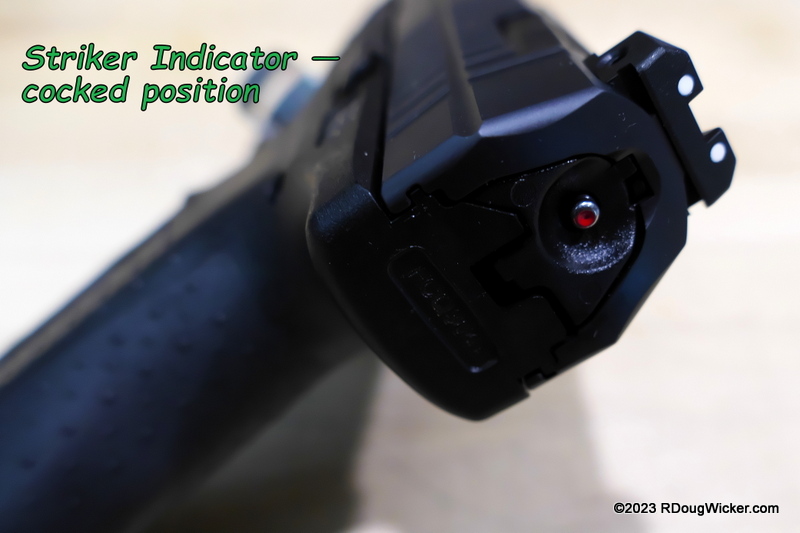
There’s even a nifty indicator on the P99 AS that tells you if the striker is cocked. It’s at the back of the pistol, and it looks like this:
P99 AS indicating a cocked striker (either single-action or anti-stress modes)
P99 AS — if you don’t see red, the striker is decocked and the weapon in double-action
An added benefit to the striker indicator is that as you are pulling the trigger in double-action, the indicator emerges to give you a visual indication that the sear is about to trip.
Walther P99 AS with an aftermarket threaded barrel
But what if you need to place an accurate shot at a distant target? There’s no hammer to thumb back, as you would on a traditional DA/SA pistol or revolver. So how do you transition the P99 AS from double-action to anti-stress without racking the slide and ejecting the round already chambered? It’s actually quite simple. You merely snick back the slide about a quarter of an inch. The striker cocks, the indicator protrudes from the rear, and the trigger remains at the double-action pull length. This is quite simply the most versatile and, in my opinion, the safest striker-fired system ever devised. I mean, other than a manual thumb safety, what’s safer than a stiff, long double-action first pull? Answer: Nothing! Even better is that the P99 came in a smaller 10+1 capacity compact version, predating the SIG P365’s 10-shot double-stack wonder by two full decades. Behold the P99c AS, in which the “c” stands for compact:
Walther P99c AS — my choice for concealed carry for a decade
That marvel weighs 20.8 ounces/590 grams (with an empty magazine). Other measurements are:
Capacity: 10+1 (9mm)/8+2 (10mm); will accept the full-size 15-round (12-rounds in 10mm) P99 magazine with a sleeve
Compare that to the more recent SIG P365:
Weight: 17.8 ounces/504 grams
Lenth: 5.8 inches/147mm
Height: 4.3 inches/110mm
Width: 1.0 inch/25mm
Barrel: 3.1 inches/79mm
Capacity: 10+1 (9mm); 12 and 15-round magazines available
Twenty-six years may separate these two weapons, but not much else does. I say twenty-six, but that’s based upon when the P99 hit the market in 1997. Development actually began about four years earlier.
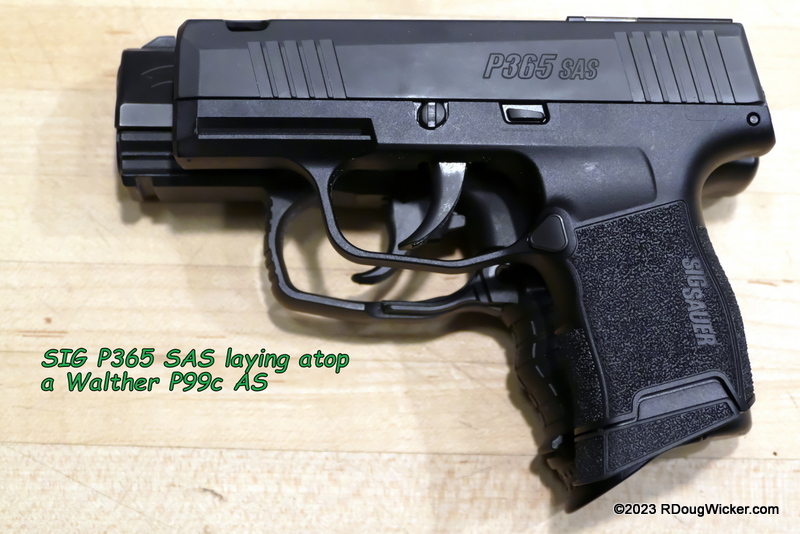
SIG P365 SAS over a Walther P99c AS
When the P99 first arrived on the scene there was no “AS” in the name. It only came with the AS trigger, so that would’ve been redundant. But here’s where Walther falls down on marketing. Not content with the marvelous and innovative Anti-Stress trigger, Walther began copying inferior striker-fired offerings from less innovative companies. There was the P99DOA (Double-Action Only) and the P99QA (Quick Action trigger with emulated the partially loaded striker of, shudder, the Glock). But why? The Walther P99 AS trigger was already at the apex of striker-fired weapons, and additional trigger configurations only managed to confuse the market and any potential customers. If some police department wants to buy a cheap Glock with an inferior trigger, one does not dumb down one’s superior product going after that market. You instead shoot (pun intended) for those departments that recognize quality, innovation, and safety, and are willing to pay a bit more for it.
Walther P99c AS dated 2014
And then things got even more confusing. Smith and Wesson entered the picture with the SW99 and SW99c (2000-2004) with frames made by Walther and most of barrels and slides made by Smith and Wesson. Smith and Wesson then proceeded to further add to the confusion by coming out with the SW99O (Double-Action only with no decocker), SW99 QA (Quick Action trigger comparable to the, shudder, Glock), and the SW99L (basically a rebranded SW99 QA minus the decocker). The only thing good to come out of the SW99/Walther collaboration was that a version of the P99 in .45 ACP became available, the SW99 .45:
Smith and Wesson SW99 .45 ACP with 9+1 capacity
At least Walther’s next collaboration led to an actual improvement, but unfortunately that didn’t last long because Magnum Research followed Walther’s lead and botched their marketing as well. Behold a beautiful long-slide variant of the P99 AS with a 4.5-inch/116mm barrel, the elegant and refined MR9 Eagle:
Long-slide version of the MR9 variant; frame by Walther, slide and barrel by Magnum Research
Magnum Research MR9 and its progenitor
Full-size P99 AS vs Magnum Research MR9 long slide
And if that Magnum Research version of the P99 was too big for you, the MR9 also came in the original 4-inch configuration. The MR9 was produced between 2011 and 2015. By the way, if you take a closer look at the MR9 and SW99 you’ll note that the ambidextrous magazine release levers are much shorter than the P99 pistols shown in this article. These are the magazine release levers that adorned the original Generation 1 P99. Also carried over from the Generation 1 is the “ski hump” inside the SW99 trigger guard.
Smith and Wesson SW99 alongside the Magnum Research MR9
SW99 and MR9
But enough about the collaborations. Let’s look at what comes with the typical full-size P99 AS right out of the case. As you can see below, Walther was yet again well ahead of the competition with modular backstraps to adjust the grip, front sights of various heights to adjust the point of aim, and an Allen wrench to install those sights:
Walther P99 AS and included accessories
There is one Walther P99 collaboration with Poland I’ve not yet covered. That would be Fabryka Broni Radom‘s double-action only P99 RAD. Yep. Another addition to the P99 confusion, and another example of why Walther is terrible at marketing.
And then there’s the unlicensed P99 AS clone from Canik of Türkiye (see also: Canik USA, importer Century Arms). It’s a remarkably close copy, right down to the decock button, striker indicator, and the operation of the three trigger modes, but the trigger on the Canik TP9DA is not nearly as refined as that on the P99. When I picked up a TP9DA and tried the trigger several years ago I gave the pistol a hard pass despite the much lower price. After Walther’s Final Edition runs out, however, the Canik may be your last shot (pun intended) at a new pistol with an Anti-Stress trigger. And, yes, Canik also cloned other P99/SW99 configurations as well: the TP9SA (single-action only with decocker) and TP9SF (single-action without the decocker).
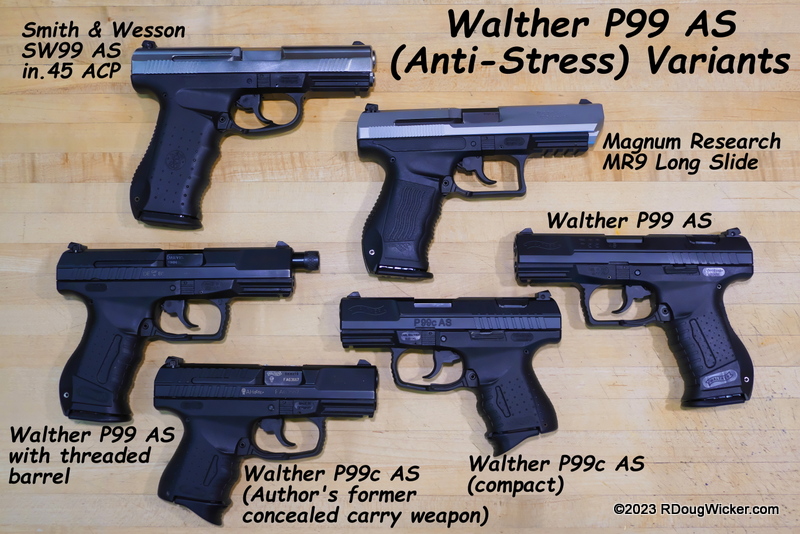
Anyway, let’s peruse this P99 AS Family Portrait:
Walther P99 AS Family Portrait, including cousins from S&W and MR
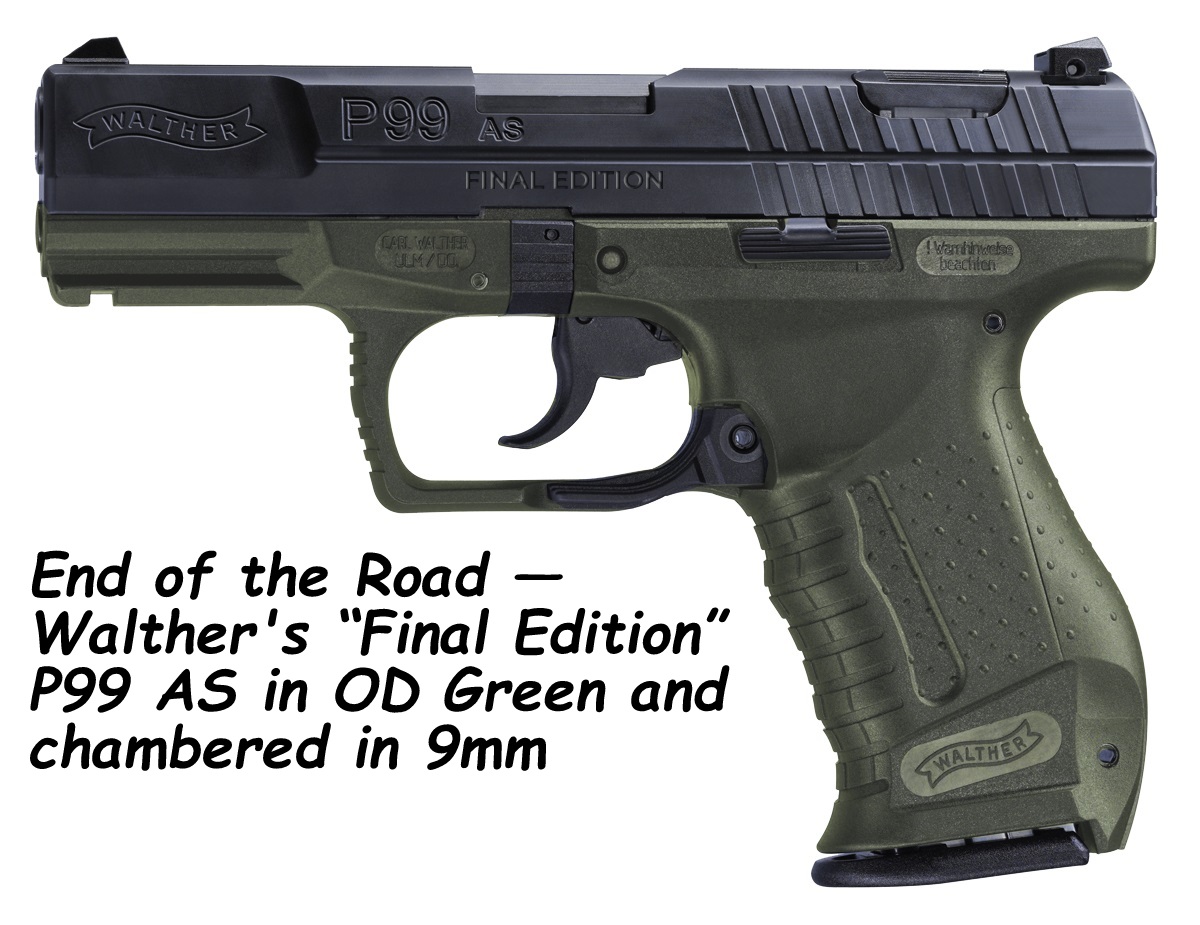
One last look, this time at theFinal Edition P99 AS currently being offered by Walther in a hideous OD Green:
Beretta Week firearms from left to right: 84B Cheetah; 21A Bobcat; 950 BS Jetfire
“He then took from under his shirts in another drawer a very flat .25 Beretta automatic with a skeleton grip, extracted the clip and the single round in the barrel and whipped the action to and fro several times, finally pulling the trigger on the empty chamber. He charged the weapon again, loaded it, put up the safety catch and dropped it into the shallow pouch of the shoulder-holster.“
— Ian Fleming from his novel Casino Royale (Jonathan Cape, 1953) describing the sidearm of his fictional spy, Commander James Bond CMG, RNVR
The Beretta 950 debuted in 1952 — “a very flat .25 Beretta automatic”
Today we’re going to have some fun, combing literature, cinema, and firearms with a focus on the most famous spy in fiction. The sidearm most associated with James Bond is, of course, the 7.65mm (.32 ACP) Walther PPK“… with a delivery like a brick through a plate glass window.” But that sidearm isn’t mentioned in any of the first five Ian Fleming novels. It’s not until the sixth, Dr. No, that 007 is forced to exchange his beloved Beretta .25 for the Walther. From the first Bond film, based upon that sixth novel:
M, speaking to James Bond:Take off your jacket.
M:Give me your gun.
M:Yes, I thought so. This damn Beretta again. I’ve told you about this before.
M, turning to the armorer: You tell him. For the last time.
Armorer, weighing the Beretta in his open hand:Nice and light… in a lady’s handbag. No stopping power.
As entertaining as Ian Fleming was, he certainly didn’t know much about firearms. He proved that repeatedly in the early Bond novels, beginning with the choice of a .25 caliber Beretta. As for the Beretta, Mr. Fleming didn’t even state the model number, which leaves us to speculate. The Beretta 950 was Beretta’s first tip-barrel pistol. It arrived in 1952, one year before the publication of the first Bond novel Casino Royale. It came in two flavors — the very weak .25 ACP/6.35mm (“Jetfire”) and the incredibly anemic .22 Short (“Minx”). Considering the weak cartridges available to the 950, anyone licensed to kill and of sound mind would resort to neither the Minx nor the Jetfire. Fortunately, in that first novel Mr. Fleming also assigned to Bond a .38 Colt Police Positive with a “sawn barrel” and a “long-barreled” .45 Colt Army Special (a.k.a., Colt Official Police) for those times when .25 ACP just wouldn’t cut it (which would pretty much be any time Bond needed a weapon).
As for that Colt Army Special, there’s also a problem with that description as well. The Colt Army Special was never chambered in .45 Colt; it was only available in the much weaker .22 LR, .32-20, .38 S&W (and related .38/200), .38 Special, and .41 Long Colt cartridges.
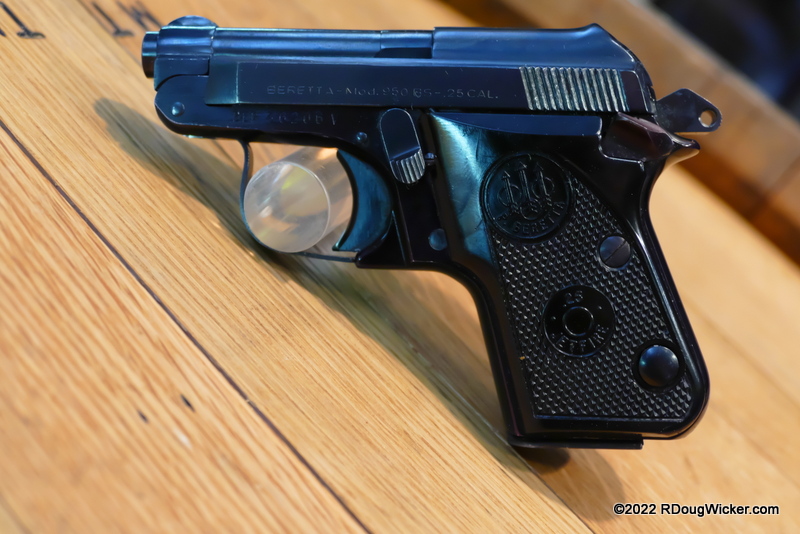
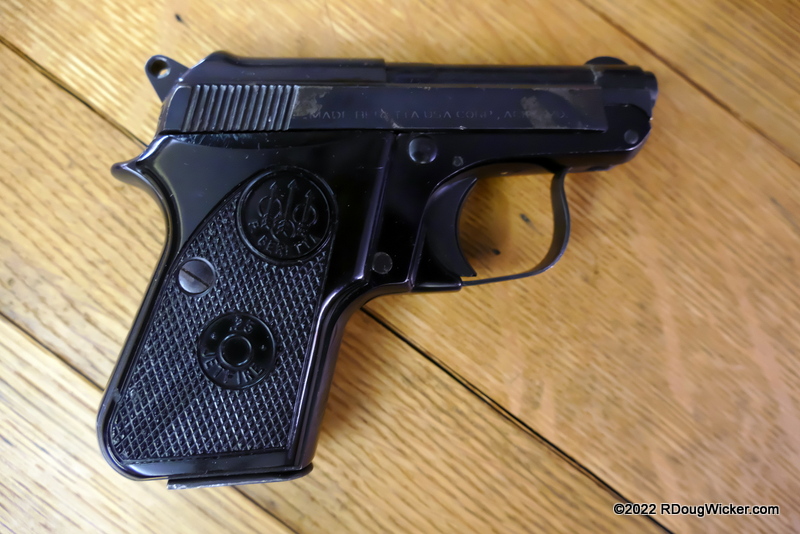
.25 ACP Beretta 950 BS Jetfire
The impotence of the .25 ACP/6.35mm aside, if one were going to arm a Double-0 with a .25 ACP Beretta, the 950 would seem a logical choice. The tip-barrel would allow Bond to drop a round directly into the chamber rather than inserting a loaded magazine into the grip and racking the slide. And to render the firearm safe, he would merely push forward the barrel release and snatch the ejected cartridge as it gets tossed into the air. That would certainly be an iconic image for a cool spy.
Beretta 950, barrel tipped
But is the 950 the weapon Ian Fleming had in mind when he assigned to 007 a very flat .25 Beretta automatic with a skeleton grip? An intriguing question, but one easily answered with a little knowledge of .25 caliber Berettas. We’ll get to that conclusion in a moment, but first a discussion on the original 950 and 950 B. The 950 was introduced to great fanfare in 1952 and, amazingly, it soldiered on in production until 2003. Impressive!
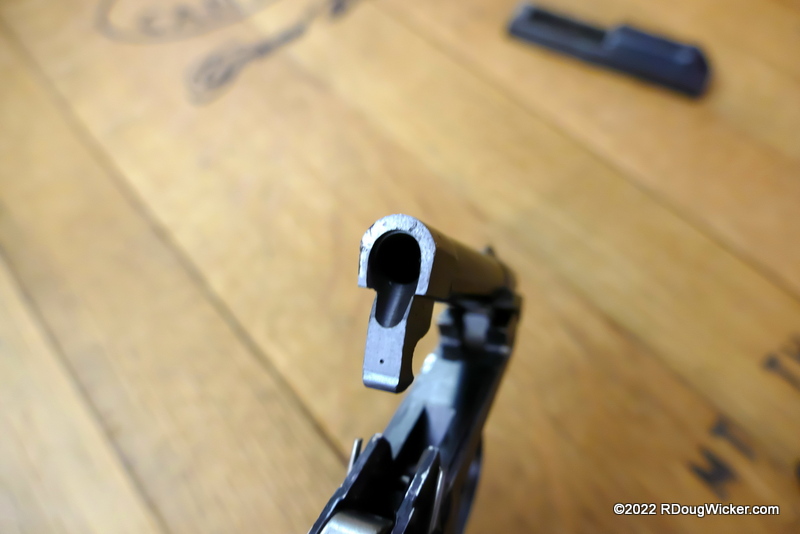
A Beretta 950 BS chamber waiting for you to just drop in a .25 ACP cartridge
The 950 and 950 B were straightsingle action only (SAO) pistols. The slide and barrel are carbon steel sitting atop an aluminum alloy frame. There is no manual safety on either the 950 or 950 B, but there is a half-cock position. That means one needs to fully cock (thumb back) the hammer before it can be fired. Not exactly spy friendly, as the act of cocking on the draw increases the time needed to ready the weapon for firing. Strike One on the 950 being Mr. Fleming’s intended choice.
Beretta 950 BS; slide removed
This original setup was changed with the 1968 introduction of the 950 BS variant. The 950 BS is also a SAO pistol, but this variant incorporates a manual safety that allows the weapon to be carried in a cocked-and-locked configuration — hammer cocked, pistol in single-action mode, safety engaged, i.e., “locked.” And, if you’ve been paying attention so far, you’ve already stumbled upon Strike Two. Any ideas? Here’s a hint from the first paragraph of this article: “He charged the weapon again, loaded it, put up the safety catch and dropped it into the shallow pouch of the shoulder-holster.”
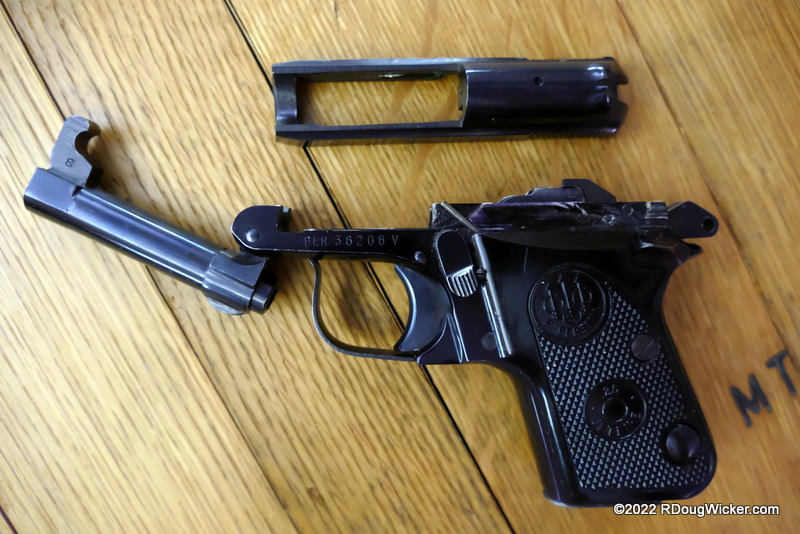
Disassembled Beretta 950 BS
So, if Bond is engaging the safety on his .25 Beretta, it’s not the 950 from 1952. Or is it? As we’ve already seen, Mr. Fleming was notoriously unversed in firearms. Remember that .45 Colt Army Special? At any rate, he certainly didn’t have in mind the 950 BS, which does come with a manual safety. The 950 BS didn’t arrive on scene until 16 years after the publication of Casino Royale, and some four years after Mr. Fleming’s death from a heart attack. So, did Mr. Fleming attribute to the 950 a nonexistent manual safety? There’s one more clue, and it comes from the “skeleton grip” of the weapon described.
The last clue. Can you spot it? Hint: Is that a paperclip protruding from the grip?
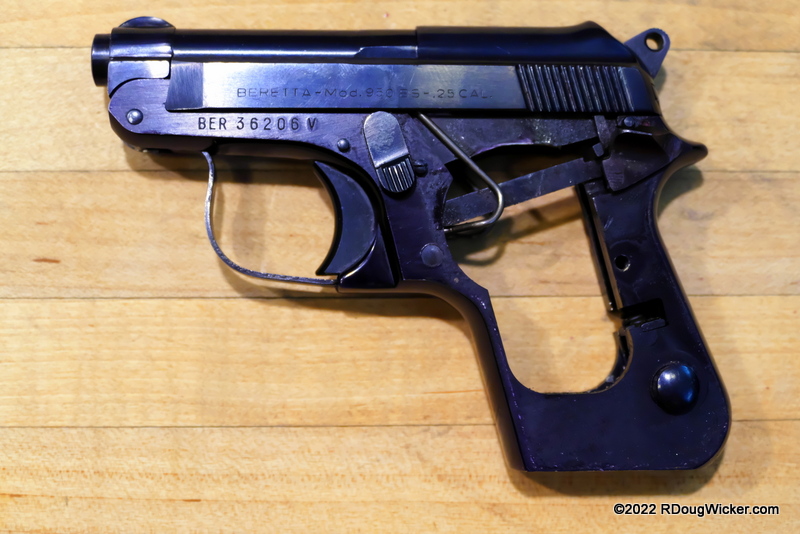
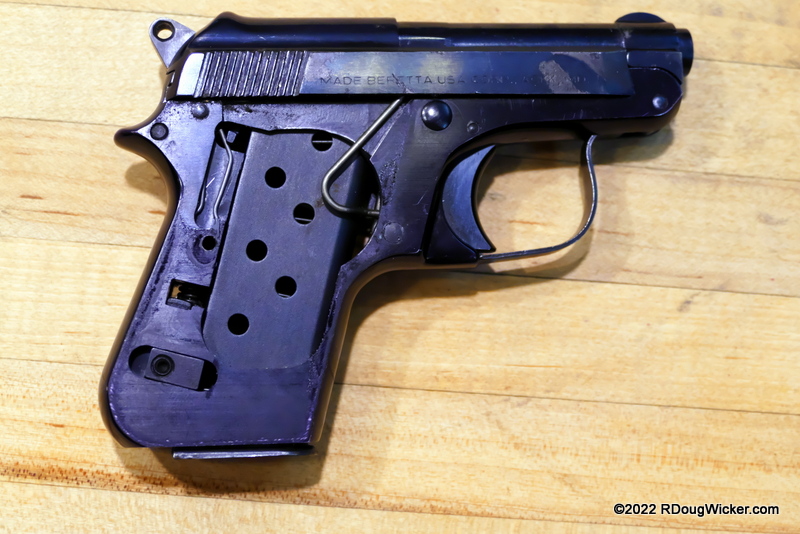
A “skeleton grip” is when one removes the left and right panel grips from the frame, leaving only the frame “skeleton” available to grasp. With the 950, that means taking off the plastic panels you see in the photos above, leaving this:
Beretta 950 BS; “skeleton grip” with magazine inserted
I made this point before in my review of the Beretta 3032 Tomcat: Notice that there is no recoil spring? Actually, if you look closely at the three photos directly above, there is. In the Tomcat there are two spring loaded plungers inside the frame. The plunger tips insert into notches on the inside of the slide. With the 950 it’s a bit simpler system. Instead of plungers and springs, the slide notches catch on the thick wire you see running outside the magazine well and protruding from the top of the grips. That is your “recoil spring,” if you want to call it that.
950 BS recoil wire (left); 3032 spring-loaded plunger tip (right)
Question: How do you run this gun with a skeleton grip configuration if the recoil system is exposed and subject to interference and binding? Answer: You don’t. Attempting to do so would make the weapon so unreliable as to render it useless.
So, if not the 950 or 950 B, what Beretta did Ian Fleming have in mind? What “flat .25 Beretta automatic” has a traditional recoil spring incorporated into the slide that would allow one to operate it with the grip panels removed? That’s easy. We’re left with the Beretta 418, which went into production in 1936 (1919 if you include the earlier design designations) and continued to run concurrently with 950 production until at least 1958.
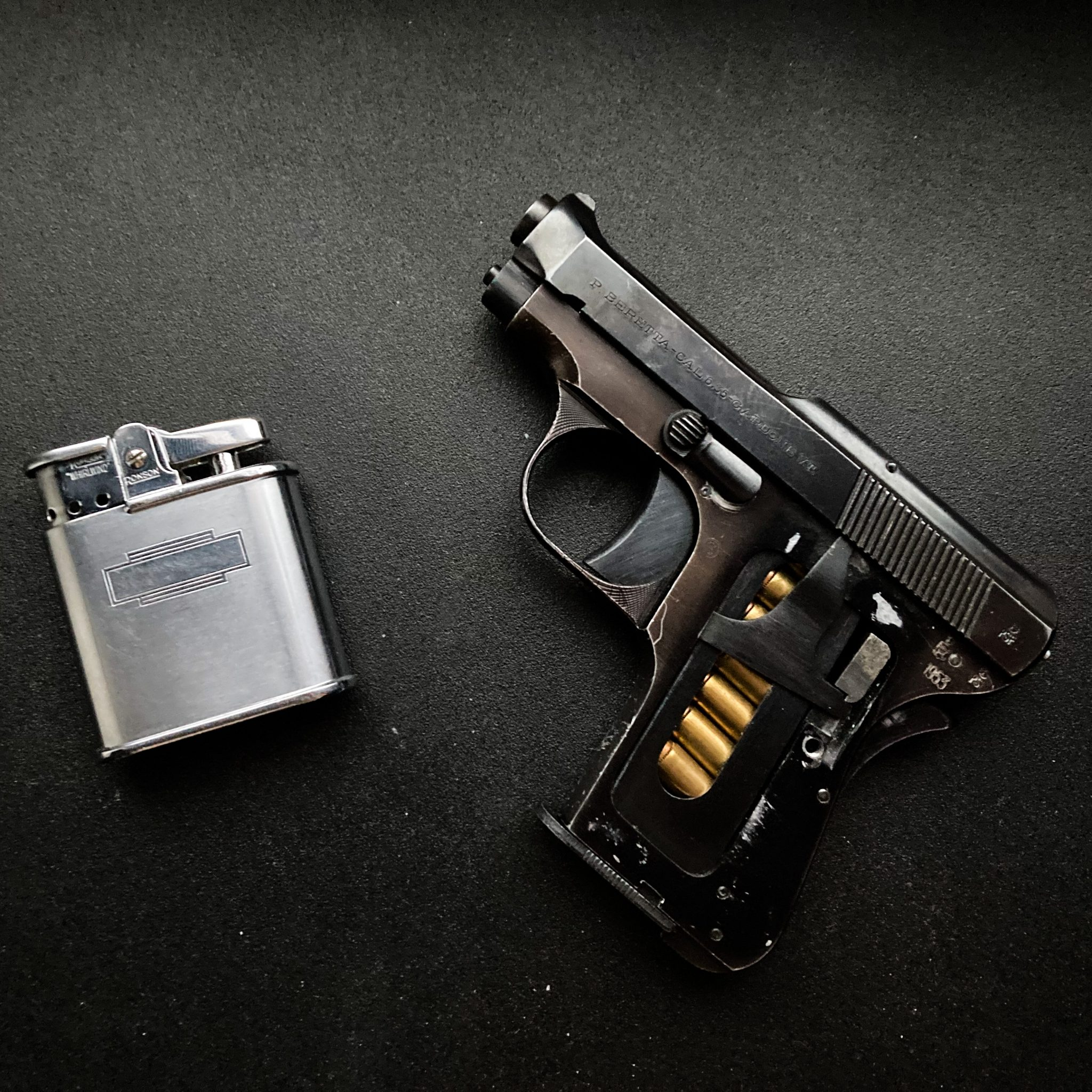
Beretta 418 as Bond would have carrried it — Picture from CommandoBond.com
And in this photograph you can see the traditional guide rod/recoil spring setup, since the 418 is not a tip-barrel design:
I can hear you now asking, but… but… but where’s that “safety catch” Bond engages? In the photo of the assembled 418, that would be the lever on the frame, just above the trigger. That lever also acts as the slide catch, something the tip-barrel Berettas lack completely. Instead, on the tip-barrels, the lever in that location is the release for the pivoting tip-barrel.
Mystery solved! Ian Fleming didn’t use the most recent (at the time) .25 Beretta. He instead went with a design dating back to 1919.
But one mystery remains. The 950 BS presented today was made in Accokeek, Maryland, but what year? These were produced in the U.S. from 1978 until 2003. If you can solve that mystery for me, I would be greatly appreciative.
While you’re pondering that, let me give you the relevant statistics and specifications on this firearm.
Model 950/950 B (1952-1968) Model 950 BS (Italy and Brazil 1968-?; USA 1978-2003):
barrel: 2.4″/60mm
length: 4.7″/120mm
width: 0.91″/23mm
height: 3.4″/87mm
weight: 9.9oz/260gr
caliber: .22 Short (Minx) and .25 ACP/6.35mm (Jetfire)
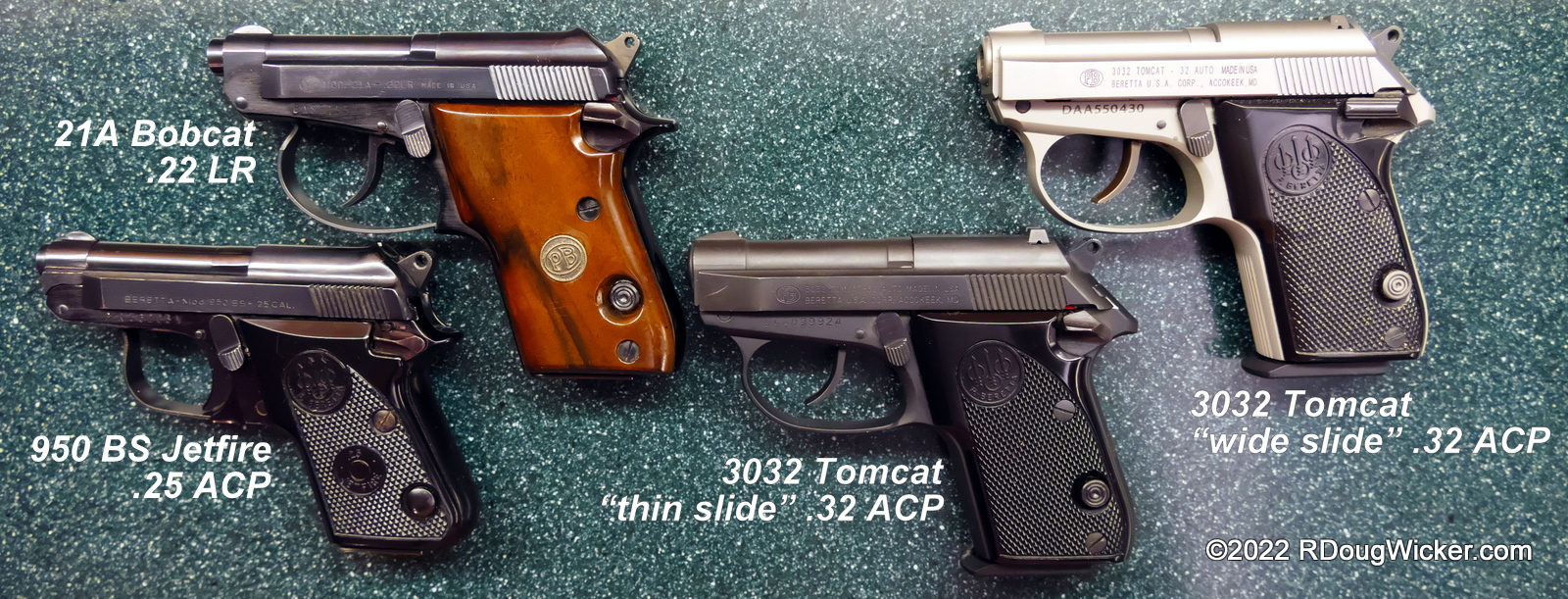
I hope you enjoyed Beretta Week, and I trust you found this Fun Firearm Friday to be particularly entertaining. Next week I return to travel, taking on our recent late April-early July 71-day excursion to Europe and back. Along the way I’ll show you the Canary Islands (again); rarely visited cruise ports in Spain and France; a charming town in Germany, and another in the Netherlands. After that it’s three back-to-back cruises to Iceland, Ireland, the U.K. (including Wales, Scotland, and Northern Ireland); and a journey to seven destinations in Norway, including deep into the Arctic Circle as far north as 71º 10′ 21″ North Latitude. That series will conclude with the four days we spent in Dublin before heading back to the U.S. Until then, I’ll leave you with this Beretta tip-barrel family portrait:
















 Decisions — Murder in Paradise
 The Globe — Murder in Luxury
 R. Doug Wicker — Author