Tag Archives: historic firearms

Six Shooter Week — Uberti 1873 El Patrón Competition


El Patrón — "The Boss"

El Patrón — “The Boss”

Regular readers of my firearms posts may have detected a slight deviation from my usual affinity toward semiautomatics.  Lately I’ve come to appreciate the firearms that tamed the Wild, Wild West, particularly Winchester lever actions.  Here are a rare pair of consecutively numbered, “Centennial Edition” Winchester Model 1894s, unfired and chambered in .30-30 and .44 Magnum.  (see:  Winchester Rifles — Part 1 and Winchester Rifles — Part 2)

Centennial Edition Winchester 1894 rifles — .30-30 and .44 Magnum

I also have a childhood fascination with the old black-and-white television westerns of the 1950s.  In those shows, the Winchester Model 1892 often substituted for the more era-appropriate Model 1873 because new 1873 weren’t being made (as they are now) and existing ones were rather pricey.  Two favorites from the Golden Age of Television were The Rifleman and Wanted: Dead or Alive.  (see:  Firearms — Television Westerns from the 1950s for more on the weapons pictured below)
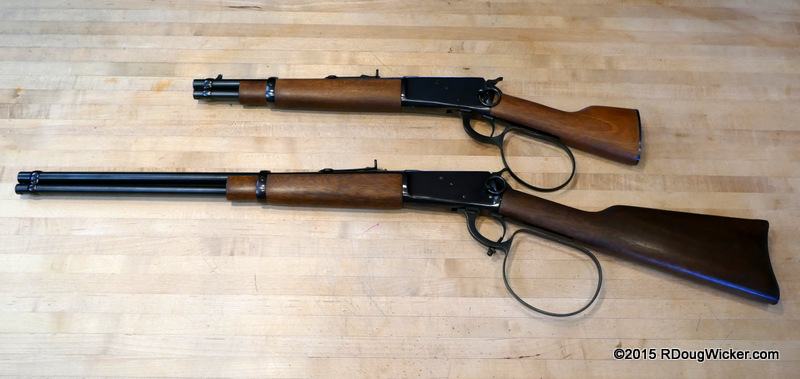
Mare’s Leg (top) — Pistol version of the M1892; Rifleman’s Rifle — Modified M1892 for trick handling and rapid fire

Two weapons bore the title of “The Gun that Won the West”.  The first was the aforementioned Winchester Model 1873.  The second was a pistol that coincidentally also made its debut in the year 1873 — the famous Colt Model 1873.  The Colt M1873 also went by several other names depending on configuration and caliber — two of the more common versions being the Single Action Army (.45 “Long” Colt), the Frontier Six Shooter (.44-40), and “The Peacemaker”.  Today, most people just refer to the Colt M1873 and its clones as Peacemakers, 1873s, or the SAA, short for Single Action Army.
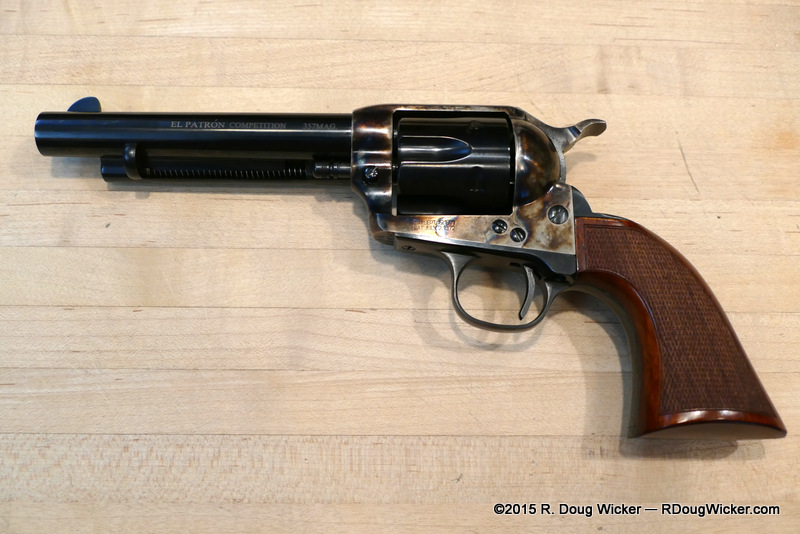
El Patrón — "The Boss"

El Patrón — “The Boss”

The M1873 you are looking at today is from Italian manufacturer Uberti, a maker of replica firearms that supplies re-branded Old West rifles and handguns to Benelli (Uberti’s direct owner), Beretta (owner of Benelli), Cimarron Firearms Company, and Taylor’s and Company.

Uberti Single Action Army box

Uberti Single Action Army box

Uberti’s El Patrón box comes with the following goodies —Instruction Manual, Instruction (be careful or you’ll shoot your eye out, kid) Sheet, Cylinder Lock, and, of course, an El Patrón Competition six-shooter.

Uberti Single Action Army — What's inside the box

Uberti Single Action Army — What’s inside the box

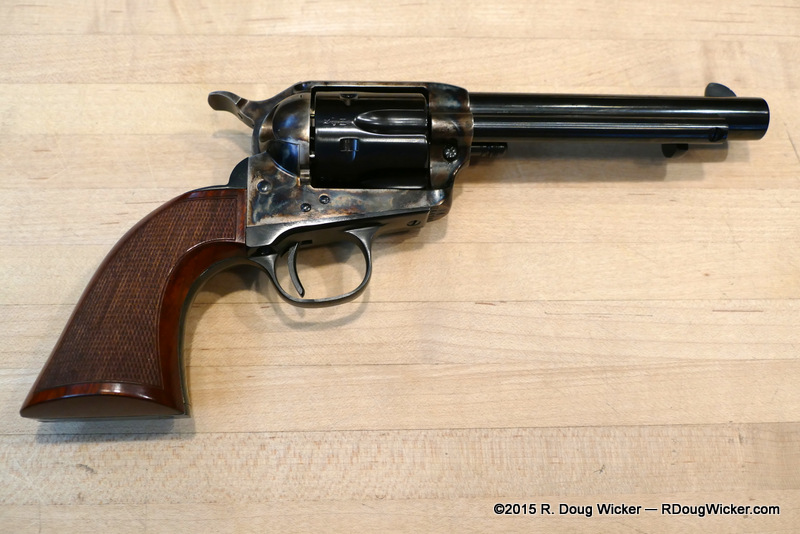
This particular Uberti is a special factory-tuned Cattleman “El Patrón Competition” model with lowered hammer for easier one-handed cocking and a very light trigger for competition shooting.  Other features include a blued cylinder, case-hardened frame, steel trigger guard and backstrap, and nicely textured walnut grips.  A stainless steel version is also available.  But, really?  This is an Old West firearm.  Stainless just wouldn’t look right.

Blued cylinder set in a case-hardened frame

Blued cylinder set in a case-hardened frame

Stamped into the barrel is the model name and caliber, in this case .357 Magnum.  That means this weapon will also handle the lower-powered, cheaper to fire .38 Special without a hitch.

Uberti El Patrón Competition barrel markings

Uberti El Patrón Competition barrel markings

I find the numbered cylinder an interesting and useful touch.  Since this is an almost exact replica of the original Colt, it is imperative that you leave the hammer down on an empty chamber for safety, and numbering the chambers makes that a snap.
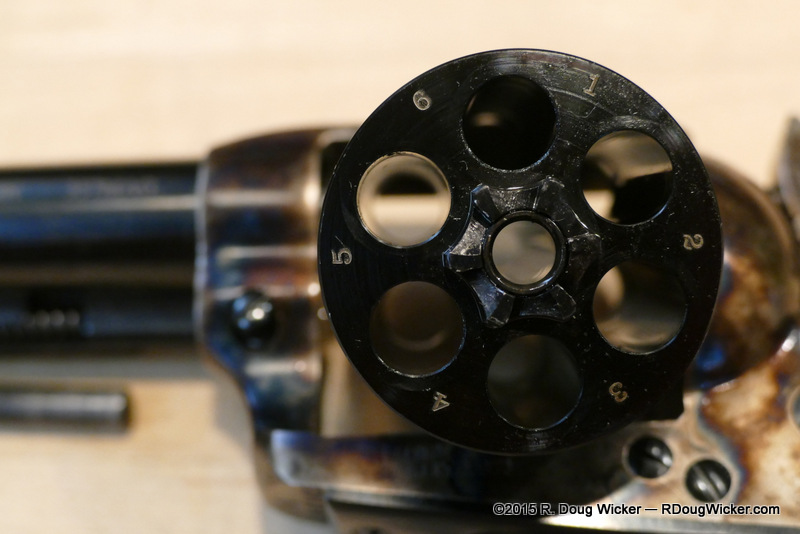
Numbered Chambers — a nice touch

Numbered Chambers — a nice touch

As anyone with experience will tell you, the proper way to accomplish this with the 1873 is to pull the hammer back to the half-cock position (don’t confuse that with a “safe” position; it isn’t), open the loading gate, rotate the cylinder to chamber 1, and load a bullet.  Now, skip chamber 6, then load in order chambers 5, 4, 3, and 2.  Loaded chamber five is now beneath the half-cocked hammer, and empty chamber six is the next in line.  Close the loading gate and cock the hammer to the firing position.  This will rotate empty chamber six into firing position.  With your thumb on the hammer, pull the trigger until the sear trips and then gently ride the hammer completely down against the frame.  Don’t release the trigger prematurely or the hammer will stop at the half-cock position.

Chamber #1 ready to load

Chamber #1 ready to load

It is possible to load five chambers in sequence, close the gate, and then carefully pull the trigger while gently pulling back the hammer until the hammer disengages from the half-cock position, then lower hammer onto the empty chamber.  But the problem with this method is that you then have to wiggle the cylinder until it locks up with the cylinder bolt, which was disengaged when the hammer was previously in the half-cocked position.  Rotating the cylinder and hopefully not inadvertently placing a loaded chamber beneath the hammer just doesn’t work for me.  I simply cannot recommend this method.
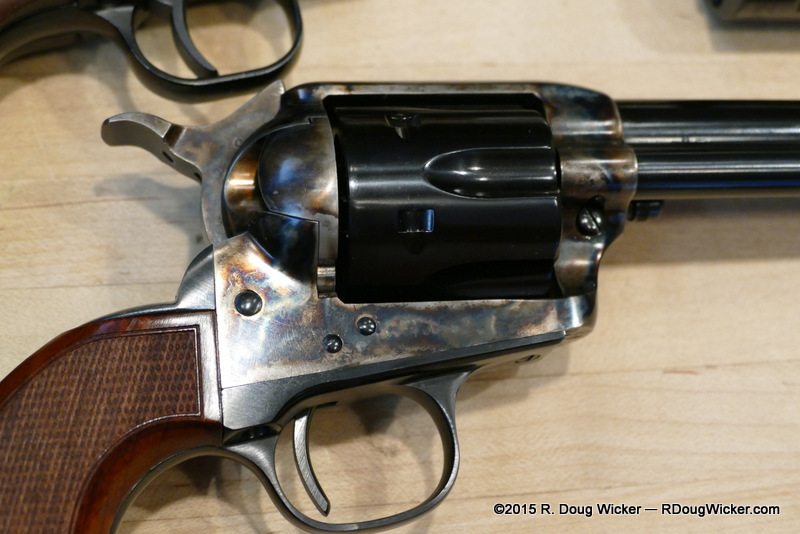
Loading gate, blued cylinder, and case-hardened frame

Loading gate, blued cylinder, and case-hardened frame

There is a third method that supposedly allows for safely carrying an 1873 with all six chambers loaded, but I’m certainly not going to do it.  That requires additional manipulation so that the firing pin built into the face of the hammer rests directly on the cylinder between the rims of two loaded cartridges.  Yeah . . . right.  I’m not doing it.

Case-hardened mottling

Case-hardened mottling

Disassembly is a snap.  Just pull the hammer to the half-cocked position, open the loading gate, push the spring loaded base pin latch, pull out the base pin (the long metal rod below), and remove the cylinder through the gate opening.  Reassembly is not quite as easy, at least for me.  You have to get the cylinder into just the right position before pushing the base pin latch and reinserting the base pin.  If it doesn’t all go together perfectly, the hammer cannot be pulled back beyond the half-cock position.  The trick here is to keep pushing on the base pin while wiggling the cylinder until the base pin snaps fully back into the frame.

Simple breakdown; reassembly not so much

Simple breakdown; reassembly not so much

Now for my impressions.  Bear in mind I’ve yet to fire this weapon.  That being said I can tell you that cylinder lockup is incredibly tight with barely any movement.  Both fit and finish are superb.  The Uberti emits the legendary ‘C-O-L-T’ cocking sound — that’s four distinct “clicks”, one for each letter in “Colt”, as the hammer is cocked back into firing position.  Because of the low-angle hammer and the custom Wolff springs, the Uberti is incredibly easy to thumb cock with no shifting of the hand required.  The trigger is by far the best I’ve encountered in any weapon.  There is absolutely no slack take-up, the break is clean and crisp with almost zero (less than a millimeter) creep, and the trigger weight feels to me as though it has to be well under three pounds.

Uberti Single Action Army and a Ruger Single-Six

Uberti Single Action Army and a Ruger Single-Six

So, show me favorably impressed.  The Uberti 1873 Cattleman El Patrón Competition is a solid, well-built, tight example of the classic, original Colt 1873 design.  Suggested retail is currently $669, or $799 for the blasphemous stainless model.  Calibers include .38SPL/.357 Magnum and .45 Colt, and barrel lengths come in 4.75 inches/120 mm, 5.5 inches/140mm, and a CMS (Custom Mounted Shooter) at 3.5 inches/90mm.

Now, if only Uberti would offer a Paladin Have Gun — Will Travel version with a 7.5-inch/190-millimeter “Cavalry” length.  Well, I can dream, can’t I?

1 Comment

Filed under Firearms, R. Doug Wicker

Fun Photo Friday — 1940 Zella-Mehlis Walther PP


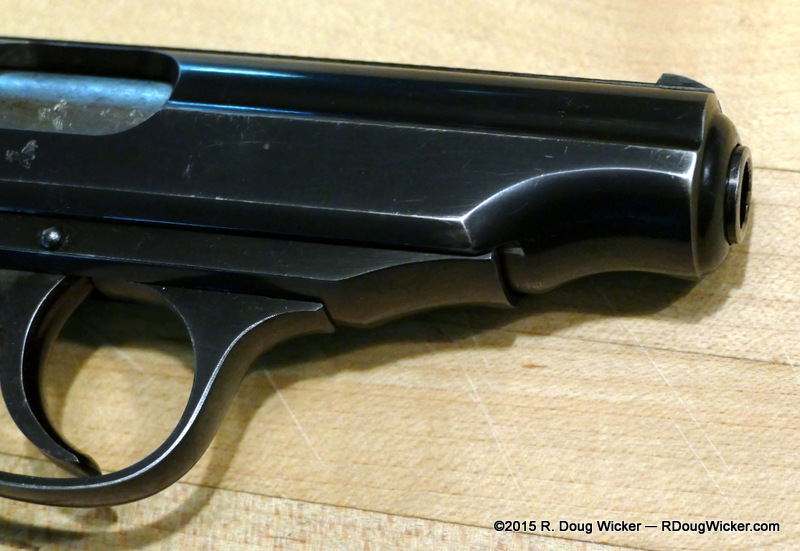
1940 Walther PP

1940 Walther PP

Well, it is firearm week.  So of course this week’s Fun Photo Friday had to contain a fun firearm photo session.

1940 Walther PP

1940 Walther PP

It pays to establish a good relationship with your favorite locally owned gun store.  It really does.  Indeed, for a collector it is vitally important to do so.

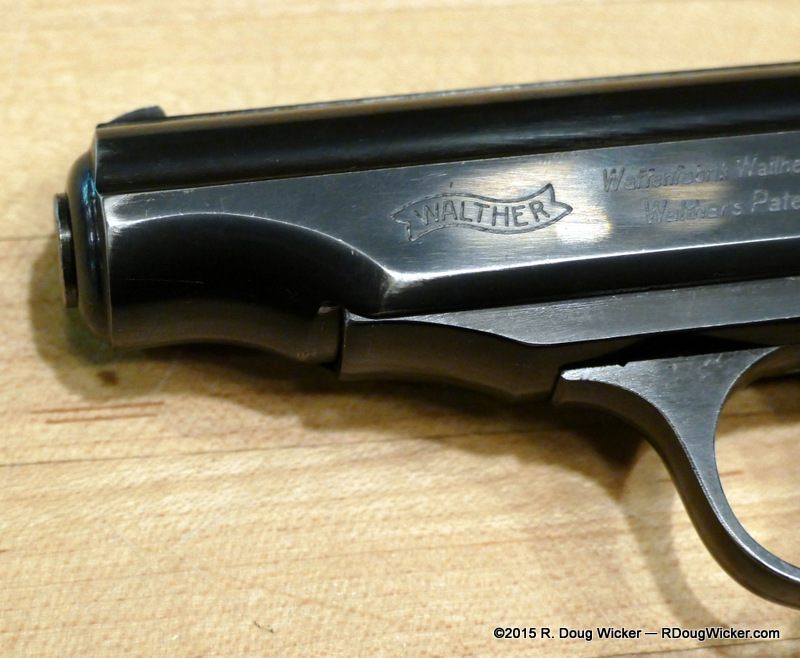
Zella-Mehlis roll mark

Zella-Mehlis roll mark

Part of that bonding is to convey to your dealer your tastes in collecting.  In my case, it’s a weakness for all things Walther.

Nazi Germany proof marks

Nazi Germany proof marks

What you see pictured here is not particularly rare, except for the condition of this 70-year-old artifact from 1940 Nazi Germany.  This is not a war piece, but rather a commercial version of the venerable 7.65mm/.32 ACP Walther PP double-action/single-action semiautomatic pistol.  It is perhaps the first truly successful DA/SA semiautomatic produced, and it was a mainstay of European military and police forces from its introduction in 1929 well into the 1980s.  Indeed, the shortened PPK version became the weapon of choice for everyone’s favorite fictional MI6 agent, the one with the Double-0 number.

Minor holster wear

Minor holster wear

As you can see, most of the original bluing remains intact with only minor holster wear and a few scratches marring the finish.

Minor holster wear

Minor holster wear

But the pistol did not come alone.  It came with a period-correct AKAH holster as well.

AKAH Holster

AKAH Holster

I took this AKAH to El Paso Saddlery for an examination to see if the leather was in need of maintenance.  It isn’t.

AKAH Holster

AKAH Holster

The boys at El Paso Saddlery said to leave it alone.  The leather is still supple and not in any danger of drying out as long as it is stored properly.

A little history here, if I could read it

A little history here, if I could read it

Unfortunately, the gun is not quite complete.  It came with a period-correct flat-base magazine, but was not accompanied by one with the finger rest extension.  That will have to wait while I find one at a reasonable price.

Period-correct magazine

Period-correct magazine

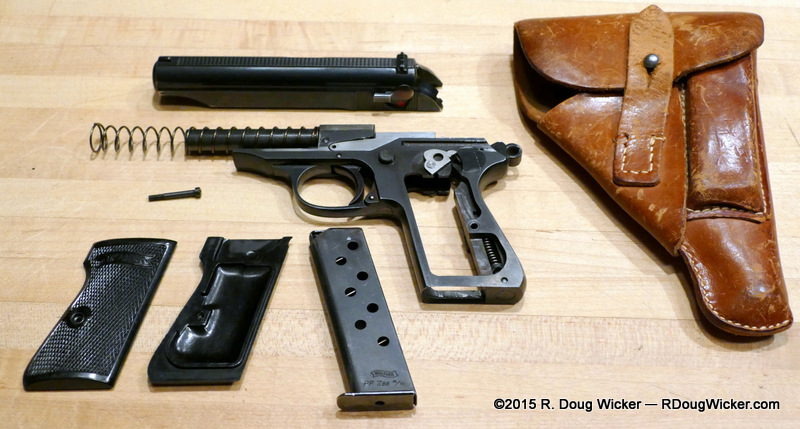
Internally the Walther PP is sound, and now clean.  I stripped away a lot of accumulated gunk and grime, but I may have a bit more work to do.

Disassembled view with AKAH Holster

Disassembled view with AKAH Holster

The loaded chamber indicator pin doesn’t seem to be under tension.  This could be because of a broken spring, or it could be something as simple as more gunk clogging up the channel above the firing pin even though the firing pin is operating normally.  To make sure I’ll need to do something I’ve not had to do before on any of my many PP-series Walthers, which is to remove the safety drum, firing pin, and loaded chamber indicator assembly.  If the spring is intact and functional, I’ll scrub out the channel and reassemble everything.  If not, it’s time to find a new spring — which I may go ahead and do anyway.

Firing pin and loaded chamber indicator channel

Firing pin and loaded chamber indicator channel

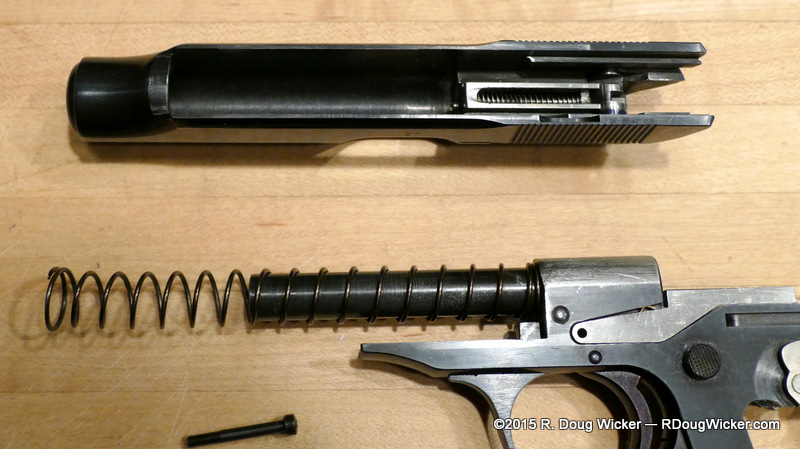
Enjoy one more look at this gorgeous pistol’s internal design:

Disassembled view

Disassembled view

3 Comments

Filed under Firearms, R. Doug Wicker

A Look at the Colt MK IV Series 70


Colt's Custom Shop Mk. IV Series 70 in stainless

Colt’s Custom Shop MK IV Series 70 in stainless

This week we’re taking a break from travel and photography and concentrating on another of my varied areas of interest — firearms. We’ll begin with a rather rare bird, a new Colt MK IV Series 70. The example you see here is in stainless steel.

But first a history lesson on the Colt “Government Model” M1911 Series 70 versus the Series 80, and the controversy surrounding the latter.

Colt's Custom Shop Mk. IV Series 70 in stainless

Colt’s Custom Shop MK IV Series 70 in stainless

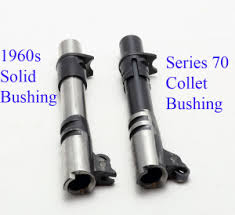
The MK IV Series 70 dates from the year 1970. It differed from the previous M1911A1 (1924) in that the pistol had installed a split barrel bushing (sometimes referred to as a “collet bushing”) to increase accuracy of an already very accurate handgun. The following photos from Hooper Gun Works illustrate the difference between the two bushings. The first show the differing bushings installed onto a Colt barrel, and the second is a close-up of the actual bushings:

Traditional bushing (left); Series 70 split barrel

Traditional bushing (left); Series 70 split barrel “collet” bushing (right); both installed on barrels


Traditional bushing left; split barrel bushing right

Traditional bushing left; split barrel bushing right

To be brutally frank about it, the split barrel “collet” bushing was a bit of a disaster. The fingers had a tendency to break off and jam the pistol. So, by 1988 the split barrel bushing gave way to a return to the solid bushing in later iterations of the Colt M1911 line.

Colt Mk IV roll mark

Colt Mk IV roll mark

Colt ended the MK IV Series 70 in 1983 with the introduction of the Series 80. This M1911 initially retained the split barrel bushing, but it incorporated a new feature hated by M1911 purists. It is theoretically possible that if a cocked-and-locked M1911 is dropped onto a hard surface in such a way that the muzzle strikes first, the free-floating firing pin may have enough inertia to overcome the tension of the firing pin spring and thus impact the bullet primer. This could produce an unintended discharge.

M1991A1 roll mark

M1991A1 roll mark

Colt addressed this concern in 1983 by redesigning the firing system to incorporate a firing pin block. The firing pin block is disengaged by the trigger mechanism as the trigger is pulled. So, why the controversy among 1911 purists? After all, isn’t increased firearm safety a good thing?

Apparently, not if it adversely impacts a great single-action trigger . . . or even if it’s merely imagined to do so.

Mk IV reverse side

Mk IV reverse side

Many claim that this trigger-deactivated firing pin block increased trigger weight and friction. I’ll be testing this claim on Wednesday with a video of a test I performed that pits the MK IV Series 70 pictured here up against a Colt M1991A1 with the so-called Series 80 trigger. Not in the video but outlined in the text on Wednesday are additional comparisons I performed with a stainless Colt M1991A1 chambered in .38 Super and another .45 ACP Colt M1991A1 identical to the one used in the video. I believe you’ll find the results most enlightening, and I’m sure very controversial among M1911 purists.

M1991A1 reverse side

M1991A1 reverse side

By now you’re asking, how the heck did Series 70 come to mean a trigger that dates from 1911 to 1983, while Series 80 describes the trigger system with a firing pin block incorporated in 1983? Good question, since the Series 70 was so designated not because of the trigger system, but rather because of the split barrel “collet” bushing — a bushing that continued on in the Series 80 pistol for some five years. The answer is convenience. It’s just easier to differentiate between the original internal trigger design of the M1911 to the later firing pin block design by referring to the two designs as “Series 70” and “Series 80” firing systems.

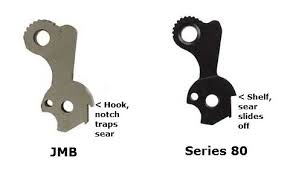
Here is another photo from Hooper Gun Works that illustrates one of the modifications made, in this case to the hammer:

Notched Series 70 hammer on left; shelved Series 80 hammer on right

Notched Series 70 hammer on left; shelved Series 80 hammer on right

(Note: There is a competing firing pin block design out there for the M1911 in which the firing pin block is deactivated by the grip safety rather than the trigger. It’s called the Swartz Firing Pin Safety, and it’s used by some competing M1911 producers such as Kimber and Smith & Wesson. Ironically, Colt pioneered the Swartz system in 1938, but dropped it after only three years because the U.S. military balked at the added expense, as did the civilian market. Modern manufacturing processes have allowed the economical reintroduction of the Swartz system, but Colt have stuck with the Series 80 firing system.)

Around the turn of the century it began to dawn on Colt that M1911 purists were leaving the fold for competing M1911s produced without the “trigger degrading” Series 80 firing pin block. This resulted in Colt reintroducing a “MK IV Series 70” that really isn’t much like the one produced from 1970 to 1983. For one thing, there was no return to the split barrel bushing. The Series 80 slide and frame were also retained, even if the firing pin block was removed. Of interest to some may be the fact that Colt continues to use in the reintroduced Series 70 the internals of the Series 80. That means the shelved hammer pictured above is still used rather than the earlier notched hammer. What Colt is giving you with the new MK IV Series 70 is in fact a Series 80 pistol with Series 80 trigger system parts, only without the actual firing pin block. This removes from the trigger-feel equation the internal movement that disengages the firing pin block.

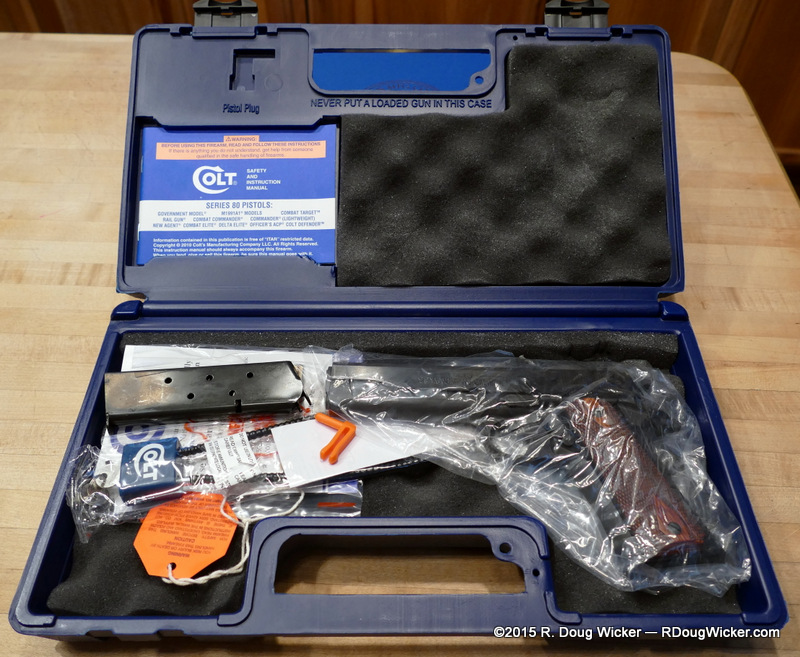
Well, there is one other difference. The new MK IV Series 70 is produced in very limited runs in the Colt Custom Shop. That means if you find one, you’re laying your hands fairly rare pistol. My source puts the annual production numbers of Colt Custom Shop MK IV Series 70s at between 500 and 1,000. Additionally, as these pistols originate from the Custom Shop, they ship in the famous blue “Colt Custom Shop” box, which alone is worth probably north of a hundred bucks.

Standard Colt plastic case next to Colt Custom Shop box

Standard Colt plastic case next to Colt Custom Shop box

Colt Mk. IV Series 70

Colt MK IV Series 70

Colt M1991A1

Colt M1991A1

Colt Custom Shop close-up

Colt Custom Shop close-up

Now let’s compare a MK IV Series 70 to an M1991A1 Series 80. Externally they appear much the same. Both are roll marked as “Government Models”. Both have nicely checkered rosewood grips. Finish is equally nice on these two examples, and slide-to-frame fit is exceedingly tight, as is the barrel-to-bushing fit. These are very tight pistols which I personally would not hesitate to put up against pistols costing two and three times as much.

Now for the differences:

  • The most obvious are the sights. Both pistols come equipped with High-Profile sights, but the M1991A1 sights use the three-dot system while the MK IV Series 70 is absent any such visual cue.
Combat sights vs. three-dot sights

Combat sights vs. three-dot sights

  • Less obvious is the trigger placement. The aluminum M1991A1 trigger is a longish affair protruding almost half way across the span inside the trigger guard. The stainless MK IV Series 70 is much shorter in length.
Short Mk. IV Series 70 trigger (top) next to the M1991A1 long trigger

Short MK IV Series 70 trigger (top) next to the M1991A1 long trigger

  • Least obvious of all is the backstrap below the grip safety. Both backstraps are grooved in this area, but the M1991A1 backstrap is straight while the MK IV Series 70 backstrap has a slight curve.
Mk. IV Series 70 curved backstrap (bottom); M1991A1 flat backstrap (top)

MK IV Series 70 curved backstrap (bottom); M1991A1 flat backstrap (top)

On Wednesday we’ll test conventional wisdom and put the Series 70 trigger to the test against the Series 80.

I would like to take this time to acknowledge the fine photo work of Hooper Gun Works, to which I linked in this blog.  Hooper probably explain the Series 70 and Series 80 difference better than I, so please give their wonderful article a look as well by clicking on the link below:

Hooper Gun Works article on the Colt Series 70

3 Comments

Filed under Firearms, R. Doug Wicker