Tag Archives: handgun

First Look: Smith and Wesson’s new Bodyguard 2.0 TS


Smith & Wesson’s new Bodyguard 2.0

Ursula and I made a recent stop at my favorite local gun store, Collector’s Gun Exchange. As I was perusing the shop, focusing mainly upon the more collectible firearms, salesman Cameron was playing around with a neat little pistol that had just arrived a very few hours earlier. He handed it over to me and asked what I thought of it. My first impression upon feeling the weight and noting the diminutive size was, is this a .22? Nope. It was the new Smith and Wesson Bodyguard 2.0, which comes chambered in .380 ACP/9mm kurz. I was immediately impressed. And when Cameron pointed out to me that this striker-fired elf came with a manual thumb safety, I was pretty much sold.

S&W Bodyguard 2.0 .380 TS (Thumb Safety)

And then I tried the trigger. Smooth, and light. Lighter than even my Sig P365 SAS (which I modified to include a manual safety), which I’ve carried for five years now, but not as good as the single-action mode on my previous carry weapon, the incomparabe Walther P99c AS. My only minor quibble was the longish takeup, about 5mm, with the reset coming in at about the same. More on the trigger later.

S&W Bodyguard 2.0 TS — comes with a 10-round and 12-round magazine

It’s nice that Smith and Wesson includes both a 10-round and 12-round magazine. It would be even better if S&W included a second 12-rounder for a total of three magazines, but since Sig Sauer only gave me two 10-rounders with the P365 I guess I’m not going to complain.

TS = Thumb Safety; NTS = No Thumb Safety

The Bodyguard 2.0 comes in two flavors — Rocky Road and Strawberry Cheesecake. No, wait. I’m thinking of something else. The Bodyguard 2.0 flavors are TS and NTS. The Bodyguard 2.0 TS is equipped with an ambidextrous Thumb Safety, and the NTS has No Thumb Safety. When it comes to a carry weapon, I’m all about the safety. All my carry pieces are either double-action/single-action, have a manual safety, or both. Holding the Bodyguard in my right had, I have no trouble disengaging or re-engaging the safety. Switching to the left hand did not go as smoothly for some reason. Unless my left thumb is drastically weaker than my right, which I doubt, this thing is just darn sticky on the starboard side of the firearm. I’ve been working the safety a bit, and it seems to be smoothing out.

Bodyguard 2.0 TS with ambidextrous manual thumb safety

Now back to the trigger. It’s a flat-face, which seems to be the current rage. And it does seem to assist somewhat in keeping a consistent pull. I rather like it. The pull weight is defintely nice, as well. A five-pull average on my trusty Lyman Digital Guage shows 4 pounds 3.6 ounces/1,915 grams. That certainly beats the P365, which comes in at 6 pounds 8.7 ounces/2,969 grams. For an additional comparison, the AS trigger on the Walther P99 was advertised as 4.4 pounds/2kg in single-action and exactly twice that in double-action. So, the P99’s single-action pretty much matches the Bodyguard’s pull weight.

Bodyguard 2.0 controls — takedown lever, slide lock, safety (engaged)

The Bodyguard’s takedown and reassembly beats the P365 hands down, but that’s because the SAS variant of the P365 swaps out an actual lever for a difficult-to-manipulate slotted head. One word of caution on taking down the Bodyguard: with the slide locked back, depress the ejector all the way down. It’s even more important to make sure the ejector is down before reinstalling the slide. Failure to do so will potentially snag the ejector and possibly damage it.
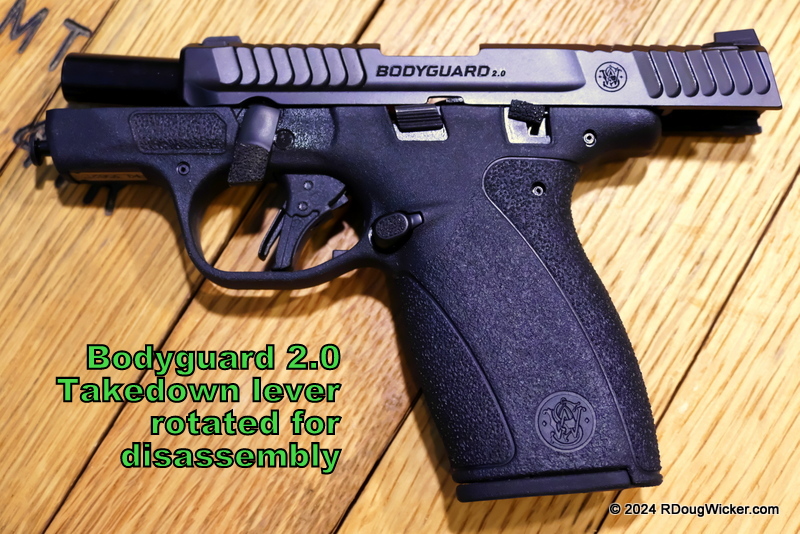
Bodyguard 2.0 ready for disassembly

To raise the ejector after reassembly, simply insert an empty magazine. If you don’t raise the ejector, the trigger will not engage the striker and you will be unable to function-check the firearm after getting it back together.

Bodyguard ejector in the raised position; make sure you lower it.

After removing the slide, everything else is a snap. Compress the guide rod and lift away from the barrel lug, then remove the barrel:
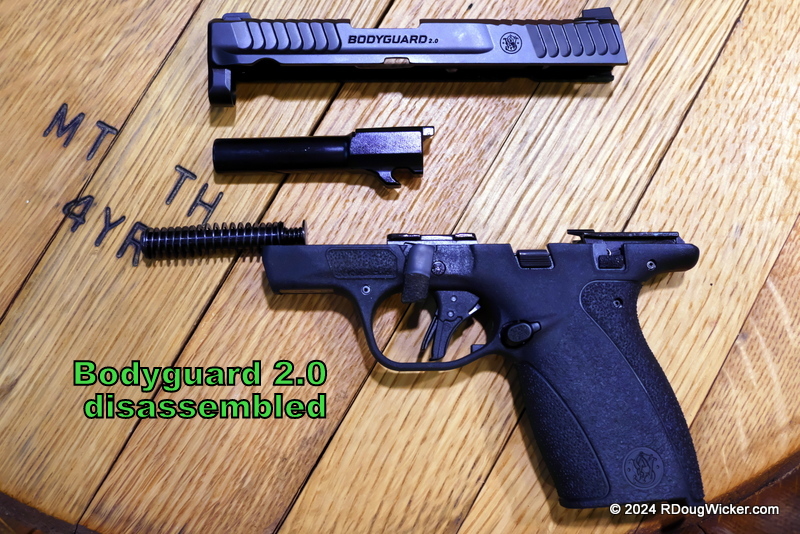
Disassembled Bodyguard 2.0
Slide with barrel and guide rod
Slide with barrel and guide rod removed
Frame with slide removed

Reassembly is not quite as easy. I had a dickens of a time reinstalling the guide rod. The darn spring just refused to compress. It was almost as if the spring was binding at the forward end of the rod when I placed it into the slide guide rod cutout. Several attempts to remove the guide rod and compress the spring with my fingers, and later a flathead screwdriver, took quite a bit of effort. But after repeated attempts I got the spring to move, and eventually got the guide rod back in, compressed, and reseated onto the barrel lug. I suspect I may have a faulty spring, but once I got it back in there was no binding.
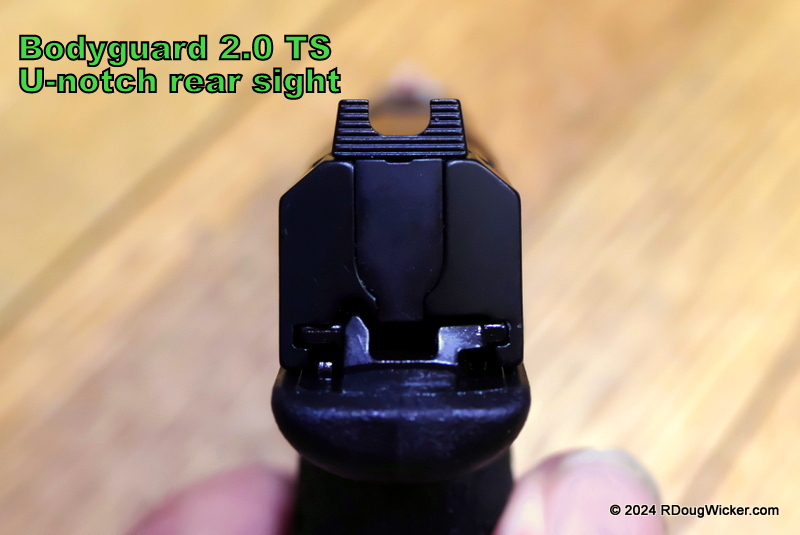
Bodyguard U-notch rear sight

The sights are a bit like a Spaghetti Western — There’s the good, the bad, and the ugly. The good is that the front sight is tritium with a high-visibility orange surround. The bad are that the tritium portion is very tiny. The ugly is the absolutely hideous U-notch rear sight — all black with no side indices for low-light acquisition and a ridiculously wide notch. There will be no match shooting with this handgun. But, then again, that’s not why it exists. Inside of 25 yards/23.8 meters I doubt I’ll have problems keeping on paper. I may not be as accurate in the dark, however. There’s simply no way to tell if I have the front sight within the notch, let alone have it centered left, right, up, or down. That’s certainly a minus in comparison with the P365’s Mepro FT Bullseye, even though the FT Bullseye also has its challenges in low-light situations.

Bodyguard 2.0 tritium front sight with orange surround

So, am I ready to swap out the P365? I think so. I’m definitely going to consider it after I’ve thoroughly checked out the Bodyguard for reliability. It’s smaller, much lighter, and holds the same number of rounds. The only downside is that I’ll be stepping down to .380 ACP/9mm kurz from the more powerful 9mm Luger. But, heck, I’ve even been known on occasion to carry .32 ACP/6.35 mm in a Beretta 3032 Tomcat or a Walther PPK and still not feel insufficiently armed.

S&W Bodyguard 2.0 vs Sig Sauer P365 SAS

I mentioned a moment ago that the S&W Bodyguard is considerably lighter than the Sig Sauer P365 SAS. I measured them today, both with empty 10-round magazines inserted. The P365 weighs 17.88 ounces/507 grams while the Bodyguard is a featherweight 11.48 ounces/326 grams.

S&W Bodyguard 2.0 vs Sig Sauer P365 SAS

S&W Bodyguard 2.0 TS Dimensions and Other Information:

  • Length: 5.5 inches/140mm
  • Height (with 10-round magazine): 4 inches/102mm
  • Width: 0.88 inches/22mm
  • Barrel length: 2.75 inches/70mm
  • Weight (with empty 10-round magazine): 11.48 ounces/326 grams
  • Capacity: 10+1 and 12+1 with included magazines
  • MSRP: $449
  • Street price: $399
S&W Bodyguard 2.0 vs Sig Sauer P365 SAS

Hopefully I’ll get out a range report soon. In the meantime, if you’ve any questions just leave me a comment.

Слава Україні! (Slava Ukraini!)

2 Comments

Filed under Firearms, R. Doug Wicker

End of the Road for the Best Striker-Fired Polymer Pistol Ever Devised


Walther’s superlative, innovative P99 AS and P99c AS

The Walther P99 AS died in 2021. Or was it 2022? Many sources site the former year, but I’ve recently seen one P99 AS with a CC date code, which translates to 2022. Or did the P99 AS die this year? In February, while Ursula and I were on our most recent travels, Walther announced the “Final Edition” of what is, in my view, the best striker-fired polymer-framed pistol ever devised. And that’s a real shame, but not unexpected. Walther has been one of the most innovative manufactures of firearms over the past century. Alas, incompetent marketing has always been Walther’s undoing. The P99 AS was no exception to this propensity to make great weapons, and then fail to follow up on actually selling the darned things. The double-action/single-action semiautomatic? Walther invented that entire genre with its PP in 1929, then let the design gather dust until it was too late to salvage it with the far superior PP Super that came out 43 years later. The dropping block locking system? Walther pioneered that concept in the P38, but when you think of the dropping block today it’s the Beretta 92 that comes to mind. A double-action/single-action striker-fired pistol? Others claim to make such a beast, but the P99 possesses the only true DA/SA system with two different trigger pulls… or is it three?

A Walther P99 AS (Anti-Stress trigger) made in 2017 (BH date code)

The AS (Anti-Stress) trigger developed for the P99 has a double-action mode that rates at 8.8 pounds/4 kilograms and a .55-inch/ 14mm trigger pull length, and a single-action mode measuring exactly half that amount — 4.4 pounds/2 kilograms — and a much shorter .31-inch/8mm trigger pull length. Channeling Ron Popeil, “But wait! There’s more!” There is in fact a third trigger mode, the Anti-Stress mode. That mode mates the single-action’s 4.4-pound trigger with the double-action’s longer .55-inch pull length. The intent of this design was to give police departments and military personnel a margin of safety in stressful situations should they opt to carry the P99 AS with a cocked striker.

Walther P99 AS trigger position for anti-stress or double-action modes
Walther P99 AS trigger in single-action position

A careful pull of the P99 AS will reset the trigger from anti-stress to single-action, although I don’t recommend staging the trigger unless you’re on target and ready to fire. You definitely don’t want to carry a P99 AS in that configuration. That’s just asking for trouble.

When you first chamber a round, the P99 AS defaults to the anti-stress trigger. So, how do you switch that to the even safer double-action? You depress the decock button atop the slide and within reach of your thumb if you’re a righthanded shooter.

P99 AS decocker for placing the trigger into double-action mode

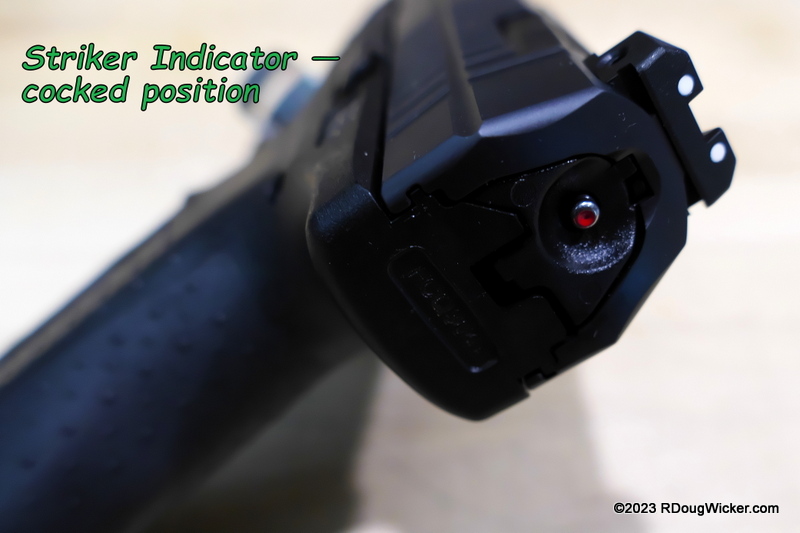
There’s even a nifty indicator on the P99 AS that tells you if the striker is cocked. It’s at the back of the pistol, and it looks like this:

P99 AS indicating a cocked striker (either single-action or anti-stress modes)
P99 AS — if you don’t see red, the striker is decocked and the weapon in double-action

An added benefit to the striker indicator is that as you are pulling the trigger in double-action, the indicator emerges to give you a visual indication that the sear is about to trip.

Walther P99 AS with an aftermarket threaded barrel

But what if you need to place an accurate shot at a distant target? There’s no hammer to thumb back, as you would on a traditional DA/SA pistol or revolver. So how do you transition the P99 AS from double-action to anti-stress without racking the slide and ejecting the round already chambered? It’s actually quite simple. You merely snick back the slide about a quarter of an inch. The striker cocks, the indicator protrudes from the rear, and the trigger remains at the double-action pull length. This is quite simply the most versatile and, in my opinion, the safest striker-fired system ever devised. I mean, other than a manual thumb safety, what’s safer than a stiff, long double-action first pull? Answer: Nothing! Even better is that the P99 came in a smaller 10+1 capacity compact version, predating the SIG P365’s 10-shot double-stack wonder by two full decades. Behold the P99c AS, in which the “c” stands for compact:

Walther P99c AS — my choice for concealed carry for a decade

That marvel weighs 20.8 ounces/590 grams (with an empty magazine). Other measurements are:

  • Lenth: 6.6 inches/168mm
  • Height: 4.3 inches/110mm (with flush-mount magazine)
  • Width: 1.26 inches/32mm
  • Barrel: 3.5 inches/89mm
  • Capacity: 10+1 (9mm)/8+2 (10mm); will accept the full-size 15-round (12-rounds in 10mm) P99 magazine with a sleeve

Compare that to the more recent SIG P365:

  • Weight: 17.8 ounces/504 grams
  • Lenth: 5.8 inches/147mm
  • Height: 4.3 inches/110mm
  • Width: 1.0 inch/25mm
  • Barrel: 3.1 inches/79mm
  • Capacity: 10+1 (9mm); 12 and 15-round magazines available

Twenty-six years may separate these two weapons, but not much else does. I say twenty-six, but that’s based upon when the P99 hit the market in 1997. Development actually began about four years earlier.

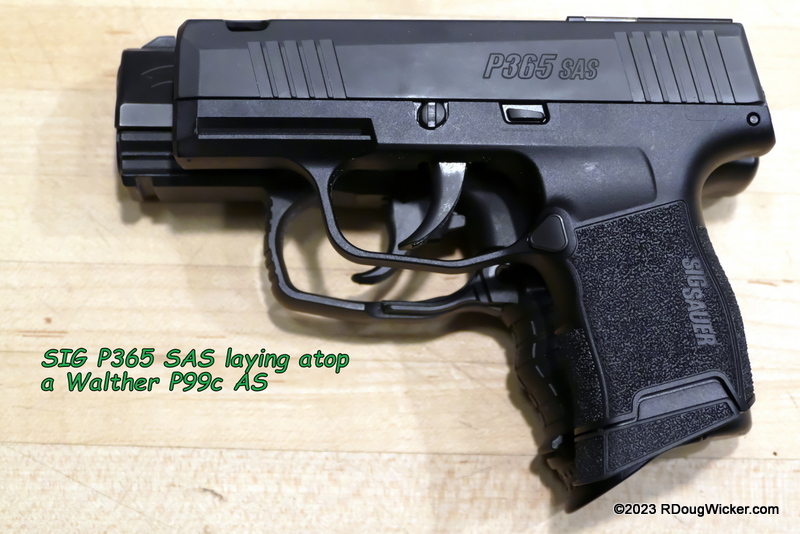
SIG P365 SAS over a Walther P99c AS

When the P99 first arrived on the scene there was no “AS” in the name. It only came with the AS trigger, so that would’ve been redundant. But here’s where Walther falls down on marketing. Not content with the marvelous and innovative Anti-Stress trigger, Walther began copying inferior striker-fired offerings from less innovative companies. There was the P99DOA (Double-Action Only) and the P99QA (Quick Action trigger with emulated the partially loaded striker of, shudder, the Glock). But why? The Walther P99 AS trigger was already at the apex of striker-fired weapons, and additional trigger configurations only managed to confuse the market and any potential customers. If some police department wants to buy a cheap Glock with an inferior trigger, one does not dumb down one’s superior product going after that market. You instead shoot (pun intended) for those departments that recognize quality, innovation, and safety, and are willing to pay a bit more for it.

Walther P99c AS dated 2014

And then things got even more confusing. Smith and Wesson entered the picture with the SW99 and SW99c (2000-2004) with frames made by Walther and most of barrels and slides made by Smith and Wesson. Smith and Wesson then proceeded to further add to the confusion by coming out with the SW99O (Double-Action only with no decocker), SW99 QA (Quick Action trigger comparable to the, shudder, Glock), and the SW99L (basically a rebranded SW99 QA minus the decocker). The only thing good to come out of the SW99/Walther collaboration was that a version of the P99 in .45 ACP became available, the SW99 .45:

Smith and Wesson SW99 .45 ACP with 9+1 capacity

At least Walther’s next collaboration led to an actual improvement, but unfortunately that didn’t last long because Magnum Research followed Walther’s lead and botched their marketing as well. Behold a beautiful long-slide variant of the P99 AS with a 4.5-inch/116mm barrel, the elegant and refined MR9 Eagle:

Long-slide version of the MR9 variant; frame by Walther, slide and barrel by Magnum Research
Magnum Research MR9 and its progenitor
Full-size P99 AS vs Magnum Research MR9 long slide

And if that Magnum Research version of the P99 was too big for you, the MR9 also came in the original 4-inch configuration. The MR9 was produced between 2011 and 2015. By the way, if you take a closer look at the MR9 and SW99 you’ll note that the ambidextrous magazine release levers are much shorter than the P99 pistols shown in this article. These are the magazine release levers that adorned the original Generation 1 P99. Also carried over from the Generation 1 is the “ski hump” inside the SW99 trigger guard.

Smith and Wesson SW99 alongside the Magnum Research MR9
SW99 and MR9

But enough about the collaborations. Let’s look at what comes with the typical full-size P99 AS right out of the case. As you can see below, Walther was yet again well ahead of the competition with modular backstraps to adjust the grip, front sights of various heights to adjust the point of aim, and an Allen wrench to install those sights:

Walther P99 AS and included accessories

There is one Walther P99 collaboration with Poland I’ve not yet covered. That would be Fabryka Broni Radom‘s double-action only P99 RAD. Yep. Another addition to the P99 confusion, and another example of why Walther is terrible at marketing.

And then there’s the unlicensed P99 AS clone from Canik of Türkiye (see also: Canik USA, importer Century Arms). It’s a remarkably close copy, right down to the decock button, striker indicator, and the operation of the three trigger modes, but the trigger on the Canik TP9DA is not nearly as refined as that on the P99. When I picked up a TP9DA and tried the trigger several years ago I gave the pistol a hard pass despite the much lower price. After Walther’s Final Edition runs out, however, the Canik may be your last shot (pun intended) at a new pistol with an Anti-Stress trigger. And, yes, Canik also cloned other P99/SW99 configurations as well: the TP9SA (single-action only with decocker) and TP9SF (single-action without the decocker).

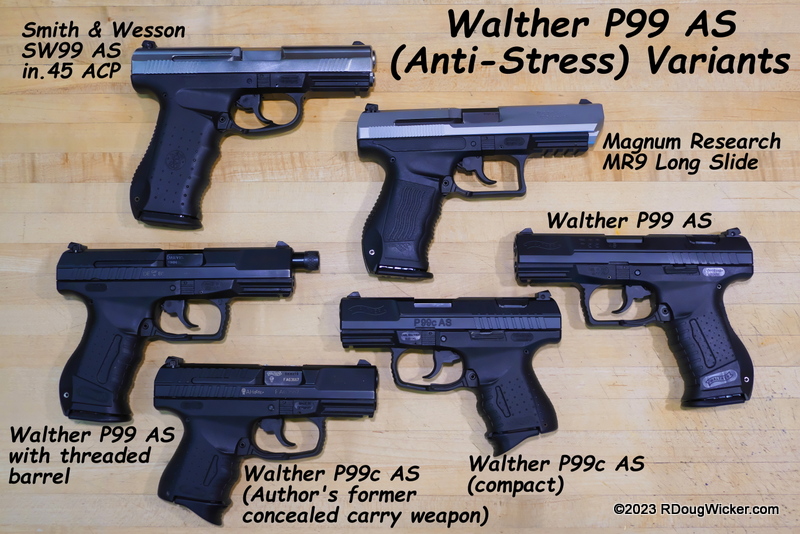
Anyway, let’s peruse this P99 AS Family Portrait:

Walther P99 AS Family Portrait, including cousins from S&W and MR

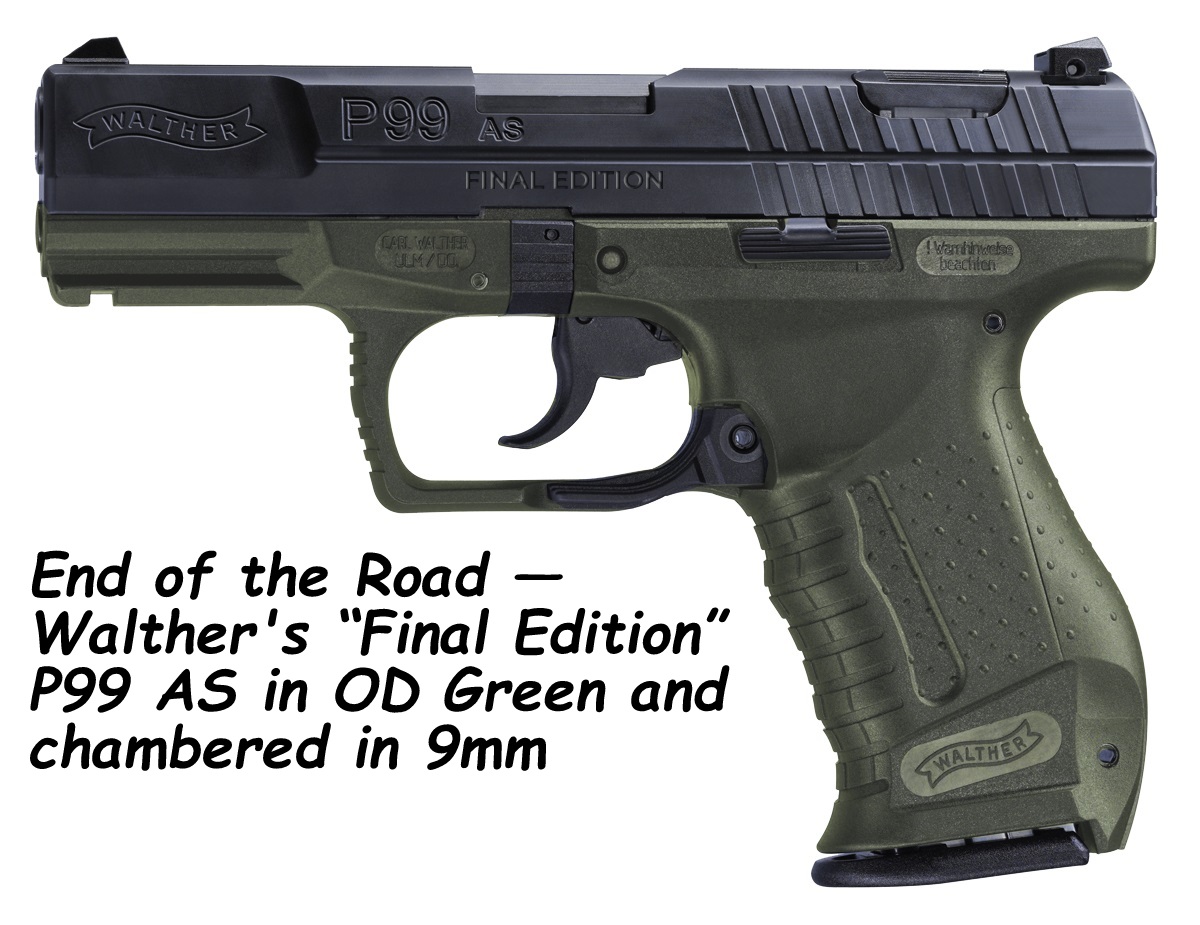
One last look, this time at the Final Edition P99 AS currently being offered by Walther in a hideous OD Green:

The End of the Road for the Best Ever Made

Слава Україні! (Slava Ukraini!)

Comments Off on End of the Road for the Best Striker-Fired Polymer Pistol Ever Devised

Filed under Firearms, Fun Firearm Friday, Opinion Piece, R. Doug Wicker

Fun Firearm Friday — Collectible 1938 Smith & Wesson K-22 ‘Outdoorsman’


1938 Smith & Wesson K-22 “Outdoorsman”

Today I’m going to present a first look and firing review of a very special firearm. This is a highly collectible prewar Smith & Wesson K-22 ‘Outdoorsman’. So, just how rare is this target-grade .22 LR pistol? The first edition K-22 was introduced in 1931, and in 1940 the ‘Outdoorsman’ was superseded by a second generation version marketed as the K-22 ‘Masterpiece’. In 1941 production ceased altogether as Smith & Wesson geared up to support the war effort.

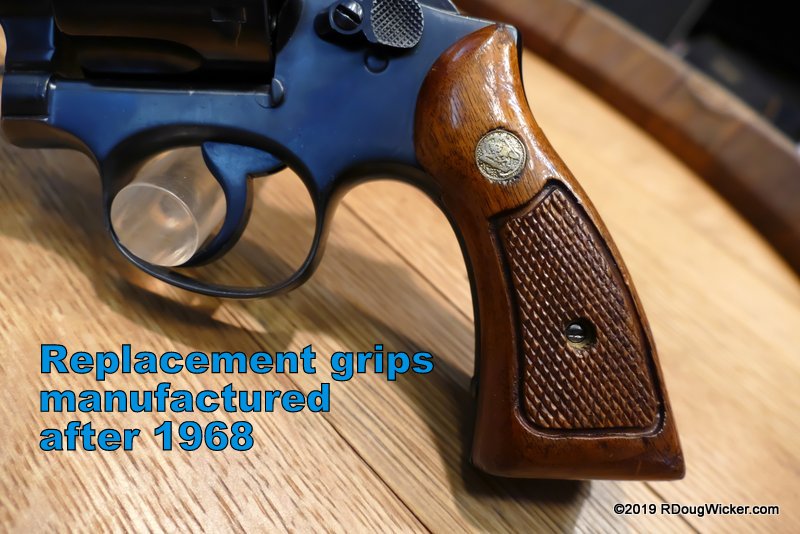
When I first saw this handgun I had an inkling that it was probably prewar because it lacked the ribbed barrel of every postwar K-Frame (medium frame) Smith & Wesson I’ve ever seen. That pencil-thin tapered barrel just looked so elegant compared to the later ribbed barrels. But I wasn’t sure, as the gun was merely tagged for sale as a, “Smith & Wesson .22,” with no further information. So, I went home and did some research, started getting excited when I thought I recognized what it was, called the store for a reading of the serial number, and verified that this was indeed a rare prewar K-22, probably with incorrect grips installed as they lacked the familiar diamond pattern surrounding the screw holes.

Replacement S&W grips

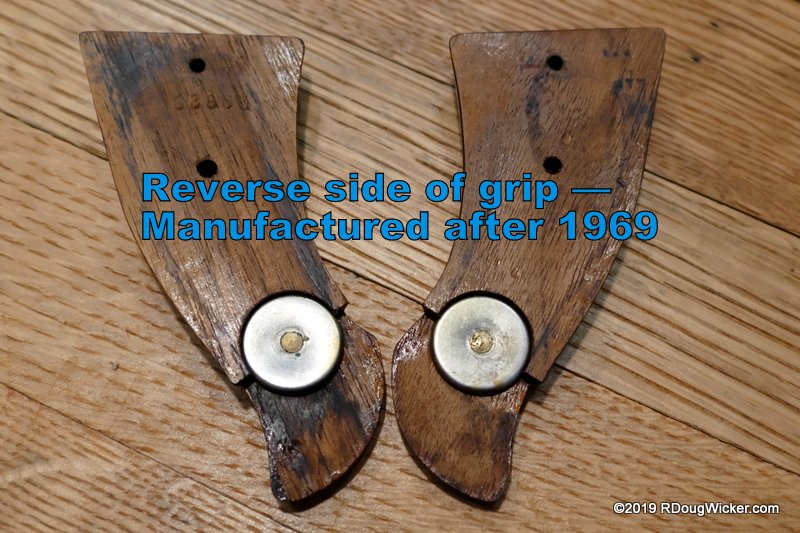
Once I got the K-22 home I removed the grips and verified that they were indeed not the originals. The factory-installed grips would have the gun’s serial number marked on the insides:

Period-incorrect grips — Made after 1969

Grips not serial numbered to this gun

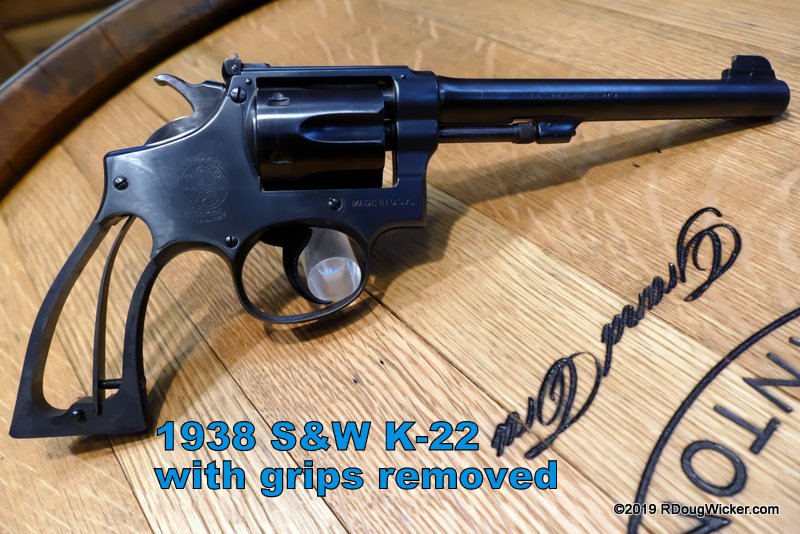
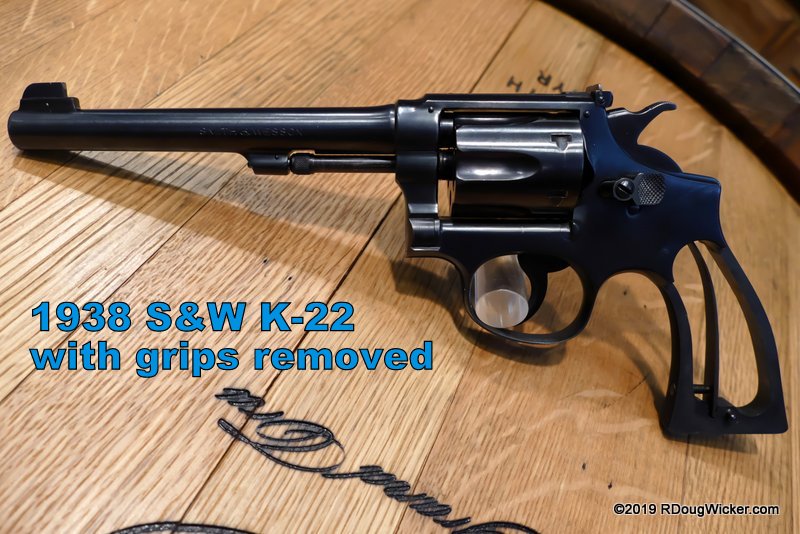
While we have the grips off this K-22, let’s take a look at what’s beneath them on the frame:

S&W K-22 grips removed

S&W K-22 grips removed

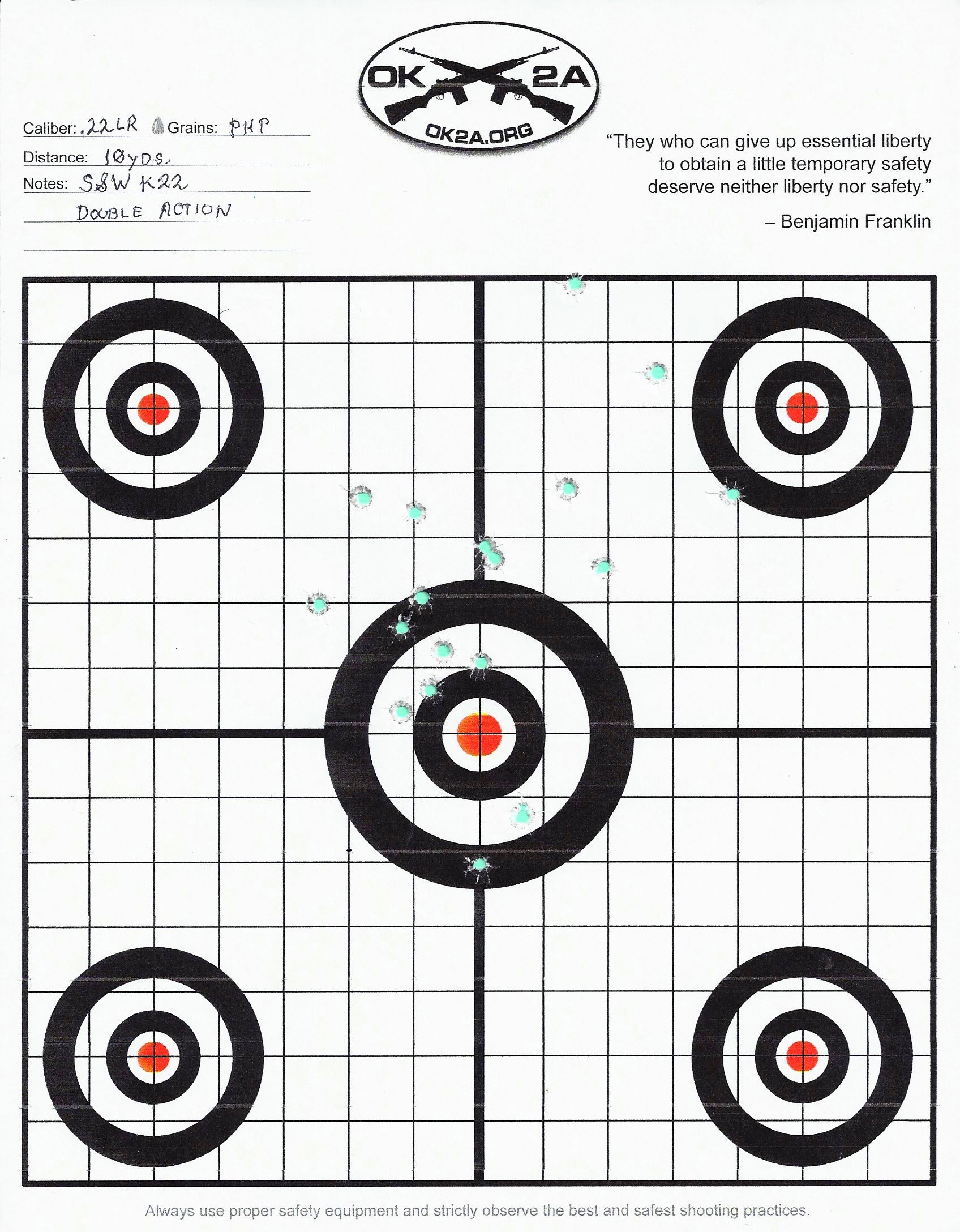
Production of the K-22 ‘Outdoorsman’ ended December 28, 1939. The total number made was 17,117 before the launch of the improved ‘Masterpiece’ K-22 in early 1940. The prewar K-22s, both the ‘Outdoorsman’ and the second generation ‘Masterpiece’, sported a non-ribbed 6-inch/152mm round barrel, adjustable rear sights, a trigger set between three and four pounds/1.4 to 1.8 kilograms, checkered Circassian walnut grips, all in a package weighing in at about 35 ounces/990 grams. With the K-22 came a Smith & Wesson claim that the gun was capable of shooting 1.5-inch/38mm groups at an astounding 50 yards/45.7 meters. That’s a lot better than I’m capable of as you can see from the two targets presented below (but in all fairness I shot free-handed rather than bench-resting the pistol). The targets I used were ones I printed on 8.5×11-inch/216x279mm standard letter-size paper.

The first target displays 18 rounds fired in single-action at a distance of 10 yards/9.1 meters:

8.5×11 target, 10 yards, 18 rounds, single-action

This next target shows 18 rounds fired in double-action at a the same distance:

8.5×11 target, 10 yards, 18 rounds, double-action

Oddly enough, I did better at double-action, but I’ve found over the years that the longer, heavier trigger pull in double-action forces me to maintain tighter concentration and control when I’m firing — pretty much the opposite of the rest of the shooting world, I’m sure. Plus, I’d just completed testing a single-action only 1973 Ruger Super Bearcat with a much lighter trigger, so I may have been thrown off by that as well.

As far as I can tell, the K-22 retailed for around $40 (S&W billed dealers $22.19 for them in 1935). In today’s money, that $40 works out to $624. Keeping in mind that this was in the midst of the Great Depression, it’s a wonder the K-22 found the audience that it did. Being billed as pistol suitable for both hunters and marksmen, the K-22 came equipped with an adjustable rear sight:

Adjustable rear sight and blued hammer

The K-22 initially came with a Call gold bead front sight (named after Charles Call), but that was changed to a higher-visibility ‘silver’ (actually stainless steel) bead about 500 pistols into production:

Silver bead front sight used after first year of production

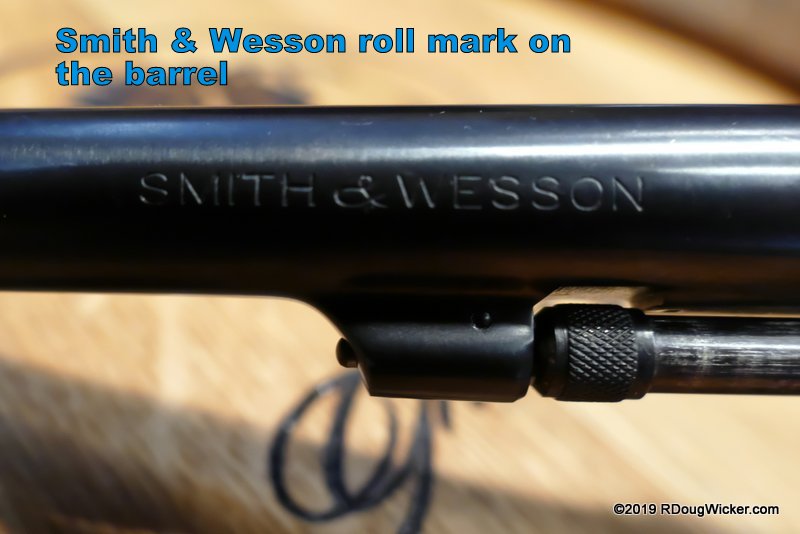
Typical roll marks and stamps on the K-22 ‘Outdoorsman’ include the following:

Smith & Wesson roll mark

S&W trademark logo

S&W patent markings

K-22 caliber mark

“MADE IN U.S.A.” stamp

I already mentioned that the grips that came with this example were not original to the gun. There is one other anomaly that I saw as well. On every K-22 I’ve found pictured on the internet, both prewar and postwar, all are equipped with case hardened triggers and hammers. Not so this example. Both are blued, and I suspect they did not come this way from the factory:

Trigger blued rather than case hardened

Hammer blued rather than case hardened

The reason that I only suspect this is because I did not receive from the Smith & Wesson historian confirmation on this even though I pointed out the bluing when I sent in photographs along with a request for the gun’s history.

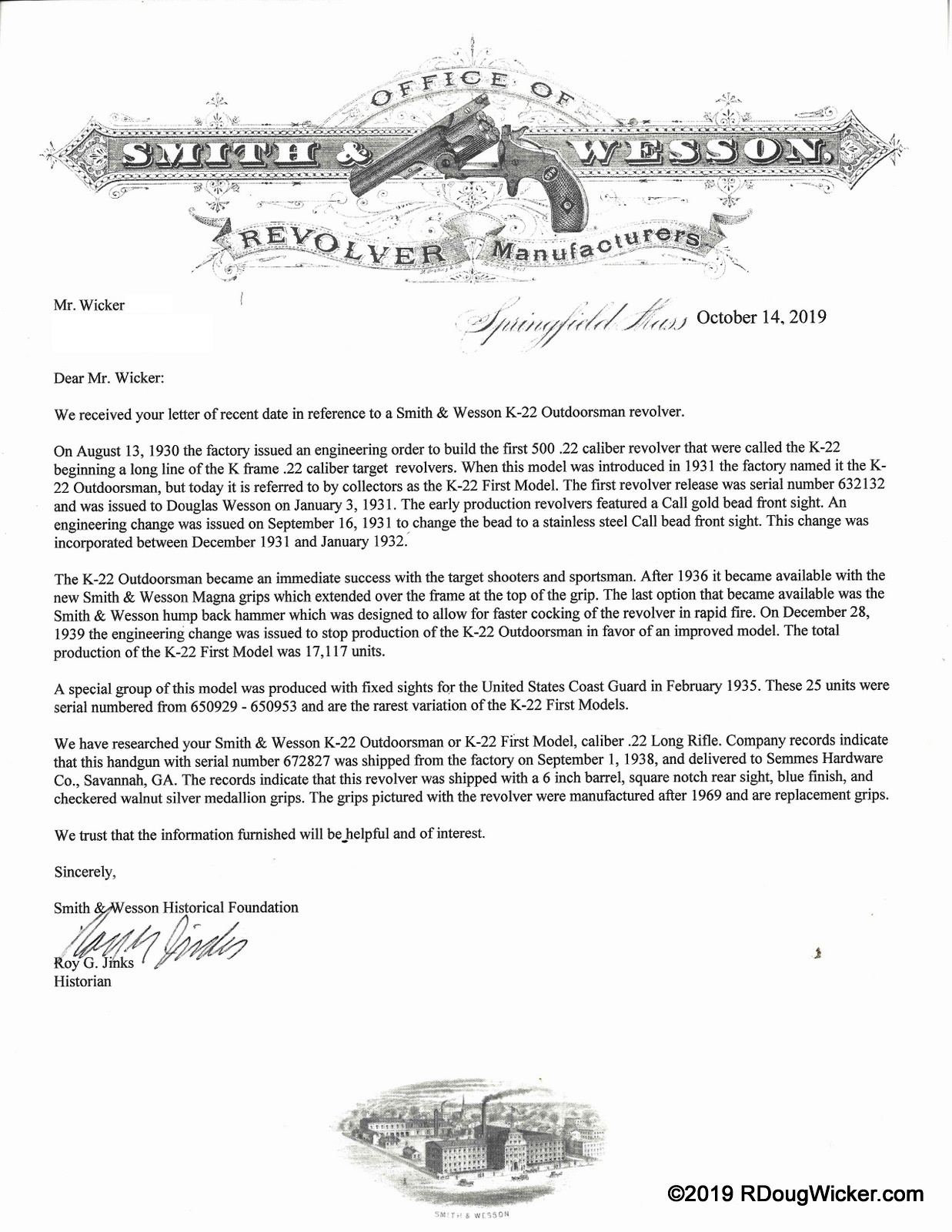
Most of the letter sent back from the S&W historian is boilerplate typical of other S&W history letters I’ve seen:

S&W Historical Foundation letter for this specific K-22

You have to get past the first four paragraphs to get to the specifics of this particular K-22, which I’ve cropped out below:

S&W Historical Foundation letter — Information specific to this K-22

A quick note about these Smith & Wesson Historical Foundation letters. If you have a Smith & Wesson firearm made between 1920 and 1966, obtaining a history on that firearm is something you should really consider. It’s fun researching where your gun first headed from the factory, and you may even get more history on it. I’ve seen at least one letter for a pristine, like-new K-22 with original box and manual that turned out to have been shipped to a police department for training purposes.

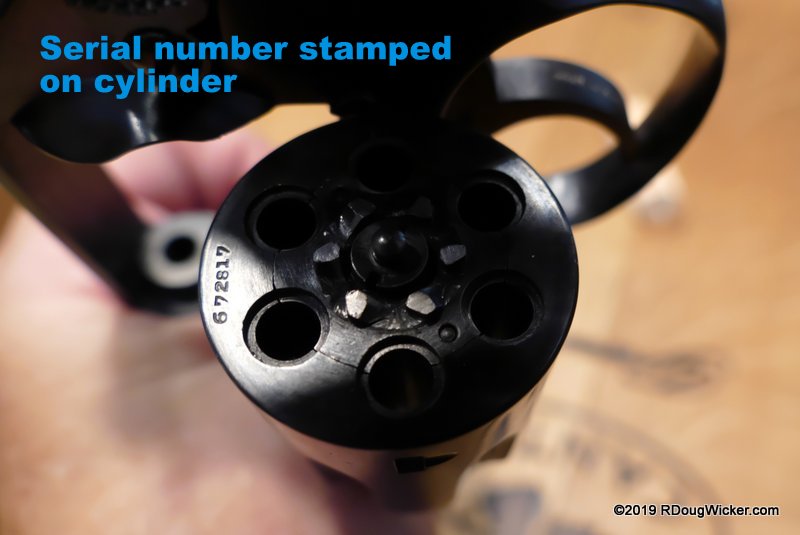
Now onto the subject of serial numbers for these pieces of prewar history. Any collector will tell you that the value of a collectible falls considerably if the gun is not fully ‘matching’. By matching, I mean all parts are original to the gun. On the K-22 Outdoorsman there are three places you need to check for this match. The first place to look is to turn over the gun and check out the primary serial number on the base of the frame butt:

Serial number stamp — Frame grip butt

Now it’s time to check the cylinder for a match:

Serial number stamp — Cylinder

And, finally, as we have the cylinder swung out away from the frame, let’s turn over the gun and look at the flat portion at the base of the barrel for one more match:

Serial number stamp — Under barrel

There is one more number stamped on these weapons, but it is not related in any way to the serial number. Again, with the cylinder swung out, look at the frame just below where the pinned barrel is mounted. Here you will find a number that was used internally at Smith & Wesson. The purpose of this number was to assist the craftsmen who handcrafted these works of art. This is an assembly number that assisted in keeping together until final assembly the parts meant for a particular gun:

This number was used by the factory to facilitate hand fitting of parts

I hope you enjoyed this little bit of firearm history at least half as much as I enjoyed researching it. For additional information, may I suggest the following articles:

American Rifleman article: A Look Back at the Smith & Wesson K-22 written by Dave Campbell; November 13, 2012

Gunblast article: Smith & Wesson K-22s written by Mike Cumpston; January 8, 2003

One last look at this nice example of a prewar (1938) Smith & Wesson K-22 Outdoorsman:

Prewar Smith & Wesson K-22 “Outdoorsman”

Comments Off on Fun Firearm Friday — Collectible 1938 Smith & Wesson K-22 ‘Outdoorsman’

Filed under Firearms, Fun Firearm Friday, R. Doug Wicker