Tag Archives: firearm collecting

Beretta Week — 84B “Cheetah” from 1982


Beretta Family Portrait of this week’s subjects

Next week I start a new travel series, but in the meantime, this is Beretta Week. Can you guess from the image above what’s on tap today, Wednesday, and this week’s Fun Firearm Friday? Hint number one: Although it looks similar to the larger and much more famous Beretta 92, the firearm on the left is a smaller blowback pistol chambered in .380 ACP/9mm kurz. Give up? Well, then, the one on the left is a Beretta 84 Cheetah. Specifically, the firearm we’re perusing today is an 84B dating back to 1982.

Beretta 84B “Cheetah”

I’ve clued you in on the remarkable Beretta 81-series pistols before, but with the current FS models. First was in November of 2016 with Shooting a Pair of Cheetahs — Comparing the Beretta 84FS and 85FS. I followed up in February 2019 with a bit of a rarity: Beretta 81FS Cheetah — And tips on gun collecting. Today we’re going back in time, back to when the Beretta 84B was produced. That would be during the short span from 1980 to 1984.

Beretta 84B with “PB” (Pietro Beretta) medallion missing

You’ll note that this example is in remarkable condition for a handgun celebrating its 38th birthday. Save for the left grip missing the “PB” — short for Pietro Beretta — medallion, there’s not much here about which to complain. The bluing is in good condition, the factory wood grips are relatively unmarred, and a replacement “PB” medallion has been ordered and should be here by the time you read this! And while you’ll note from the image below that this example came with a factory box, don’t get too excited. I wasn’t.

Beretta 84B factory box

I mean, sure, it looks complete, but there’s a catch:

Beretta 84B box, warning card, cleaning rod, and owner’s manual

This box, while correct for the 84B and the year this example was born, is not the box originally issued to this specific firearm. How did I know this before I even decided to take it? Simple. The serial number on the label doesn’t match that on the firearm. Neither the clerk nor the store owner had noticed the discrepancy. This is something to watch out for when you think you’re getting a complete set on a collectible.

Right era box; wrong firearm

Nevertheless, that’s not that big a deal. It beats the later expense of having to purchase a correct era box and owner’s guide on eBay. Besides, this example was not priced out of line even for a firearm that was missing the extras. And it’s always great to have an original owner’s manual:
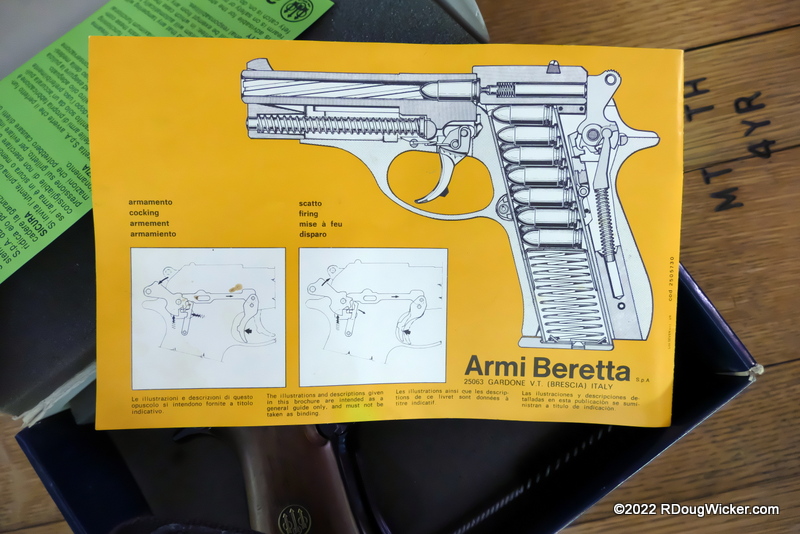
“Armi Beretta” translates to Beretta Weapons

Now time for a little history lesson. The Beretta 81-series pistols began life in 1976, and would eventually include Cheetah models 81, 82, 83, 84, 85, 86, 87, 87 Target, and 89.  If you’re wondering about those designations, here’s a breakdown:

  • Model 81: .32 ACP/7.65mm with 12-round, double-stack magazine and wide grip
  • Model 82: .32 ACP/7.65mm with 9-round, single-stack magazine and thin grip
  • Model 83: .380 ACP/9mm kurz with 7-round, single-stack magazine, and longer 4-inch/102mm barrel
  • Model 84: .380 ACP/9mm kurz with 13-round, double-stack magazine
  • Model 85: .380 ACP/9mm kurz with 8-round, single-stack magazine
  • Model 86: .380 ACP/9mm kurz with 8-round magazine; differs from other Cheetahs in that it has longer 4.37-inch/111mm barrel, and a unique tipping barrel that allows a round to be dropped directly into the chamber rather than necessitating a load from the magazine
  • Model 87: .22 LR with 10-round magazine
  • Model 87 Target: .22 LR with one of the longest barrels in the Cheetah line at 5.91 inches/150mm
  • Model 89: .22 LR with 8-round magazine; this is the competition model of the Cheetah series; it has the longest barrel at 5.98 inches/152mm and weighs in at a rather hefty 41 ounces/1,160 grams.
  • Browning BDA380: Now, this one is a bit tricky. The BDA380 was indeed based upon the Beretta 81 and 84, but examples were made not only by Beretta (.380 ACP/9mm kurz), but also Fabrique Nationale (FN) Herstal (.32 ACP/7.5mm) of Belgium. Visual differences include an enclosed barrel and a slide-mounted safety. Even the grips look nearly the same, down to the medallion inserts. The primary difference there is that the medallions show “B” for Browning rather than the three arrows on the right grip and the “PB” on the left.
Beretta 84B, slide removed

As for those letters that follow the model number? Let’s stick to the Model 84 specifically on this. The original 1976 Model 84 had no letter following the number. In 1980 the improved 84B arrived, with a shortened extractor, groves added to the frame at the front and back straps, an automatic firing pin safety, and a trigger disconnect when the safety is engaged. The 84BB changes included improvements to the sights, which previously were all black combat-style. Additional cocking serrations were placed on the slide, and the slide was made wider and slightly heavier. There were also changes to the guide rod and recoil spring.

Beretta 84B slide with barrel, guide rod, and recoil spring in place

Things got more interesting with the change from the 84BB to the 84F and later FS. Engaging the safety on the original Model 84, 84B, and 84BB resulted in a 1911-style cocked-and-locked situation in which the hammer is cocked, leaving this Double-Action/Single-Action (DA/SA) pistol in single-action mode once the safety is disengaged. Internally the barrel and chamber gained chrome lining.
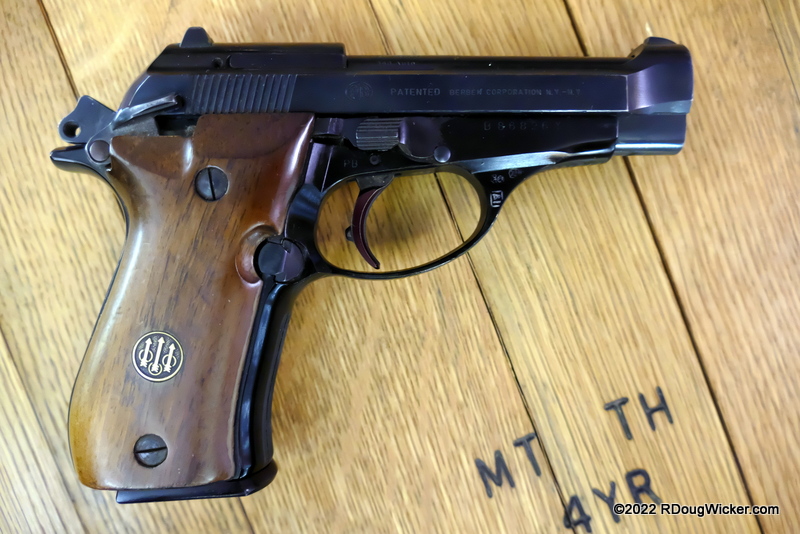
Beretta 84B — Cocked and locked (hammer back; safety engaged)
Beretta 84B — Single-action mode (hammer cocked; safety disengaged)

Cosmetically, the differences between the 84BB and 84F were huge. The finish went from high-gloss blue to Beretta’s more durable, semi-matte Bruniton finish (and, yes, I’ve seen a factory nickel version of the FS as well). Gone were the wood grips with medallions; they were replaced with hard plastic grips. The elegantly rounded trigger guard gave way to a squared-off combat-style with some front serrations. The slide was also notched at the safety, and the slide indentation for the catch was now hidden from view. You can see some of these changes in the image below from my previous 2016 article on the 84FS and 85FS Cheetahs:
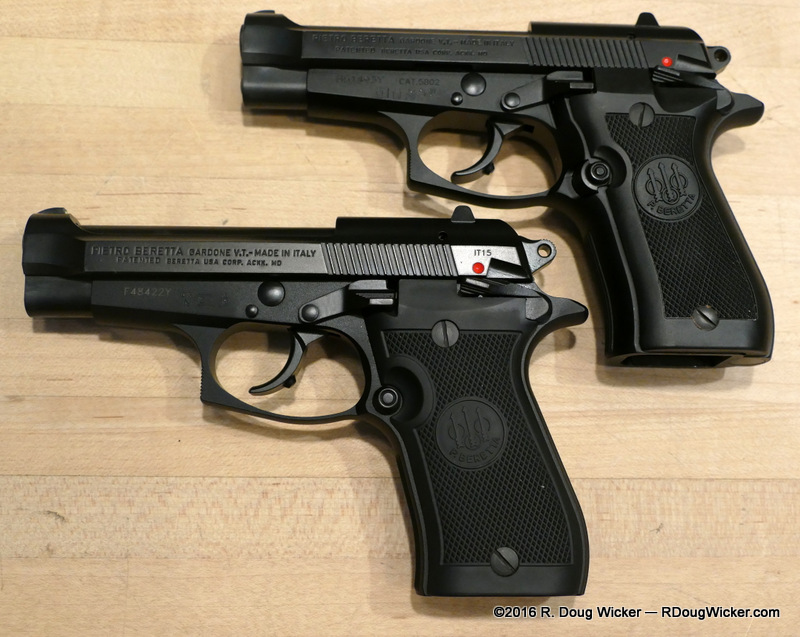
Beretta 84FS (top) and 85FS (single-stack variant)

As for the changes between the 84F and 84FS, you won’t see any, but there’s one internal difference. The safety on the 84FS supposedly has a more positive engagement. The criticism with the 84F was that you could halfway engage the safety, leaving one with the mistaken tactile impression that the safety was engaged. The hammer would remain cocked, and if you pulled the trigger, the gun would still fire. Now, I tried this on an 84FS and 85FS, and as far as I can tell it still operates that way. So, if you have either an F or FS, be warned — that safety must be fully and forcefully engaged to the point where the hammer drops before the gun is truly placed in a safe condition.
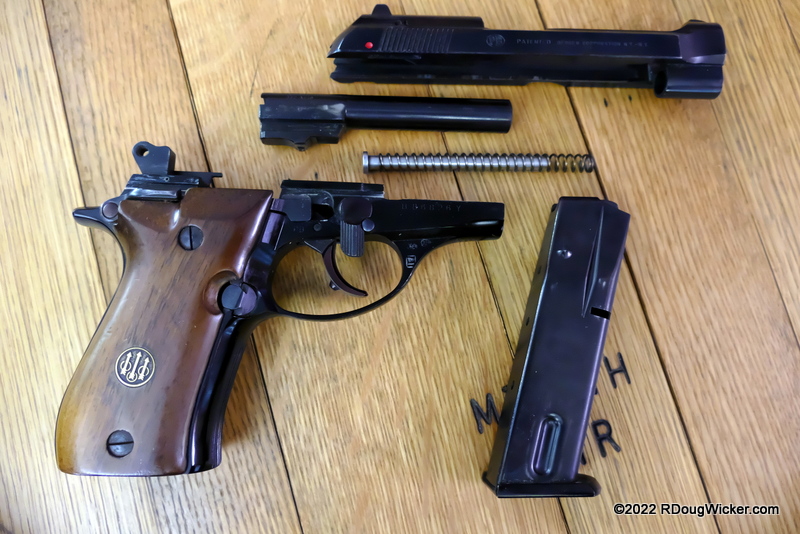
Beretta 84B with barrel, guide rod, and recoil spring removed

As with the previously reviewed Beretta 84FS, most of the specifications remain the same save for the weight. This is a result of the slightly narrower, lighter slide. My measurements show a difference of 40 grams/1.4 ounces.

Beretta 84B:

  • Length: 6.77 inches/172mm
  • Width (see text): 1.37 inches/35mm
  • Width (at grip): 1.37 inches/35mm
  • Height: 4.8 inches/122mm
  • Weight (with empty magazine): 22.4 ounces/634 grams
  • Barrel: 3.82 inches/97mm
  • Capacity: 13+1
13+1 rounds of .380 ACP/9mm kurz (or “corso in Italian)

I hope you’re enjoying Beretta week. We’ve now finished with the firearm on the left (see below). On Wednesday we move on to something even smaller, that little guy in the middle:

Beretta Family Portrait

Слава Україні! (Slava Ukraini!)

Comments Off on Beretta Week — 84B “Cheetah” from 1982

Filed under Firearms, R. Doug Wicker

Fun Firearm Friday — A Revolver Week Fraud!


WARNING:
Severe, exceedingly obscure, fascinatingly trivial, yet amazingly fun history lesson follows! Approach with extreme caution.

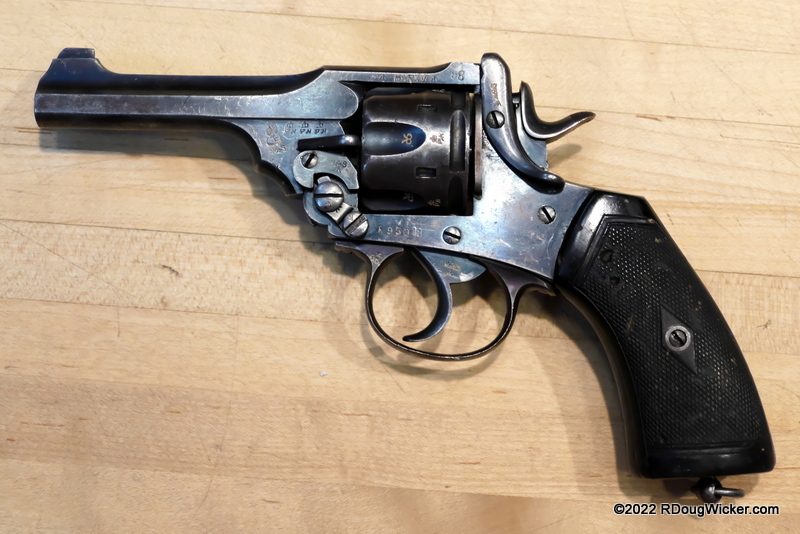
A Webley Mk VI… or is it?

Webleys are the iconic English military pistol. They’ve been around since 1887, and continued in Commonwealth and U.K. military service until withdrawal in 1970. The most famous of the Webley series was the Mk VI dating back to World War I, all of which were factory chambered in the oddball .455 Webley (most have since been rechambered for reduced pressure .45 ACP loadings). Worldwide there are probably tens of thousands of these things still being used in former colonies of the British Empire.

A Webley Mk VI… or is it?

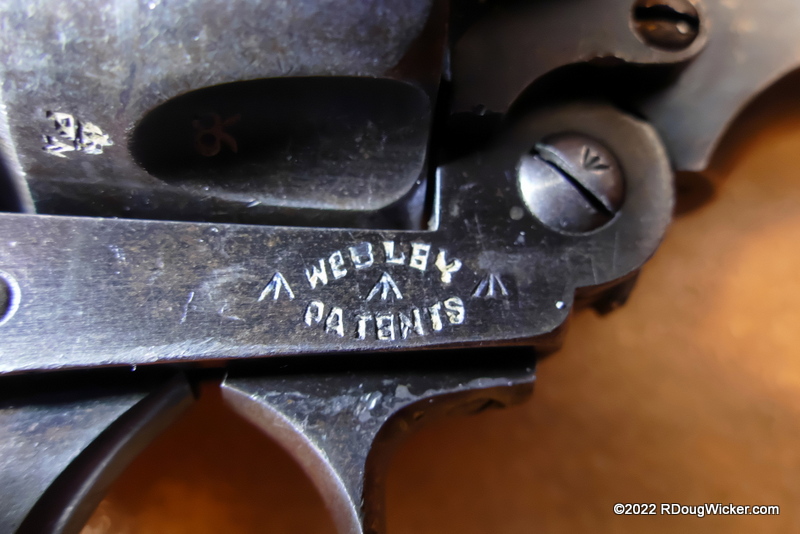
Well, this certainly looks like a Webley. And it’s even stamped “WEBLEY PATENTS” above the trigger guard:

“WEBLEY PATENTS” stamp

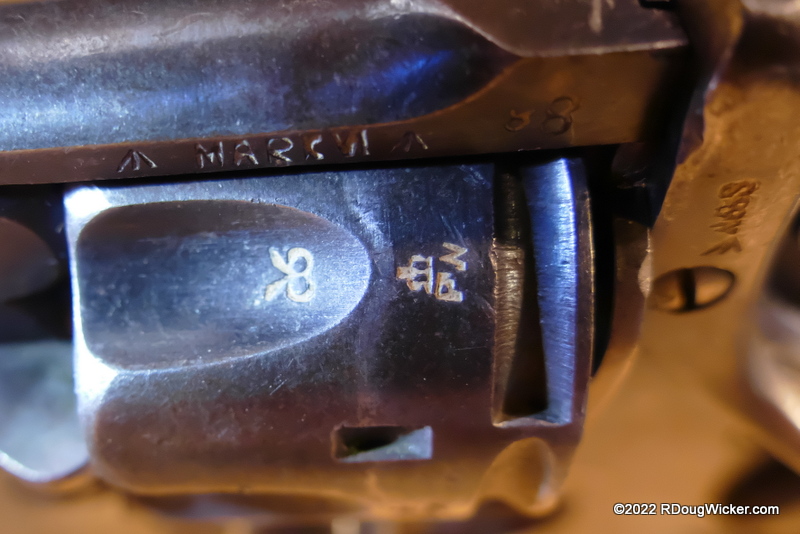
And it’s stamped as a “MARK VI” along the backstrap:

“MARK VI” stamp

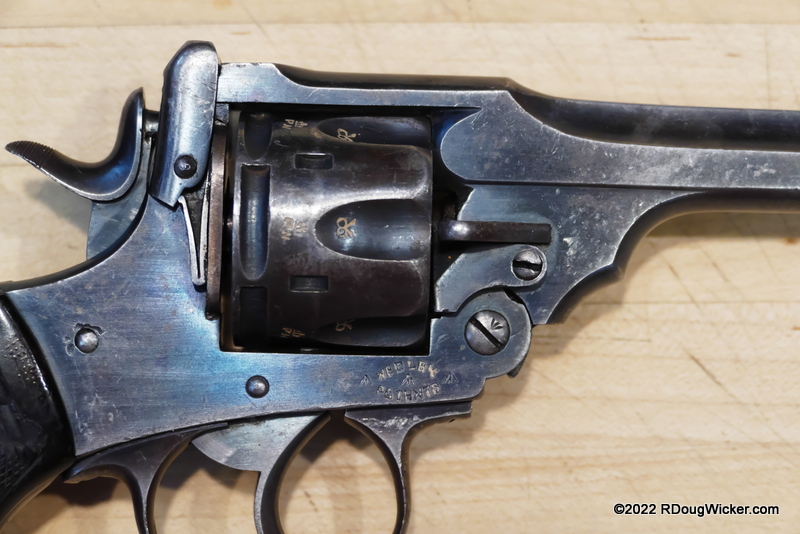
The “broad arrow” stamps are a nice touch as well. The “broad arrow” was used as a British property stamp, and those “broad arrows” are all over this weapon. And I do mean all over it.

British “broad arrow” property stamp
I count five “broad arrows” on this image alone
Even on the trigger!

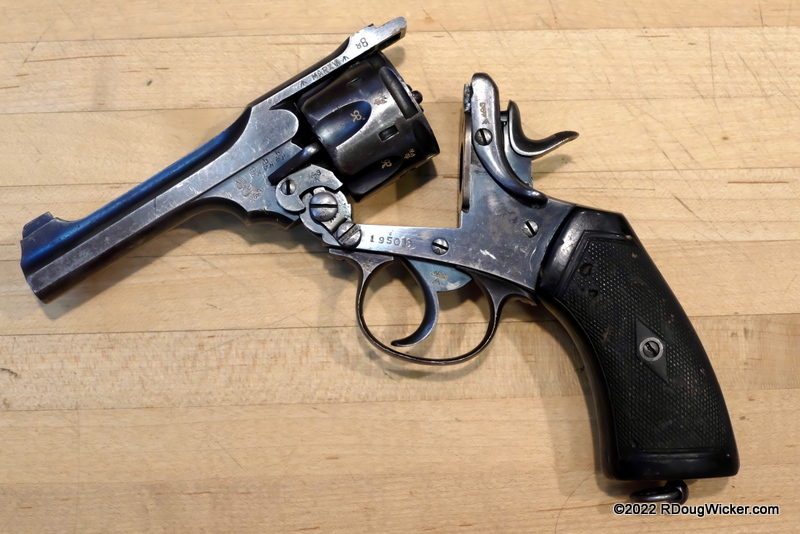
Indeed, this weapon even operates like a traditional top-breaking, self-extracting Webley revolver. You can see in the sequence below how this thing elegantly breaks open at the top. Then, as you continue to rotate the barrel-cylinder assembly away from the frame, the star extractor arm extends to eject cartridges from the cylinder. Finally, continue even farther and the extractor arm snaps back into its recessed position, ready for the user to reload the cylinder with fresh rounds.

Thumb the cylinder lock below the hammer to break open
Continue rotation to extend the star extractor arm (above the cylinder) to unload spent cartridges
Extend farther and the star extractor snaps back into the cylinder for reloading

I believe Smith & Wesson pioneered this break-top, self-extraction concept back in 1870 with their S&W Model 3. If there is an earlier version, I’d love to hear about it. And, yes, I am aware of the break-top 1858 French Divesme, but it used a manual extractor rod to push cartridges out from the front one at a time rather than an automatic self-extractor to pull out of them simultaneously from the rear. At any rate, this Smith & Wesson-style extractor is now more closely associated with Webley revolvers.

“Broad arrow” acceptance marks even on some of the screws

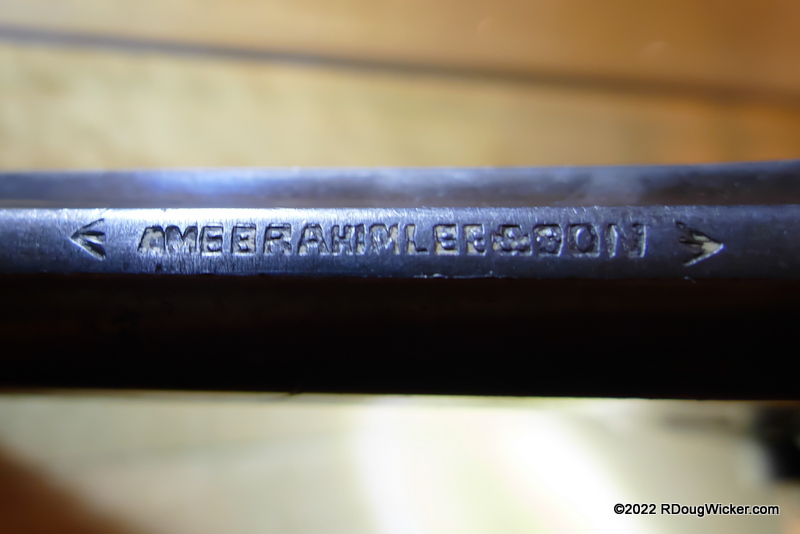
As you may have guessed by now, looking at all the bizarre “broad arrow” proof marks, there is something decidedly amiss with this “Webley.” But there are other clues, such as nonsensical “English” stamps:

“AMEBRAHIMLEE&SON”? Really? And bracketed by yet more broad arrows?
And don’t even ask me what these three cylinder stamps represent

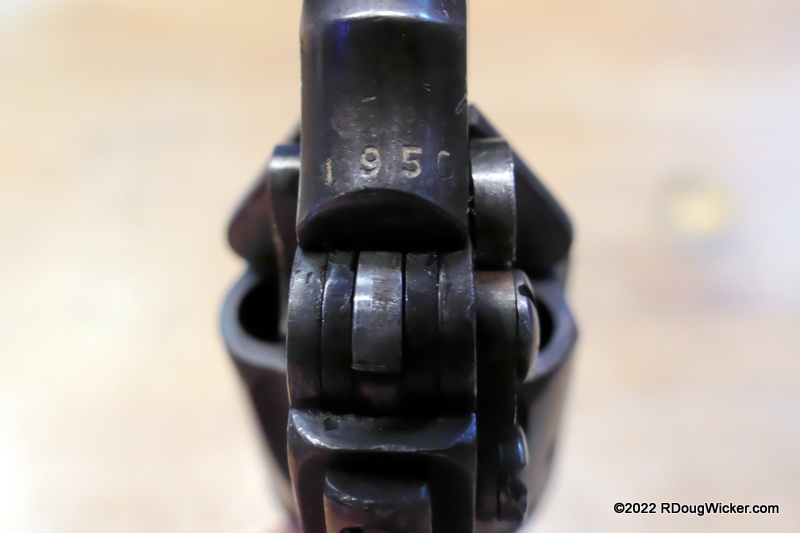
Well, let’s take look at the serial number for some additional clues:

Serial Number 1950

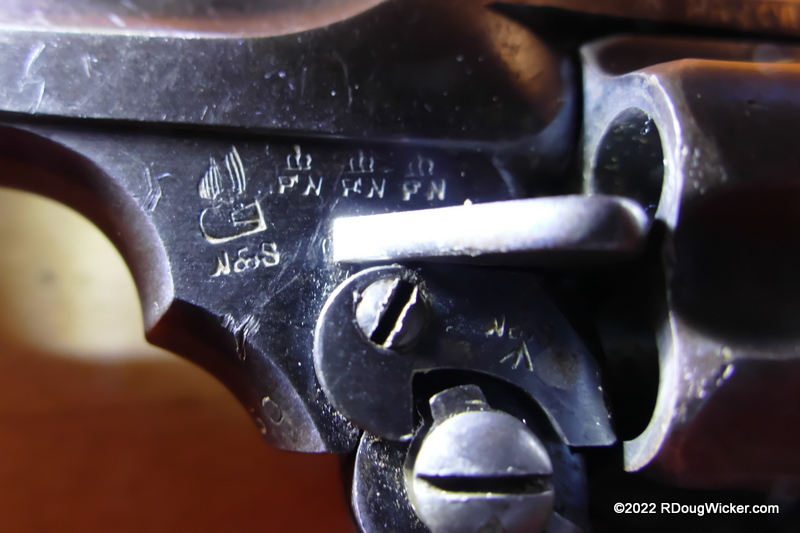
But, wait. What’s this stamped above the trigger guard?

195018

So, which is it? Is the serial number 1950, or 195018? Being on the cautious side, and noting that the frame usually bears the serial number, the gun store went with 195018 on the ATF Form 4473. Probably a good move, as I’m pretty sure that’s the number it would have been imported under. Although… there is no import stamp, so it’s very likely a G.I. bring-back from…. Any guesses yet? I’ll give you a clue. This had to have wound up in the duffle bag of someone returning from a recent combat zone which would in the past have been under the United Kingdom sphere of influence (hey, it is after all a WEBLEY, right?). And the logical suspect would be…

More nonsense, probably from a non-English speaking “manufacturer”

I’m sure some of you have probably guessed by now that this an infamous, and here in the U.S. a very rare and much sought, “Khyber Pass clone” from somewhere along the Pakistan-Afghanistan border. These clones are still made today by local gunsmiths operating their own metallurgic furnaces, casting and forging parts copied from abandoned relics of conflicts from long ago. In other words, this is a poor copy of a Webley revolver made at the hands of some backyard smithy. He then embellished his work of art with fake stamps meant to convey a place of origin on distant soil this gun never saw.

More gibberish and additional “broad arrows”

The only question remaining is which side of the Kyber Pass did this gun originate? Was it the Khyber Pakhtunkhwa region of Pakistan, or was it Afghanistan’s Nangarhar Province? My gut tells me Nangarhar, but who knows? It’s a mystery, and likely to remain as such.

Cylinder stamp

This particular example of a Khyber Pass clone is not something I’m ever going to test fire. The cylinder lockup is sloppy, and that’s an understatement. The metallurgy is suspect enough that I wouldn’t trust it to handle even the weak .38 S&W “Short for which it is supposedly chambered. Which, by the way, is a round for which the Mark VI was never chambered. Yet another clue that something is amiss.

Gibberish Galore!

I hope you enjoyed today’s Fun Firearm Friday, which closes out Revolver Week here at the blog. Next week we return to travel, with my first week-long ever review of a single cruise ship. And what a ship it is — 226,963 Gross Tonnage, 5,479 double-occupancy passenger capacity (6,780 maximum capacity), 2,300 crew, and seven distinct “neighborhoods” throughout this behemoth.

Meanwhile, if you found today’s article interesting and would like to know more about these Khyber Pass gunsmiths, here’s a nice, informative article for you to peruse:

The Gunmakers of the Khyber Pass

Comments Off on Fun Firearm Friday — A Revolver Week Fraud!

Filed under Firearms, Fun Firearm Friday, R. Doug Wicker

Fun Firearm Friday — Collectible 1938 Smith & Wesson K-22 ‘Outdoorsman’


1938 Smith & Wesson K-22 “Outdoorsman”

Today I’m going to present a first look and firing review of a very special firearm. This is a highly collectible prewar Smith & Wesson K-22 ‘Outdoorsman’. So, just how rare is this target-grade .22 LR pistol? The first edition K-22 was introduced in 1931, and in 1940 the ‘Outdoorsman’ was superseded by a second generation version marketed as the K-22 ‘Masterpiece’. In 1941 production ceased altogether as Smith & Wesson geared up to support the war effort.

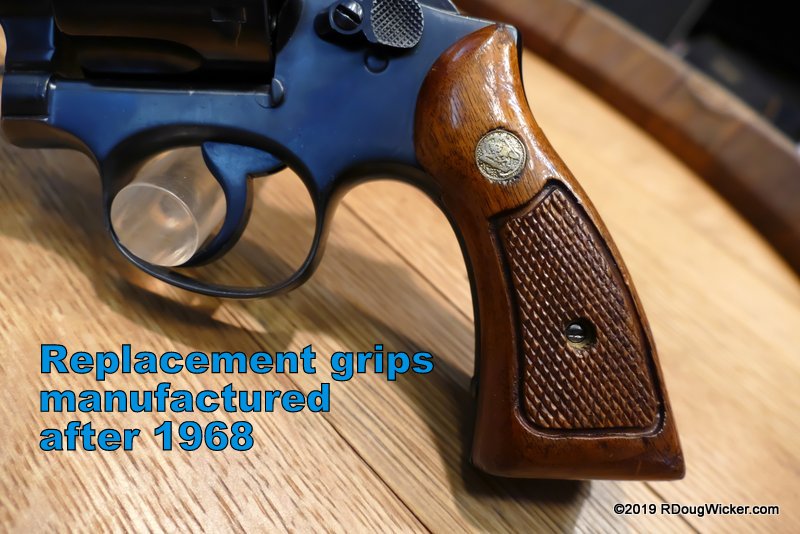
When I first saw this handgun I had an inkling that it was probably prewar because it lacked the ribbed barrel of every postwar K-Frame (medium frame) Smith & Wesson I’ve ever seen. That pencil-thin tapered barrel just looked so elegant compared to the later ribbed barrels. But I wasn’t sure, as the gun was merely tagged for sale as a, “Smith & Wesson .22,” with no further information. So, I went home and did some research, started getting excited when I thought I recognized what it was, called the store for a reading of the serial number, and verified that this was indeed a rare prewar K-22, probably with incorrect grips installed as they lacked the familiar diamond pattern surrounding the screw holes.

Replacement S&W grips

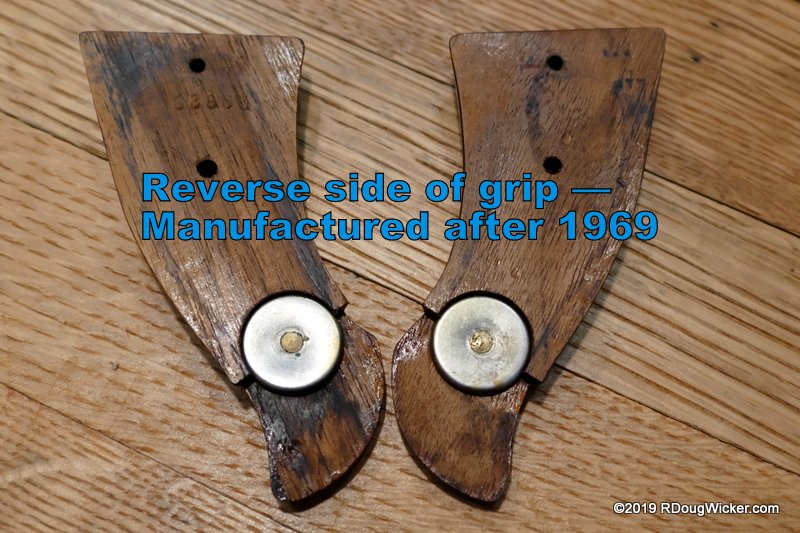
Once I got the K-22 home I removed the grips and verified that they were indeed not the originals. The factory-installed grips would have the gun’s serial number marked on the insides:

Period-incorrect grips — Made after 1969

Grips not serial numbered to this gun

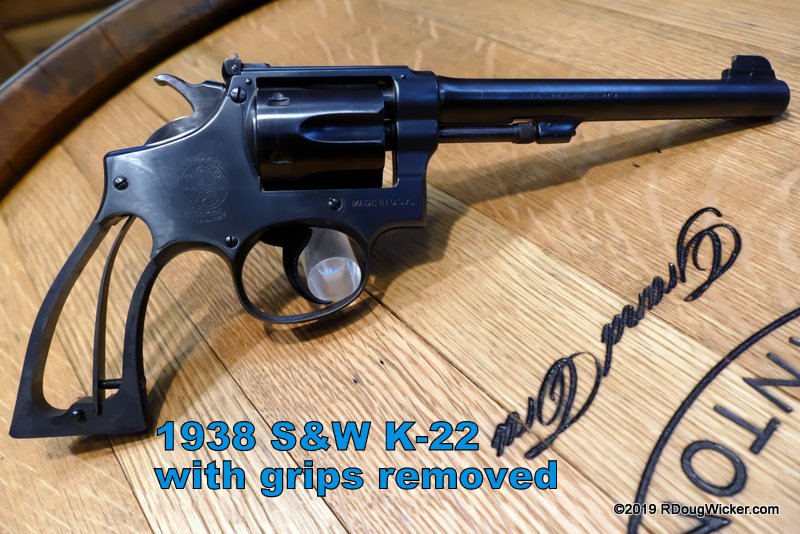
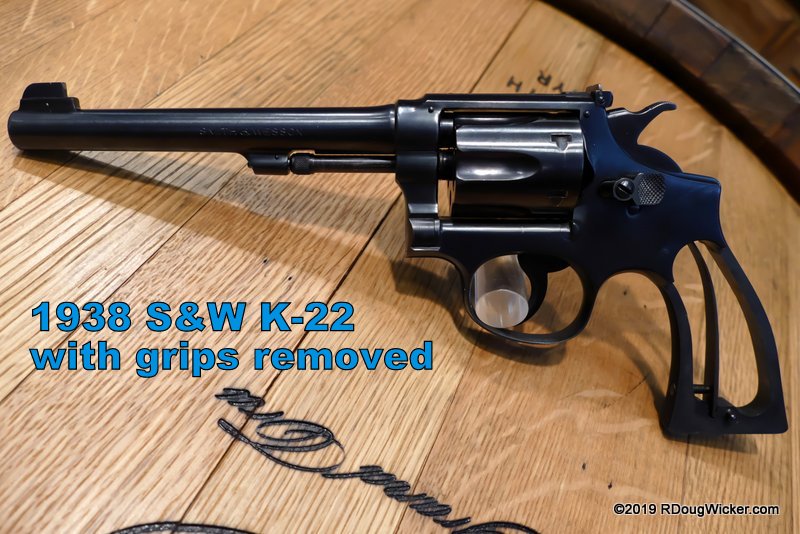
While we have the grips off this K-22, let’s take a look at what’s beneath them on the frame:

S&W K-22 grips removed

S&W K-22 grips removed

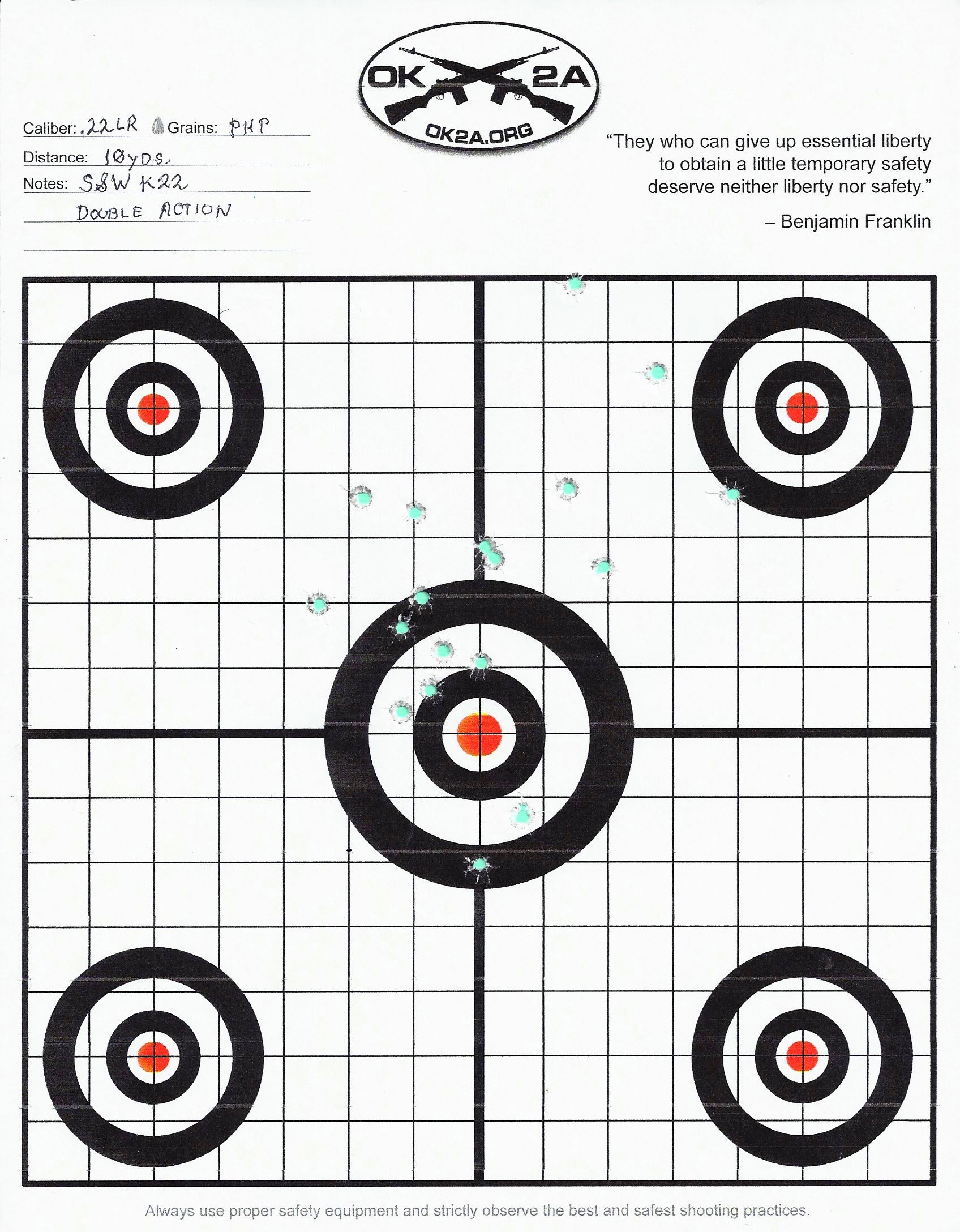
Production of the K-22 ‘Outdoorsman’ ended December 28, 1939. The total number made was 17,117 before the launch of the improved ‘Masterpiece’ K-22 in early 1940. The prewar K-22s, both the ‘Outdoorsman’ and the second generation ‘Masterpiece’, sported a non-ribbed 6-inch/152mm round barrel, adjustable rear sights, a trigger set between three and four pounds/1.4 to 1.8 kilograms, checkered Circassian walnut grips, all in a package weighing in at about 35 ounces/990 grams. With the K-22 came a Smith & Wesson claim that the gun was capable of shooting 1.5-inch/38mm groups at an astounding 50 yards/45.7 meters. That’s a lot better than I’m capable of as you can see from the two targets presented below (but in all fairness I shot free-handed rather than bench-resting the pistol). The targets I used were ones I printed on 8.5×11-inch/216x279mm standard letter-size paper.

The first target displays 18 rounds fired in single-action at a distance of 10 yards/9.1 meters:

8.5×11 target, 10 yards, 18 rounds, single-action

This next target shows 18 rounds fired in double-action at a the same distance:

8.5×11 target, 10 yards, 18 rounds, double-action

Oddly enough, I did better at double-action, but I’ve found over the years that the longer, heavier trigger pull in double-action forces me to maintain tighter concentration and control when I’m firing — pretty much the opposite of the rest of the shooting world, I’m sure. Plus, I’d just completed testing a single-action only 1973 Ruger Super Bearcat with a much lighter trigger, so I may have been thrown off by that as well.

As far as I can tell, the K-22 retailed for around $40 (S&W billed dealers $22.19 for them in 1935). In today’s money, that $40 works out to $624. Keeping in mind that this was in the midst of the Great Depression, it’s a wonder the K-22 found the audience that it did. Being billed as pistol suitable for both hunters and marksmen, the K-22 came equipped with an adjustable rear sight:

Adjustable rear sight and blued hammer

The K-22 initially came with a Call gold bead front sight (named after Charles Call), but that was changed to a higher-visibility ‘silver’ (actually stainless steel) bead about 500 pistols into production:

Silver bead front sight used after first year of production

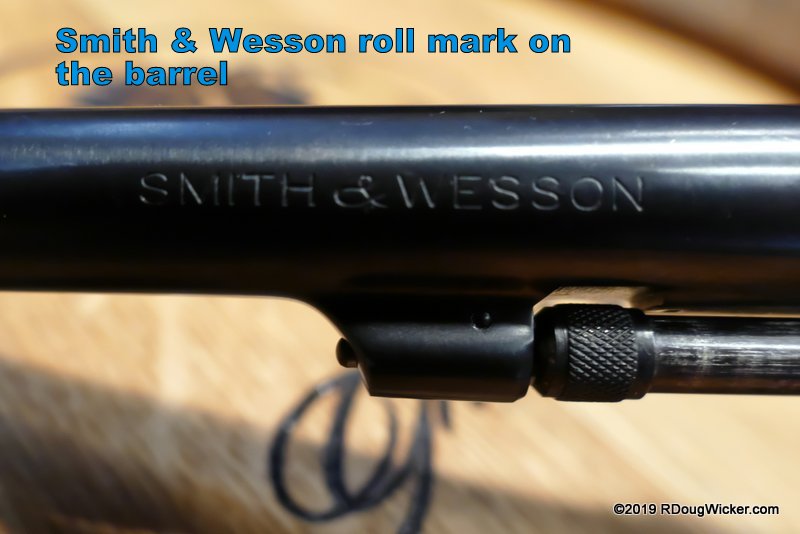
Typical roll marks and stamps on the K-22 ‘Outdoorsman’ include the following:

Smith & Wesson roll mark

S&W trademark logo

S&W patent markings

K-22 caliber mark

“MADE IN U.S.A.” stamp

I already mentioned that the grips that came with this example were not original to the gun. There is one other anomaly that I saw as well. On every K-22 I’ve found pictured on the internet, both prewar and postwar, all are equipped with case hardened triggers and hammers. Not so this example. Both are blued, and I suspect they did not come this way from the factory:

Trigger blued rather than case hardened

Hammer blued rather than case hardened

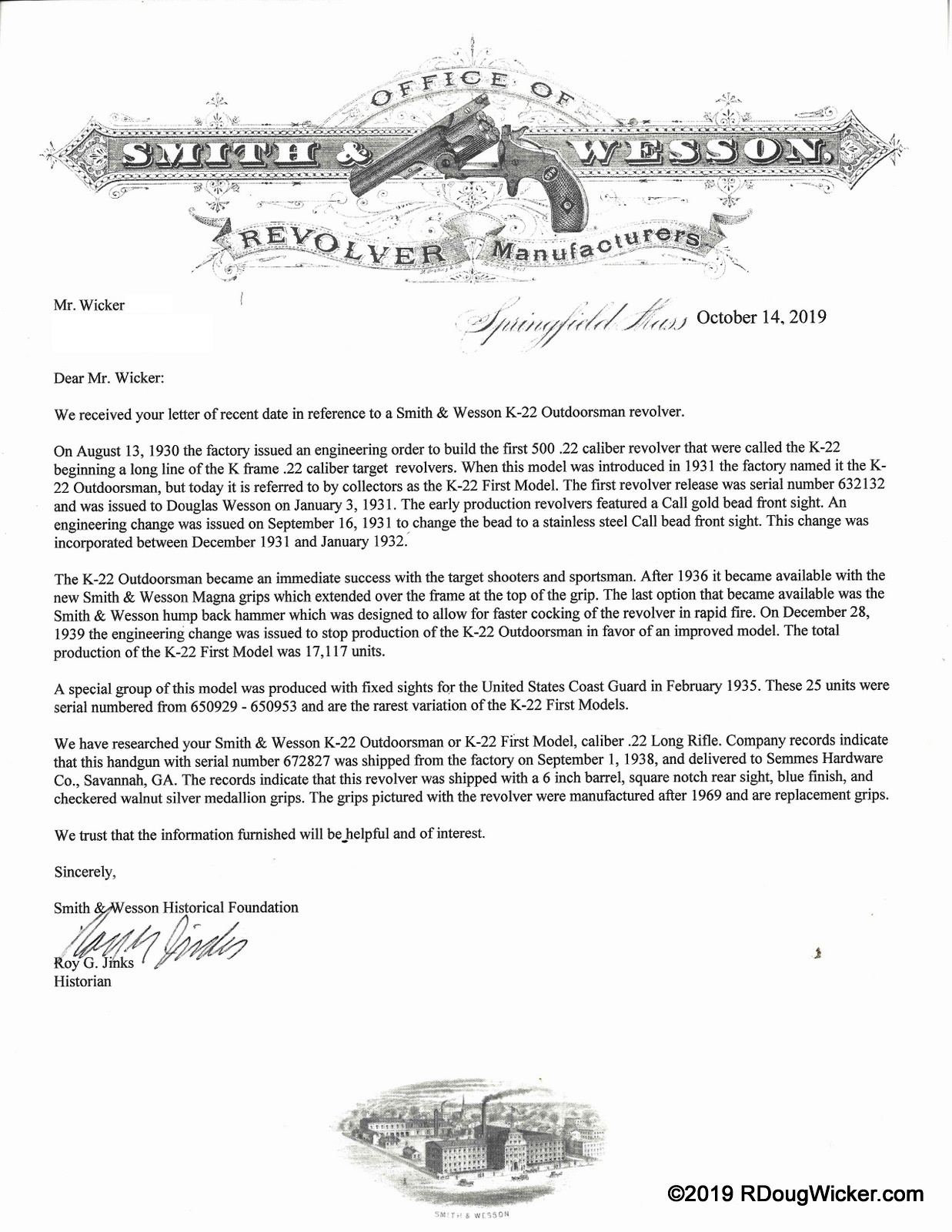
The reason that I only suspect this is because I did not receive from the Smith & Wesson historian confirmation on this even though I pointed out the bluing when I sent in photographs along with a request for the gun’s history.

Most of the letter sent back from the S&W historian is boilerplate typical of other S&W history letters I’ve seen:

S&W Historical Foundation letter for this specific K-22

You have to get past the first four paragraphs to get to the specifics of this particular K-22, which I’ve cropped out below:

S&W Historical Foundation letter — Information specific to this K-22

A quick note about these Smith & Wesson Historical Foundation letters. If you have a Smith & Wesson firearm made between 1920 and 1966, obtaining a history on that firearm is something you should really consider. It’s fun researching where your gun first headed from the factory, and you may even get more history on it. I’ve seen at least one letter for a pristine, like-new K-22 with original box and manual that turned out to have been shipped to a police department for training purposes.

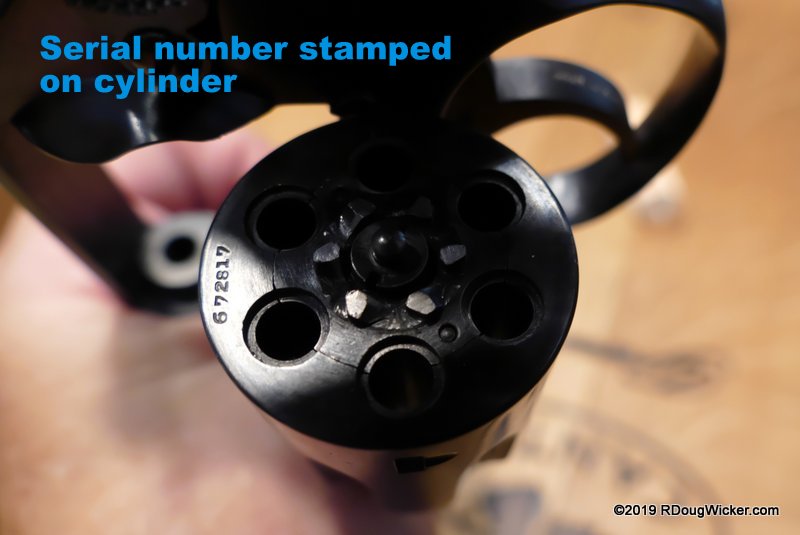
Now onto the subject of serial numbers for these pieces of prewar history. Any collector will tell you that the value of a collectible falls considerably if the gun is not fully ‘matching’. By matching, I mean all parts are original to the gun. On the K-22 Outdoorsman there are three places you need to check for this match. The first place to look is to turn over the gun and check out the primary serial number on the base of the frame butt:

Serial number stamp — Frame grip butt

Now it’s time to check the cylinder for a match:

Serial number stamp — Cylinder

And, finally, as we have the cylinder swung out away from the frame, let’s turn over the gun and look at the flat portion at the base of the barrel for one more match:

Serial number stamp — Under barrel

There is one more number stamped on these weapons, but it is not related in any way to the serial number. Again, with the cylinder swung out, look at the frame just below where the pinned barrel is mounted. Here you will find a number that was used internally at Smith & Wesson. The purpose of this number was to assist the craftsmen who handcrafted these works of art. This is an assembly number that assisted in keeping together until final assembly the parts meant for a particular gun:

This number was used by the factory to facilitate hand fitting of parts

I hope you enjoyed this little bit of firearm history at least half as much as I enjoyed researching it. For additional information, may I suggest the following articles:

American Rifleman article: A Look Back at the Smith & Wesson K-22 written by Dave Campbell; November 13, 2012

Gunblast article: Smith & Wesson K-22s written by Mike Cumpston; January 8, 2003

One last look at this nice example of a prewar (1938) Smith & Wesson K-22 Outdoorsman:

Prewar Smith & Wesson K-22 “Outdoorsman”

Comments Off on Fun Firearm Friday — Collectible 1938 Smith & Wesson K-22 ‘Outdoorsman’

Filed under Firearms, Fun Firearm Friday, R. Doug Wicker