If you are here for the continuation of my fall foliage cruise series, I’ll be continuing those articles starting December 30. This week, however, I owe my firearms fans some long-promised handgun reviews. And after that I go to two weeks of Christmas-themed reruns.
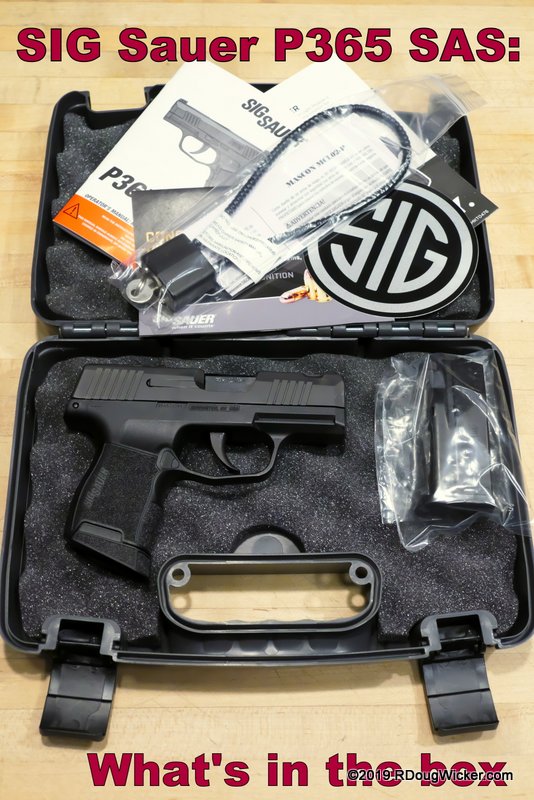
SIG Sauer P365 SAS — What’s in the box
Today I’ll be giving a first look and shooting review of the SIG Sauer P365 SAS with the Meprolight FT Bullseye sighting system equipped with an innovative tritium-illuminated sight using fiber optic light tubes. Take a look below and at first glance you’ll wonder where the front and rear sights are located:

SIG Sauer P365 SAS (SIG Anti-Snag): Too much of a good thing?
First, the handgun. SIG Sauer’s P365 subcompact 9mm arrived to the market in 2018. What amazed the concealed carry world was the 10+1 capacity in a handgun very nearly the size of a .380 ACP/9mm kurz 6+1 Colt Mustang. My personal favorite concealed carry pistol since 2009 also holds 10+1 rounds of 9mm, but by P365 standards my trusty ol’ Walther P99c AS is positively gargantuan in comparison even though the P99c (compact) was quite a breakthrough when it was introduced some twenty years ago.
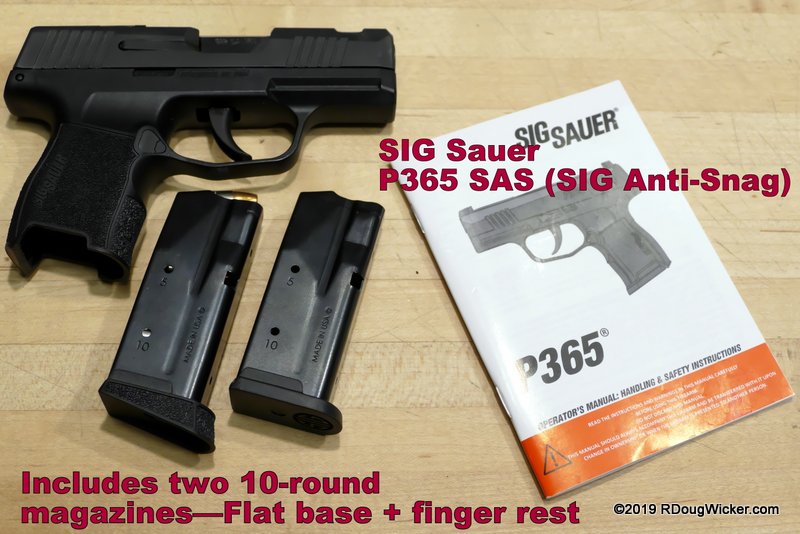
SIG Sauer P365 SAS comes two 10-round magazines; flat-base and finger-rest
Let’s take a look at some images showing the size differences among the P365 SAS, Walther P99c AS, a Colt Mustang Lite sporting an aftermarket 7+1 magazine, and the incredibly small Beretta 3032 Tomcat holding 7+1 rounds of .32 ACP/7.65mm:
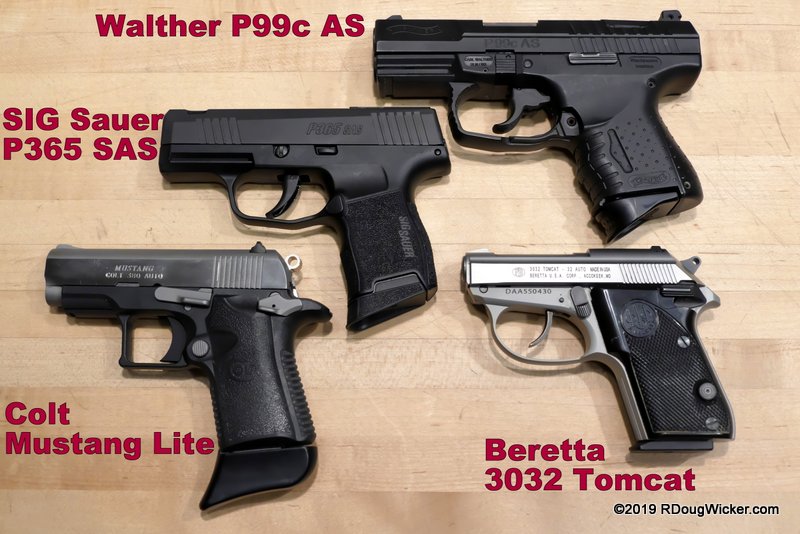
From top: Walther P99c AS, SIG P365 SAS, Colt Mustang Lite, Beretta Tomcat
First up, SIG P365 SAS versus Walther P99c AS:
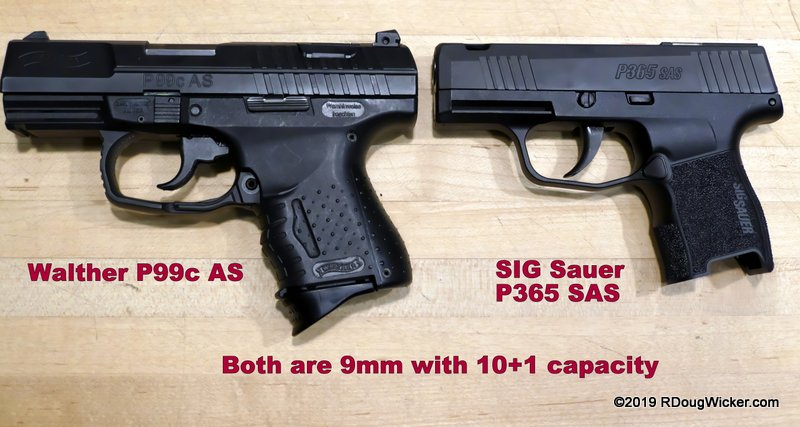
SIG P365 vs. Walther P99c
Let’s take a look at the differences in grip width, even though both guns have a 10+1 capacity:

Grip comparison — Walther P99c vs. SIG P365
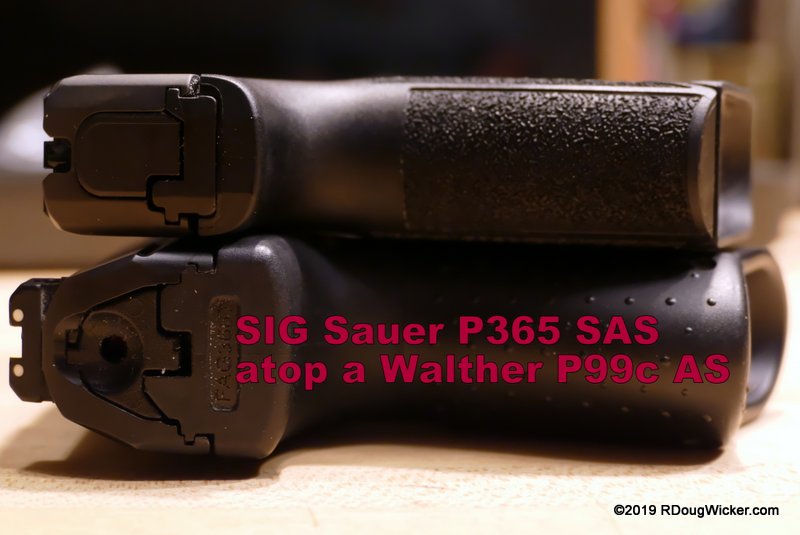
SIG P365 atop a Walther P99c AS
Now for a shot of the P365 overlaying the P99c, which weighs about two ounces more than the SIG:
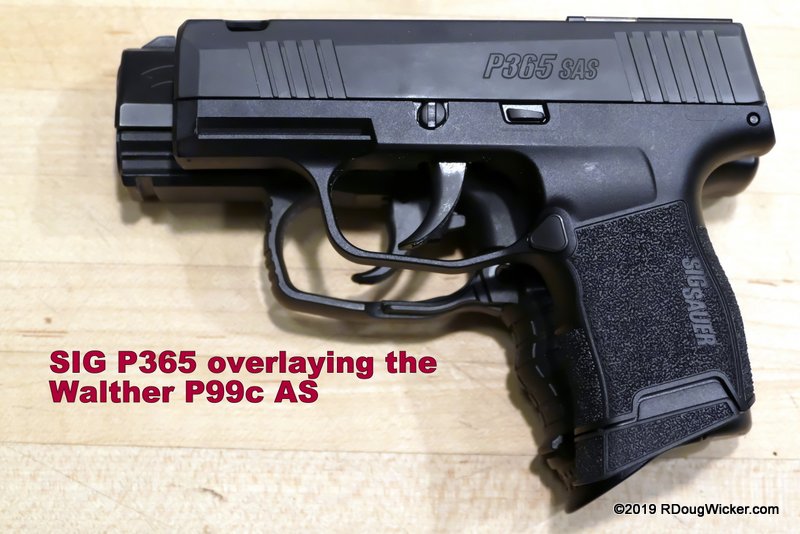
SIG P365 overlaying a Walter P99c
I know I was certainly impressed, but how does the SIG stack up against a .380 ACP/9mm kurz Colt Mustang Lite with an aftermarket 7+1 magazine with a finger rest? I forgot to insert a magazine into the P365 before taking these shots, but even with the finger rest SIG magazine the height still would have come out far less than the Colt’s. Let’s take a gander:
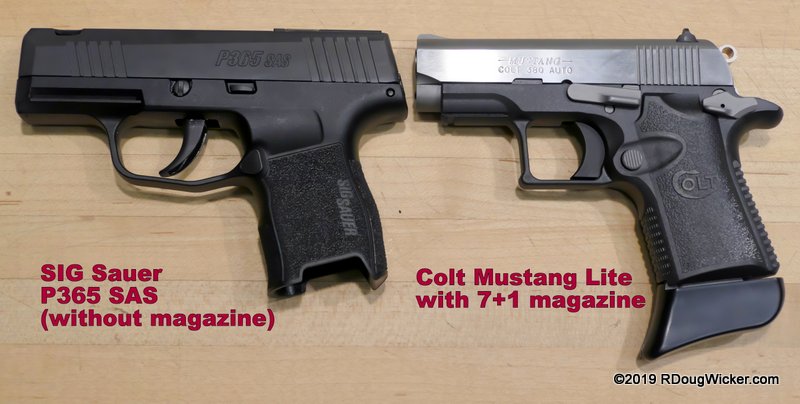
P365 next to a Colt Mustang Lite
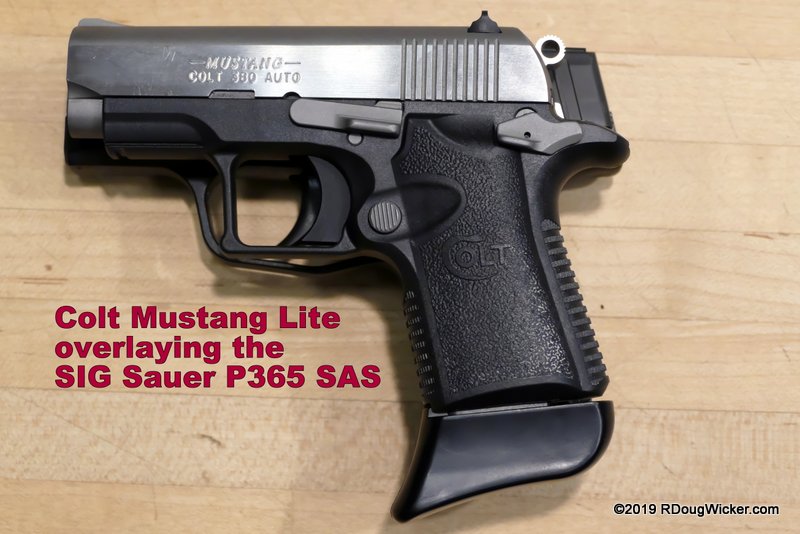
Mustang overlaying the P365
Finally, let’s compare the P365 against one of the smallest practical pocket pistols around, the Beretta 3032 Tomcat with 7+1 rounds of .32 ACP/7.65mm:

Beretta Tomcat overlaying the P365 with finger rest magazine inserted
Now that’s impressive. The P365 SAS has the ‘SIG Anti-Snag (SAS) treatment, more so than any other SIG SAS pistol I’ve yet seen. Perhaps too much. The takedown lever is gone, replaced by a latch that requires a coin or flat-head screwdriver to manipulate. The slide stop is now completely useless, although I don’t miss that because I always slingshot the slide to chamber a round rather than depress the slide stop.

SIG Sauer P365 SAS (SIG Anti-Snag)
Fortunately, though, I found one pleasant surprise upon reassembling the weapon. Attaching the slide and moving it back to the slide-lock position, then engaging the slide lock upward into the slide notch, the slightest of touches causes the takedown latch to snap back to the ready position. That’s a neat feature, for sure, and one that negates some criticism of the original P365 takedown lever being difficult to rotate back upon reassembly. Speaking of disassembly, let’s take a look at the innards of the P365 SAS:

P365 SAS frame and inverted slide
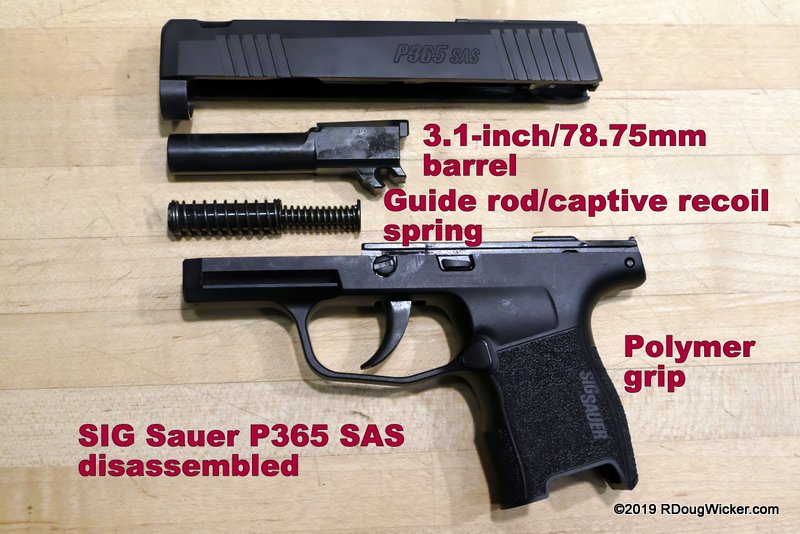
Disassembled P365 SAS
The P365 is a very light weapon chambered for a not-so-subtle 9mm round. But don’t worry. The gun is not that snappy. First of all, the barrel sits very low over the frame, giving an incredibly low bore axis. Then, as part of the SAS treatment, SIG went further and ported both the slide and barrel. This porting directs gasses upward in a V-shaped pattern about 15mm from the muzzle. The result is that recoil is somewhat mitigated, which also helps to negate the tendency for the muzzle to rise.

SIG P365 SAS ported barrel and slide
I found the P365 very controllable, with easy and quick target reacquisition despite my unfamiliarity with the Meprolight FT Bullseye sight. You’ll note that I said ‘sight’ rather than ‘sights’. That’s because the traditional front sight is completely missing from this system. Observe:

Meprolight FT Bullseye tritium/fiber-optic sight
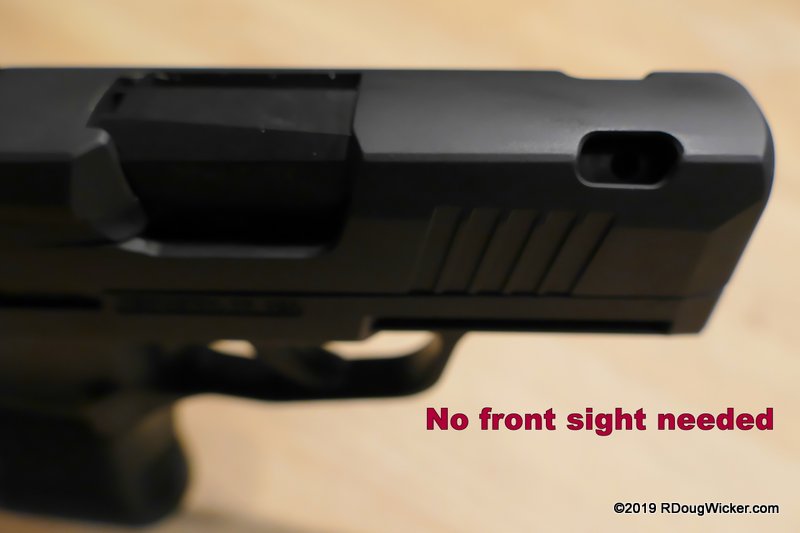
No front sight needed . . . or wanted
It takes a little time to get accustomed to the FT Bullseye sight, but for a defense pistol used inside of, say, twenty yards or so, they’re simply fantastic. Before I took the P365 SAS to the range, I spent about two weeks practicing target acquisition at various ranges. The brighter the light striking the top of the gun, the better the illumination, but bringing the gun aligned with your line-of-sight is critical, or you wind up hunting for the magic bullseye to appear. This is especially critical in low light situations, as the tritium on this particular sight is nowhere near as bright as on SIG’s other tritium night sights, and far less than SIG’s superlative X-Ray sights. The best way I’ve found to practice this is to have the unloaded P365 nearby, and then on occasion snatch it up level to your dominate shooting eye, then looking to see if the bullseye is visible. If you’re off on the alignment, you may not see anything, but if you’re close enough you’ll get this:
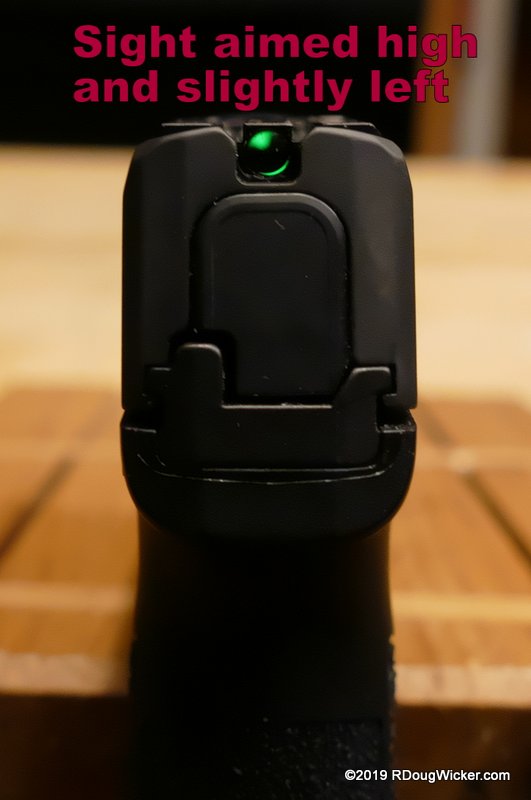
P365 aimed high and to the left

FT Bullseye misaligned right
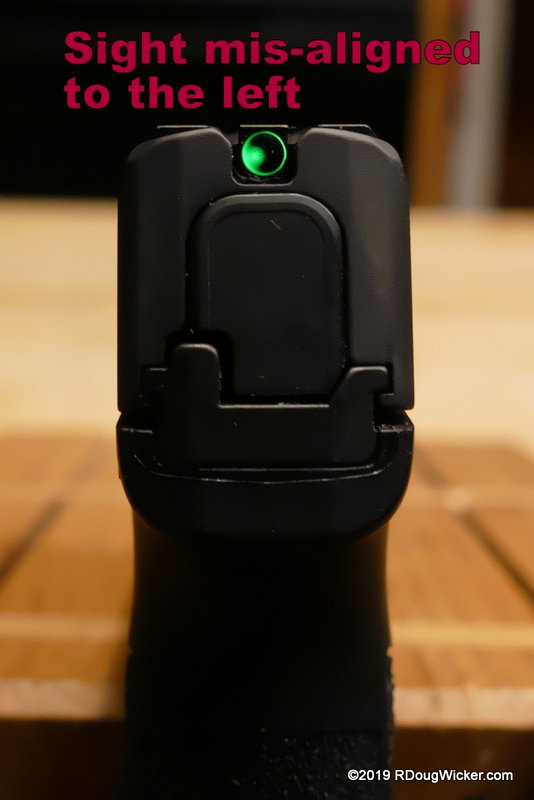
FT Bullseye misaligned left
Once you’ve mastered getting the top of the P365 slide aligned with your dominate shooting eye, however, centering the bullseye is done rapidly as long as you were close enough initially to see some green. When it all comes together, this is what you see as you squeeze the trigger:

FT Bullseye sight properly aligned.
One more word about sighting: I found that initially, despite lots of dry-fire practice, I was shooting low. That’s because I’m used to either a six-o’clock sight picture, or placing the intended point-of-impact at the top of the front sight post, depending on how the particular gun is sighted in. That’s not going to happen with the FT Bullseye, and you have to train yourself out of that habit. It’s much closer to a combat sight picture. With this sight you place the bullseye directly over the intended point-of-impact. Do that, and you’re dead on target. Revert back to your prior training, and you’re going low.
So, how does this sighting system work in conjunction with a handgun specifically designed around it? Quite well once you work it all out. Below are the targets I used. All are printed on 8.5×11-inch/216x280mm paper. The first three targets simulate the distance requirements for Texas state qualification for a license to carry — 20 shots at 3 yards/2.74 meters; 20 shots at 7 yards/6.4 meters; 20 shots at 15 yards/13.7 meters (Texas requirement at 15 yards is 10 shots, but I doubled that). And while these requirements are with a much larger B27 silhouette target, again I was using targets printed on standard letter-size paper:
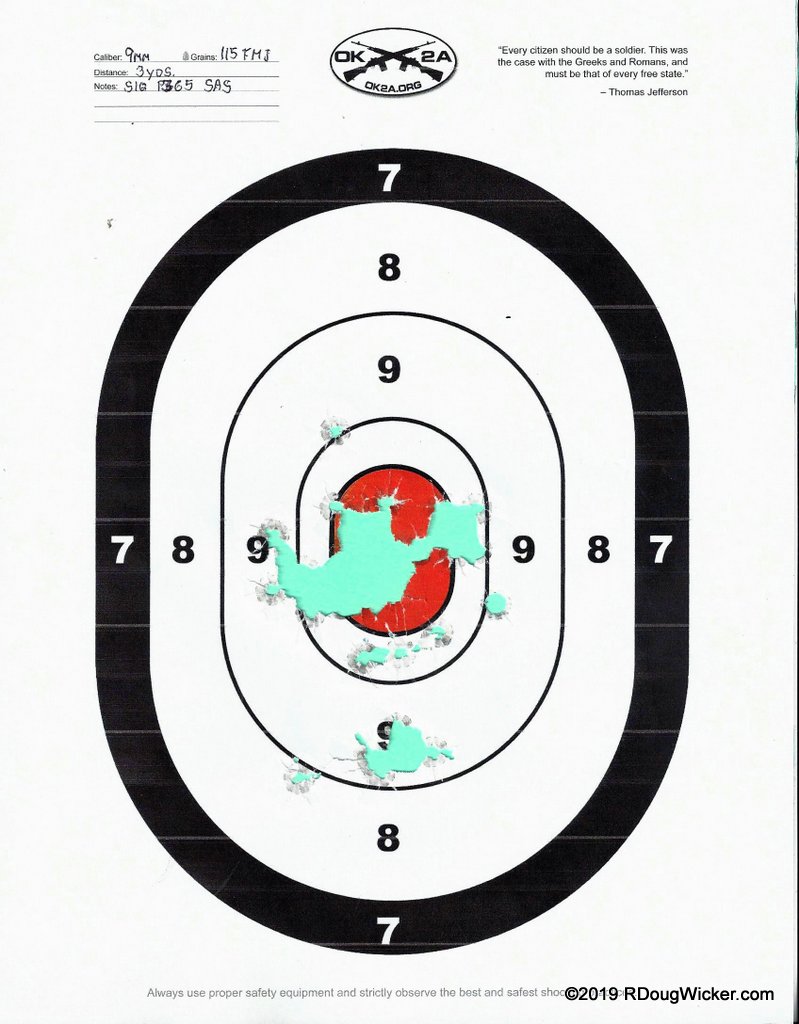
P365 3yds 20 rounds
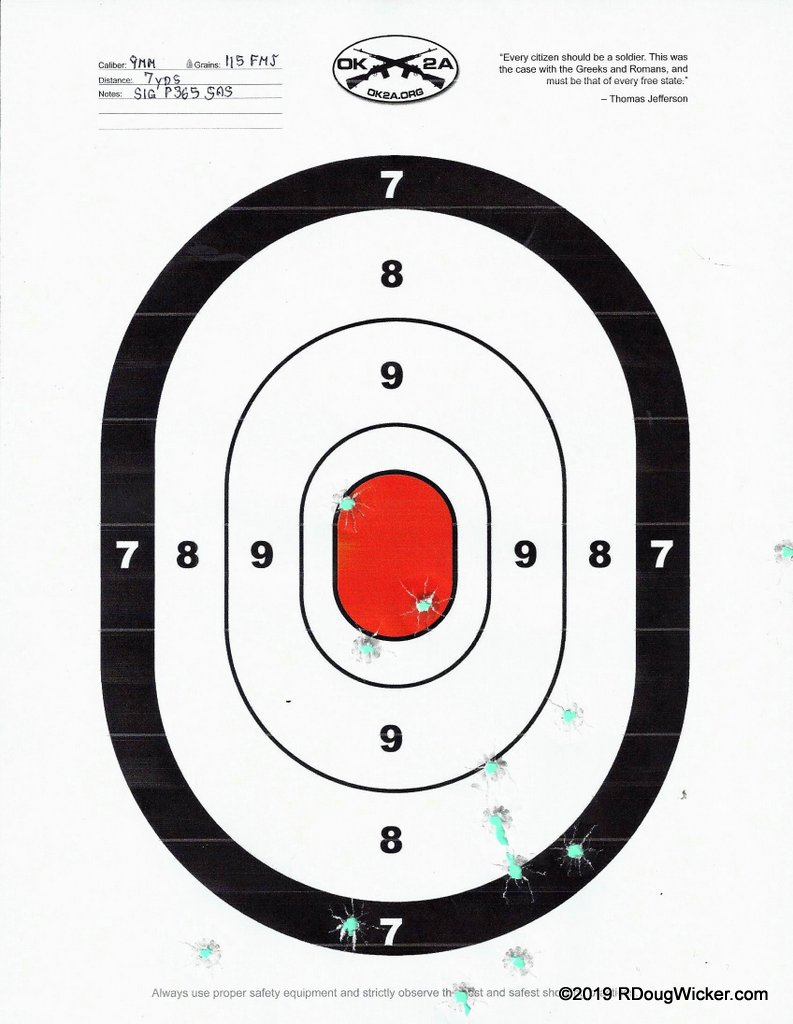
P365 7yds 20 rounds
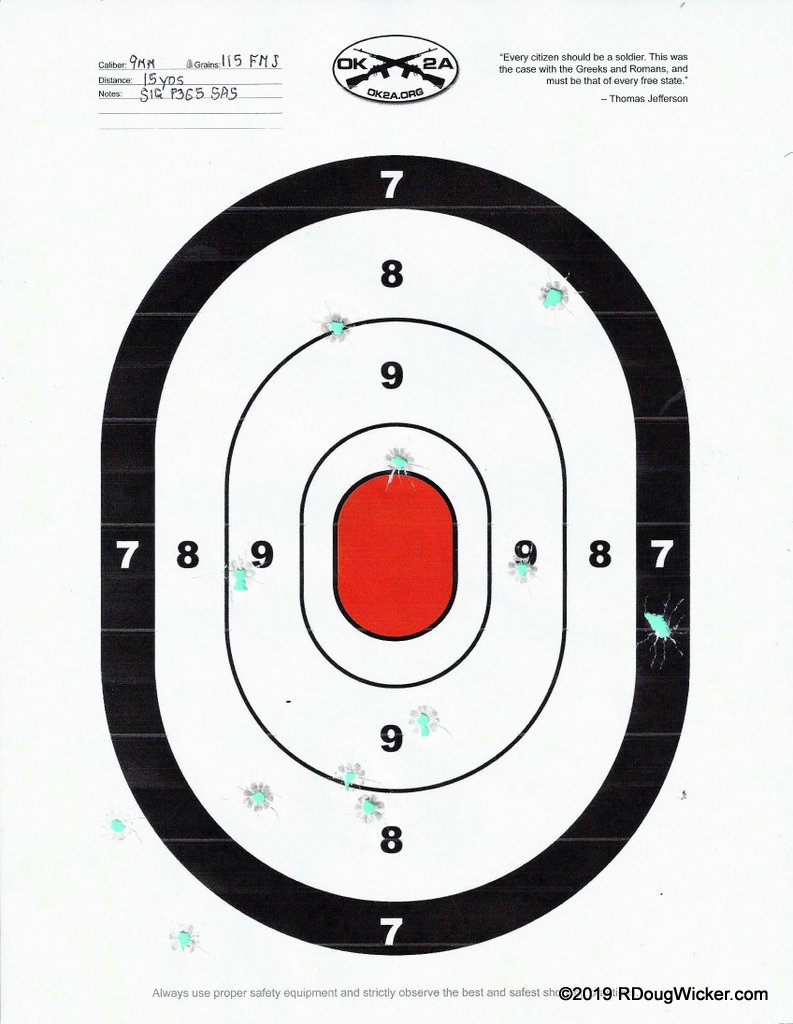
P365 15yds 20 rounds
Next up is ten rounds of 124-grain JHP at a distance of 7 yards, followed by eleven rounds of 115-grain FMJ at 7 yards one-handed:
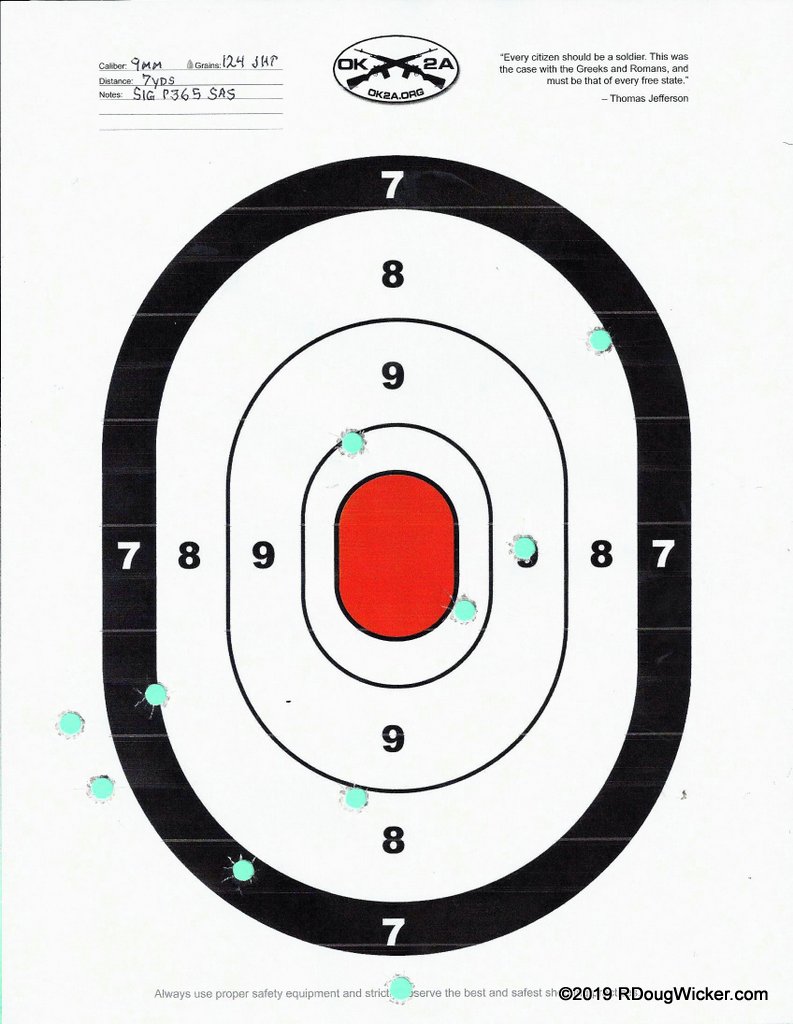
P365 7yds 10 rounds 124gr JHP

P365 7yds 10+1 round One-Handed
Finally, here are twenty rounds at 5 yards/4.6 meters shot in a rapid-fire exercise at about one-second intervals to see how quickly I could get back on target. Those holes marked ‘FB’ were fired from the included flat-base magazine, while ‘FR’ stands for the finger rest magazine, as I wanted to see if the additional purchase afforded by the finger rest allowed for better rapid-fire accuracy. I’ll let you judge that one:

P365 20-round Rapid Fire Test (FB=flat base; FR=finger rest)
Test notes and observations:
- Out of 101 rounds fired I experienced very early in the testing one failure to extract using 115-grain Winchester White Box target ammunition. Subsequent testing using mostly Magtech 115-grain ammunition failed to duplicate that failure.
- When chambering a round on a freshly inserted magazine with the slide locked back, I twice experienced a failure of the slide to go fully into battery. I believe these failures may have been due to me applying insufficient rearward force when slingshotting the slide back, or perhaps I may have briefly ridden the slide forward before releasing it. In either case, the gun did not fire while out of battery (a good thing), and a light tap on the back of the slide remedied the problem.
- The flash from the ported barrel and slide was impressive in the dim light of the indoor range, but not overly distracting. I didn’t much notice it after about twenty rounds or so. But I certainly appreciated those ports for the reduction in recoil and muzzle flip in a gun that weighs in at 17.6 ounces/499 grams with empty magazine, or 22.3 ounces/632 grams fully loaded.
- The magazine release took some getting used to, as depressing it with my thumb caused the back side of the button to protrude into the first joint of my middle finger. It was also incredibly stiff initially. After working the release, the stiffness has gone away, and as long as I don’t relax my grip when engaging the release, the back side no longer fights against the middle finger joint. Magazines now eject without drama.
- The rail is proprietary, so lights and lasers are not going to be readily available. But, then, that FT Bullseye sight kind of negates the need for a laser at any rate.
- The grip is nicely textured without being overly aggressive about it. The P365 SAS is comfortable in the hand, and putting 100+ rounds down range was not fatiguing in the least. Unlike most comparably sized blow back pistols in .380 ACP/9mm kurz (Walther PPK/S for example), this is an all-day shooter.
- I don’t have a trigger measuring device, but I place the P365’s trigger pull at between the P99’s 8.8-pound double-action pull and its 4.4-pound single-action pull. My best guess is right around six pounds, although SIG claims closer to 5.5. Trigger take up is about 4mm, with another 2mm to go beyond that to the trigger trip. Reset is very positive, giving both audible and tactile indications at about 3mm. All in all, an entirely acceptable combat trigger, but one that is lacking for anyone thinking this is a target pistol.
- Accuracy is completely acceptable for the intended purpose of this weapon — self-defense at ranges inside of twenty yards or so. With practice, that FT Bullseye sight is probably good for perhaps another ten yards beyond that against a man-sized target, but the sight does begin to block out the intended point-of-impact fairly quickly. This is not a target pistol. But at defense ranges, this is probably the quickest and most accurate sight I’ve used, as you no longer need to focus on a front sight while simultaneously getting half-way decent depth-of-field and resolution on both the rear sight and the target. With the FT Bullseye you lock in on centering the bullseye and placing that bullseye over the intended point-of-impact. This is, in my view, a much better system for close ranges inside of twenty yards, but it takes time to master.
Additional notes:
- My carry weapons have in the past always been either double-action/single-action, equipped with a manual safety, or both. The P365 gives me pause in that the trigger is lighter than my comfort level for concealed carry, but no overly so. I already feel comfortable carrying the P365 in a Don Hume H721 “Double Nine” belt holster.
- SIG offers higher capacity magazines for the P365. You can get 12-round and 15-round magazines, although the fifteen rounders appear to start negating the height advantage of the weapon. I’ve yet to handle a twelve-round magazine, but looking at side-by-side photos next to the finger rest ten-rounder, there isn’t that much difference between the two. I suspect three 12-rounders will be in my future, and perhaps a 15-rounder would make a good, high-capacity spare magazine for pocket carry.
SIG Sauer P365 SAS dimensions:
- Length: 5.8 inches/147mm
- Barrel length: 3.1 inches/78.7mm
- Height (with flat-base magazine): 4.1 inches/104mm
- Width: 1.0 inch/25.4mm
- Weight (measured with empty flat base magazine): 17.6 ounces/499 grams
- Weight, loaded (measures with 10+1 rounds and finger rest magazine: 22.3 ounces/632 grams
- Capacity: 10+1 (included magazines); 12+1 (optional magazine); 15+1 (optional magazine)
Conclusion:
- SIG Sauer have a concealed carry winner with this handgun. Before acquiring this pistol my every day carry for the past decade was the Walther P99c AS, with the .380 ACP/9mm kurz Colt Mustang used for deeper concealment needs during winter months, and the .32 ACP/7.65mm Beretta Tomcat performing that duty during warmer weather. The P365 has made both the Walther and the Colt redundant. The Tomcat still beats it in casual summer attire, however, on the rare occasions when something more compact will be needed.







 Decisions — Murder in Paradise
 The Globe — Murder in Luxury
 R. Doug Wicker — Author