
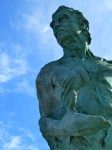
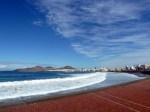
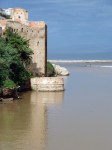
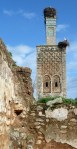
Monday we took a look at Barcelona, Spain, and Casablanca and Rabat in Morocco. Today we continue with some more photographs of Rabat before moving onto the Hassan II Tower and the Mausoleum of Mohammed V, the Taroudant Palace, a spice shop in Taroudant, and finally Playa las Palmas de Gran Canaria (Grand Canary Island).
Nine Days out of Barcelona—Rabat, Taroudant Palace, and Playa las Palmas










Filed under Photography, travel
Nine Days out of Barcelona—Barcelona, Casablanca, and Rabat
Cruising. One of the best travel values for the money out there. Where else can you partake of higher end dining this reasonably, sleep in a private room this cheaply, all the while only having to unpack one time and still get to see different exotic locales almost daily? Then, included with that already low price, comes the nightly live entertainment, movies (on some ships), a library, a card room for bridge, and classes ranging from cooking to photography to lectures on history and everything in between.
And if that weren’t enough, break out your wallet (actually, your room keycard for charges to your shipboard account) and go shopping for everything from jewelry and watches to digital cameras and liquor. Keep that wallet out and you can purchase alcoholic beverages, partake of wine samplings and pairings, or even hit the onboard casino.
Last year, Ursula and I spent eighty-eight days at sea, fifty-four of which were on one cruise alone. On another cruise, nine days out of Barcelona back to Barcelona, we went to Casablanca, Rabat, and Taroudant in Morocco; Las Palmas in the Canary Islands; and Funchal, Madeira. Along the way we visited the Hassan II Mosque, a 12th Century Kasbah (fort), and went sliding down a steep city street in a wicker toboggan.
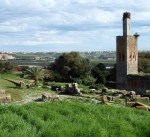
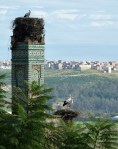
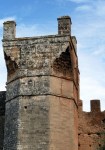
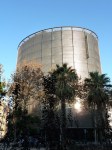
Over the course of the this week’s blogs, I’ll be showing you pictures of this grand adventure. Today we’ll view photographs of Barcelona, Casablanca and the Hassan II Mosque, and that 12th Century Kasbah near Rabat:











Filed under Photography, travel
The View from the Control Tower—Ten Years Later
It was a calm Tuesday morning when I arrived early for my 6:30 A.M. shift at the El Paso Airport Traffic Control Tower in far West Texas. The winds were light. The golden glow advancing from the east revealed the promise of a relatively cloudless day ahead, and the sun would soon be peeking over the horizon. Sunrise in El Paso would arrive at 6:48.
In New York City sunrise had occurred some two hours earlier, at 6:32 A.M. Eastern time. As I entered the tower cab in El Paso just before 6:30 my time, it was approaching 8:30 on the eastern seaboard. The attack on One World Trade Center —the North Tower—was some twenty minutes away.
Nationwide, there were 3,786 IFR aircraft (Instrument Flight Rules) in the air. There would be thousands more VFR airplanes (Visual Flight Rules) not under ATC control flying as well.
The radio in the back on the Control Tower softly filled the air with easy music as I opened up the Ground Control position in anticipation of the early morning airliner rush. At the Ground Control position, I would be responsible for handling aircraft taxiing to and from the runways. The controller to my right, working Local Control, would handle the actual runways and the airspace immediately surrounding the airport.
Downstairs, another controller began the procedures necessary to assume Radar Approach Control responsibilities from the Local Controller, shifting those responsibilities to the radar room downstairs. A second controller would be assisting and standing by to open a second radar position if things got busy.
Things were about to get very busy.
I don’t recall from where the word first came—the radio in the back or a call from downstairs—but we heard that a light aircraft had impacted into the World Trade Center. A light aircraft. We took that to mean a single-engine airplane most likely being flown by a private pilot. It would be a short while later before we would learn the true nature of what had occurred.
This time the news came from the radio—news that a second aircraft, far larger, had just flown into Two World Trade Center, the South Tower. And then came the chilling correction on the first impact—not a light aircraft after all. Something much, much larger.
By now the number of airborne IFR aircraft had grown to 4,205.
It was then that I instinctively knew what was happening. I called my wife at home. I told her that I didn’t have time to talk. I told her to turn on the television. I told her we were at war. I hung up the telephone and turned back to my immediate duties—guiding the morning rush of airliners to the runway for departure.
Within minutes of the attack on the South Tower, word spread that other aircraft had been hijacked as well. All aircraft nationwide scheduled to fly anywhere near New York City or Boston were ordered held on the ground. Those already in the air began receiving orders to divert.
El Paso International Airport was unaffected, as we had nothing filed for those areas. Nevertheless, I began mentally reviewing the covert signals a pilot would use to indicate to me that an aircraft was being hijacked. I was confident that my colleagues working Local and Approach would be doing likewise.
But El Paso soon would be affected, as would every air traffic control facility in the nation. It was 7:25 A.M. when our orders changed. We were to stop all departing aircraft regardless of destination. Not just airliners on IFR clearances, but all VFR aircraft as well. Nothing was to take off. Anywhere. No matter what. Thirteen minutes after this order was given, a helicopter was reported to have crashed into the Pentagon. It wasn’t a helicopter; it was American Flight 77. United Flight 93 had begun flying erratically only three minutes before the Pentagon crash and was also presumed hijacked.
4,360 IFR aircraft now plied the skies above.
The unprecedented order to clear the skies came at 7:45 A.M. El Paso time. Everything. IFR and VFR. The only exception—military aircraft.
The number of potential flying bombs now stood at 4,452, and we all knew that every second counted. That number still did not include the thousands of VFR aircraft also flying around the country.
At El Paso, as everywhere else in the nation, controllers began doing something for which they had no training and no frame of reference. They began emptying the skies. Aircraft were lined up on final approaches to runways all over the country, strung out from each other like never-ending strands of carefully spaced individual pearls.
From Ground Control I looked out onto the final for Runway 26 Left. Aircraft stretched out for as far as I could see. A glance at the radar display showed that the line of mostly airliners stretched out for dozens of miles to the east.
I soon ran out of room at the Airport Terminal. There were no more gates available to handle an influx of people who had never been to El Paso, and who probably never had any intention of ever going there. I began directing large passenger jets to every spot of empty, available ramp space I could find as Airport Operations rounded up mobile stairs to disembark the passengers and buses to transport them.
Eventually the stream reduced to a trickle, the trickle to a dribble, and the dribble to sporadic drops before the flow finally subsided completely. Then, and only then, did I accept a break, strip off my headset, and let out a long sigh of relief as I mentally processed and analyzed what had just occurred. I made my way downstairs, into the break room, and plopped down in front of the television, greeted by repetitive images of the impacts into the Towers and their eventual collapse in ominous twin clouds of dust that only served to validate the wisdom of that day’s grounding order.
One final word about that day:
During this never-before attempted feat, there was not even one Operational Error (loss of approved separation standards between aircraft) reported anywhere in the country.
Filed under Author, Aviation Safety
 Decisions — Murder in Paradise
 The Globe — Murder in Luxury

