Cruising for Classic Cars in Curaçao


It was a cloudy day that October 31 of last year, and we were standing on the side of a busy street in Willemstad, the capital of Curaçao.  Willemstad is a quaint and very picturesque little town that features a lot of interesting Dutch colonial architecture.  The charming buildings come in myriad colors that draw the eye without assaulting the sensibilities.  It just works, and works very well.

But architecture is not the point of this blog; automobiles are.  Lots of automobiles.  Classic automobiles.  Automobiles ranging from American muscle of the ’60s to the classis European econoboxes of the same era.

Ursula and I were slowly making your way back to our cruise ship, NCL’s Norwegian Spirit, when we suddenly found ourselves in the midst of a car show.

If you’re a lover of cars, sit back and enjoy the show:

3 Comments

Filed under Photography, travel

When Fashion Goes Macho—Walther P99c AS in 9mm


Well, I must say that I had a pleasant surprise a few weeks ago.  I tried something a bit different.  I reviewed the classic, compact, iconic Walther PPK chambered in .32 ACP—the cartridge for which that gun was originally designed—and compared it against the slightly larger Walther PPK/S chambered for the more powerful .380 ACP cartridge.  The result was The Perfect Fashion Accessory—Walther PPK in .32 ACP.

The response went way beyond expectations.  And, as we all know, if you reward bad behavior you only wind up reinforcing it.  So, today we’ll take a look at my favorite concealed carry weapon, the Walther P99c AS, and compare it once again to my former favorite, the Walther PPK/S.

The great thing about these pistols is that they are small, yet not so small that you can’t get a good grip on them.  They are also extremely accurate out to a considerable distance.  Indeed, my diminutive PPK/S remains the pistol with which I’m most accurate—far more accurate than even my old Springfield Armory XD-45 Tactical.  That XD-45 is now history.  I sold it some time ago in part because of my inability to shoot it well, as well as for other reasons.

Now for the basics:

The P99 series is available in two calibers—9mm or .40 S&W.  The weapon depicted here is a 9mm, which is considerably more powerful than the .380 ACP round that is the most powerful round for which the PPK/S is designed.

The “c” in P99c stands for “compact,” as this is the compact version of the P99.  The compact versions of this pistol are about half an inch shorter and a full inch less in height.  But you give up capacity for concealment.  In the case of the 9mm, you lose five rounds (10 rounds in the magazine plus 1 in the chamber vs 15+1 on the full size) and four rounds on the .40S&W (8+1 vs 12+1).

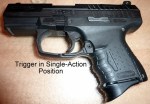
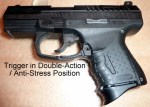
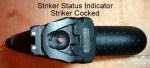
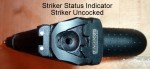
“AS” means it has Walther’s “Anti-Stress” trigger configuration—in addition to double-action and single-action, this third configuration has the light feel of a single-action pull, but the long trigger travel of a double-action pull.  Anti-stress is the default trigger configuration immediately following the chambering of a round.  If the de-cock button is pressed, the weapon reverts to double-action, the recommended position for concealed carry because the heavier trigger pull affords a greater margin of safety.  The weapon goes into single-action following a shot, and remains that way until the magazine is depleted or the de-cock button is pressed.

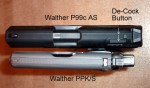
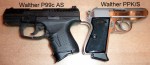
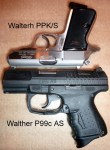
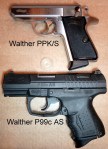
So, how does this weapon compare in size to the PPK/S?  After all, size is very important to concealment, with some dimensions more important than others.  In my own opinion height is much more important than length, and width is slightly more important than height.  On this score the P99c compares quite favorably to the PPK/S, but the PPK/S still wins during those times when I need something thinner.  Weight can also be important, and here the polymer construction of the P99c tops the smaller PPK/S.

The PPK/S measures 6.1” (155mm) long, 4.3” (109mm) high, .98” (25mm) wide, and weighs in at 24 ounces (680.4 grams) with an empty magazine.

The P99c comes in at half an inch longer at 6.6” (168mm), is almost exactly the same height at 4.3” (110mm vs 109mm for the PPK/S), loses to the PPK/S in width at 1.26” (32mm), and weighs less with an empty magazine at 20.8 ounces (589.7 grams).

Because of these very slight dimensional differences, I find myself carrying the P99c far more often than the PPK/S, especially under the bulkier clothing of winter.  The two extra rounds and the higher powered cartridge are also a plus in its favor.  But in the summer, under a light-weight shirt, I still find myself switching to the PPK/S when clothing dictates something slightly thinner.  The smaller holster of the PPK/S also helps under these conditions.

At the range the P99c has proven itself extremely reliable, eating with ease every type and brand of ammunition I’ve ever fed it.  It doesn’t matter if the diet is full metal jacket or jacketed hollow points—it’ll eat anything.  And being of European origin, the P99 was designed around the slightly heavier 124-grain NATO round, although this weapon has had no problems feeding on the 115-grain rounds more commonplace here in the U.S.  The P99 is also rated for +P ammunition, although Walther does warn of increased wear when using this significantly more powerful round.  I tend to stick to 124-grain hollow points in standard-pressure rounds for defense and 115-grain full metal jacket for practice.  To me +P is more hype than of any actual benefit, so I don’t use it.

As for accuracy, the P99c is very good but I’m still better with the PPK/S for some reason.  It’s just nearly impossible to not hit what you’re aiming at with that classic little charmer, and others I know who’ve fired both weapons concur with that assessment.  Nevertheless, the P99c is more than up to the task when it comes to hitting your target.

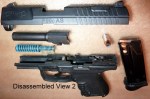
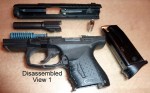
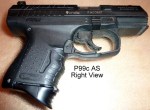
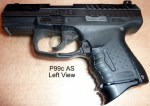
But, hey, a picture is worth a thousand words, right?  So here’re 12,000 words worth of images for you:

6 Comments

Filed under Firearms

A John Carr Retrospective on 9/11—Part 3


This week I’ve dedicated my normal blog schedule to a retrospective of the 9/11 attacks written by my long-time friend former NATCA President John Carr.  Monday I brought you Part 1, and Part 2 ran on Wednesday.  Today, we conclude John’s historically significant account with Part 3:

Brad Troy headed up our CISM (Critical Incident Stress Management Team) response to the attacks and we were in immediate contact on the morning of the 11th.  The FAA was cooperative and we managed to dispatch teams to Washington, New York, Boston, Cleveland and we had a chance to fan out to the other local area facilities as well.  I had always been impressed by our peer debriefers and our CISM program; when our briefers finally got to their respective locations they made themselves available to anyone and everyone who wanted the chance to either talk or meet.

I was very proud of our response to the crisis in terms of helping our members work through their natural responses to the tragedy and the agency’s willingness to help us address it.  The FAA helped us use our agreements with them to rush to the aid and comfort of our brethren on the front end, and this cooperation kept their employees productive but more importantly healthy on the back end.  I give the FAA a lot of credit for that.

Our generation’s date with destiny was brutal and grotesque and yet, in the face of that horror the very best of our people and our professions shone through.

All NATCA members—every single bargaining unit—are a unique institution, an inherently governmental guardian of this country’s liberty tasked with national security, national defense and public safety.  Political points are scored too easily with cheap talk concerning your significance.  Your value to the nation will always be challenged by the words of the weak.  But on that September morning those challenges were answered by the deeds of the strong—deeds that will remain recorded in history books long after the mousey squeaks of yesterday’s ex-chairman have faded into oblivion.

When someone asks you why you belong to a union, tell them this:  This great nation is only twelve percent union yet on that day of infamy fully twenty percent of her dead were union members.  While thousands fled for their lives, hundreds of union men and women ran towards those burning towers, up those jet fueled stairs, helping others to safety as they marched themselves headlong into their own graves.

We grieved then and remember now our nation’s innocence lost, a sense of invincibility we all had morning that slowly gave way to a feeling of dread and foreboding.  On that most beautiful of September mornings you could see fear in the faces of policemen; you could taste jeopardy and danger in the back of your own throat.

My daughter is nine; my triplets eight.  All my children and many of yours have never known a day without war.  Yet while we yearn for peace we must stand erect in our embrace and support of our democracy, never shrinking from the dirty work that lies ahead but remembering what has brought us here and moving forward with the resiliency of the republic.

The beast did not consume our nation like it did so many innocents that brilliant, beautiful and sinister day.  The treachery of zealots did not extinguish the flame of liberty.  Quite the contrary, it fanned it.  The imbeciles who blindly followed Osama “I Met Seal Team Six And All I Got Was This Giant Hole In My Head” Bin Laden did not steal the untroubled essence that is true freedom in a democracy.  No, my friends, they stole nothing;  children still laugh and play iPods in the streets.  By now the fools who spent their summers becoming terror camp graduates have either been given a Predator drone enema or been wired for lamp post duty and snapshots at Abu Graib.

Since that morning ten years ago America’s military has taken the fight to the enemies’ dingy little corner of the world, chasing gutless cowards across the globe.  Over six thousand of our country’s bravest fighting men and women have made the ultimate sacrifice, paying with their lives for our freedom to live, to work, to associate, to travel, to do and to speak as we choose.  Like the saying goes…freedom really isn’t free after all.

Six thousand combat dead in the war on terror.  In New York there is a saying:  “Kill one of mine, I kill ten of yours.”  According to the Associated Press there have been 110,000 Iraqi Army war dead.  Other estimates go as high as 150,000.  According to Wikipedia there have been over 24,000 Taliban war dead in Afghanistan since 2001 and the number is estimated to be at least as high for Al Qaeda worldwide, bringing the total for the Afghan theatre to upwards of 48,000.

Last week American forces killed the latest “Senior Al Qaeda Leader,” again taking the fight to Pakistan and leaving a smoking crater where an Al Qaeda Regional Facrep Meeting was just about to begin.  Getting named “Senior Al Qaeda Leader” used to mean something….now it’s like getting stuck with the bar tab after the NATCA Reloaded Get-Together.  One minute you’re surrounded by pals, then BOOM!

Our forefathers faced an enemy who approached their shores with overwhelming force and superior firepower and they could have withered.  Instead, they stated their intent: “Live Free or Die.”  And so they did: both, in great numbers.  On September 11, 2001 a new generation of Americans were branded with that iron, baptized by burning fires in New York, Washington and Pennsylvania.  And so we did, and so we have, and so we will.

A Partial Final Tally:

Estimated number of children who lost a parent in the attacks:  3051

Number of children of NYC firefighters who lost a parent:  1200

Number of families who got no remains:  1,717

Number of days WTC continued to burn after attack:  99

Percentage of Americans who knew someone hurt or killed:  20

Number of body parts found:  19,858

Bodies found intact:  289

Source:  New York Magazine  nymag.com

Comments Off on A John Carr Retrospective on 9/11—Part 3

Filed under Aviation Safety