

SIG Sauer’s P229 Enhanced Elite in 9mm
We’ll be getting back to travel and photography on Wednesday (more on that at the end of today’s blog post). However before I start another photo travel series, I wanted to get in one quick entry of my highly popular firearms reviews. Indeed, such reviews hold five of my top ten most popular posts, and this year’s review of the FNH FNX-45 is currently at number eleven and rapidly gaining ground.
Today I’m presenting to you another SIG Sauer — this time the P229 Enhanced Elite chambered for the 9x19mm Parabellum cartridge. This is actually the second SIG I’ve reviewed, the first being the SIG P220 Equinox chambered in .45 ACP, which is functionally pretty much the same. The differences between these two, besides the caliber and magazine capacity, are in the reach of the trigger, SIG’s new E² enhanced grip, and in cosmetic treatments.

SIG Sauer .45 ACP P220 Equinox
One of the first things the observant reader will notice about the Enhanced Elite is the enormous beavertail extension above the grip. Many guns incorporate this feature as a way to minimize or eliminate slide bite and hammer bite. Slide bite occurs when the hand is too high on the grip, allowing the bottom of the slide under recoil operation to potentially bruise the shooter’s hand or even gouge out two parallel tracks along the top of the hand behind the area between the thumb and index finger. Not fun.
Indeed, this is often referred to as “Walther bite” by fans of the Walther TPH and PP-series pistols, and is the primary reason that Smith & Wesson redesigned the beavertail on the PPK and PPK/S pistols that they manufacture (the other reason being to assist in recoil control for quicker follow-up shots). Hammer bite occurs when this same area of the hand is pinched or otherwise injured by the rapid rearward movement of the hammer being cocked under recoil operation. Hammer bite was common in the original Model 1911, but later redesigns extended the beavertail on this weapon to eliminate the problem.
Here are a pair of images comparing the original Walther PP-series beavertail to the Smith & Wesson redesign:
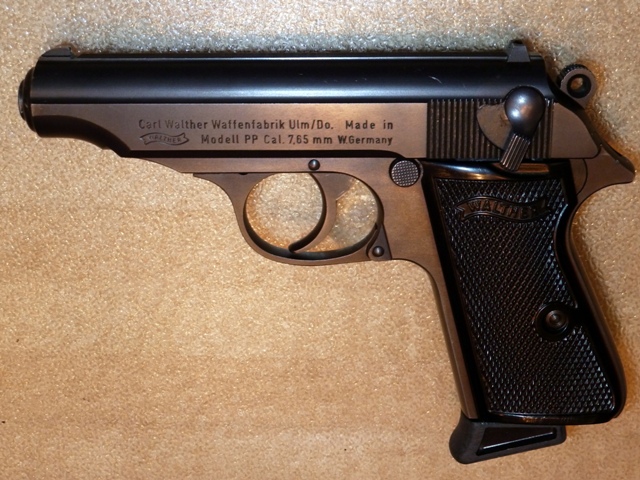
German-made 7.65mm (.32 ACP) Walther PP with original beavertail

Smith & Wesson redesigned extended beavertails on the Walther PPK and PPK/S
Let me assure you that the beavertail (the “Elite” part of “Enhanced Elite) on the SIG P229 is for cosmetic purposes only. Having fired SIGs for some time now, I can assure you that a properly held P22(x) series pistol does not inflict injury through either slide or hammer bite, and that these weapons have a mass that is more than sufficient to tame the recoil to a very manageable level. Bottom line: It just looks darn good, but it is an exercise in indulgence.

SIG Sauer P229 Enhanced Elite in carrying case
Now that you know to what “Elite” refers, let us take a look at the “Enhanced” part of “Enhanced Elite. That simply means that the P229 Enhanced Elite comes equipped with SIG’s modular, one-piece E² Enhanced Ergonomic grip in conjunction with a revised trigger that reduces the distance between the face of the trigger and the grip. Here is a comparison image of the standard versus E² grip configurations on the P229:

Standard SIG P229 versus P229 with E² enhancement
While this may not seem like much of an improvement, this is huge for anyone with small to medium size hands or short fingers. My hands are by no means small, and even I find this enhancement a noticeable improvement over the original SIG P22(x) design.
By the way, the one-piece E² grip is not held in place by the traditional screws. SIG includes a special tool that helps pry the grip from the frame should you need to remove the E² for a more detailed cleaning of the weapon.

Included E² grip removal tool on left side of image
The SIG P229 Enhanced Elite also comes equipped with tritium-filled night sights:

One great thing about the SIG P22(x) line of pistols is the ease with which they disassemble. As I described in my review of the P220 Equinox, it’s simply locking back the slide, rotating the take-down lever, releasing the slide, and pulling the slide forward off the rails. Once that’s done you just strip out the guide rod, recoil spring, and barrel for cleaning. Putting SIGs back together is just as quick and easy.

Disassmbled P229 Enhanced Elite
And how does this weapon perform at the range? With the class, grace, verve, and aplomb befitting its pedigree, and without the drama and tantrums of many of its lighter polymer-framed competition. This is, after all, a design for the rigors of police work and the harsh environment of combat, combined with the reliability and ease of use demanded by both. SIG simply makes, in my opinion, the best pistols on the market for the price whether you are an experienced shooter or someone new to handguns.

SIG Sauer P229 Enhanced Elite
This particular P229 is the type of double-action/single-action weapon which I personally prefer. I find that the added safety benefits of a heavy, long double-action first pull of the trigger suits my comfort level, and mastering that first shot is not at all difficult. Besides, if I need the accuracy of a lighter, shorter single-action shot, it takes but a fraction of a second to thumb the hammer back into its cocked position.
Accuracy is superb, and SIG’s 4.5-pound single-action trigger pull is one of the best on the market short of a customized handgun. Slack take-up occurs in about 5/16ths of an inch, with the trigger breaking both cleanly and crisply with no slop after that initial travel. Double-action is rated at a 10-pound pull, and takes about three-quarters of an inch to accomplish — the first quarter-inch for take-up of trigger slack, and another half-inch to bring the hammer back to its trip point. Trigger reset after a shot is about a quarter-inch with an audible “click” and a positive tactile indication. That quarter-inch reset is a tad less than what I measured on the SIG P220.
As far as concealment, the SIG P229 is not as much of a challenge as you might expect from a weapon weighing in at 32 ounces (with an empty magazine) and measuring 7.4 inches long, 5.1 inches high, and 1.6 inches wide. The P229 hasn’t replaced my Walther P99c AS as my primary roaming companion, but it does get taken for a walk every now and then. After all, 15+1 rounds 0f 9mm is sometimes more of a comfort than the Walther’s 10+1 capacity. Just remember to use a high-quality holster and a good, stiff gun belt and you should have no problems.
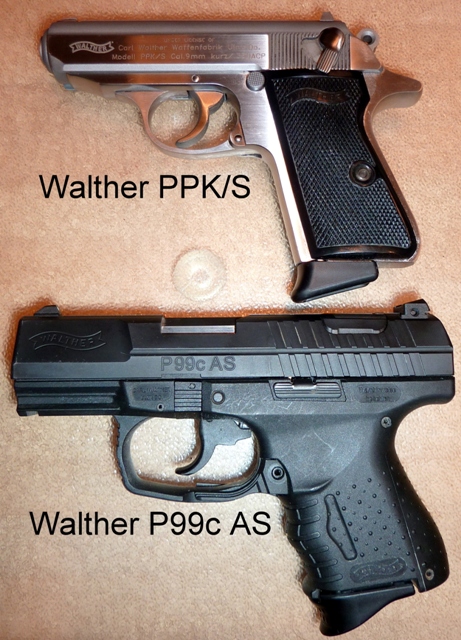
My trusty 9mm P99c AS alongside my equally trusty and frequently carried .380 ACP PPK/S
Originally I had planned for my next photo travel blog series to be our 28-day transpacific crossing from Sydney, Australia, and Seattle, Washington. Instead, I’m going to delay a look at that cruise until later (about the time the ships reposition from Alaska back to Sydney). Starting Wednesday I’ll present to you a cruise that is currently making the rounds until fall — the Montreal-Boston run on Holland America’s MS Maasdam.



 Decisions — Murder in Paradise
 The Globe — Murder in Luxury

