Category Archives: travel

The Mexican Riviera—Acapulco


Remember back when travel in Mexico was both fun and safe?  Yeah . . . neither do I.  Thanks a lot, War On Drugs.  Didn’t we try this “Prohibition” thing back in the 1920s?

On my January 25, 2012, blog I showed you what a cruise ship looks like without a 230-foot (70-meter) gash down the side with a big boulder protruding from it.  That blog was about NCL’s Norwegian Star, a really great ship.  The photographs in that blog were taken on a cruise Ursula and I took to the Mexican Riviera back in December of 2006.

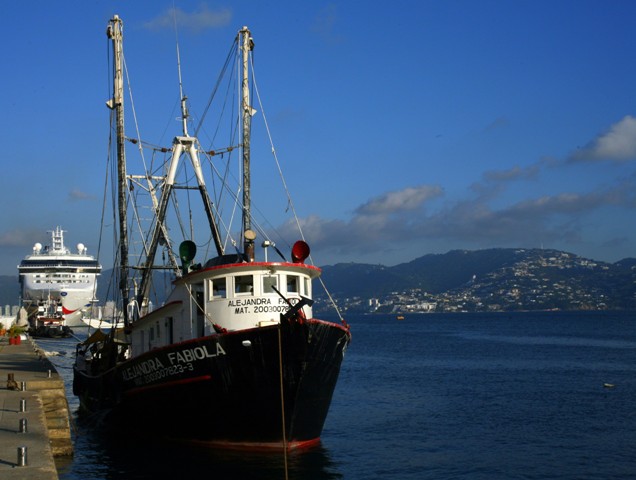
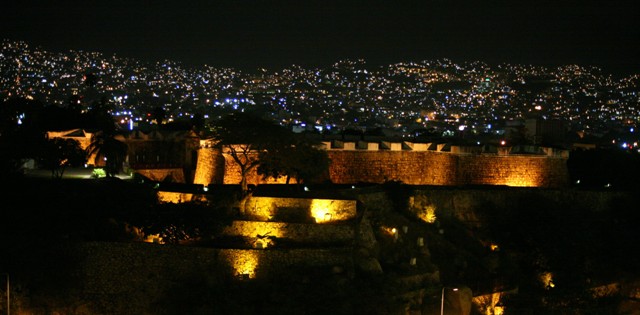
All this week I’ll be showing photos taken during that excursion.  Today’s shots are of Acapulco.  Acapulco was the place to go for the Hollywood elite back in the 1950s and ’60s.  Elvis Presley even filmed a movie there back in 1963—Fun in Acapulco.  And, of course, that film had our hero joining the famous La Quebrada Cliff Divers.

Today, Acapulco is a bit more famous for gunfights, kidnappings, and headless bodies being dumped near shopping centers.

Gee, what a difference a little over five years make:

2 Comments

Filed under Photography, travel

Costa Concordia—My Guess on What Was Really Happening on the Bridge


Image Linked from CruiseLawNews

On Monday’s blog I gave you the reported timeline for the Costa Concordia disaster.  Let me be very clear that what follows today is entirely speculation on my part and is not be to considered in any way established fact.

Referring back to Monday’s timeline, at 22:00 the Costa Concordia’s bow thrusters were used to turn the ship to the right, initially heading it away from the island of Giglio.  This maneuver reportedly aggravated the flooding below decks, substantially increasing the flow of water pouring into the five compromised compartments.  But even before this maneuver the ship had already begun listing dangerously to one side.  The thrusters were left operating until the ship had turned almost completely around and was very nearly facing in the direction from which it came.

While there remains much for which to blame Captain Schettino, this maneuver is probably the one thing he actually did right that fateful night . . . or did he?  Even with the loss of engine power, the Costa Concordia’s momentum kept the ship sailing past the main port on the island of Giglio.  Reportedly to slow down the ship, Captain Schettino initially turned the Costa Condordia into the nautical equivalent of a car in a sideways skid, using the natural resistance of the water pushing broadside against the ship to reduce inertial momentum to the point where the thrusters could be used to maneuver.  Then, turning the ship broadside to both the current and the prevailing wind, it is speculated that he used both natural forces to assist the thrusters in bringing the Costa Concordia closer into shore and running it aground.

Yet it seems to me unfathomable that Captain Schettino remained levelheaded enough to intentionally perform this maneuver considering all the bad decisions he made leading up to the disaster and, especially, in the aftermath that followed.  All his post-collision decision-making to me reeks of panic (and, trust me, having been an air traffic controller for over 34 years and watching how people handle pressure during an emergency, I know panic when I see it).  So, while there are many who are crediting Captain Schettino’s ship skidding and thruster maneuver with an attempt to minimize the danger to both passengers and crew, I remain both unconvinced and skeptical that this was indeed the intention.

Yes, I’m a novelist.  Yes, it’s my job to spin fantastic tales.  So, what follows may very well be a fiction manufactured out of an overactive imagination, but here is my take on what Captain Schettino may have been attempting to do.  While the aforementioned maneuver may be consistent with an attempt to beach the ship, it can also be seen at least initially as an attempt to swing the Costa Concordia out into deeper water.  And why would someone want to do that considering that the passengers and crew had not been instructed to prepare for evacuation, nor had the lifeboat crews been ordered to their muster stations?

There are reports that officers aboard the Concordia, in what could be construed an act of mutiny, ordered the lifeboat stations manned before authorization came from the bridge.  Italian Coast Guard reports would seem to confirm this, as lifeboats were seen fleeing the ship some ten minutes after the order to abandon ship was finally given by the recalcitrant captain.  Ten minutes would have been insufficient for such an act even under ideal conditions, and conditions aboard the Costa Concordia were anything but ideal considering the angle at which it was by then listing to the side.  That begs the question:  If a mutiny did in fact occur, how high did it reach up the chain of command?  Did Captain Schettino order the thrusters to remain on once the ship had turned back out away from Giglio, or did someone else on the bridge keep those thrusters activated in an attempt to swing around the Costa Concordia and run it aground?

Considering Captain Schettino’s actions both before and after the actual maneuver, it seems not very far beyond the realm of possibility that Captain Schettino fully intended that the Costa Concordia go down in deep water in a desperate attempt to hide his responsibility for the initial collision.  This seems even more probable when considered in the context of his initial and totally false claims that the collision occurred with an uncharted obstruction when in fact the rock the Costa Concordia struck was clearly on his navigation charts.  And the failure to prepare for an evacuation would also seem to indicate that he didn’t want a lot of witnesses around to contradict his multitudinous and mutually contradictory stories.

Speculatory?  Perhaps.  But it will indeed be interesting to see the testimony of the bridge crew at Captain Schettino’s trial in any case.

The above positioning graphics are linked from this site, which does a marvelous job of explaining the actual maneuver described above.  Thank you for the perspective, Mr. James Hamilton.

3 Comments

Filed under travel

So, What Did Happen Aboard the Costa Concordia?


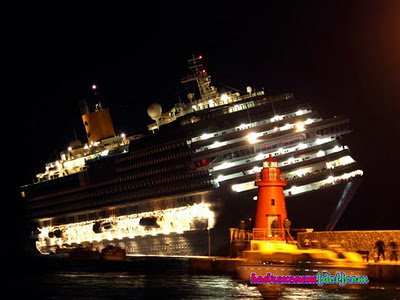
Photo Linked from CruiseLawNews

Last week I hinted that I might in a future blog share with you my opinions about the Costa Condordia disaster.  Before I do, let’s recap what we already know.  First, the timeline of events:

21:16 hours—The Costa Concordia deviates from its preprogrammed route in order to pass near the island of Giglio off the Italian coast.  Speed:  15.5 knots (about 17.8 miles per hour).

21:36 hours—The Costa Concordia begins its turn to the north to avoid shallow waters and obstructions.  Unfortunately, according to Captain Francesco Schettino the order for this turn to the north is given three minutes late.  The ship’s mass and momentum continue to carry the ship even closer to disaster.

21:38 hours—The Costa Concordia strikes a navigationally charted rock.  A seventy-meter (230 feet) gash is ripped into the port side of the ship.  The Concordia immediately starts taking on water and, within minutes, the engines fail and electrical power is disrupted.  Backup generators come online shortly thereafter.

21:42 hours—A general warning blast to the crew is given.  Nothing detailing the developing crisis is broadcast to the passengers.

21:50 hours—The Costa Concordia begins to list.  Loose objects start sliding off tables and other surfaces.  Some passengers start retrieving flotation jackets and begin gathering on deck.  Others await word from the bridge—word that will not come for another one hour eight minutes.

21:57—Captain Schettino makes his first communication with Costa headquarters advising them of a loss of power and flooding in one compartment (in fact five compartments had been breached and were taking on water; the Concordia was designed to survive a maximum of three flooded compartments).  This call to Costa Cruises as the first of four made over a 36-minute period.

22:00—The Costa Concordia’s bow thrusters are employed to turn the ship to the right.  The current carries the ship closer to shore.

22:06—Captain Schettino makes his second contact with Costa and advises that two compartments are taking on water.

22:12—The Italian Coast Guard is alerted by the police that passengers aboard the Costa Concordia are reporting that something has happened to the ship.  The Italian Coast Guard makes contact with the ship to verify the reports.  Someone aboard the ship replies, “We have a blackout and we are checking the conditions on board.”  The Coast Guard is not advised of the flooding.

22:16—Captain Schettino advises Costa Cruise Lines that he has everything under control.

22:33—Captain Schettino finally advises Costa Cruise Lines that the Costa Concordia is in fact listing and taking on more water than it can handle.  He tells the company that he intends to evacuate the ship.  The ship has been listing for 43 minutes and is now listing so badly that the lifeboats can no longer be safely deployed for an orderly evacuation.  Captain Schettino withholds his intention to evacuate from the passengers, ostensibly to avoid a panic that has already begun.

22:42—Over an hour after the collision Captain Schettino finally comes clean to Giglio port authorities and reports that there has been an accident.

22:58—Captain Schettino orders the evacuation of the Costa Concordia. It is already far too late for an orderly and safe evacuation.  Later, one crew member would be quoted as saying that had the order to lower lifeboats been given an hour earlier (a commonsense precaution even if the full extent of damage had not been known at that time), all passengers and crew would have arrived on Giglio without so much as, “. . . getting their feet wet.”

00:40—The Italian Coast Guard is still struggling to find out how many people remain aboard the Costa Concordia.  Captain Schettino advises that there are between 200 and 300 still aboard.  Ten minutes later the Coast Guard asks again, and this time Captain Schettino says that only about 40 people await evacuation.  The Coast Guard, incredulous of the report that upwards of 200 people were successfully evacuated in the ten minutes between the two reports, asks Captain Schettino if he is still aboard.  His reply was, “No. I’m not on board because the bows of the ship are coming up. We’ve abandoned her.”  At this time there are still hundreds of passengers and crew yet to be evacuated from the stricken ship.  Unconfirmed reports from witnesses place Captain Schettino ashore and snuggled in a blanket as early as 23:40.

01:46—The Italian Coast Guard orders Captain Schettino to return to the Costa Concordia to oversee the evacuation of his ship.  He repeatedly refuses the order.  Eventually he tells the Coast Guard that he will return.  Coast Guard personnel are on record as stating they do not believe he ever went back aboard.

Wednesday—My thoughts on what really was going on during all this.

4 Comments

Filed under travel