Category Archives: Firearms

On Selectively Mining Data to Push an Agenda


No matter which side of the table you sit in a debate, I find it morally reprehensible to selectively mine data to push a specific agenda.  In discourse over public policy especially, one should either present data in its unrefined (and thus unbiased) form so that an honest debate and reasoned decision may be made, or the data should not be put forth at all.

But the individual below says it so much better than I in the following presentation of unfiltered factual data from reliable, unbiased sources — unbiased, that is, before the media, politicians, or those with an agenda get to them.

I’ve touched upon this topic before in my very popular blog article:  What Does Sandy Hook School Have in Common with Columbine High School, Virginia Tech, and the Century Aurora 16 Theater?  In that article I stated that so-called “assault weapons” (which are not truly military assault weapons by definition, as they are not fully automatic) are used in less than 5% of violent crimes.  Apparently I was way off.  I apologize for that, but in my defense I didn’t want to be caught fudging the figures in my favor.  The actual statistic according to the latest FBI figures is much closer to 3.5%.

Walther P99c AS

Walther P99c AS

Yet this is the type of weapon on which Senator Dianne Feinstein and others are concentrating their efforts?  Not really.  Don’t believe that “assault weapons” are the true goal for even a second.  Defining semiautomatic rifles with military-style cosmetic appearances as “assault weapons” is the opening volley in an agenda that aims to incrementally remove the right to bear arms from all law abiding citizens.  This despite raw, unfiltered data that shows such firearms are very rarely used in violent crimes despite the Sandy Hook and Aurora Theater slayings.

As for the ultimate goal of disarming law abiding citizens, that agenda is being pushed despite raw, unfiltered data that consistently shows almost across the board a sizable reduction in violent crime in those states and localities which have broadened the ability of their citizens to carry concealed weapons upon their person.  Remember — twenty years ago only a very few states allowed for concealed carry.  Today forty-one states allow it, and many of those states have reciprocal agreements allowing their citizens to cross into other states while availing themselves of the same “privilege” of self-protection.  Think for a second about that wording I just used.  Scary, isn’t it, that self-protection for law abiding citizens has become a “privilege” rather than a right in some places, and in others it is prohibited altogether.

During that same twenty-year period we’ve seen national violent crime rates cut in half, and the national murder rate has dropped 54%.  So, where is violent crime still a major problem?  In places in which law abiding citizens do not have the right to defend themselves from society’s predators.  Places such as New York City (where even a subway can be used as a weapon); Chicago (where, to paraphrase a popular song, only the unarmed die young); Boston (in which the violent crime rate routinely runs over double the national average); and Washington, D.C. (a national disgrace crime-wise).  Indeed, about the only exception as far as I can tell is perennially economically depressed Detroit, which is located in a state with actually pretty lenient concealed carry laws.
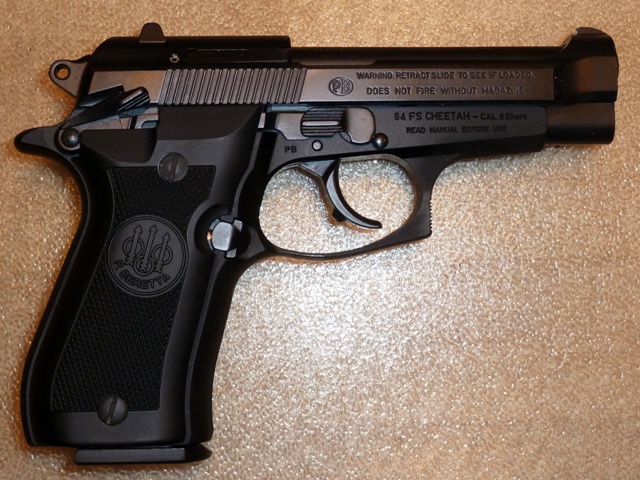
Beretta 84FS "Cheetah"

Beretta 84FS “Cheetah”

As for Senator Dianne Feinstein’s home state of California?  Now, there’s a national poster child for gun control.  We all know the decades-long horror story that is the Greater Los Angeles Area.  Let’s take a look instead at San Bernardino, as it is instructive to a citizenry that is frequently told by officials both elected and appointed that they should rely not upon themselves for protection, but rather local law enforcement.

San Bernardino recently went into bankruptcy.  As a result cost cutting hit even essential services — the San Bernardino police department being among those services.  Eighty officers were let go.  Predictably, crime went through the roof.  In one case, during an active home invasion call to 911, the residents were told there would be a three-hour response time.  Three hours!  Yet remember, we are told that we should entrust our lives and property protection to local law enforcement.

Indeed, things deteriorated so quickly in San Bernardino that City Attorney James Penman just last November advised the residents that they should, “. . . lock their doors and load their guns.”  Of course, if you’re traveling beyond the front door of your home then you’re on your own; California is a “may issue” state in which the local police chief or sheriff can decline at whim your application for a concealed carry license . . . even if their response time in a life-threatening situation is up to three hours.

Walther PPK/S

Walther PPK/S

While we’re on the topic of relying upon local law enforcement for your protection as well as the protection of your loved ones, I would like to direct your attention to two Supreme Court decisions:  Castle Rock v. Gonzales and DeShaney v. Winnebago County.  Without wading into the entire legal morass, the upshot is this — the Supreme Court of the United States has held on multiple occasions that there is no Constitutional requirement for local law enforcement to protect you, or even to respond in the event of imminent danger.  None, which means in San Bernardino the response time is free to go from three hours to three days, weeks, or even months without any consequences to the local government whatsoever.

Some final words on Gun Free Zones.  I mentioned in my article — What Does Sandy Hook Elementary School Have in Common with Columbine High School, Virginia Tech, and the Century Aurora 16 Theater? — that all the aforementioned mass slaying sites were Gun Free Zones.  I also noted in that article that:

“. . . in not one of the cases cited did those responsible for those [Gun Free Zone] designations take adequate (or even any) steps to ensure that the law-abiding citizens they were disarming were protected from those who would ignore their ‘Gun-Free Zones.'”

I have since learned that Sandy Hook Elementary, Columbine High, Virginia Tech, and the Century Aurora 16 Theater have something in common with nearly every single mass shooting in which there were more than four victims.  Each and every one save one occurred in what was ostensibly a “Gun Free Zone.”  That exception was the tragic 2011 Tucson shooting in which nineteen people were shot, U.S. Representative Gabrielle Giffords was severely wounded, and six people were killed.

Contrast that record for a moment with sites in which a heavily armed crazy chose as a killing ground an area not so designated.  That’s kind of hard to do, as such sites appear to be routinely avoided by mass killers for obvious reason.  But we do have a few cases to compare.  Just three days before the horrendous Sandy Hook shootings Jacob Tyler Roberts entered the Clackamas Town Center mall near Happy Valley, Oregon.  Mr. Roberts had with him a stolen AR-15 Bushmaster rifle, the same make and model used by Sandy Hook shooter Adam Lanza.  From that weapon Mr. Roberts fired sixty rounds, killing two and wounding one other.  And then he stopped his shooting and suddenly committed suicide well before local law enforcement could intervene.

Why?  Because of a man named Nick Meli, a civilian licensed to conceal carry and who, fortunately, had with him that day a .40 S&W Glock 22.  Mr. Meli pulled his weapon and took aim at Mr. Roberts, but decided not to take the shot for fear of hitting a person whom he saw standing behind the killer.  Instead, Mr. Meli ducked into a nearby store to await a better opportunity to stop the slayings without endangering someone himself (a wise course of action those of us who have taken concealed carry courses are admonished to follow).  The one thing Mr. Meli knew with any certainty at that point was that the killer saw him with his Glock 22 before he made his tactical retreat.

What happened next is instructive.  With no police in sight and no one else to stop him, that confrontation with an armed civilian was apparently enough for Mr. Roberts.  Mr. Roberts turned and fled, running down a stairwell and out onto a lower floor.  The next shot fired by Mr. Roberts was the one used by him to take his own life.

P99c AS, 84FS, and PPK/S Comparison

P99c AS, 84FS, and PPK/S Comparison

So, I’m going to say this once again:  Those who insist upon creating feel-good, do-nothing “Gun Free Zones” have a moral obligation to insure that the law abiding citizens they intentionally disarmed with that designation are protected from those who prey upon areas so designated.

It is way beyond time for those who insist upon implementing “Gun Free Zones” to take responsibility for their actions rather than allowing them to pass to an inanimate object the blame for what they themselves have wrought.  If lawmakers and other government officials insist upon repeating a demonstrably failed experiment with tragically repetitive and predictable results, they should at the very least be held civilly libel and perhaps even criminally negligent for the resulting loss in lives if they do nothing to protect those they have placed inside what amounts to a “Free Fire Zone” for those with deranged minds or criminal intent.  For private business owners such as those who designated the Century Aurora 16 Theater a “Gun Free Zone,” there should be absolutely no question as to holding them legally responsible for the outcome of their poor decisions.

Clackamas Town Center is, by the way, not the lone example of an armed civilian or off-duty officer intervening to possibly prevent a much larger tragedy.  For additional cites, take a look at the following (and note while you do that some were stopped because an armed citizen or off-duty officer fortunately disregarded that “Gun Free” designation, such as assistant principal Joel Myrick who had a .45 in his truck parked on school grounds in apparent violation of the 1990 Federal Gun Free School Zones Act; I say ‘apparent’ because there are exceptions to that law and I’ve been unable to determine if Mr. Myrick’s possession on school property was under one of those exceptions):

Sanktikos Mayan Palace 14 Theater

Players Bar & Grill

Appalachian School of Law

Pearl High School

Parker Middle School Dance

Colorado YWAM and New Life Church

8 Comments

Filed under Firearms, Opinion Piece

What Does Sandy Hook Elementary School Have in Common with . . .


. . . Columbine High School, Virginia Tech, and the Century Aurora 16 Theater?  We’ll get to the answer to that riddle in a moment.  First, however, I want to address the recent tragedy that occurred at the Sandy Hook Elementary School in Newtown, Connecticut, and the inevitable outcries to “do something.”

Smith & Wesson SW99

Homicides by firearm peaked in the United States at over 14,000 gun murders back in 1994.  That peak followed a nine-year surge in such crimes that began in 1985.  In 2011 there were 12,626 murders of which 8,552 (67.7%) were committed with firearms.  In a nation of 311,591,917 that comes out to a rate of 2.74 deaths per 100,000.  Contrast that to the rate of 10.39 traffic deaths per 100,000 and you can see that you are at considerably more risk of losing your life every time you get into that incredibly dangerous horseless carriage contraption upon which you rely daily, but that’s not really the point of this missive.

In 2004 this country’s ten-year assault weapons ban was allowed to lapse despite dire predictions that such a lapse would result in an immediate upsurge in deaths nationwide.  It didn’t happen.  Assault weapons were never really the problem as they only accounted for less than 5% of crimes committed with firearms.

Meanwhile, what has happened since 1994?  Why are gun crime rates down nationwide despite the lapse of the “assault weapon” ban?

Well, for one thing the number of states authorizing private citizens to carry a handgun, either in the open or concealed, has gone from just a very few to 41.  Many of these states granting concealed weapons licenses have entered into reciprocal agreements with other states.  For instance, as a licensee of the state of Texas, I can carry a concealed weapon in Alabama, Alaska, Arizona, Arkansas, Colorado, Delaware, Florida, Georgia, Idaho, Indiana, Iowa, Kansas, Kentucky, Louisiana, Michigan, Mississippi, Missouri, Montana, Nebraska, New Mexico, North Carolina, North Dakota, Oklahoma, Pennsylvania, South Carolina, South Dakota, Tennessee, Utah, Vermont, Virginia, West Virginia, Wisconsin, and Wyoming subject, of course, to the laws and restrictions in each of those states.

Likewise, concealed carry licensees in those state can and do routinely carry weapons while visiting us here in Texas.

But how can this be?  Nationwide gun-related crime rates are down, not up, right?  After all, isn’t reducing gun violence the whole raison d’être behind the Brady Center and their call for increasing gun restrictions?  Isn’t this the mantra — reduce guns to reduce violence — of New York City Mayor Michael Bloomberg, a man with 24/7 police protection available to him?

Now notice some of the states not on the above list, states such as Illinois (home of Chicago); Washington, D.C. (I know.  Not really a state, but you get my meaning); New York (home of New York City); California, Massachusetts, New Jersey, and other high-crime states.  You’ll notice that also on the list is Connecticut, home to the community of Newtown and the Sandy Hook Elementary School.

Coincidence?  Not at all.  Blanket gun laws disarm one group, and one group only — the law abiding citizen — and deny to that citizen the right of self-protection.  The criminal doesn’t care about such laws; he will be armed regardless.

In other words, if you rely upon 911 and the police to protect you, then your “savior” will arrive only after the crime has been committed and the criminal has long departed.  Or, as a good friend and former law enforcement friend of mine likes to say, “When seconds mean the difference between life and death, remember that the police are only minutes away.”

The main danger now is the public outcry to “do something.”  This country has a long and rich tradition of, during a period of emotional urgency, creating both bad policy and bad law.

In the wake of assassinations in the 1960s, for example, came the Gun Control Act of 1968.  That law prohibited the importation of the ever popular Walther PPK because of its small, concealable size.  The result was the PPK/S — a handgun nearly as small, just as concealable, but with one additional round carried in the magazine because of the mandated expansion of the weapon’s grip to make it legal.  That’s an improvement?  Then, to further get around the restriction, PPK manufacture was taken up by an American company resulting in an even cheaper version of the weapon than what was previously coming into the country from West Germany and France.

Walther PPK and Walther PPK/S

Other examples of how we overreact as a nation include the Gulf of Tonkin Resolution which resulted in the escalation of the Vietnam War.  Want a more current example?  Consider the creation of the monolithic, bureaucratic Department of Homeland Security and the much despised Transportation Safety Administration as well as the unwarranted and costly invasion of Iraq in the aftermath of the 9/11 attacks and the calls to “do something.”  Now is not the time to make hasty and irrational mistakes with the Second Amendment, which isn’t the Amendment causing the current problems in any case.

You read that correctly.  It’s Freedom of Speech (particularly the Press) rather than the Right to Bear Arms that is fueling this latest wave of violence. By publicizing the names, sensationalizing the crimes, and making the perpetrators famous, the media are encouraging other deranged individuals to take a similar path.  It’s called the Copycat Effect.

Yet somehow I don’t hear the same media now advocating for restrictions on Amendment 2 calling for restraint on their part in the exercise of Amendment 1.  Indeed, far from it in today’s never ending 24-hour news cycle.

Walther P99c AS

Now, back to our original question:

What does Sandy Hook Elementary School have in common with Columbine High School, Virginia Tech, and the Century Aurora 16 Theater?

The answer:  All four areas were designated by either law or by posted corporate policy as “Gun-Free Zones,” yet in not one of the cases cited did those responsible for those designations take adequate (or even any) steps to ensure that the law-abiding citizens they were disarming were protected from those who would ignore their “Gun-Free Zones.”

One last point aimed (pun intended) at those who advocate the elimination of the Second Amendment — and this is a point they simply must answer for any credibility whatsoever:

In Switzerland, every able-bodied male between the ages of 19 and 31 is trained on and issued a fully automatic (read: machine gun) military (read: real assault) weapon, which they store along with ammunition in their homes. When they exit mandatory military service, they are offered the option of having that weapon converted from full automatic to semiautomatic so that they may keep that weapon as their own. That means there is either a fully automatic or semiautomatic “assault weapon” in many Swiss homes, and Switzerland leads the world in gun ownership with 45.7 weapons per 100 residents.

Meanwhile, Mexico has some of the strictest gun ownership laws in the world.

So the point that must be answered by those who fear private ownership of weapons are these:

If availability of weapons is truly the problem, then why isn’t Switzerland the most dangerous country on the planet, and why isn’t Mexico a violence-free paradise?  Why has the expansion in the U.S. of both gun ownership and the right to carry a weapon in public for self-defense been accompanied by the lowest gun-homicide rates seen in this country since the early 1970s?

5 Comments

Filed under Author, Firearms, Opinion Piece

SW99—The .45-Caliber Walther


I’ll bet you didn’t know that Walther made a handgun chambered in the mighty and formidable .45 ACP round.  But they did.  Sort of.

After over a dozen years of marriage, Walther and Smith & Wesson are getting a divorce.  Shortly after the mysterious and secretive Samuel Cummings (the inspiration for the Sterling Heyward character in my mystery novel The Globe) passed away in 1998, Smith & Wesson became the primary importer of Walther firearms into the United States, taking over this task from Mr. Cummings’ International Armament Corporation (Interarms).  After the end of this year, that partnership will partially dissolve with the introduction of Walther’s own American-based distribution company—Walther Arms, Inc.  Smith & Wesson will continue as the sole world-wide manufacturer of the Walther PPK and PPK/S line and will distribute Walther pretender pistols such as the Umarex-made (Umarex is Walther’s parent company), Walther-branded P22 and PK380.

But, as with many marriages, there are progeny involved.  One of those children was the far too short lived SW99.  The SW99 frame was made by Walther—based upon their much-vaunted P99 design (my favorite concealed carry weapon in compact form).  Indeed, the Walther banner can be clearly seen on the frame above the trigger guard.  The barrel and slide, however, were manufactured by Smith & Wesson.  The SW99 came in standard P99 calibers—9mm and .40 S&W, but Smith & Wesson decided to go one better and offered the SW99 in .45 ACP as well.

Additionally, the SW99 came in multiple trigger configurations.  There was the unique and innovative Anti-Stress (AS) trigger with three trigger modes; the double-action only SW990 and SW990L; and the Glock-style SW99 QA.  Compact versions of the SW99 were also made.

Because of my very positive experiences with the P99c AS (compact version with Anti-Stress trigger), I decided to acquire a .45 ACP version of the very similar SW99 in the same trigger configuration.  Thanks to my friends at Walther Forums, I was soon able to track down one for sale in Arizona.  A deal was made and the SW99 was shipped to my favorite local gun store—El Paso Collectors Gun Exchange—where the required federal paperwork was completed and transfer of control of the weapon was made.  I must say that the weapon was everything that was promised.  It appeared to have never been fired outside of the factory.  The original carrying case, spent cartridge, and all other factory-included accoutrements were received in like-new condition.

So, what is this “Anti-Stress” (AS) trigger?  Basically, it’s a traditional double-action/single-action trigger much like that used in a modern, hammer-fired revolver.  But in addition to double- and single-actions, there’s a third AS configuration that has the light feel of a single-action pull, but the longer trigger travel of a double-action pull.  Anti-stress is the default trigger configuration immediately following the chambering of a round.  If the de-cock button is pressed, the weapon reverts to double-action, which is the recommended configuration for concealed carry because the heavier trigger pull affords a greater margin of safety.  The weapon goes into single-action following the first shot, and remains that way until the magazine is depleted or the de-cock button is pressed.  The SW99 can be placed back into AS trigger configuration by racking back the slide a fraction of an inch, thus recocking the striker.

I finally got around to testing my latest acquisition this past Friday, and I was very impressed.  Accuracy was incredible, with a tight eight-inch (20-centimeter) grouping of all thirty-six shots fired (only 36 because it was outdoors, hot, and I had three other weapons to test).  Range was around twenty yards (18 meters).  There was one failure to feed, but I believe that’s because the weapon had never been previously fired and, even though I broke it down and lubricated it beforehand, this SW99 has been sitting around since probably 2005 or 2006.  Nevertheless, I’ll have more confidence in it when I break it in with another 100 more rounds or so.

As you can see in the photographs below, the SW99 has the ski-jump trigger guard and shorter magazine release levers (mounted in the trigger guard) of the original Generation 1 P99.  If you compare the SW99 to the P99c AS photographed next to it, you can see the differences.  Another difference is the rounded, slightly longer front of the trigger guard.  That presents the unfortunate situation of preventing the SW99 from seating completely into the holsters made for my P99c.

As for the shooting experience, recoil is easily managed with no surprises.  Consequently, target reacquisition is rapid and easy.  Aim, as with most Walther products, is very intuitive and takes very little effort even with my corrected vision.  Capacity leaves a bit to be desired for a modern, full-size weapon with a double-stack magazine (nine rounds versus, say, 13 for the Springfield Armory 45 Tactical I used to own), but overall this is a much more satisfying weapon despite that shortcoming.  I’m also not a fan of plastic guide rods.  That will soon get replaced with a metal one, as I did with the P99c AS.

And here are the photographs of the SW99 .45, with the Walther P99c AS alongside for visual comparison:

17 Comments

Filed under Firearms, Photography