Monthly Archives: July 2013

Replacing a Home Defense Weapon


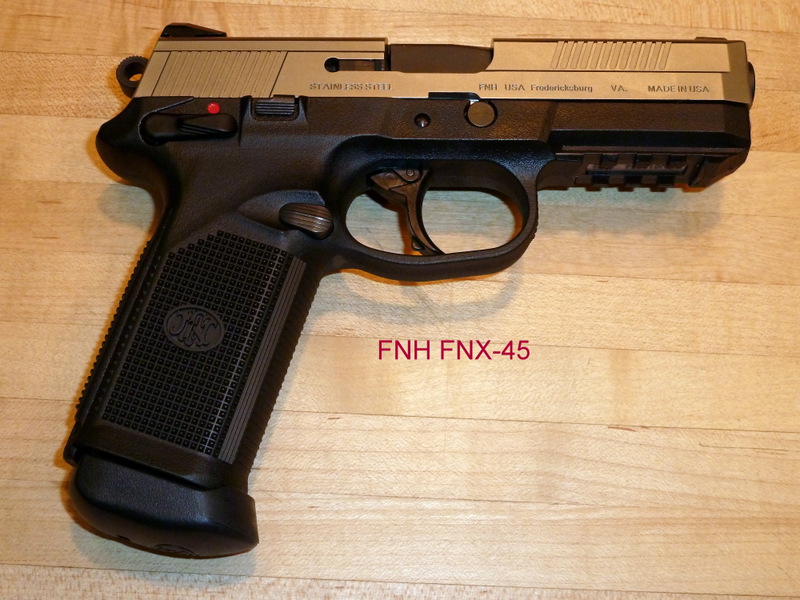
The FNH FNX-45 — 15+1 rounds of potent .45 ACP ammunition

The FNH FNX-45 — 15+1 rounds of potent .45 ACP ammunition

Before you get too far into this article, be advised that this is a non-shooting first-impression.  I will give a more in-depth review of the shooting characteristics of the FNX-45 at a later date.
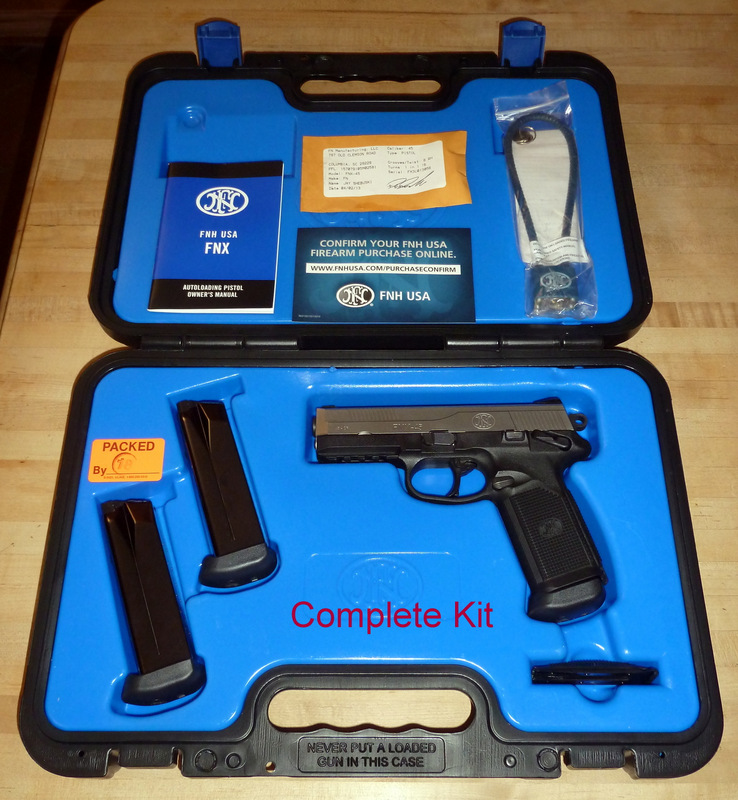
The Entire FNX Kit

The Entire FNX Kit — Three magazines included

While I consider anything from .32 ACP on up to be perfectly adequate for concealed carry protection, I prefer the .45 ACP for home defense.  Barring a person stoned out of their mind, someone breaking into your home has already made a conscious decision to do you harm if they find you inside.  Sorry, but that’s just a fact.  As such, you want that person down and out as soon as possible, and the bigger the cartridge the better.  The .45 ACP with it’s heavy weight and low velocity (for reduced chance of over-penetration and consequent danger to innocents) makes it in my opinion the best home defense option outside of a shotgun or a semiautomatic rifle.

And when it comes to home defense, the more rounds the better (hear that well, those of you who would arbitrarily classify 10-round or even 6-round magazines as “high-capacity”).  Home invasions frequently involve more than one intruder, and the number of rounds necessary to stop a determined threat (depending on what study you read) can reach three or even more.  The last thing you want facing multiple dangerous thugs is to be one round short.

FNX, PT 24/7, and SW99

FNX, PT 24/7, and SW99

I now possess four handguns chambered for this proven, highly effective round.  One you’ve already read about:  SW99 — The .45-Caliber Walther.  The SW99 is a nice weapon, but at 9+1 rounds it lacks a bit in capacity.  Another is a SIG P220 Compact SAS Gen 2 which, at 6+1 rounds, is better suited for concealed carry and, with night sights, nighttime carry at that.  So, my initial choice for home defense became the Taurus PT 24/7 Pro DS with 12+1 capacity.  My previous XD45 Tactical with 13+1 was a weapon I just could never warm up to — neither double-action first pull nor external safety for me makes for a weapon that should not find a place inside your home.  They’re quite simply too dangerous to have around, as police department accidental/negligent discharge statistics on transitioning to the Glock have repeatedly shown (That’s personal opinion, so don’t shoot the messenger . . . so to speak).  The PT 24/7 had both an external safety and a double-action first pull, and the added benefit of allowing for cocked-and-locked configuration (something I wouldn’t do, but which fans of the 1911 will enjoy).

Cocked-and-Locked 1911-Style

Cocked-and-Locked 1911-Style

Alas, the PT 24/7 proved unreliable, and the more rounds I put through it the worse it became.  Eventually, I was experiencing multiple jams on each and every magazine.  It went back to the factory for warranty work and returned with vastly improved trigger and a short list of fixes accomplished, but I never test fired the repaired weapon as I simply had lost faith in it.  It’s going to my favorite local gun store on consignment where hopefully the next owner will be happy with the repairs made to it.

Length Comparison

Length Comparison

The lesson here is that you get what you pay for.  The Taurus is an extremely affordable handgun.  I purchased it new for just under $320.  But it turned out to be a false economy, and I began a search for a replacement.  That search narrowed to the Heckler & Koch HK45 and the FNH FNP-45, both reportedly finalists in the (unfortunately) cancelled DoD Joint Combat Pistol evaluation to replace the combat inadequate 9mm Beretta M9.  The FNX is an improved, fully ambidextrous version of the FNP, and the HK USP is the genesis for the HK45.  After considerable research and extensive hands-on testing of the trigger and ergonomics at my favorite local gun store (Collector’s Gun Exchange), I settled on the FNX-45.

Height Comparison

Height Comparison

The decision was not even close.  The FNX-45 had by far the better trigger in both double- and single-action modes.  The grip felt more natural.  The controls are easy to manipulate, intuitively placed, and fully ambidextrous — a nice feature for those times when walls, obstacles, or even injury may require you to fire using your off hand.  If you’re left handed, this has got to be a real plus.

Fully Ambidextrous Controls

Fully Ambidextrous Controls

As you can see from the above, these are not small weapons.  As such they are not really suited for concealed carry.  The two+ pound weight of the FNX along with an additional pound of ammunition once it’s fully loaded makes this an even sillier choice.  But, then, as I said this wasn’t the task assigned to this particular handgun.  Carry duty remains the function of my Walther P99c AS, Walther PPK, and Walther PPK/S pistols.  Different jobs require different tools.

Attached Laser Sight — A nice home defense option

Attached Laser Sight — A nice home defense option

Disassembly and reassembly of the FNX is the easiest and quickest of any weapon I have ever owned other than my PPK and PPK/S.  I can break down the pistol and put in back together in under half a minute, and that’s with no real practice.  Lock back the slide, rotate the take-down lever, release the slide and ease it forward off the frame, then remove the recoil spring and barrel and you’re done.  It’s just that simple, and notice that there is no need to pull the trigger to remove the slide — no need to “Glockify” this weapon with unnecessary trigger pulls.
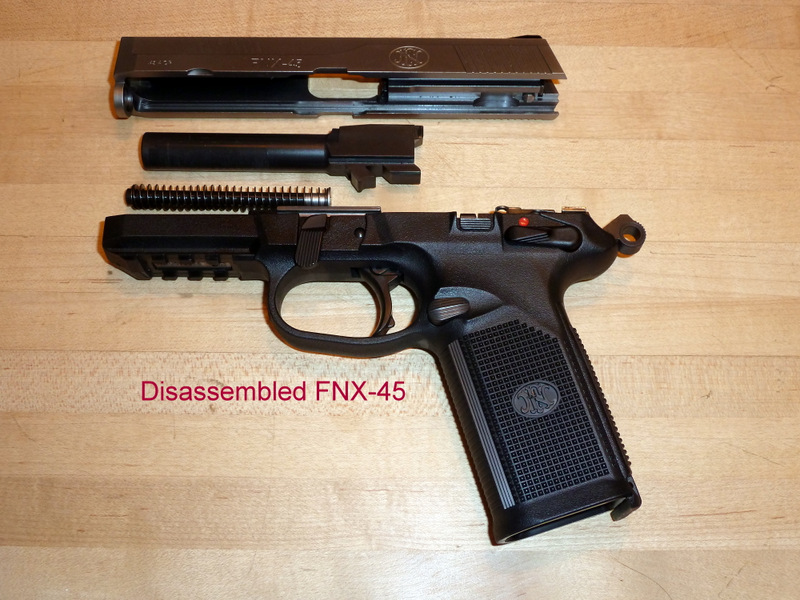
Extremely Easy Disassembly and Reassembly

Extremely Easy Disassembly and Reassembly

Internally, this weapon sports a feature I’ve not yet seen in a polymer pistol.  FNH claim that the frame rails on polymer pistols are prone to wear after extensive round counts (I have to believe they’re talking in excess of 100,000 rounds here, but who knows?).  As such, FNH have installed into the FNX replaceable metal frame rails.  Nice feature, though I doubt most people would ever need to do that.

Replaceable Frame Rails

Replaceable Frame Rails

Regardless, this detail seems a testament to the attention which FNH have placed into the design of this weapon.  Now, let us hope that the performance equals the promise.

Now for my impressions on the triggers.  For this I added a fourth .45 ACP weapon to the mix — my recently acquired SIG P220 Compact SAS Gen 2.  I tested all weapons using both hands (dry firing) in back-to-back comparisons in both double- and single-action modes.

Double-Action Results:  The SIG P220 and the FNX weapons are both hammer-fired.  The SW99 and and Taurus PT 24/7 use strikers.  In head-to-head comparisons I found the two striker-fired weapons had lighter pulls.  All four though were perfectly acceptable, with a steady pull followed by a clean break.  The SW99 however had the best double-action trigger.  The SIG P220 was my second favorite because of the smoothness of the trigger, followed closely by the FNX.  The 24/7 brought up the rear because of the long pull and a less solid feel (completely subjective), but the trigger was much better than before the Taurus was sent in for warranty work.

Single-Action Results:  Here it was a hammer-fired weapon that came out on top — the SIG P220.  The SIG had a shorter pull, lighter trigger, and crisper break by far.  It wasn’t even close.  Next came the SW99 with a fairly short pull once the trigger was taken out of Anti-Stress (AS) mode and placed into single-action (see my SW99 review for an explanation).  The FNX placed third because of a mushy quarter-inch pause from the time the slack was taken up to the point where the hammer tripped.  The FNX wasn’t bad, it just wasn’t as great as the SIG and the SW99.  I’m thinking this will probably improve after a couple of hundred rounds are pushed through it.  Coming in last (and proving once again that you get what you pay for) was the 24/7.  The trigger pull in single-action is ridiculously long — as long as the double-action pull — although the trigger does have a short reset if you ride it forward.  Once the excessive slack is taken up, the trigger broke cleanly and predictably.

All things considered, I would rate these weapons as follows:

  1. SIG P220 SAS Gen 2, which is also by far the most expensive of the lot.  Not related to the trigger, but — oh, brother, does SIG put on a great set of night sights on these things.  Too bad it’s so thick yet only holds 6+1 rounds.
  2. SW99.  For the price you just can’t beat the safety and consistency of Walther’s AS trigger system.  If you decide to get this discontinued .45 ACP (Walther made the frames; Smith & Wesson the barrels and slides), make sure you get the AS trigger over the other options.
  3. FNX, the second most expensive and, trigger-wise, not far behind the SW99.  However, taking into consideration that 15+1 capacity in .45 ACP, I would rate this over the SW99 when this feature is considered.  As a home defense weapon, it would even top the SIG P220 because of its high capacity.
  4. Taurus PT 24/7 Pro DS is the economy weapon of the lot, but not when you can pick up a used SW99 for the price of one of these brand new.  The trigger isn’t bad, it just doesn’t compare to the other weapons listed.  Capacity is great at 12+1, coming in at only one round less than my long-departed Springfield Armory XD45 Tactical (what a terrible trigger that thing had).  If you’re willing to take a chance and you get a Taurus that actually fires consistently without jamming, this may work for you if you’re on a budget.  Fortunately, the Taurus offer a lifetime warranty.  Unfortunately, they don’t offer reimbursement for your cost of shipping it out to them.  That’s pretty bad when you consider that this particular weapon was failing from the start, and only getting worse.

Let me close with a hearty “congratulation” to the citizens of Illinois in general and the those currently under daily siege in Chicago in particular.  Yesterday your state legislature overrode Governor Pat Quinn’s ill-advised veto of Illinois’ recently passed, court-mandated concealed carry law.  The law as passed is still ridiculously over-restrictive, but no longer is Illinois the last state in the Union to deny its citizens the right to defend themselves.  This is particularly fitting coming on the heels of this past weekend’s horrendous gun crime statistics — seventy people gunned down in Chicago, a dozen dead.  The day of waiting for the police to pick up evidence and the medical examiner to haul away the body bag is finally in sight.  It’s been a long, dangerous, and bloody haul, but soon the cowardly gang-banger who pulls out a weapon will have to consider if a law-abiding and properly trained citizen is going to return fire and make him the “victim” for a change.  Right now no such deterrent exists.  Rest assured, Chicago — your violent crime rate is about to take a dive.

1 Comment

Filed under Firearms

Asiana Airlines Flight 214 — What We REALLY Know


And it ain’t much.

Speculation this early after a plane crash is nearly always incorrect because of insufficient information, yet speculation abounds on Saturday’s crash of Asiana Airlines Flight 214.  You could write a book on what we do not currently know — the cockpit crew interviews, the information from the “Black Boxes,” witness interviews, crash damage analysis, etc., etc., etc.

Here’s what we do know about the crash:  Asian Airlines Flight 214, a Boeing 777-28EER operating with two Pratt & Whitney PW4090 engines (an important detail as you’ll see in a moment), landed short of Runway 28 Left at San Francisco International Airport (SFO).  Aboard Flight 214 were sixteen crew and 291 passengers for a total of 307 POB (Personnel on Board).  The aircraft apparently struck the seawall located short of the approach end of Runway 28L.  The vertical and both horizontal stabilizers were sheared off and lay upon the runway just short of the landing threshold line and threshold markings (see images below).  Landing gear parts lay between the threshold markings and the touchdown zone markings.  The aircraft skidded off the runway to the left and at some point caught fire.  Two passengers (both schoolgirls) died, their bodies both found outside of the wreckage (not reported is if the bodies were still strapped to their respective seats).  Injuries were sustained by 181 people.  Of those 181 people, forty-nine are deemed in critical condition.

Runway Markings — image linked from http://www.pilotfriend.com

Asiana Airlines Flight 214 debris field — photo linked from ww2.hdnux.com

Here’s what we know leading up to the crash:  The weather at SFO was VMC (Visual Meteorological Conditions) with blue skies, few clouds, good visibility, and light winds reported.  The Runway 28L ILS (Instrument Landing System) was out of service, so the pilots would not have had a Glide Slope instrument indication in the cockpit to advise them of their angle of descent.  They would however (provided it was working, which appears to be the case) have a good view of the Runway 28L 4-Light Precision Approach Path Indicator (PAPI), which was set to visually guide pilots onto a 2.85° glide path (slightly below the more normal three-degree angle most commonly used).

PAPI — What the Pilot Sees — image linked from http://www.m0a.com

Here’s some expert Air Traffic Control speculation:  Since the weather was clear and the ILS was out of service, it is reasonable to assume that Asiana Airlines Flight 214 was conducting what is known as a Visual Approach (See definition below) to Runway 28L at the time of the accident.  If that is the case, the cockpit crew would have been responsible for maintaining the proper descent angle to the runway using visual references (including the PAPI previously mentioned) and other on-board, non-ILS derived information (radar altimeter, etc.).

Visual Approach Definition (U.S.):  An approach conducted on an instrument flight rules (IFR) flight plan which authorizes the pilot to proceed visually and clear of clouds to the airport.  The pilot must, at all times, have either the airport or the preceding aircraft in sight.  This approach must be authorized and under the control of the appropriate air traffic control facility.  Reported weather at the airport must be ceiling at or above 1,000 feet and visibility of 3 miles or greater

What we know about the Boeing 777:  Quite simply put, this aircraft is one of the safest in existence.  Over 1,100 have been built since 1993, and the aircraft remains a bestseller for Boeing to this day.  There have been a total of only three “hull losses” (meaning the aircraft was a total write-off) involving the Boeing 777 and only one previous fatality.  The previous two hull losses and one fatality were:

  • September 5, 2001 — Denver International Airport:  British Airways Flight 2019, Boeing 777-236, suffered a mishap during a refueling operation at Terminal Gate A37.  Minor, reparable damage was sustained to the left wing and the left engine cowling and thrust reverser.  A ground crewman died six days after the accident from injuries sustained during the fire.
  • January 17, 2008 — Heathrow Airport, London:  British Airways Flight 38, a Boeing 777-200ER, landed short of Runway 27 Left.  That may sound familiar, but keep in mind those Pratt & Whitney PW4090 engines I told you about above.  We’ll get back to that in a moment.  Forty-seven people were injured; there were no fatalities.  The aircraft was destroyed.
  • July 29, 2011 — Cairo Airport, Egypt:  Egyptair Flight 667, a Boeing 777-200 pushing back from Gate F7, Terminal 3, experienced a fire in the cockpit.  The twelve crew and 307 passengers deplaned with no injuries.  The aircraft was irreparably damaged.

So, what’s so important about those engines, and why is speculation so prone to error at this point?  Here’s why:  Already at least one major news organization, The Daily Mail, has had one blazing headline pronouncing, “Crash landing at San Francisco mirrors that of BA Boeing 777 crash at London Heathrow five years ago.”  Uh . . . no, guys, it really doesn’t.  The only similarity is that both aircraft impacted short of the runway and skidded onto it.  Beyond that the crashes are in no way “mirrored.”

The Daily Mail speculates that, as in the British Airways 38 crash, there was something amiss with the engines on Asiana 214.  The problem with British Airways 38 (and two other loss-of-power incidents involving the Boeing 777) was eventually tracked down to a flaw in the design of the fuel/oil heat exchanger used in the Rolls-Royce Trent 800 engine.  That flaw allowed ice slush to reduce fuel flow to the engines, allowing enough fuel to keep them turning but restricting fuel needed to apply go-around power (powering up the engines to sufficiently and safely lift the aircraft back into the air after an aborted approach to the runway).  That component has since been redesigned and flown without incident ever since that redesign was incorporated into existing fleets and subsequently manufactured aircraft.  The Pratt & Whitney PW4090 has never displayed any such problem.  Ever.  If there was an engine problem with the engines on Asiana 214, it is unlikely to have affected both engines simultaneously and only one engine is needed to abort a landing.

What to watch for (and what to ignore) in the coming investigation:

  • It’s far too early to speculate on the possibility of pilot error, but right now that appears to be the focus.  Did the crew wait too long to initiate a go-around (unknown at this time, but it appears a go-around order was given only seven seconds before impact)?  Did the aircraft come in too fast and/or too low (no evidence to date, but eyewitness accounts and video seem to show that the aircraft was far below normal height on the final approach)?  Were the pilots under- or overcorrecting from initially coming in too high (no indication of this as yet)?  These answers will come from the crew interviews and the Digital Flight Data and Cockpit Voice Recorders (DFDR and CVR — the orange colored “Black Boxes” about which you hear so much).

Cockpit Voice Recorder (CVR) left; Digital Flight Data Recorder (DFDR) right — photo linked from en.wikipedia.org

  • There’s been some online speculation that the left wing flaps appear to have not been extended.  Sorry guys, but you’re incredibly wrong here.  The slats are obviously extended so the flaps would have been as well.  Additionally, the right side flaps can clearly be seen in the extended position.  And if the right side were somehow extended while the left side flaps remained retracted, the Boeing would have experienced an uncontrollable roll to the left such as happened in the case of American Airlines Flight 191 at Chicago O’Hare on May 25, 1979.  This is not a retracted flap/slat issue.  If it is a flap/slat issue, it’s related to insufficient extension of the flaps and slats for that phase of flight, which is highly doubtful considering the warning devices aboard modern aircraft.

American Airlines Flight 191 in an Uncontrolled Roll to the Left — photo linked from http://www.chicagotribune.com

  • Could this be a simultaneous engine problem?  Such things have occurred in the past, but such events are exceeding rare and have usually been attributed to outside influences (ingestation of birds, hail or extremely heavy precipitation, volcanic ash, etc.).  The few mechanical events on record were either poor design (see the Roll-Royce Trent 800 discussion above) or maintenance errors (Eastern Airlines Flight 855; Miami International Airport; May 5, 1983).  So far the CVR shows no indication of an engine malfunction, and the pilot is heard calling for go-around power as if the engines were operating normally.

Easter Airlines Flight 855 — photo linked from en.wikipedia.org

For those with a fear of flying I would ask that you keep in mind the number of survivors in this otherwise devastating crash — over 99.3% of those aboard got out, and most of them with either no or only minor injuries.

As for the rank speculation you’re hearing so far, take all that guesswork from the rank amateurs and wannabe pilots for what it is — the rantings of people who will gladly (and in most cases anonymously) point fingers now but who won’t retract unwarranted accusations later if and when they’re proven wrong.

About the author’s credentials:  R. Doug Wicker spent over thirty-four years as an Air Traffic Controller for both the U.S.A.F. and F.A.A.  During his time in the F.A.A. he was also trained in accident/incident investigation for his duties as a Quality Assurance & Training Instructor (QATS) for El Paso International Airport from 1987 until 1996.  Mr. Wicker is the author of The Bombing of Pan Am Flight 103 as well as three as yet unpublished novels on aircraft sabotage.

The Bombing of Pan Am Flight 103 — Rosen Publishing, 2003

7 Comments

Filed under Aviation Safety, travel

Return to Carlsbad Caverns — Part 3


Bashful Elephant

Bashful Elephant

Up until 1996 visitors had unfettered access to all the main cavern rooms.  This changed because of vandalism, and since that time access to the four “Scenic Rooms” is strictly controlled.  Tours to these four rooms are limited in numbers, escorted, and require reservations.  By all means make sure that you reserve a spot on one of these tours or you’ll miss some of the most spectacular formations in Carlsbad.

Scenic Rooms Tour

Scenic Rooms Tour

Give yourself at least one full hour to stroll from the cavern entrance to the meeting point in the Big Room.  We made it in from the Visitors Center in just over forty minutes, but I wouldn’t want to try that again.  The trails are steep and at times slippery, and weekend crowds will block your way if you’re rushed for time.

Carlsbad Caverns 61

Carlsbad Caverns 61

The four scenic rooms on this special tour are:  The King’s Palace, The Papoose Room, The Queen’s Chamber, and The Green Lake Room.

5 Comments

Filed under Photography, travel