
This begins a three-part review on Canon’s latest semiprofessional compact camera—the G1 X. Today we’ll focus on how this camera was selected and highlight the performance of Canon’s latest image processor the DIGIC 5 and the effectiveness of this camera’s built-in image stabilization.

Canon G1 X with 15.1-60.4 (28-112mm in 35mm equivalency) f/2.8-5.8 lens.
If you’ve been following this blog since April 2, then you’ve been viewing the progression of our last cruise trip. Last week we covered Bruges, Belgium, and this week I was going to end the series with our two-day stay in Brussels. I’m going to postpone that series finale until next week, as I have some other information I would like to impart.
So, have you enjoyed the photographs over the past five weeks? If so, then you can give at least partial credit to my latest photographic tool. More on that in a moment.
I really enjoy DSLR photography. For that I have a Canon EOS 5D with a 24-105mm f/4.0L Image-Stabilized lens and, a 70-300mm f/4-5.6 Image Stabilized telephoto lens, and a 430EX Speedlite external flash. The 5D is a great camera capable of great images at even fairly high ISO settings. Problem is that it’s a boat anchor around your neck. When mated to my 24-105mm lens, the darned thing weighs in at a massive 3 pounds, 7.2 ounces (1,565 grams)! And don’t even get me started on the conspicuousness of the size. It’s like trying to hide a toaster oven.
So, for most international travel I like to take a couple of small travel zooms—my Panasonic DMC-ZS3 and DMC-ZS6—and leave the Rock of Gibraltar at home. Those Panasonics are great little point-and-shoots with a fantastic zoom range (25-300mm in 35mm equivalency), but they have some serious limitations. The ZS6 has limited controls for aperture and shutter speed, as well as the ability to provide some manual control. The ZS3 won’t even do that much. Because of their small sensor size (1/2.33”—6.08 x 4.56mm), neither is very good at anything above ISO 400, and the image actually starts to degrade well before even that. Neither stores images in raw format. Still, you can take award-winning photographs with them if you understand photography and how to get the most out what little control the ZS series offers.
But I still wanted more in the way of creative control, better high ISO performance, increased resolution, and the wider latitude that raw gives you in post-processing. With this latest once-in-a-lifetime trip to Normandy coming up, I started doing my research for another camera system.
For travel photography I would need in order of importance:
1) Wide angle capability for landscapes, preferably starting in at around 24mm (in 35mm equivalency).
2) Good low-light capabilities for photographing interiors of monasteries, churches, cathedrals, fortresses, etc. That means a fast lens at wide angles (f/2.0 or better would be ideal), good performance at higher ISO settings (at least ISO 800, preferably even higher), and exceptional image stabilization (at least 3-stops) for hand-held shots.
3) Good low-light means a fairly large sensor. There is simply no way around that using current technology. This means I would have to balance the need for a large sensor against the desire to keep the camera/lens combination small and light.
4) Moderate telephoto capability for zooming in on architectural details (I like at least 105mm).
Here’s what I didn’t need:
1) Fast focusing. In landscapes it’s all about the framing and light conditions. Capturing action is toward the bottom of any travel photographer’s priority.
2) High frames-per-second. Again that’s for capturing sports action, playful puppies, rambunctious kitties, and annoyingly hyperactive children.
Here’s what I was willing to give up:
1) Interchangeable lenses, if the range was close enough to my specifications (see above). There’s nothing more bothersome than specks of dust on the sensor, and changing lenses in the field is an open invitation for these insidious invaders. Plus, it’s heck trying to get cleaning solution for camera sensors past TSA—guns and knives seem to slip through with alarming regularity, but you’d better not have more than three ounces of anything wet, up to and including Granny’s Depends it would seem.
2) Macro capability. Nice to have for close-ups of flowers, but landscapes and architecture don’t normally require it.
3) Wide aperture at mild zoom ranges. That’s a hallmark of a portrait lens, as it defocuses the background and directs the viewer’s attention to the person being photographed.
Given this list, my search for a new travel camera began to look like a tall order. Most bridge cameras have more zoom range than I would ever need, but their small sensor sizes (usually around 1/1.8”—7.176 x 5.319mm) meant I would once again be sacrificing ISO performance. APS-C sensors are large enough for what I needed ISO-wise, but (save for one exception) we’re once again talking about going to a DSLR—a DSLR smaller than my full-frame (35mm) EOS 5D, but still a large, burdensome package. I could go with a smaller ILC, but most use the smaller Micro Four Thirds system, some use an APS-C size, nearly all come with a kit lens that only zooms between 27 and 82.5mm (in 35mm equivalency), and I would be back to having an interchangeable lens dust magnet.
Life was suddenly looking like an endless series of compromises that I didn’t really care to make. I was considering packages as small as the Canon G12 and Nikon P7100 and as large as the Sony NEX 5N and NEX 7.
Then came the April edition of my Popular Photography subscription. Right there, on both the cover and on Page 77, was the Canon G1 X. Specifications:
Huge 1.5-inch (18.7 x 14mm) 14.3 megapixel CMOS sensor.
4x 28-112mm zoom lens.
Great ISO performance through ISO 1,600, and perfectly acceptable all the way through ISO 6,400. Only at ISO 12,800 did the G1 X reach unacceptable performance levels in Popular Photography’s testing, and even then it just barely scored outside the moderate range on noise (3.1 scored on a 3.0 cutoff).
Image Stabilization good for 3.5 stops even full-out zoom of 112mm.
Image quality and resolution both rated as Extremely High (vertical resolution 2,310 lines at ISO 100 and an incredible 2,220 lines even at ISO 1,600)
4.6 inches (117mm) wide; 3.1 inches (78mm) tall; 2.6 inches (68mm) deep (lens retracted); and weighing “only” 1 pound 4 ounces (566 grams) including battery, memory card, neck strap, and lens cap (I say “only” because that seemed high until I found out the G1 X is built like a tank on a stainless steel chassis).
Articulated 3-inch high-resolution (920,000-dot )screen.
Internal pop-up flash and a hot shoe for TTL (through the lens) flash metering and exposure control using Canon Speedlite flash units.
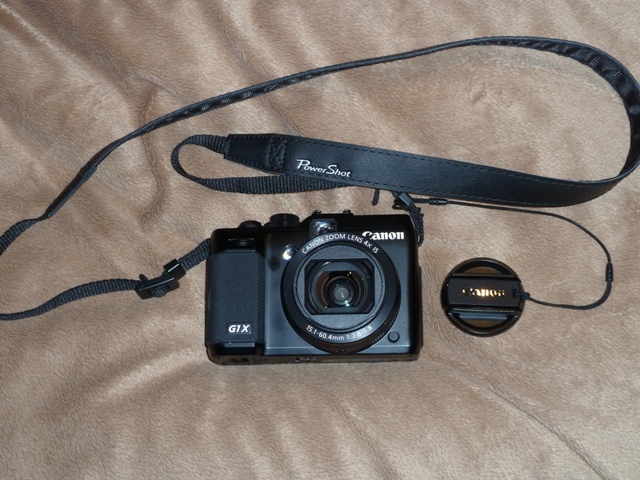
Canon G1 X with neck strap, lens cap, and lens cap retaining cord. Altogether with battery and memory card the entire package weighs in at 1 pound 4 ounces.
My search was over. Yes, I was giving up a bit on the wide zoom side and lens aperture, but I was exceeding my specifications in nearly every other criteria. On top of that, I was gaining the latest Canon image processor—the DIGIC 5.
My impressions on the DIGIC 5? I’m personally stunned at the improvement over the EOS 5D’s DIGIC 2 on everything from automatic white balancing to contrast and color rendition. Quite simply put, the DIGIC 5 in most cases makes raw photography and post-processing totally unnecessary. Except for specialized instances requiring HDR (high-dynamic range) photography, extreme color shifts in lighting, isolated color spectrum subjects, or a few other situations, the DIGIC 5 will in my opinion consistently produce better pictures than I can with raw manipulation. It’s simply that good. You’ll be hard pressed to find an excuse to take anything but JPEGs with this camera.
The DIGIC 5 is also the secret behind the remarkably low-noise, high-resolution photographs taken at heretofore unusable high ISO settings.
The image stabilization is also astounding. I was taking hand-held shots of cathedral interiors at shutter speeds as slow as 1/15th of a second.
Part 2 of this review will continue on Wednesday. Until then, I would like to present the following hand-held pictures. Move your cursor over the picture to find the shot details, such as ISO, shutter speed, aperture, etc. None of these straight-from-the-camera JPEG photographs have been post-processed in any way other than to reduce the size for inclusion in this blog. All colors, contrast, white balance, noise reduction and other factors result solely from the DIGIC 5 processor and the camera’s built-in image stabilization.
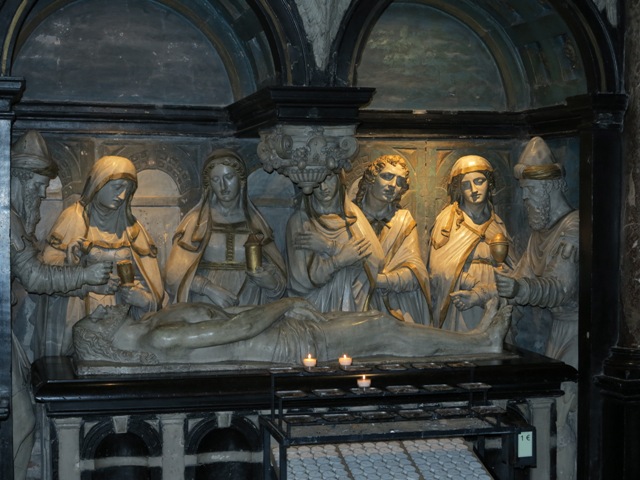
ISO 400, f/5, 1/15th second, 35.8mm (66mm in 35mm equivalency)

ISO 1000, f/2.8, 1/20th second, 15.1mm (28mm in 35mm equivalency)

ISO 500, f/2.8, 1/30th second, 15.1mm (28mm in 35mm equivalency)
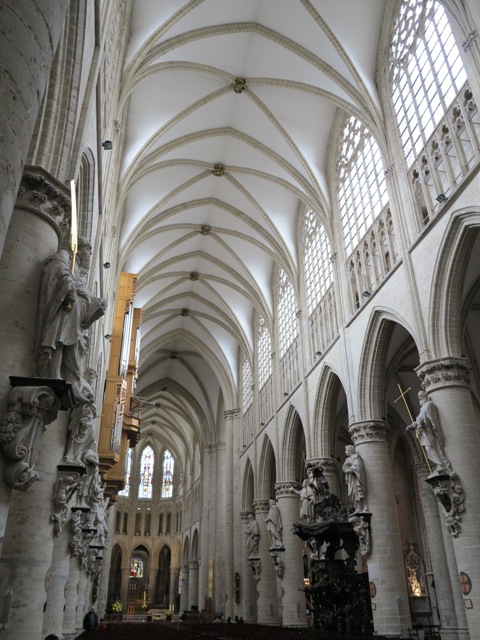
ISO 1000, f/2.8, 1/20th second, 15.1mm (28mm in 35mm equivalency)
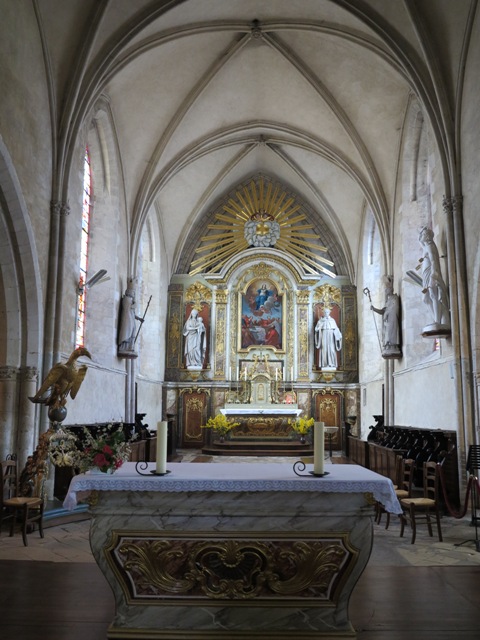
ISO 1000, f/2.8, 1/20th second, 15.1mm (28mm in 35mm equivalency)
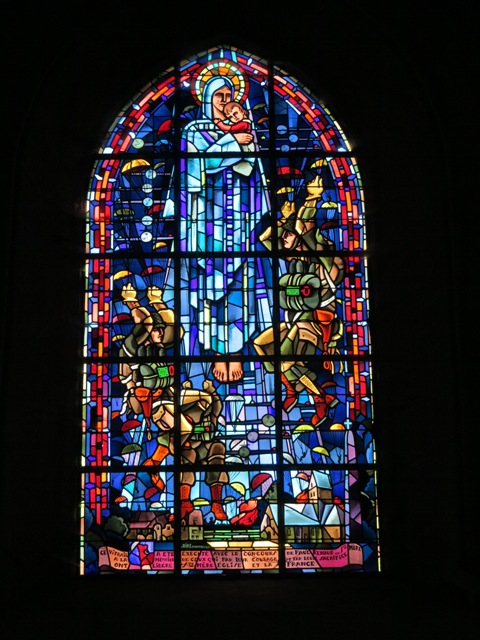
ISO 500, f/5.8, 1/80th second, 60.4mm (112mm in 35mm equivalency)





 Decisions — Murder in Paradise
 The Globe — Murder in Luxury
 R. Doug Wicker — Author