Tag Archives: Malaysia Airlines crash

What We Now Know About Malaysia Airlines 370, and What We Still Do Not


9M-MRO, the aircraft that would become Flight 379

Many of you will recall that I said it was just far too early to determine what happened to Malaysia Airlines Flight 370. (See: Malaysia Airlines Flight 370 — What We Know and What We Don’t and Malaysia Airlines Flight 370 — It’s STILL All About What We Don’t Know)  Guess what: It’s still too early And it will be until the aircraft is located and the black boxes recovered.  We may all be scratching our heads over this a decade from now, and probably will be.

Any “expert” on CNN telling you otherwise is only displaying their total ignorance. Indeed CNN’s reputation took at least as big a hit as Malaysia Airlines did during this entire fiasco, but in the case of CNN all that remains of their journalistic credibility is a smoking crater with a bunch of people standing around it, scratching their heads, wondering when they went from being respected journalists to being merely silly, uninformed, and unworthy of the profession.  At least they now know that they’re of Fox News caliber if they ever lose their jobs at CNN.
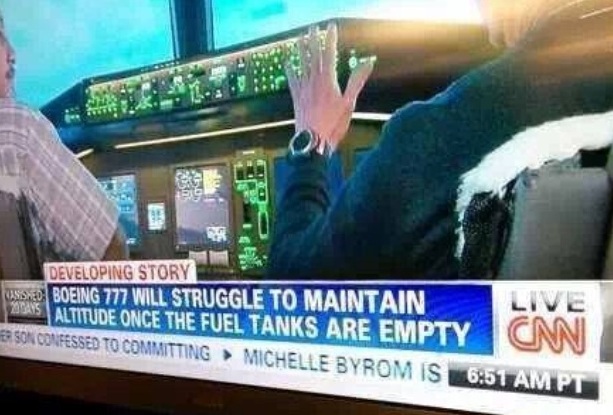
News Flash: Boeing 777 won’t fly without fuel. REALLY?!

 So, what do we know?  We know the Boeing 777 did not land on some remote airfield.  We know that the Malaysia Air Force defense radar was not sufficiently accurate enough to justify the earlier report of the aircraft climbing to 45,000 feet — several thousand feet higher than the Boeing 777’s certified ceiling.  We know that the Australians were searching in the wrong location based on an erroneous “ping” detection that turned out to not be from MAS370.  (no, I’m not faulting the Aussies; they did what they had to do because of the reported detection)  We know that Inmarsat told the Australians that the most likely final resting place is several hundred miles south southwest of where they were looking.  We know that this new search area is 23,000 square miles (the previous search area, which took a month to cover, was only 330 square miles — do the math on that one).  And we know that we have long missed our chance of picking up those black box pingers in this new location, so the search is going to be painfully slow, exceedingly tedious, and ridiculously expensive.

What we have surmised.  The Boeing 777 was probably on autopilot from the time it turned south to the time it impacted in the waters of the Southern Indian Ocean after fuel exhaustion (see CNN headline above for what most likely happens when the fuel runs out).  It appears that no one attempted to open the cabin doors after impact and escape, suggesting that no one survived the impact.

What we do not know (despite the “experts” on the telly, and especially over at CNN).  We do not know if the aircraft was hijacked.  We do not know if one or both of the pilots commandeered the aircraft.  We do even know if the crew were conscious after the initial “event” that led us to this point, which would make for a lot of red faces if this is indeed the case.  If they were unconscious, we’re suddenly looking at a whole host of very different possibilities including unintentional gradual depressurization from a hull leak or rapid decompression from an explosion or major catastrophic structural failure.

So, once again, disregard all those “experts” telling y0u what happened or may have happened.  Listen instead to the true experts who are telling you to sit tight and wait . . . and that wait could be for a very, very long time.

4 Comments

Filed under Aircraft, Aviation Safety

Malaysia Airlines Flight 370 — It’s STILL all about what we DON’T know


Boeing 777-2H6ER, Registration 9M-MRO — The now infamous Malaysia Airlines Flight 370

Well, I did try to warn everyone.  Remember this post?  Malaysia Airlines Flight 370 — What We Know and What We Don’t.  I did say that it’s not about what we know at this point (and that isn’t much).  Rather, it’s about what we do not know, and won’t until the aircraft is found, the CVR and DFDR are retrieved, or until other information surfaces.

Despite that clear warning not just from me, but also others who are expert in the field, the usual Internet Commandos are subjecting everyone to nothing less than a steady stream of garbage.  These armchair “experts” in everything are sitting before their keyboards in their underwear delighting in spewing forth a steady stream of unsubstantiated rumors and crazy theories all the while grasping at any piece of misinformation that comes their way if it even remotely makes it appear that they know what they’re talking about.

The Boeing 777 that became MAS370 (IATA Code MH370)

What I find really reprehensible is when the head of the Malaysian Air Force — General Rodzali Daud — prematurely breaks unconfirmed military radar “information” that not only appears now to have been completely erroneous, but which served to divert critically needed naval and airborne resources from the primary search site to go on a wild goose chase several hundred miles away.  The general has since tried to back away from those public comments, but the damage was already done and many critical hours were wasted in the search.

Now for a primer on civilian air traffic radar versus military defense radar:  Civilian radar displays both primary radar (reflected radio energy bounced off a “target”) and secondary radar (an “interrogator” signal sent by radar to an aircraft’s transponder, which encodes information and sends a “reply” signal back to the radar antenna.  Military radar does the same, but whereas civilian radar operators are more concerned with the information supplied by secondary radar returns, the military’s central interest are the primary radar returns.

That’s because air traffic control is designed to guide and assist aircraft that want to be seen, and the military is geared more toward detecting an enemy that does not want to be seen.

Did the Malaysian military see a target overfly Malaysia that night from east to west?  Very possibly.  Do the Malaysia military have a way of knowing who that aircraft was?  Not unless the primary target was tracked from its point of origin, or the operator maintained a track on a target from before the secondary radar transponder was no longer sending a reply.  In other words, they couldn’t possibly know that target was MAS370 unless they’d been tracking the aircraft before it went from a secondary radar target with an operating transponder to just a straight primary target in what some would call a “stealth mode” that isn’t really all that stealthy.

Would Malaysian military defense radar operators be watching a civilian target that closely, closely enough to maintain positive identification the whole time from the moment the transponder was deactivated?  Why would they?  They’re looking for the guy who is running without a transponder trying to sneak into their airspace.  They don’t care about a civilian airliner unless that airliner becomes a threat, and they won’t know that until they get a call from civilian ATC telling them that the airliner is no longer responding to air traffic control instructions.  In that case ATC is going to tell military defense precisely where the target is so that military radar can initiate a positive track on the aircraft and keep it under surveillance.

So, who are the experts in the media whom you can currently trust for your information?  Here’s the test of a true aviation expert:

Beyond the straight, verified, concrete facts, the more someone tells you that they “know” about this situation the less of an “expert” that person is.  The true experts are still waiting for more information before they go spouting off about what “may” have happened to MAS370.  The faux “experts” are telling you what happened and what didn’t based upon information that just isn’t there.

6 Comments

Filed under Aircraft, Aviation Safety

Malaysia Airlines Flight 370 — What We Know and What We Don’t


A Malaysia Airlines Boeing 777-200ER

In the wake of any major airline accident involving a horrendous number of fatalities the “experts” scatter across the media like so many cockroaches across the kitchen counter-tops after the lights are turned off for bed.  Unfortunately the recent crash of Malaysia Airlines Flight 370 is no different.  Thus it becomes important to differentiate what we do know from what we do not, and the factual from the speculative.  And as I’ve admonished before in previous accidents, it’s far too early to say with any degree of certainty what may have happened.

Here’s what we know:

Malaysia 370 was a Boeing 777-200ER (Extended Range) with 227 passengers and a dozen crew members aboard.  MAS370 (IATA code MH370) departed Kuala Lumpar en route to Beijing at 00:41 local time on March 8 (March 7 on the U.S. side of the International Date Line), 2014.  Reports indicate that approximately 41 minutes after departure, while MAS370 was over the Gulf of Thailand in the South China Sea, Malaysia’s Subang En Route Area Control Center lost both radio and radar contact with the aircraft.

Link to Wikipedia article at: https://i0.wp.com/upload.wikimedia.org/wikipedia/commons/thumb/f/f7/Malaysia_Airlines_MH370_path_labelled.png/601px-Malaysia_Airlines_MH370_path_labelled.png

Approximate last known location of MAS370

No distress call was received from MAS370, and there were no previous indications from the cockpit crew to Air Traffic Control that anything was amiss.

No signal has been received from the Emergency Locator Transmitter (ELT) on MAS370.

Despite previous false (and probably malicious) reports floating about the Internet, MAS370 has not landed at an alternate field in Southern China nor anywhere else.

So far extensive search activities involving Vietnamese, Malaysian, Chinese, Filipino, Singaporean, and U.S. assets have yet to find the missing aircraft, although Vietnam reported finding two “oil” slicks consistent with what would be expected to come from jet fuel leaking from the two wings of the aircraft.  These slicks were reportedly discovered 140 nautical miles (161 statute miles; 259 kilometers) south of Thổ Chu Island.

What we know based upon other accidents:

The Boeing 777 is an incredibly safe aircraft with an enviable record.  Other than one ground refueling  accident at Denver International Airport in 2001, the only fatal accident involving the Boeing 777 was Asiana Airlines Flight 214 during the San Francisco mishap last July.  That accident was pilot error.  In 2008 British Airways Flight 38 crashed 1,000 feet short of the runway while on final approach to London Heathrow Airport.  The cause of that nonfatal accident was the formation of ice crystals clogging the fuel supply of that aircraft’s Rolls Royce Trent 800-series engines.  All Boeing 777 aircraft using that particular engine have since been modified, and a repeat incident of that nature has not recurred.  MAS370 was also equipped with Rolls Royce Trent 800-series engines, but it’s doubtful that the previously identified problem is a factor in this case.

It is highly unusual for any airliner to suffer a catastrophic loss while at cruise altitude, which is the strata at which MAS370 was operating at the time of the incident.  Despite Air France Flight 447 such incidents are an anomaly.  Indeed, AFR447 (IATA code AF447) was as much a result of pilot error as it was an instrumentation malfunction.  The vast majority of airliner accidents occur at low altitude, most often on approach to or shortly after departure from an airport.

Other facts leading to premature speculation:

Two of the passengers on the manifest were not the people that the manifest reported them to be.  These two passengers were using passports stolen in Thailand from Austrian and Italian  citizens — Christian Kozel and Luigi Maraldi respectively.  In the case of Mr. Kozel, the theft of his passport occurred two years ago.  While some are pointing to the use of stolen passports as an indication of terrorism other less sinister explanations (drug smuggling for instance) are just as likely.

What we can speculate from the known facts:

It is highly likely that the crew did not radio distress because they did not have time to do so.  That would indicate any of three possibilities that I can think of off-hand.  The first is an immediate and catastrophic inflight breakup of the aircraft that incapacitated the crew or which lead to a failure of the cockpit electrical system.  Another possibility is that the crew were too busy trying to save a malfunctioning aircraft to make either a radio call or to set their transponder to the international emergency code (7700).  The third possibility is that the crew lost both their radios and their transponder due to an electrical malfunction prior to a more catastrophic occurrence.

It will be interesting to see if Subang Center observed the altitude from MAS370’s transponder as it descended from cruise altitude, or if the transponder failed before indicating a descent.  So far I’ve yet to see any report on what Subang controllers witnessed on their radar, if indeed their radar even extends to the position where the incident occurred.

The lack of an ELT signal would seem to indicate that MAS370 did indeed go into the water.  Absent an extremely high-speed impact an ELT would normally survive a crash on land, and any ELT signal should have been pinpointed long before now.

What we’re waiting to see:

Subang Center data on the flight, including both radar and voice recordings.  Location of the wreckage.  Recovery of the Digital Flight Data Recorder (DFDR) and the Cockpit Voice Recorder (CVR) — the so-called “Black Box” which are actually two boxes of orange coloration.

DFDR — The infamous orange “Black Box”

CVR — The other infamous orange “Black Box”

Any speculation before the release of any or all of the above data is far too premature at this point.  Don’t let the media and especially the “experts” on the Internet convince you otherwise.

Update blog at: Malaysia Airlines Flight 370 — It’s STILL all about what we DON’T know

9 Comments

Filed under Aircraft, Aviation Safety