
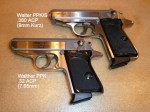
Well, I must say that I had a pleasant surprise a few weeks ago. I tried something a bit different. I reviewed the classic, compact, iconic Walther PPK chambered in .32 ACP—the cartridge for which that gun was originally designed—and compared it against the slightly larger Walther PPK/S chambered for the more powerful .380 ACP cartridge. The result was The Perfect Fashion Accessory—Walther PPK in .32 ACP.
The response went way beyond expectations. And, as we all know, if you reward bad behavior you only wind up reinforcing it. So, today we’ll take a look at my favorite concealed carry weapon, the Walther P99c AS, and compare it once again to my former favorite, the Walther PPK/S.
The great thing about these pistols is that they are small, yet not so small that you can’t get a good grip on them. They are also extremely accurate out to a considerable distance. Indeed, my diminutive PPK/S remains the pistol with which I’m most accurate—far more accurate than even my old Springfield Armory XD-45 Tactical. That XD-45 is now history. I sold it some time ago in part because of my inability to shoot it well, as well as for other reasons.
Now for the basics:
The P99 series is available in two calibers—9mm or .40 S&W. The weapon depicted here is a 9mm, which is considerably more powerful than the .380 ACP round that is the most powerful round for which the PPK/S is designed.
The “c” in P99c stands for “compact,” as this is the compact version of the P99. The compact versions of this pistol are about half an inch shorter and a full inch less in height. But you give up capacity for concealment. In the case of the 9mm, you lose five rounds (10 rounds in the magazine plus 1 in the chamber vs 15+1 on the full size) and four rounds on the .40S&W (8+1 vs 12+1).
“AS” means it has Walther’s “Anti-Stress” trigger configuration—in addition to double-action and single-action, this third configuration has the light feel of a single-action pull, but the long trigger travel of a double-action pull. Anti-stress is the default trigger configuration immediately following the chambering of a round. If the de-cock button is pressed, the weapon reverts to double-action, the recommended position for concealed carry because the heavier trigger pull affords a greater margin of safety. The weapon goes into single-action following a shot, and remains that way until the magazine is depleted or the de-cock button is pressed.
So, how does this weapon compare in size to the PPK/S? After all, size is very important to concealment, with some dimensions more important than others. In my own opinion height is much more important than length, and width is slightly more important than height. On this score the P99c compares quite favorably to the PPK/S, but the PPK/S still wins during those times when I need something thinner. Weight can also be important, and here the polymer construction of the P99c tops the smaller PPK/S.
The PPK/S measures 6.1” (155mm) long, 4.3” (109mm) high, .98” (25mm) wide, and weighs in at 24 ounces (680.4 grams) with an empty magazine.
The P99c comes in at half an inch longer at 6.6” (168mm), is almost exactly the same height at 4.3” (110mm vs 109mm for the PPK/S), loses to the PPK/S in width at 1.26” (32mm), and weighs less with an empty magazine at 20.8 ounces (589.7 grams).
Because of these very slight dimensional differences, I find myself carrying the P99c far more often than the PPK/S, especially under the bulkier clothing of winter. The two extra rounds and the higher powered cartridge are also a plus in its favor. But in the summer, under a light-weight shirt, I still find myself switching to the PPK/S when clothing dictates something slightly thinner. The smaller holster of the PPK/S also helps under these conditions.
At the range the P99c has proven itself extremely reliable, eating with ease every type and brand of ammunition I’ve ever fed it. It doesn’t matter if the diet is full metal jacket or jacketed hollow points—it’ll eat anything. And being of European origin, the P99 was designed around the slightly heavier 124-grain NATO round, although this weapon has had no problems feeding on the 115-grain rounds more commonplace here in the U.S. The P99 is also rated for +P ammunition, although Walther does warn of increased wear when using this significantly more powerful round. I tend to stick to 124-grain hollow points in standard-pressure rounds for defense and 115-grain full metal jacket for practice. To me +P is more hype than of any actual benefit, so I don’t use it.
As for accuracy, the P99c is very good but I’m still better with the PPK/S for some reason. It’s just nearly impossible to not hit what you’re aiming at with that classic little charmer, and others I know who’ve fired both weapons concur with that assessment. Nevertheless, the P99c is more than up to the task when it comes to hitting your target.
But, hey, a picture is worth a thousand words, right? So here’re 12,000 words worth of images for you:
-
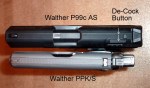
- Width Comparison
-
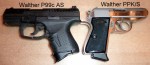
- Height Comparison
-
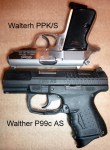
- Slide Length Comparison
-
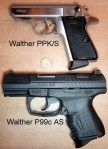
- Walther PPK/S Alongside Walther P99c AS
-
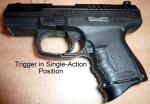
- Trigger in Single-Action Position
-
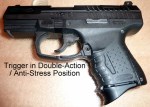
- Trigger in Double-Action and Anti-Stress Mode Position
-
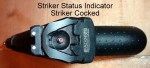
- Striker Status Indicator Displays When Striker is Cocked
-
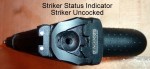
- Striker Status Indicator is Hidden When Striker is De-Cocked
-
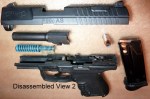
- Disassembled View from Above
-
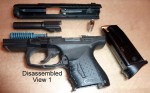
- Disassembled View from Below
-
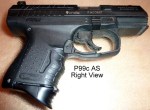
- Walther P99c AS—Right Profile
-
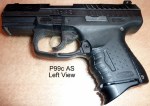
- Walther P99c AS—Left Profile


 Decisions — Murder in Paradise
 The Globe — Murder in Luxury
 R. Doug Wicker — Author