Tag Archives: handgun review

SIG P229 Enhanced Elite — An Exercise in Indulgence


SIG Sauer's P229 Enhanced Elite in 9mm

SIG Sauer’s P229 Enhanced Elite in 9mm

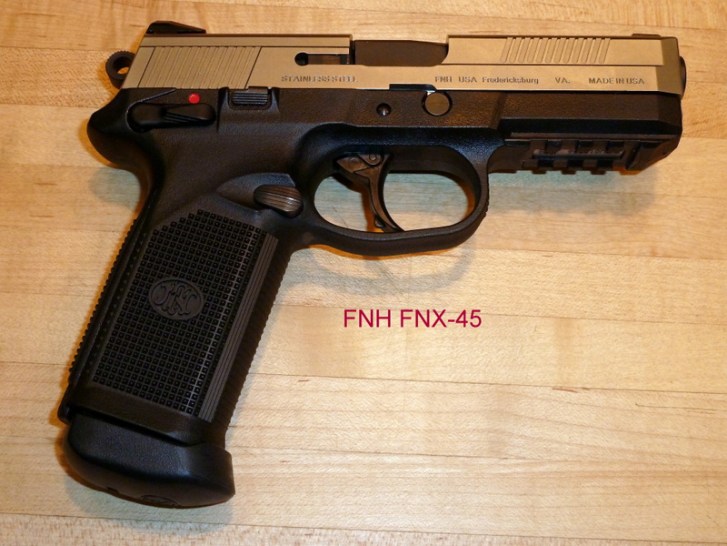
 We’ll be getting back to travel and photography on Wednesday (more on that at the end of today’s blog post).  However before I start another photo travel series, I wanted to get in one quick entry of my highly popular firearms reviews.  Indeed, such reviews hold five of my top ten most popular posts, and this year’s review of the FNH FNX-45 is currently at number eleven and rapidly gaining ground.

Today I’m presenting to you another SIG Sauer — this time the P229 Enhanced Elite chambered for the 9x19mm Parabellum cartridge.  This is actually the second SIG I’ve reviewed, the first being the SIG P220 Equinox chambered in .45 ACP, which is functionally pretty much the same.  The differences between these two, besides the caliber and magazine capacity, are in the reach of the trigger, SIG’s new E² enhanced grip, and in cosmetic treatments.

SIG Sauer .45 ACP P220 Equinox

One of the first things the observant reader will notice about the Enhanced Elite is the enormous beavertail extension above the grip.  Many guns incorporate this feature as a way to minimize or eliminate slide bite and hammer bite.  Slide bite occurs when the hand is too high on the grip, allowing the bottom of the slide under recoil operation to potentially bruise the shooter’s hand or even gouge out two parallel tracks along the top of the hand behind the area between the thumb and index finger.  Not fun.

Indeed, this is often referred to asWalther bite” by fans of the Walther TPH and PP-series pistols, and is the primary reason that Smith & Wesson redesigned the beavertail on the PPK and PPK/S pistols that they manufacture (the other reason being to assist in recoil control for quicker follow-up shots).  Hammer bite occurs when this same area of the hand is pinched or otherwise injured by the rapid rearward movement of the hammer being cocked under recoil operation.  Hammer bite was common in the original Model 1911, but later redesigns extended the beavertail on this weapon to eliminate the problem.

Here are a pair of images comparing the original Walther PP-series beavertail to the Smith & Wesson redesign:
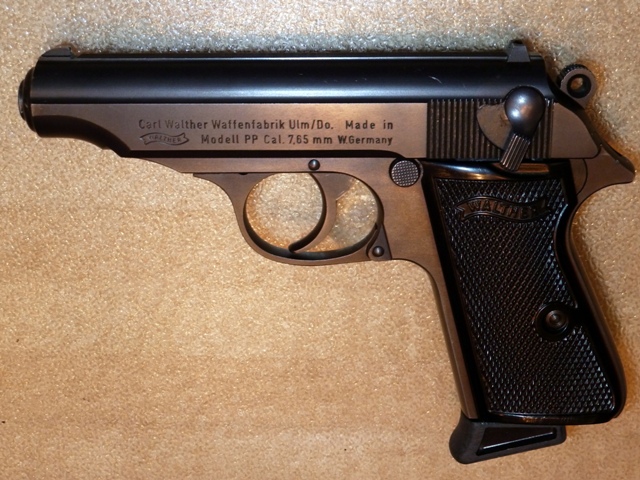
German-made 7.65mm (.32 ACP) Walther PP with original beavertail

Smith & Wesson redesigned extended beavertails on the Walther PPK and PPK/S

Let me assure you that the beavertail (the “Elite” part of “Enhanced Elite) on the SIG P229 is for cosmetic purposes only.  Having fired SIGs for some time now, I can assure you that a properly held P22(x) series pistol does not inflict injury through either slide or hammer bite, and that these weapons have a mass that is more than sufficient to tame the recoil to a very manageable level.  Bottom line:  It just looks darn good, but it is an exercise in indulgence.

SIG Sauer P229 Enhanced Elite in carrying case

SIG Sauer P229 Enhanced Elite in carrying case

Now that you know to what “Elite” refers, let us take a look at the “Enhanced” part of “Enhanced Elite.  That simply means that the P229 Enhanced Elite comes equipped with SIG’s modular, one-piece E² Enhanced Ergonomic grip in conjunction with a revised trigger that reduces the distance between the face of the trigger and the grip.  Here is a comparison image of the standard versus E² grip configurations on the P229:

Standard SIG P229 versus P229 with E² enhancement

Standard SIG P229 versus P229 with E² enhancement

While this may not seem like much of an improvement, this is huge for anyone with small to medium size hands or short fingers.  My hands are by no means small, and even I find this enhancement a noticeable improvement over the original SIG P22(x) design.

By the way, the one-piece E² grip is not held in place by the traditional screws.  SIG includes a special tool that helps pry the grip from the frame should you need to remove the E² for a more detailed cleaning of the weapon.

Included E² grip removal tool on left side of image

Included E² grip removal tool on left side of image

The SIG P229 Enhanced Elite also comes equipped with tritium-filled night sights:

Tritium night sights are standard on this SIG

One great thing about the SIG P22(x) line of pistols is the ease with which they disassemble.  As I described in my review of the P220 Equinox, it’s simply locking back the slide, rotating the take-down lever, releasing the slide, and pulling the slide forward off the rails.  Once that’s done you just strip out the guide rod, recoil spring, and barrel for cleaning.  Putting SIGs back together is just as quick and easy.

Disassmbled P229 Enhanced Elite

Disassmbled P229 Enhanced Elite

And how does this weapon perform at the range?  With the class, grace, verve, and aplomb befitting its pedigree, and without the drama and tantrums of many of its lighter polymer-framed competition.  This is, after all, a design for the rigors of police work and the harsh environment of combat, combined with the reliability and ease of use demanded by both.  SIG simply makes, in my opinion, the best pistols on the market for the price whether you are an experienced shooter or someone new to handguns.

SIG Sauer P229 Enhanced Elite

SIG Sauer P229 Enhanced Elite

This particular P229 is the type of double-action/single-action weapon which I personally prefer.  I find that the added safety benefits of a heavy, long double-action first pull of the trigger suits my comfort level, and mastering that first shot is not at all difficult.  Besides, if I need the accuracy of a lighter, shorter single-action shot, it takes but a fraction of a second to thumb the hammer back into its cocked position.

Accuracy is superb, and SIG’s 4.5-pound single-action trigger pull is one of the best on the market short of a customized handgun.  Slack take-up occurs in about 5/16ths of an inch, with the trigger breaking both cleanly and crisply with no slop after that initial travel.  Double-action is rated at a 10-pound pull, and takes about three-quarters of an inch to accomplish — the first quarter-inch for take-up of trigger slack, and another half-inch to bring the hammer back to its trip point.  Trigger reset after a shot is about a quarter-inch with an audible “click” and a positive tactile indication.  That quarter-inch reset is a tad less than what I measured on the SIG P220.

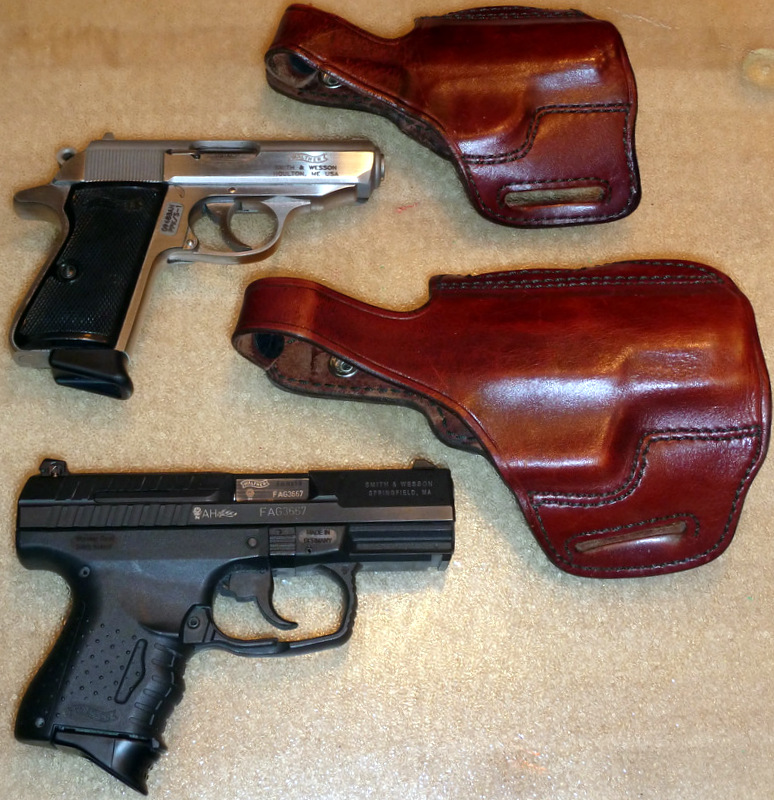
As far as concealment, the SIG P229 is not as much of a challenge as you might expect from a weapon weighing in at 32 ounces (with an empty magazine) and measuring 7.4 inches long, 5.1 inches high, and 1.6 inches wide.  The P229 hasn’t replaced my Walther P99c AS as my primary roaming companion, but it does get taken for a walk every now and then.  After all, 15+1 rounds 0f 9mm is sometimes more of a comfort than the Walther’s 10+1 capacity.  Just remember to use a high-quality holster and a good, stiff gun belt and you should have no problems.
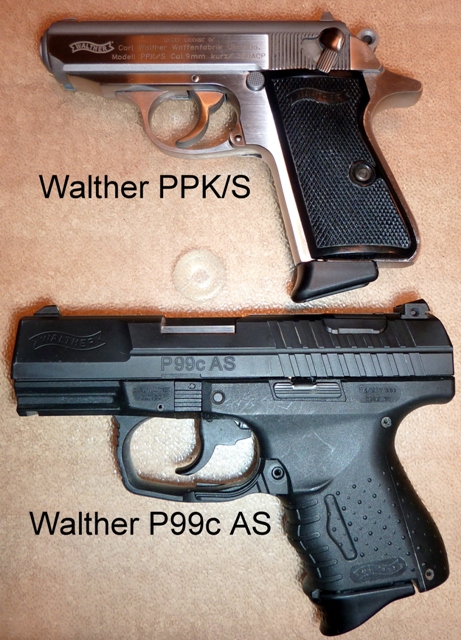
My trusty 9mm P99c AS alongside my equally trusty and frequently carried .380 ACP PPK/S

Originally I had planned for my next photo travel blog series to be our 28-day transpacific crossing from Sydney, Australia, and Seattle, Washington.  Instead, I’m going to delay a look at that cruise until later (about the time the ships reposition from Alaska back to Sydney).  Starting Wednesday I’ll present to you a cruise that is currently making the rounds until fall — the Montreal-Boston run on Holland America’s MS Maasdam.

11 Comments

Filed under Firearms, R. Doug Wicker

SIG P220 Equinox — Beauty is More than Skin Deep


SIG P220 Equinox

SIG P220 Equinox

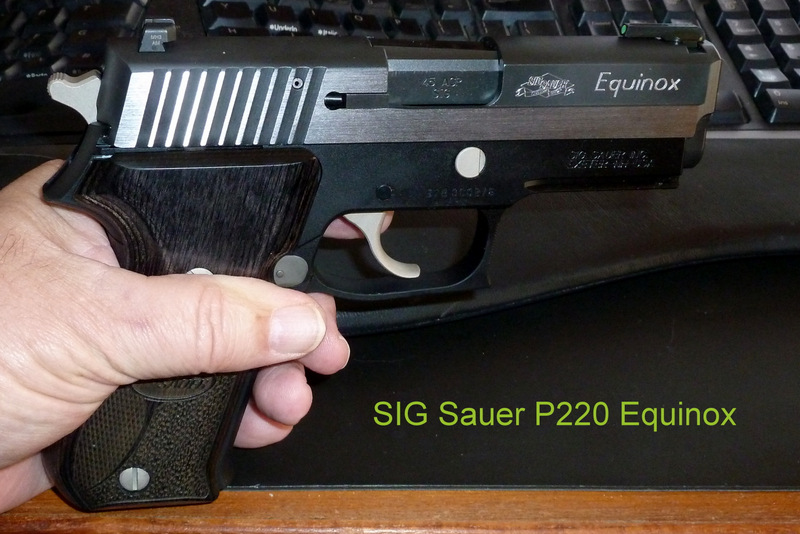
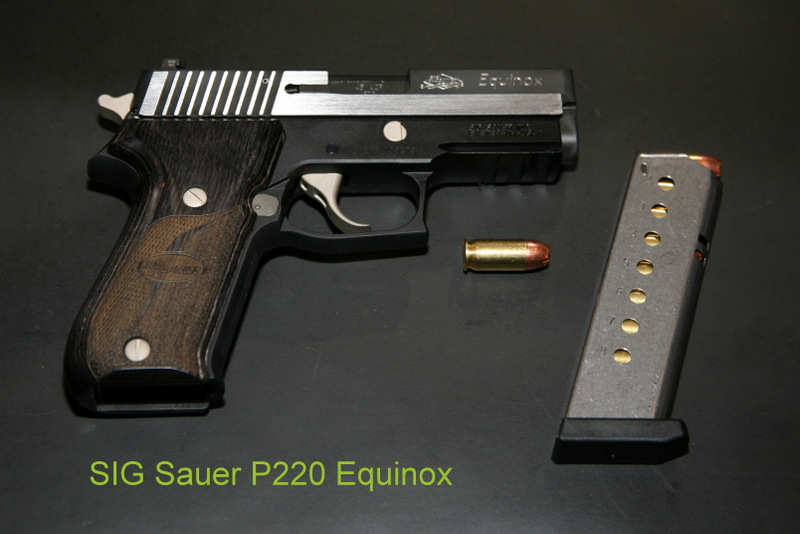
Who says form should take a backseat to function?  SIG Sauer certainly doesn’t as you can see in the above picture.  One of the first things you’ll notice upon seeing any of SIG’s Equinox line of pistols is that there simply is no scrimping on cosmetic detail, and the .45 ACP P220 Equinox is certainly no exception.

Just take a look at the attention to detail:  Two-tone stainless steel slide with contrasting Nitron® finish; alloy frame (for reduced weight) with black anodized finish; matte-finished nickel-accented controls (slide release, take-down lever, decocker, and magazine release), screws, trigger, and hammer; custom wrap-around, stippled and checkered, gray-colored laminated wood grips; and finally SIG’s superb “SIGLITE®” tritium-filled night sights at the rear, and a TRUGLO® tritium fiber optic front sight in high-visibility green.  The P220 Equinox also comes with an accessory rail for attaching a tactical light or laser sight.

Factory-Equipped Tritium Night Sights

Factory-Equipped Tritium Night Sights

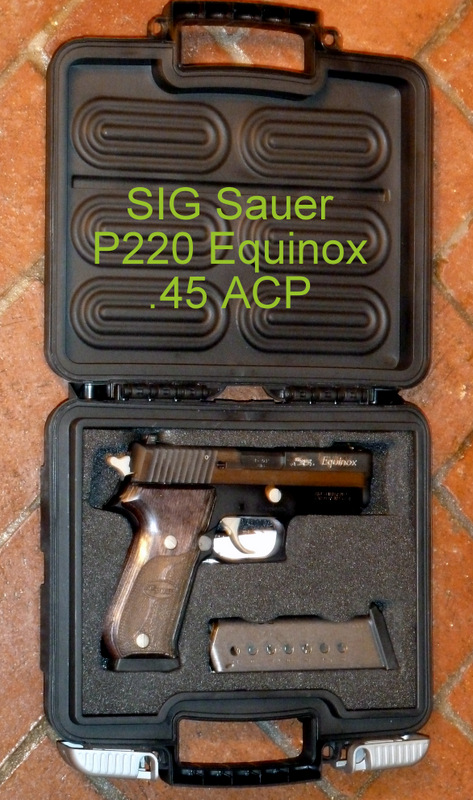
The entire kit comes with the standard SIG components — hard plastic case, two high-polished 8-round magazines, instruction manual, and even a tube of my favorite TW25B rail grease which (along with Breakfree CLP) I use on all my semiautomatic handguns.

Complete SIG P220 Equinox Kit

Complete SIG P220 Equinox Kit

Even though the SIG P220 is far from light (a hefty 30.4 ounces/862 grams with magazine) and a bit on the bulky side (7.7 inches/19.5cm long; 5.5 inches/14cm high; 1.5 inches/3.8cm wide), it’s not uncomfortable for concealed carry in the right holster (I can highly recommend the Don Hume H721) suspended on a good-quality gun belt.  I wouldn’t want to have it behind my hip while sitting in a cramped theater seat for two hours or while driving a long distance, but other than than it’s certainly manageable for all-day concealment.

Don Hume H721 — So comfortable and rugged that I own several for different weapons

Don Hume H721 — So comfortable and rugged that I own several for different weapons

I’ll get to how this beauty shoots, but first a little SIG P22(X) history.  SIG Arms (short for Schweizerische Industrie Gesellschaft, or Swiss Industrial Society) of Switzerland first produced the SIG P220 in 1975.  That pistol is the genesis of an entire line of SIG pistols such as the P224 (SIG’s very recent and smallest version of the P22(X) line), P225 (designated the P6 by European police forces and the Swiss Army), P226 (basis for the Navy SEAL Mark 25), P227 (SIG’s new double-stack .45 ACP), P228 (close cousin to the P229 and the basis for the M11-A1 pistol used by various U.S. military units — If you watch NCIS you’ve seen the M11), and the hugely successful P229 (concealed carry version of the P226, and a weapon which I will review at a future date).

A Truly Beautiful Weapon

A Truly Beautiful Weapon

The original SIG P220-line was chambered for various calibers — 9mm Parabellum, .38 Super, .45 ACP, .30 Luger (7.65x21mm), and even .22 Long Rifle — but as the line expanded and diversified SIG started reserving the P220 designation for only those pistols chambered for the .45 ACP (originally SIG’s .45 ACP pistols were designated P245).

Confused yet?  The history of the entire SIG P22(X) line is both a lengthy and convoluted one, but it speaks volumes that this particular pistol is still in great demand from both military forces and law enforcement agencies nearly forty years after the design’s introduction.

Let’s take a closer look at the pistol itself.  While the original P220 had a very German heel-mounted magazine release (think Walther P38 or early pre-war version of the Walther PP), SIG instituted the more popular button-style release sometime in the early 1980s.  Other than that all controls have remained consistent with this line from its inception up until the recent introduction of various trigger modifications such as the Double-Action Kellerman (DAK).  The more typical Double-Action/Single-Action (DA/SA) controls however remain the same today as on the original P220 of 1975.

Standard SIG Controls

Standard SIG Controls

The decocker is rather unique in that it doesn’t allow the cocked hammer to just slam into the hammer block.  Rather the decocker initially releases the hammer, which partially falls toward the double-action position, but then the hammer is gently lowered the rest of the way as you release the sliding decock control.  It’s an innovation I’ve not seen on any other DA/SA-style semiautomatic, and it relieves me of the desire to ride the hammer down with my thumb during the decocking operation (as I routinely do with my PP-series pistols and others).

SIG Sauer P220 Equinox

SIG Sauer P220 Equinox

Disassembly is stupid-simple.  Just as with the FNH FNX-45 it’s a simple lock the slide back, rotate the take-down lever, release the slide, and pull the slide forward off the rails.  Once that’s done you just strip out the guide rod, recoil spring, and barrel for cleaning.

SIG SauerP220 EquinoxThis may be a  beauty in the hand, but at the range it’s all business.  In typical SIG style the double-action is both stiff (rated by SIG at 10 pounds/4.54 kilograms) and long (approximately .25 inches/6.35mm to take up the slack and another half an inch/12.7mm to cock and release the hammer), but the pistol is easy to hold on target while you pull toward the hammer trip point.  Let’s face it though — it’s the single-action mode that sells the SIG P22(X) line, and the single action on the SIG P220 Equinox does nothing to discredit the well-deserved reputation this whole line has acquired since 1975.  Slack disappears at the about 5/16ths of an inch/8mm, but release comes immediately afterward with a crisp break, no trigger slop, and a relatively light 4.4 pounds/2 kilograms.  Trigger reset, for those of you interested in such things, is a mere 3/8ths of an inch/9.5mm.

SIG P220 Equinox

Note the P220 Equinox accessory rail

All  that translates into a weapon that can easily be handled in double-action for a quick, mid-range shot if needed.  Indeed, since I always practice double-action on the first shot of every magazine I load, I can comfortably keep bullets center-mass on a standard B-27 silhouette target out to fifteen yards or even farther.  In single-action mode any good SIG P22(X) will give you close to target pistol-accuracy out to ranges much farther than that, and the P220 Equinox is certainly no exception.

Conclusion:  While the P220 Equinox has not displaced the 9mm Walther P99c AS as my primary concealed carry choice, it’s certainly a viable carry option.  The P220 is acceptably sized, won’t drag you down too badly weight-wise, and offers better than adequate capacity (8+1 rounds) of proven .45 ACP ammunition (although I do tote a spare magazine when I’m carrying it).  Where this choice really shines is when you find yourself in low-light/no-light situations because of the exquisite factory tritium rear-mounted night sights and the high-visibility tritium fiber optic front sight.  When I’m out and about after dusk this is definitely one of my more favored options.  The night sights also make this a good home defense option.  So, too, does the accessory rail for attaching a tactical light or laser sight.  The P220 Equinox is a good, basic, all-round pistol that is more than adequate for most of your defensive needs.

And it looks so incredibly good while doing it.

2 Comments

Filed under Firearms

FNH FNX-45 — A Shooting Review


Fabrique Nationale d’Herstal (FNH) FNX-45 — As reliable as it is intimidating

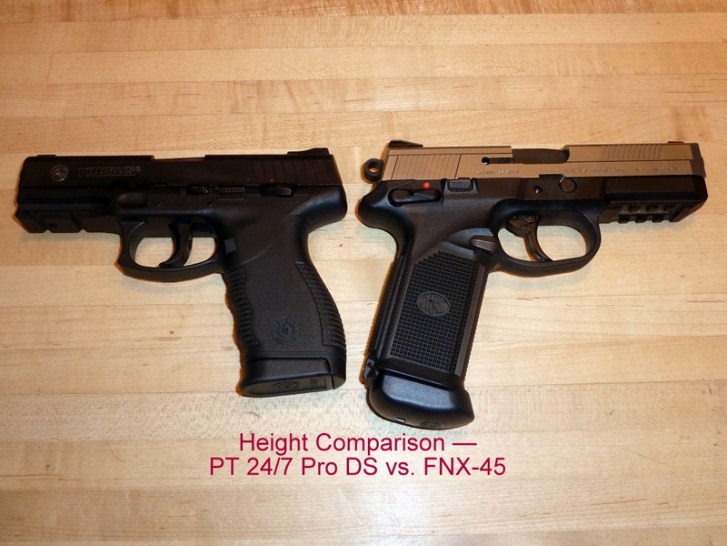
In July of last year I blogged about my search for a home defense weapon to replace a rather disappointing Taurus PT 24/7 Pro DS I had acquired specifically for that role (see:  Replacing a Home Defense Weapon).  The problem with the Taurus?  Reliability.  The PT 24/7 Pro DS was quite simply one of only two handguns I have ever purchased over several decades that flat out failed to properly cycle ammunition.  And even though I sent it in for warranty work, by the time it returned I had irretrievably lost all faith in the weapon for its assigned role.  Without any post-warranty test firing on my part it immediately went on consignment at my local gun store.  May Taurus have fixed its problems, and may the next owner have better luck with it.  As for me, Taurus is no longer a consideration for any future firearm acquisition.  There’s simply too much at stake when it comes to such matters.

The New Kid on the High-Capacity .45 Block

The considerations for the Taurus’ replacement were fairly basic:  The new weapon would have to be .45 ACP; it would have to at least match the 12+1 capacity of the handgun it would replace; for safety it would require either a double-action first pull or an external, manually operated safety; it would need an accessory rail for mounting a laser targeting system; and this time it would have to be a quality product from a known, reliable manufacturer.  This time around price was not a consideration — the Taurus proved to me that an “affordable” price is a false economy if you wind up having to replace the weapon and sell it at a loss.

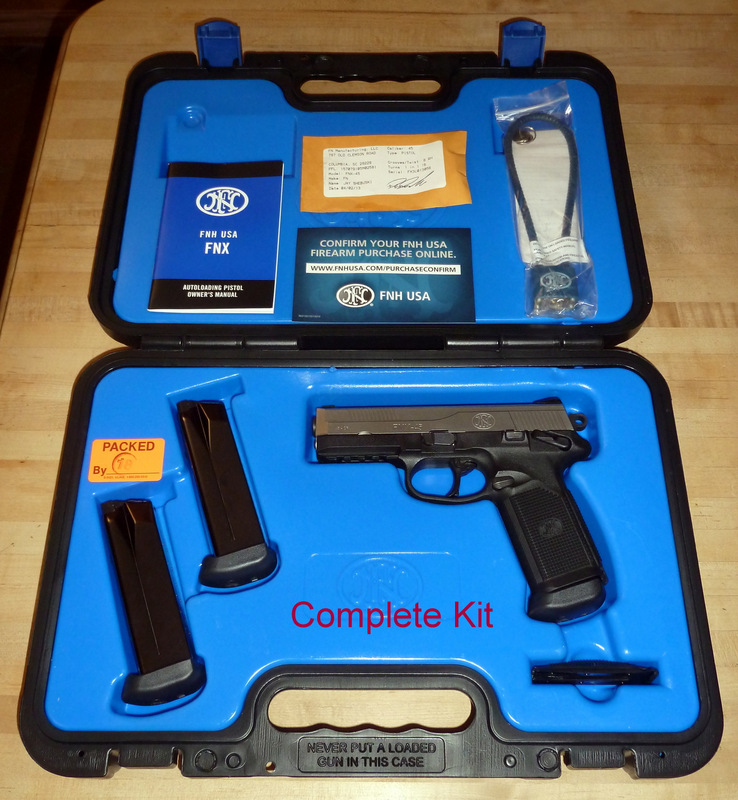
A well-appointed kit — hard case; extra, thicker back strap; and a very generous three 15-round magazines

A visit to my favorite local gun store (Collector’s Gun Exchange owned and operated by the ever-friendly and helpful Mr. Paul Lee) helped me to narrow my search to two weapons — The Heckler & Koch (H&K) USP-45 which matches the Taurus’ 12+1 rounds, and FNH’s new FNX-45 which, at 15+1 rounds, far surpasses it.  In the end it wasn’t even close.  In addition to the higher capacity the FNX-45 was fully ambidextrous (a minor consideration, but possibly important if you ever have to engage left handed), a much better trigger in both double- and single-action, and it cost several hundred dollars less for a weapon from a manufacturer with a comparable reputation to H&K’s.

FNX-45 Cocked and Locked

So how does the FNX-45 perform?  In a word:  Masterfully.  But first the basics.  As previously mentioned the FNX-45 is fully ambidextrous save for the take-down lever.  Controls for magazine release, slide release, and manual thumb safety (which doubles as a decocker when pressed downward beyond the firing position) are fully duplicated on both sides of the weapon.  Additionally the manual safety allows for safely carrying the weapon in M1911-style “Cocked-and-Locked” mode, which means that the hammer is fully cocked into single-action mode.  With the safety engaged the fully cocked hammer will not fall even if the trigger is inadvertently operated.  This addresses the concerns of those who for whatever reason do not feel comfortable learning to operate a traditional (and inherently very safe) double-action/single-action trigger system.  As I train that way with nearly all my weapons (save for a Colt M1991A1), this is not really a consideration with me.

FNH FNX-45 with SIG Sauer Targeting Laser Attached

FNH FNX-45 with SIG Sauer Targeting Laser Attached

On the range the first thing you notice about the FNX-45 is the remarkable lack of recoil.  It is without question the softest shooting .45 ACP weapon I have ever personally fired, and I’ve fired many — Colt 1911 Gold Cup; Colt M1991A1; SIG P220; SIG P220 Compact; SW99; and of course the Taurus PT 24/7 Pro DS, the gun that got us to this point.

I attribute this to several factors:  The FNX-45 has a lot of mass — 2 pounds 1 ½ ounces empty and almost 12 ounces more when fully loaded.  But there’s something else going on here, and I believe it has to do with the locked breech mechanism.  There appears to me to be a considerable amount of travel before the barrel unlocks from the slide, much more in my opinion than most other handguns.  Take a look at what I mean:

Slide and Barrel at Rest

Slide and Barrel at Rest

The Point at which the Barrel unlocks from the Slide

Almost at the Point at which the Barrel unlocks from the Slide

Just eyeballing it, it appears that the barrel and slide are locked up for a full 7mm of travel before they disengage.  On many weapons you have to watch closely to see any movement before the barrel unlocks.

The trigger is good.  Almost great, even.  This is after all a combat weapon rather than a match-grade pistol.  As is typical of hammer-fired weapons, the double-action is long and moderately heavy (but less so than many double-action pistols).  It also has no tactile feedback just before the trigger breaks and the hammer falls.  In close quarters this doesn’t really matter, and the trigger is not overly heavy to the point where I couldn’t keep on target even at a range of about fifteen yards.  Single-action is better, but not perfect.  Trigger take-up is about half an inch (almost 13mm) before resistance is met.  Beyond that point the trigger mushes along for perhaps another eighth of an inch before the trigger trips.

A word about the trigger reset:  A short reset is not all that important to me as I don’t believe in pushing the envelope in a defensive situation.  Better in my opinion to let the trigger go fully forward and take the followup shot from that position rather than chance missing the reset point.  I realize however that others disagree, so I also checked this aspect of the trigger.  The reset point is about ½ inch with a positive tactile indication and barely audible click, but then you’re back to the previously mentioned mushy, eighth of an inch creep before reaching the trip point.  That’s just a tad on the long side from my experience with semiautomatics, but not dramatically so.

In the final analysis the trigger is certainly not as great as a SIG P22(X) or even a Walther P99 AS, and nowhere near the perfection obtained in the Colt Gold Cup or the crispness of a Walther PP-series pistol in single-action mode, but it’s better than adequate (in my opinion better than H&K and light-years ahead of Glock, the Walther PPS, or the Springfield Armory XD-line) and presents absolutely no problems in holding on target.  Indeed, the soft recoil more than makes up for any trigger slop in allowing for very quick target reacquisition for followup shots.  Accuracy is simply superb.  I would put this pistol up against anything else on the market short of perhaps a SIG P210 or a match-grade 1911.

Disassembled FNH FNX-45

Disassembled FNH FNX-45

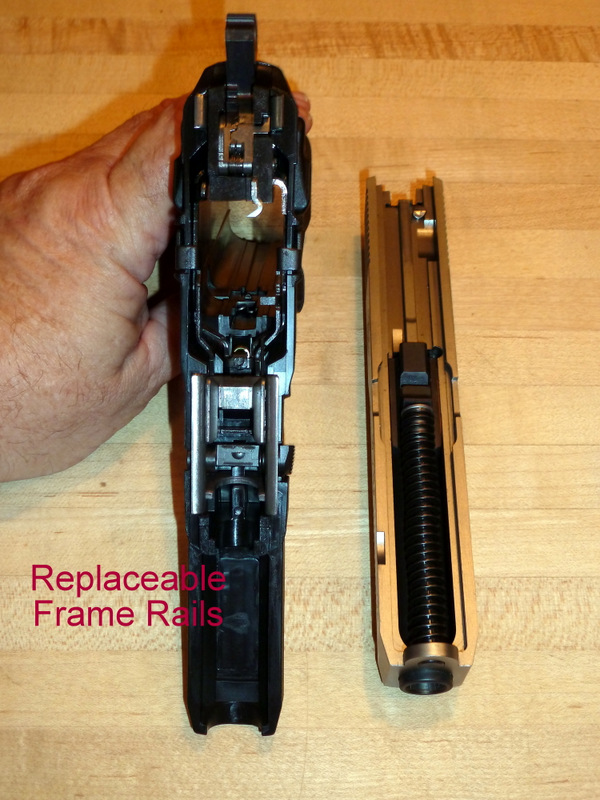
Take down is incredibly simple.  Lock the slide back, rotate the take down lever, release the slide, and pull the slide forward off the rails.  It’s just that easy.  After that you remove the guide rod with captive spring and pluck out the barrel.   Reassembly is equally quick and carefree.  While we’re at this point let me mention a feature of the FNX-45 I’ve not seen on other polymer frame pistols, but which makes an incredible amount of sense for a weapon that was designed for the abuse of the military — replaceable frame rails.  I doubt most people would ever fire the weapon to the point where replacing the rails would ever become necessary, but it’s nice to know that the FNX-45 is made for the long haul.

Replaceable Frame Rails

Now for the downside of 15+1 rounds — don’t even think about trying to thumb that many rounds of .45 ACP.  Do yourself a favor and get an UpLULA or similar thumb-saver.  You’ll be glad you did.

There are a lot of options out there for home defense:  Shotguns, carbines, handguns.  Most people underestimate the penetration dangers of a 12-guage shotgun.  Consequently they overload it with buckshot.  That’s a surefire recipe for disaster — you may get the intruder and your next-door neighbor, or one of your own in the room behind.  Carbines offer a lot of firepower, but they’re hard to maneuver inside tight hallways or through doorways when necessary and they, too, are subject to over-penetration dangers.  That leaves handguns.  And as I mentioned in my previous article on choosing the FNX-45 to replace that rather disappointing Taurus, “The .45 ACP with it’s heavy weight and low velocity (for reduced chance of over-penetration and consequent danger to innocents) makes it in my opinion the best home defense option outside of a shotgun or a semiautomatic rifle.

Link to my review of the FNH FNX-9:  FNH FNX-9 — A Shooting Review

Next week I will be giving a review on a carbine that truly is adequate for home defense because it uses pistol-caliber ammunition, but which still suffers from maneuverability issues inherent to the design — The Beretta CX4 Storm chambered in 9mm.  I’ll also be evaluating the EOTech 512 holographic sight I installed on the CX4.  Until then I would have to say that in my opinion the FNH FNX-45 may very well be the perfect home defense weapon.

4 Comments

Filed under Firearms