Tag Archives: FNX-45

FNH FNX-45 — A Shooting Review


Fabrique Nationale d’Herstal (FNH) FNX-45 — As reliable as it is intimidating

In July of last year I blogged about my search for a home defense weapon to replace a rather disappointing Taurus PT 24/7 Pro DS I had acquired specifically for that role (see:  Replacing a Home Defense Weapon).  The problem with the Taurus?  Reliability.  The PT 24/7 Pro DS was quite simply one of only two handguns I have ever purchased over several decades that flat out failed to properly cycle ammunition.  And even though I sent it in for warranty work, by the time it returned I had irretrievably lost all faith in the weapon for its assigned role.  Without any post-warranty test firing on my part it immediately went on consignment at my local gun store.  May Taurus have fixed its problems, and may the next owner have better luck with it.  As for me, Taurus is no longer a consideration for any future firearm acquisition.  There’s simply too much at stake when it comes to such matters.
The New Kid on the High-Capacity .45 Block

The considerations for the Taurus’ replacement were fairly basic:  The new weapon would have to be .45 ACP; it would have to at least match the 12+1 capacity of the handgun it would replace; for safety it would require either a double-action first pull or an external, manually operated safety; it would need an accessory rail for mounting a laser targeting system; and this time it would have to be a quality product from a known, reliable manufacturer.  This time around price was not a consideration — the Taurus proved to me that an “affordable” price is a false economy if you wind up having to replace the weapon and sell it at a loss.
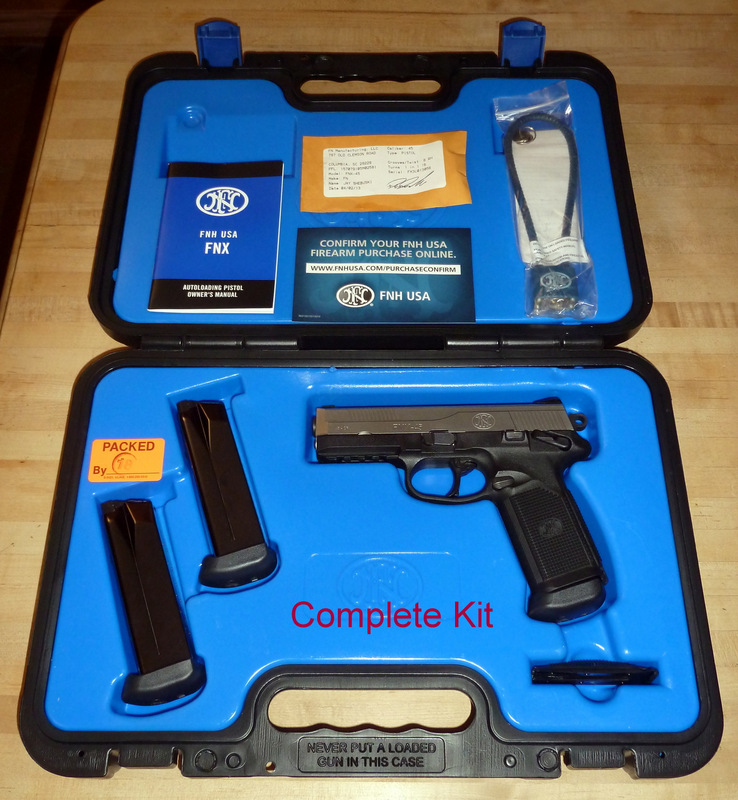
A well-appointed kit — hard case; extra, thicker back strap; and a very generous three 15-round magazines

A visit to my favorite local gun store (Collector’s Gun Exchange owned and operated by the ever-friendly and helpful Mr. Paul Lee) helped me to narrow my search to two weapons — The Heckler & Koch (H&K) USP-45 which matches the Taurus’ 12+1 rounds, and FNH’s new FNX-45 which, at 15+1 rounds, far surpasses it.  In the end it wasn’t even close.  In addition to the higher capacity the FNX-45 was fully ambidextrous (a minor consideration, but possibly important if you ever have to engage left handed), a much better trigger in both double- and single-action, and it cost several hundred dollars less for a weapon from a manufacturer with a comparable reputation to H&K’s.

FNX-45 Cocked and Locked

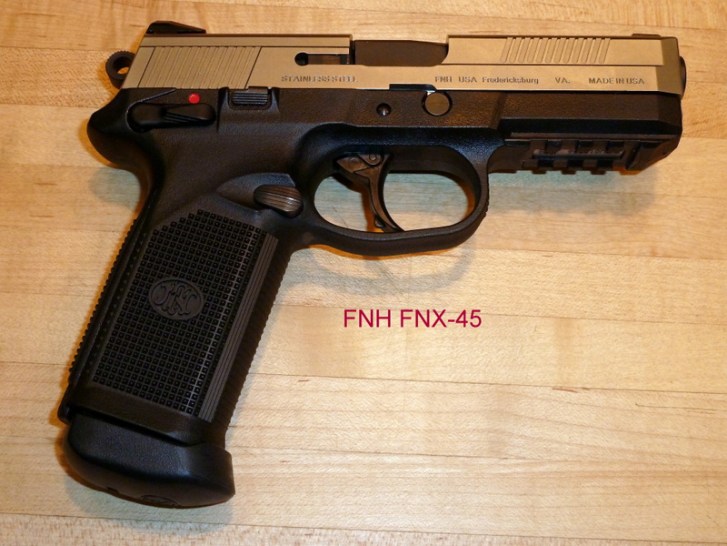
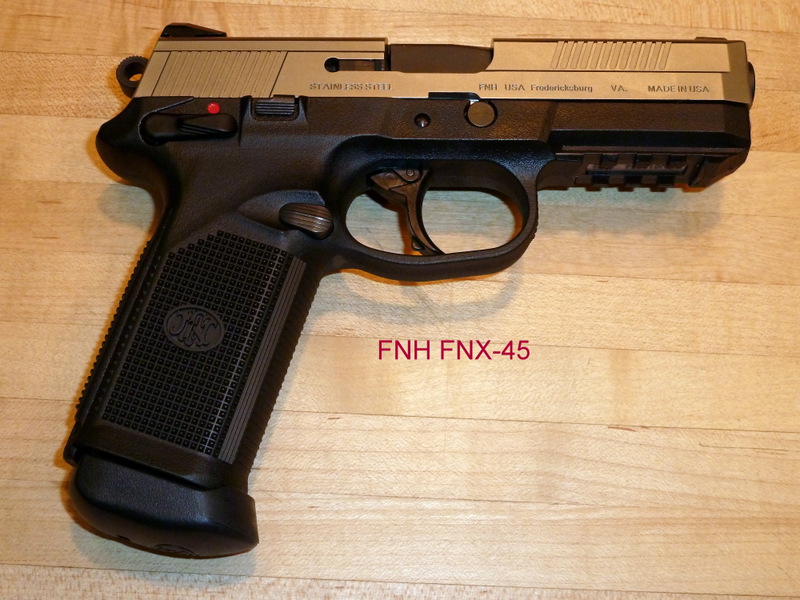
So how does the FNX-45 perform?  In a word:  Masterfully.  But first the basics.  As previously mentioned the FNX-45 is fully ambidextrous save for the take-down lever.  Controls for magazine release, slide release, and manual thumb safety (which doubles as a decocker when pressed downward beyond the firing position) are fully duplicated on both sides of the weapon.  Additionally the manual safety allows for safely carrying the weapon in M1911-style “Cocked-and-Locked” mode, which means that the hammer is fully cocked into single-action mode.  With the safety engaged the fully cocked hammer will not fall even if the trigger is inadvertently operated.  This addresses the concerns of those who for whatever reason do not feel comfortable learning to operate a traditional (and inherently very safe) double-action/single-action trigger system.  As I train that way with nearly all my weapons (save for a Colt M1991A1), this is not really a consideration with me.

FNH FNX-45 with SIG Sauer Targeting Laser Attached

FNH FNX-45 with SIG Sauer Targeting Laser Attached

On the range the first thing you notice about the FNX-45 is the remarkable lack of recoil.  It is without question the softest shooting .45 ACP weapon I have ever personally fired, and I’ve fired many — Colt 1911 Gold Cup; Colt M1991A1; SIG P220; SIG P220 Compact; SW99; and of course the Taurus PT 24/7 Pro DS, the gun that got us to this point.

I attribute this to several factors:  The FNX-45 has a lot of mass — 2 pounds 1 ½ ounces empty and almost 12 ounces more when fully loaded.  But there’s something else going on here, and I believe it has to do with the locked breech mechanism.  There appears to me to be a considerable amount of travel before the barrel unlocks from the slide, much more in my opinion than most other handguns.  Take a look at what I mean:
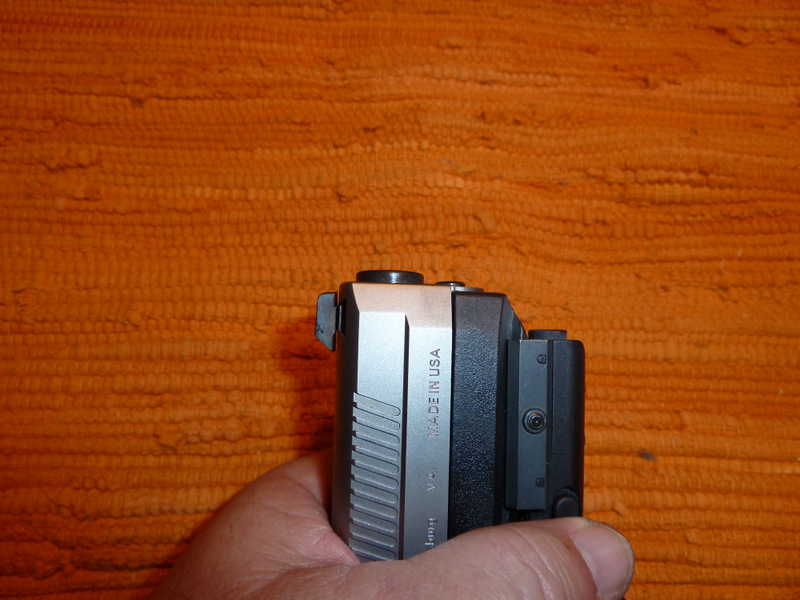
Slide and Barrel at Rest

Slide and Barrel at Rest

The Point at which the Barrel unlocks from the Slide

Almost at the Point at which the Barrel unlocks from the Slide

Just eyeballing it, it appears that the barrel and slide are locked up for a full 7mm of travel before they disengage.  On many weapons you have to watch closely to see any movement before the barrel unlocks.

The trigger is good.  Almost great, even.  This is after all a combat weapon rather than a match-grade pistol.  As is typical of hammer-fired weapons, the double-action is long and moderately heavy (but less so than many double-action pistols).  It also has no tactile feedback just before the trigger breaks and the hammer falls.  In close quarters this doesn’t really matter, and the trigger is not overly heavy to the point where I couldn’t keep on target even at a range of about fifteen yards.  Single-action is better, but not perfect.  Trigger take-up is about half an inch (almost 13mm) before resistance is met.  Beyond that point the trigger mushes along for perhaps another eighth of an inch before the trigger trips.

A word about the trigger reset:  A short reset is not all that important to me as I don’t believe in pushing the envelope in a defensive situation.  Better in my opinion to let the trigger go fully forward and take the followup shot from that position rather than chance missing the reset point.  I realize however that others disagree, so I also checked this aspect of the trigger.  The reset point is about ½ inch with a positive tactile indication and barely audible click, but then you’re back to the previously mentioned mushy, eighth of an inch creep before reaching the trip point.  That’s just a tad on the long side from my experience with semiautomatics, but not dramatically so.

In the final analysis the trigger is certainly not as great as a SIG P22(X) or even a Walther P99 AS, and nowhere near the perfection obtained in the Colt Gold Cup or the crispness of a Walther PP-series pistol in single-action mode, but it’s better than adequate (in my opinion better than H&K and light-years ahead of Glock, the Walther PPS, or the Springfield Armory XD-line) and presents absolutely no problems in holding on target.  Indeed, the soft recoil more than makes up for any trigger slop in allowing for very quick target reacquisition for followup shots.  Accuracy is simply superb.  I would put this pistol up against anything else on the market short of perhaps a SIG P210 or a match-grade 1911.

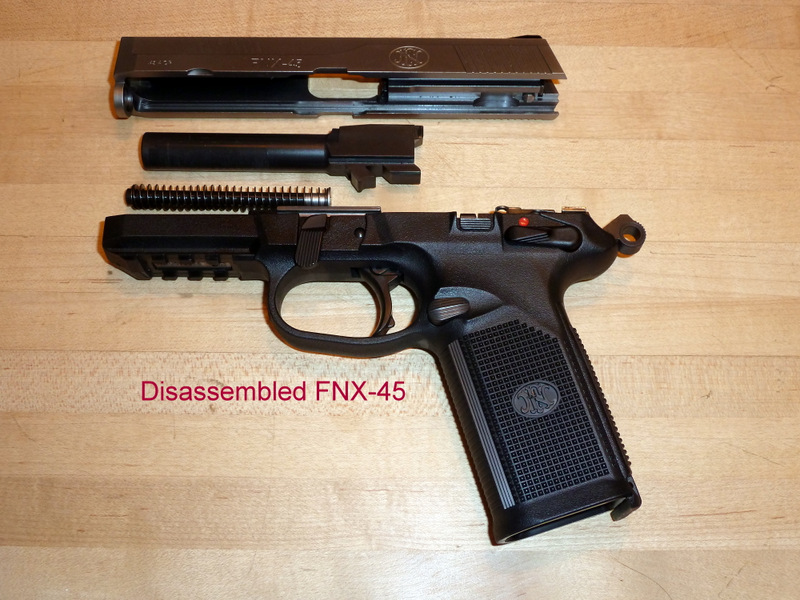
Disassembled FNH FNX-45

Disassembled FNH FNX-45

Take down is incredibly simple.  Lock the slide back, rotate the take down lever, release the slide, and pull the slide forward off the rails.  It’s just that easy.  After that you remove the guide rod with captive spring and pluck out the barrel.   Reassembly is equally quick and carefree.  While we’re at this point let me mention a feature of the FNX-45 I’ve not seen on other polymer frame pistols, but which makes an incredible amount of sense for a weapon that was designed for the abuse of the military — replaceable frame rails.  I doubt most people would ever fire the weapon to the point where replacing the rails would ever become necessary, but it’s nice to know that the FNX-45 is made for the long haul.
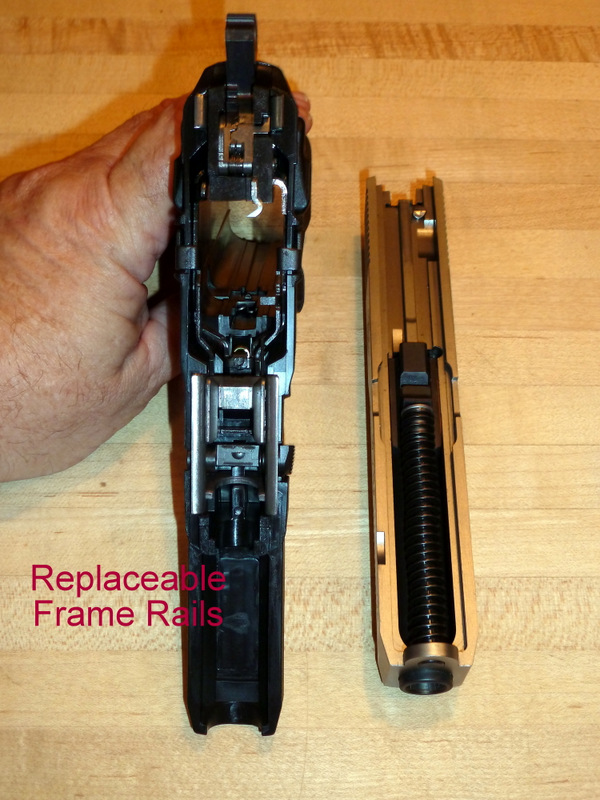
Replaceable Frame Rails

Now for the downside of 15+1 rounds — don’t even think about trying to thumb that many rounds of .45 ACP.  Do yourself a favor and get an UpLULA or similar thumb-saver.  You’ll be glad you did.

There are a lot of options out there for home defense:  Shotguns, carbines, handguns.  Most people underestimate the penetration dangers of a 12-guage shotgun.  Consequently they overload it with buckshot.  That’s a surefire recipe for disaster — you may get the intruder and your next-door neighbor, or one of your own in the room behind.  Carbines offer a lot of firepower, but they’re hard to maneuver inside tight hallways or through doorways when necessary and they, too, are subject to over-penetration dangers.  That leaves handguns.  And as I mentioned in my previous article on choosing the FNX-45 to replace that rather disappointing Taurus, “The .45 ACP with it’s heavy weight and low velocity (for reduced chance of over-penetration and consequent danger to innocents) makes it in my opinion the best home defense option outside of a shotgun or a semiautomatic rifle.

Link to my review of the FNH FNX-9:  FNH FNX-9 — A Shooting Review

Next week I will be giving a review on a carbine that truly is adequate for home defense because it uses pistol-caliber ammunition, but which still suffers from maneuverability issues inherent to the design — The Beretta CX4 Storm chambered in 9mm.  I’ll also be evaluating the EOTech 512 holographic sight I installed on the CX4.  Until then I would have to say that in my opinion the FNH FNX-45 may very well be the perfect home defense weapon.
4 Comments

Filed under Firearms

Replacing a Home Defense Weapon


The FNH FNX-45 — 15+1 rounds of potent .45 ACP ammunition

The FNH FNX-45 — 15+1 rounds of potent .45 ACP ammunition

Before you get too far into this article, be advised that this is a non-shooting first-impression.  I will give a more in-depth review of the shooting characteristics of the FNX-45 at a later date.

The Entire FNX Kit

The Entire FNX Kit — Three magazines included

While I consider anything from .32 ACP on up to be perfectly adequate for concealed carry protection, I prefer the .45 ACP for home defense.  Barring a person stoned out of their mind, someone breaking into your home has already made a conscious decision to do you harm if they find you inside.  Sorry, but that’s just a fact.  As such, you want that person down and out as soon as possible, and the bigger the cartridge the better.  The .45 ACP with it’s heavy weight and low velocity (for reduced chance of over-penetration and consequent danger to innocents) makes it in my opinion the best home defense option outside of a shotgun or a semiautomatic rifle.

And when it comes to home defense, the more rounds the better (hear that well, those of you who would arbitrarily classify 10-round or even 6-round magazines as “high-capacity”).  Home invasions frequently involve more than one intruder, and the number of rounds necessary to stop a determined threat (depending on what study you read) can reach three or even more.  The last thing you want facing multiple dangerous thugs is to be one round short.

FNX, PT 24/7, and SW99

FNX, PT 24/7, and SW99

I now possess four handguns chambered for this proven, highly effective round.  One you’ve already read about:  SW99 — The .45-Caliber Walther.  The SW99 is a nice weapon, but at 9+1 rounds it lacks a bit in capacity.  Another is a SIG P220 Compact SAS Gen 2 which, at 6+1 rounds, is better suited for concealed carry and, with night sights, nighttime carry at that.  So, my initial choice for home defense became the Taurus PT 24/7 Pro DS with 12+1 capacity.  My previous XD45 Tactical with 13+1 was a weapon I just could never warm up to — neither double-action first pull nor external safety for me makes for a weapon that should not find a place inside your home.  They’re quite simply too dangerous to have around, as police department accidental/negligent discharge statistics on transitioning to the Glock have repeatedly shown (That’s personal opinion, so don’t shoot the messenger . . . so to speak).  The PT 24/7 had both an external safety and a double-action first pull, and the added benefit of allowing for cocked-and-locked configuration (something I wouldn’t do, but which fans of the 1911 will enjoy).

Cocked-and-Locked 1911-Style

Cocked-and-Locked 1911-Style

Alas, the PT 24/7 proved unreliable, and the more rounds I put through it the worse it became.  Eventually, I was experiencing multiple jams on each and every magazine.  It went back to the factory for warranty work and returned with vastly improved trigger and a short list of fixes accomplished, but I never test fired the repaired weapon as I simply had lost faith in it.  It’s going to my favorite local gun store on consignment where hopefully the next owner will be happy with the repairs made to it.

Length Comparison

Length Comparison

The lesson here is that you get what you pay for.  The Taurus is an extremely affordable handgun.  I purchased it new for just under $320.  But it turned out to be a false economy, and I began a search for a replacement.  That search narrowed to the Heckler & Koch HK45 and the FNH FNP-45, both reportedly finalists in the (unfortunately) cancelled DoD Joint Combat Pistol evaluation to replace the combat inadequate 9mm Beretta M9.  The FNX is an improved, fully ambidextrous version of the FNP, and the HK USP is the genesis for the HK45.  After considerable research and extensive hands-on testing of the trigger and ergonomics at my favorite local gun store (Collector’s Gun Exchange), I settled on the FNX-45.

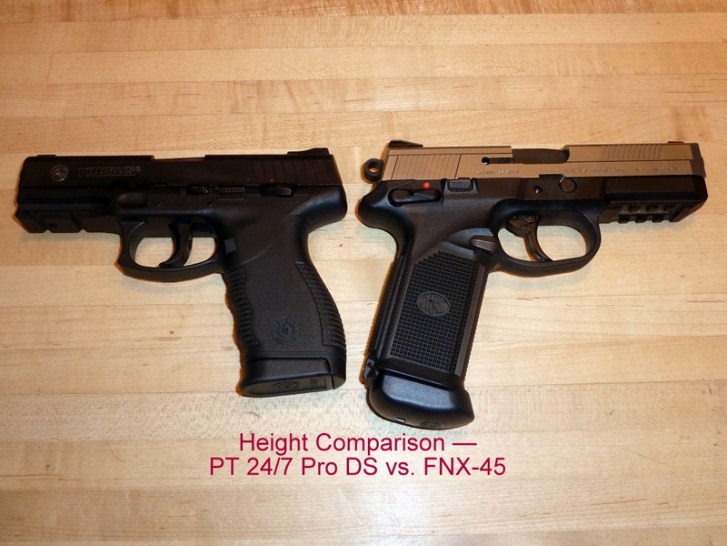
Height Comparison

Height Comparison

The decision was not even close.  The FNX-45 had by far the better trigger in both double- and single-action modes.  The grip felt more natural.  The controls are easy to manipulate, intuitively placed, and fully ambidextrous — a nice feature for those times when walls, obstacles, or even injury may require you to fire using your off hand.  If you’re left handed, this has got to be a real plus.

Fully Ambidextrous Controls

Fully Ambidextrous Controls

As you can see from the above, these are not small weapons.  As such they are not really suited for concealed carry.  The two+ pound weight of the FNX along with an additional pound of ammunition once it’s fully loaded makes this an even sillier choice.  But, then, as I said this wasn’t the task assigned to this particular handgun.  Carry duty remains the function of my Walther P99c AS, Walther PPK, and Walther PPK/S pistols.  Different jobs require different tools.

Attached Laser Sight — A nice home defense option

Attached Laser Sight — A nice home defense option

Disassembly and reassembly of the FNX is the easiest and quickest of any weapon I have ever owned other than my PPK and PPK/S.  I can break down the pistol and put in back together in under half a minute, and that’s with no real practice.  Lock back the slide, rotate the take-down lever, release the slide and ease it forward off the frame, then remove the recoil spring and barrel and you’re done.  It’s just that simple, and notice that there is no need to pull the trigger to remove the slide — no need to “Glockify” this weapon with unnecessary trigger pulls.

Extremely Easy Disassembly and Reassembly

Extremely Easy Disassembly and Reassembly

Internally, this weapon sports a feature I’ve not yet seen in a polymer pistol.  FNH claim that the frame rails on polymer pistols are prone to wear after extensive round counts (I have to believe they’re talking in excess of 100,000 rounds here, but who knows?).  As such, FNH have installed into the FNX replaceable metal frame rails.  Nice feature, though I doubt most people would ever need to do that.

Replaceable Frame Rails

Replaceable Frame Rails

Regardless, this detail seems a testament to the attention which FNH have placed into the design of this weapon.  Now, let us hope that the performance equals the promise.

Now for my impressions on the triggers.  For this I added a fourth .45 ACP weapon to the mix — my recently acquired SIG P220 Compact SAS Gen 2.  I tested all weapons using both hands (dry firing) in back-to-back comparisons in both double- and single-action modes.

Double-Action Results:  The SIG P220 and the FNX weapons are both hammer-fired.  The SW99 and and Taurus PT 24/7 use strikers.  In head-to-head comparisons I found the two striker-fired weapons had lighter pulls.  All four though were perfectly acceptable, with a steady pull followed by a clean break.  The SW99 however had the best double-action trigger.  The SIG P220 was my second favorite because of the smoothness of the trigger, followed closely by the FNX.  The 24/7 brought up the rear because of the long pull and a less solid feel (completely subjective), but the trigger was much better than before the Taurus was sent in for warranty work.

Single-Action Results:  Here it was a hammer-fired weapon that came out on top — the SIG P220.  The SIG had a shorter pull, lighter trigger, and crisper break by far.  It wasn’t even close.  Next came the SW99 with a fairly short pull once the trigger was taken out of Anti-Stress (AS) mode and placed into single-action (see my SW99 review for an explanation).  The FNX placed third because of a mushy quarter-inch pause from the time the slack was taken up to the point where the hammer tripped.  The FNX wasn’t bad, it just wasn’t as great as the SIG and the SW99.  I’m thinking this will probably improve after a couple of hundred rounds are pushed through it.  Coming in last (and proving once again that you get what you pay for) was the 24/7.  The trigger pull in single-action is ridiculously long — as long as the double-action pull — although the trigger does have a short reset if you ride it forward.  Once the excessive slack is taken up, the trigger broke cleanly and predictably.

All things considered, I would rate these weapons as follows:

  1. SIG P220 SAS Gen 2, which is also by far the most expensive of the lot.  Not related to the trigger, but — oh, brother, does SIG put on a great set of night sights on these things.  Too bad it’s so thick yet only holds 6+1 rounds.
  2. SW99.  For the price you just can’t beat the safety and consistency of Walther’s AS trigger system.  If you decide to get this discontinued .45 ACP (Walther made the frames; Smith & Wesson the barrels and slides), make sure you get the AS trigger over the other options.
  3. FNX, the second most expensive and, trigger-wise, not far behind the SW99.  However, taking into consideration that 15+1 capacity in .45 ACP, I would rate this over the SW99 when this feature is considered.  As a home defense weapon, it would even top the SIG P220 because of its high capacity.
  4. Taurus PT 24/7 Pro DS is the economy weapon of the lot, but not when you can pick up a used SW99 for the price of one of these brand new.  The trigger isn’t bad, it just doesn’t compare to the other weapons listed.  Capacity is great at 12+1, coming in at only one round less than my long-departed Springfield Armory XD45 Tactical (what a terrible trigger that thing had).  If you’re willing to take a chance and you get a Taurus that actually fires consistently without jamming, this may work for you if you’re on a budget.  Fortunately, the Taurus offer a lifetime warranty.  Unfortunately, they don’t offer reimbursement for your cost of shipping it out to them.  That’s pretty bad when you consider that this particular weapon was failing from the start, and only getting worse.

Let me close with a hearty “congratulation” to the citizens of Illinois in general and the those currently under daily siege in Chicago in particular.  Yesterday your state legislature overrode Governor Pat Quinn’s ill-advised veto of Illinois’ recently passed, court-mandated concealed carry law.  The law as passed is still ridiculously over-restrictive, but no longer is Illinois the last state in the Union to deny its citizens the right to defend themselves.  This is particularly fitting coming on the heels of this past weekend’s horrendous gun crime statistics — seventy people gunned down in Chicago, a dozen dead.  The day of waiting for the police to pick up evidence and the medical examiner to haul away the body bag is finally in sight.  It’s been a long, dangerous, and bloody haul, but soon the cowardly gang-banger who pulls out a weapon will have to consider if a law-abiding and properly trained citizen is going to return fire and make him the “victim” for a change.  Right now no such deterrent exists.  Rest assured, Chicago — your violent crime rate is about to take a dive.

1 Comment

Filed under Firearms