Tag Archives: firearms

First Look: Smith and Wesson’s new Bodyguard 2.0 TS


Smith & Wesson’s new Bodyguard 2.0

Ursula and I made a recent stop at my favorite local gun store, Collector’s Gun Exchange. As I was perusing the shop, focusing mainly upon the more collectible firearms, salesman Cameron was playing around with a neat little pistol that had just arrived a very few hours earlier. He handed it over to me and asked what I thought of it. My first impression upon feeling the weight and noting the diminutive size was, is this a .22? Nope. It was the new Smith and Wesson Bodyguard 2.0, which comes chambered in .380 ACP/9mm kurz. I was immediately impressed. And when Cameron pointed out to me that this striker-fired elf came with a manual thumb safety, I was pretty much sold.

S&W Bodyguard 2.0 .380 TS (Thumb Safety)

And then I tried the trigger. Smooth, and light. Lighter than even my Sig P365 SAS (which I modified to include a manual safety), which I’ve carried for five years now, but not as good as the single-action mode on my previous carry weapon, the incomparabe Walther P99c AS. My only minor quibble was the longish takeup, about 5mm, with the reset coming in at about the same. More on the trigger later.

S&W Bodyguard 2.0 TS — comes with a 10-round and 12-round magazine

It’s nice that Smith and Wesson includes both a 10-round and 12-round magazine. It would be even better if S&W included a second 12-rounder for a total of three magazines, but since Sig Sauer only gave me two 10-rounders with the P365 I guess I’m not going to complain.

TS = Thumb Safety; NTS = No Thumb Safety

The Bodyguard 2.0 comes in two flavors — Rocky Road and Strawberry Cheesecake. No, wait. I’m thinking of something else. The Bodyguard 2.0 flavors are TS and NTS. The Bodyguard 2.0 TS is equipped with an ambidextrous Thumb Safety, and the NTS has No Thumb Safety. When it comes to a carry weapon, I’m all about the safety. All my carry pieces are either double-action/single-action, have a manual safety, or both. Holding the Bodyguard in my right had, I have no trouble disengaging or re-engaging the safety. Switching to the left hand did not go as smoothly for some reason. Unless my left thumb is drastically weaker than my right, which I doubt, this thing is just darn sticky on the starboard side of the firearm. I’ve been working the safety a bit, and it seems to be smoothing out.

Bodyguard 2.0 TS with ambidextrous manual thumb safety

Now back to the trigger. It’s a flat-face, which seems to be the current rage. And it does seem to assist somewhat in keeping a consistent pull. I rather like it. The pull weight is defintely nice, as well. A five-pull average on my trusty Lyman Digital Guage shows 4 pounds 3.6 ounces/1,915 grams. That certainly beats the P365, which comes in at 6 pounds 8.7 ounces/2,969 grams. For an additional comparison, the AS trigger on the Walther P99 was advertised as 4.4 pounds/2kg in single-action and exactly twice that in double-action. So, the P99’s single-action pretty much matches the Bodyguard’s pull weight.

Bodyguard 2.0 controls — takedown lever, slide lock, safety (engaged)

The Bodyguard’s takedown and reassembly beats the P365 hands down, but that’s because the SAS variant of the P365 swaps out an actual lever for a difficult-to-manipulate slotted head. One word of caution on taking down the Bodyguard: with the slide locked back, depress the ejector all the way down. It’s even more important to make sure the ejector is down before reinstalling the slide. Failure to do so will potentially snag the ejector and possibly damage it.
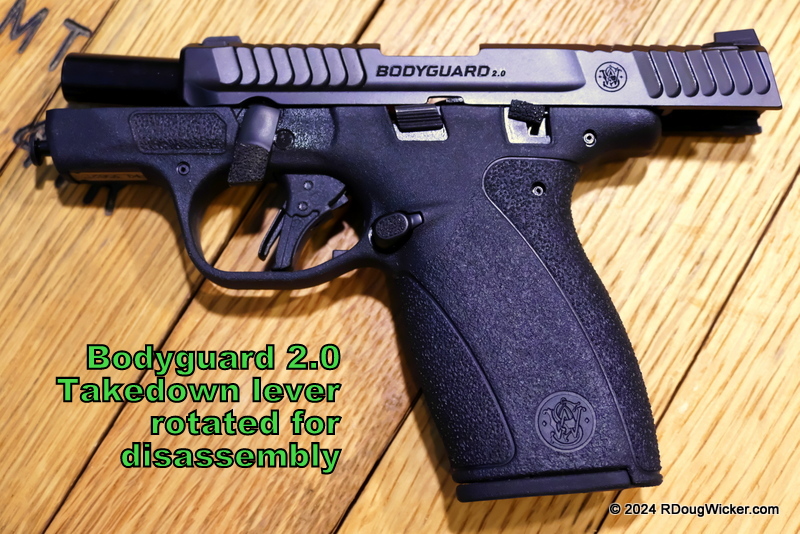
Bodyguard 2.0 ready for disassembly

To raise the ejector after reassembly, simply insert an empty magazine. If you don’t raise the ejector, the trigger will not engage the striker and you will be unable to function-check the firearm after getting it back together.

Bodyguard ejector in the raised position; make sure you lower it.

After removing the slide, everything else is a snap. Compress the guide rod and lift away from the barrel lug, then remove the barrel:
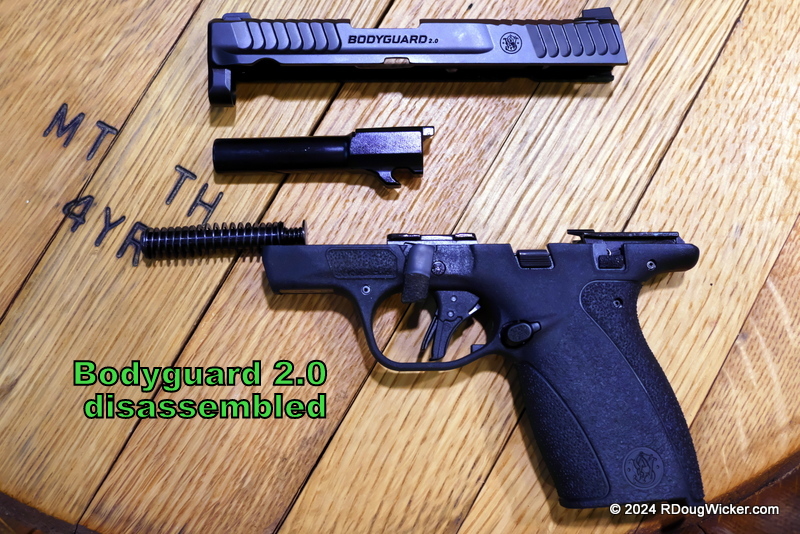
Disassembled Bodyguard 2.0
Slide with barrel and guide rod
Slide with barrel and guide rod removed
Frame with slide removed

Reassembly is not quite as easy. I had a dickens of a time reinstalling the guide rod. The darn spring just refused to compress. It was almost as if the spring was binding at the forward end of the rod when I placed it into the slide guide rod cutout. Several attempts to remove the guide rod and compress the spring with my fingers, and later a flathead screwdriver, took quite a bit of effort. But after repeated attempts I got the spring to move, and eventually got the guide rod back in, compressed, and reseated onto the barrel lug. I suspect I may have a faulty spring, but once I got it back in there was no binding.
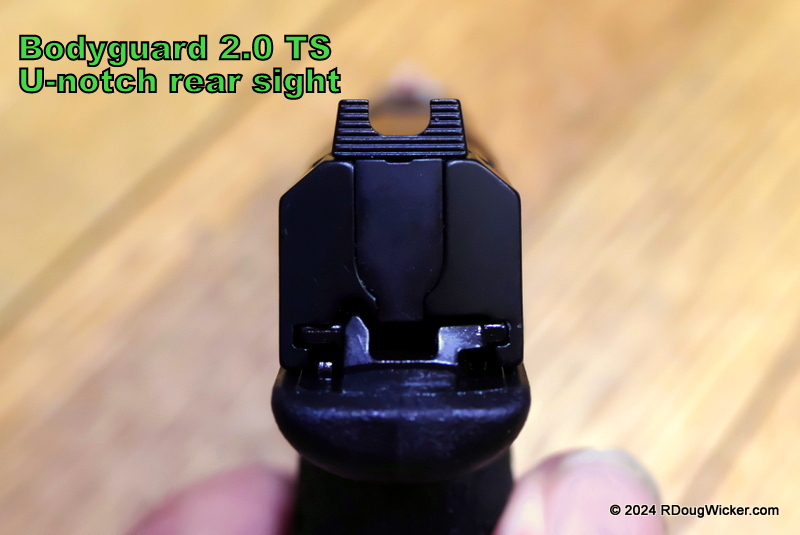
Bodyguard U-notch rear sight

The sights are a bit like a Spaghetti Western — There’s the good, the bad, and the ugly. The good is that the front sight is tritium with a high-visibility orange surround. The bad are that the tritium portion is very tiny. The ugly is the absolutely hideous U-notch rear sight — all black with no side indices for low-light acquisition and a ridiculously wide notch. There will be no match shooting with this handgun. But, then again, that’s not why it exists. Inside of 25 yards/23.8 meters I doubt I’ll have problems keeping on paper. I may not be as accurate in the dark, however. There’s simply no way to tell if I have the front sight within the notch, let alone have it centered left, right, up, or down. That’s certainly a minus in comparison with the P365’s Mepro FT Bullseye, even though the FT Bullseye also has its challenges in low-light situations.

Bodyguard 2.0 tritium front sight with orange surround

So, am I ready to swap out the P365? I think so. I’m definitely going to consider it after I’ve thoroughly checked out the Bodyguard for reliability. It’s smaller, much lighter, and holds the same number of rounds. The only downside is that I’ll be stepping down to .380 ACP/9mm kurz from the more powerful 9mm Luger. But, heck, I’ve even been known on occasion to carry .32 ACP/6.35 mm in a Beretta 3032 Tomcat or a Walther PPK and still not feel insufficiently armed.

S&W Bodyguard 2.0 vs Sig Sauer P365 SAS

I mentioned a moment ago that the S&W Bodyguard is considerably lighter than the Sig Sauer P365 SAS. I measured them today, both with empty 10-round magazines inserted. The P365 weighs 17.88 ounces/507 grams while the Bodyguard is a featherweight 11.48 ounces/326 grams.

S&W Bodyguard 2.0 vs Sig Sauer P365 SAS

S&W Bodyguard 2.0 TS Dimensions and Other Information:

  • Length: 5.5 inches/140mm
  • Height (with 10-round magazine): 4 inches/102mm
  • Width: 0.88 inches/22mm
  • Barrel length: 2.75 inches/70mm
  • Weight (with empty 10-round magazine): 11.48 ounces/326 grams
  • Capacity: 10+1 and 12+1 with included magazines
  • MSRP: $449
  • Street price: $399
S&W Bodyguard 2.0 vs Sig Sauer P365 SAS

Hopefully I’ll get out a range report soon. In the meantime, if you’ve any questions just leave me a comment.

Слава Україні! (Slava Ukraini!)
2 Comments

Filed under Firearms, R. Doug Wicker

Fun Firearm Friday — A Revolver Week Fraud!


WARNING:
Severe, exceedingly obscure, fascinatingly trivial, yet amazingly fun history lesson follows! Approach with extreme caution.

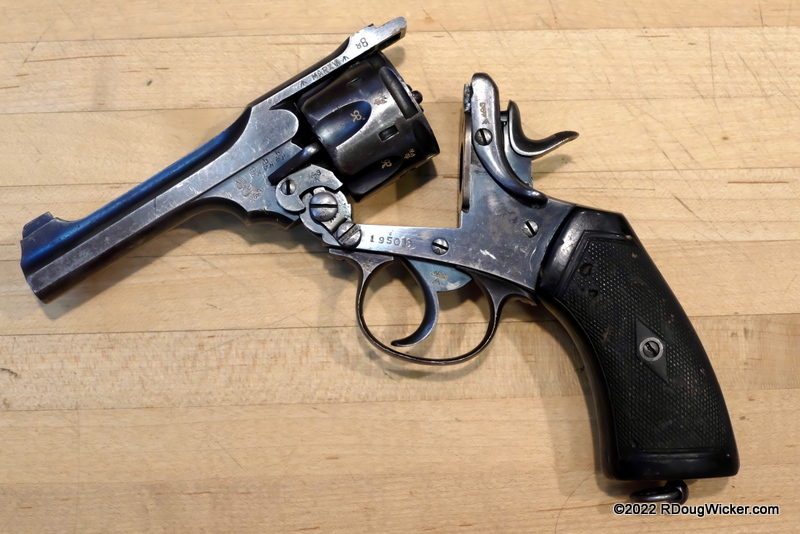
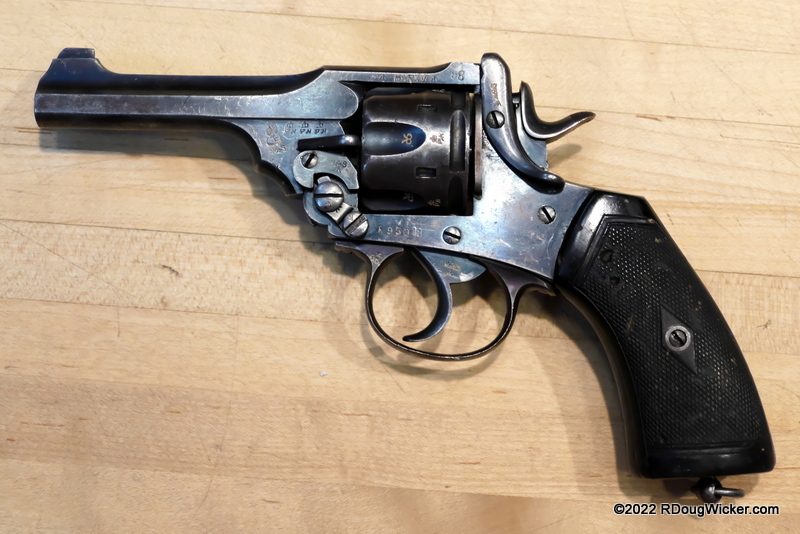
A Webley Mk VI… or is it?

Webleys are the iconic English military pistol. They’ve been around since 1887, and continued in Commonwealth and U.K. military service until withdrawal in 1970. The most famous of the Webley series was the Mk VI dating back to World War I, all of which were factory chambered in the oddball .455 Webley (most have since been rechambered for reduced pressure .45 ACP loadings). Worldwide there are probably tens of thousands of these things still being used in former colonies of the British Empire.

A Webley Mk VI… or is it?

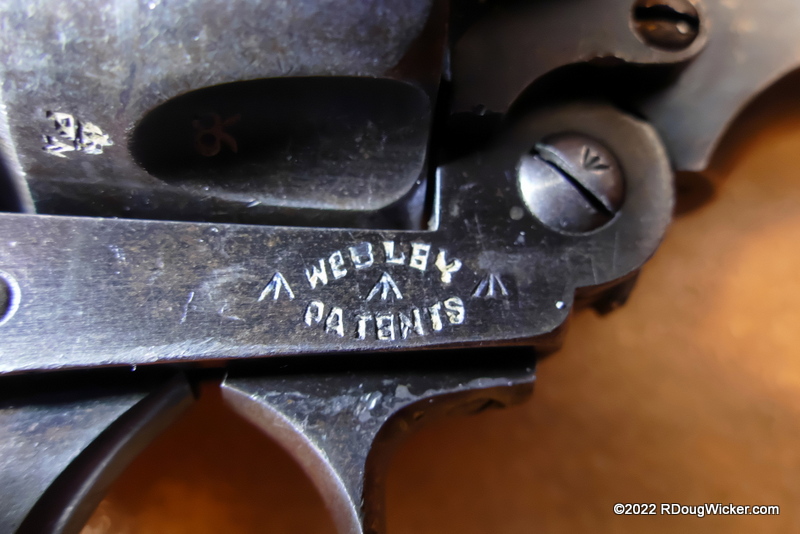
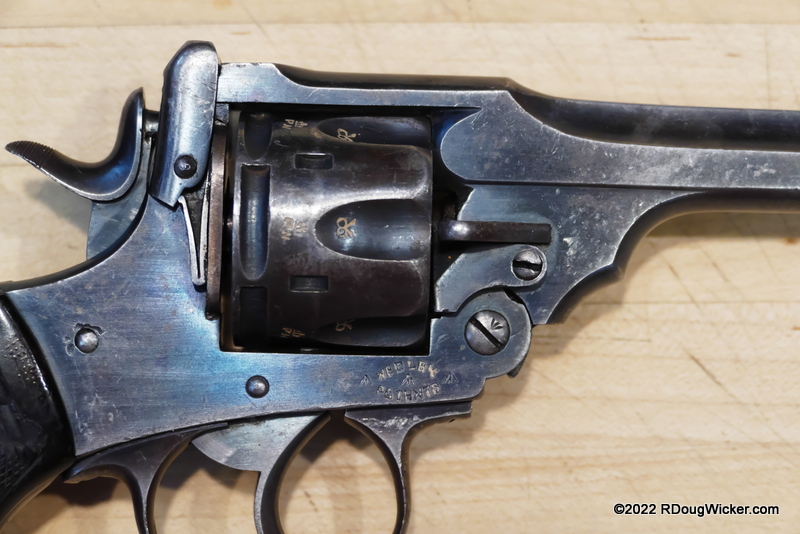
Well, this certainly looks like a Webley. And it’s even stamped “WEBLEY PATENTS” above the trigger guard:

“WEBLEY PATENTS” stamp

And it’s stamped as a “MARK VI” along the backstrap:

“MARK VI” stamp

The “broad arrow” stamps are a nice touch as well. The “broad arrow” was used as a British property stamp, and those “broad arrows” are all over this weapon. And I do mean all over it.

British “broad arrow” property stamp
I count five “broad arrows” on this image alone
Even on the trigger!

Indeed, this weapon even operates like a traditional top-breaking, self-extracting Webley revolver. You can see in the sequence below how this thing elegantly breaks open at the top. Then, as you continue to rotate the barrel-cylinder assembly away from the frame, the star extractor arm extends to eject cartridges from the cylinder. Finally, continue even farther and the extractor arm snaps back into its recessed position, ready for the user to reload the cylinder with fresh rounds.

Thumb the cylinder lock below the hammer to break open
Continue rotation to extend the star extractor arm (above the cylinder) to unload spent cartridges
Extend farther and the star extractor snaps back into the cylinder for reloading

I believe Smith & Wesson pioneered this break-top, self-extraction concept back in 1870 with their S&W Model 3. If there is an earlier version, I’d love to hear about it. And, yes, I am aware of the break-top 1858 French Divesme, but it used a manual extractor rod to push cartridges out from the front one at a time rather than an automatic self-extractor to pull out of them simultaneously from the rear. At any rate, this Smith & Wesson-style extractor is now more closely associated with Webley revolvers.

“Broad arrow” acceptance marks even on some of the screws

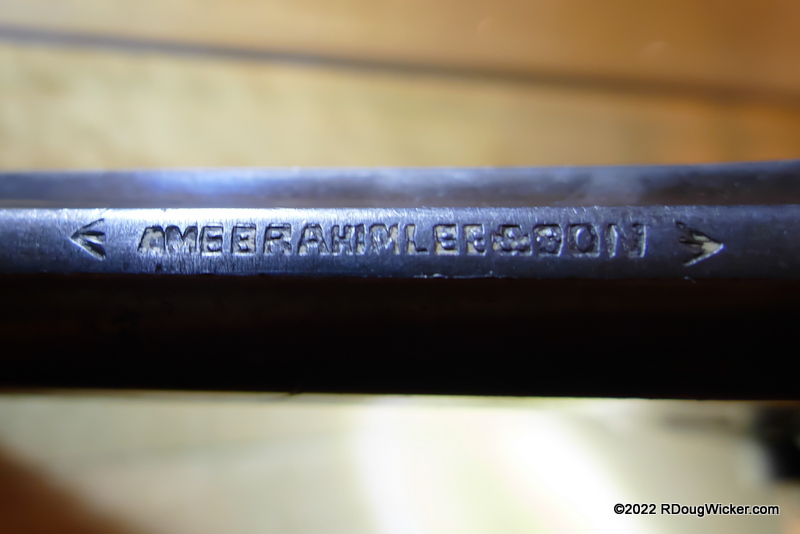
As you may have guessed by now, looking at all the bizarre “broad arrow” proof marks, there is something decidedly amiss with this “Webley.” But there are other clues, such as nonsensical “English” stamps:

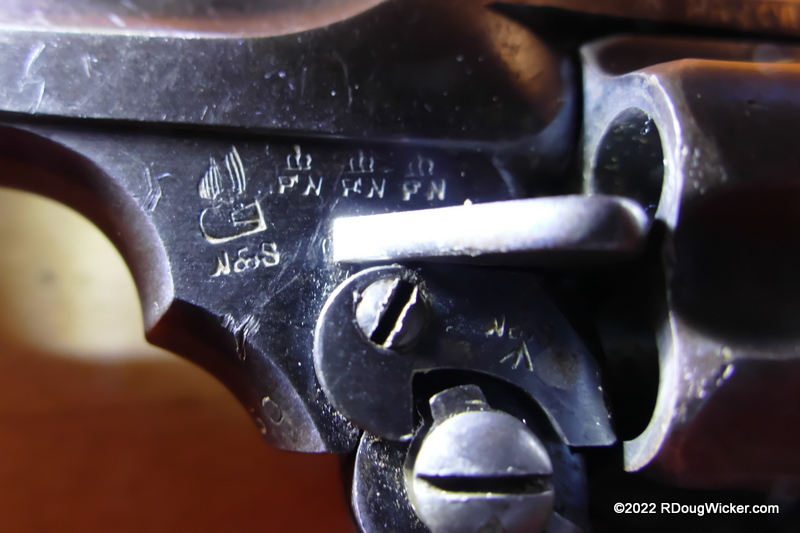
“AMEBRAHIMLEE&SON”? Really? And bracketed by yet more broad arrows?
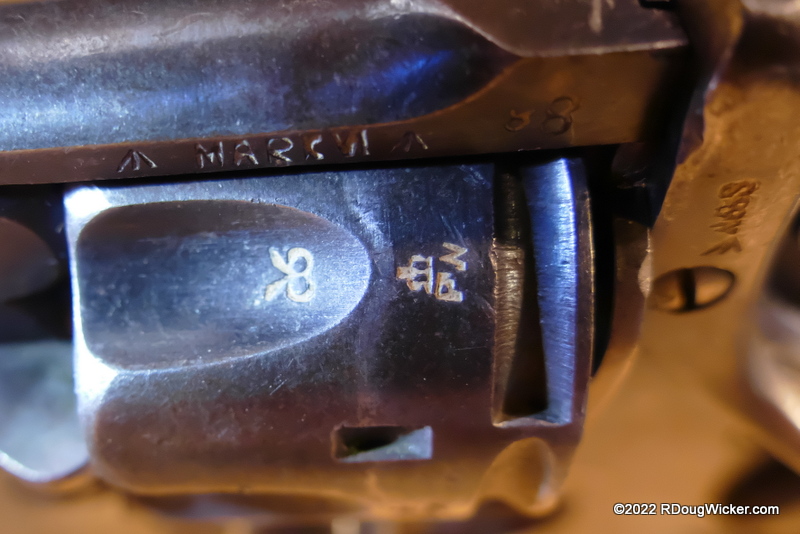
And don’t even ask me what these three cylinder stamps represent

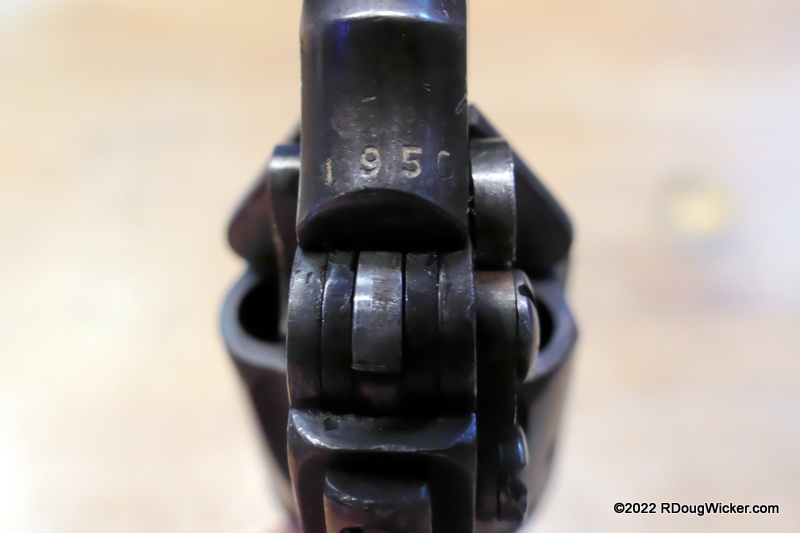
Well, let’s take look at the serial number for some additional clues:

Serial Number 1950

But, wait. What’s this stamped above the trigger guard?

195018

So, which is it? Is the serial number 1950, or 195018? Being on the cautious side, and noting that the frame usually bears the serial number, the gun store went with 195018 on the ATF Form 4473. Probably a good move, as I’m pretty sure that’s the number it would have been imported under. Although… there is no import stamp, so it’s very likely a G.I. bring-back from…. Any guesses yet? I’ll give you a clue. This had to have wound up in the duffle bag of someone returning from a recent combat zone which would in the past have been under the United Kingdom sphere of influence (hey, it is after all a WEBLEY, right?). And the logical suspect would be…

More nonsense, probably from a non-English speaking “manufacturer”

I’m sure some of you have probably guessed by now that this an infamous, and here in the U.S. a very rare and much sought, “Khyber Pass clone” from somewhere along the Pakistan-Afghanistan border. These clones are still made today by local gunsmiths operating their own metallurgic furnaces, casting and forging parts copied from abandoned relics of conflicts from long ago. In other words, this is a poor copy of a Webley revolver made at the hands of some backyard smithy. He then embellished his work of art with fake stamps meant to convey a place of origin on distant soil this gun never saw.

More gibberish and additional “broad arrows”

The only question remaining is which side of the Kyber Pass did this gun originate? Was it the Khyber Pakhtunkhwa region of Pakistan, or was it Afghanistan’s Nangarhar Province? My gut tells me Nangarhar, but who knows? It’s a mystery, and likely to remain as such.

Cylinder stamp

This particular example of a Khyber Pass clone is not something I’m ever going to test fire. The cylinder lockup is sloppy, and that’s an understatement. The metallurgy is suspect enough that I wouldn’t trust it to handle even the weak .38 S&W “Short for which it is supposedly chambered. Which, by the way, is a round for which the Mark VI was never chambered. Yet another clue that something is amiss.

Gibberish Galore!

I hope you enjoyed today’s Fun Firearm Friday, which closes out Revolver Week here at the blog. Next week we return to travel, with my first week-long ever review of a single cruise ship. And what a ship it is — 226,963 Gross Tonnage, 5,479 double-occupancy passenger capacity (6,780 maximum capacity), 2,300 crew, and seven distinct “neighborhoods” throughout this behemoth.

Meanwhile, if you found today’s article interesting and would like to know more about these Khyber Pass gunsmiths, here’s a nice, informative article for you to peruse:

The Gunmakers of the Khyber Pass

Comments Off on Fun Firearm Friday — A Revolver Week Fraud!

Filed under Firearms, Fun Firearm Friday, R. Doug Wicker

Fun Firearms Friday — First Look: Ruger® AR-556® MPR


We’re finishing up “M” Week at the blog. Monday was Mosin. Wednesday we ran with Marlin. Today’s “M” is for Ruger’s MPR version of their AR-556.

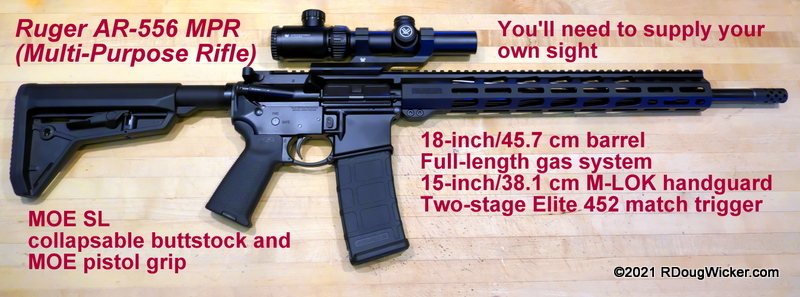
I finally gave in to the AR-style rifle bug. But give in I did, after a lot of research. I had no desire to ever travel this road again, and I didn’t want to make a mistake, so I studied for months. Along the way I discovered a lot of information that directed me towards today’s subject — the Ruger AR-556 MPR (Multi-Purpose Rifle).

What were the other contenders, and how did I finally arrive at the AR-556 MPR? Let’s explore that for a moment, bearing in mind that my choices won’t necessarily align with your choices.

I’ll start with a brief look at the original AR-15 designed around the .223 Remington round. The .223 Remington was developed for the commercial varmint rifle market back in 1957, and by 1963 the first rifles chambered for this round became available. Eugene Stoner got involved when Remington invited him to scale down his existing ArmaLite AR-10 to handle the .223. The result was the ArmaLite AR-15, which like the AR-10 uses a unique direct gas impingement design (okay, not technically correct, but “direct impingement” is the popular name for it) that directed gas directly into the bolt carrier to cycle the weapon. Mr. Stoner set the barrel length at 20 inches/50.8 cm to make full use of the propellant in the .223 Remington, as barrels shorter than that length resulted in incomplete ignition of the propellant before the bullet exited the muzzle. That 20 inches also allowed for an optimal “rifle length” gas system, which would reduce recoil, thus lessening the stress on the bolt and buffer, and introduce less gas-fouling into the bolt carrier. Keep that in mind, as shorter barrels result in a shorter gas system, more recoil, faster bolt speeds causing more stress, and hotter gases getting introduced into the bolt carrier.

About this time the U.S. Air Force were looking for an alternative to their M1 and M2 carbines, and the Army were considering something easier to handle in full-automatic than their M14. This led Colt to purchase the rights for Mr. Stoner’s AR-15 from ArmaLite (contrary to myth the “AR” in “AR-15” stands for ” ArmaLite Rifle, not “Assault Rifle”). Colt then further developed the now “Colt” AR-15 into the M-16 chambered for the M193 cartridge. The M193 (not to be confused with the later similar NATO 5.56 mm round developed by FN in the 1970s) is basically a 55-grain/3.56 gram version of the .223 Remington. After some trial and error, Colt settled on 6-groove rifling with a 1:12/ 1:30.48 cm right-hand twist optimized for the lightweight 55-grain round.

Yeah . . . just  try to find a rifle-length gas system on an AR-style rifle today. There are some out there, but you’ll pay for it. The rage today is to go tacti-cool and get the barrel length down to the legal non-NFA minimum of 16 inches/40.6 cm barrel. That’s because the military’s current M4 version has a ridiculously short 14.5-inch/36.8 cm barrel and, hey, everybody wants that military look regardless of how the rifle performs in most civilian applications. (Again, don’t take offense; I’m describing my preferences here, not necessarily your preferences.)

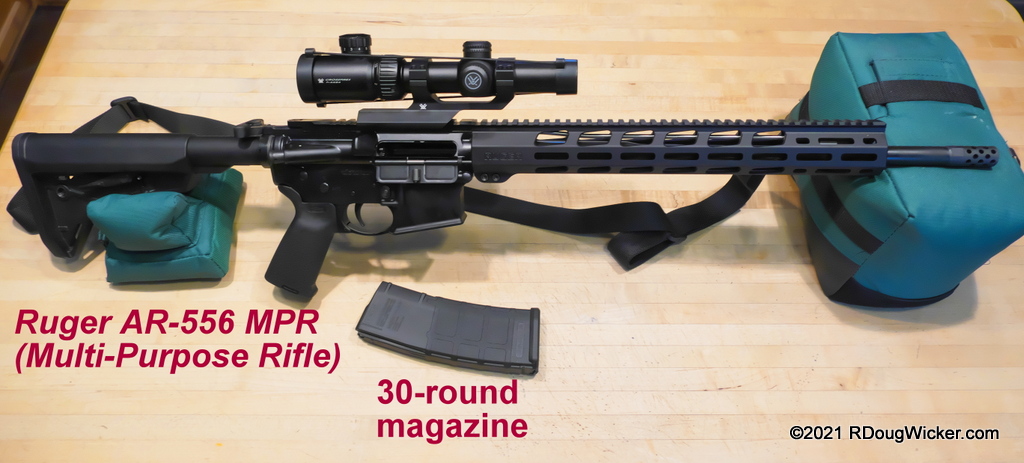
Ruger AR-556 MPR comes in one 30-round magazine

But remember what you give up for the modern Battle-of-Fallujah look — that rifle-length gas system goes by the wayside. That gets you incomplete burning of propellant; which in turn results in a reduction in muzzle velocity and energy; increased muzzle flash from the still-burning propellant blasting out the muzzle; increased bolt speed with the additional wear-and-tear that entails; and more fouling in the receiver from hotter, unburnt gases. Sorry, but I’m just not seeing any real advantages here for civilian applications. It’s not as if I’ll be using a shortened AR-style rifle with a carbine-length gas system in an urban warfare environment, or even to protect the homestead. In an AR-style rifle I’d rather have the longer range, lower recoil, and all the other advantages that a full-length gas system affords.

Again, that’s my choice meeting my needs. When you go shopping for an AR-style rifle, you need to evaluate what works best for you. And if you like what I’m about to describe on the MPR version of Ruger’s AR-556 but want a shorter barrel, you’re in luck. Ruger also makes the MPR in a 16.1-inch version (Model 8542). You can also get the MPR chambered for .350 Legend (Model 8532) and .450 Bushmaster (Model 8522). Unfortunately, if you want .300 AAC Blackout, you must go with Ruger’s standard AR-556 (Model 8530) or get the “pistol” version (Model 8572) with an even sillier 10.5-inch/26.7 cm barrel.

Here is the list of contenders that in the end were vying for my dollars:

  • SIG Sauer M400 Tread: SIG has discontinued anything longer than a 16-inch barrel; you pay for the SIG name.
  • FN 15 Military Collector M16: 20-inch barrel available; but lacked a lot of features for an MSRP of $1,749.
  • Colt: The original; you can’t go wrong with the Prancing Pony, but only the expensive M16A1 Retro Reissue offered a rifle-length gas system . . . at $2,499 MSRP!
  • Springfield Saint: Barrel maxes out at 16 inches.
  • Smith & Wesson M&P 15 Competition: This one comes closest yet to the MPR:
    • Pros: 18-inch barrel; rifle-length gas system; two-stage match trigger; 15-inch free-float M-LOK compatible handguard; full-length rail; adjustable buttstock.
    • Cons: Heavier than the MPR; MSRP is $700 higher than the MPR with nothing to show for the additional cost.

First, the relevant technical statistics for the Ruger® AR-556® MPR (Model 8514):

  • Caliber: 5.56 NATO/.223 Remington (other calibers available; see text)
  • Length: 35 to 38.25 inches/88.9 to 97.2 cm
  • Length of pull: 11.1 to 14.4 inches/28.2 to 36.6 cm
  • Weight: 6.8 pounds/3.1 kg
  • Gas system: Rifle length
  • Buffer: Mil-Spec (Military Specification) buffer tube
  • Barrel: 18 inches/45.7 cm
  • Barrel twist: 1:8, 5-groove, right hand
  • Barrel forging and metallurgy: Cold hammer-forged; 4041 chromium-molybdenum alloy steel; nitride lining
  • Barrel attachment thread pattern: ½”x28
  • Lower specifications: CNC-machined 7075-T6 aluminum forgings; Type III (Mil-Spec) hard coat anodization
  • Sights: None included in keeping with the free-floating barrel design
Barrel on the AR-556 in 5.56 NATO/.223 Remington comes with a 1-in-8 twist

Other included goodies:

  • Trigger: Ruger’s Elite 452® two-stage trigger (a huge plus for this rifle) with a claimed 4.5-pound/2-kilogram pull
  • Accessory Rail: Full length Picatinny M1913 rail
  • Handguard: 15-inch/38.1 cm free-floating Magpul® handguard with:
    • M-LOK® Slots at 3, 6, and 9 O’clock (eight slots per O’clock position)
    • Additional single M-LOK slots at 1:30, 4:30, 7:30, and 10:30 positions
  • Buttstock: Magpul MOE® (Magpul Original Equipment) SL® (Slim Line) collapsible buttstock
  • Pistol grip: Magpul MOE grip
  • Capacity: The MPR comes with one 30-round Magpul PMAG® Gen-2 MOE magazine (a pet peeve of mine; come on, Ruger, you can do better than just one magazine)
  • Owner’s Manual: Of course
  • Safety lock: Cable type key lock
  • Box: Cheap cardboard, of course
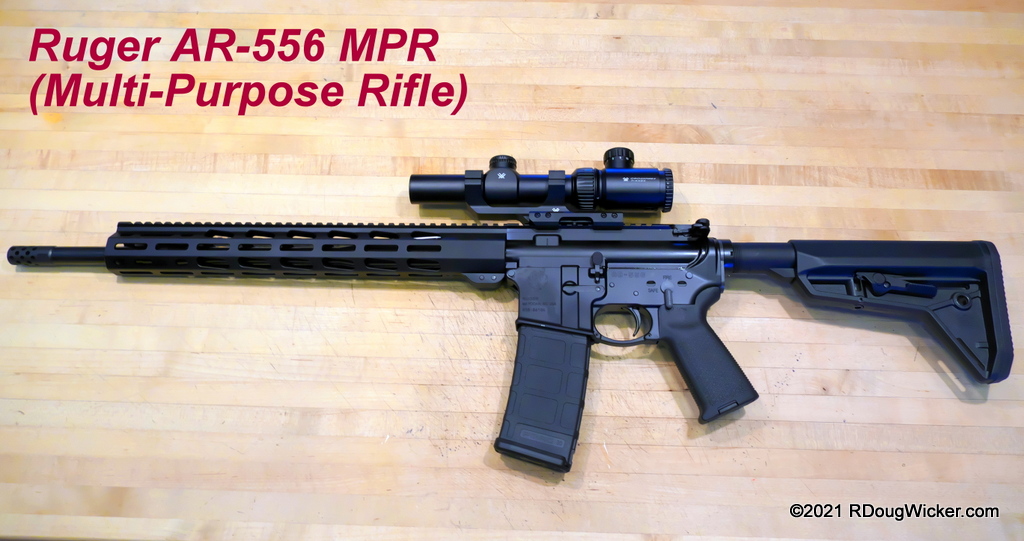
Ruger AR-556 MPR

Now let’s take a look at the rifle.  First off, that scope you see mounted does not come with the AR-556 MPR. Indeed, since this rifle has a free-float barrel, it does not come with a sight of any type — not even the usual combination gas block/front sight most associated with this type of rifle. As such, you’ll have to cough up some money upfront to fix that. The scope you see mounted here is a Vortex Crossfire II 1-4×24 with Vortex’s V-Brite red dot.

Barrel is free-floating

Also not included was the two-point sling you see pictured, nor the M-LOK Quick Dismount (QD) rail attachment. The MOE SL buttstock does however have a QD attachment point, in addition to a slot for your sling if you prefer.

Magpul MOE SL collapsible butt stock

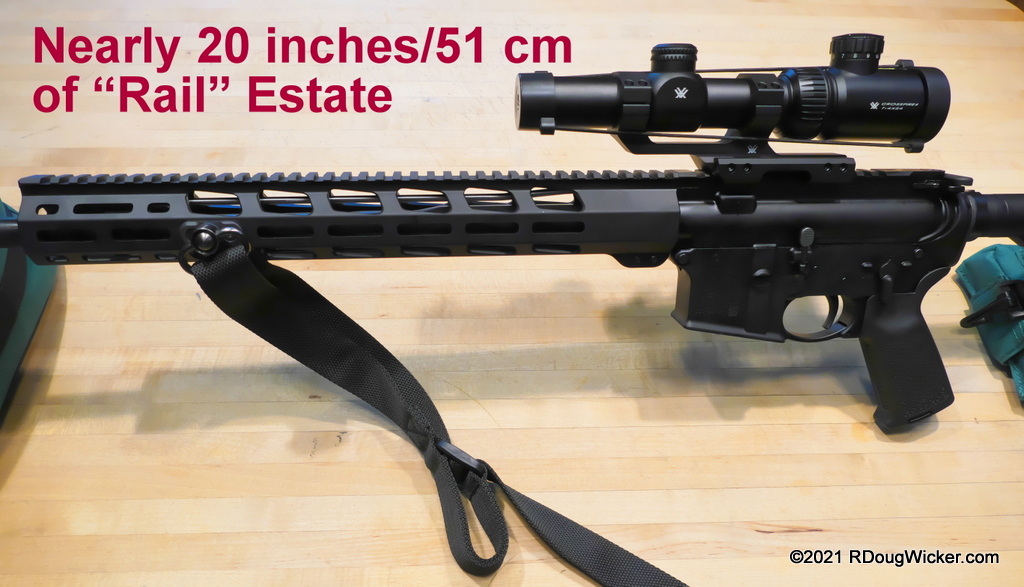
But no matter what sight you choose to mount, there’s nearly 20 inches/51 cm of slot “rail” estate along the rail atop the MPR’s flat upper receiver. Go with iron sights, red dot, red dot with magnifier, low-power scope, high-power scope, night scope, or even optics co-witnessed with iron sights if you wish. The options are limited only by your imagination and your wallet.

Nearly 20 inches of rail for lots of customization options

Now, what about Ruger’s claimed 4.5-pound/2.04 kg Elite 452 trigger? Turns out they fudged on that one. The pull worked out closer to 4.17 pounds, but I’m not going to quibble when it’s to my advantage. The actual five-pull average came in at a mere 4 pounds 2.7 ounces/1.89 kg. Trigger reset is so miniscule I had trouble measuring it, but my best eyeball guesstimate puts it at around an eighth of an inch, or about 3 mm.

Magpul MOE pistol grip

I’ve yet to fire the AR-556 MPR, so I haven’t even had the opportunity to sight in the Crossfire II. But I can tell you how I perceive the handling characteristics thus far. The MPR is well balanced and easy to handle. It’s both light and comfortable to carry, and quick to get on target when the sling is properly adjusted. All controls are just where one would expect on any AR-style rifle, so there are no surprises here and they are all easy to manipulate . . . if you’re righthanded; none of the controls are ambidextrous.

No ambidextrous controls on this rifle
Controls

Fit and finish I would rate as good. The MPR certainly looks good. There was one minor flaw in the hard coat anodization on the edge of the magazine well (see below). But that’s a quibble. It’s not worth the time and effort for a trip back to the mothership for a rifle that is meant to be used.

A word of caution: make sure you disassemble your MPR and check for copious amounts of lubrication. One of the things I really appreciate about Ruger is that they way overengineer nearly everything they make, but they also love to overlubricate. In the case of this MPR, there was far too much lubricant inside the bolt carrier and on the tail of the bolt. I hate to think how much carbon would have cooked onto those surfaces if I hadn’t wiped them down. Other areas were positively dripping with lubrication as well, but that’s been remedied.

Ruger’s fit and finish almost got an A+, except for this

Overall, I’m impressed. But then I’m also a novice in the AR market, so there’s that. Perhaps I’m just easily impressed. But I don’t believe that’s the case here. For all the features Ruger threw into this AR-556 variant, the MPR is an impressive rifle at a price point hundreds less than anything comparable in a nationally known and respected brand.

Ruger AR-556 MPR

That concludes this week’s firearms series. If you’re not a fan, do not despair.

Next week this blog returns to travel the photography. That series will start in Ireland, head transatlantic with a stop in Ponta Delgada in the Azores, continue into Key West for some sunset photos, then head over to the Mayan ruins of Chichen Itza on the Yucatán Peninsula.

Comments Off on Fun Firearms Friday — First Look: Ruger® AR-556® MPR

Filed under Firearms, Fun Firearm Friday